
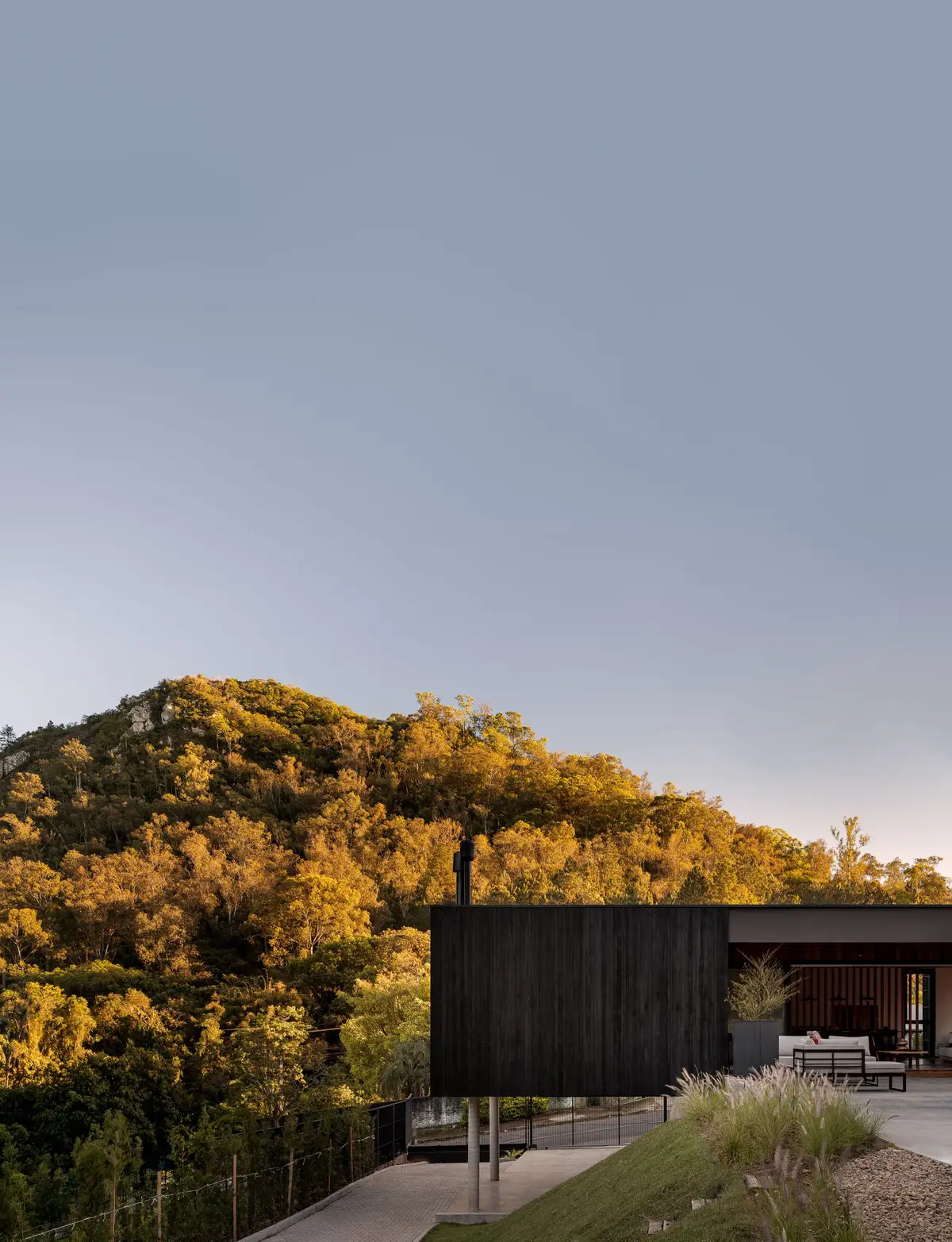
Harpa Arquitetura Nests a Charred Timber House Between Two Hills in Southern Brazil
Entremontes House in Montenegro occupies a rare triangular site where the town's two defining hills converge, wrapped entirely in shou sugi ban cladding.


A house that takes its name from the space between two mountains had better earn that address. Harpa Arquitetura, led by Júlia Hamann, has done so with Entremontes House, a 390 square meter single-family residence wedged into a triangular urban lot in Montenegro, a small city in Rio Grande do Sul whose skyline is defined by a pair of forested hills. The project doesn't compete with that landscape. Instead, it adopts a low, linear posture, stretching dark timber volumes across the sloped terrain like a series of charred dashes between two green masses.
What makes Entremontes worth studying is the precision with which it manages a genuinely difficult site. The triangular geometry, the slope, and the presence of those hills on either side could easily produce a house that feels hemmed in. Harpa's response is to break the program into linked pavilion bars arranged in an L-shaped plan, opening a central courtyard that channels views and air while giving each room its own relationship to the hillside. The charred timber cladding, uniform across every volume, reads as a single geological gesture: something that was always between these mountains, just now made visible.
Dark Volumes Against Green Terrain
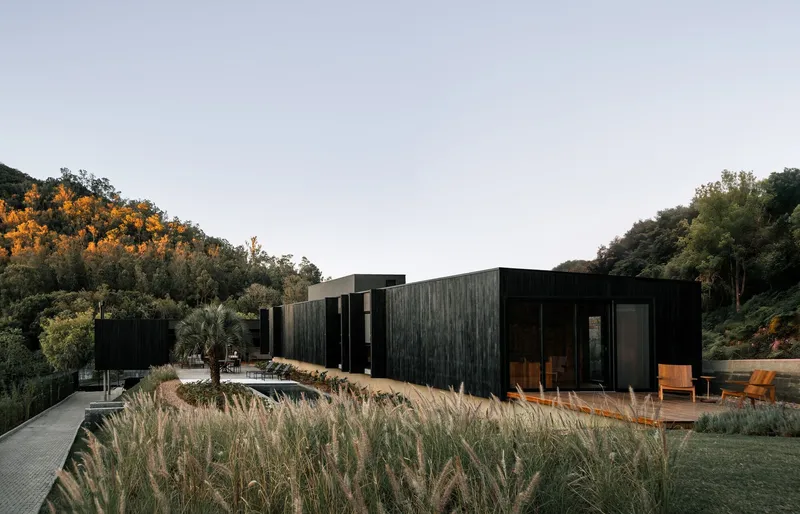
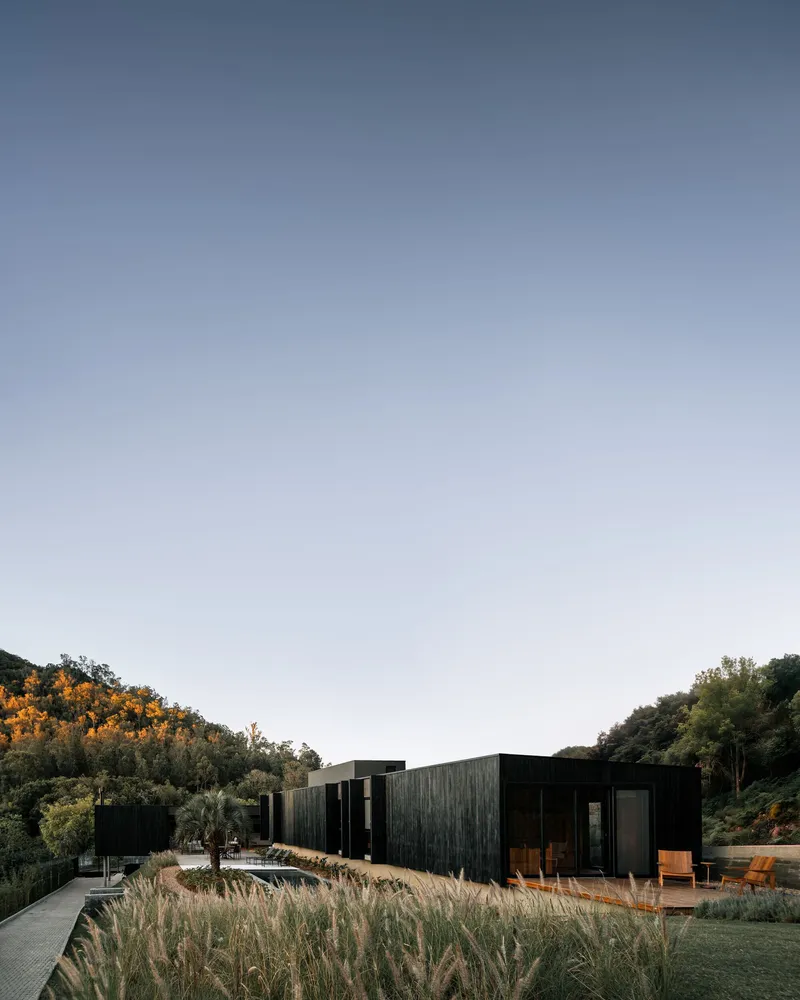
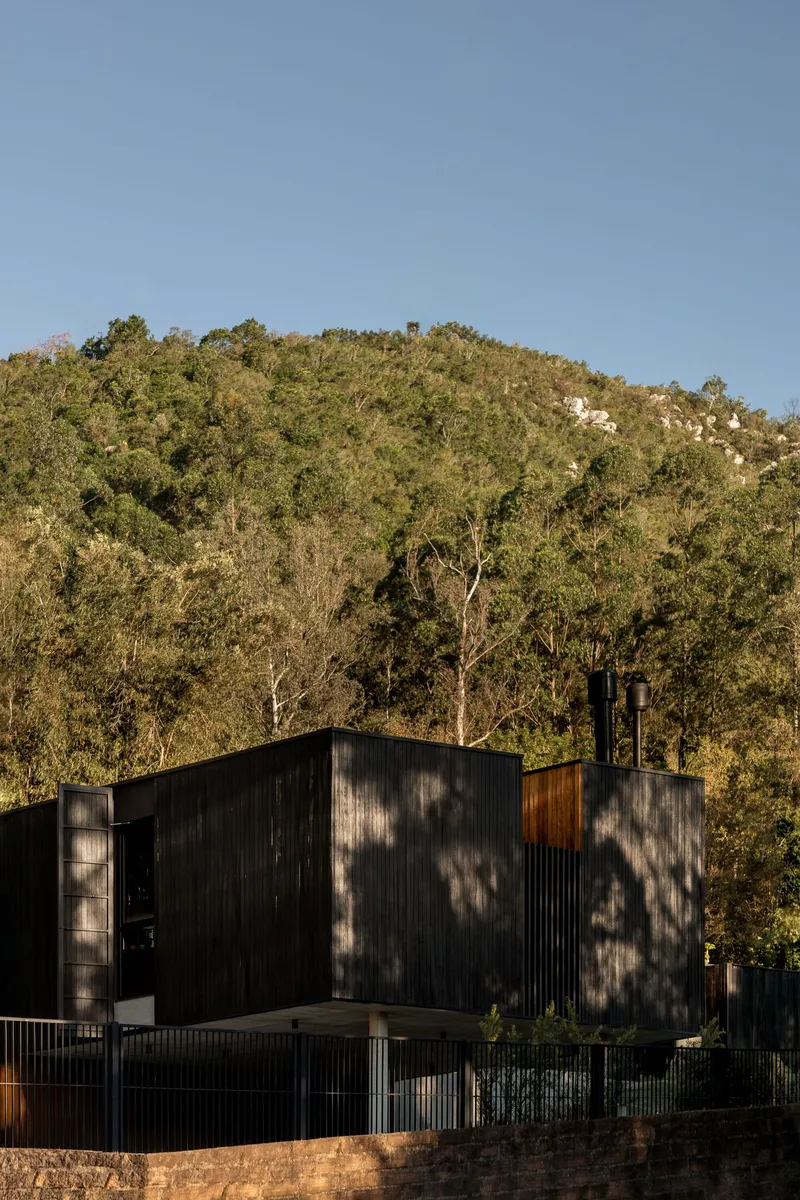
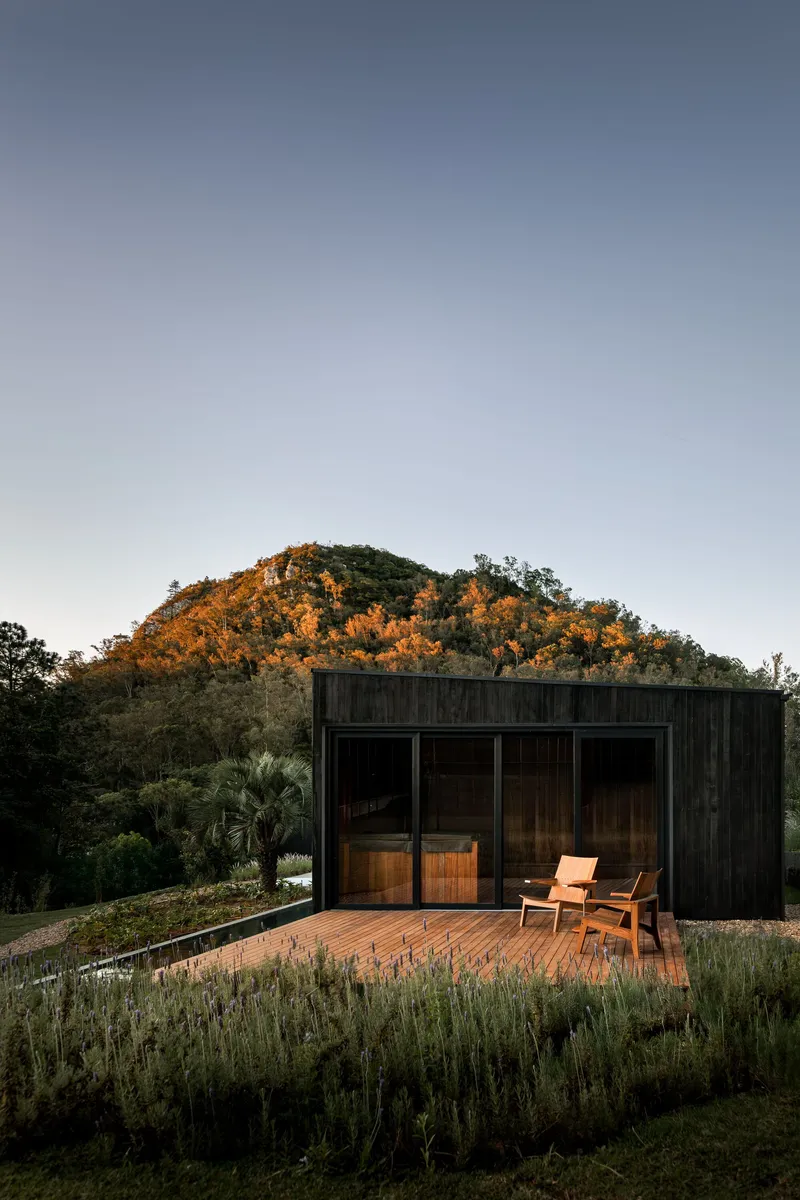
The first impression of Entremontes is chromatic contrast. Blackened vertical timber battens absorb light while the hillside vegetation radiates it, creating a figure-ground inversion where the house recedes and nature advances. At dusk the effect intensifies: the volumes become near-silhouettes, punctuated only by warm glow leaking through recessed openings. Ornamental grasses planted at the base of each volume soften the transition from building to ground, blurring the edge between architecture and topography.
The shou sugi ban treatment is not decorative shorthand for "natural material." Charring timber creates a self-protective carbon layer, an appropriate choice for southern Brazil's humid subtropical climate. The vertical orientation of the battens reinforces the sense of height in what are essentially single-story bars, lending a subtle cathedral proportion to facades that could otherwise read as utilitarian.
Navigating a Triangular Site
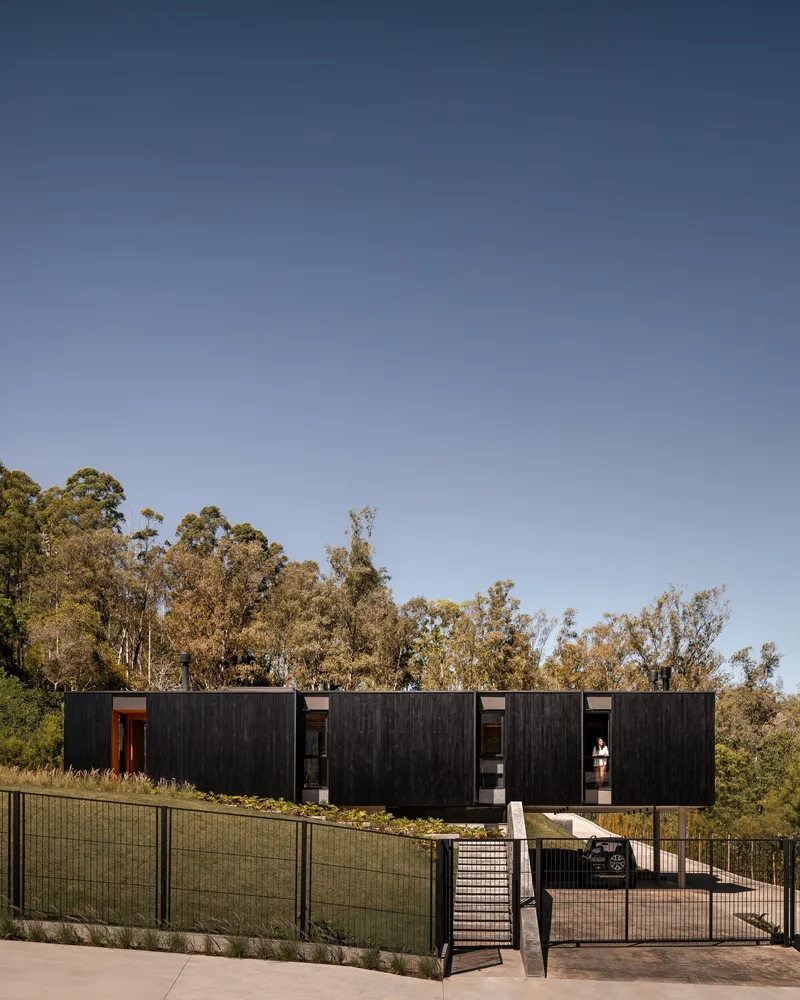
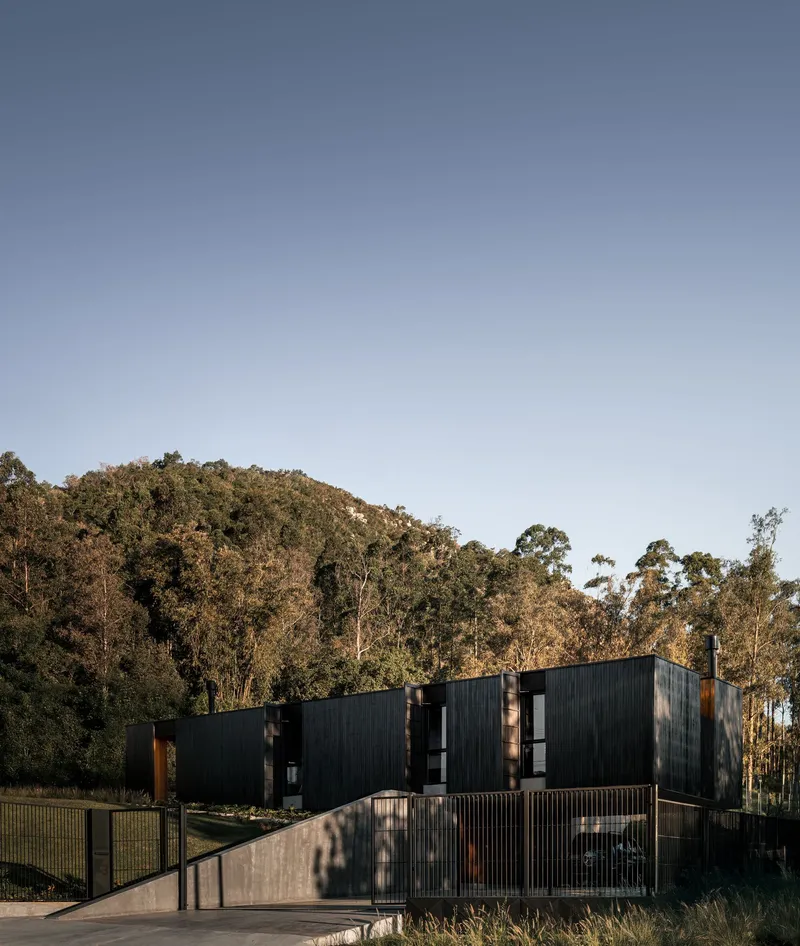
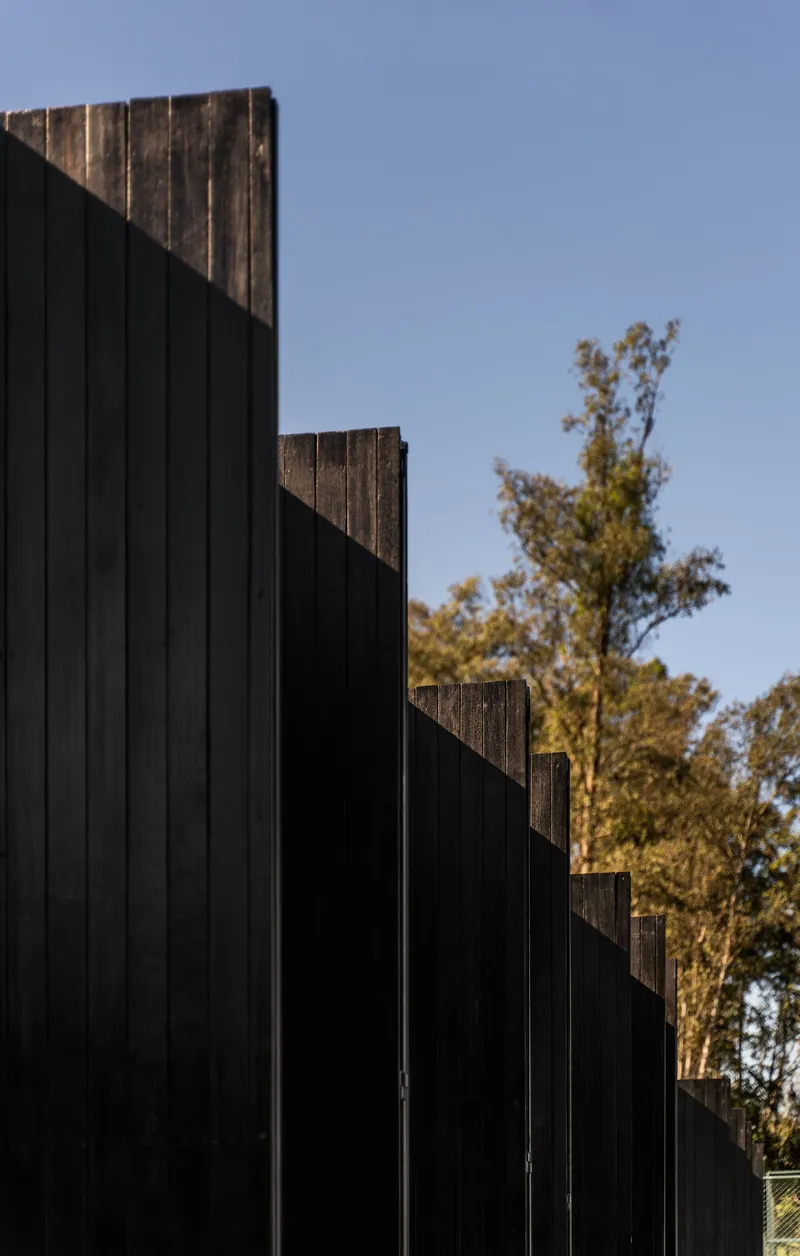
Triangular lots are notoriously hard to plan. Harpa's strategy is to ignore the triangle at the level of the individual room and honor it at the level of the site. Each bar building is a clean rectangle; the angles and leftover zones become gardens, ramps, and buffer planting. A concrete access ramp threads between eucalyptus trunks to reach the entry, establishing a processional sequence that unfolds the house gradually rather than revealing it in one shot. The stepped massing absorbs grade changes without retaining walls, allowing the volumes to step down with the slope.
There is a sunken garage visible in the roof plan that handles vehicular access without any driveway cutting through the planted landscape. It is a small decision that pays enormous dividends: the entire ground plane remains pedestrian and green, a rarity even in well-designed residential projects.
The Courtyard as Organizing Heart
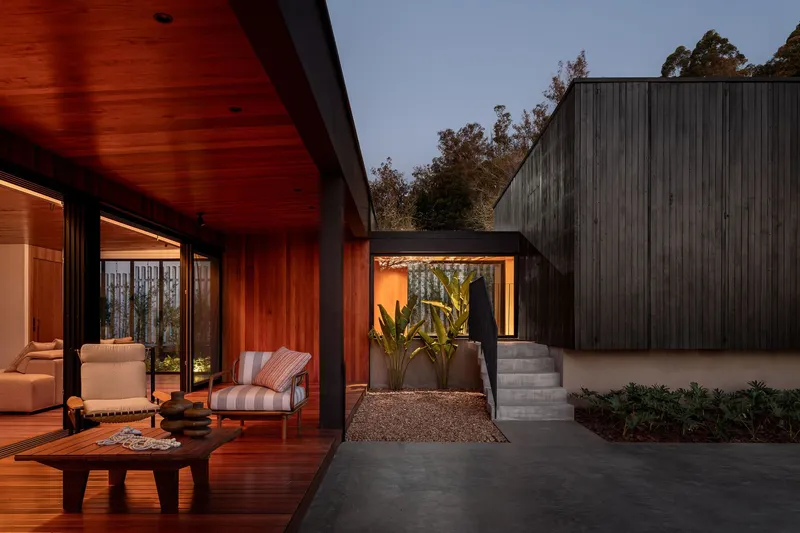
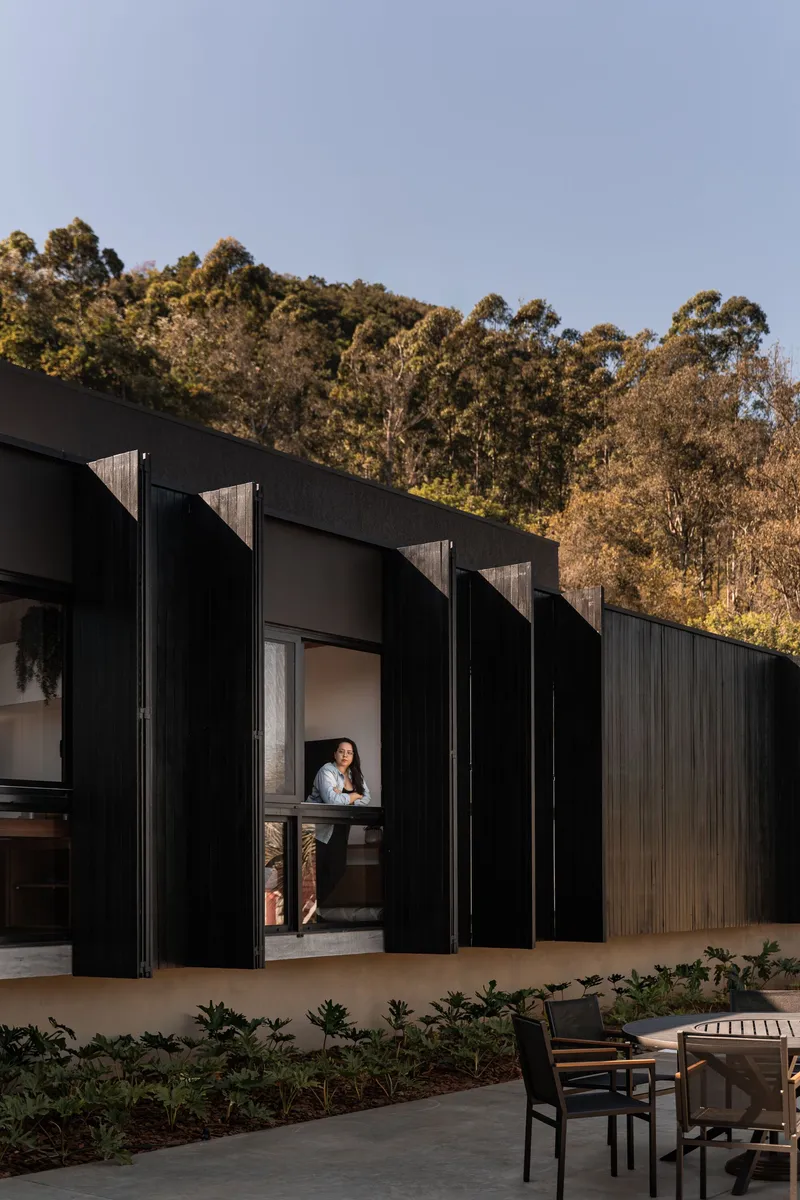
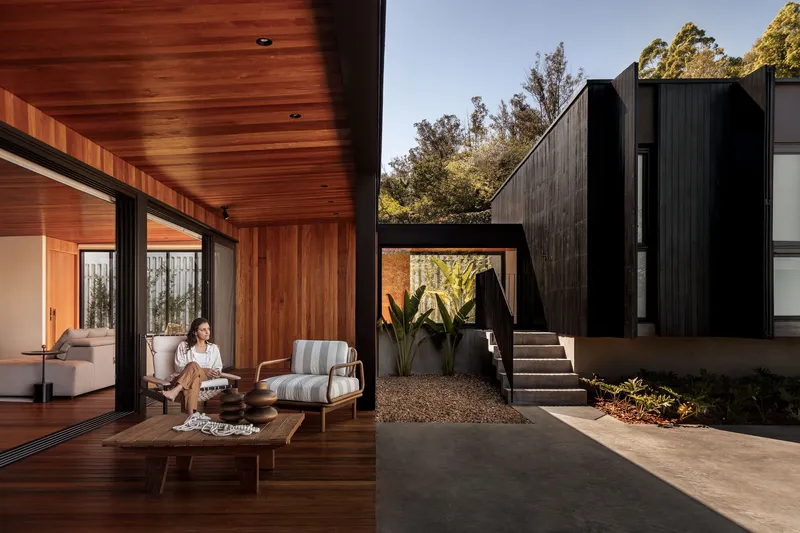
The L-shaped plan creates a generous courtyard that does more than provide light and ventilation. It is the primary social space, the circulation hub, and the lens through which the hills are framed. Concrete stairs, planters with bird-of-paradise, and a gravel surface give it a material character distinct from the timber interiors. Accordion folding doors dissolve the boundary between inside and out, so the courtyard functions as an extension of the living areas during warm months.
The covered terrace wrapping one edge of the courtyard acts as a threshold zone. Its timber ceiling and flooring are continuous with the interior, but its open sides place you in the courtyard's microclimate. This is where the house lives most of the day, and Harpa has calibrated it accordingly: deep enough for shade, open enough for breeze, low enough to feel intimate.
Timber Interiors and the Quality of Light
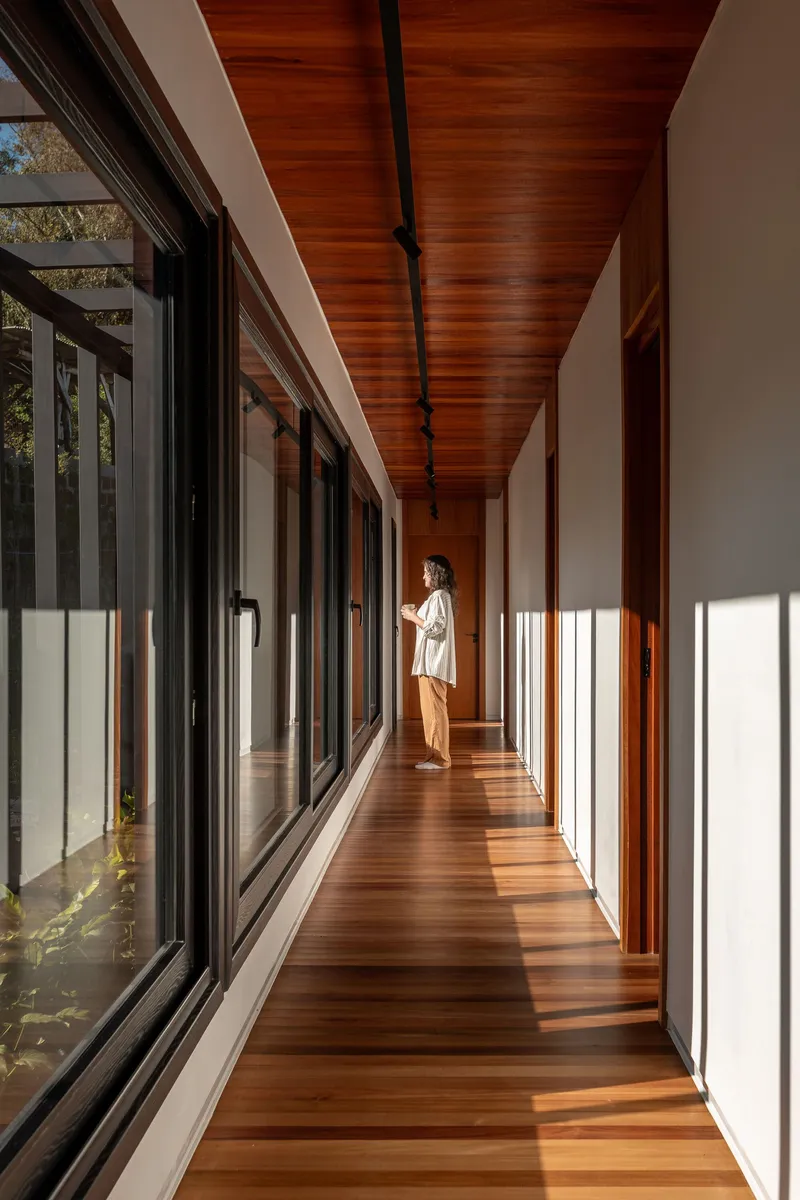
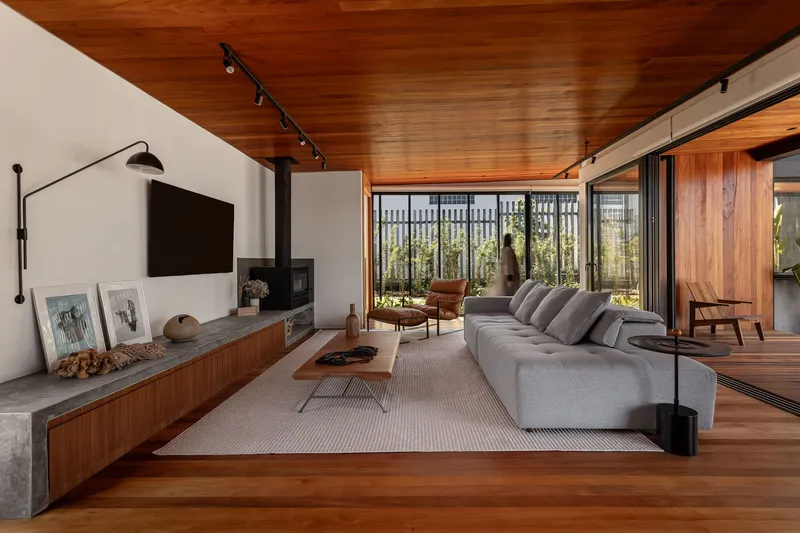
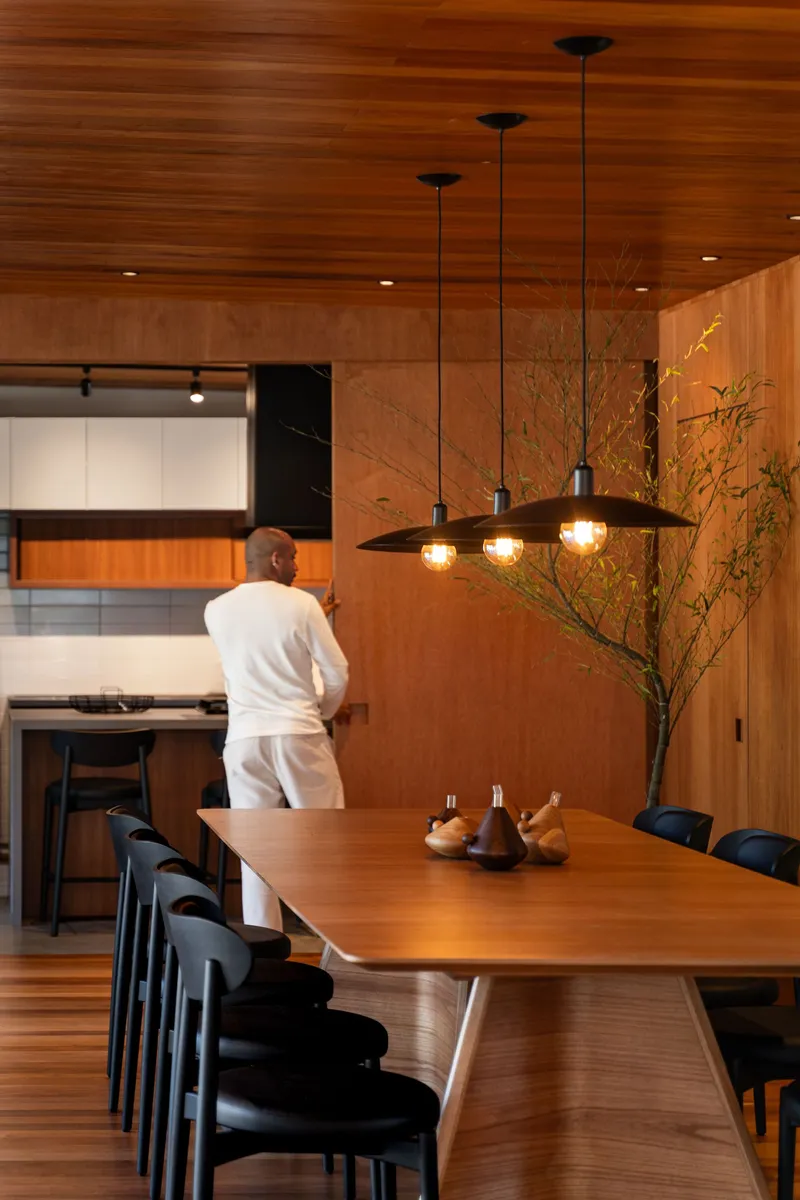
Inside, the palette shifts from black to warm gold. Timber plank ceilings and cabinetry create a continuous envelope that absorbs the harsh midday sun and returns it as a diffuse amber glow. Full-height glazing on the corridor side washes the floor with afternoon light, giving even the circulation spine a sense of generosity. The dining area, lit by three pendant fixtures suspended below the timber ceiling, demonstrates the discipline of the interior strategy: a limited number of materials handled with enough variation to keep things alive.
The living room anchors itself around a concrete media console and a firebox with stacked wood storage, grounding the space with weight and texture against the lighter timber surfaces. Vertical timber screens filter views to the garden, creating a layered visual field that rewards movement through the house.
Private Rooms, Public Landscape
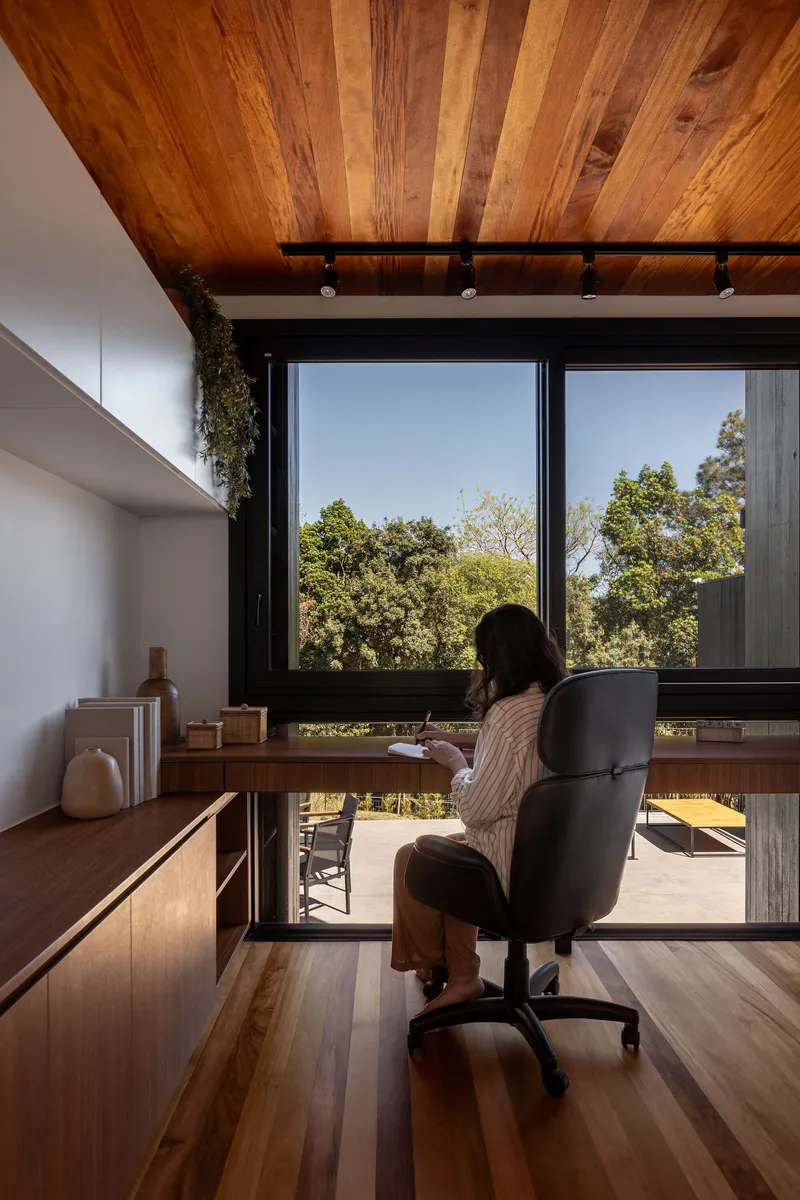
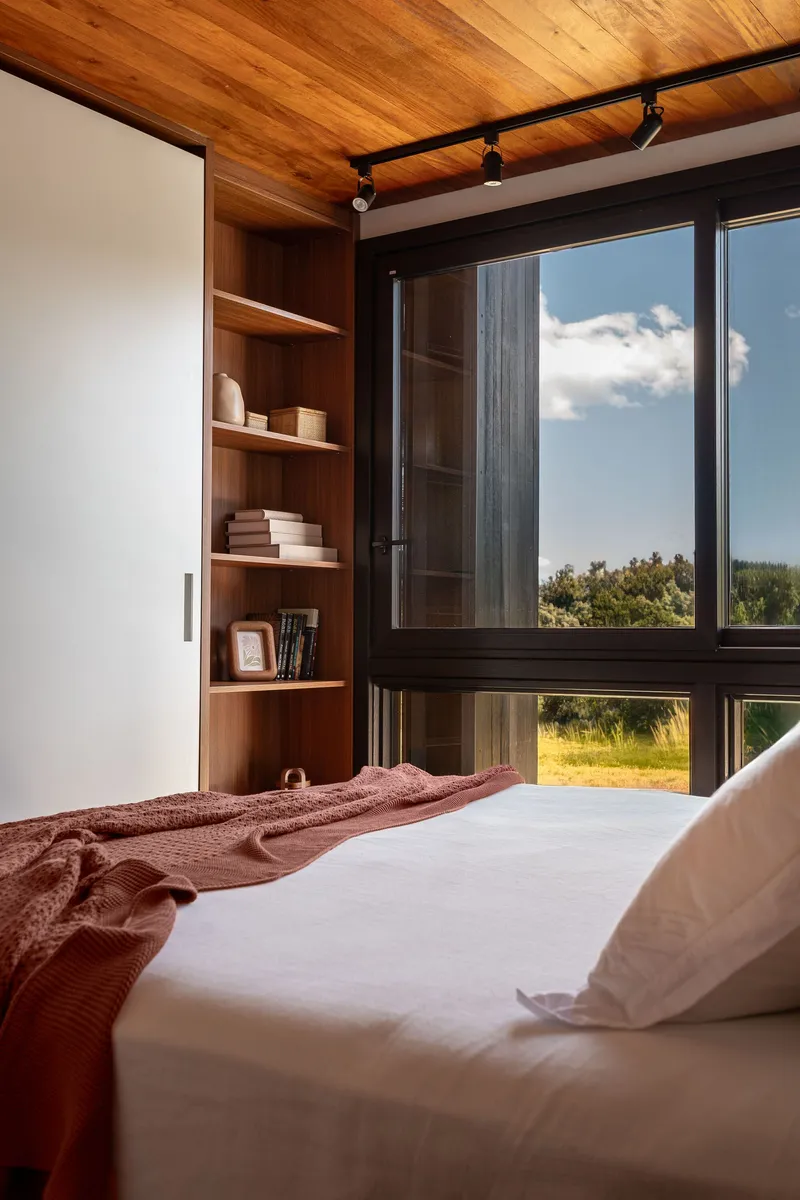
The private rooms are tucked into the quieter wing, each given a carefully sized opening to the surrounding landscape. A home office faces floor-to-ceiling windows that fill the frame with treetops, turning work into a form of inhabiting the canopy. A bedroom uses built-in timber shelving and a black-framed window to compose a still life of landscape and domestic routine. These rooms are modest in area but extravagant in their relationship to what lies outside.
On the timber deck at the far end of the house, a single chair faces the illuminated hillside. It is the kind of moment that only happens when a house is designed not as an object but as a series of vantage points calibrated to a specific geography.
Pool, Deck, and the Extended Ground Plane
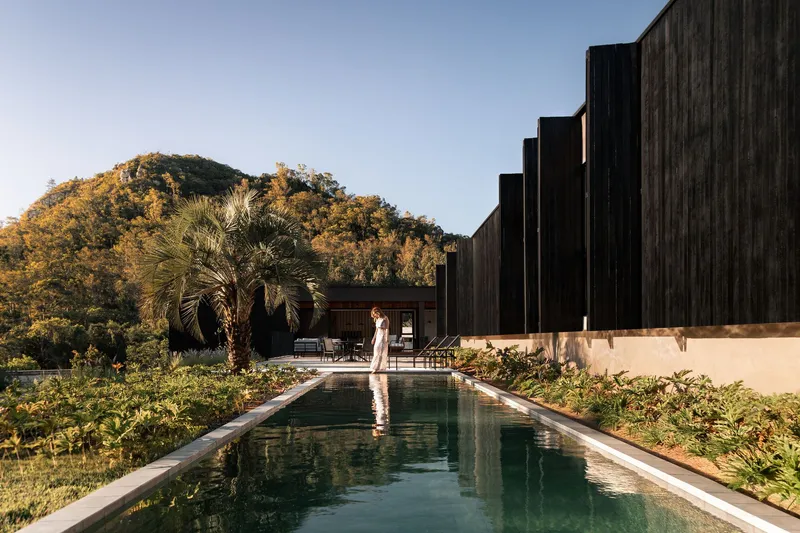
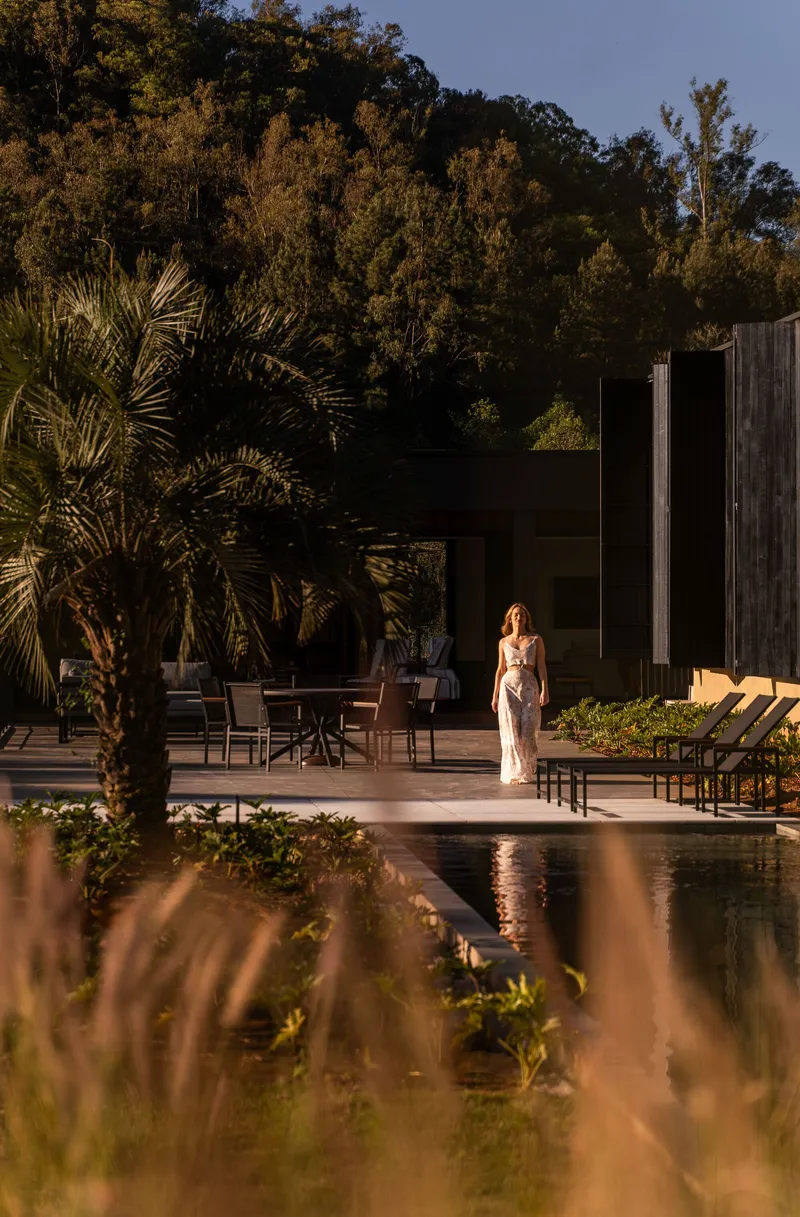
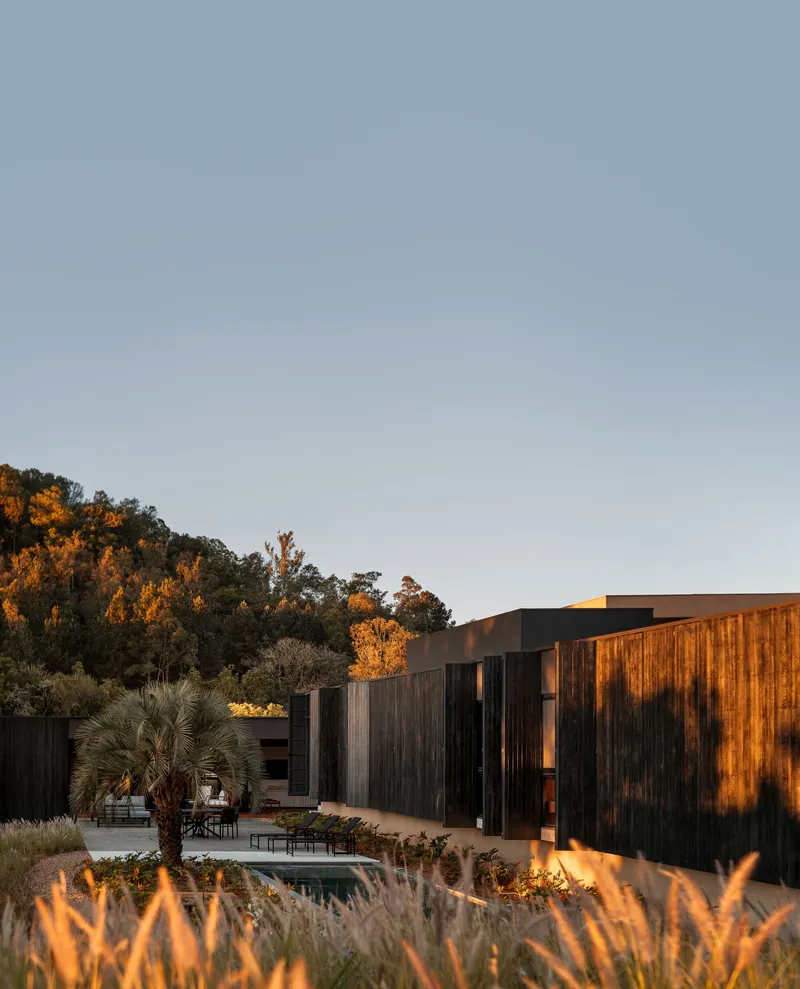
A long lap pool runs parallel to one of the black timber volumes, its still surface reflecting the cladding and sky in equal measure. The pool terrace is treated as a continuation of the architectural ground plane, with the same decking material extending from interior to exterior. At golden hour, the linked timber pavilions and their planted intervals compose a scene that feels simultaneously constructed and found, as if the house had always been part of the terrain's logic.
The outdoor furniture placement is deliberate rather than decorative, oriented toward the hills and the garden rather than toward the pool itself. It signals a house that understands the pool is not the amenity; the landscape is.
Thresholds and Entry Sequences
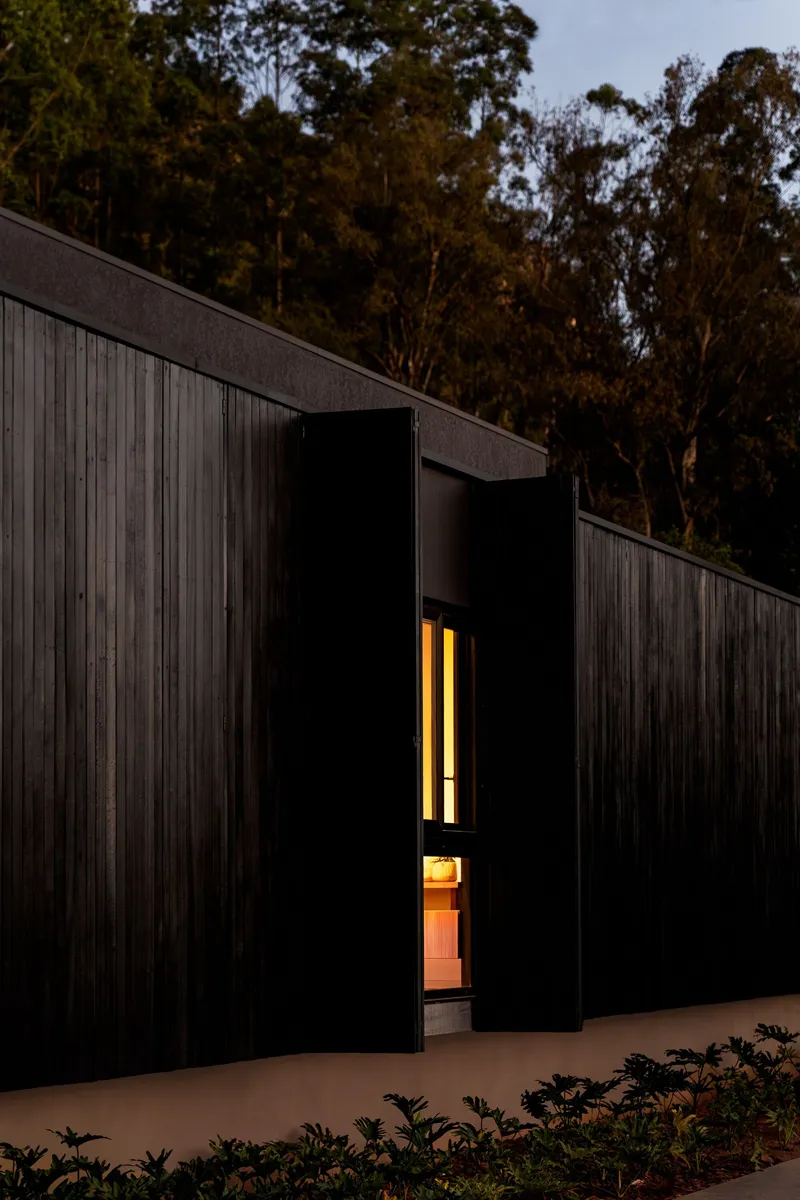
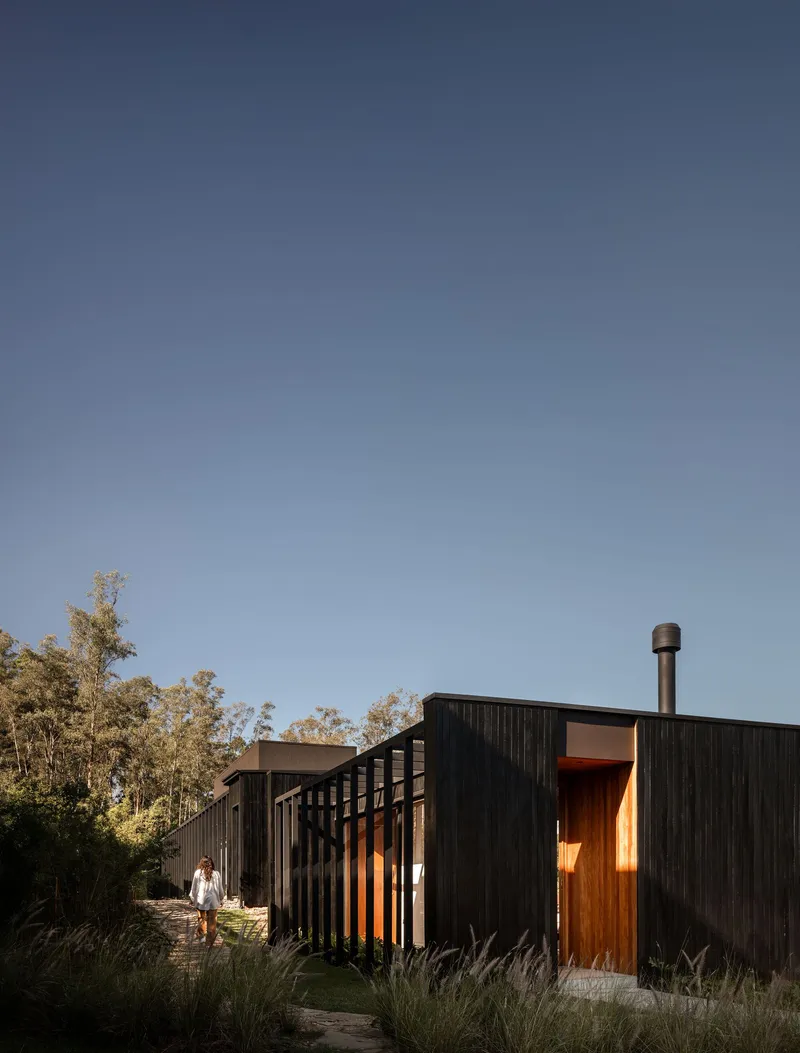
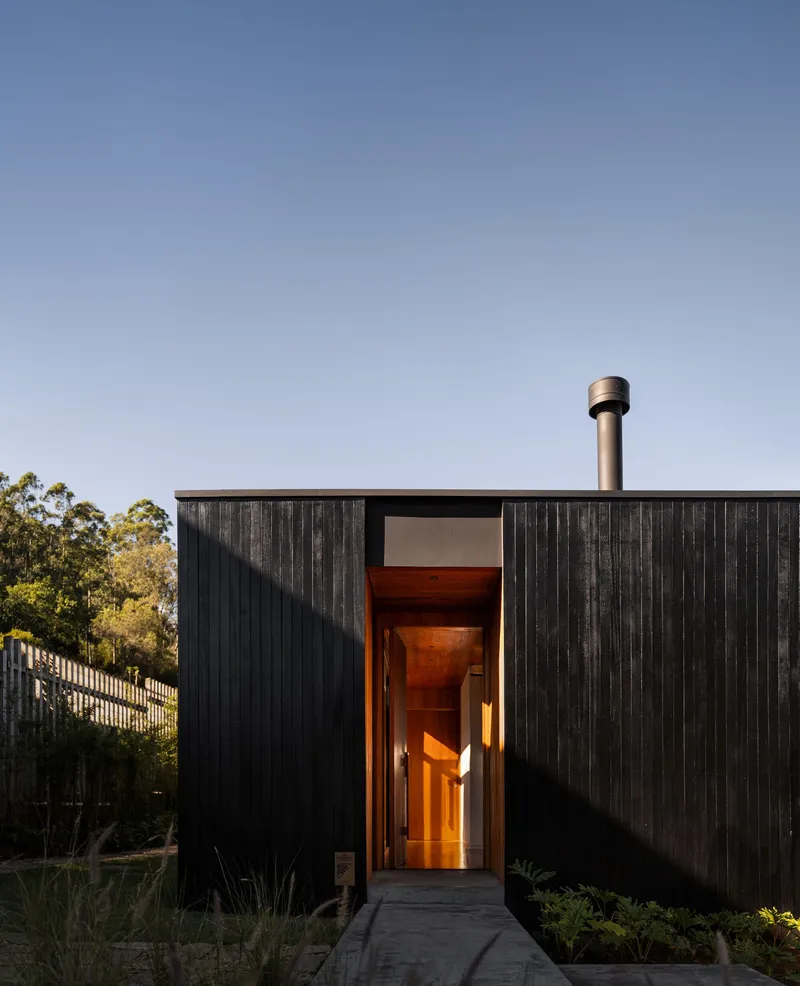
Entremontes takes its entry sequence seriously. The charred facade presents a nearly opaque face to the street, with a deep recess at the front door that glows with interior light at twilight. The vertical timber battens frame the entry door like a controlled aperture, compressing the view before releasing it into the courtyard beyond. It is a classic architectural move, compression and release, executed here with restraint and material consistency.
The illuminated threshold visible from the street at night is one of the strongest images of the project. It suggests hospitality without exposure, a house that acknowledges its urban context while maintaining privacy. The chimney stack punctuating the roofline gives the silhouette a vertical anchor, marking the house's presence between the two hills without competing with them.
Plans and Drawings
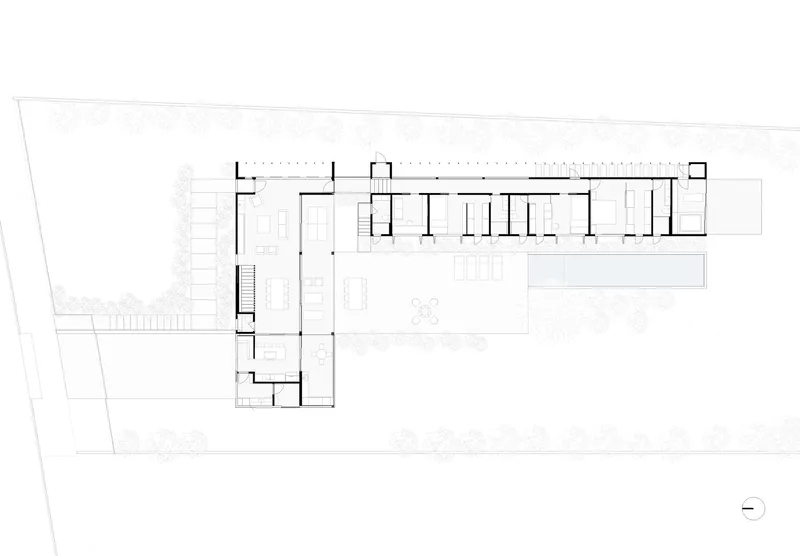
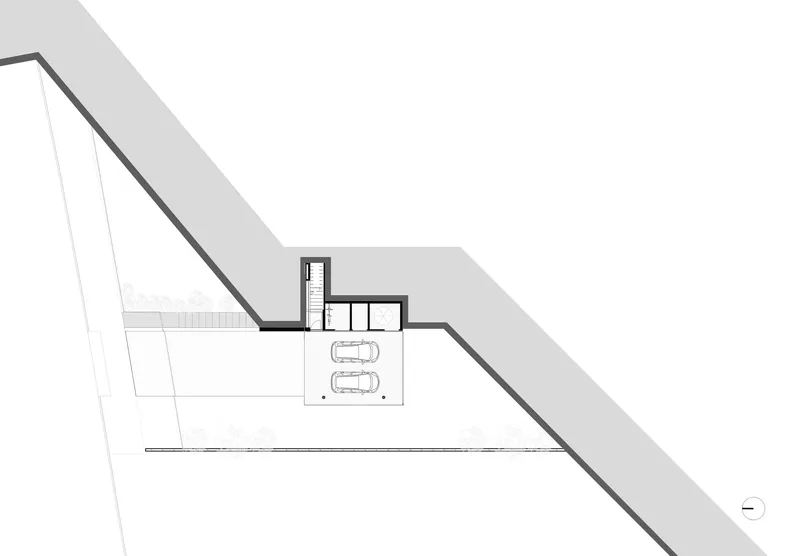
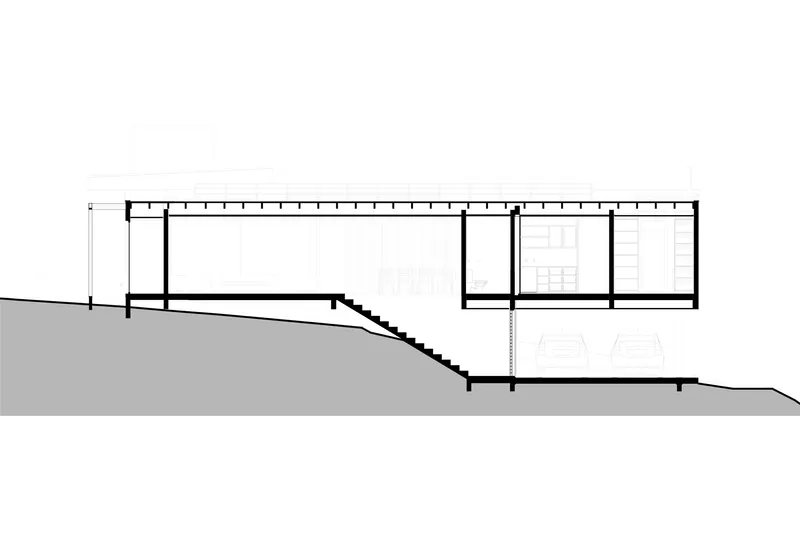
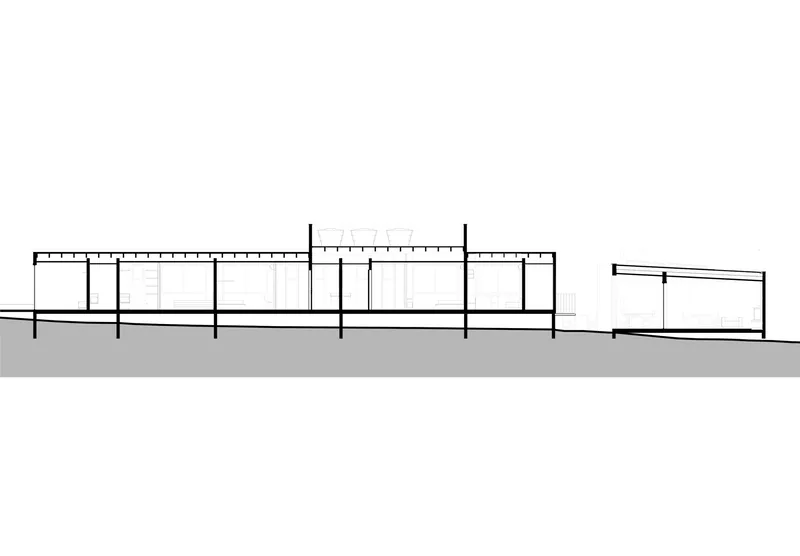
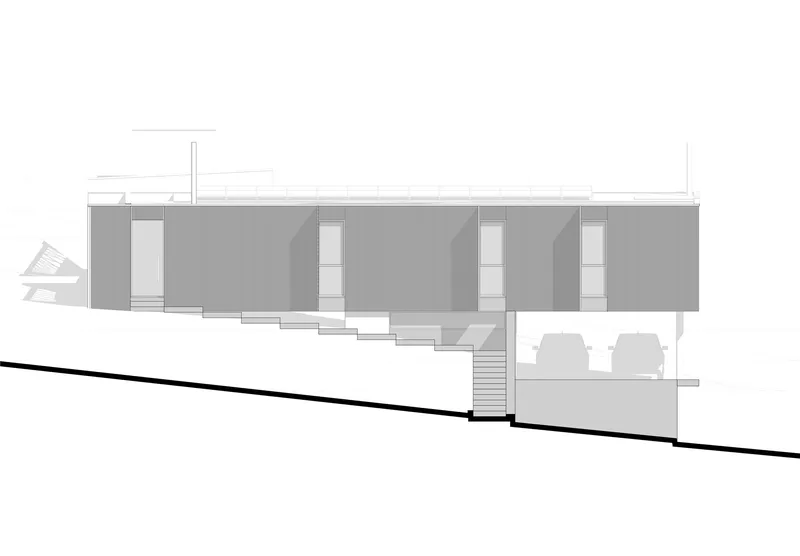
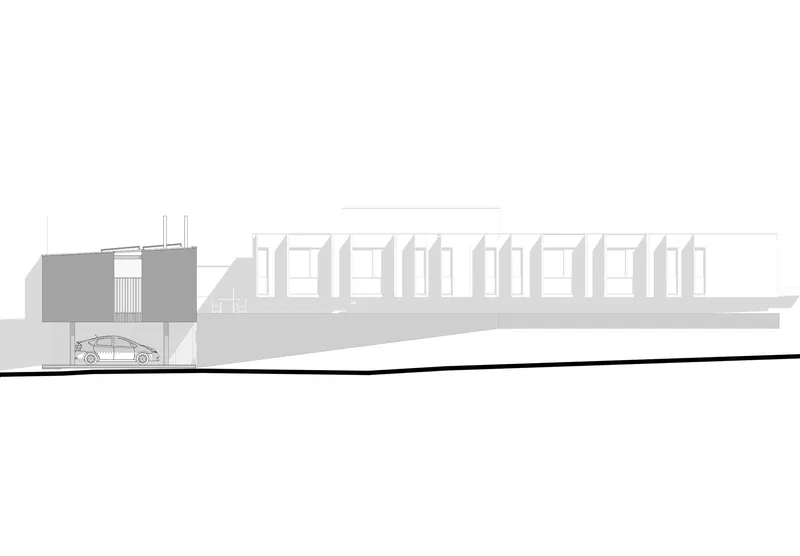
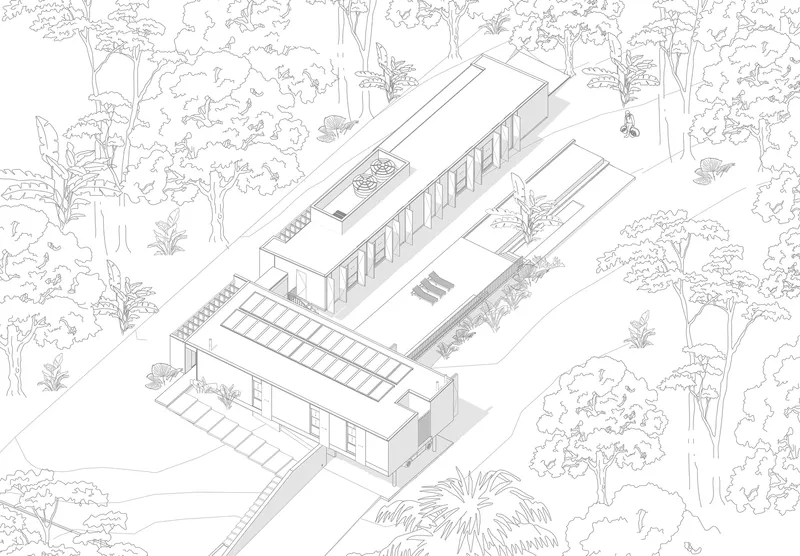
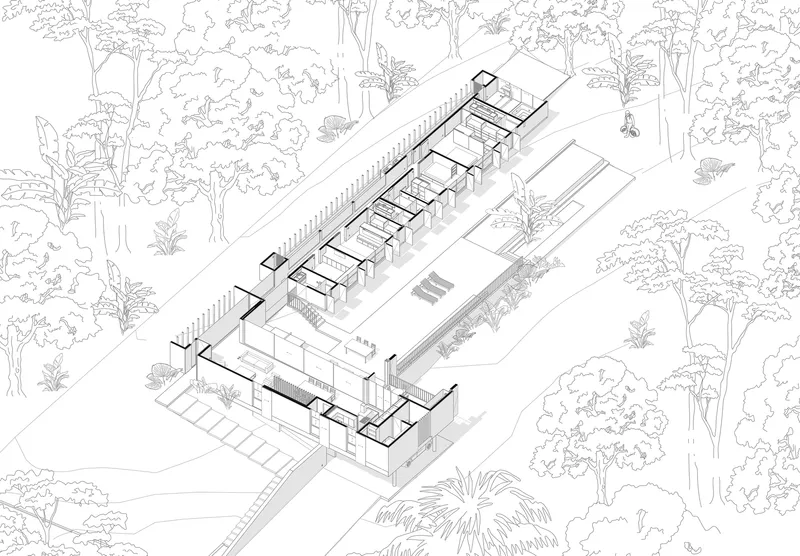
The ground floor plan confirms the L-shaped strategy: a long linear wing houses the private program while a shorter bar contains social spaces, the two joined at the courtyard corner. The roof plan reveals the triangular site in full, with the sunken garage occupying the acute angle and the upper-level volumes stepping along the slope. Sections show how the flat-roofed bars ride on slender columns where the grade drops, creating a cantilevered condition that lifts the house above the terrain without earthworks.
The axonometric cutaway drawings are particularly revealing. They show how the three bar buildings are distinct structures linked by covered circulation, a strategy that allows cross-ventilation through every room and gives each wing its own structural independence. The longitudinal section through the main wing illustrates the repeating rhythm of columnar supports, a colonnade that reads on the exterior as a disciplined facade of vertical frames.
Why This Project Matters
Entremontes House is a reminder that site constraints are design opportunities. A triangular lot between two hills could produce a compromised plan and an awkward relationship with topography. Instead, Harpa Arquitetura used the constraints as generators: the triangle becomes a courtyard strategy, the slope becomes a sectional opportunity, and the hills become the framing device for every room. The charred timber cladding unifies volumes that could otherwise feel scattered, giving the project a material identity as specific as its address.
More broadly, the project contributes to a growing body of Brazilian residential work that takes ecological embedding seriously without resorting to green-wash gestures. The native planting, the passive ventilation strategy, the climatic logic of the charred timber, and the refusal to flatten the site all point toward an architecture that works with geography rather than against it. In a discipline that still too often treats houses as objects dropped on cleared land, Entremontes demonstrates what it means to build between mountains.
Entremontes House by Harpa Arquitetura, lead architect Júlia Hamann. Located in Montenegro, Rio Grande do Sul, Brazil. 390 m², completed 2025. Photography by Gabriel Konrath.
About the Studio
Share Your Own Work on uni.xyz
If projects like this are the kind of work you want to make, uni.xyz is a place to publish your own, find collaborators, and enter design competitions.


Popular Articles
Popular articles from the community


GROUP A Strips a 1969 Rotterdam Harbor Headquarters to Its Frame and Wraps It in Timber Louvers
In Rotterdam's M4H harbor district, Ferro Offices reuses a 1969 frame, adds one timber storey and reaches BREEAM-NL Outstanding.

LT2A and OPEN Architectes Thread a Brick and Glass High School Through a Wooded Belgian Campus
In Braine-l'Alleud, a 3,000 m² wing for Collège Cardinal Mercier pairs pale brick with a glazed colonnade, deferring to a small chapel and a dense wood.

Architekt Andreas Gruber Scatters 23 Dark Timber Chalets Across a South Tyrolean Forest Edge
In Molini di Tures, Amonti Chalets breaks a resort into a hamlet of gabled timber houses, with parking, storage and services pushed into the slope.

David Macias Steps a Doorless Stone and Plaster House Down a Tropical Colombian Hillside
In the humid hills of Colombia, Threshold House replaces the front door with an open void and terraces its 850 m² down the slope instead of fighting it.

Similar Reads
You might also enjoy these articles


LAVA Architecten Gives Vocational Education a Sawtooth-Roofed Face on a Mechelen School Campus
In Mechelen, Belgium, a 2,053 m² STEM school on a 6×6 m grid turns workshops and classrooms into rooms that can be rearranged as teaching changes.

KEMA Studio Turns a Derelict Marvila Attic into a 60 m² Lighthouse Apartment Above Lisbon
In Lisbon's Marvila district, a rebuilt roof, four skylights and two plywood volumes turn an unlivable attic into a bright home facing the Tagus.

Pixel Gardens: One Repeated Module Stacked Into a Terraced Social Housing Tower for Famagusta
Salem Bader's shortlisted housing tower builds a vertical neighbourhood from one repeated module, offsetting units to carve terraces, light and air.

Bao Huynh Watercolor Atelier: A Serene Art Retreat in Hội An
Bao Huynh Watercolor Atelier in Hội An blends multifunctional art spaces, sustainable design, local materials, and family-friendly living in a serene environment.

Explore Plug-In House Competitions
Discover active competitions in this discipline

Challenge to design a portable theatre

Challenge to design a portable music platform

Challenge to design an open learning module for the elderly

Challenge to design mud housing for contemporary communities
Comments (0)
Please login or sign up to add comments
No comments yet. Be the first to comment!