
Hayley Pryor Architect Distills a Full Home into a Tiny Timber Pavilion in Byron Bay
Set among eucalyptus in the Byron Bay hinterland, The OCULUS proves that radical restraint can feel generous and calm.


A house does not need to be large to be complete. Hayley Pryor Architect makes that argument with conviction in The OCULUS, a tiny house tucked into the hinterland behind Byron Bay. Sitting on a wheeled chassis, the pavilion is technically mobile, but nothing about its material palette or spatial discipline reads as temporary. Vertical timber cladding, a corrugated metal gable roof, plywood-lined interiors, and carefully placed openings give the structure an architectural seriousness that most dwellings twice its size never achieve.
What makes The OCULUS genuinely interesting is the way it refuses the usual tiny-house tradeoffs. There is no lofted sleeping platform reached by a ladder, no folding furniture gymnastics. Instead, Pryor has organized a simple rectangular plan so that every function occupies a distinct zone, each with its own relationship to the landscape. The result is a dwelling that feels calm rather than clever, and that treats minimal living as a spatial opportunity rather than a constraint.
A Quiet Presence in the Canopy
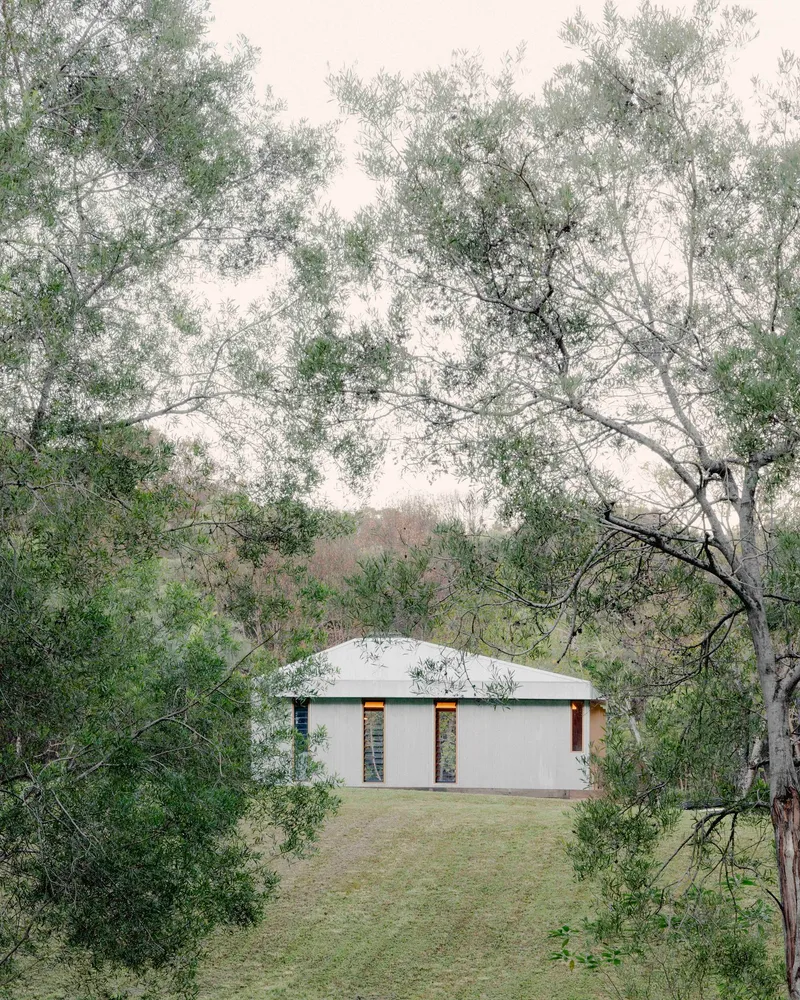
Approached through dense eucalyptus, The OCULUS registers as a modest gabled volume rather than a statement object. The vertical timber cladding weathers toward the same silver-grey as the surrounding bark, and the corrugated roof picks up the muted tones of the Australian bush. From the rear, twin openings glow through early morning mist, giving the pavilion the presence of a lantern without any of the showiness that word usually implies.
Pryor has clearly thought about the building's profile from every direction. The gable is steep enough to shed rain convincingly but shallow enough to sit below the tree canopy line, keeping the structure subordinate to its setting. It is an exercise in architectural manners: the house occupies its clearing without dominating it.
Facade and Threshold
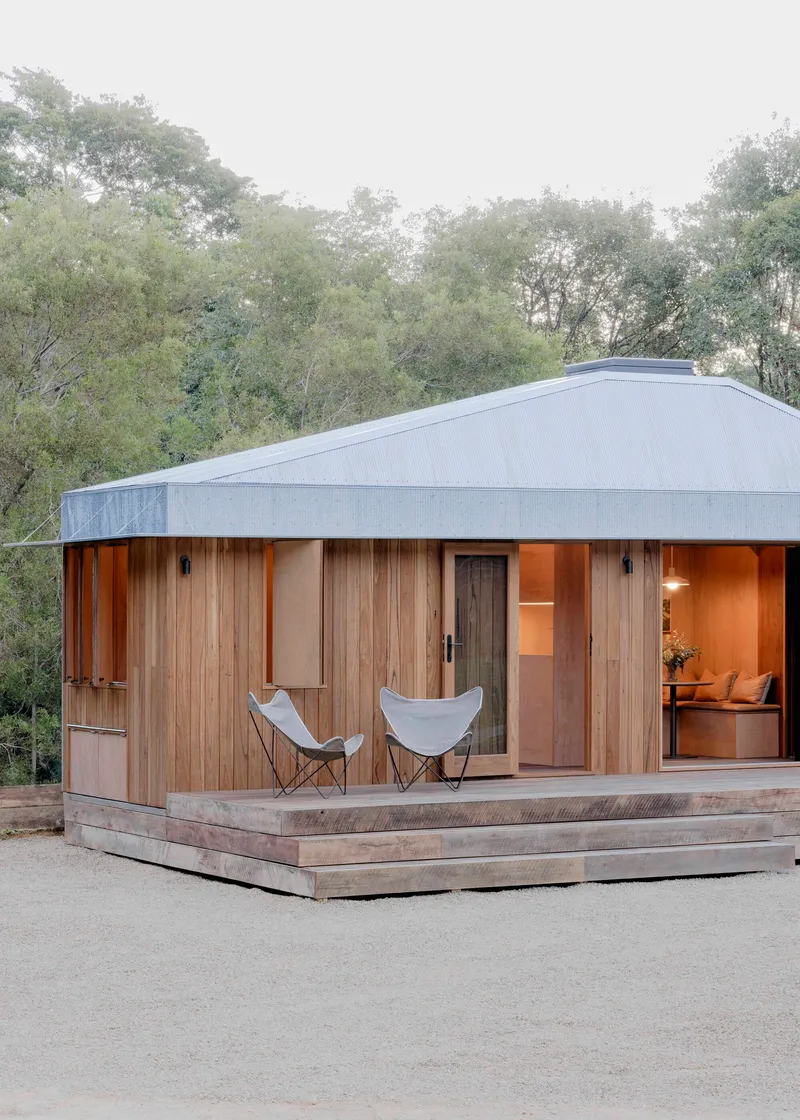
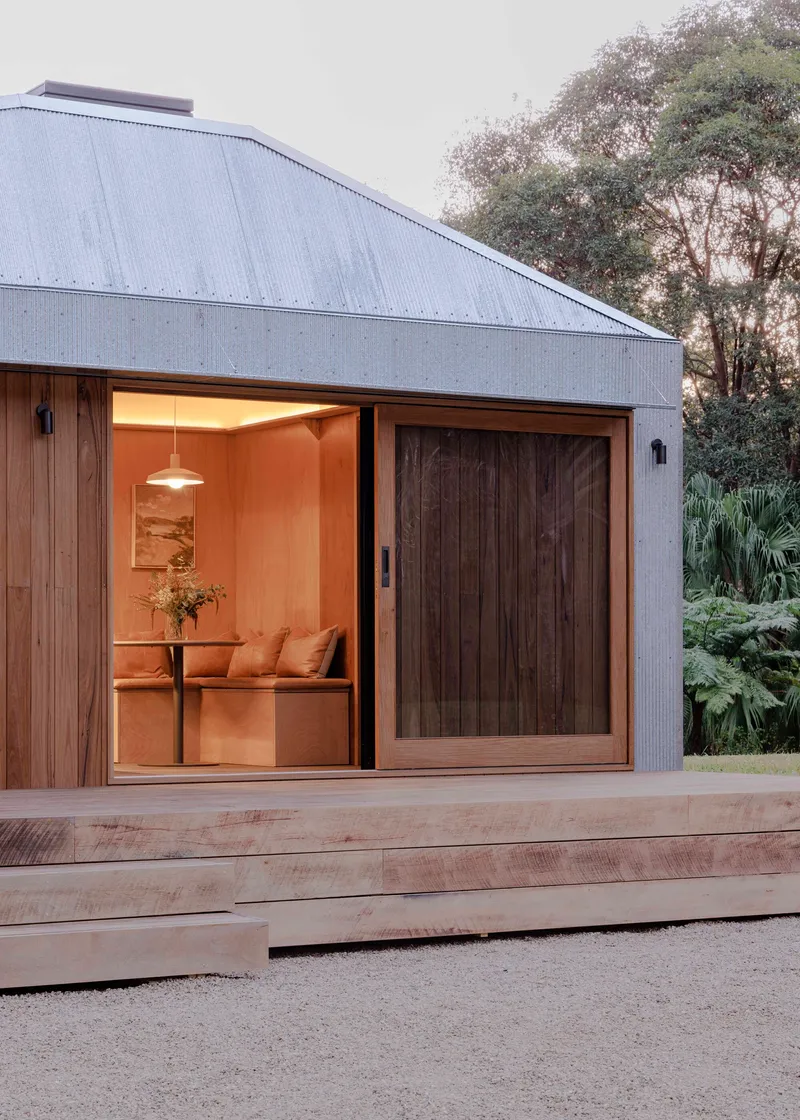
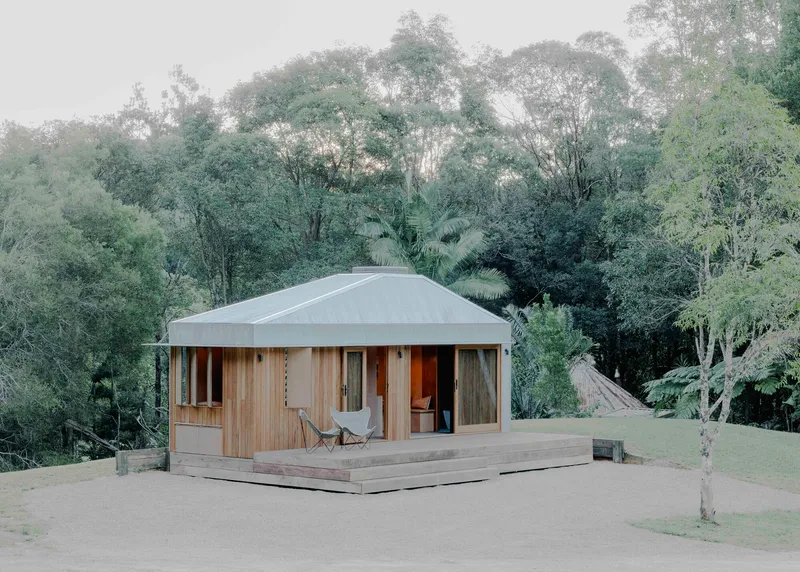
The front elevation is essentially a wall of vertical timber battens punctured by glazed openings and a generous sliding door. Two canvas chairs sit on the deck, and the composition reads like a weekender's porch rather than a micro-dwelling's only outdoor space. That distinction matters. By extending a proper timber deck from the living zone, Pryor doubles the usable area of the home in fair weather without adding a single square meter of enclosed floor.
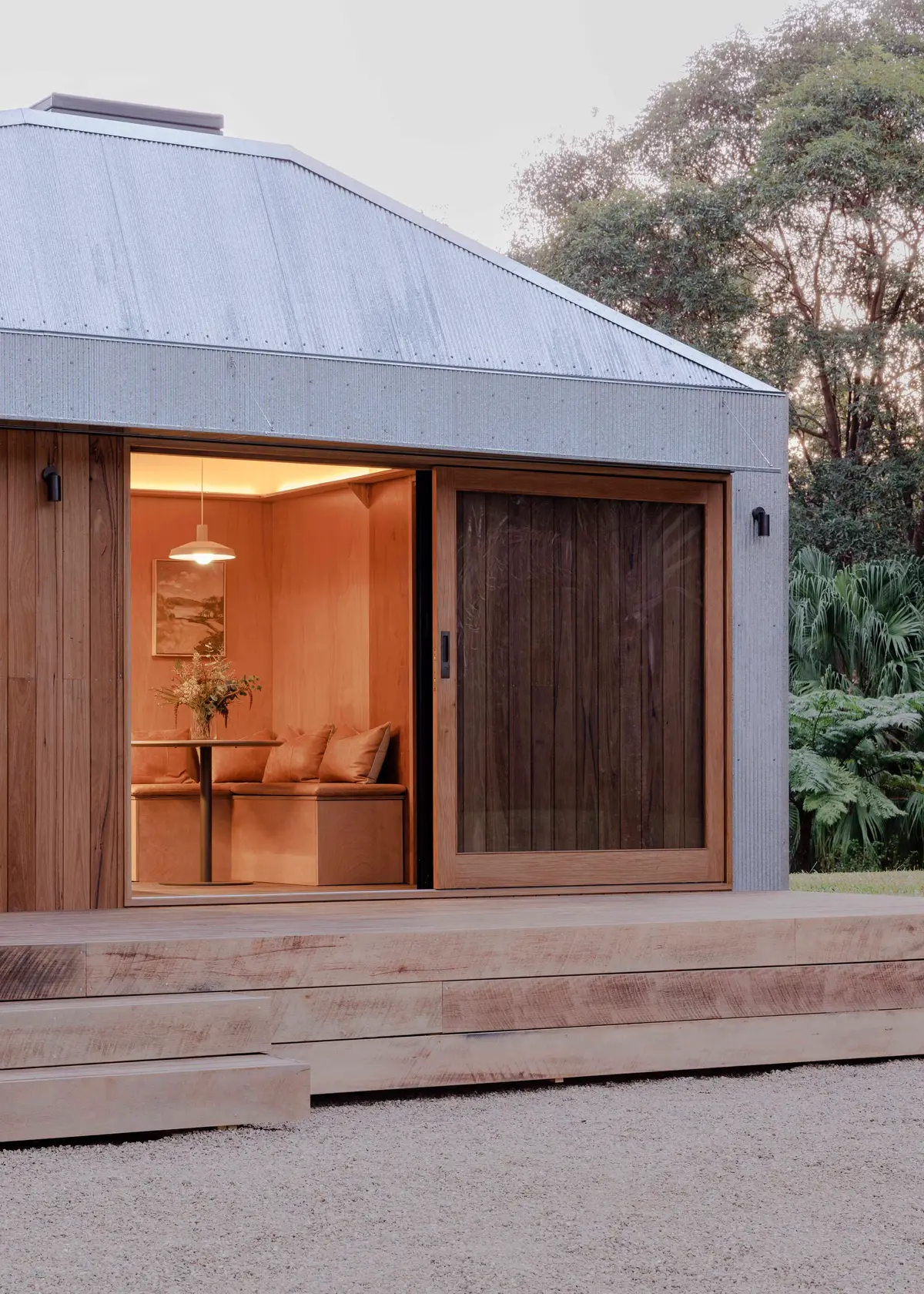
The sliding timber door deserves attention. At dusk it pulls back to reveal the plywood-lined interior glowing warmly under the metal roof, collapsing the boundary between inside and out. When closed, the batten rhythm continues unbroken across the facade. It is a simple detail, but it gives the occupant genuine control over privacy and exposure, something many conventional houses handle far less gracefully.
Plywood as Interior Architecture
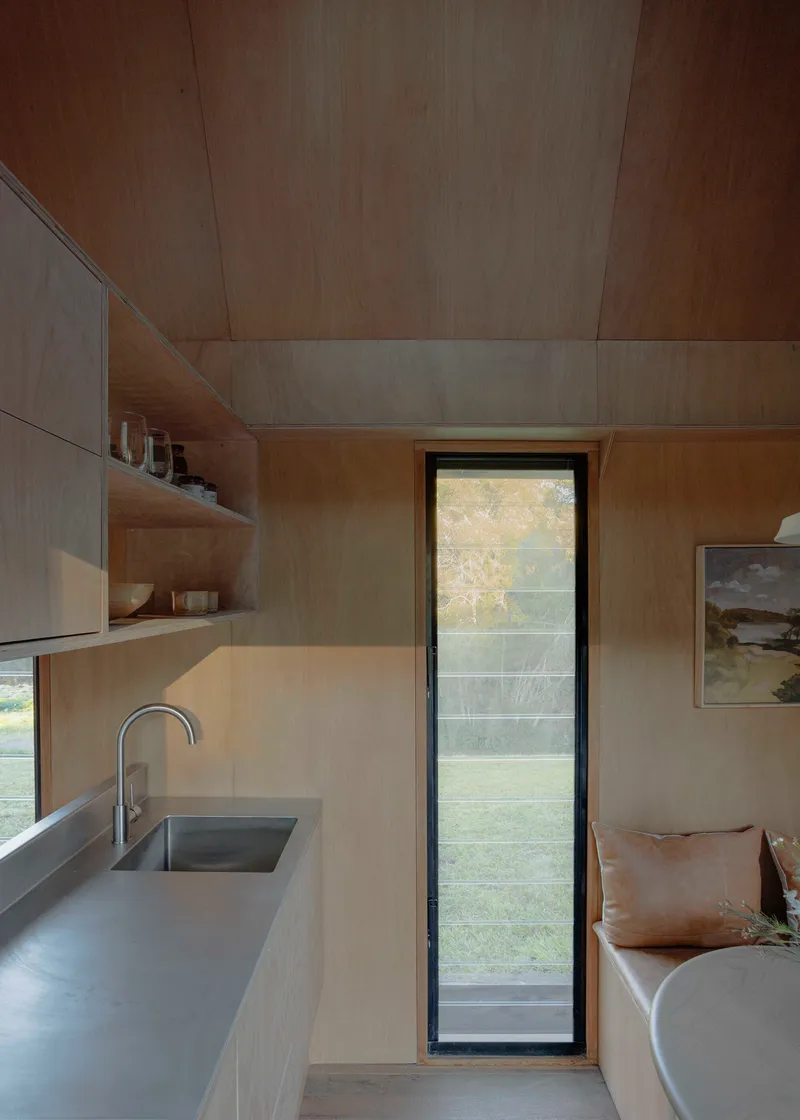
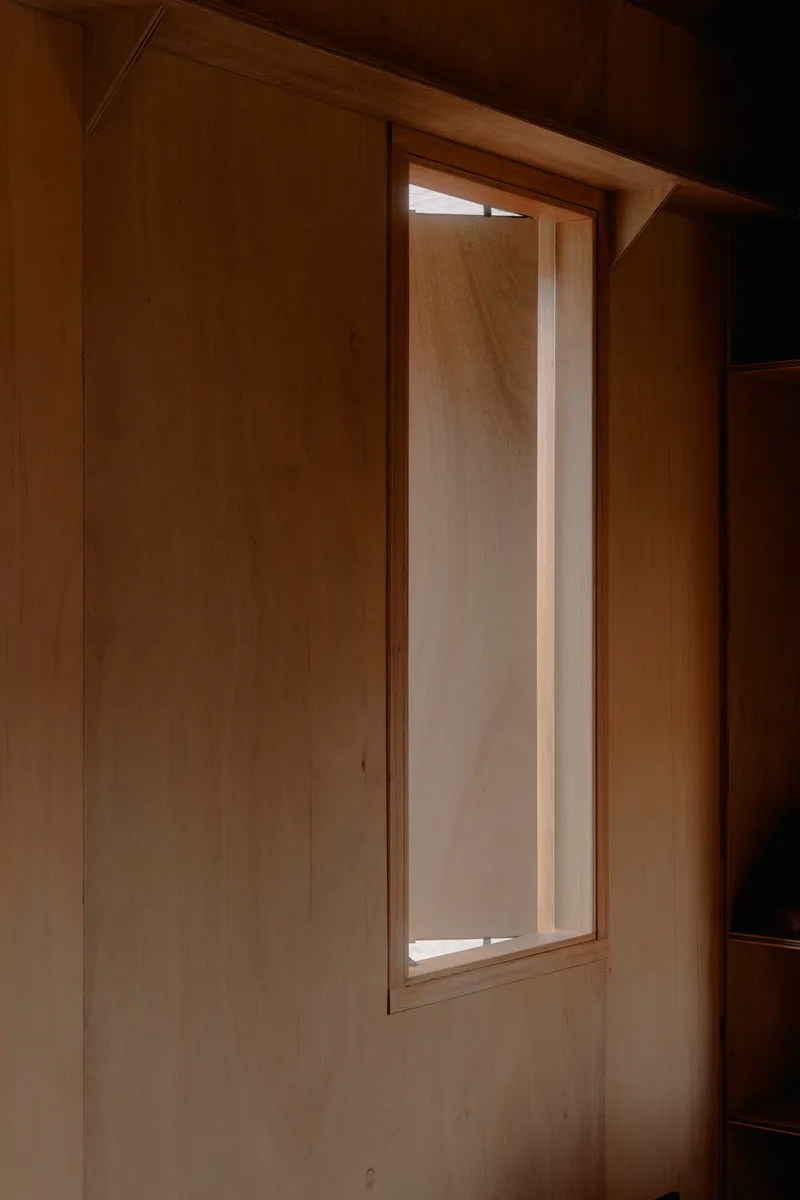
Inside, every surface is lined in plywood. Walls, ceiling, cabinetry, and window reveals share the same warm blond tone, creating a continuous shell that reads as carved from a single piece of timber. The kitchenette is a masterclass in compact planning: an integrated sink, a narrow vertical window framing the foliage outside, and just enough bench space to prepare a meal without feeling squeezed.
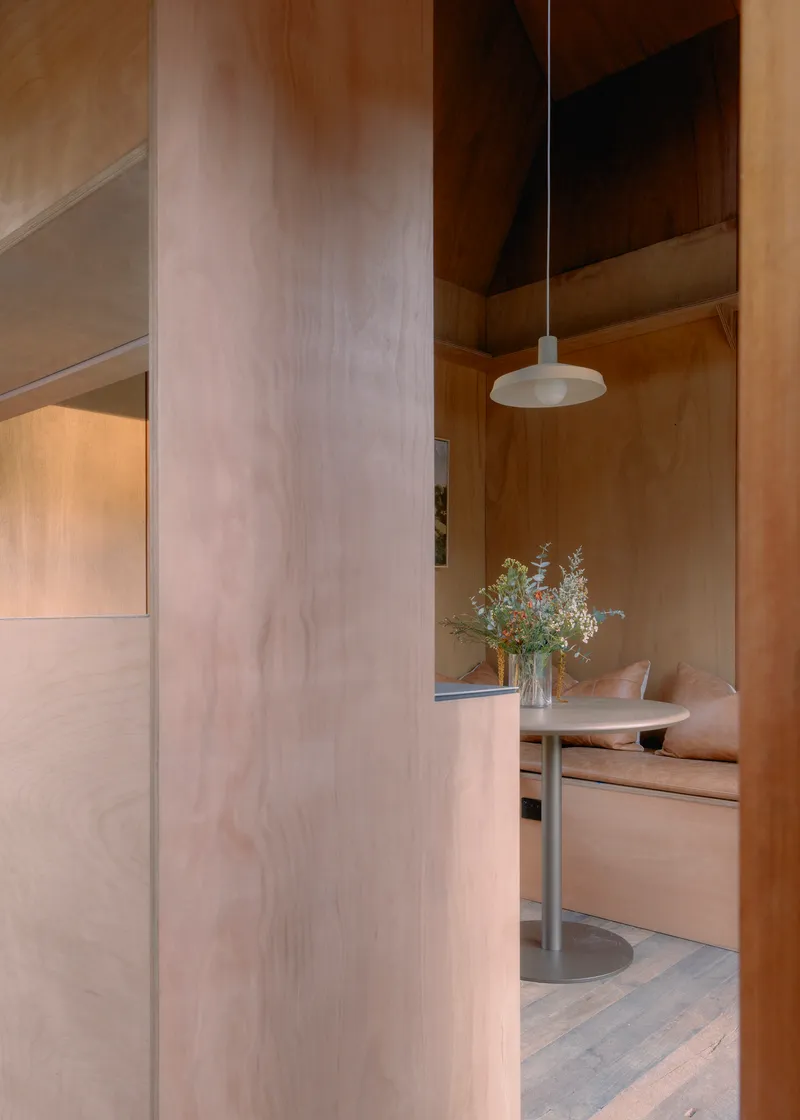
A view down the corridor toward the dining zone, where a pendant light hangs above a vase of wildflowers, reveals how Pryor uses depth to generate atmosphere. The space is narrow, but the axial sightline gives it a sense of procession that tiny houses almost never possess. A tall, narrow window set into the plywood wall acts as a vertical light slot, softly washing the surface at dusk and reinforcing the idea that every opening here is a deliberate compositional decision, not a building-code afterthought.
Sleeping at the Edge of the Landscape
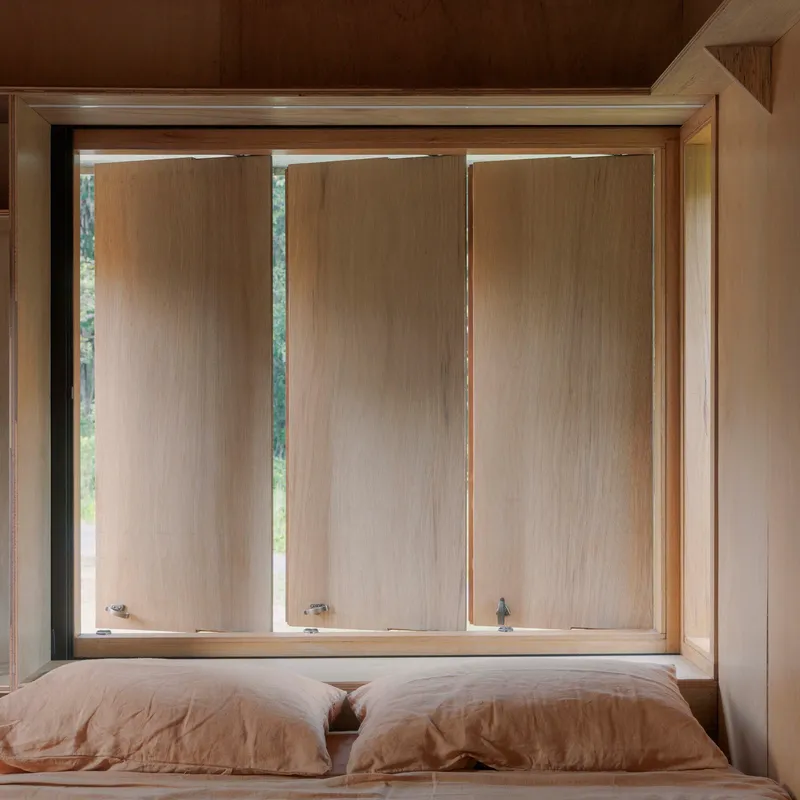
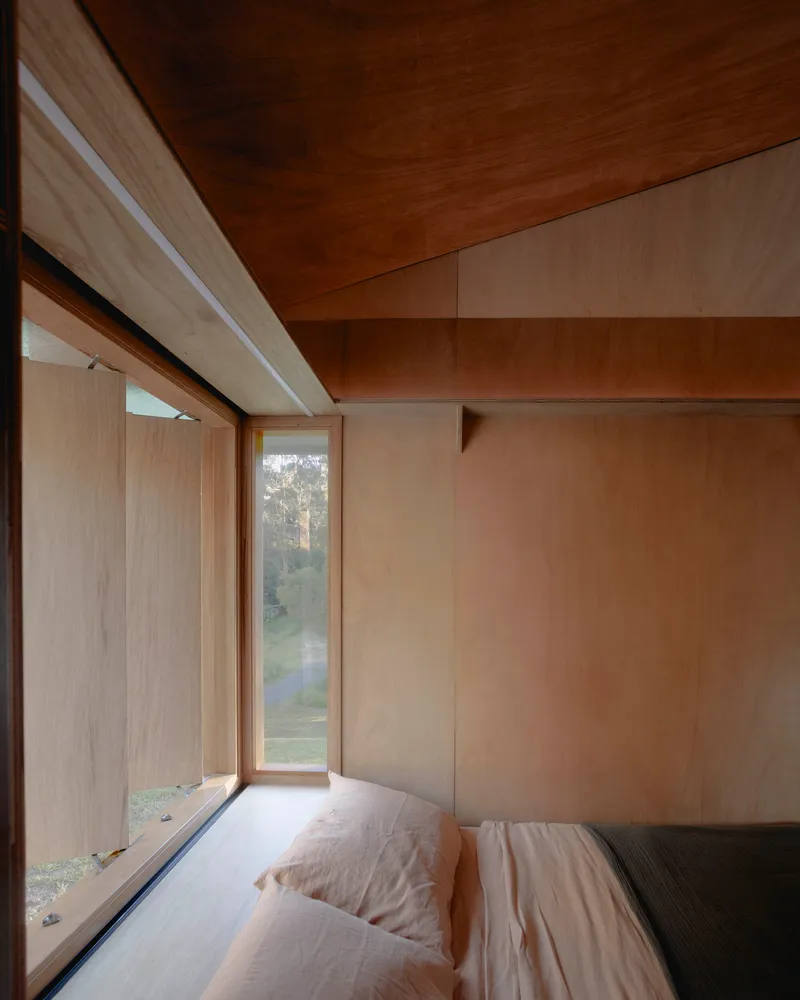
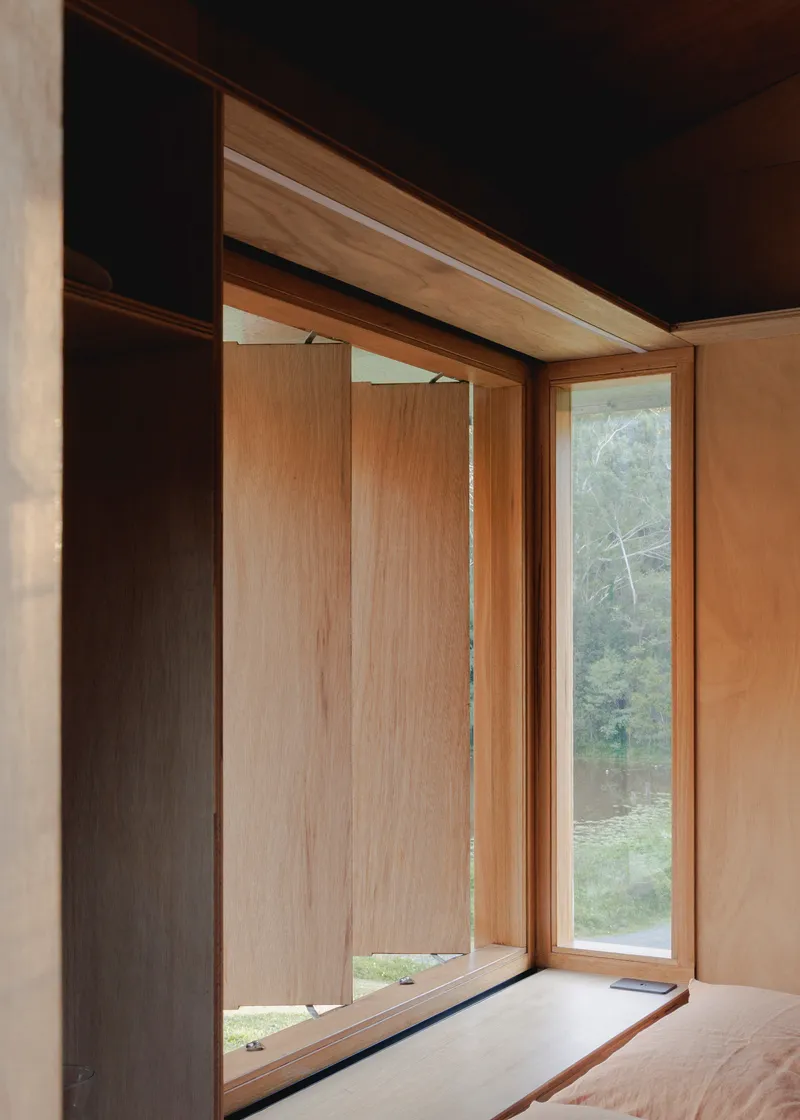
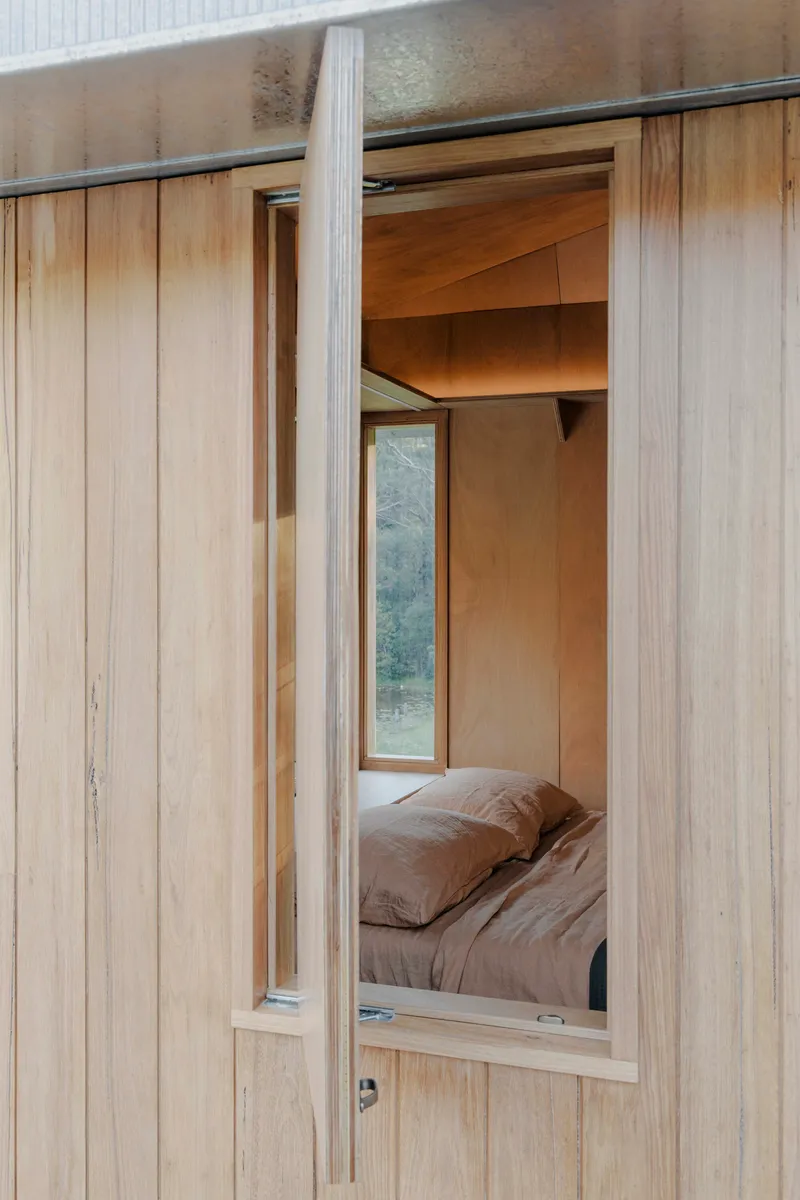
The bedroom occupies one end of the plan, anchored by a low bed beneath three vertical timber panels that open to the trees. Pryor has pushed the sleeping zone into a corner where two walls of plywood meet a low window seat overlooking the landscape, creating a nook that feels protected without being enclosed. The proportions recall a Japanese alcove: horizontal, intimate, oriented toward a single framed view.
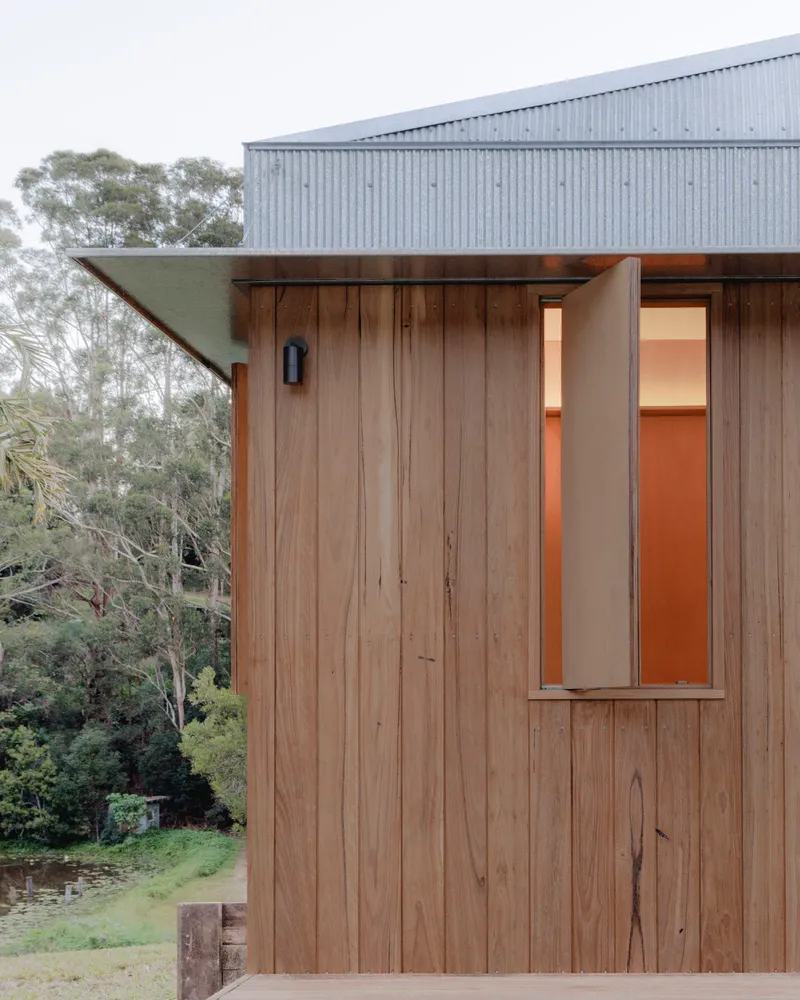
Corner window details, where the timber frame meets plywood reveals, show the level of care at work here. The joints are tight, the geometry is precise, and the material warmth softens what could easily become clinical minimalism. It is the kind of detail that separates a considered architectural project from a prefab kit, and it suggests that Pryor sees the tiny house typology as a design problem worth taking seriously.
Plans and Drawings
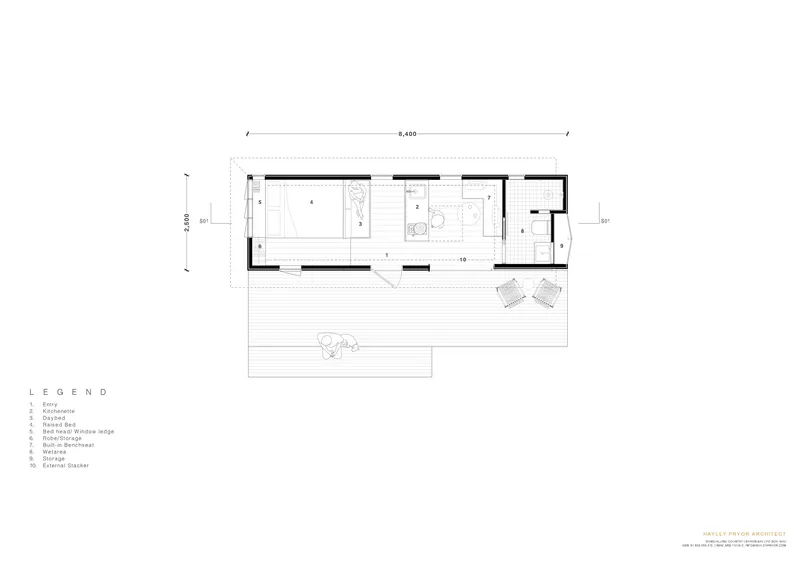
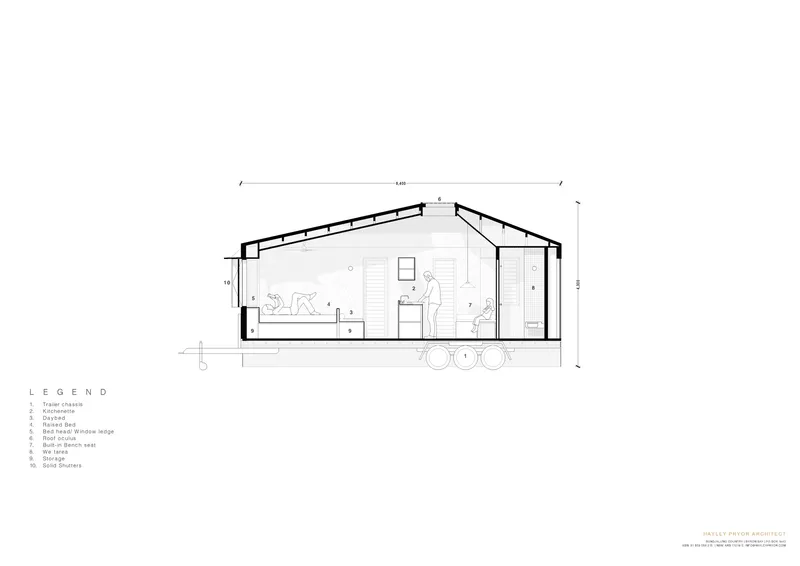
The floor plan confirms what the photographs suggest: a simple rectangle divided into sleeping, living, and service zones, with the deck extending the social space outward. There is no wasted circulation. The section drawing is more revealing still, showing the pitched roof creating a generous ceiling height at the ridge line and the entire volume sitting on a wheeled chassis. That last detail reframes the project. The OCULUS is not a permanent structure; it is a transportable room that can serve as a hinterland retreat, a backyard studio, or a guest suite, moving from site to site as need dictates.
The section also clarifies how Pryor handles the roof: the pitch is steep enough to generate a sense of volume inside the gable but stops short of creating an unusable attic void. Every cubic centimeter of interior space is inhabited, a discipline that distinguishes good compact design from small-house novelty.
Why This Project Matters
The tiny house movement has produced plenty of Instagram-ready capsules, but very few buildings that feel like architecture. The OCULUS is one of them. By committing to a limited palette of timber, plywood, and corrugated metal, and by treating every opening and joint as a design problem, Hayley Pryor elevates a compact dwelling into something genuinely dignified. There is no trick furniture, no transformer wall, no gimmick. The house works because the plan is clear, the proportions are right, and the materials are allowed to be themselves.
For architects interested in affordability, portability, or simply doing more with less, The OCULUS is worth studying. It demonstrates that the tiny house is not inherently an anti-architectural proposition; it is a brief that rewards the same spatial intelligence and material discipline demanded by any other residential project. In the Byron Bay hinterland, surrounded by eucalyptus and morning mist, this small pavilion makes a large point about what good design can accomplish within tight constraints.
The OCULUS by Hayley Pryor Architect, Byron Bay, Australia, completed 2025. Photography by Tim Clark.
About the Studio
Share Your Own Work on uni.xyz
If projects like this are the kind of work you want to make, uni.xyz is a place to publish your own, find collaborators, and enter design competitions.


Popular Articles
Popular articles from the community


Conexión: Biophilic Design Reimagines High-Rise Living in Hong Kong
Conexión reimagines high-rise living in Hong Kong through biophilic design, green facades, shared spaces, daylight, water and nature within.

Hill & Cross Opera: Sculptural Opera House Architecture Shaped by Tallinn’s Landscape and Identity
Hill & Cross Opera reimagines opera house architecture in Tallinn through its sculptural hill, civic plaza, glass wave and a luminous cross.

The Musturak Paradise: Senior Living Architecture for a Connected Future in Temara, Morocco
The Musturak Paradise reimagines senior living architecture in Temara via private homes, social spaces, culture, community, and shared care.

Play: Fragments of Their World
Familiar architecture becomes modular playground design, creating safe spaces where displaced children can learn, connect, imagine and play.

Similar Reads
You might also enjoy these articles

Bao Huynh Watercolor Atelier: A Serene Art Retreat in Hội An
Bao Huynh Watercolor Atelier in Hội An blends multifunctional art spaces, sustainable design, local materials, and family-friendly living in a serene environment.

Atelier Macri Concept Store Interior Design by CASE-REAL
Atelier Macri store features a "ko" counter, walnut wood details, cork displays, blending retail, gallery, and seamless customer experiences.

Manuel Vargas Izquierdo Stadium and High-Performance Sports Center: Architectural Excellence in Jalpa de Méndez
The Manuel Vargas Izquierdo Stadium blends sustainable design, inclusive sports facilities, and cultural-inspired architecture, revitalizing Jalpa de Méndez’s public spaces.

KAKR Buluh Awar Hall: Revitalizing Community and Ecology Through Bamboo Architecture
Community built bamboo hall revitalizes Buluh Awar village, empowering youth, restoring ecology, celebrating vernacular craftsmanship through sustainable architecture and culture.

Explore Residential Building Competitions
Discover active competitions in this discipline

Challenge to design a portable theatre

Challenge to design a portable music platform

Challenge to design an open learning module for the elderly

Challenge to design mud housing for contemporary communities
Comments (0)
Please login or sign up to add comments
No comments yet. Be the first to comment!