
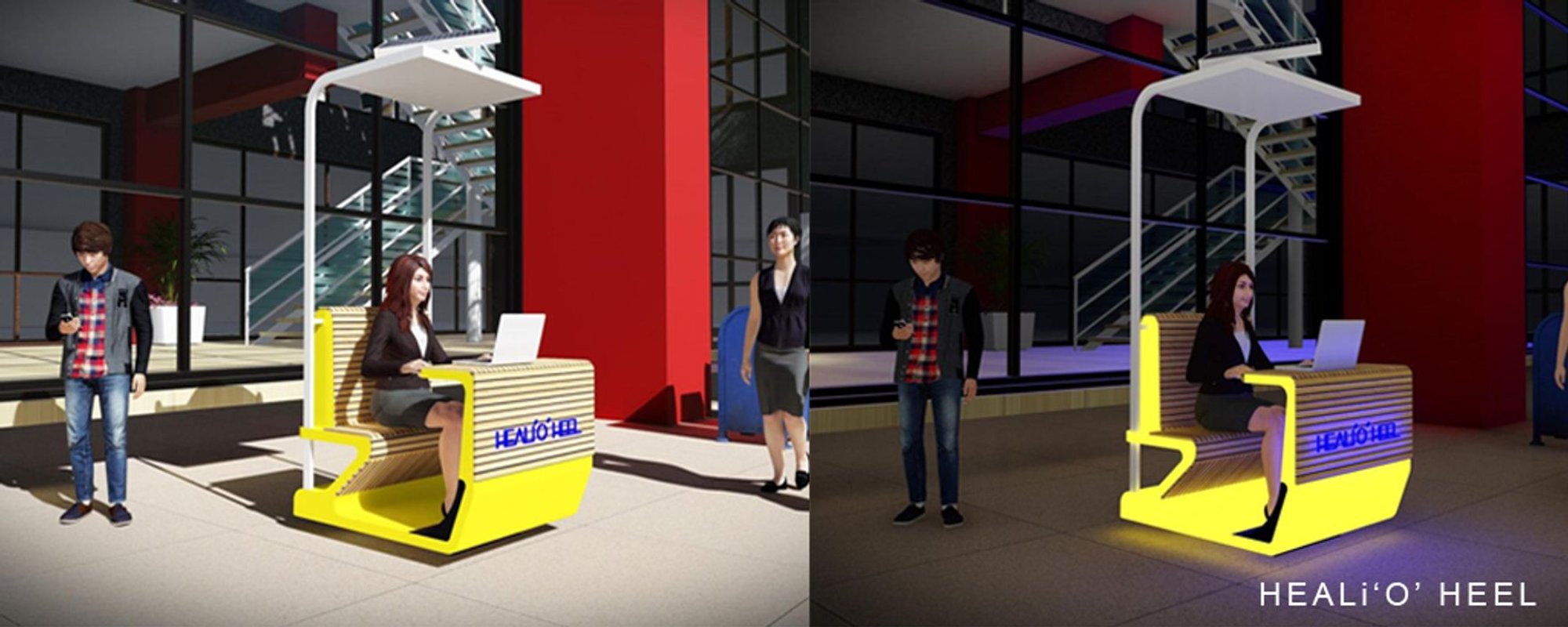
HEALi'O' HEEL: Solar-Powered Street Furniture That Massages Your Feet
A modular urban seat integrates foot massagers, workstations, and solar panels into a self-sustaining public furniture unit.

A public bench that charges your laptop, massages your feet, and powers itself entirely through solar energy sounds like a design fiction prompt. HEALi'O' HEEL takes that prompt seriously. The project reimagines urban furniture as a self-sustaining micro-infrastructure: a canopy-shaded seating unit that combines rest, work, wellness, and renewable energy generation into a single modular installation. It argues, convincingly, that the humble street bench is one of the most underutilized platforms for sustainable urban intervention.
The project was designed by Jaykrishnan Pillai, Pratham Pincha, Gargi Chati, and Stuti Vij. Their design packs an ambitious programme into a compact footprint: resting spaces for tired pedestrians, integrated foot massagers, workstation desks, and device charging points, all powered by an overhead solar panel array. The name itself hints at the core philosophy: architecture that heals.
A Canopy That Generates, Not Just Shelters
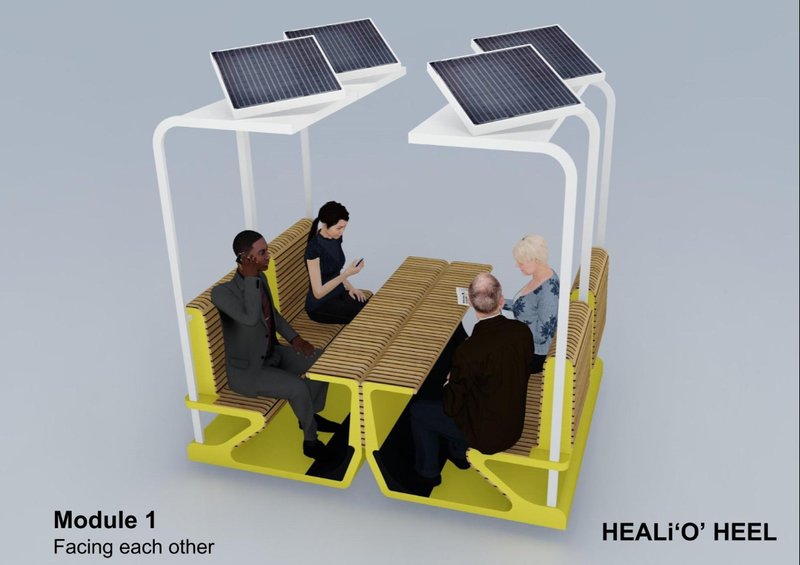
The most immediately legible move in HEALi'O' HEEL is its overhead canopy. Rather than functioning purely as shade or rain cover, the canopy doubles as a solar energy harvester. Embedded photovoltaic panels generate clean power that feeds directly into the unit's electrical systems: the charging sockets for laptops and mobile devices, and the foot massagers built into the seat structure. The result is a fully self-sustaining loop where the furniture produces everything it consumes. No grid connection, no external power source. The rendering shows four users gathered around a central table beneath this active canopy, yellow ribbed seating curving around them in a configuration that encourages lingering rather than passing through.
Recycled Wood and Fiberglass: Material Logic for Public Use
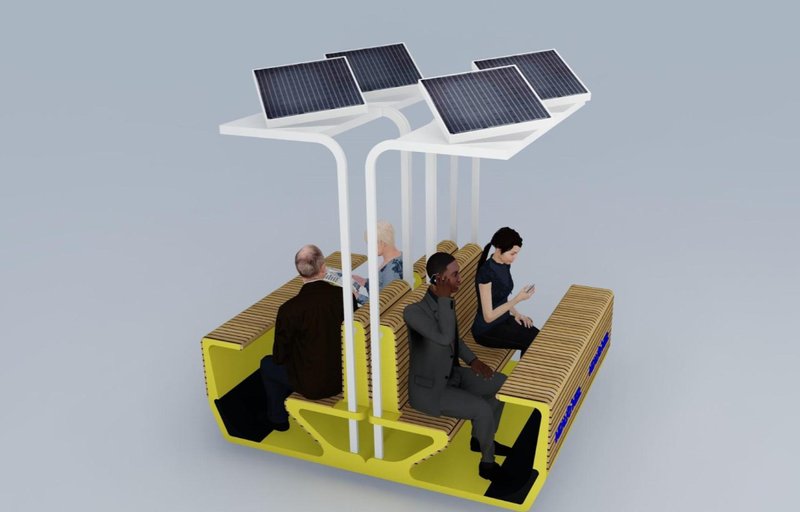
The angled view reveals the structural language more clearly. A white tubular frame carries the solar array overhead while supporting the seating and desk surfaces below. The designers chose recycled wooden slats for the seating and desk planes, lending warmth and tactile comfort to what could easily have been a cold, industrial object. Structural integrity comes from polyurethane and fiberglass components, materials selected for their strength, weather resistance, and longevity in exposed outdoor conditions. The material palette is deliberately restrained: the yellow slats read as inviting against the clean white frame, while the dark solar panels above signal the unit's technological ambition without overpowering its human scale.
This material logic extends to the design's modularity. The team developed two distinct configurations. Module 1 seats occupants facing each other around a shared surface, optimized for conversation and collaborative work. Module 2 arranges seating back-to-back, offering privacy and individual focus. Both modules share the same structural system and component library, meaning they can be deployed interchangeably across different urban contexts, from high-traffic plazas to quieter park edges, without requiring bespoke fabrication for each site.
Scaled for the Sidewalk, Not the Showroom
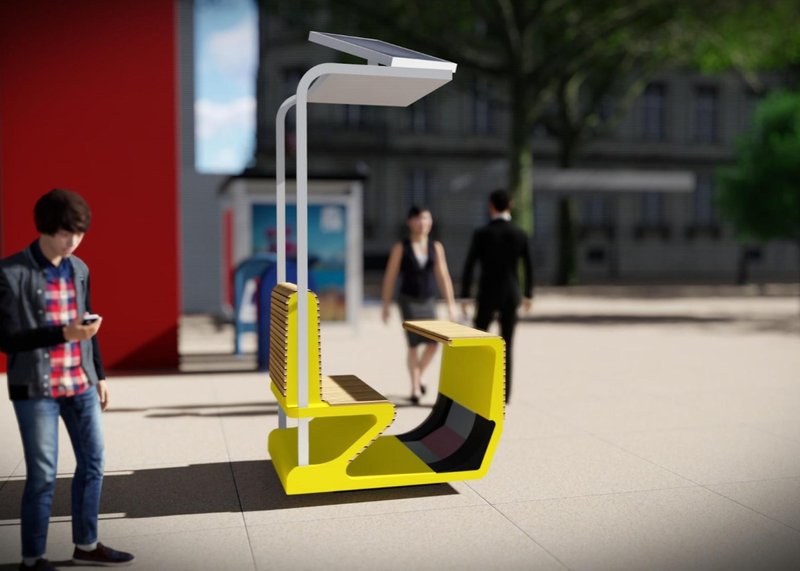
The street-level rendering is the most revealing image of the three. It places a single HEALi'O' HEEL unit on an actual sidewalk with pedestrians walking past, and the proportions hold up. The canopy rises high enough to feel open and accessible rather than claustrophobic, while the yellow bench beneath it reads as a clear invitation to sit. This is where the project's ambition becomes tangible: it does not exist as an isolated pavilion in a park but as a repeatable element in everyday streetscape infrastructure. The foot massager and charging features are not visible in the rendering, which is actually a strength. They are integrated into the seat structure rather than bolted on as afterthoughts, keeping the formal language clean.
Why This Project Matters
Urban furniture design often falls into one of two traps: it is either purely formal, prioritizing sculptural ambition over function, or it is purely utilitarian, treating the bench as nothing more than a surface to sit on. HEALi'O' HEEL sidesteps both by treating the street bench as a genuine piece of infrastructure with multiple performance criteria. It generates energy. It supports physical wellness. It enables work. And it does all of this through a modular system that can adapt to different social configurations and urban conditions.
The project by Pillai, Pincha, Chati, and Vij is a compelling demonstration that sustainability in architecture does not have to operate at the scale of a building or a district. Sometimes the most effective intervention is the smallest one, repeated across a city. If every public bench harvested solar energy and offered the kind of programmatic density packed into HEALi'O' HEEL, the cumulative impact on urban livability and energy consumption would be significant. That is the real argument this project makes, and it makes it well.
View the Full Project
About the Designers
Designers: Jaykrishnan Pillai, Pratham Pincha, Gargi Chati, Stuti Vij
Enter a Design Competition on uni.xyz
uni.xyz runs architecture and design competitions year-round that reward proposals with spatial conviction and real site intelligence.
Project credits: HEALi’O’ HEEL by Jaykrishnan Pillai, Pratham Pincha, Gargi Chati, Stuti Vij.




Popular Articles
Popular articles from the community

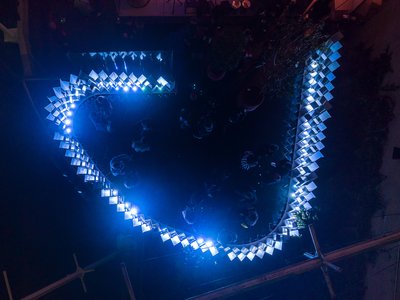
Rojkind Arquitectos and Think Parametric Build a Glueless Pavilion from 67 Interlocking Panels
A serpentine fiber-cement installation in Chapultepec Park celebrates a decade of architectural media in Mexico City.
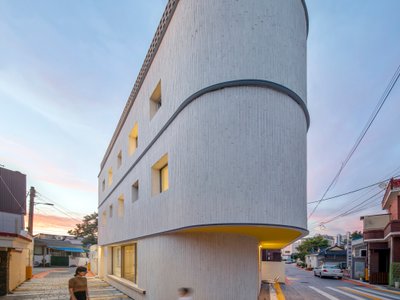
YOAP Architects Round a Corner in Yeongcheon with a Cylindrical Community Hub
A 197-square-meter brick and ribbed-clad tower turns a forgotten alley corner in South Korea into a public garden with a low threshold.
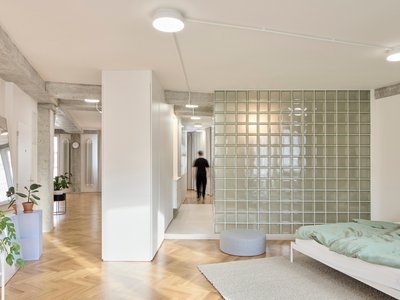
RDTH architekti Rips Out Nearly Every Wall in a Prague Apartment and Replaces Them with Furniture
A 101-square-meter post-war flat in Prague trades rigid partitions for a single rotated furniture block, curtains, and glass concrete.
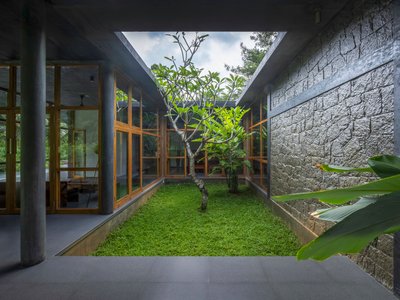
3dor Concepts Wraps a Kerala Home in Mirrored Concrete Arcs Around a Courtyard Tree
In the Western Ghats foothills of Thamarassery, a 270 m² single-story house uses two curved volumes to frame nature as its center.


Similar Reads
You might also enjoy these articles


Mechanism of Memories: Adaptive Architecture Reimagines Offshore Structures as Living Cultural Machines
Floating adaptive architecture transforms abandoned offshore structures into cultural spaces that preserve memory, habitation, and human connection.

Wildlife Rehabilitation Architecture in Australia: A Regenerative Sanctuary for Koalas by Philip Skein and Keegan Mayber
A regenerative wildlife sanctuary in Queensland redefines sustainable architecture through habitat restoration, healing, and ecological awareness.
The Interfusion: Mobile Performance Architecture Reconnecting Art and Public Space
A mobile performance architecture project transforming Madrid’s streets into inclusive cultural spaces through adaptive urban design.
Biophilic Architecture and Regenerative Stadium Design: Biophilia Lagos by Rachel George
A regenerative stadium in Lagos transforms landfill into a living ecosystem through biophilic architecture, waste reuse, and environmental healing.

Explore Product Design Competitions
Discover active competitions in this discipline




The Global Benchmark for Architecture Dissertation Awards


Challenge to merge furniture with learning


Design challenge to equip cities with modern furniture


Competition to design a workstation for architects
Comments (0)
Please login or sign up to add comments
No comments yet. Be the first to comment!