
Heatherwick Studio Shapes Seoul's Daegyo Apartments into Mountain-Silhouette Towers above Sunken Gardens
A community-driven redevelopment near the Han River replaces 576 aging units with 900 homes lifted on organic columns over public landscapes.


Seoul's Yeouido district sits on an island in the Han River, hemmed by expressways and packed with financial towers, yet the residential blocks that once filled its interior have aged past repair. The Daegyo Apartments, completed in 1975 with 576 units, are among them. Heatherwick Studio's proposal, presented to the Yeouido Daegyo Residents' Union in February 2026, replaces those units with roughly 900 new homes spread across four ribbed towers whose rooflines rise and fall like the mountain ridges that ring Seoul. It is the studio's first residential project in South Korea, and it arrives with a mandate shaped not just by the architect's instincts but by the explicit preferences of over 600 union members and a broader survey of 1,000 Seoul residents.
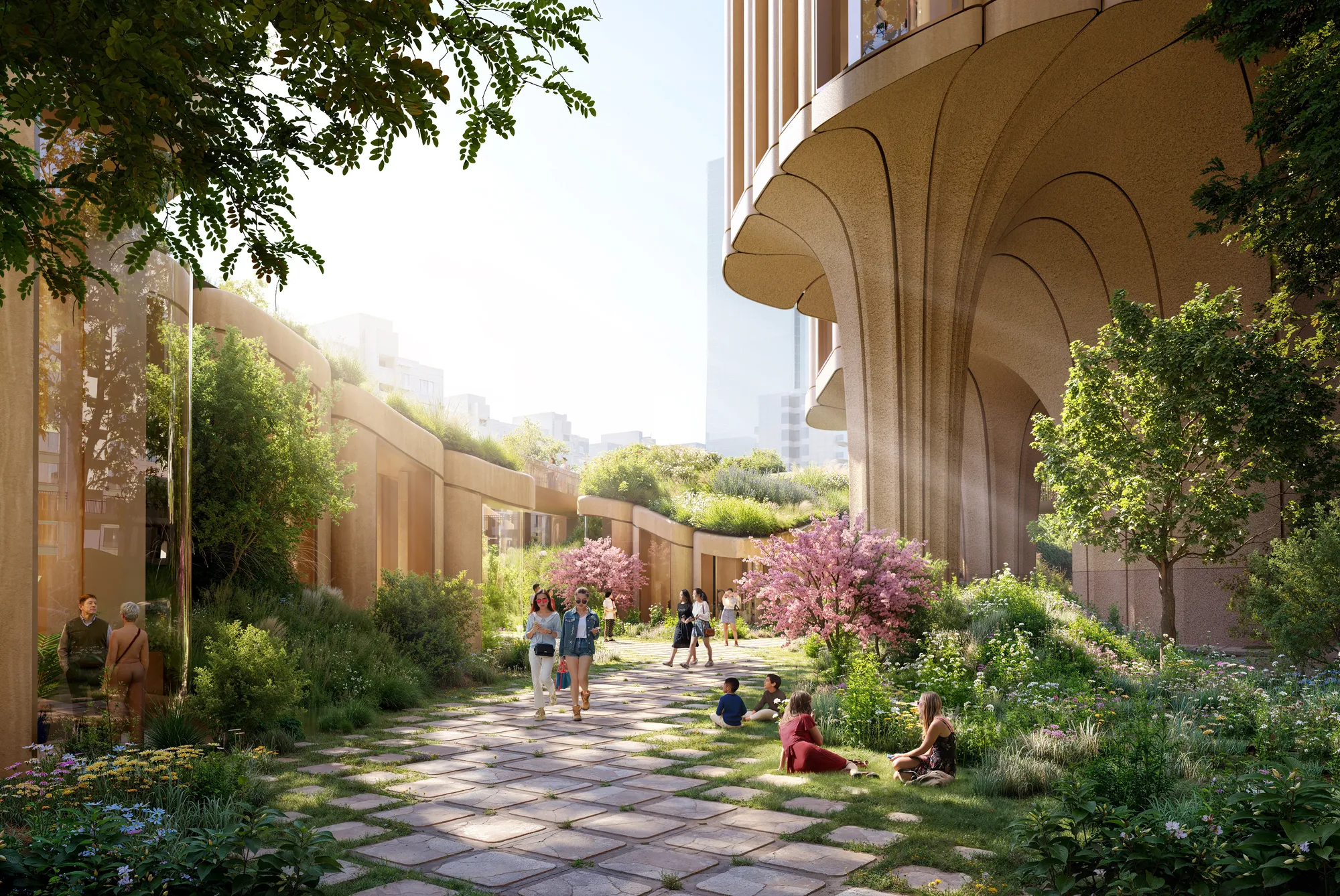
What makes the scheme worth paying attention to is not the tower count or the headline number of homes. It is the argument the project makes about the ground plane. Most Korean apartment complexes treat the ground as a parking deck or a residual gap between slabs. Here, the towers are lifted on clusters of organic structural columns to create a continuous landscape of stepped gardens, sunken courtyards, shaded walkways, and community programs that buffer residents from the surrounding traffic. The ground is not leftover space; it is the central amenity.
A Skyline That Remembers Mountains
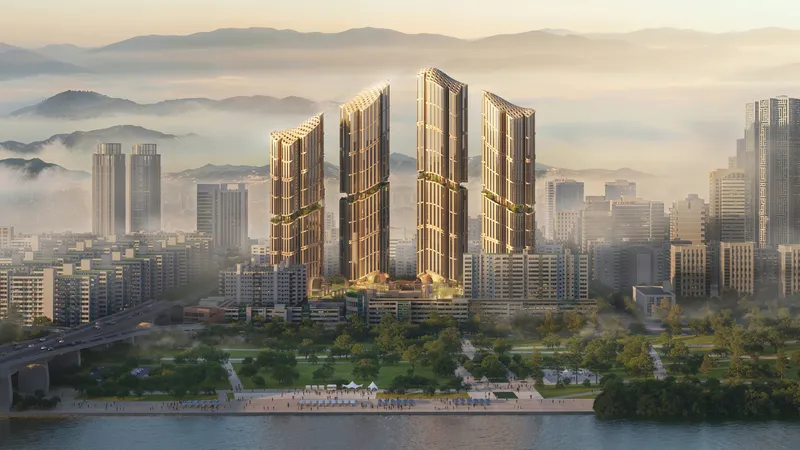

The five ribbed volumes do not terminate in the flat rooflines typical of Korean apartment blocks. Instead, each tower undulates gently at the top, producing a collective silhouette that reads as a chain of peaks against the sky. Seen from the Han River at dawn, the towers merge with the misty ridgelines of Bukhansan and Gwanaksan beyond. The gesture is topographic rather than decorative: these profiles are shaped by the natural horizon they sit against, not by a parametric algorithm applied for visual novelty.
Alternating bands of glass and solid facade panels reinforce the vertical rhythm while controlling solar gain on the south-facing river side. The ribbing gives each tower a tactile, almost textile quality that distances the project from the relentless smoothness of Seoul's speculative residential towers. Heatherwick Studio's 2025 Humanise Campaign, which surveyed Seoulites about what they actually want from housing, found a strong preference for distinctive, textured surfaces. The facade strategy is a direct response.
Lifting the Towers, Liberating the Ground
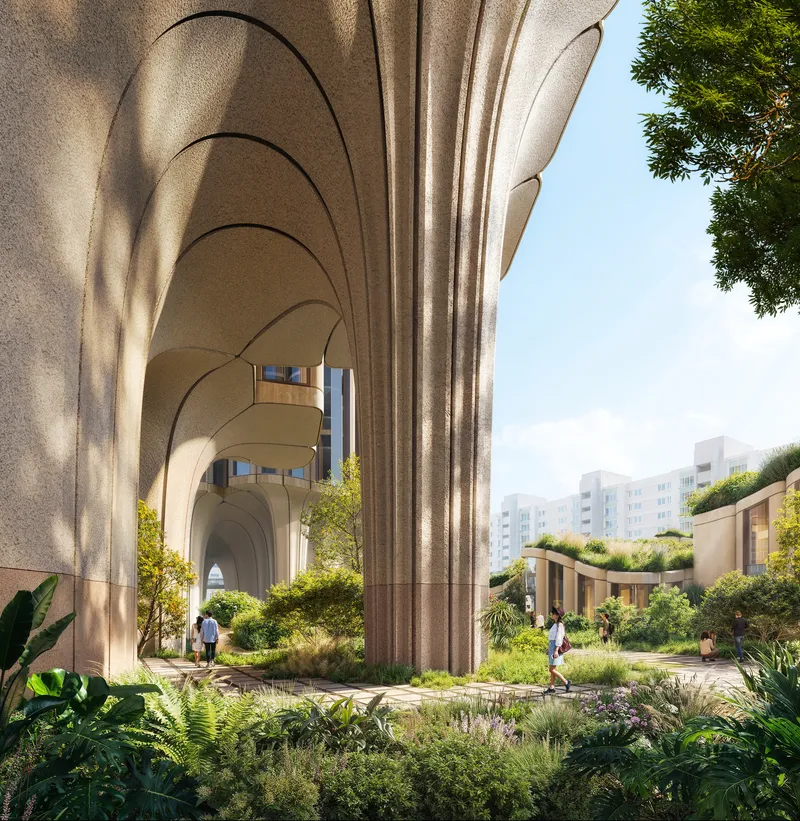
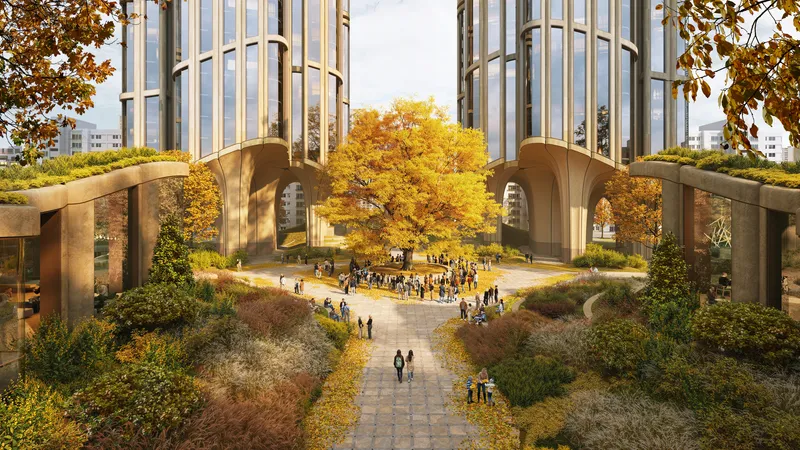

The most consequential design decision here happens at the base. Organic, tree-like concrete columns carry the towers above a generous ground-floor datum, opening the site to continuous pedestrian movement and public landscape. The arched undercrofts formed by these columns create sheltered passages that feel more like the vaulted arcades of a European city than the pilotis of a modernist slab. Residents walk beneath the buildings rather than around them.
Lifting portions of the site edges also serves as a traffic buffer. Yeouido's perimeter roads carry heavy vehicle loads; by raising the building mass along these edges and sinking courtyards inward, the scheme shields its interior gardens from noise and exhaust without resorting to the blank perimeter walls that plague so many Korean apartment complexes. The strategy trades defensive enclosure for topographic manipulation.
A Ground Plane Designed for Staying
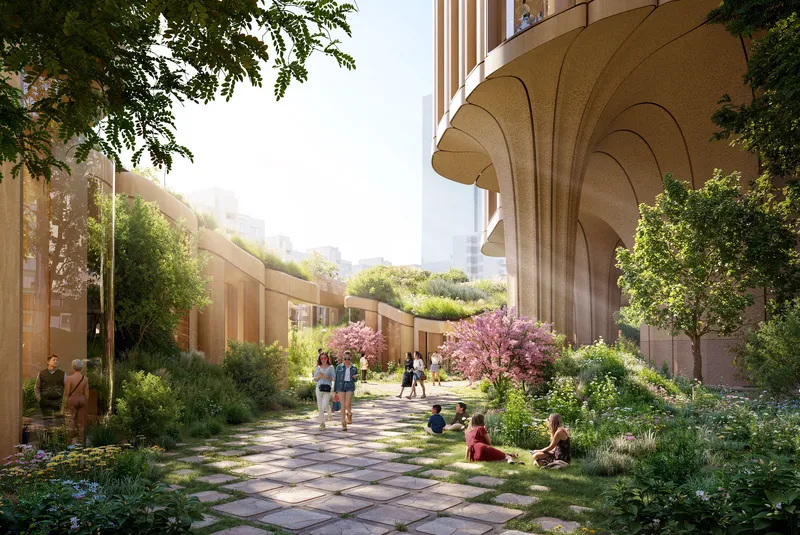

Korean apartment redevelopments routinely promise landscaped courtyards but deliver thin strips of grass between parking ramps. The Daegyo scheme pushes further: terraced gardens step down to sunken courtyards, cherry trees bloom under vaulted concrete canopies, and curved walkways with timber handrails thread through arched openings that admit dappled light. The landscape is not ornamental overlay. It is structured by the same vaulted geometries that define the towers above, creating a continuity between architecture and ground.
Joggers, strollers, and seated residents appear in the renderings not as scale figures but as evidence of an argument: the ground plane should sustain long occupation, not just transit. Shaded alcoves, paved clearings, and planted edges are sized for pausing. The community programs, including children's play areas, sports amenities, and welfare services for senior citizens, are woven into this landscape rather than boxed into a separate podium building.
Communal Life at Every Level
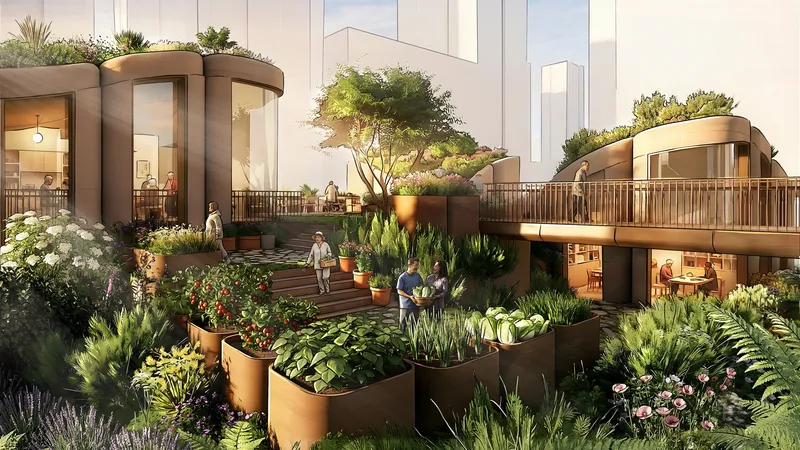

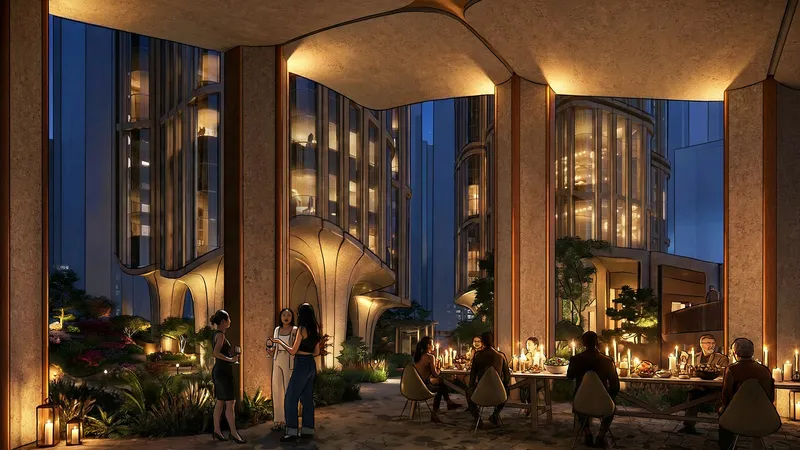
The sky garden at the tower tops extends the community logic upward. Curved planters filled with vegetables and grasses occupy rooftop terraces where residents gather informally, framed by the surrounding high-rises. One level down, outdoor decks with wooden slats and planted edges give children room to play within sight of glass-fronted residential units. In the evening, arched canopies shelter terrace dining with potted plants and candlelit tables, transforming the building's perimeter into something closer to a neighborhood street than a hallway.
These shared spaces matter because they counter a well-documented weakness of Korean apartment culture: the privatization of domestic life behind identical doors on identical corridors. Heatherwick Studio's approach distributes social space vertically, giving residents reasons to leave their units and encounter neighbors without descending to the street. Whether these spaces will function as intended depends on management and culture, but the architectural commitment is clear.
A Survey-Driven Design Process
The project's backstory is almost as interesting as its form. More than 600 members of the Daegyo Residents' Union provided input that shaped the program, and the studio's broader Humanise Campaign survey of 1,000 Seoul residents informed decisions about texture, distinctiveness, and the desire for homes that do not look like every other apartment block in the city. Thomas Heatherwick presented the design directly to the union in February 2026, an unusual step that signals the studio's intent to treat the community as a genuine client rather than a passive beneficiary.
This consultative approach does not guarantee a better building, but it does change the terms of the conversation. Korean apartment redevelopment is often driven by construction companies maximizing floor area ratio. When residents have a voice in shaping the architecture, priorities shift toward livability, identity, and shared amenity. Whether the final built project preserves these ambitions through the long gauntlet of approvals and value engineering remains to be seen.
Why This Project Matters
Seoul is in the middle of a massive wave of apartment redevelopment. Thousands of complexes built in the 1970s and 1980s are being demolished and rebuilt at higher densities, and the default outcome is a forest of identical glass towers on a parking podium. The Daegyo proposal challenges that default at the level of form, ground strategy, and process. Its mountain-inspired rooflines, vaulted ground plane, and distributed community spaces propose an alternative that takes its cues from the city's geography and the residents' stated desires rather than from a developer's spreadsheet.
The test will come in execution. Heatherwick Studio has committed to involvement from concept through completion, which is encouraging but not a guarantee that the textured facades, the sunken courtyards, and the rooftop gardens will survive the pressures of cost, code, and market expectation. If even half of what is shown in these renderings gets built, it will mark a significant step for residential design in Seoul and for the idea that apartment redevelopment can produce neighborhoods, not just units.
Daegyo Apartments Redevelopment, designed by Heatherwick Studio, Yeouido, Seoul, South Korea. Approximately 900 homes across four residential buildings. Design presented 2026.
About the Studio
Share Your Own Work on uni.xyz
If projects like this are the kind of work you want to make, uni.xyz is a place to publish your own, find collaborators, and enter design competitions.



Popular Articles
Popular articles from the community


AL-JANNAH: Sustainable Architecture and Permaculture for Afghan Widows
AL-JANNAH uses sustainable architecture and permaculture to create resilient oasis of housing, learning, work and renewal for Afghan widows.

Co-life: Sustainable Architecture for Age-Friendly Community Living
Co-life reimagines sustainable architecture for seniors through courtyards, rammed earth, shared gardens, and spaces designed for belonging.

The Earth Pod: 3D Printed Homes for Resilient Refugee Communities
The Earth Pod reimagines refugee housing through 3D printed homes made from clay, combining resilience, self-sufficiency, and rapid shelter.
EW PARK: Sustainable Architecture Reimagines the Future of Urban Parking
EW PARK reimagines city parking as a modular wooden tower combining automation, solar energy, electric mobility, and adaptable urban design.


Similar Reads
You might also enjoy these articles

Bao Huynh Watercolor Atelier: A Serene Art Retreat in Hội An
Bao Huynh Watercolor Atelier in Hội An blends multifunctional art spaces, sustainable design, local materials, and family-friendly living in a serene environment.

Atelier Macri Concept Store Interior Design by CASE-REAL
Atelier Macri store features a "ko" counter, walnut wood details, cork displays, blending retail, gallery, and seamless customer experiences.

Manuel Vargas Izquierdo Stadium and High-Performance Sports Center: Architectural Excellence in Jalpa de Méndez
The Manuel Vargas Izquierdo Stadium blends sustainable design, inclusive sports facilities, and cultural-inspired architecture, revitalizing Jalpa de Méndez’s public spaces.

KAKR Buluh Awar Hall: Revitalizing Community and Ecology Through Bamboo Architecture
Community built bamboo hall revitalizes Buluh Awar village, empowering youth, restoring ecology, celebrating vernacular craftsmanship through sustainable architecture and culture.


Comments (0)
Please login or sign up to add comments
No comments yet. Be the first to comment!