

The New Komma Grafts a Concrete Extension onto a 1775 Farmhouse in the South Tyrolean Vineyards
At the Ausserrothhof in Schenna, bush-hammered concrete, local larch, and frameless glass negotiate a careful truce between heritage and modern life.


Heritage renovation in the Alps tends to fall into two camps: the timid restoration that embalms a building in amber, or the loud contemporary insertion that treats the old fabric as a prop. At the Ausserrothhof in Schenna, The New Komma sidesteps both traps. Led by architect Markus Klotzner, the studio has added a rectilinear concrete and glass volume to a listed farmhouse dating to 1775, and the result reads neither as pastiche nor as provocation. It reads as a farmstead that has simply grown another limb, rooted in the same slope that feeds its Pinot Blanc vines.
What makes the project genuinely interesting is its material strategy. Rather than defaulting to weathering steel or blackened timber, the usual shorthand for "contemporary meets rustic," The New Komma developed a bush-hammered exposed concrete with lime aggregates that directly references the mineral quality of 17th-century lime plaster. The aggregate is visible; the texture is rough and geological. Paired with local larch cladding, the new volume picks up the material DNA of its host without mimicking its forms. The extension sits partially submerged into the hillside, its green roof dissolving into the meadow when viewed from above, while the original stone farmhouse retains its skyline prominence. It is a hierarchy established through topography, not deference.
Slope as Strategy
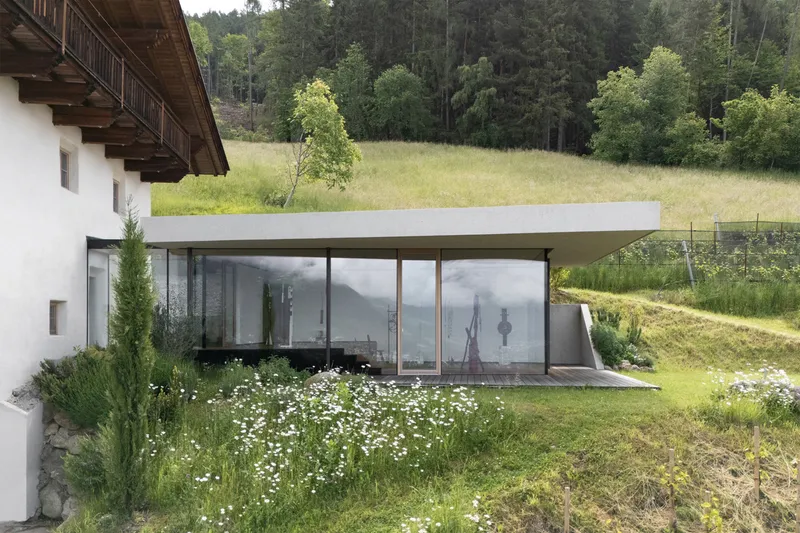
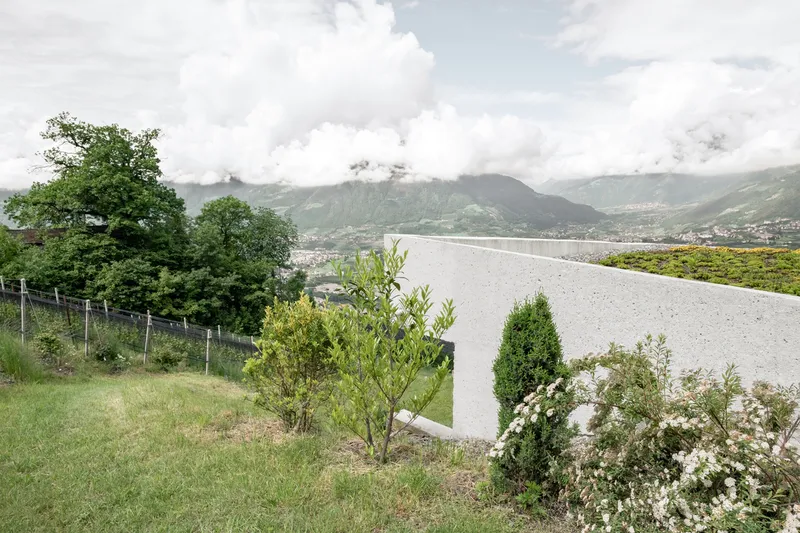
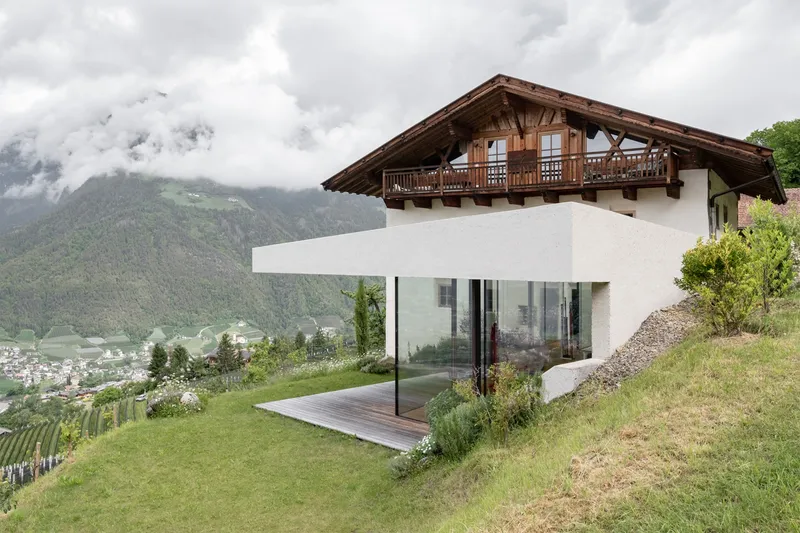
The extension does not stand beside the farmhouse so much as it emerges below it. Set into the slope at a slight offset, its flat concrete roof barely crests the grade line, allowing wildflowers and grasses to colonize the surface. From the valley, the new volume registers as a horizontal plinth anchoring the traditional gabled mass above. From uphill, it nearly vanishes. The architects exploit the section, not just the plan, to resolve the tension between old and new.
The site itself is a working vineyard, and positioning the extension within the fall of the terrain means the agricultural landscape flows uninterrupted around the building. A cantilevered concrete roof extends outward to frame valley views toward Merano, creating a covered outdoor threshold that belongs equally to the house and the hillside.
The Glass Joint
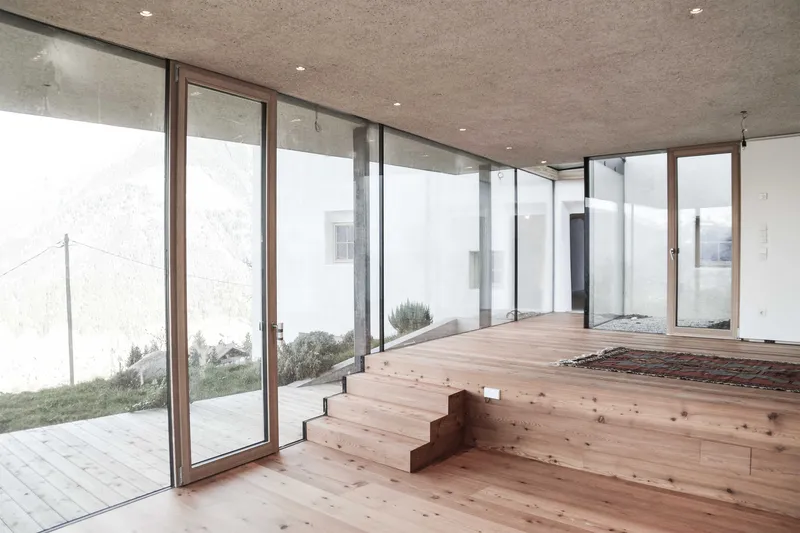
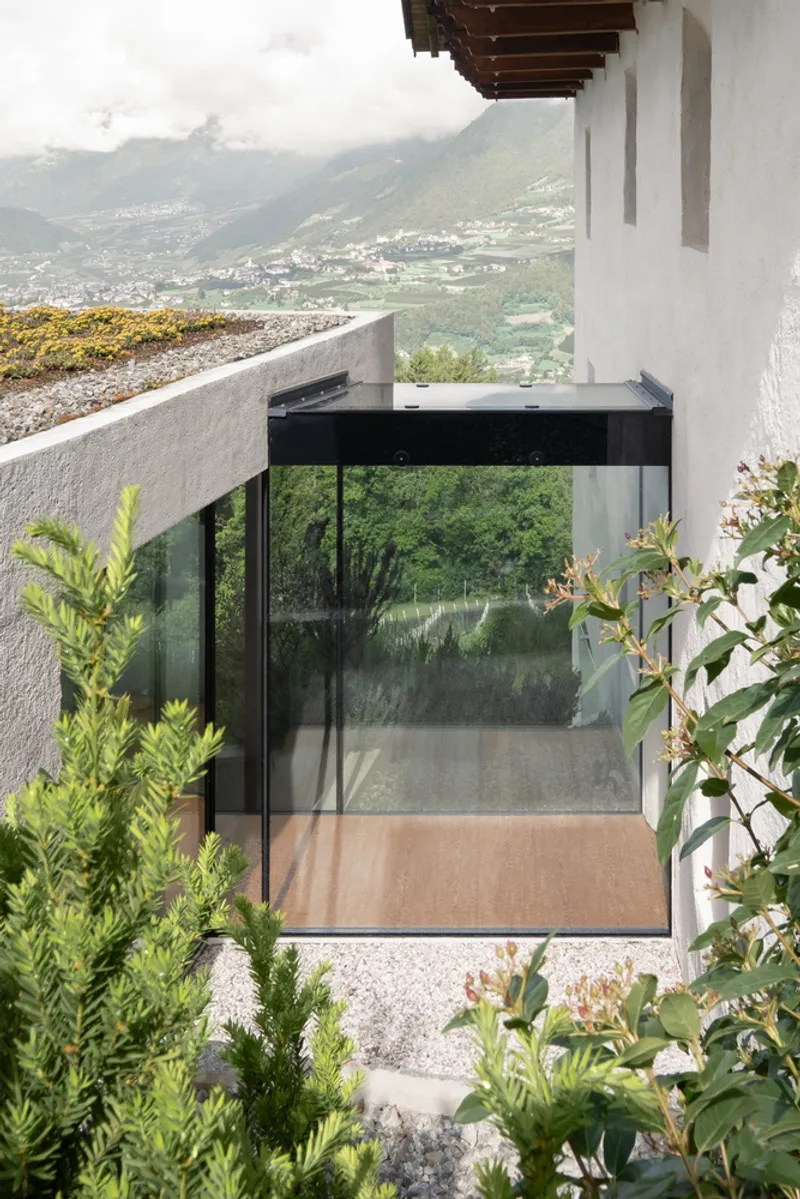
Where the old stone walls meet the new concrete, a glass link acts as a deliberate pause. It is narrow enough to register as a joint rather than a room, transparent enough to let both structures breathe on their own terms. Gravel courtyards and planted beds line this seam, drawing exterior light deep into the transition zone and making the threshold between centuries feel generous rather than abrupt.
The glazing system is frameless in key locations, which lets the landscape operate as a continuous backdrop. Sliding glass doors open onto timber decks, collapsing the boundary between interior and vineyard. It is a controlled dissolve: stone walls give way to plaster, plaster gives way to glass, glass gives way to open air.
Inside the Old Walls
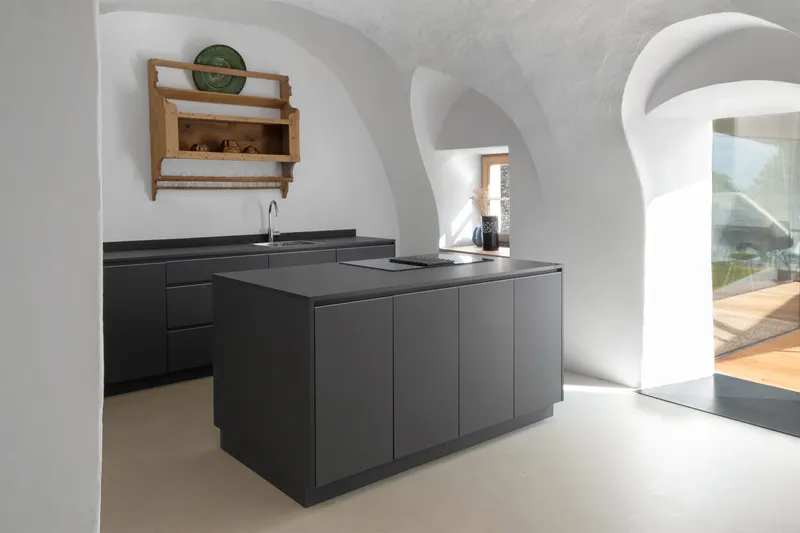
The original farmhouse interiors were not merely conserved; they were excavated. The soot-blackened smoke kitchen, its barrel-vaulted ceiling darkened by centuries of open flame, has been left in its atmospheric state beneath freshly whitened arches. A black kitchen island sits beneath the vaults, a contemporary object placed with surgical care in a space that predates it by several lifetimes. The contrast is stark, and it works because the architects resist the urge to soften it.
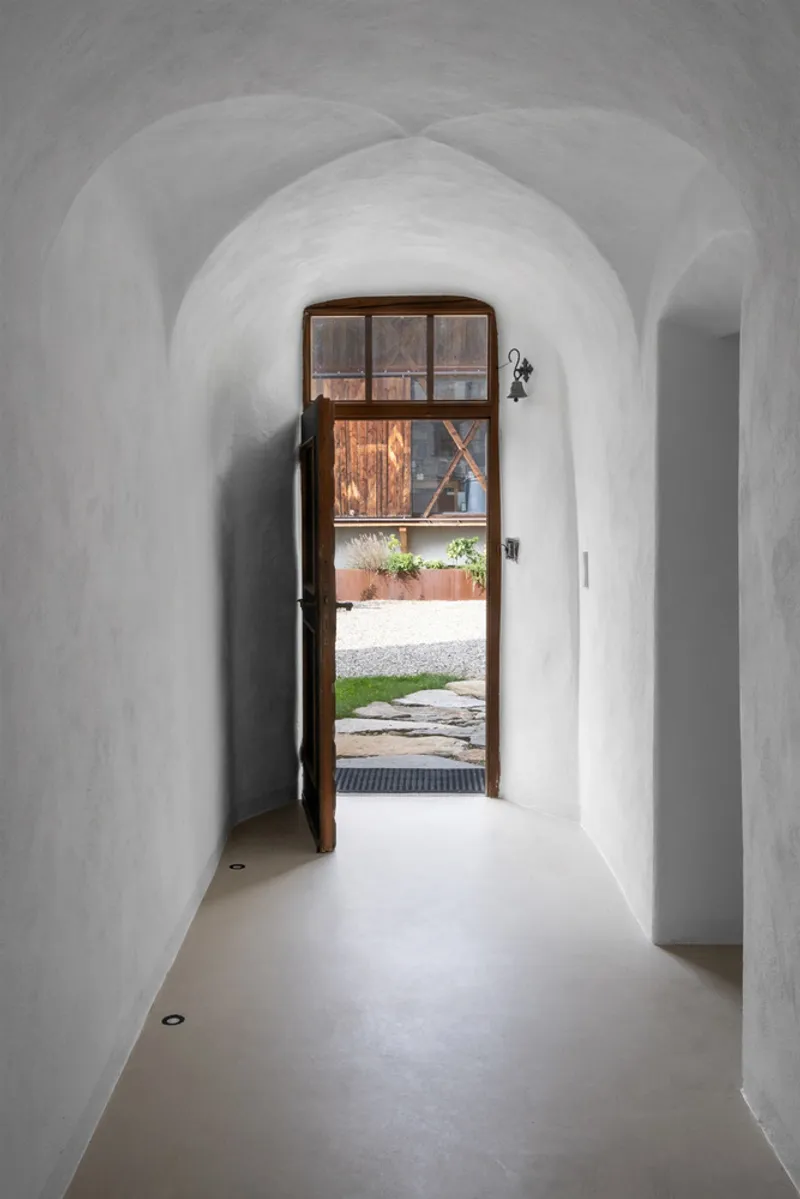
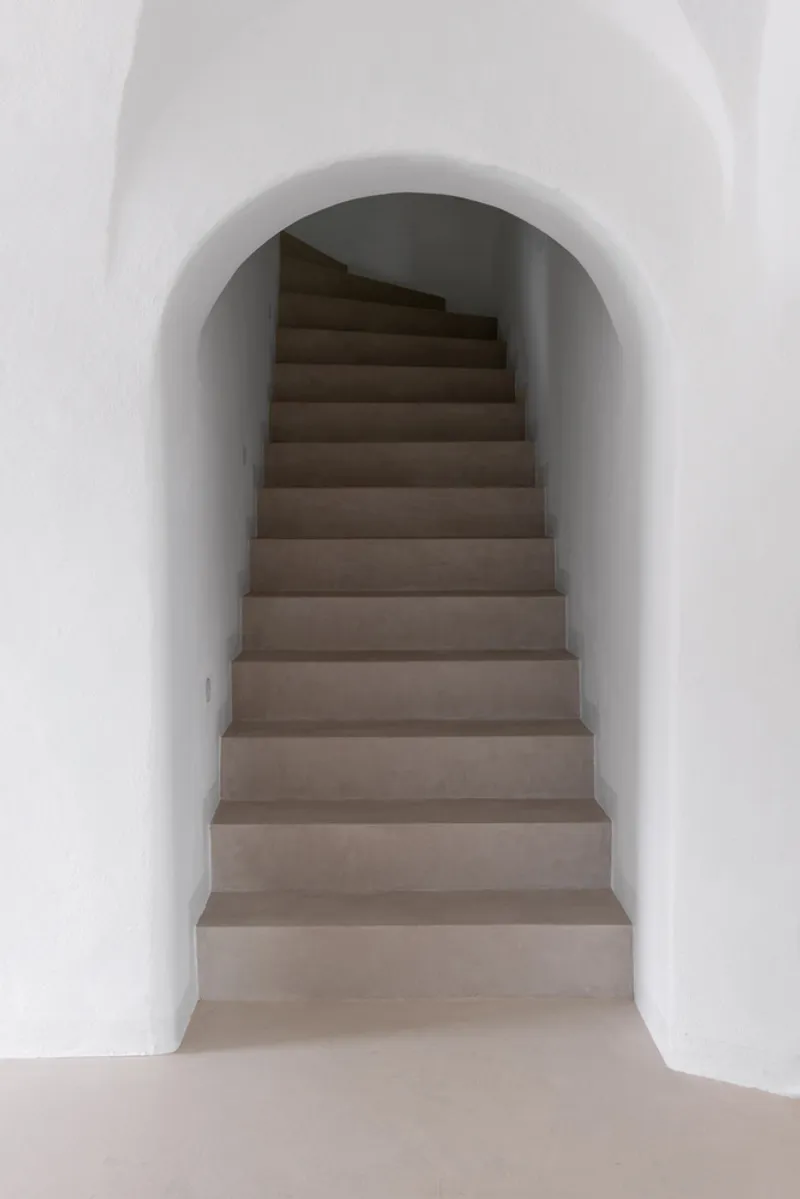
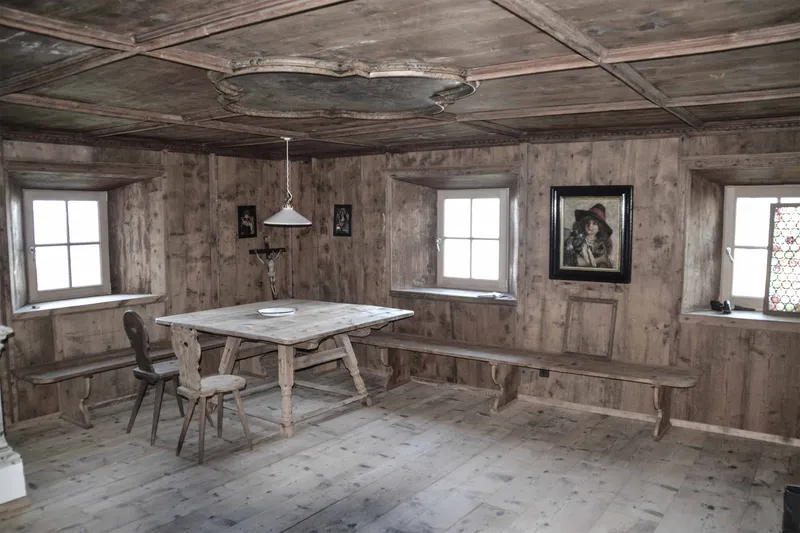
Elsewhere, the traditional timber parlor survives intact: coffered ceiling, small windows, a central table lit by filtered daylight. Curved stone staircases wind through arched plaster passages where the walls are thick enough to absorb sound and modulate temperature. These spaces carry a weight that no new construction can replicate, and The New Komma wisely lets them do the talking.
Concrete, Larch, and the Logic of Texture
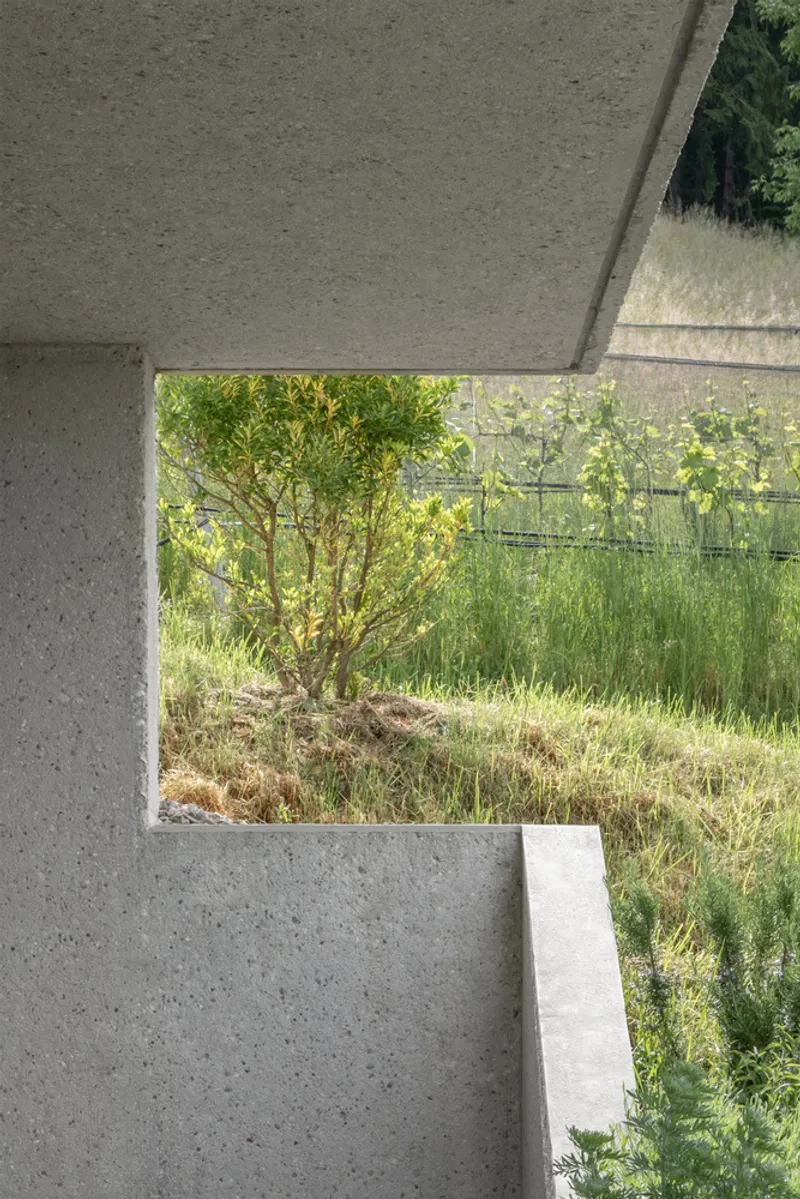
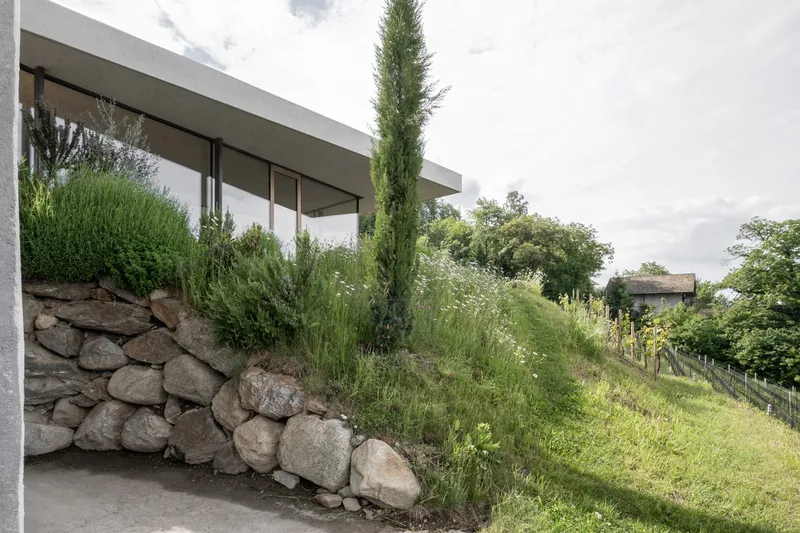
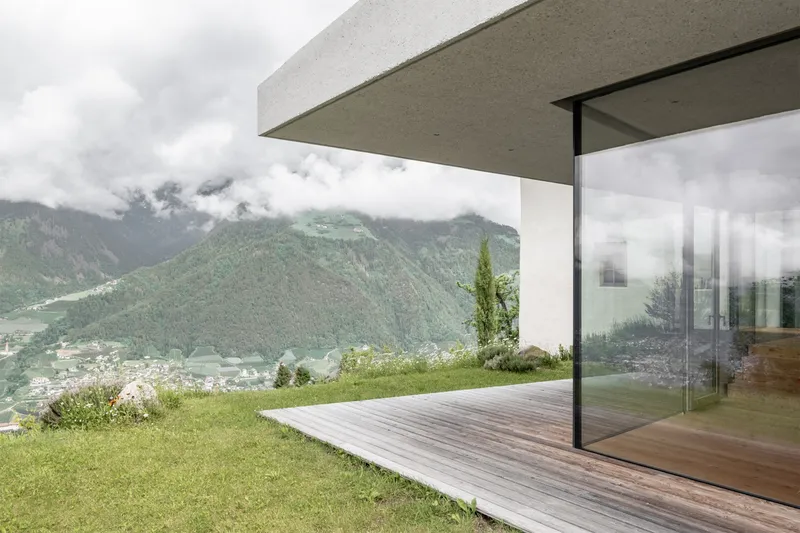
The bush-hammered concrete of the extension deserves closer attention. By using lime as an aggregate, The New Komma creates a surface that shares a tonal palette with the farmhouse's original lime plaster, but the method of making is entirely legible. You can see the formwork pattern, the exposed stone within the mix, the slightly bruised texture left by the bush hammer. It is honest about being concrete, yet it belongs to the same mineral family as the building it serves.
Local larch appears on decking, cladding, and interior paneling, tying the project to the regional timber tradition without overplaying it. The wood will silver with exposure, eventually matching the grey of weathered Alpine barns. Planted stone retaining walls, grasses, and a lone cypress soften the base of the extension where concrete meets earth, blurring the line between construction and cultivation.
Living Between Eras
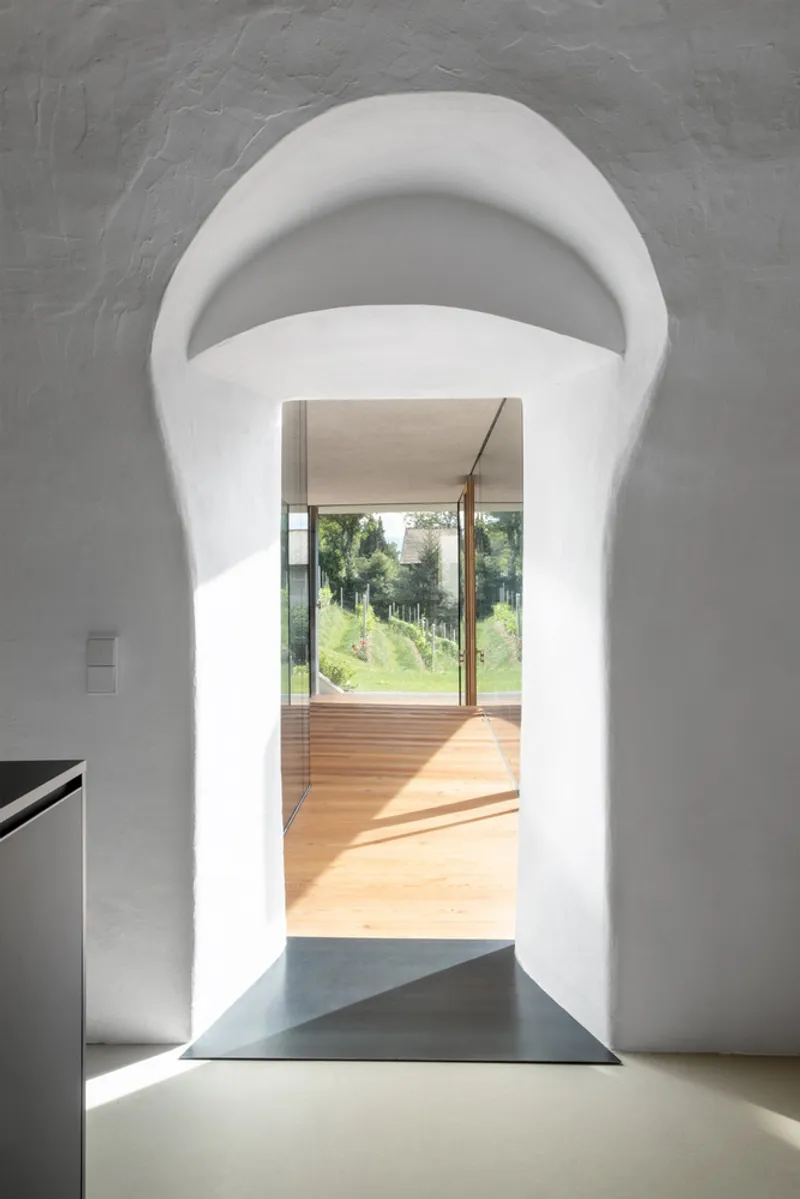
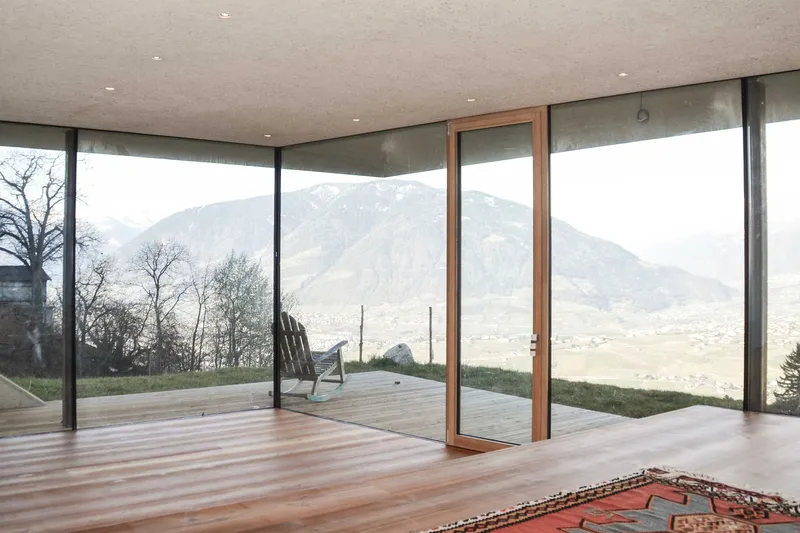
The dual program of residence and exhibition space means the Ausserrothhof must accommodate both private domesticity and public encounter. Floor-to-ceiling glazing in the extension opens rooms to the valley, while the farmhouse's thick walls and small apertures provide retreat. Exposed screed floors and built-in steel furniture in the new volume feel restrained, almost industrial, offering a neutral backdrop for art or daily life.
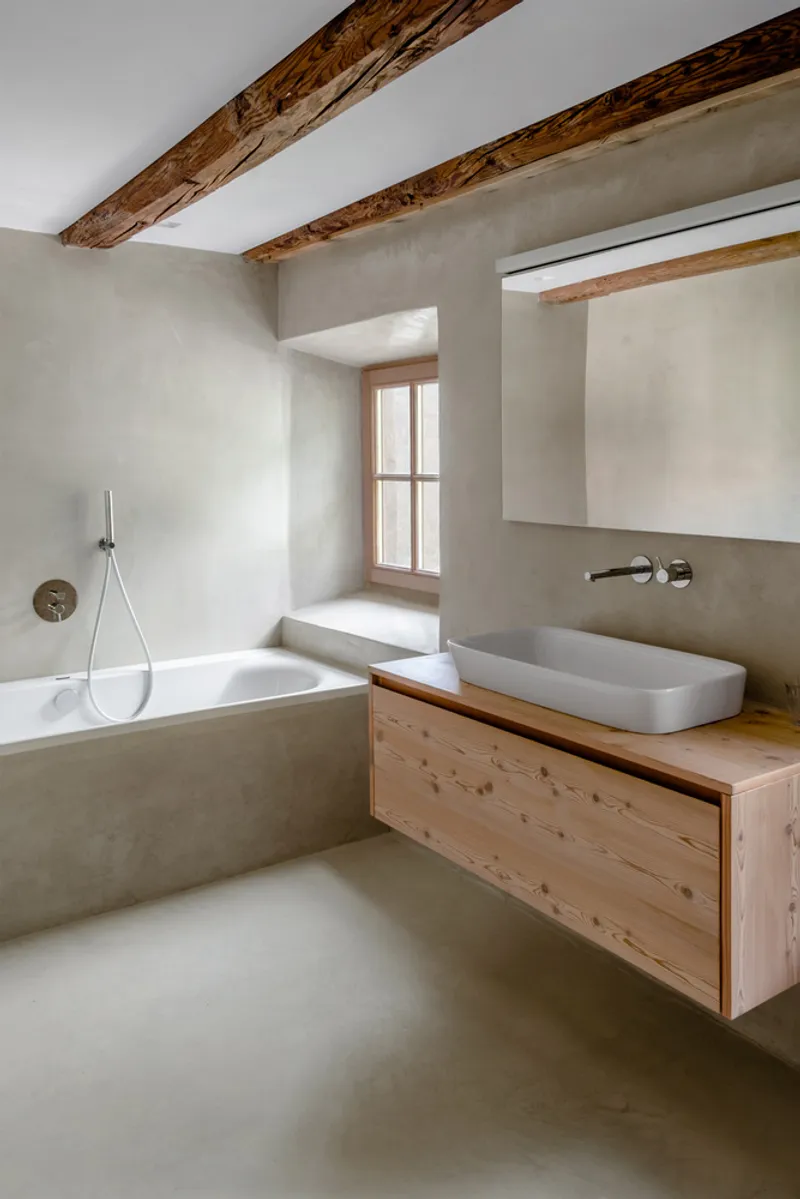
A bathroom tucked under original timber beams, with a troweled plaster tub surround and a pine vanity, captures the project's tonal range in a single room. Nothing about it is precious, yet every surface has been considered. The terrazzo flooring, glimpsed at thresholds with recessed rubber drain grommets, is another detail that signals craft without spectacle.
The Farmhouse and Its Landscape
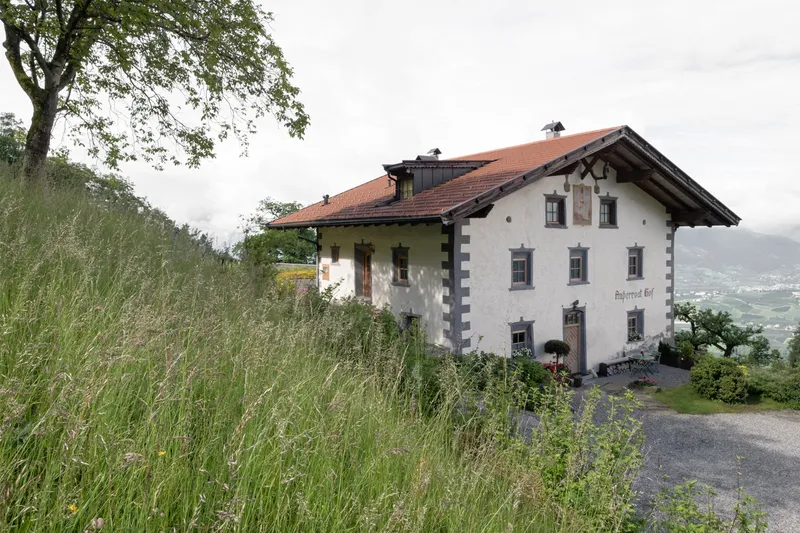
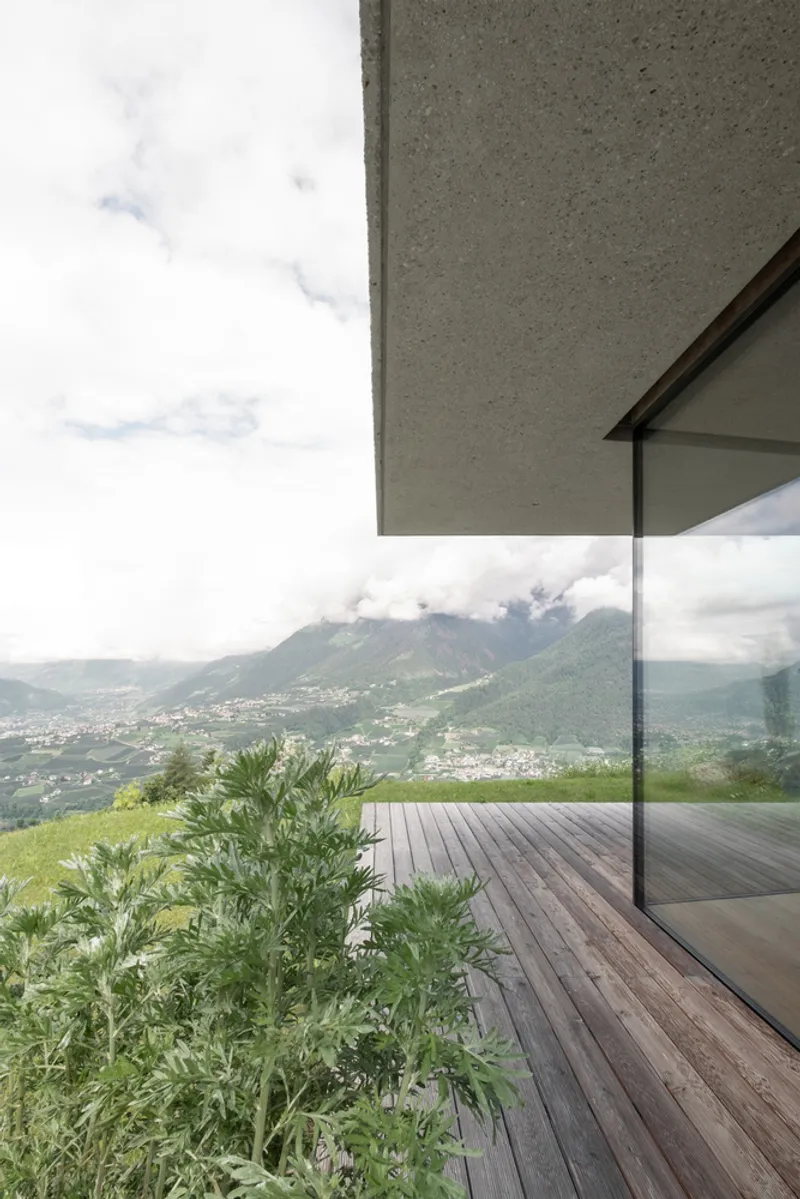
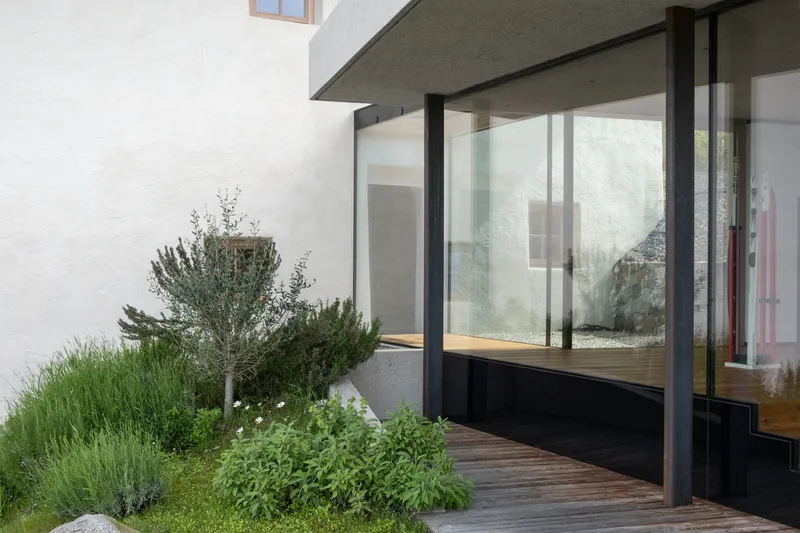
Viewed from the meadow, the original white plastered farmhouse with its quoined corners and terracotta roof remains the protagonist. The extension defers, visible only as a horizontal concrete edge and a timber deck stepping out toward the valley. The covered terrace under the cantilevered roof becomes the primary gathering space, framing misty mountain panoramas through a clean concrete aperture. It is the kind of outdoor room that earns its place through proportion and position rather than decoration.
Sliding glass doors, planted beds along stucco walls, and gravel margins create a series of micro-landscapes at every threshold. The architecture does not end at its walls; it bleeds into the vineyard, the meadow, the hillside retaining structures. For a farmhouse that has produced Pinot Blanc for generations, this porousness between building and ground feels entirely natural.
Interior Details
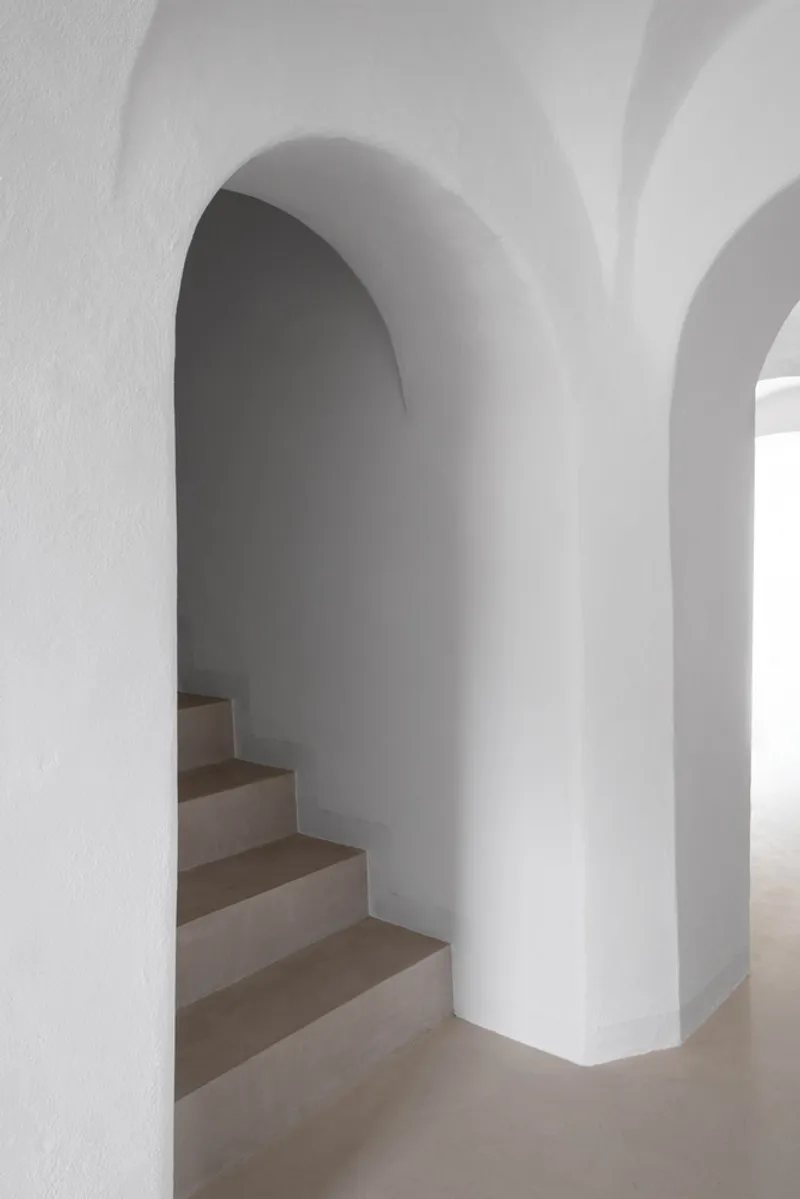
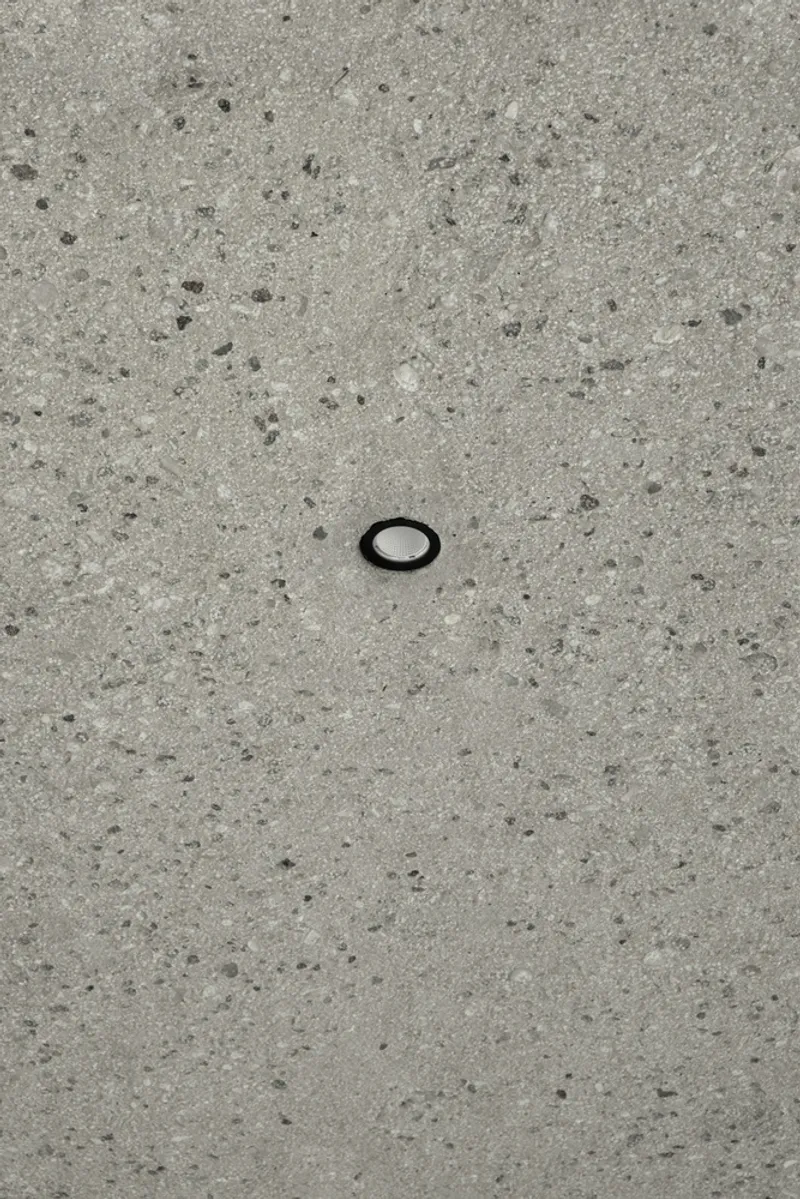
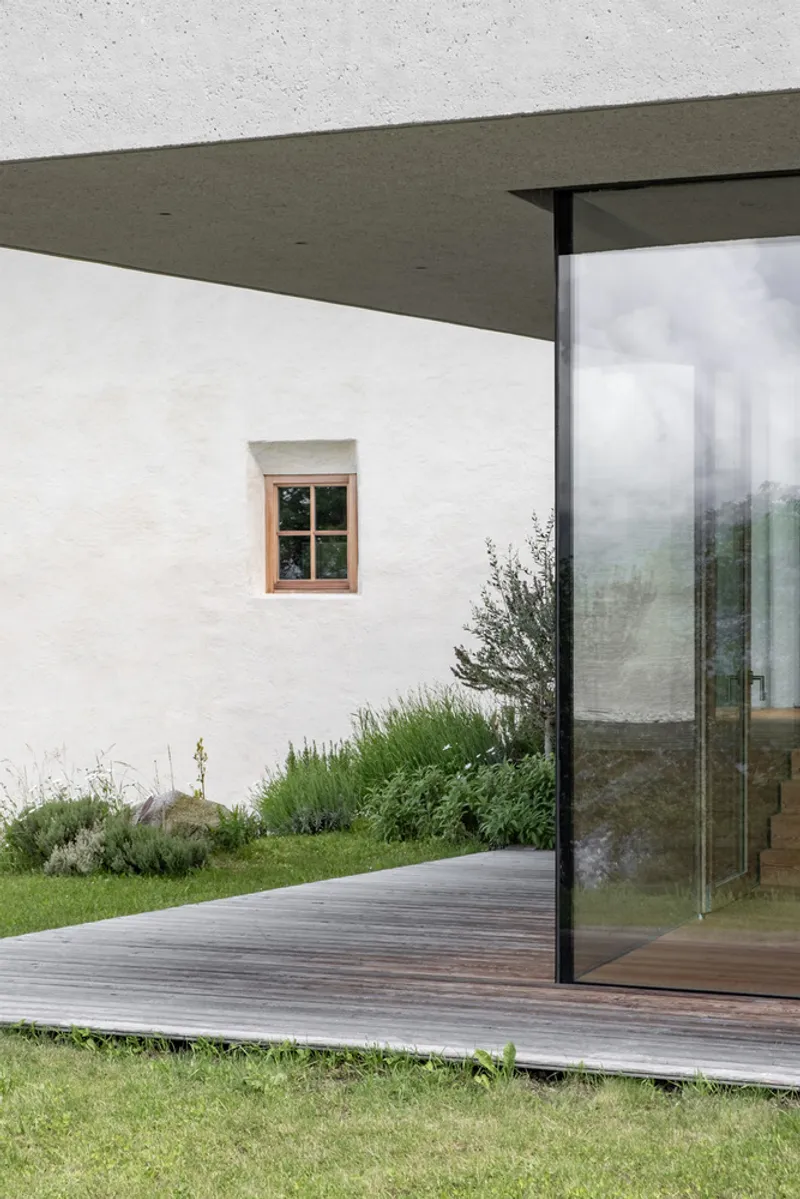
Throughout both old and new volumes, the architects maintain a restrained hand. White plaster arched passages in the farmhouse are left unadorned, relying on geometry and light to generate atmosphere. The extension's timber deck extends from glass walls beneath a flat concrete overhang, its proportions calibrated to feel generous without competing with the view. Even the drainage details on the terrazzo floors are designed as recessed elements rather than afterthoughts.
Plans and Drawings
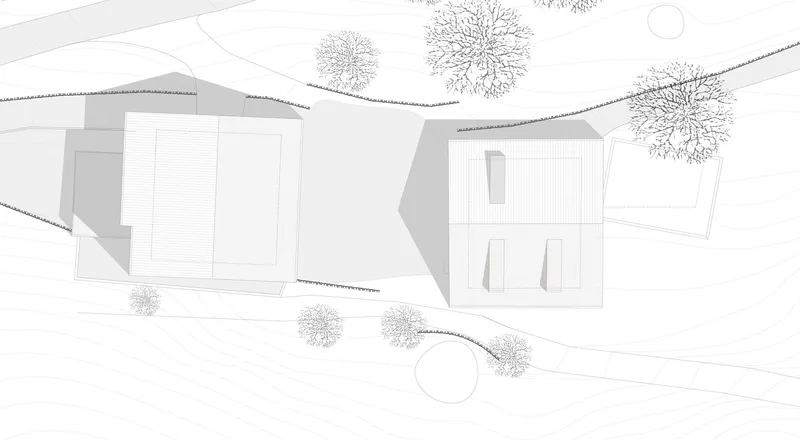
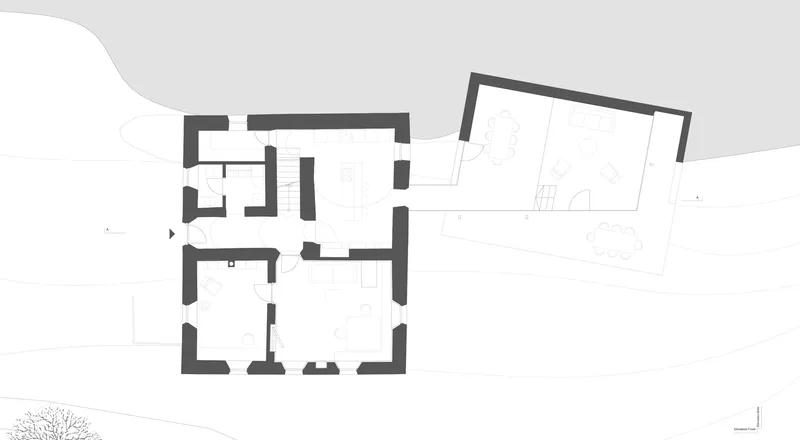
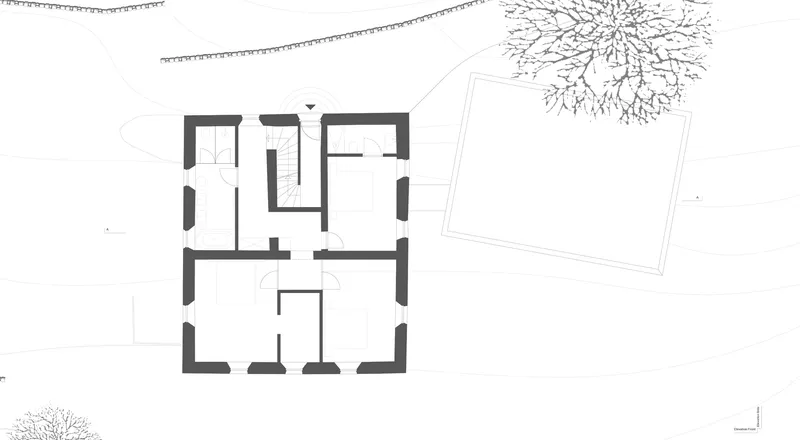
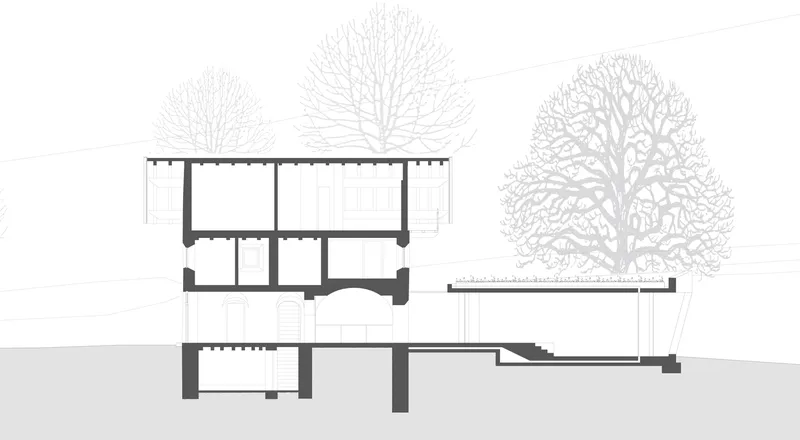
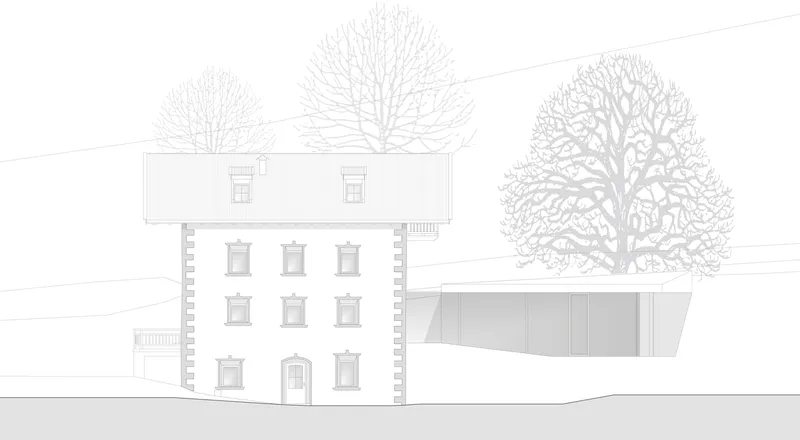
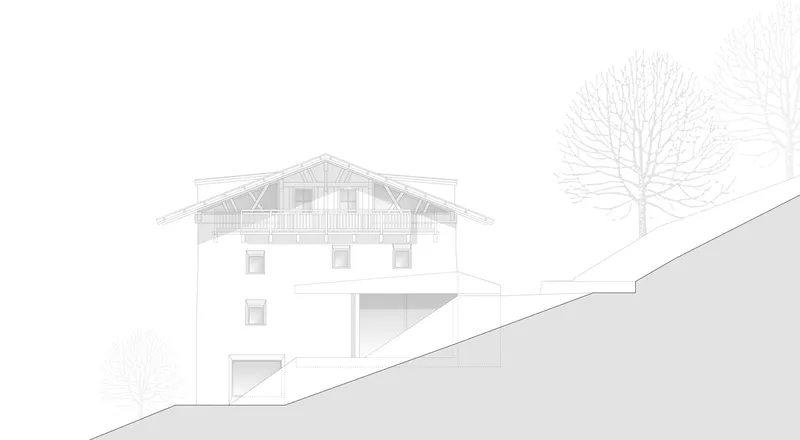
The drawings reveal the full scope of the topographic strategy. In section, the extension is carved into the slope, its floor levels stepping down with the terrain while the farmhouse sits at the crest. The floor plan shows the thick masonry walls of the original rooms, their irregular geometries a product of centuries of incremental building, connected by the glass link to the orthogonal precision of the new volume. Site plans confirm the minimal footprint: the extension occupies ground that was already below grade, preserving the vineyard's productive area.
The elevations are particularly telling. From the south, the traditional gabled silhouette reads clearly against the hillside, with the subterranean extension registering only as a horizontal line beneath a mature tree. From the east, the three-story stone mass with its dormer windows and exposed roof trusses asserts its historical identity, while the adjacent new volume remains subordinate. The architects have drawn the project as a composite organism, not a collision.
Why This Project Matters
The Ausserrothhof Extension matters because it demonstrates that the concept of genius loci need not be a vague romantic appeal. Here, it is a concrete design method. The lime aggregate in the bush-hammered concrete, the larch sourced from local forests, the green roof that returns the meadow to the slope, the glass joint that refuses to fuse old and new into a single identity: every decision traces back to a specific reading of place. The New Komma has produced a building that could only exist on this particular hillside, attached to this particular farmhouse, surrounded by these particular vines.
In a region where tourism increasingly pressures historic structures toward boutique hotel conversions and heritage theme parks, the Ausserrothhof offers an alternative trajectory. It proves that a listed building can absorb a significant contemporary addition without losing its character, and that new architecture gains authority not by shouting but by listening. The farmhouse remains the farmhouse. The extension is plainly, unapologetically new. And the vineyard, indifferent to both, keeps making wine.
Ausserrothhof Extension by The New Komma, Schenna, Italy, completed 2024. Photography by Lucas Clemens.
About the Studio
Share Your Own Work on uni.xyz
If projects like this are the kind of work you want to make, uni.xyz is a place to publish your own, find collaborators, and enter design competitions.


Popular Articles
Popular articles from the community


David Ortega Stacks a Two-Story Mexico City Penthouse Around a Steel Stair and a Pergola-Shaded Roof Terrace
In Colonia Roma, a 300 m² penthouse uses oak joinery, a planted steel stair and a slatted roof pergola to make a new-build apartment feel like a house.

longwave studio Reorganizes a 112 m² Tainan Apartment Around the Daily Routines of a Family and Two Cats
In Tainan, Taiwan, birch plywood, rust-red furniture and a freestanding plaster wall link arrival, storage, work and family life in one apartment.

Architekt Andreas Gruber Scatters 23 Dark Timber Chalets Across a South Tyrolean Forest Edge
In Molini di Tures, Amonti Chalets breaks a resort into a hamlet of gabled timber houses, with parking, storage and services pushed into the slope.

Juan García Correa, John González and Claudia Rueda Sink a Circular Amphitheater into a Manizales Engineering Building
On the La Nubia campus in Manizales, Colombia, the S1 Building folds labs and offices into a hillside of ramped lawns that double as a campus route.

Similar Reads
You might also enjoy these articles


Hodi-Mandai Geram
Project Function: Preservation and revitalization of the Intangible heritage and socio-spatial identity of the Hodi by Housing, Cultural Memory Center, Sacred Grove, landscape, local tourism economy


Olio Towers: A Mid-Rise for Performers That Fuses Housing, Rehearsal, and Stage
Located blocks from Houston's Theater District, this modular tower stacks living units around a central performance atrium.

Oasis: Modular Green Housing Carved into Dhaka's Urban Fabric
A shortlisted Plugin Housing entry reclaims unauthorized settlements in Dhaka with stepped concrete volumes, green roofs, and ventilation-driven design.

Black Hole: A Floating Megastructure for the Post-Physical Era
Emiliano Mazzarotto envisions a spherical, self-scaling arena where e-sports, digital hotels, and holographic stadiums replace traditional public space.

Explore Architecture Competitions
Discover active competitions in this discipline

Challenge to reimagine the Iron Throne

Photograph architecture without architects

Illustrate the lost glory of Angkor Wat - Render Challenge

Design challenge to reuse E-waste
Comments (0)
Please login or sign up to add comments
No comments yet. Be the first to comment!