

Heterotopia of an Augmented Public Space
Creating an Augmented Reality Religious Park in Mumbai

I strongly feel that the way our cities have evolved (rather dissolved) is a complex network of networks. They are fragmented, not a unified set and they exhibit a variety of relations inhabited by unstable communities and their lifestyles. As Foucault rightly puts, we exist in the epoch wherein the space given to us is relations between emplacements. The boundaries of public, private have been blurred by the introduction of semi-public, semi-private and similarly, peri-urban, rur-ban by the competing systems. Homogenous communities exist and try to create their own public spheres and are more often than not, backed by political influences. This leads to fragments in the public space which was ideally meant to be all- inclusive. Through the process I have understood that one of the relatively neglected issues of an urban study in urban planning is the centrality of political domination and how some spaces resist and some spaces comply with this and it affects spatial order of how our fabric gets arranged over time. For this, Foucault’s heterotopology (topology of heterotopias) provides crucial insight into the analysis of the urban environment. Today, in the Gen z generation, like many other definitions, ‘public space’ also seems to be renewed from the traditional focus on formal squares, parks to a broader conception of less formal ‘leftover’ spaces and the everyday uses that occur there.
The most exciting factor about public spaces is that they are representations of all the people who use them (drawing on Lefebvre’s lines) and exhibit the capacity of accommodating all meanings that the users give them. Hence, as we evolve, so do our spaces and expectations and meanings from them. However, it is only within our public spaces to have the potential to withstand narratives of history as they have created collective memories that relate to a mass population and the ownness is shared.
After an intensive study of public spaces in the city to which I belong - Mumbai, I have come to the realization that a common perception of a public space is associated with a park or a playground of leisure which forces me to ask if our public spaces are limited to that. However the taxpayer’s view is not completely wrong, at least in the scope of Mumbai and it’s fringes that leisure and play comes at a paid expense with the exception of a local park, which also has its limitations to a duration.
Heterotopias and its understandings help to identify the nature, opposition, placement, contradiction and porosity of such spaces with ‘otherness’. I must clarify that time, technology and space as terms for theory in architecture have taken leaps since Foucault introduced the concept of ‘otherness’ and thus don't comply with archaic meanings but have amputations to them. Architecture- the act of building itself- creates opportunities of violence and I suggest Heterotopias induce violence - Violence in terms of user agencies, environment, cultural differences, design languages. So, To put it in Tschumi’s terms, the relationship between a consumer of the architecture and the architecture itself is like that of a parasite and host that assembles this violence of meaning and value. Sometimes, it is symbiotic and sometimes the roles interchange.
This thesis was an attempt to- 1. identify a PUBLIC heritage place in the core of Mumbai on the contours of public and private, slowly losing its publicness
2. To help intensify the existing heterotopic qualities of the site so that the mesh of different users and incompatible functions becomes a glorified network
3. To preserve the heritage with interventions that subtly cater to futuristic demands of the users who reside there in addition to opening up the place to tourists. And using technology as an aid for doing so. Thus, creating spaces that comply with the technology.

Popular Articles
Popular articles from the community

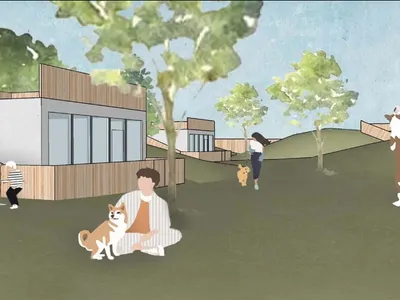
Temporary Home for Dogs: A Reversed Zoo Rethinks Animal Shelter Architecture
In Bucharest, a sinuous corridor and freed landscape flip the logic of containment, designing a shelter that works to make itself unnecessary.

Manzana Morphosis: Stretching Barcelona's Grid into a Living Landscape for 2050
A radical reworking of the Eixample manzana turns density into a tool for generous public space, vertical ecology, and environmental performance.
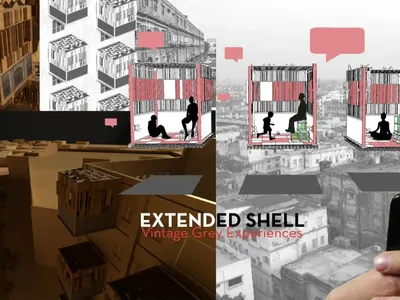
Extended Shell: Retrofitting Kolkata's Balconies as Living Urban Thresholds
A modular retrofit system recovers the social and environmental intelligence of Kolkata's historic verandas for contemporary Park Street residents.

Singing Woman: An Opera House That Performs Before the Curtain Rises
Ovidiu Cristian Pavel's conceptual opera house translates Estonia's choral identity into a sculpted waterfront landmark facing the Baltic Sea.

Similar Reads
You might also enjoy these articles
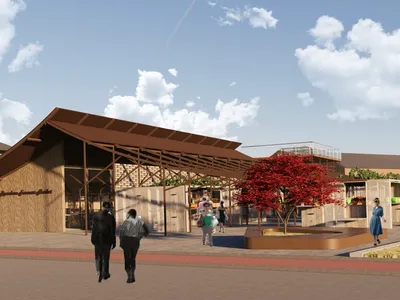
The Rhythm of Seasons
A Farmers' Market Connecting Nature and the City

More Than a Building-Designing a Living System
More Than a Building-Designing a Living System
Base Beyond
DESERT COMPOUND ARID: TOURISM OF ABSENCE AND ABUNDANCE

Explore Conservation Architecture Competitions
Discover active competitions in this discipline


Challenge to reimagine the Iron Throne

Photograph architecture without architects

Illustrate the lost glory of Angkor Wat - Render Challenge

Design challenge to reuse E-waste
Comments (0)
Please login or sign up to add comments
No comments yet. Be the first to comment!