

HIRAYÁ
REIMAGINING STUDENT LIVING

INTRODUCTION
Living in a student housing is a necessity for students who are attending universities and colleges that are far from home. After a day of studying and working, all one wants are the comforts of a home – a space that feels like his or her own. According to Abraham Maslow’s Hierarchy of Needs, a safe and healthy environment is considered as one of the important factors for human motivation to achieve other needs and desires. Hence, housings highly influence how student tenants live and progress through personal and academic success.
The project aims to create a sense of place where students can feel included and comfortable; a place where they can get involved and foster a culture of sustainability and shared striving.
DESIGN INVESTIGATION
Student housings are expected to meet and fulfill the basic housing needs of every student. It should stimulate a study environment, encourage productivity and socialization through spaces therein. However, it does not seem to be the situation in some student housing in the Philippines. Research and case studies manifest that many operators have violated design requirements under the National Building Code. Common dilemmas such as lack of privacy, inadequacy of spaces, and unfavorable area for studying are deemed by the tenants. The growing concern about the physical and environmental components of student housing must be addressed.
In order to effectively address the problem, it is important that the design solution should stem from the analysis of the actual needs, desires and values of students in which the structure is to meet. For the basis, we relied on studies and actual student living experience. This method concerned with the living patterns, lifestyle, and preferences towards the design of a student housing. During the planning stage, as an example, we were considering whether there is a need of having a balcony for each unit. We weighed down all the pros and cons arriving with the conclusion that balconies are essential for multiplicity of uses such as private outdoor space, gardening, storage or alternative drying area.
Another method used during the design phase is the application of the development controls (DC) based on various codes of the Philippines, as well as the local zoning ordinance. DC includes floor area ratio, building height limit, percentage site occupancy, and site setbacks. After careful consideration of the technical aspects, we then moved to the site analysis where we considered site access, vehicular and pedestrian circulation, building orientation, and zoning of spaces by use and importance.
CONCEPT
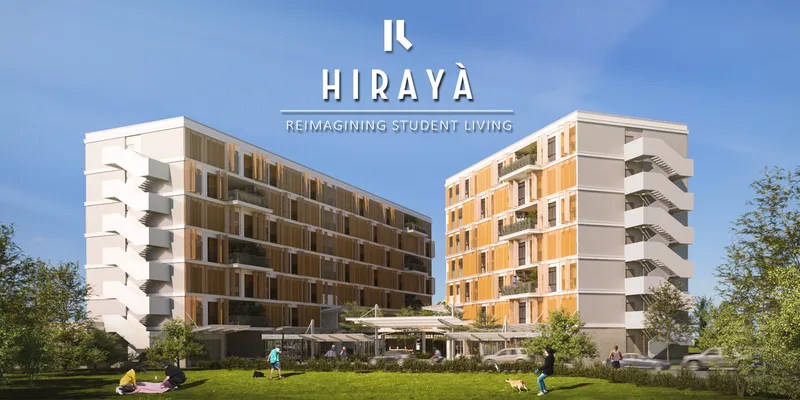
Social Architecture as a platform for people to learn, interact and experience life, it serves as a conduit for the students to get out of their own comfort bubble and urge them to get out and interact with the community around them. The project is equipped with the capabilities of multiple zones to generate social interaction, whilst conserving the serenity and privacy of one’s own home. The concept inspired the project to be more than a house but a new social community within the area.
DESIGN SOLUTIONS
1. Two Separate Tower Mass
The building mass took into consideration the current student housing situation in the Philippines where there is separation of sexes in dormitories. This is to ensure the privacy and security of its tenants due to having shared spaces such as common toilet and bath, and etc.
2. Parks and Recreational Space
By considering the vehicular circulation, pockets of spaces were created and transformed into green and recreational spaces such as parks, jogging paths, al frescos and collaborative spaces like the sunken amphitheater. This is to equip the project with variety of social spaces where people can interact and relax, as well as providing additional vegetation for the project.
3. Structural System
The Structural system is inspired by the modularity of the unit. The use of Load-Bearing Wall System is much more effective, efficient and economical than the conventional method (Post and Lintel System) in minimizing time and cost while maximizing the projects potential. This type of Structural system is already in use with various low cost- medium cost residential towers in the Philippines.
4.Indoor Amenities & Amenity Platform
The amenity platform serves as a social link in between two towers. It is a place where student tenants can interact and mingle with their peers. Through the platform, indoor amenities such as co-working spaces, gym, game room, and prayer room, can be accessed.
5. Façade Design
The façade was designed to provide flexibility for the units, by using collapsible lattices, student tenants have the option to operate the lattices to allow more sunlight and ventilation, or close it to provide sun protection as well as privacy & security from the neighboring buildings, preventing direct overlooking of spaces.

Popular Articles
Popular articles from the community


David Macias Steps a Doorless Stone and Plaster House Down a Tropical Colombian Hillside
In the humid hills of Colombia, Threshold House replaces the front door with an open void and terraces its 850 m² down the slope instead of fighting it.

LT2A and OPEN Architectes Thread a Brick and Glass High School Through a Wooded Belgian Campus
In Braine-l'Alleud, a 3,000 m² wing for Collège Cardinal Mercier pairs pale brick with a glazed colonnade, deferring to a small chapel and a dense wood.

longwave studio Reorganizes a 112 m² Tainan Apartment Around the Daily Routines of a Family and Two Cats
In Tainan, Taiwan, birch plywood, rust-red furniture and a freestanding plaster wall link arrival, storage, work and family life in one apartment.

Architekt Andreas Gruber Scatters 23 Dark Timber Chalets Across a South Tyrolean Forest Edge
In Molini di Tures, Amonti Chalets breaks a resort into a hamlet of gabled timber houses, with parking, storage and services pushed into the slope.

Similar Reads
You might also enjoy these articles


Vereda Arquitetos Renovates a 40-Square-Meter Apartment Inside Niemeyer's Copan Building
A compact unit in São Paulo's most iconic residential tower gets a material overhaul that pairs exposed concrete with bold blue Formica.

Shakur's House: Exposed Brick as an Interior Organiser in a 168 m² Mashhad Residence
Brick moves indoors in this Mashhad residence, where masonry walls, glass partitions and teal planes sequence a compact home without closing it off.

Day and Night Park: A Time-Based Urban Newsstand in Beijing
A temporary urban newsstand in Beijing blending travel, light, and reading through poetic colors, compact form, and community-focused design.

Modernist Patio Renovation in El Masnou, Barcelona by Oliver Segura Arquitectura + Cebrià Arquitectura
Modernist patio renovation blending tradition and innovation with a movable pool, leveled floors, and Catalan materials in El Masnou.


Comments (0)
Please login or sign up to add comments
No comments yet. Be the first to comment!