

Corde Architetti Associati Returns a Forgotten Villa in Grado to a State of White Calm
A municipal security intervention strips decades of neglect from a rural Italian villa, revealing a stark cubic form amid wild vegetation.


Somewhere in the flat countryside outside Grado, where fertile fields stretch toward a lagoon you can smell but never quite see, a white cube rises from a tangle of palms, ivy, and unchecked native grasses. Villa Dominicale is not a new building. It is an early 20th-century rural house that was gutted of its character by heavy-handed 1960s remodeling, then left to rot for decades until the roof and windows stood on the verge of collapse. When the municipal administration finally commissioned a security intervention, Corde Architetti Associati, led by Giovanni Scirè Risichella, Alessandro Santarossa, Giacomo Cornale, and Elisabetta Fava, faced a question with no easy answer: what do you preserve when the thing worth preserving has already been largely destroyed?
Their response, completed in 2024, is deliberately restrained. The 440-square-meter structure received a new roof, replacement windows, and restored external surfaces, but the interior was left untouched, awaiting a future phase of work. The result is less a finished restoration than a deliberate pause: the villa stabilized, sealed, and returned to a stark, neutral state that refuses nostalgia. Its white cubic form now reads as a geometric counterpoint to the wild garden that has consumed its grounds. That tension, between architectural control and natural entropy, is the project's real subject.
A White Volume Against Wild Green


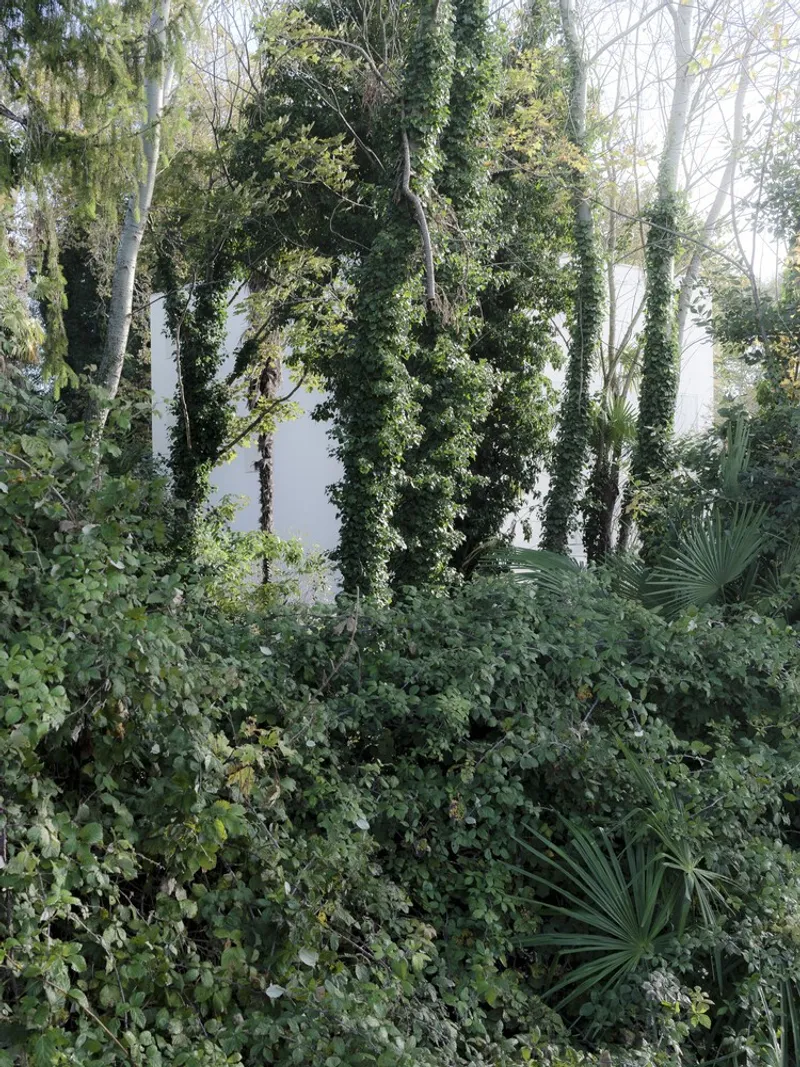
The most striking quality of the restored villa is not any single detail but the totality of the contrast it sets up. White rendered walls, sharp edges, and a gridded arrangement of shuttered windows meet a landscape that has gone feral. Decades of abandonment allowed the garden, once part of an ancient agricultural centuriation extending to the lagoon, to erupt into a dense subtropical thicket. Corde Architetti chose not to tame it. The vegetation remains untended, pressing close to the facades, wrapping tree trunks in ivy, and pushing native grasses up to the building's base.
The decision turns what could have been a conventional heritage project into something closer to a landscape installation. The villa does not sit politely in a manicured plot. It asserts itself against the green, and the green pushes back. The effect is startling and specific to this site, where flat farmland, salt air, and the distant silhouette of mountains create a microclimate that sustains this particular kind of lush overgrowth.
Shadow, Light, and the Moving Facade
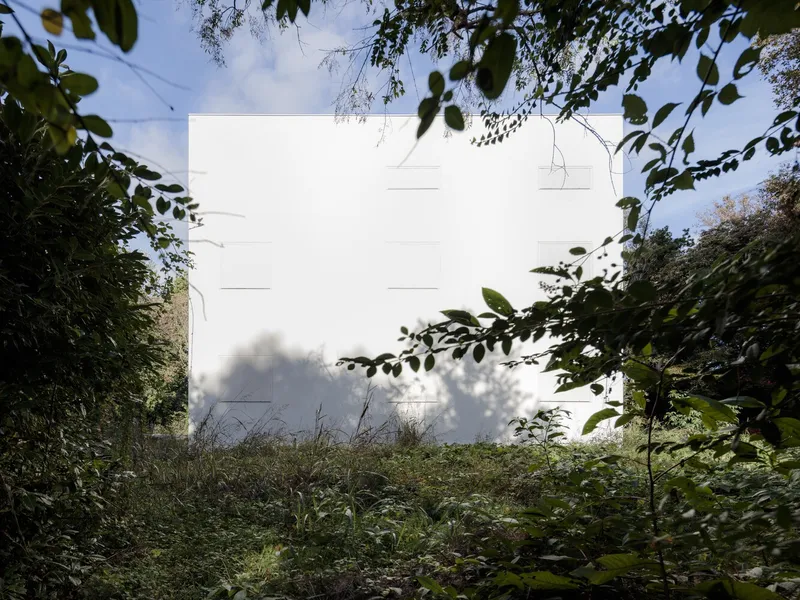


White walls are cheap canvases, and Corde Architetti clearly understood this. The sun's movement throughout the day casts constantly shifting patterns of tree shadow across the facades, turning the building's blankness into something animated and unpredictable. In morning mist the villa appears almost spectral, its slit windows barely legible against the pale render. By afternoon, dappled light through overhanging foliage fractures the surfaces into a mosaic of warm and cool tones.
The shutters, aligned flush with the exterior cladding, reinforce this flatness. When closed, the facade becomes a near-continuous plane. When one window is opened, the effect is immediate and disproportionate: the sealed box cracks open, and the boundary between interior and garden dissolves. It is a small gesture with large spatial consequences, and it speaks to the architects' understanding that in a project this restrained, every opening and closure carries weight.
Aerial Logic: The Building in Its Territory
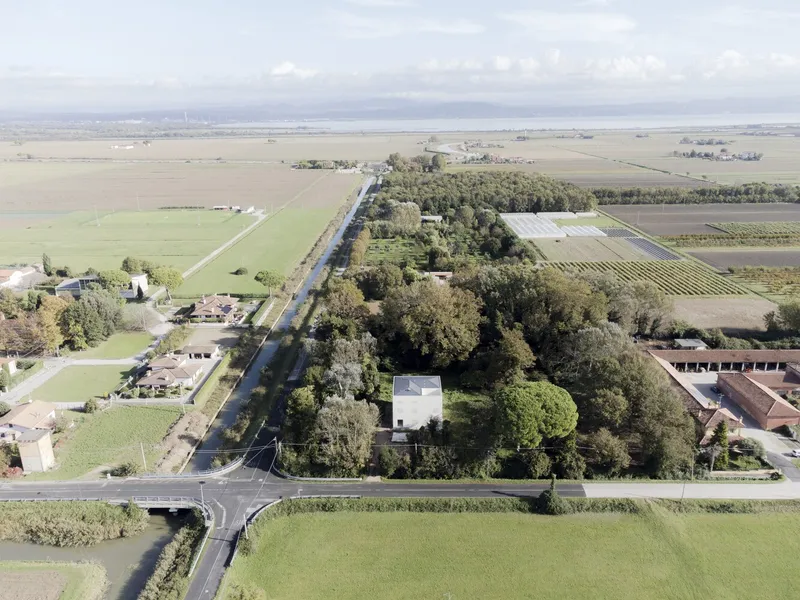


From above, the relationship between the villa and its site becomes legible in a way that ground-level photographs cannot convey. The building sits like a precise white chip dropped into a clearing within a dense canopy. Agricultural fields extend in every direction, ruled by the ancient geometry of Roman centuriation, while the villa's own parcel has grown into something closer to a small forest. The aerial view reveals how compact the structure actually is: a tight square footprint surrounded by an almost impenetrable ring of mature trees.
Approached from the road, this density means the villa appears only in fragments. A white corner surfaces between palm trunks. A roofline catches light above a wall of shrubs. The experience of arrival is one of gradual revelation rather than a single commanding view, and the architects have wisely left this sequence intact rather than clearing sightlines.
The Entrance and Exterior Shell
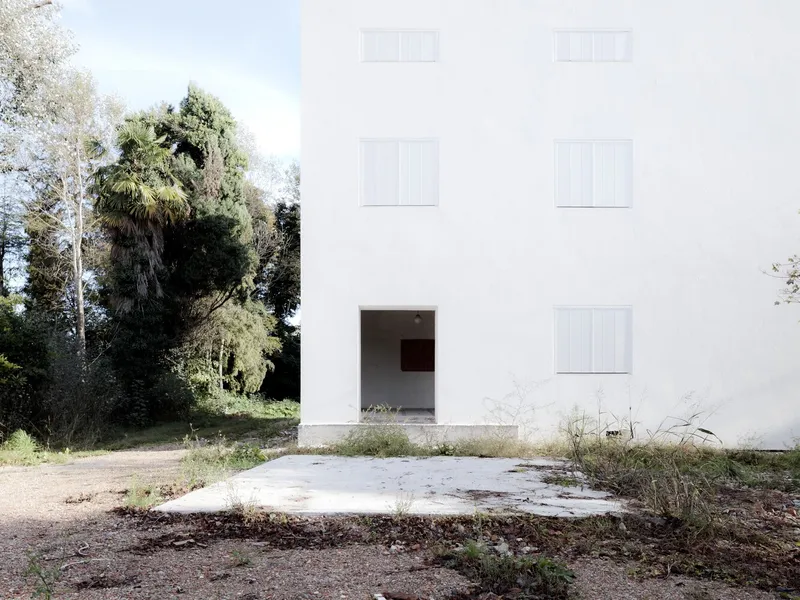

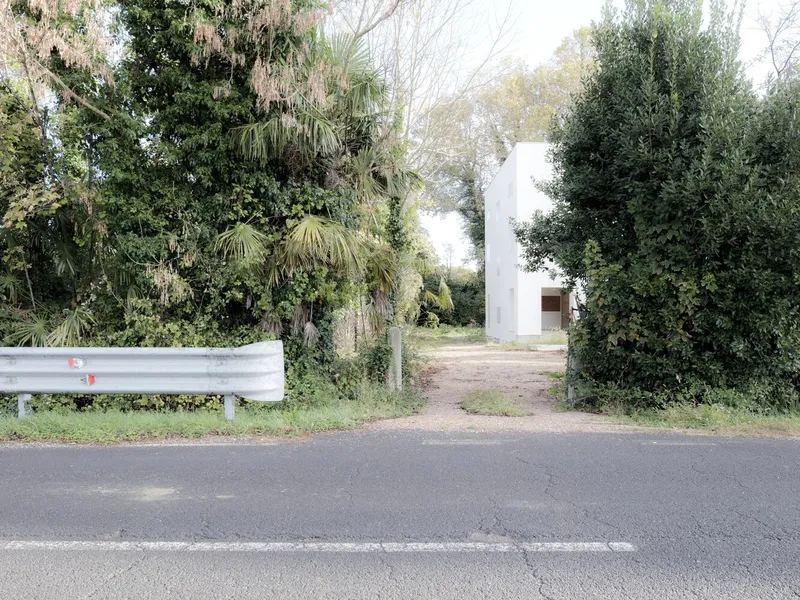
The entrance facade is the most composed elevation, with a central opening and recessed shuttered windows set into a weathered concrete apron. It is deliberately understated. There is no portico, no ornamental surround, no gesture of welcome beyond the simple fact of an opening in a wall. The two-story white box behind reads as a single volume, its gabled roof visible in the elevation drawings but barely perceptible from the ground where trees crowd the upper sightlines.
Seen through layers of subtropical vegetation from the road, the villa has the quality of a building discovered rather than presented. Palms, eucalyptus, and wild shrubs form a natural screen that filters views and softens the geometric rigor of the form. The building does not compete with this context; it simply persists within it.
Interior Remnants: What Survived
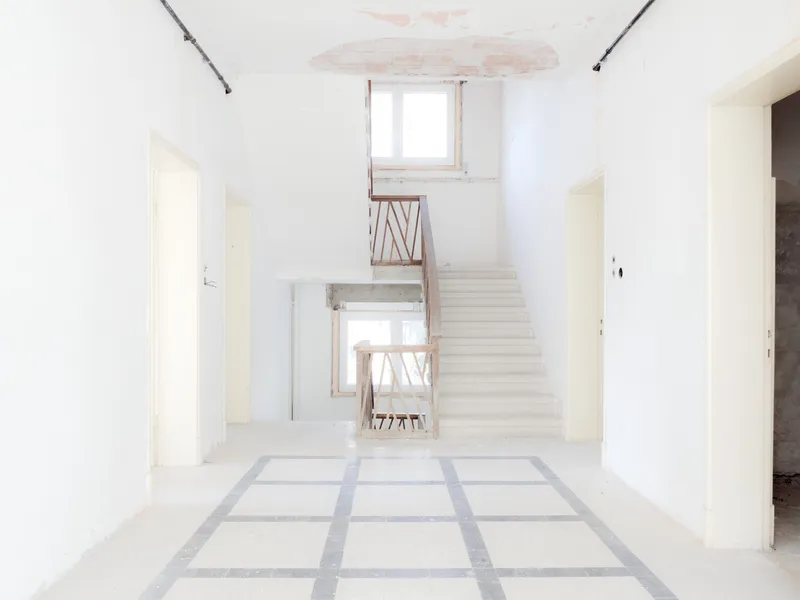


Inside, the villa is a space suspended between interventions. The 1960s remodeling destroyed the early 20th-century typological character, but certain elements survived: original doors, terrazzo floors, and a carved wooden staircase that ascends through a generous triple-height void. Corde Architetti treated these survivors with respect but without sentimentality. The staircase balustrade, clearly handcrafted and finely detailed, stands next to distressed plaster walls and raw concrete beams. No attempt has been made to reconcile these different material eras.
The decision to leave the interior unfinished is the project's most provocative move. White-painted walls meet exposed timber joists and conduit runs on ceilings. Rooms stand empty, their proportions legible but their future use undefined. It is honest in a way that many restorations are not: rather than fabricating a coherent historical narrative, the architects have simply stabilized the evidence and stepped back.
Framing the Garden from Within


The new windows do more than seal the envelope. They frame the untamed garden as a series of composed views, turning overgrown vegetation into something pictorial. One wide opening captures palm trunks and eucalyptus in bright daylight, the greens almost artificially vivid against the white interior walls. A timber-framed glazed partition at the end of a corridor transforms a functional threshold into a viewport.
These interior moments suggest what the villa might become in its next life. The bones are good: generous room heights, exposed timber structures with a rough warmth, and a plan that distributes rooms around a central stair core in a straightforward, adaptable arrangement. The building is ready. It simply waits.
The Villa in the Landscape

Grado's flat terrain and soft, salt-tinged light give the villa a particular atmospheric quality that shifts dramatically with weather and time of day. In mist, the white volume becomes ghostly, its edges dissolving. Under overcast skies, it reads as a solid presence, the brightest object in a grey-green field. The mountains visible on the horizon provide a distant scale reference that makes the villa feel simultaneously intimate and exposed.
Plans and Drawings


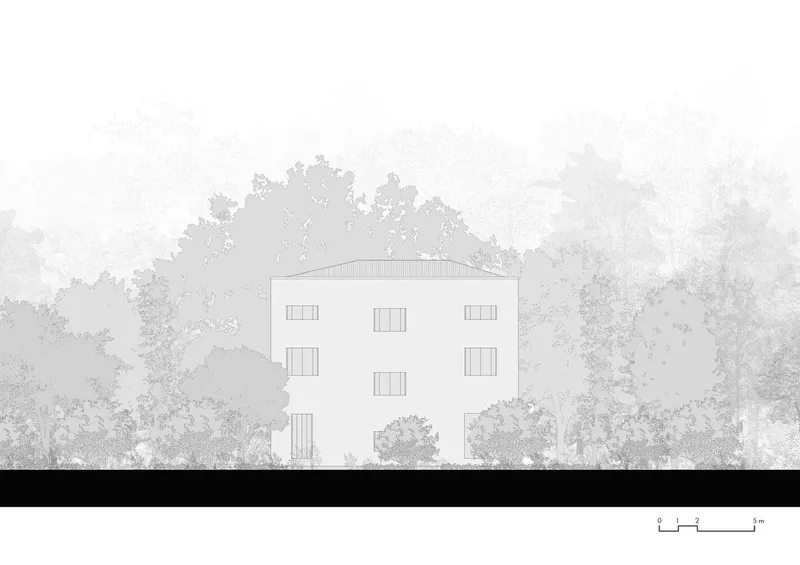


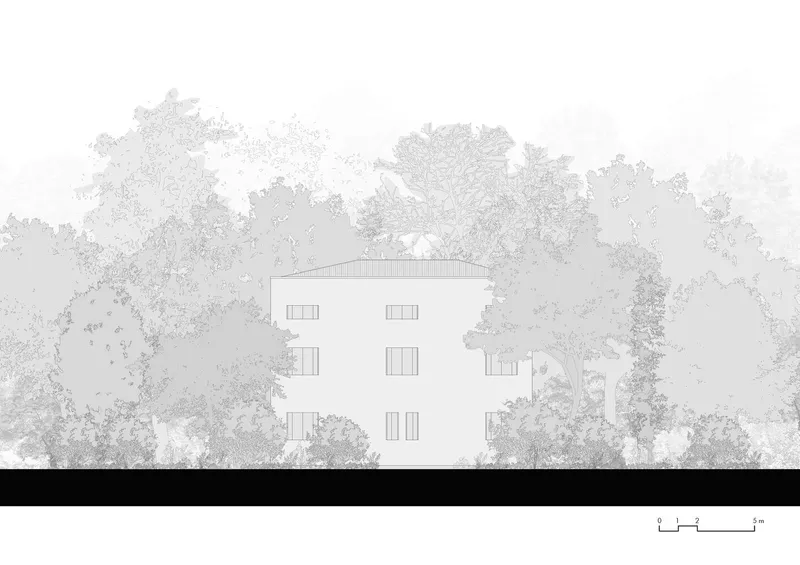
The site plan reveals how tightly the villa is embedded within its wooded parcel, the compact square footprint surrounded by circular clearings and dense canopy. The floor plans show a symmetrical organization at ground level, with five rooms arranged around a central corridor, that loosens slightly on upper floors as the stairwell becomes the organizing spine. By the second floor, the plan simplifies to four rooms around the stair core.
The elevation drawings are perhaps the most telling documents. They depict the building not in isolation but nestled within silhouettes of mature vegetation, acknowledging that the trees are not backdrop but co-authors of the villa's spatial experience. The gabled roof, barely visible in photographs, appears in section as a simple triangular profile, its modesty consistent with the project's refusal of dramatic gesture. Balconies marked on one elevation hint at the building's earlier, more articulated identity.
Why This Project Matters
Villa Dominicale is not a showcase of restoration craft or a triumph of historical reconstruction. It is something rarer: an honest acknowledgment of what can and cannot be recovered. When a building has been stripped of its original identity and left to decay, the impulse is often to invent a new character or to fabricate a historical one. Corde Architetti did neither. They sealed the envelope, stabilized the structure, and left the interior as a space of possibility rather than predetermined use. The white cubic form that results is not a finished statement but a held breath.
The project also demonstrates that the relationship between a building and its landscape can become the primary architectural experience when the building itself is deliberately muted. The wild garden, the shifting shadows, the slow revelation of the white volume through layers of vegetation: these are not incidental qualities but the core of the project's identity. In a field that often equates intervention with transformation, this work argues for the value of restraint, patience, and the courage to leave things unfinished.
Villa Dominicale Security Intervention by Corde Architetti Associati (Giovanni Scirè Risichella, Alessandro Santarossa, Giacomo Cornale, Elisabetta Fava). Grado, Italy. 440 m². Completed 2024. Photography by gerdastudio Giorgio De Vecchi.
About the Studio
Share Your Own Work on uni.xyz
If projects like this are the kind of work you want to make, uni.xyz is a place to publish your own, find collaborators, and enter design competitions.


Popular Articles
Popular articles from the community


Architekt Andreas Gruber Scatters 23 Dark Timber Chalets Across a South Tyrolean Forest Edge
In Molini di Tures, Amonti Chalets breaks a resort into a hamlet of gabled timber houses, with parking, storage and services pushed into the slope.

U.GA Architects Wraps an Oval Rooftop Pool in Curved Board-Formed Concrete on Busan's Jeollidan-gil
In Busan's Jeonpo-dong, a 454 m² mixed-use block stacks a neighborhood facility, guest rooms and an oval rooftop pool inside spiraling concrete walls.

David Macias Steps a Doorless Stone and Plaster House Down a Tropical Colombian Hillside
In the humid hills of Colombia, Threshold House replaces the front door with an open void and terraces its 850 m² down the slope instead of fighting it.

Juan García Correa, John González and Claudia Rueda Sink a Circular Amphitheater into a Manizales Engineering Building
On the La Nubia campus in Manizales, Colombia, the S1 Building folds labs and offices into a hillside of ramped lawns that double as a campus route.

Similar Reads
You might also enjoy these articles

Bamboo Housing Challenge 2026: Design Affordable, Sustainable Homes Using Bamboo
An international design competition by Bamboo U and IBUKU inviting architects and designers to reimagine affordable housing using bamboo — with the winning design built full-scale in Bali.

Computational Design & Education: Beegraphy Design Awards Introduces 7th Category (Featuring Jiyun's Innovative Approach)
Dive into Beegraphy’s 7th Design Awards category, where computational design meets education to create immersive, interactive learning tools, inspired by Jiyun’s work.

From Parametric Lighting to Urban Furniture: Join the 2nd Workshop in Beegraphy’s Computational Design Series
Dive into Cutting-Edge Design Techniques and Practical Applications with Industry Experts

Last Call: Unleash Your Architectural Genius in SHAK's Kindergarten Design Competition
Urgent call for architects to join SHAK's kindergarten design competition before the looming deadline

Explore Villa Vernacular Competitions
Discover active competitions in this discipline

Challenge to reimagine the Iron Throne

Photograph architecture without architects

Illustrate the lost glory of Angkor Wat - Render Challenge

Design challenge to reuse E-waste
Comments (0)
Please login or sign up to add comments
No comments yet. Be the first to comment!