
HK Associates Strips a 1960s Tom Gist House to Its Desert Bones in Tucson's Catalina Foothills
Casa Luce reopens a mid-century modern home to the Sonoran landscape through structural surgery, skylit corridors, and an infinity-edge pool.


Tom Gist was Tucson's quiet modernist, a designer whose burnt-adobe walls and low-slung roofs sat so close to the desert floor they seemed geologic. His 1960s house in the Catalina foothills had all the right instincts: heavy masonry piers, a Douglas Fir ceiling grid, and a sunken indoor terrarium that brought the landscape inside. But sixty years of incremental changes had turned the home inward. The kitchen was dark and sealed at the center. A low corridor linked the bedrooms like a tunnel. Four massive piers, originally structural, boxed in the living space and blocked the view south toward the Santa Rita Mountains.
HK Associates Inc, led by Kathy Hancox and Michael Kothke, took the project apart to put it back together. Casa Luce is not a restoration in the museum sense; it is a renovation that asks what the original house wanted to be before decades of accretion got in the way. The most consequential move, removing the four masonry piers and engineering a floating ceiling in their place, required serious structural intervention. The result is a 3,558-square-foot home that finally breathes the way a desert house should: open to the sky, oriented to the horizon, and cooled by the shadows its own bones cast across polished concrete floors.
Arrival and Threshold

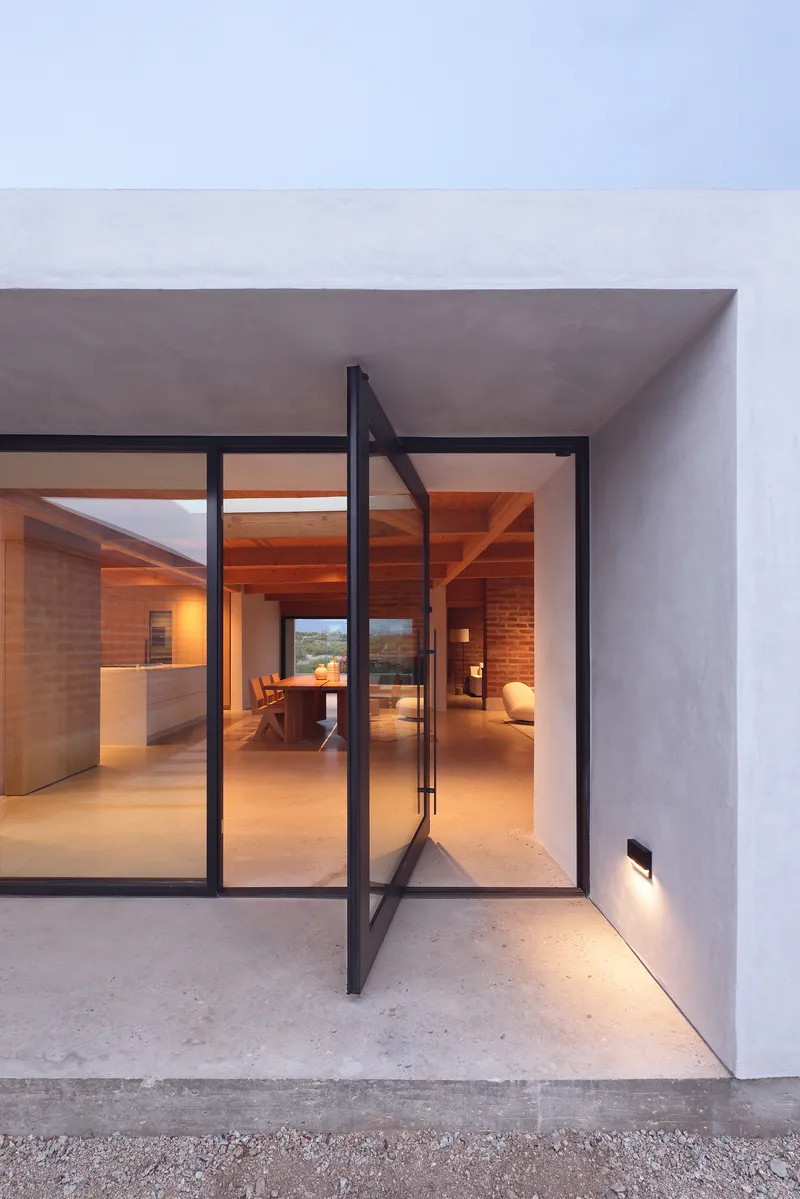
The entry sequence announces the project's material logic before you step inside. A black steel pivot door, oversized and deliberate, sits within a white stucco frame flanked by the original brick walls. The contrast is blunt: new metal against old masonry, clean plane against textured surface. When the door swings open, the view channels straight through to the brick interior, establishing an axis that pulls you toward the landscape beyond. There is no foyer clutter, no decorative flourish. The threshold is the argument.
Structural Liberation

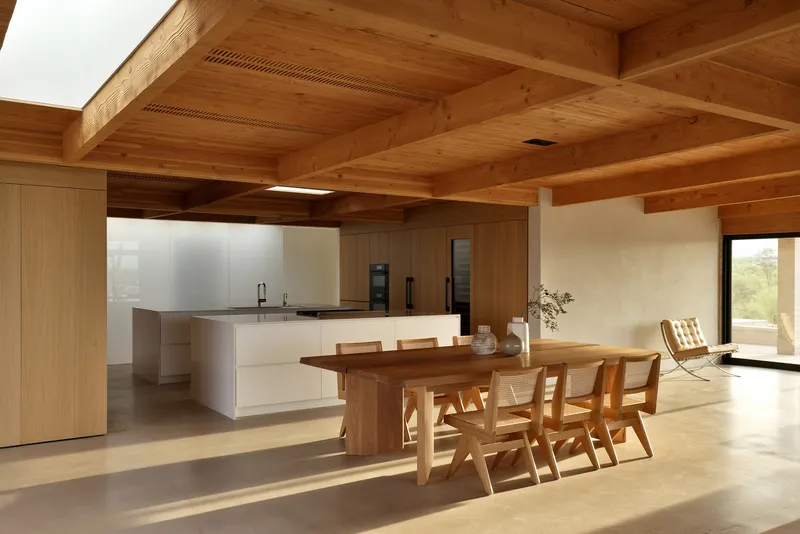

The defining act of Casa Luce is an absence. Where four masonry piers once carved the central space into quadrants, there is now open air and an uninterrupted sightline from the kitchen island to the panoramic window overlooking the desert. Removing those piers was not a cosmetic decision; it demanded innovative engineering and meticulous carpentry to transfer loads to the perimeter and create a floating ceiling. The result reads as effortless, which is precisely the point.
The original grid of painted wood beams and textured white plaster ceiling survives, now more legible without the piers cluttering the field below. Clerestory skylights introduced above the dining zone wash the timber frame in even light, turning the ceiling into an inhabitable diagram of the building's structure. You eat dinner under a structural grid that finally makes visual sense.
Light as Material


The project's name translates to "House of Light," and the renovation earns it. The skylit corridor running behind the kitchen's back wall of frosted glass is the most precise intervention: it transforms what was once the darkest zone of the house into a luminous spine. Overhead skylights cast striped shadows along the white counter, producing a sundial effect that shifts through the day. In the bathroom, a single skylight above the frosted glass shower enclosure turns bathing into a skyward experience.
Throughout the house, the partially exposed roof structure functions as a passive solar instrument. Douglas Fir tongue-and-groove planking and the beam grid filter and redirect light, casting moving shadows across the lime plaster walls and polished concrete slab floors. The effect is architectural rather than theatrical: you are always aware of where the sun is and how far it has traveled.
The Fireplace Wall and Original Fabric
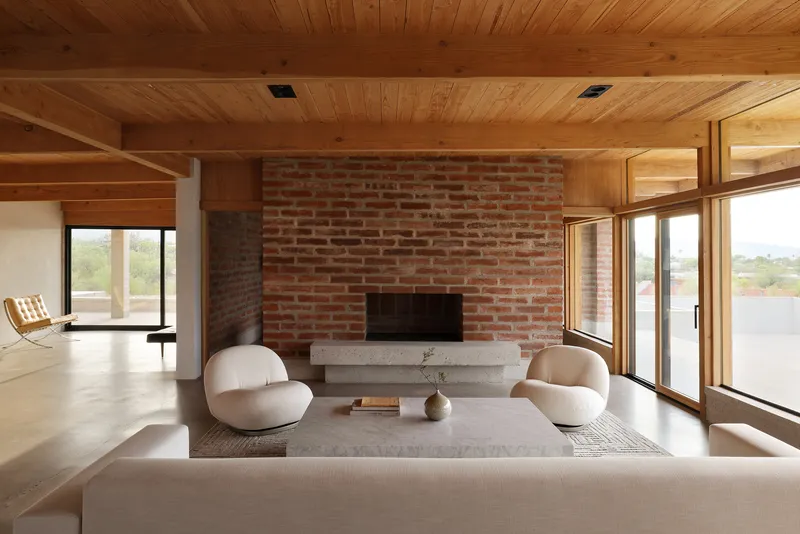


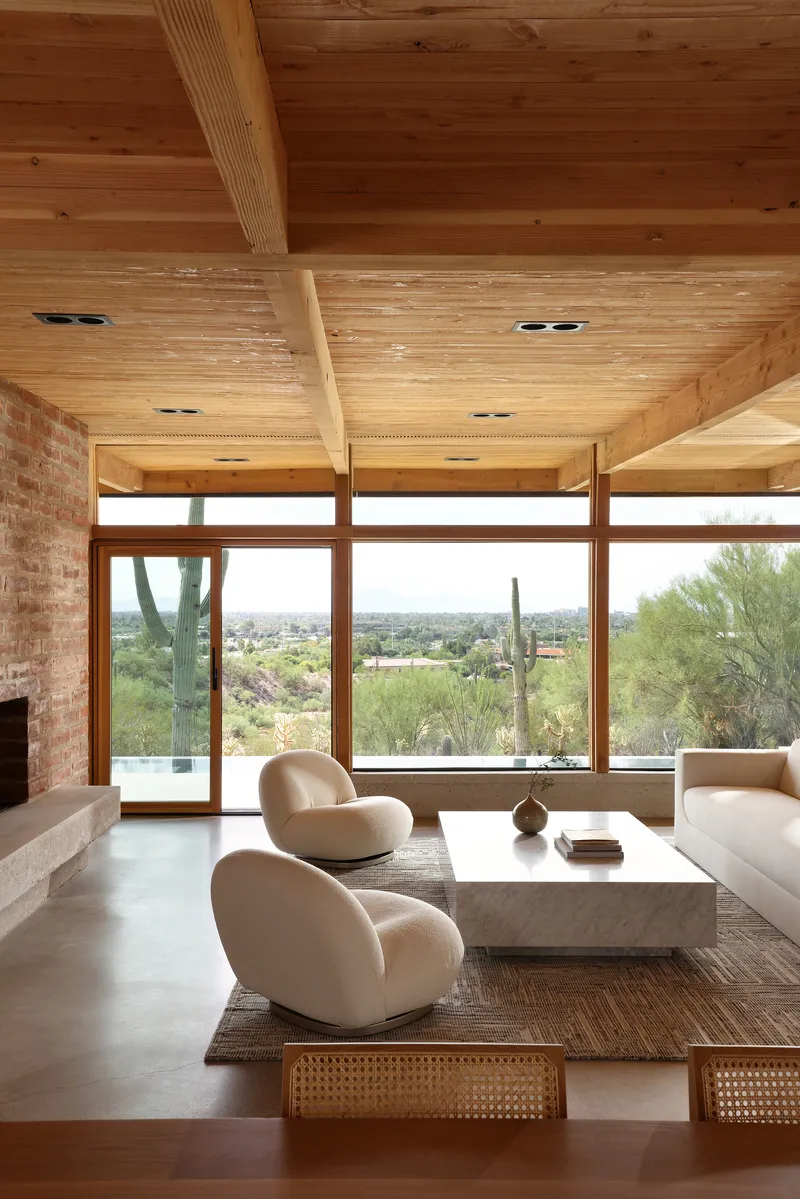
Not everything was stripped away. The red brick fireplace wall, with its concrete hearth and massive proportions, survives as the emotional anchor of the living room. Where the brick meets the timber paneling under the vaulted ceiling's diagonal wood planking, you can read the original Gist design in its purest form: heavy, warm, and unapologetically material. HK Associates had the discipline to leave this alone.
A white millwork niche tucked beneath a staircase, with exposed brick backsplash, demonstrates how new insertions can defer to the existing palette without mimicking it. The lime plaster is smooth and contemporary; the brick is rough and 1960s. They share a wall without competing.
Kitchen and Domestic Core

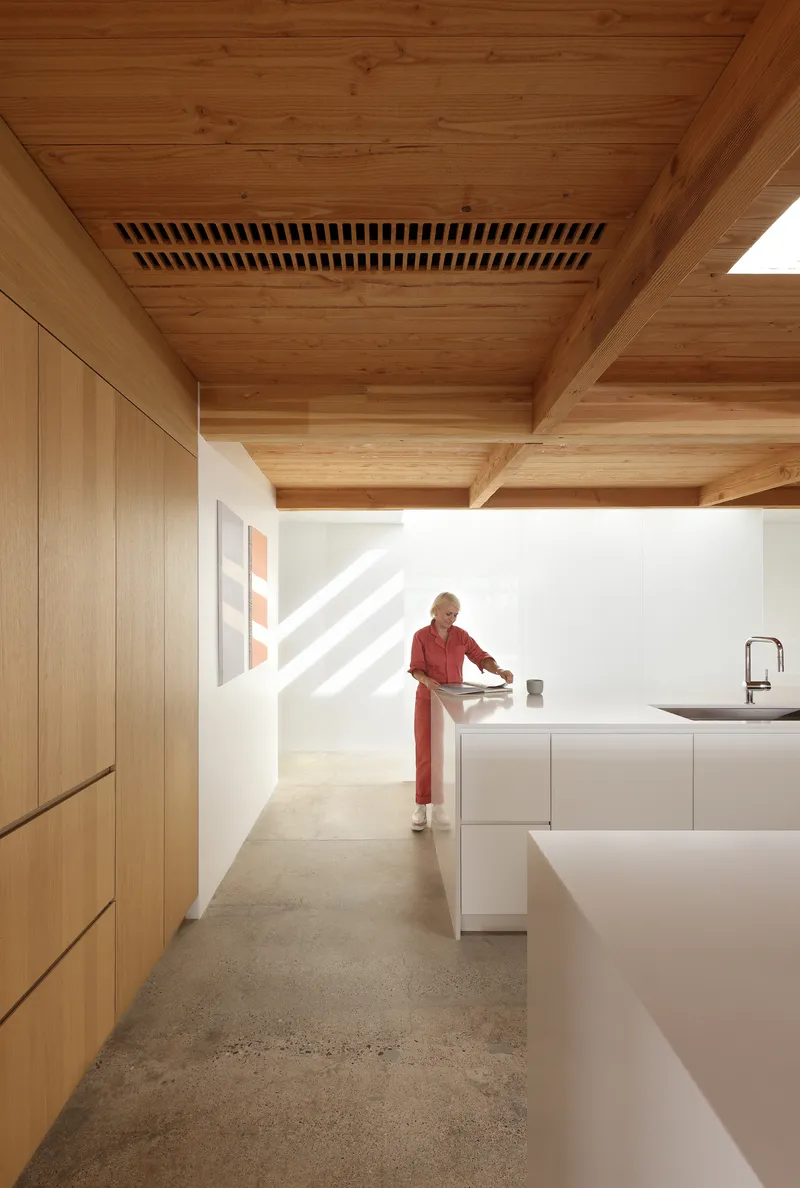

Gist's original kitchen was closed off and dimly lit, a service room hidden at the center of the plan. The renovation blows it open, connecting it visually to the dining area and the desert courtyard beyond through a continuous ceiling plane of heavy timber beams. Sustainable wood veneer cabinetry and a slatted timber ventilation grille inset in the ceiling maintain the material warmth while reading as distinctly contemporary in their detailing. The black undermount sink and dark faucet are small, deliberate contrasts against the Douglas Fir overhead.
Standing at the island counter, you look past the dining table, through the glass doors, and into the courtyard. The kitchen is no longer a room; it is a vantage point.
The Pool Terrace and Desert Horizon


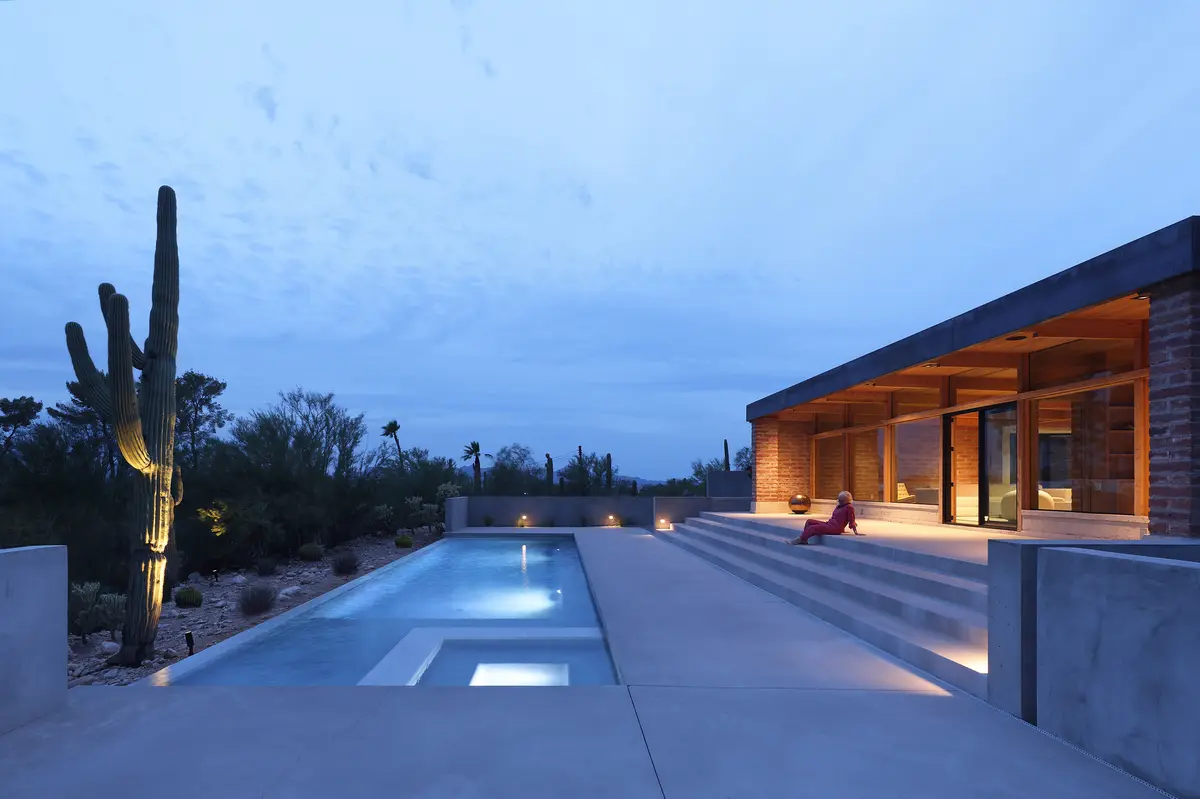
The outdoor sequence is where the project makes its most cinematic claim. A stepped concrete terrace descends from the glazed living pavilion to an infinity-edge pool that draws the eye south toward the Santa Rita Mountains. At twilight, the pool becomes a mirror: the timber ceiling, the saguaro silhouettes, and the last orange light all fold into the water's surface. The new patio just outside the picture windows dissolves the boundary between the polished concrete floor inside and the poured concrete deck outside.

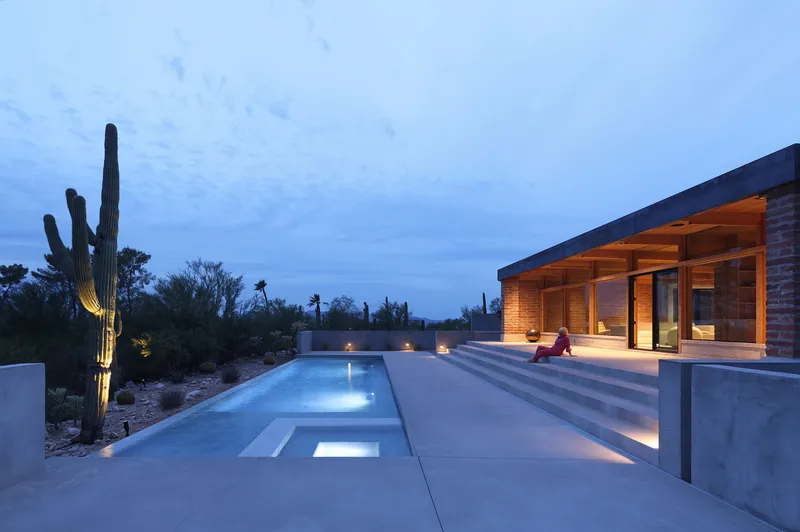

At night, the glass-walled pavilion glows like a lantern set into the hillside. The coffered timber ceiling and full-height glazing are reflected in the still pool, doubling the geometry. It is a house that photographs well at dusk because it was designed for dusk: the Sonoran Desert is most alive in the hours when the sun is low and the heat relents.
Bedroom Wing and Private Spaces


The bedroom wing, once connected by a low dark corridor, now participates in the house's larger commitment to light and air. A platform bed sits against warm timber wall panels in afternoon light that enters horizontally, filtered by the surrounding landscape. The powder room, with its floating white vanity, angled mirror, and constellation of spherical brass sconces, is the most overtly decorative moment in the house. It works because it is contained: a small, deliberate burst of personality within an otherwise disciplined material palette.
Plans and Drawings


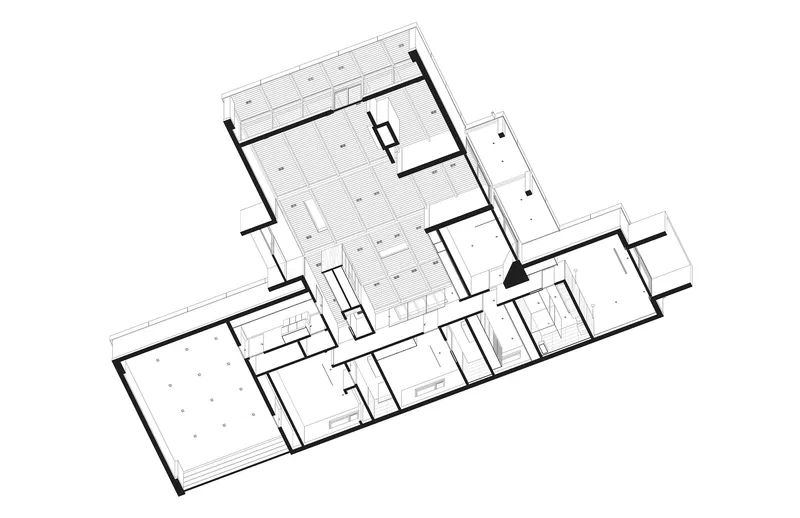
The site plan reveals how tightly the house grips its sloped site in the Catalina foothills, with the pool extending south as a landscape element rather than an afterthought. The floor plans show the open living spaces arranged along the south-facing edge, maximizing desert views, while a grid of bedrooms lines the perimeter for privacy. The removal of the four central piers is legible in plan as a void where structure used to be: the living room reads as one continuous field.

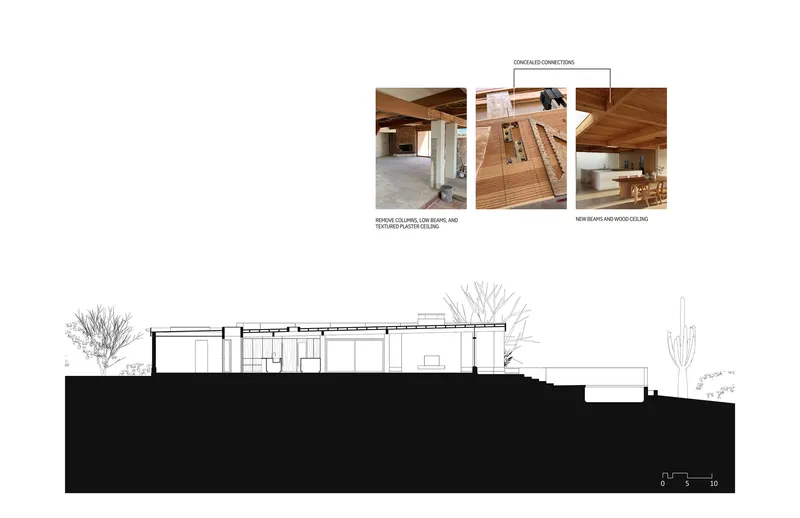
The section drawing through the sloped site is the most revealing document. It shows how the timber ceiling structure hovers above the interior volumes, creating a single continuous plane that unifies the disparate rooms below. The sketch elevations and perspectives illustrate the pavilion logic: exposed rafters, full-height glazing, and a roofline that barely rises above the desert scrub. Gist's original ambition to keep the house low and grounded survives intact.
Why This Project Matters
Mid-century modern renovations in the American Southwest tend to fall into two camps: reverential restorations that freeze the house in amber, or gut jobs that erase the original character in favor of contemporary minimalism. Casa Luce does neither. HK Associates treated the Gist house as a thesis with the wrong conclusion. The original materials, the adobe, the timber, the brick, were always right. The spatial organization was the problem. By removing the masonry piers and opening the core, they completed an argument that was started sixty years ago.
The project also demonstrates that "letting light in" is not a vague aspiration but a series of specific, engineerable moves: a skylit corridor here, a frosted glass wall there, a clerestory above the dining zone. Each intervention is targeted and legible. The house does not glow uniformly; it glows where it matters. That discipline, knowing when to cut and when to leave the brick alone, is what separates a good renovation from a thorough one.
Casa Luce, designed by HK Associates Inc (Kathy Hancox and Michael Kothke), Tucson, United States. 3,558 sq ft. Completed 2024. Photography by Ema Peter Photography.
About the Studio
Share Your Own Work on uni.xyz
If projects like this are the kind of work you want to make, uni.xyz is a place to publish your own, find collaborators, and enter design competitions.


Popular Articles
Popular articles from the community


ALGAL REALM: A Bio-Integrated Lunar Habitat Design for Life Beyond Earth
ALGAL REALM reimagines lunar habitat design with algae-powered life support, 3D-printed regolith, and vertical living for a lunar future.

Little Red Riding Hood: Architectural Design as a Journey Through Fear, Light, and Storytelling
Little Red Riding Hood reimagines the fairy tale through architectural design shaped by fear, light, scale, memory, uncertainty, and choice.

Co-life: Sustainable Architecture for Age-Friendly Community Living
Co-life reimagines sustainable architecture for seniors through courtyards, rammed earth, shared gardens, and spaces designed for belonging.

Hill & Cross Opera: Sculptural Opera House Architecture Shaped by Tallinn’s Landscape and Identity
Hill & Cross Opera reimagines opera house architecture in Tallinn through its sculptural hill, civic plaza, glass wave and a luminous cross.

Similar Reads
You might also enjoy these articles

Bao Huynh Watercolor Atelier: A Serene Art Retreat in Hội An
Bao Huynh Watercolor Atelier in Hội An blends multifunctional art spaces, sustainable design, local materials, and family-friendly living in a serene environment.

Atelier Macri Concept Store Interior Design by CASE-REAL
Atelier Macri store features a "ko" counter, walnut wood details, cork displays, blending retail, gallery, and seamless customer experiences.

Manuel Vargas Izquierdo Stadium and High-Performance Sports Center: Architectural Excellence in Jalpa de Méndez
The Manuel Vargas Izquierdo Stadium blends sustainable design, inclusive sports facilities, and cultural-inspired architecture, revitalizing Jalpa de Méndez’s public spaces.

KAKR Buluh Awar Hall: Revitalizing Community and Ecology Through Bamboo Architecture
Community built bamboo hall revitalizes Buluh Awar village, empowering youth, restoring ecology, celebrating vernacular craftsmanship through sustainable architecture and culture.

Explore Luminaire Competitions
Discover active competitions in this discipline

Challenge to design luxury tourism on rails

VR headsets Storefront design competition

Bring back Drive In's

Designing a staircase for a client
Comments (0)
Please login or sign up to add comments
No comments yet. Be the first to comment!