
Hoem and Folstad Arkitekter Wrap an Old Log House in Windswept New Volumes on Norway's North Sea Coast
A young family's home in Åkrehamn grows from a salvaged log core into a cluster of shingle-clad gables facing the open prairie and sea.


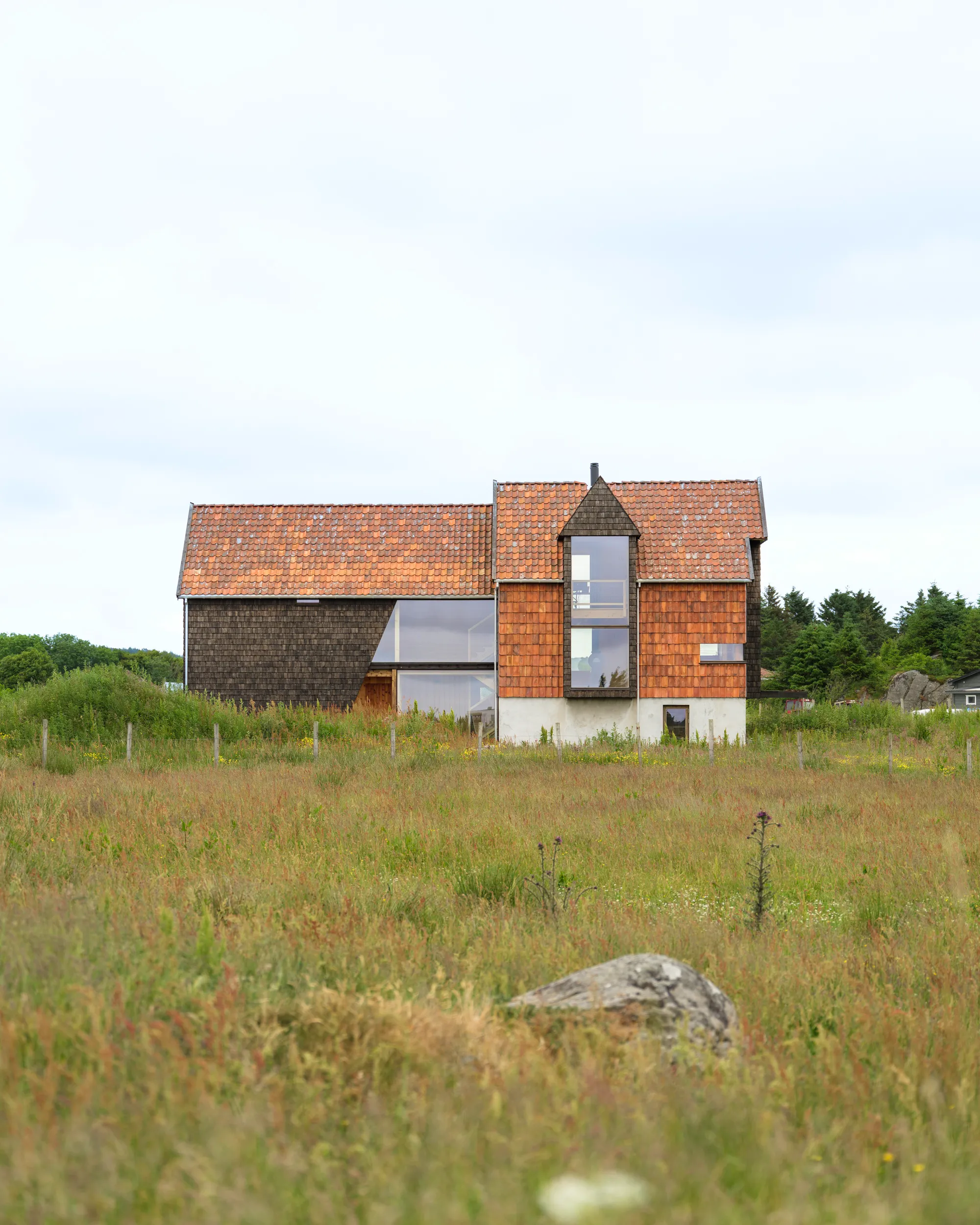
On the flat, wind-battered coastline near Åkrehamn, Norway, a house had to earn its place. Hoem and Folstad Arkitekter did not start from scratch: an existing log house already occupied the site, and rather than demolish it, the architects absorbed it into a new family dwelling. The result, completed in 2023, reads as a small settlement of interlocking gabled forms that looks as though it has been accumulating on this plain for generations.
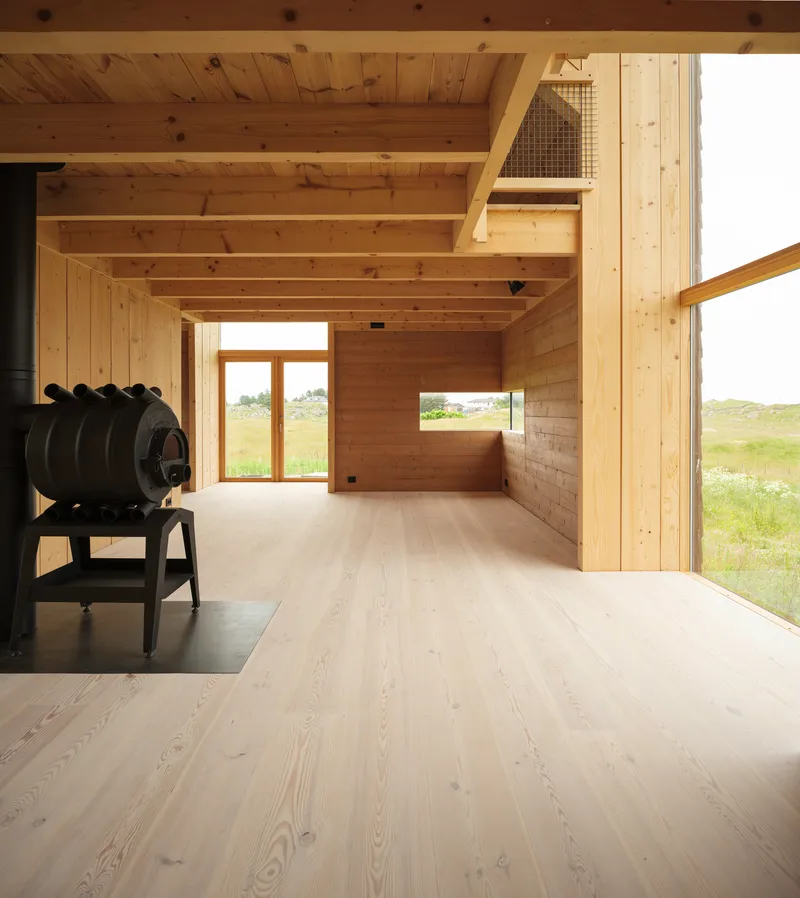
What makes The Prairie House compelling is the tension between preservation and invention. The old log structure provides thermal mass, a sense of gravity, and a narrative anchor. The new volumes that cluster around it are clad alternately in weathered shingles and rough-sawn timber, their steep gables acknowledging both regional building tradition and the practical need to shed the relentless rain driven in from the North Sea. Inside, the architecture is almost entirely timber: walls, ceilings, stairs, and thresholds are lined with planks that blur the boundary between the inherited structure and the new one surrounding it.
A Cluster That Reads as a Settlement


Seen from the pasture below, the house does not present itself as a single object. Instead, it appears as a gathering of individual gabled buildings at slightly different scales, their rooflines stepping up and down the gentle slope. Sheep graze in the foreground, reinforcing the agrarian character. The architects clearly wanted the project to sit within its landscape rather than announce itself against it.
The cladding strategy is central to this effect. Dark, fish-scale shingles cover the primary gable facades, while lighter timber boards wrap the connecting volumes and secondary elevations. The material contrast gives each volume its own identity, as if one section had been built a decade before the next. It is a deliberate fiction, but it works: the house achieves a compositional ease that a single monolithic form never could on this exposed, treeless site.
Timber Inside and Out
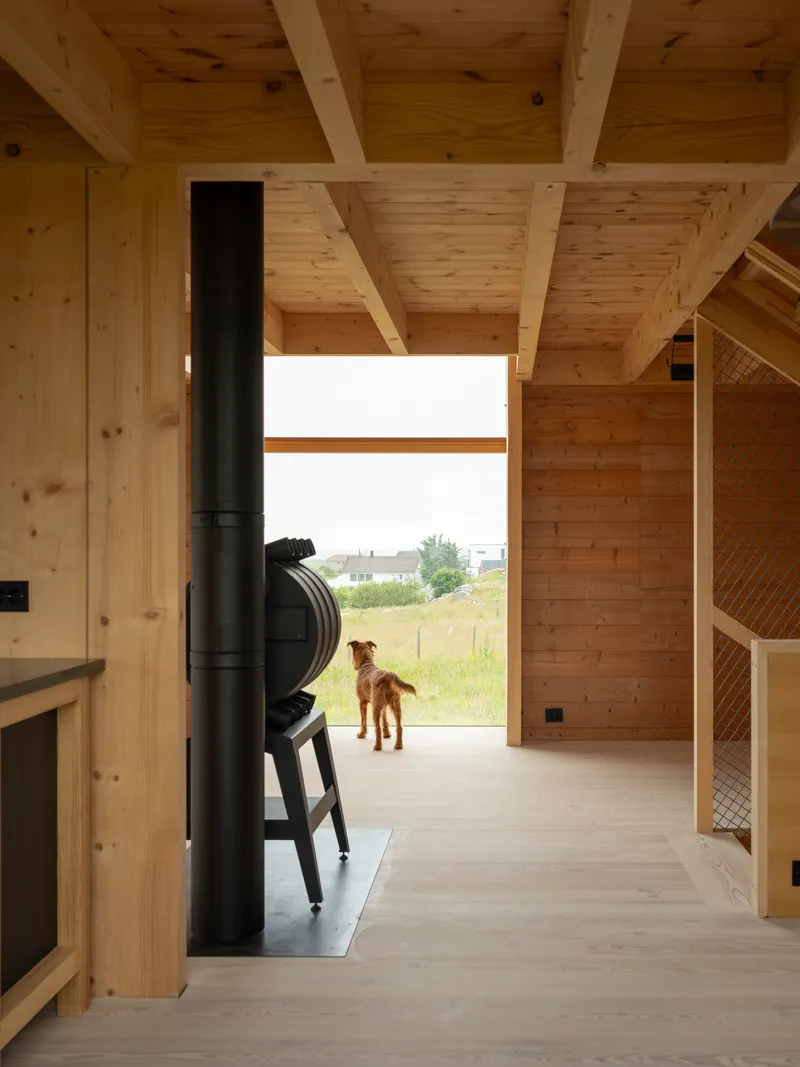

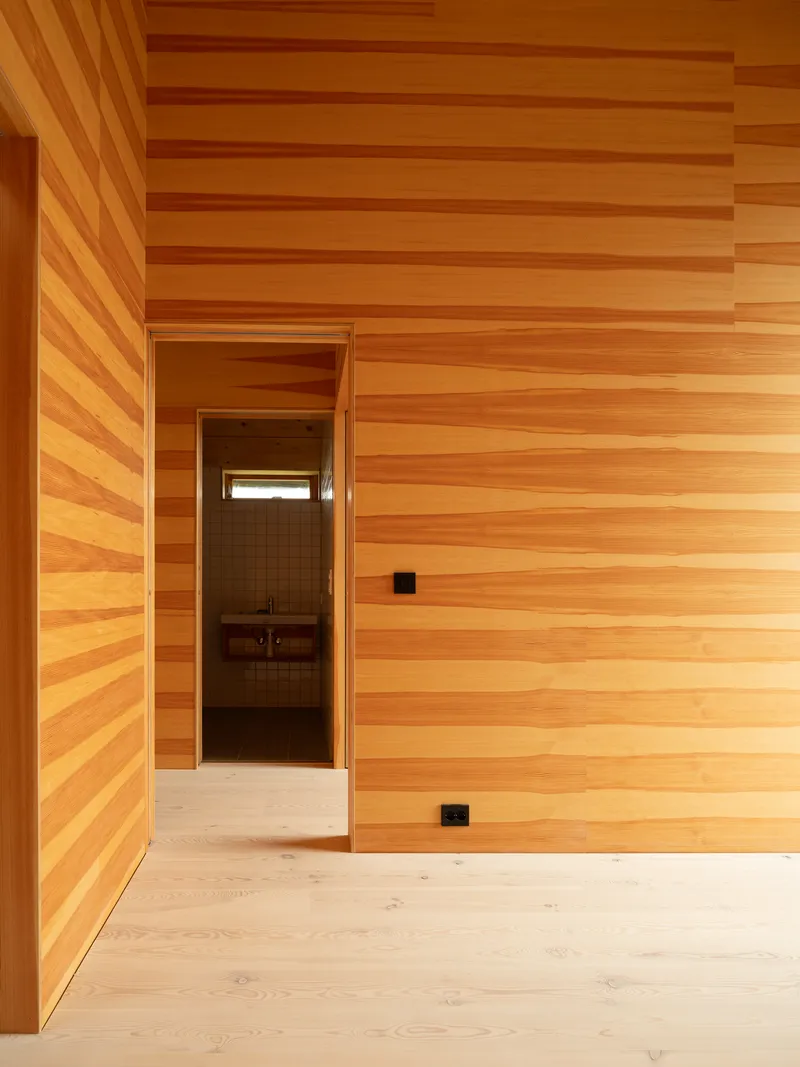
Step through any doorway and the interior is overwhelmingly wood: horizontal planks on the walls, exposed joists overhead, solid timber thresholds that mark the passage from one volume to the next. There is no drywall in sight. The planking runs in different directions and profiles depending on whether you are in the older log core or a new addition, which gives each room a subtly different character while maintaining a unified material palette.
Doorways are deliberately narrow and low, framing views through to the rooms beyond. Light enters from different angles as you move through the plan, and the timber surfaces shift from golden warmth to deep amber depending on exposure. It is an interior that rewards slow movement.
Living with the Landscape

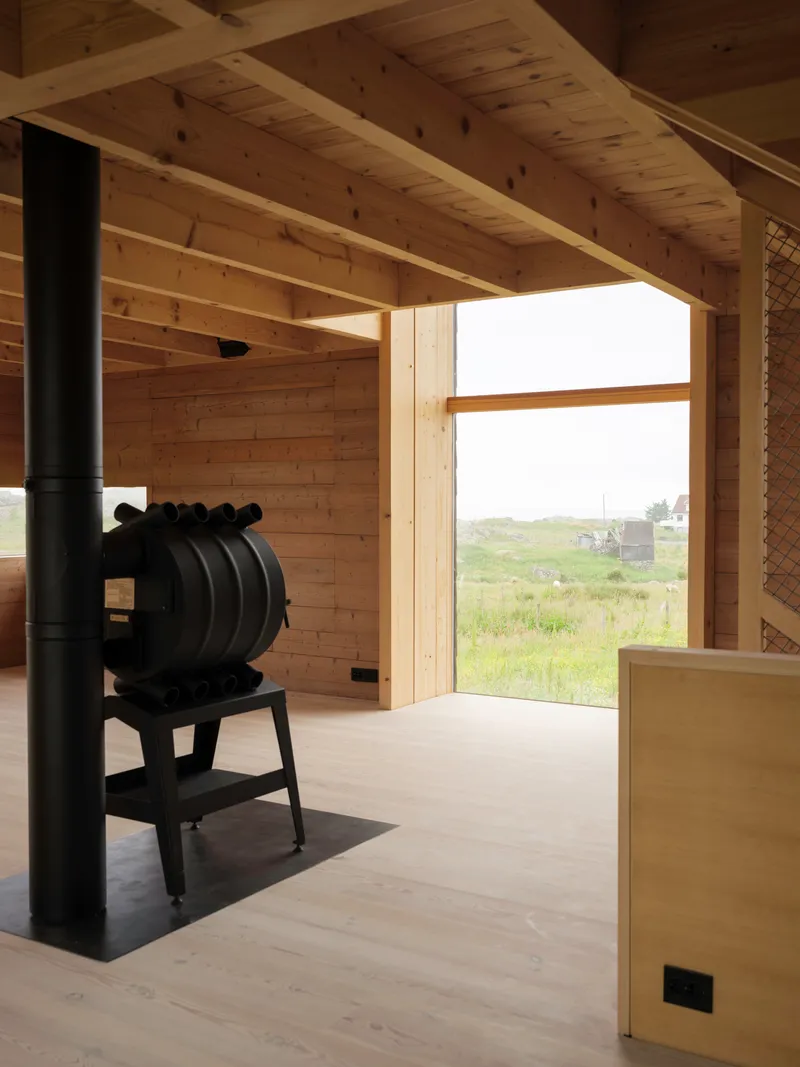
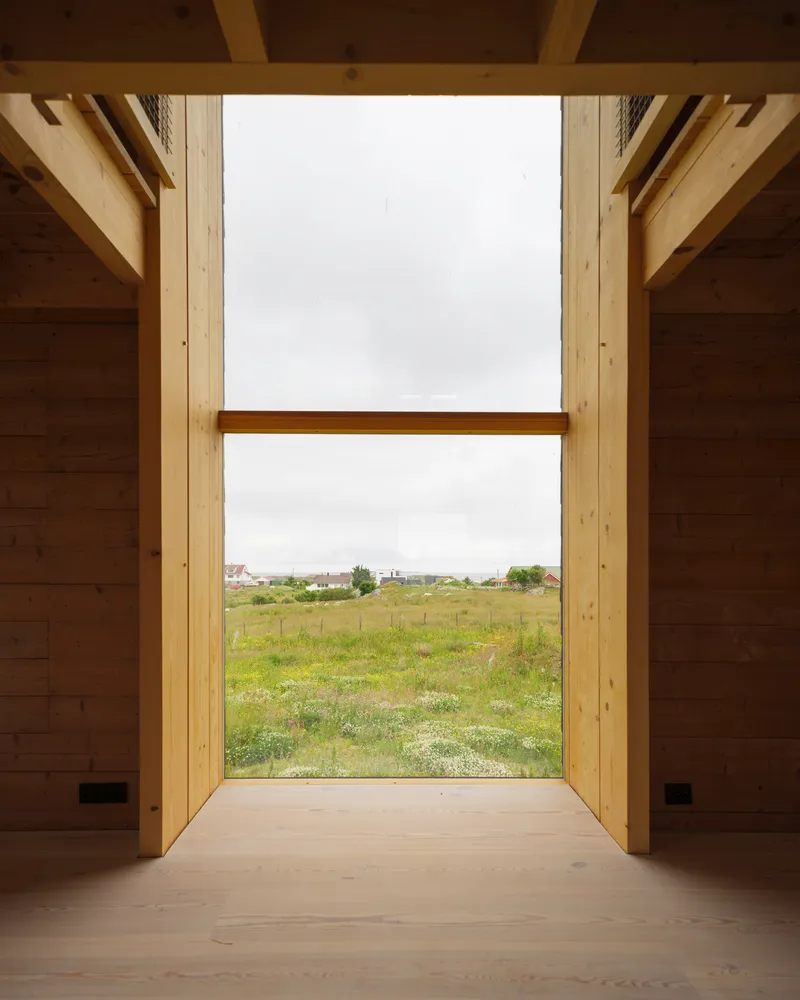
The house faces one of Norway's best coastal landscapes, and the architects exploit this fact without resorting to floor-to-ceiling glass walls. Windows are carefully sized and placed: tall vertical slots in the gable ends, a generous window seat beside the wood stove, a picture frame that captures the green meadow and scattered houses beyond. Each opening offers a composed view rather than a panorama, which makes the landscape feel more present, not less.
The black cast-iron stove is a recurring anchor point. It appears in the main living space and again in secondary rooms, its dark metal form standing out sharply against the warm timber. On a site where winter storms drive rain horizontally off the North Sea, the stove is not decorative. It is the center of domestic life, and the architecture defers to it accordingly.
The Central Stair as Vertical Spine

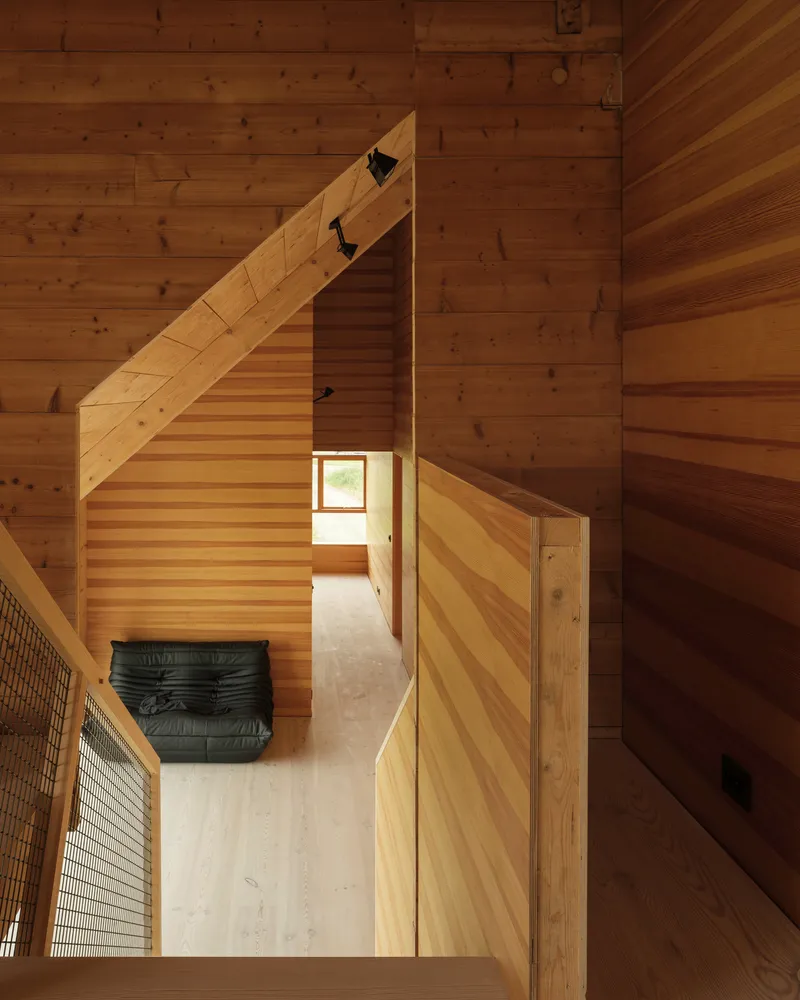
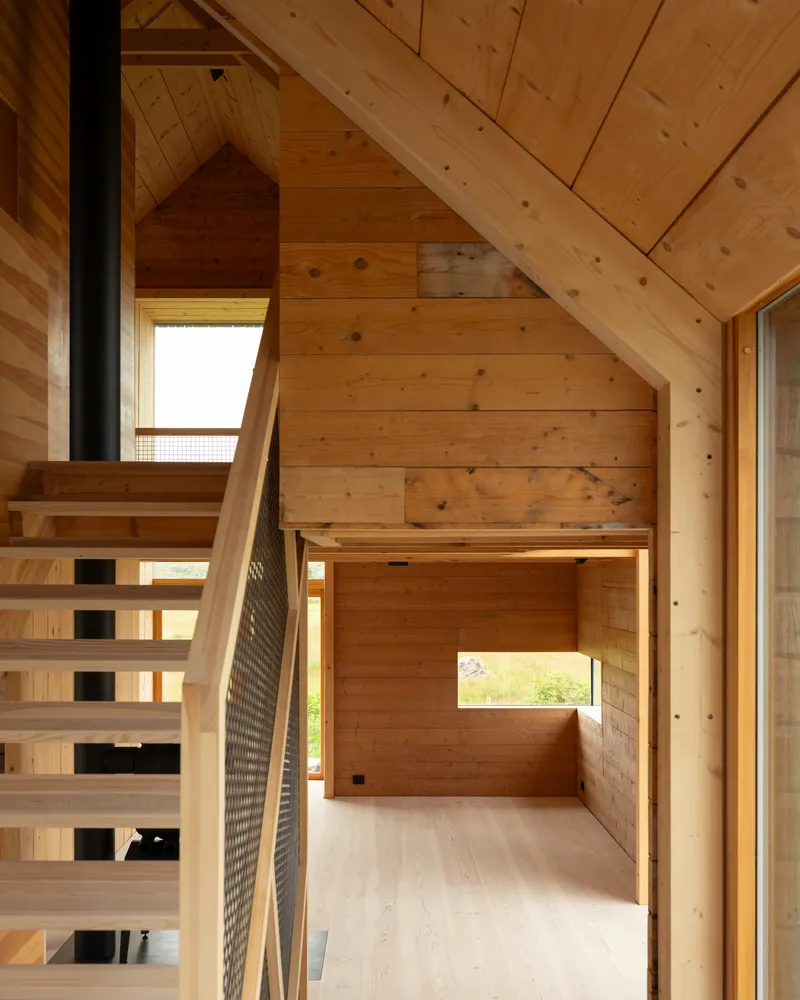
An open-tread timber staircase rises through the house like a spine, connecting the ground floor living spaces to the bedrooms and library above. Its diagonal run is visible from multiple rooms, creating long sightlines that make the compact plan feel larger than its footprint. Wire mesh guardrails keep the stair transparent without sacrificing safety, a pragmatic choice for a house with young children and, judging by the photographs, at least two dogs.
The stair also brings light deep into the section. Skylights in the pitched roof above wash the upper landing, and this borrowed light filters down through the mesh and open treads to the ground floor corridor. It is a simple move executed with care.
Upper Rooms Under the Gable


The upper floor occupies the pitched volumes, and the gabled ceilings give each room a tent-like enclosure. Horizontal timber cladding follows the rake of the roof, pulling your eye upward. Mesh guardrails appear again at windows that reach down to floor level, letting children look out over the meadow safely.
One room is lit by a spherical pendant lamp that hangs in an illuminated doorway, the only moment of visual softness in an otherwise rectilinear interior. These upper spaces feel intimate without being cramped, their proportions calibrated to the steep roofline rather than fighting it.
The Bathing Room and Quiet Details

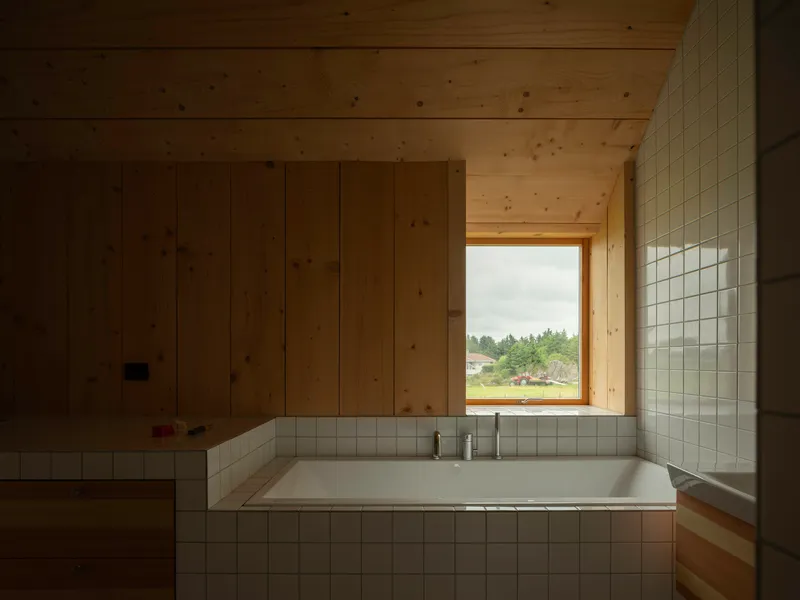

The bathroom makes a deliberate material shift. White tiles replace timber, creating a cooler, cleaner register that contrasts with the warmth of the rest of the house. A recessed bathtub sits beneath a timber-framed window that looks out over distant forest and shoreline. It is a considered luxury in a project that otherwise avoids indulgence.
Elsewhere, a raised timber platform with built-in steps serves as a casual seating area, its sun-drenched surface apparently claimed by the family dogs. These small moments of spatial invention, a step here, a nook there, give the house a tactile generosity that compensates for what is likely a modest overall area.
The Log House and Its Afterlife


One photograph reveals a white timber-clad gabled structure elevated on concrete piers within a dense conifer grove, likely the original log house in an earlier or adjacent condition. The contrast with the new construction is stark: where the old house sat lightly on the land, the new volumes grip the hillside and claim territory. Yet the old house's DNA, its log walls, its proportions, its modest scale, persists inside the new envelope.
The architects' decision to retain the log core is both pragmatic and poetic. Pragmatic because reuse avoids waste and preserves embodied energy. Poetic because the old structure introduces a temporal depth that new construction alone cannot achieve. You can feel it in the slightly uneven surfaces, the thicker walls, the different rhythm of the original timber.
Plans and Drawings


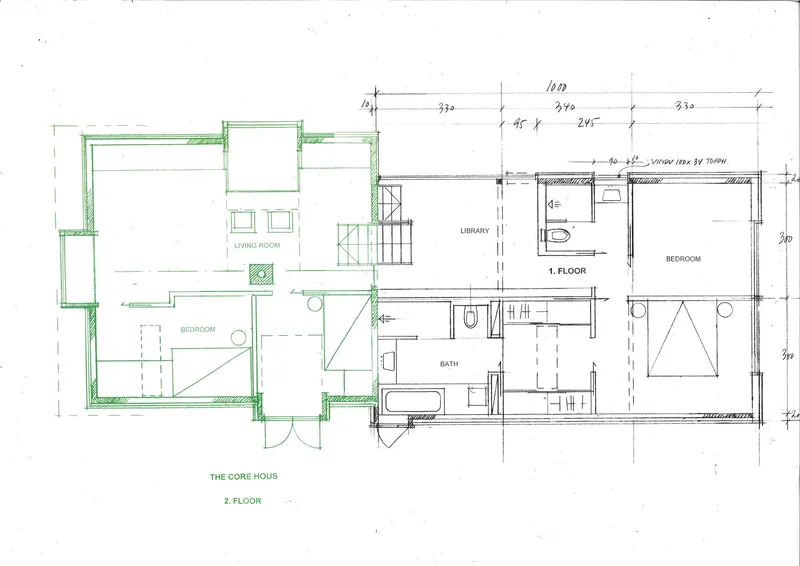


The site plan shows the building's footprint in relation to the existing structure and the surrounding grassland parcel, confirming the additive logic visible in the elevations. The ground floor plan reveals the central stair hall connecting the living room and kitchen to a garage volume, while the second floor distributes bedrooms, a library, and a bathroom around the same staircase. The section drawing cuts through the primary gabled volume and exposes the bay windows, chimney, and timber framing that give the interior its character.
What the drawings clarify is the compactness of the plan. The house is not large; it reads as generous only because the architects used every cubic centimeter of the gabled volumes and threaded light through the section with precision. The library on the upper floor, tucked into one of the smaller gables, is a particularly elegant use of leftover roof space.
Why This Project Matters
The Prairie House matters because it demonstrates that preservation and new construction need not be separate acts. By absorbing an old log house into a cluster of new volumes, Hoem and Folstad Arkitekter have produced a dwelling that possesses both the material memory of the existing building and the spatial ambition of contemporary design. On a site where the climate is hostile and the landscape is vast, this kind of anchoring, to history as much as to the ground, gives the house a rootedness that purely new architecture rarely achieves.
The project also offers a quiet lesson in restraint. There are no dramatic cantilevers, no performative sustainability gadgets, no gestures aimed at publication rather than habitation. The house is timber, shingles, a stove, and well-placed windows. It is architecture that trusts its materials and its site, and that confidence makes it one of the more convincing new houses we have seen on the Norwegian coast in recent years.
The Prairie House, by Hoem and Folstad Arkitekter. Åkrehamn, Norway. Completed 2023. Photography by Knut Folstad.
About the Studio
Share Your Own Work on uni.xyz
If projects like this are the kind of work you want to make, uni.xyz is a place to publish your own, find collaborators, and enter design competitions.



Popular Articles
Popular articles from the community


Riyadh For All: Intergenerational Urban Design for Active Aging in Rabat
Riyadh For All reimagines urban design in Rabat with intergenerational co-living, adaptive courtyards, and Moroccan cultural exchange today.

Conexión: Biophilic Design Reimagines High-Rise Living in Hong Kong
Conexión reimagines high-rise living in Hong Kong through biophilic design, green facades, shared spaces, daylight, water and nature within.

The Earth Pod: 3D Printed Homes for Resilient Refugee Communities
The Earth Pod reimagines refugee housing through 3D printed homes made from clay, combining resilience, self-sufficiency, and rapid shelter.

Co-life: Sustainable Architecture for Age-Friendly Community Living
Co-life reimagines sustainable architecture for seniors through courtyards, rammed earth, shared gardens, and spaces designed for belonging.


Similar Reads
You might also enjoy these articles

Bao Huynh Watercolor Atelier: A Serene Art Retreat in Hội An
Bao Huynh Watercolor Atelier in Hội An blends multifunctional art spaces, sustainable design, local materials, and family-friendly living in a serene environment.

Atelier Macri Concept Store Interior Design by CASE-REAL
Atelier Macri store features a "ko" counter, walnut wood details, cork displays, blending retail, gallery, and seamless customer experiences.

Manuel Vargas Izquierdo Stadium and High-Performance Sports Center: Architectural Excellence in Jalpa de Méndez
The Manuel Vargas Izquierdo Stadium blends sustainable design, inclusive sports facilities, and cultural-inspired architecture, revitalizing Jalpa de Méndez’s public spaces.

KAKR Buluh Awar Hall: Revitalizing Community and Ecology Through Bamboo Architecture
Community built bamboo hall revitalizes Buluh Awar village, empowering youth, restoring ecology, celebrating vernacular craftsmanship through sustainable architecture and culture.




Comments (0)
Please login or sign up to add comments
No comments yet. Be the first to comment!