
CZWG Architects Wraps Two Docklands Towers in Rippling Balconies That Borrow Heat from Next Door
Hoola London rises on a former island site in Royal Victoria Docks, pairing sinuous precast concrete balconies with a radical off-site energy strategy.


London's Royal Victoria Docks have been a proving ground for regeneration optimism since the 1990s, but much of what has been built there treats the water as backdrop rather than design driver. Hoola London, completed in 2017 by CZWG Architects, takes the opposite approach. Its two towers, 23 and 24 stories respectively, sit on a stranded scrap of land that highway engineering in the 1960s turned into a near-island, severed from its surroundings by slip roads, the DLR, and a high tidal water table. The architects responded to every one of those constraints by folding them into the architecture itself: the oval floor plates, the undulating balconies, even the decision to import heat from the neighboring ExCeL exhibition centre all flow from a close reading of what the site actually offers and what it withholds.
What makes Hoola genuinely interesting is how its most visible gesture, those rippling concrete balconies, does double duty as both climate device and structural expression. The 1,410 precast balcony sections alternate in width from floor to floor, limiting overshadowing of the apartments below while generating a visual rhythm that links the towers to the movement of water in the docks. It is a rare case where the photogenic move and the performance move are the same thing.
Reclaiming an Island
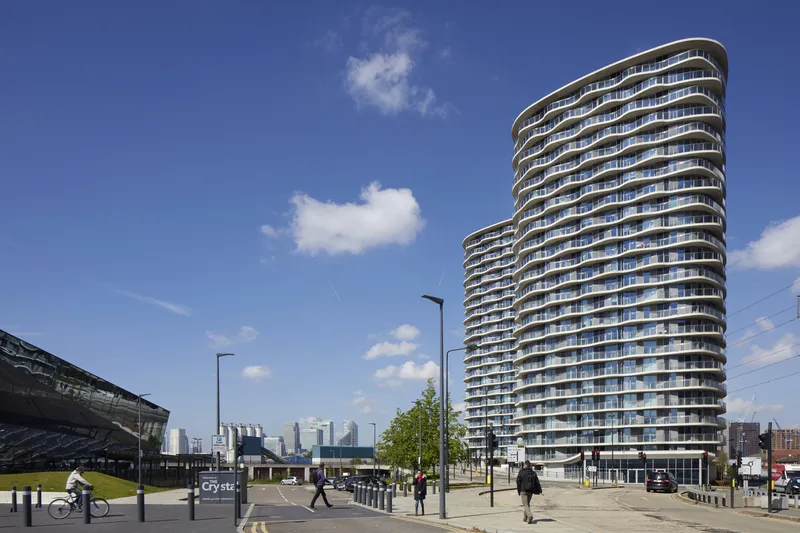
The site's isolation was real. Cut off to the north by the Docklands Light Railway, hemmed in to the west by highway systems, and bounded to the south by a climbing slip road, the parcel was essentially derelict. CZWG's most consequential design decision may have been the least visible: they built an artificial hill beneath the towers, raising the ground plane so that the main entrance shifts from lower to upper Tidal Basin Road. That single topographic move creates a new street frontage, reconnects the development to the mainland, and gives the landscape architect, Churchman Landscape Architects, something to sculpt. Planted terraces cascade down the northern and western edges, concealing a single-level basement that houses parking, refuse, and plant spaces.
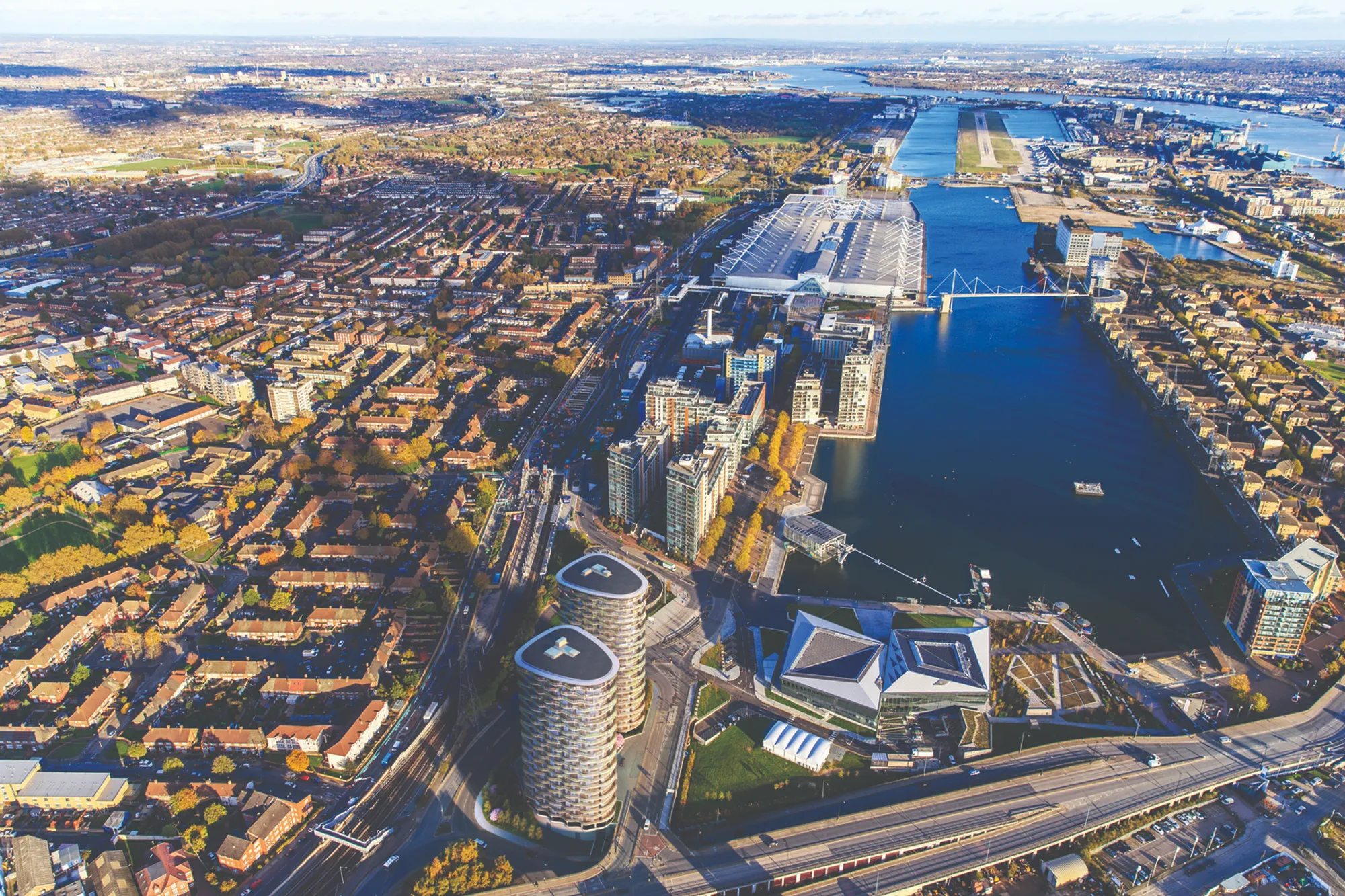
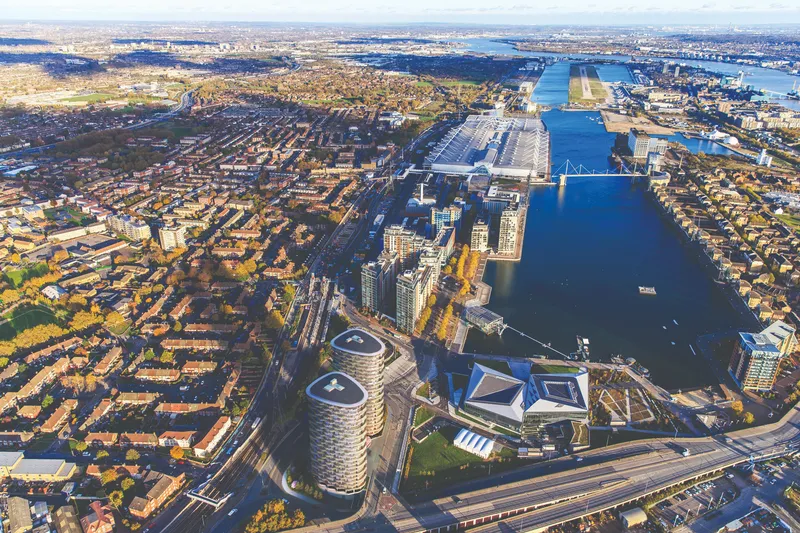
From the air, the two oval footprints read as calm counterpoints to the angular infrastructure around them. The shapes are not arbitrary. The orientation maximizes southeast and western views while minimizing the distance at which residents in one tower look directly into the other. Story heights were squeezed to the legal minimum so that the architects could stack more floors under a hard ceiling imposed by London City Airport's flight path. Every dimension is the product of negotiation between aspiration and regulation.
A Facade That Breathes
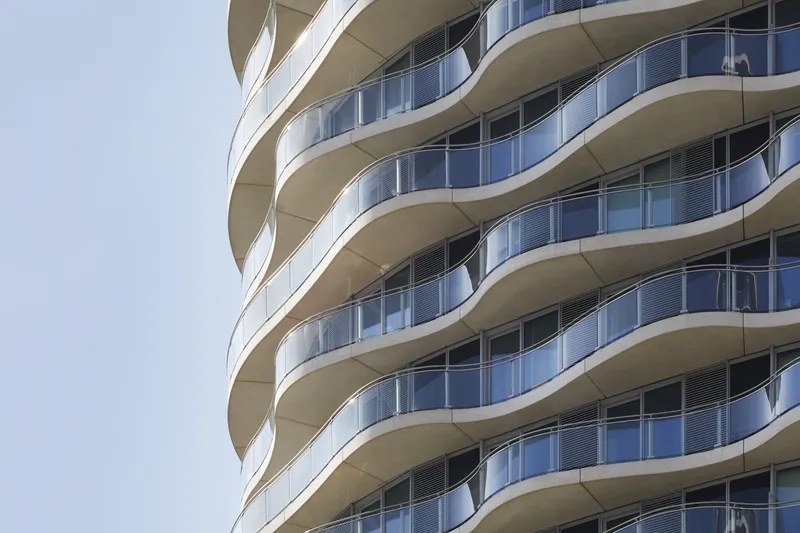
The balconies are Hoola's signature, and CZWG took the detailing seriously. Nearly 50 different dimensional configurations were required for the curved front faces, all cast in reconstituted Portland Stone Concrete and connected to the in-situ concrete structure through Schöck Isokorb thermal breaks. Those breaks are essential: without them, each balcony slab would act as a thermal bridge, bleeding heat from the apartments in winter. With them, the envelope stays super-insulated and the concrete frame functions as a heat sink, absorbing warmth on hot days and releasing it when temperatures drop.
The alternating balcony widths create the ripple effect that photographs capture so well, but the pattern is also functional. By varying projection from one floor to the next, the design limits the shadow cast on the apartment directly below, preserving daylight access across the full height of each tower. Floor-to-ceiling UV-reflecting glass completes the envelope strategy, maximizing views while filtering solar gain.
Borrowing Energy from the Neighbors
Sustainability claims in residential towers often amount to a checklist of green technologies bolted onto a conventional plan. Hoola's approach is more systemic. The development entered an energy-sharing agreement with the adjacent ExCeL London exhibition centre, tapping excess heat from ExCeL's combined heat and power plant. That single arrangement eliminated the need for any on-site heating provisions, a remarkable outcome for an £80 million, 360-unit scheme. Combined with the passive strategies embedded in the facade and structure, the project achieved a carbon reduction of nearly 57% against the 2010 baseline.
The lesson here is infrastructural, not just architectural. Hoola demonstrates that the most impactful sustainability decisions for a residential tower may lie outside its site boundary, in the energy relationships a developer is willing to negotiate with neighboring buildings. It is a model that requires trust, contractual sophistication, and proximity to a suitable heat source, but when those conditions align, the carbon savings dwarf anything a rooftop solar array can deliver.
Living Between Water and Sky
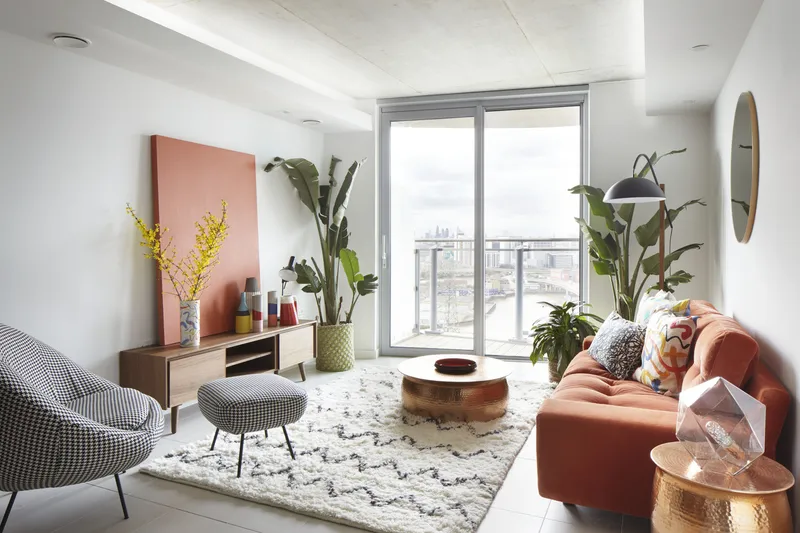
Interiors, designed by Johnson Naylor, let the views do the talking. The floor-to-ceiling glazing turns each apartment into a panoramic frame for the docks, the cable car, and the broader London skyline. The 360 units range from studios to three-bedroom apartments, with the Western Tower anchored by a residents' lounge and gym and the Eastern Tower oriented toward business facilities and a ground-level commercial unit that fronts the Royal Docks. The split programming is a quiet acknowledgment that a tower of this scale needs to serve more than one mode of daily life.
Structurally, Ramboll UK engineered the concrete cores to support the oval floor plates and the continuous glazed facade while accommodating the site's considerable challenges: Crossrail tunnels running beneath, an existing culvert threading through the parcel, and a high tidal water table. That the finished building reads as effortless is a testament to how thoroughly the engineering was resolved before the first balcony section was cast.
Plans and Drawings
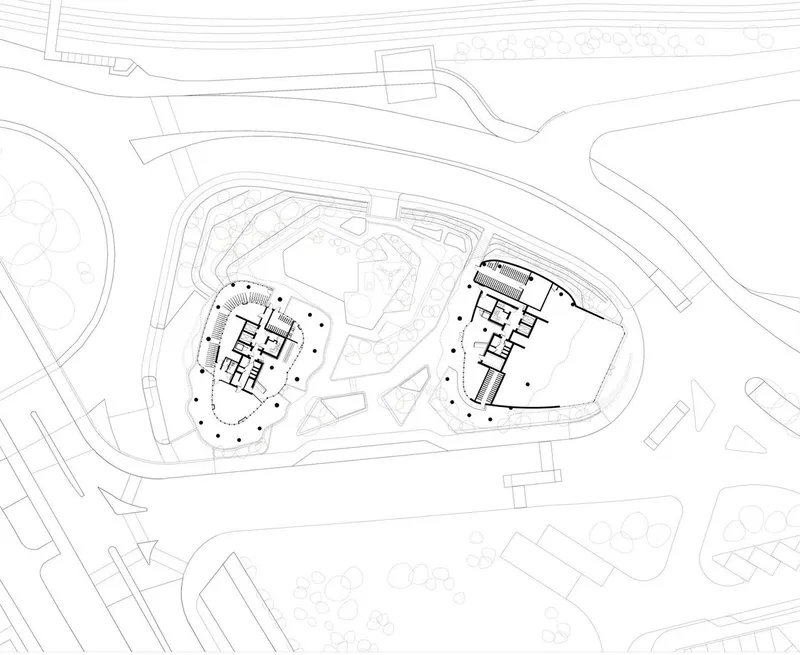
The site plan reveals how precisely the two oval footprints are oriented within the landscaped parcel. The curvilinear geometry is not a stylistic preference; it is the shape that maximizes apartment frontage toward the southeast and west while keeping the two towers far enough apart to prevent direct overlooking. The green spaces between and around the towers function as a transition device, mediating between the raised ground plane and the surrounding road network while providing courtyards, play areas, and quiet seating for residents.
Why This Project Matters
Hoola London matters because it proves that a high-density residential tower on a constrained, previously derelict site can be more than the sum of its planning compromises. CZWG turned every limitation, the airport flight path, the highway isolation, the proximity of Crossrail tunnels, into a design parameter rather than an excuse. The result is a pair of towers whose shape, structure, and energy strategy are all derived from the same site logic.
It also matters as a precedent for inter-building energy sharing in London's rapidly densifying docklands. If neighboring developments begin to see each other as thermal partners rather than competing plots, the cumulative carbon impact could be transformative. Hoola is not a utopian diagram; it is a built, occupied demonstration that the idea works. For a profession fond of speculative sustainability rhetoric, that built proof is worth more than any manifesto.
Hoola London by CZWG Architects. Location: Tidal Basin Road, Royal Victoria Docks, London, United Kingdom. 360 apartments across two towers of 23 and 24 stories. Completed April 2017. Structural Engineer: Ramboll UK. Landscape Architect: Churchman Landscape Architects. Interior Design: Johnson Naylor. Photography by Jack Hobhouse.
About the Studio
Share Your Own Work on uni.xyz
If projects like this are the kind of work you want to make, uni.xyz is a place to publish your own, find collaborators, and enter design competitions.




Popular Articles
Popular articles from the community


The Musturak Paradise: Senior Living Architecture for a Connected Future in Temara, Morocco
The Musturak Paradise reimagines senior living architecture in Temara via private homes, social spaces, culture, community, and shared care.

Hill & Cross Opera: Sculptural Opera House Architecture Shaped by Tallinn’s Landscape and Identity
Hill & Cross Opera reimagines opera house architecture in Tallinn through its sculptural hill, civic plaza, glass wave and a luminous cross.

Lunar Spiral: Space Architecture Shaped by the Mathematics of the Universe
Lunar Spiral reimagines space architecture through Fibonacci geometry, lunar regolith, levitating habitats, and self-sustaining Moon living.

Riyadh For All: Intergenerational Urban Design for Active Aging in Rabat
Riyadh For All reimagines urban design in Rabat with intergenerational co-living, adaptive courtyards, and Moroccan cultural exchange today.


Similar Reads
You might also enjoy these articles


Hodi-Mandai Geram
Project Function: Preservation and revitalization of the Intangible heritage and socio-spatial identity of the Hodi by Housing, Cultural Memory Center, Sacred Grove, landscape, local tourism economy


Olio Towers: A Mid-Rise for Performers That Fuses Housing, Rehearsal, and Stage
Located blocks from Houston's Theater District, this modular tower stacks living units around a central performance atrium.

Oasis: Modular Green Housing Carved into Dhaka's Urban Fabric
A shortlisted Plugin Housing entry reclaims unauthorized settlements in Dhaka with stepped concrete volumes, green roofs, and ventilation-driven design.

Black Hole: A Floating Megastructure for the Post-Physical Era
Emiliano Mazzarotto envisions a spherical, self-scaling arena where e-sports, digital hotels, and holographic stadiums replace traditional public space.

Explore Architecture Competitions
Discover active competitions in this discipline



Challenge to reimagine the Iron Throne


Photograph architecture without architects


Illustrate the lost glory of Angkor Wat - Render Challenge


Design challenge to reuse E-waste
Comments (0)
Please login or sign up to add comments
No comments yet. Be the first to comment!