
Hourglass: A Climate Change Memorial in Egypt That Uses Sunlight as Its Warning System
A suspended field of glass, a forest of stone columns and a solar lens combine to turn global warming into a shifting, wordless experience of light.


Most memorials look backward, fixing a finished event in stone. Hourglass points its attention at something still unfolding. It treats climate change as a process with a clock running, and builds that clock out of sunlight, glass and stone. The result is less a monument than an instrument: a structure that takes the abstract mechanics of global warming and makes visitors feel them through heat, refraction and shifting colour.
Conceived by Mikhail Skisov, the speculative project proposes a monumental intervention in Egypt's desert landscape. The hourglass gives the scheme its name and its argument. Time, depletion and irreversible change are compressed into one spatial figure, and the design deliberately avoids conventional symbolism. Skisov does not tell a story about the crisis. He stages a condition and asks the visitor to read it.
A Raised Disc Over Hanging Glass and Grounded Stone
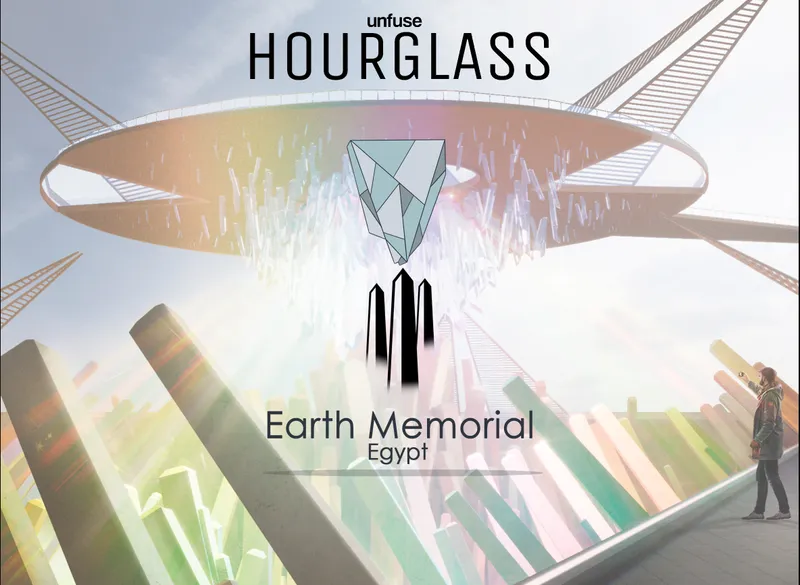
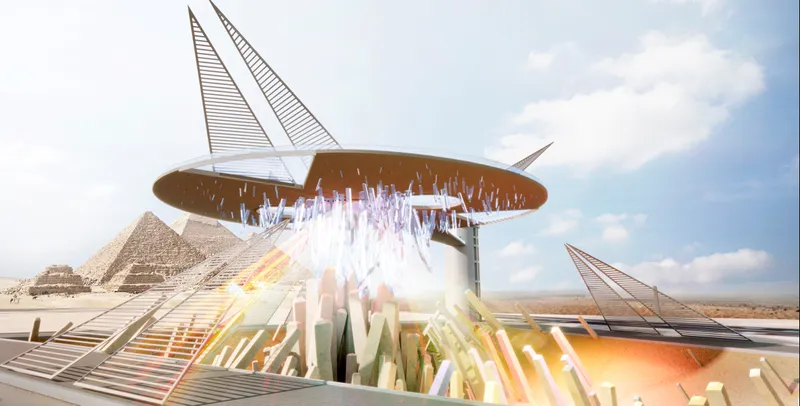
The composition stacks three layers. At the top sits a circular platform raised above the ground plane. Hung beneath it is a field of crystalline elements, standing in for an environment that has become fragile and fragmented. Below that, a dense forest of vertical stone-like forms rises from the sand to represent the Earth itself. The tension between suspended glass and rooted stone is where the project carries its meaning: artificial against natural, brittle against permanent, with the visitor caught between them at the railing.
Triangular structural elements radiate outward from the disc, visible in the second rendering as slatted masts. They do practical work, anchoring the platform and steering movement and sightlines, but they also push the composition outward, a quiet figure for damage that spreads beyond its source. With the pyramids on the horizon, the scheme sets itself beside Egypt's most famous attempt at permanence, a framing that sharpens its own message about how temporary our present conditions may be.
A Lens That Turns Sunlight Into a Greenhouse Metaphor

The project's sharpest move is to make the sun a working component. A lens mechanism on the observation platform captures and refracts sunlight, sending it toward the central stone mass. As the light passes through the glass elements it breaks into a spectrum, the rainbow wash that falls across the figure in this low view beneath the central oculus. Skisov is clear that this is not ornament. Concentrating and redirecting energy onto the earth-like mass is a direct analogue of the greenhouse effect, and the beauty of the phenomenon is part of the trap.
Because the effect depends on solar movement, the memorial is never the same twice. Light conditions change through the day, so the building behaves like a living system rather than a fixed image. That temporal quality does more to communicate urgency than any inscription could: the visitor understands that what they are watching is still happening.
An Ascent That Makes the System Legible From Above
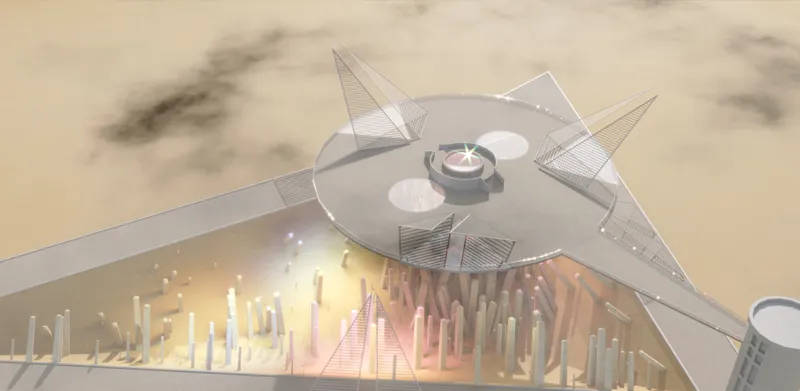
The visit is organised as a climb toward observation. From ground level, the crystal shards and stone columns read as a dense, almost disorienting thicket. Once visitors reach the circular platform, the relationship between lens, glass and stone falls into place, and the aerial view shows how the deck, its skylights and the surrounding columns work as one calibrated system rather than a standalone object.
There is no textual signage. The project leaves out language altogether and relies on form, light and spatial relationships to carry the message. That restraint is what gives the memorial a claim to universality: a crisis that crosses every border is explained in a vocabulary that needs no translation.
Why This Project Matters
Climate memorials face an awkward problem: how do you commemorate a disaster that is not over? Hourglass answers by turning commemoration into observation. Its strength lies in insisting that form and meaning cannot be separated. The suspended glass, the stone forest and the lens are not illustrations of an idea; together they perform the idea, in real time, under the desert sun.
For a young designer, the discipline here deserves recognition. Skisov resists the urge to explain, trusting light and material to persuade where text would only lecture. Whether built or not, Hourglass makes a useful case for what climate architecture can be: not a plaque marking a loss, but a device that keeps the clock visible and lets people watch the sand fall.
View the Full Project
About the Designers
Designer: Mikhail Skisov
Enter a Design Competition on uni.xyz
uni.xyz runs architecture and design competitions year-round that reward proposals with spatial conviction and real site intelligence.
Project credits: Hourglass by Mikhail Skisov.


Popular Articles
Popular articles from the community


GROUP A Strips a 1969 Rotterdam Harbor Headquarters to Its Frame and Wraps It in Timber Louvers
In Rotterdam's M4H harbor district, Ferro Offices reuses a 1969 frame, adds one timber storey and reaches BREEAM-NL Outstanding.

longwave studio Reorganizes a 112 m² Tainan Apartment Around the Daily Routines of a Family and Two Cats
In Tainan, Taiwan, birch plywood, rust-red furniture and a freestanding plaster wall link arrival, storage, work and family life in one apartment.

U.GA Architects Wraps an Oval Rooftop Pool in Curved Board-Formed Concrete on Busan's Jeollidan-gil
In Busan's Jeonpo-dong, a 454 m² mixed-use block stacks a neighborhood facility, guest rooms and an oval rooftop pool inside spiraling concrete walls.

Juan García Correa, John González and Claudia Rueda Sink a Circular Amphitheater into a Manizales Engineering Building
On the La Nubia campus in Manizales, Colombia, the S1 Building folds labs and offices into a hillside of ramped lawns that double as a campus route.

Similar Reads
You might also enjoy these articles
Healing Façade: A Modular Chapel System That Restores Ethiopia's Sacred Forests
Winner of the Eco-Chapel competition, this circular timber façade collects water from air to rebuild soil and reforest degraded Ethiopian landscapes.
Kaffeebühnen: Where Coffee Shop Architecture Becomes a Civic Stage in Vienna
A linear sequence of timber boxes, transparent shells, and open yards turns the Viennese café tradition into a public performance space.
Eco Chapel: A Modular Forest Pavilion That Grows Like the Landscape It Protects
Hexagonal timber modules weave through existing trees, turning a chapel into a living system for prayer, education, and reforestation.


Urban Forest: A Vertical Ecosystem for 5,000 Workers in Singapore's Changi Business Park
Radially stacked pods and layered green decks turn a 7-acre plot into 47 acres of ecological workspace projected for 2040.

Comments (0)
Please login or sign up to add comments
No comments yet. Be the first to comment!