

House B–T: A Brutalist-Inspired Home Designed for Life in Place
Brutalist-inspired concrete home in Belgium combining lifelong living, care housing, refined craftsmanship, panoramic landscapes, and human-centered architecture for aging in place.


Zwalm, Belgium | GRAUX & BAEYENS architecten
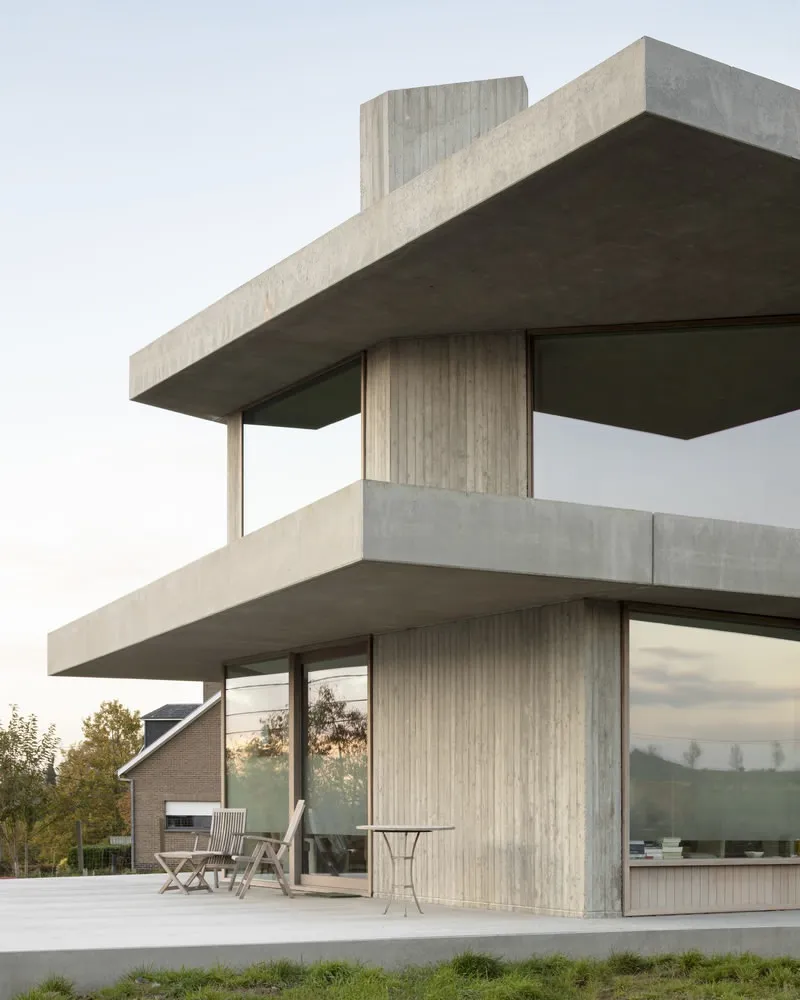
Designed as a home to grow old in with comfort and dignity, House B–T is a carefully considered two-family residence that balances Brutalist architecture with refined craftsmanship. Located in the rural landscape of Zwalm, Belgium, the house responds both to the clients’ long-term living needs and their admiration for the expressive concrete architecture of Belgian modernist Juliaan Lampens.
Architecture for Lifelong Living
The clients’ brief was explicit: a house they could inhabit for the rest of their lives, without sacrificing architectural ambition. GRAUX & BAEYENS architecten answered with a care-oriented residential typology, combining a family home and an independent care unit within one sculptural volume. The result is a robust yet elegant concrete house that merges aging-in-place design, spatial flexibility, and strong material identity.
Site Integration and Landscape Dialogue
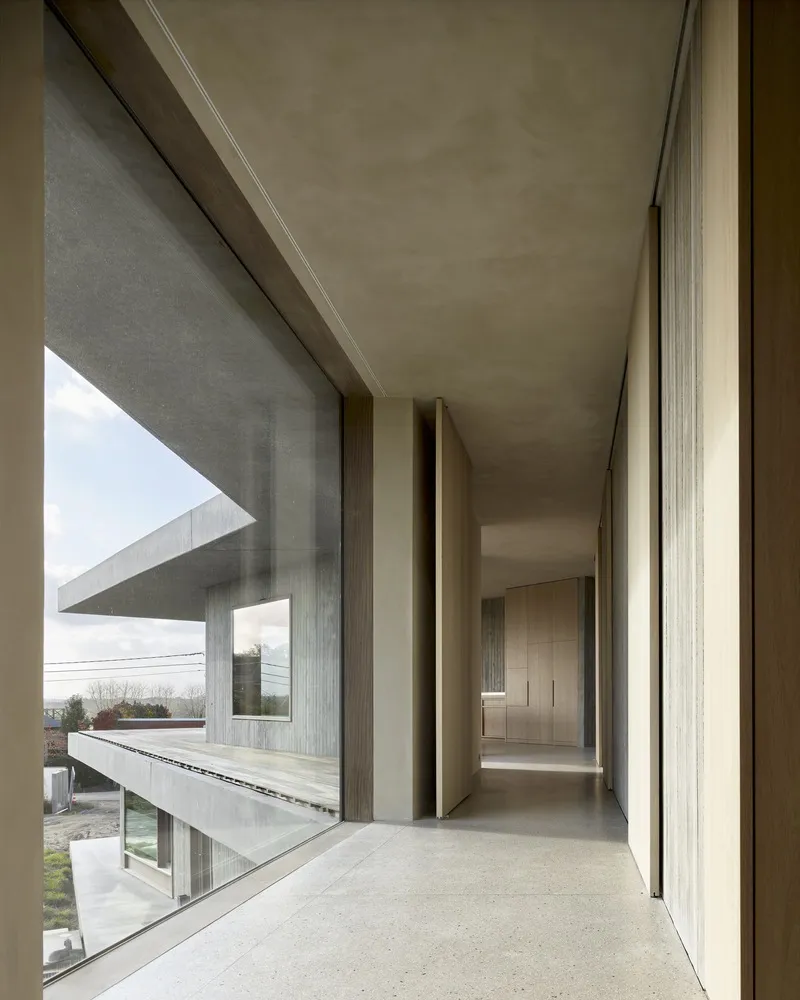
The building is strategically positioned to maximize views of the garden and rolling hills at the rear, while maintaining a subtle relationship with the village center of Meilegem at the front. This dual orientation allows the house to be both introverted and connected—anchored in its rural surroundings yet socially aware.
The architecture alternates between landscape-scale gestures, such as deep concrete canopies, and human-scale interventions that enhance daily comfort. These canopies not only articulate the facade but also provide structural sun protection and generate a series of outdoor spaces, including breakfast terraces and generous living terraces.
Spatial Organization and Program
House B–T is composed of three staggered plateaus, each with a distinct footprint. This layered configuration creates varied spatial experiences while reinforcing the building’s sculptural character.
- Ground Floor: A fully independent dwelling for a care person or family, with direct garden access. In exchange for inhabiting this unit, residents may support the homeowners with daily tasks such as maintenance or shopping—an innovative blend of social sustainability and architectural planning.
- Upper Residence: An elevator located in the entrance hall ensures full accessibility, transporting the owners directly to their main living quarters on the second floor. Here, the living spaces are organized around a central core, unfolding into a large open plan with ceiling-high windows and panoramic views.
From different vantage points, the open space reveals changing perspectives, giving each area its own identity while remaining visually connected. The bedroom, dressing room, and bathroom extend naturally from the living area, reinforcing the idea of a complete, future-proof home on one level. Multiple terraces allow the owners to enjoy outdoor spaces without using stairs.
Materiality: Robust Meets Refined
At the heart of the project lies a nuanced dialogue between raw concrete and refined detailing. The exposed concrete facade is paired with slender balustrades, creating a visual tension between heaviness and precision. This material language continues into the garden wall, where horizontal formwork emphasizes the house’s grounding in the landscape.
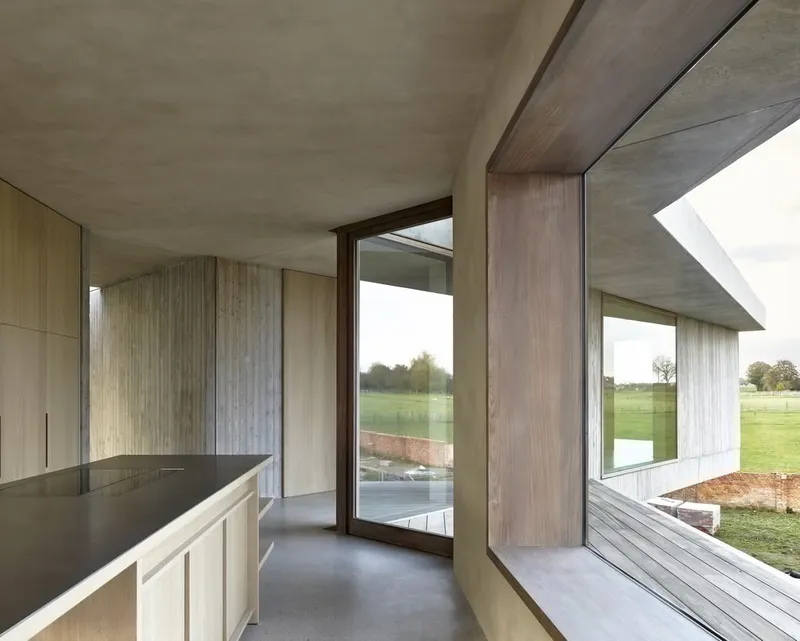
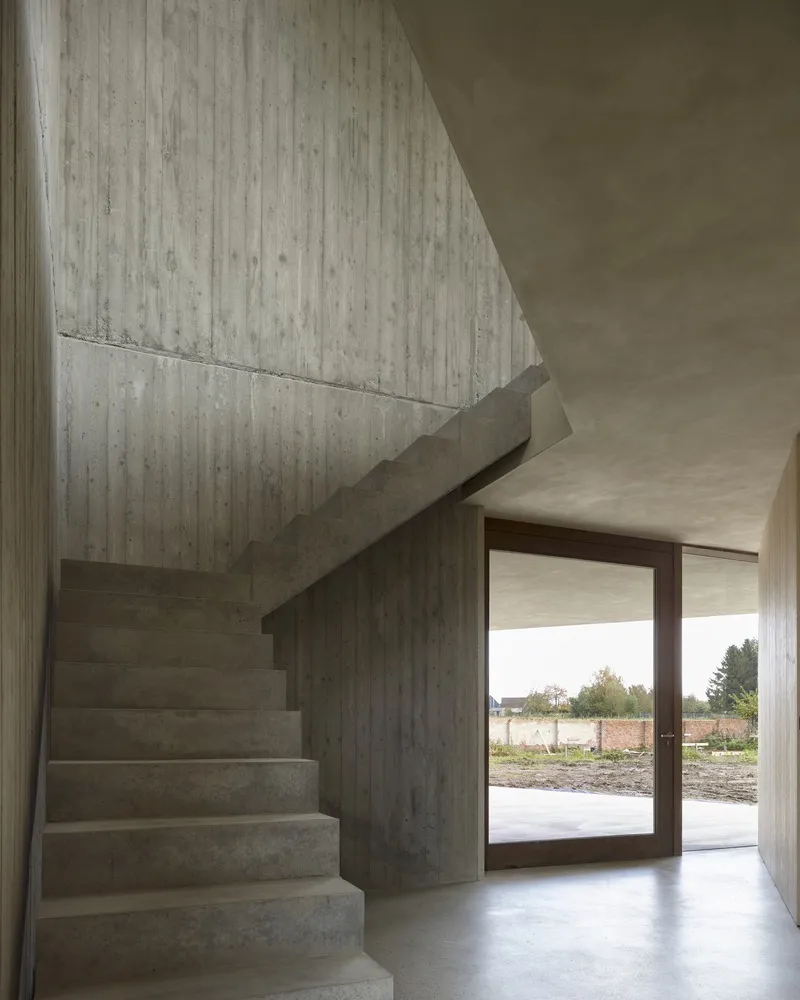
Inside, concrete is softened through a carefully curated palette of natural lime plaster, afrormosia wood, and oak veneer. Custom-designed furniture and window elements enhance material continuity, while meticulous detailing elevates everyday experiences.
Notable interior moments include:
- A sculptural staircase detached from the wall, allowing daylight to wash across the textured concrete surface
- A built-in kitchen seating window that transforms cooking into a social, intimate ritual
- A thoughtfully designed carport for a mobile home, constructed in rust-colored steel—a subtle reference to the corrugated metal barns of the neighboring farm
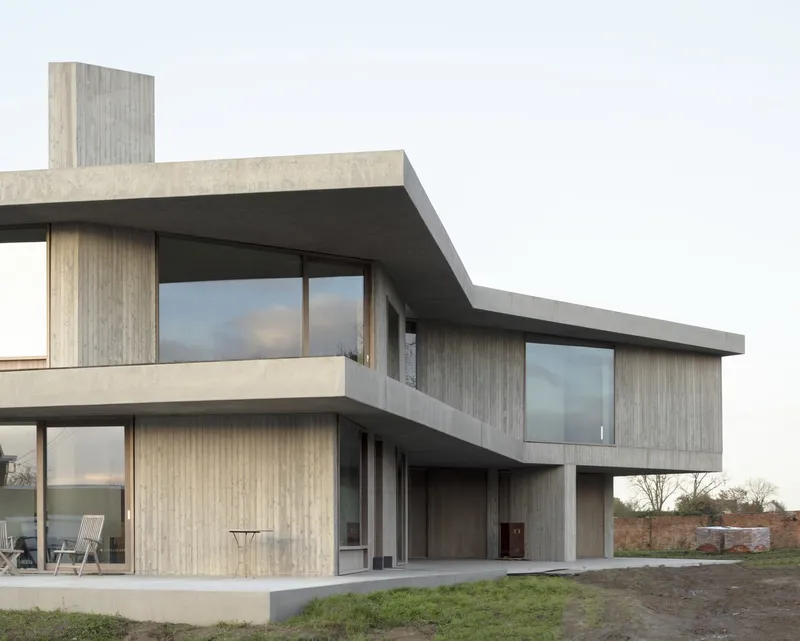
A Contemporary Care Home with Architectural Integrity
House B–T exemplifies how care housing, Brutalist-inspired residential architecture, and high-quality detailing can coexist harmoniously. It is both a family home and a long-term dwelling, rooted in place, material honesty, and human-centered design.
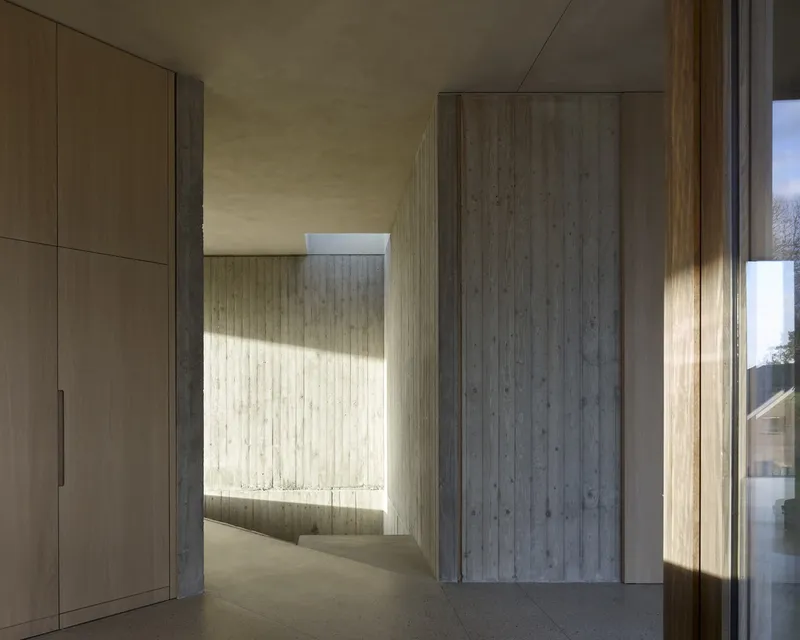
By combining robust concrete architecture with warm, tactile finishes, GRAUX & BAEYENS architecten have created a house that is not only resilient and functional, but deeply personal—designed to support life, aging, and everyday beauty in the Belgian countryside.
All photographs are works of Dennis De Smet


Popular Articles
Popular articles from the community


Extended Shell: Retrofitting Kolkata's Balconies as Living Urban Thresholds
A modular retrofit system recovers the social and environmental intelligence of Kolkata's historic verandas for contemporary Park Street residents.

Faces of the Soviet Avant-Garde: Turning Moscow's Street Names into an Open-Air Museum
A network of sculptural installations across a Moscow residential district transforms forgotten architect names into spatial encounters with cultural memor

Tsunami Convergenics: Turning Catastrophic Ocean Forces into Underwater Housing Infrastructure
A speculative underwater settlement off the coast of Onagawa, Japan, treats tsunamis and typhoons as energy sources rather than threats.

The Amber Palace Opera: A Geological Fiction Surfaces on Tallinn's Baltic Waterfront
Pierre Brillard reimagines a Baltic legend as a public landscape, opera house, and waterfront promenade rooted in Tallinn's coastal identity.

Similar Reads
You might also enjoy these articles


Hodi-Mandai Geram
Project Function: Preservation and revitalization of the Intangible heritage and socio-spatial identity of the Hodi by Housing, Cultural Memory Center, Sacred Grove, landscape, local tourism economy


Olio Towers: A Mid-Rise for Performers That Fuses Housing, Rehearsal, and Stage
Located blocks from Houston's Theater District, this modular tower stacks living units around a central performance atrium.

Oasis: Modular Green Housing Carved into Dhaka's Urban Fabric
A shortlisted Plugin Housing entry reclaims unauthorized settlements in Dhaka with stepped concrete volumes, green roofs, and ventilation-driven design.

Black Hole: A Floating Megastructure for the Post-Physical Era
Emiliano Mazzarotto envisions a spherical, self-scaling arena where e-sports, digital hotels, and holographic stadiums replace traditional public space.

Explore Brutalist Architecture Competitions
Discover active competitions in this discipline

Challenge to reimagine the Iron Throne

Photograph architecture without architects

Illustrate the lost glory of Angkor Wat - Render Challenge

Design challenge to reuse E-waste
Comments (0)
Please login or sign up to add comments
No comments yet. Be the first to comment!