
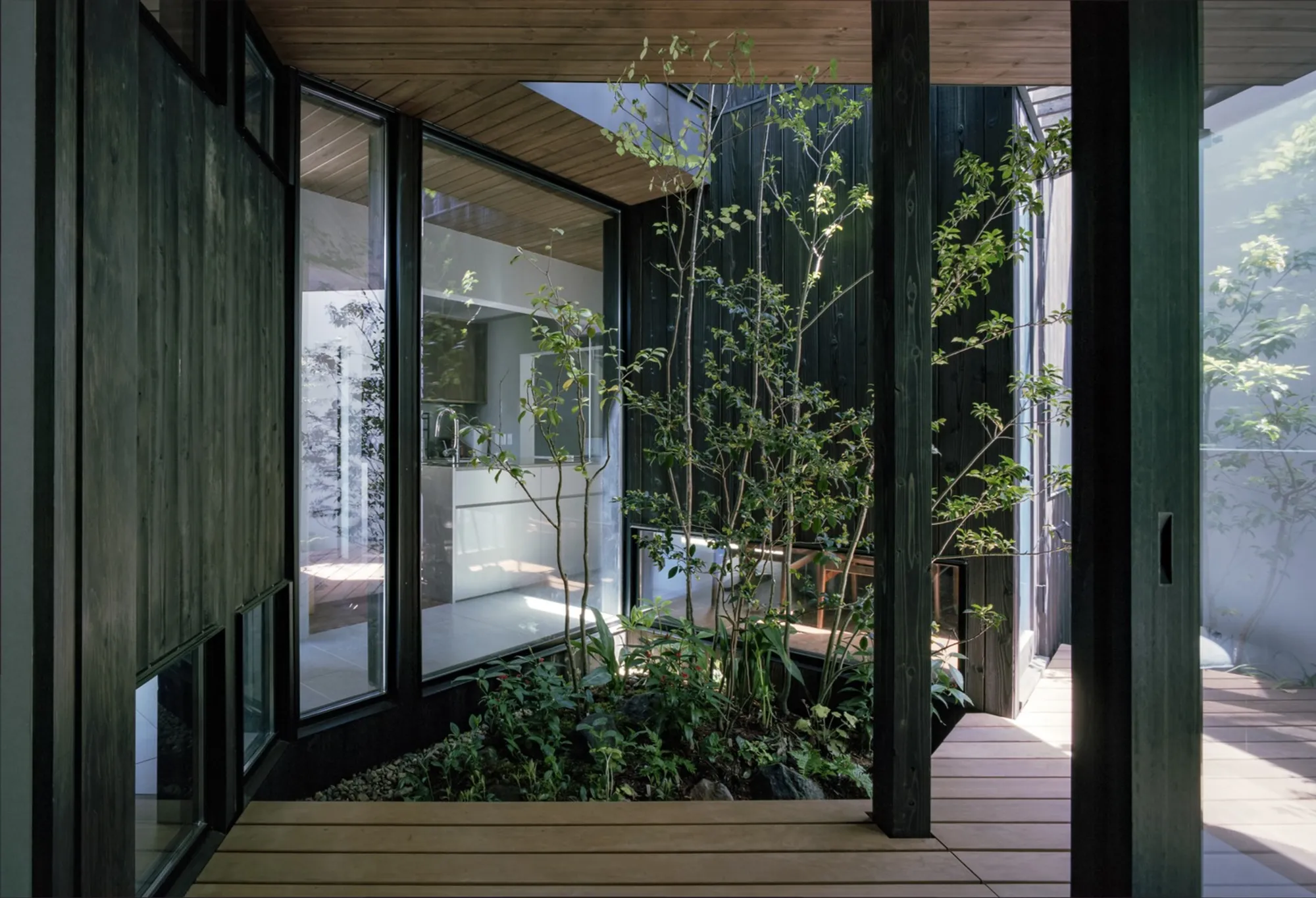
FujiwaraMuro Architects Zigzag a Family Home Through a Slender Osaka Plot
In Fujiidera, a zig-zagging cluster of rooms and courtyards turns an awkward leftover site into a layered domestic landscape.


A leftover sliver of land, carved from a larger property in the Osaka suburb of Fujiidera, is exactly the kind of site most developers would flatten into a single box. FujiwaraMuro Architects did the opposite. Their 2023 house for a family of four zigzags across the irregular footprint, breaking the program into a cluster of volumes that interlock around a series of small courtyards. The result is a home that feels far larger and more varied than its modest lot should allow.
What makes the project worth studying is not the zigzag as a formal gesture but as a spatial instrument. Each turn in the plan compresses and then releases space, shifts sightlines, and repositions the inhabitant relative to light, planting, and neighboring walls. The architects describe the goal as creating "a sense of distance and spatial depth by layering many small spaces," and the built reality delivers on that ambition with unusual precision.
A Dark Threshold Sets the Tone
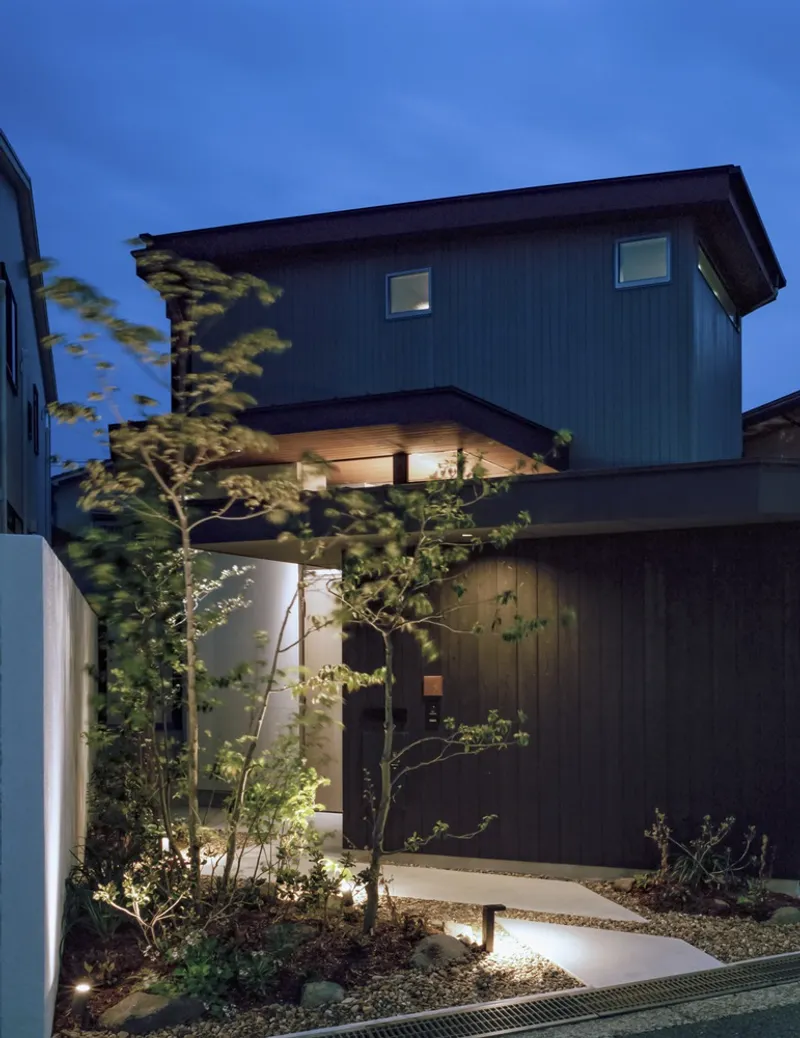
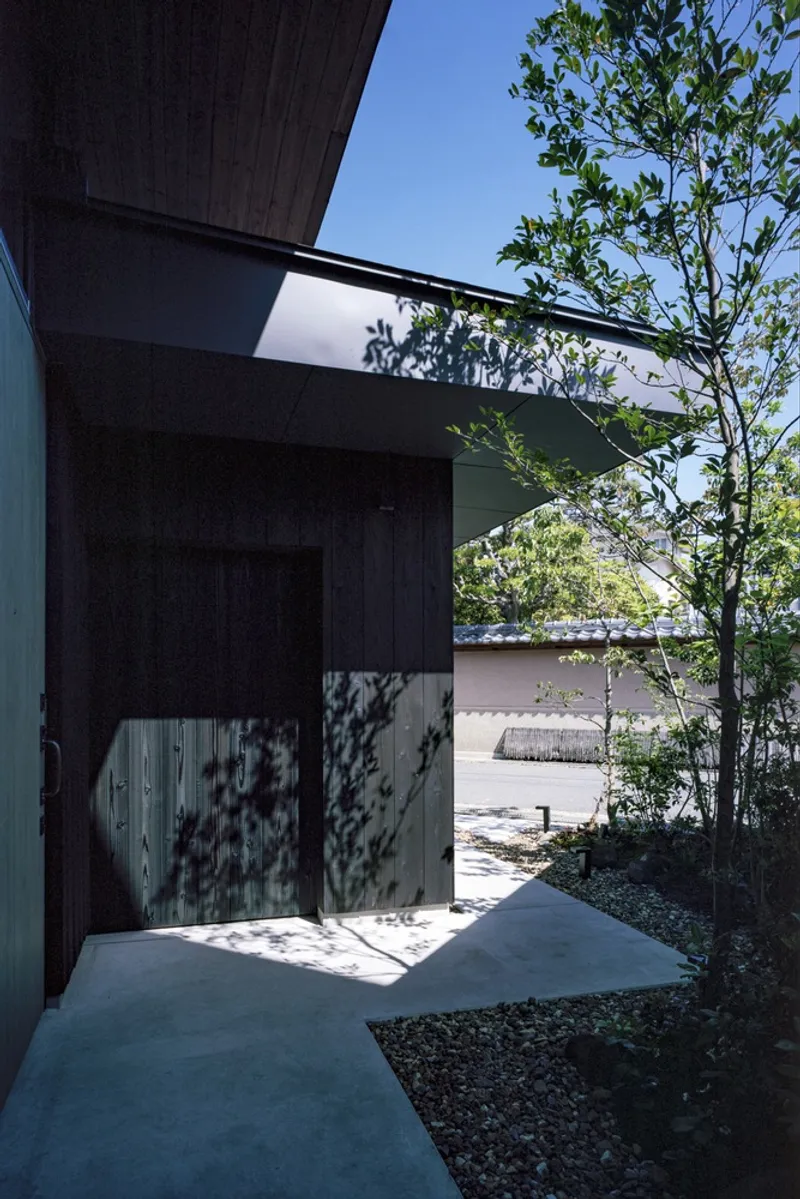
From the street, the house presents a restrained face: corrugated metal, charred cedar, and a slim covered walkway that draws you sideways into the plan. Young trees in gravel soften the approach without cluttering it. The overhanging eaves cast deep shadows on the concrete path, so even before you step inside, the transition from public to private has already begun.
The entrance is deliberately compressed. Dark timber cladding wraps the walls and ceiling, narrowing your field of vision and slowing your pace. It is a classic threshold move, but it works here because the architects commit to it fully: the darkness is not decorative, it is the first spatial event in a sequence that alternates tight and open, dim and bright, all the way through the house.
The Corridor as Alleyway
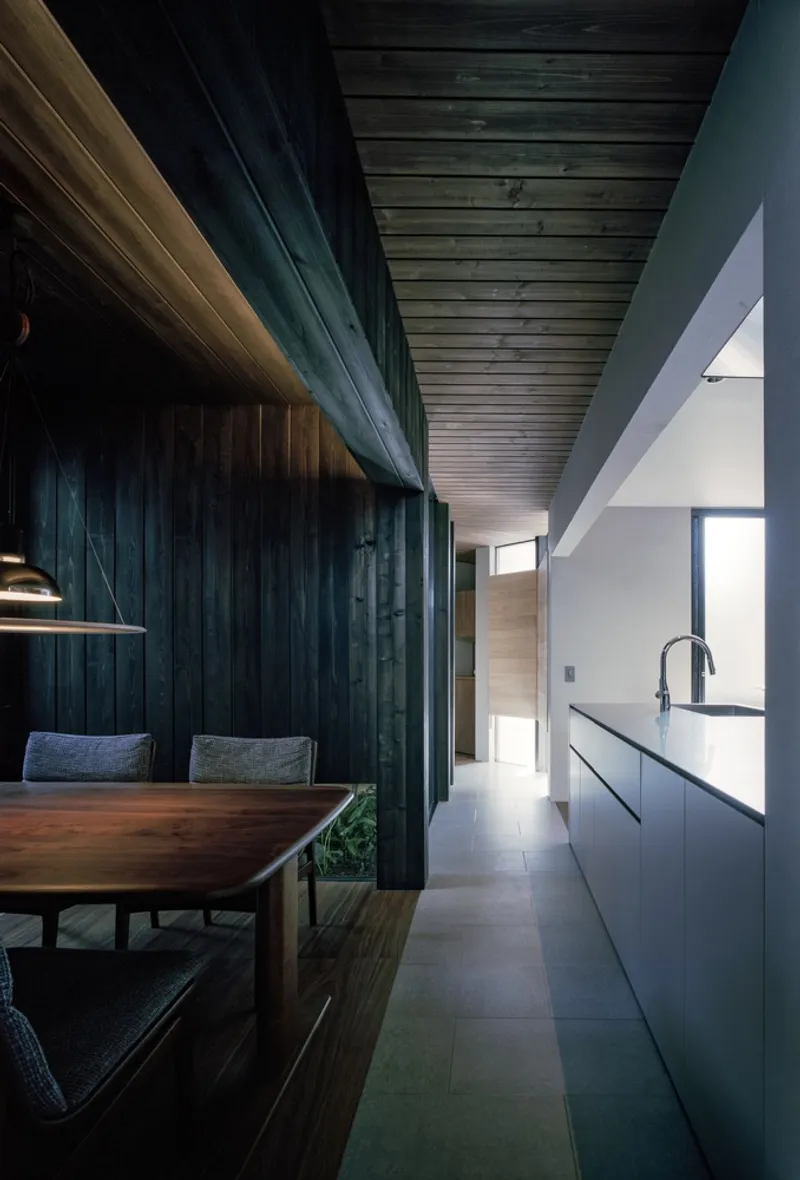
A central corridor runs front to back on the ground floor, organizing the garage, study, workspace, kitchen, dining area, and living room along its length. FujiwaraMuro describe it as an alleyway, and the analogy is apt. The passage is narrow enough to feel urban, lined with contrasting finishes, and punctuated by turns that prevent you from reading the entire plan at once. Where a conventional hallway is dead circulation, this one is experiential.
The material logic reinforces the reading. Dark timber panels line the corridor wall on one side while a white galley kitchen opens on the other, the tonal contrast amplifying the perceived width of both zones. Overhead, timber plank ceilings provide warmth without competing with the starkness of the white surfaces. Each zone gets its own material identity, yet the corridor stitches them into a continuous narrative.
Courtyards That Multiply the Interior
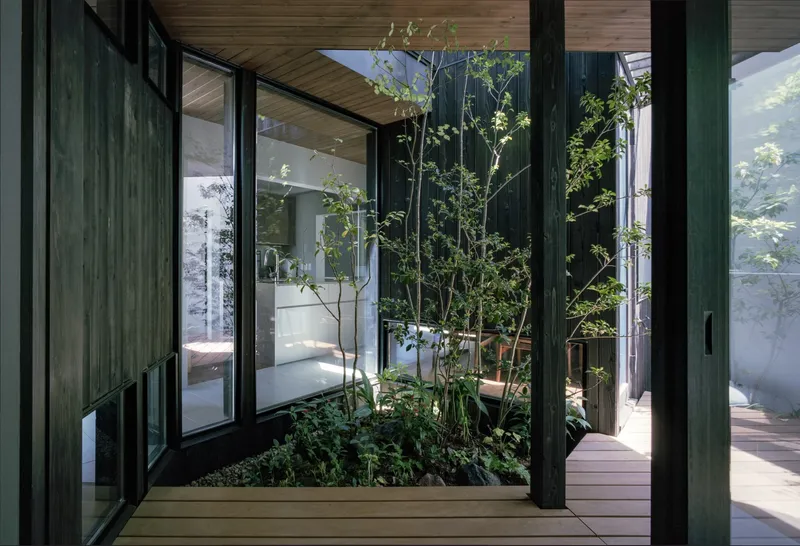
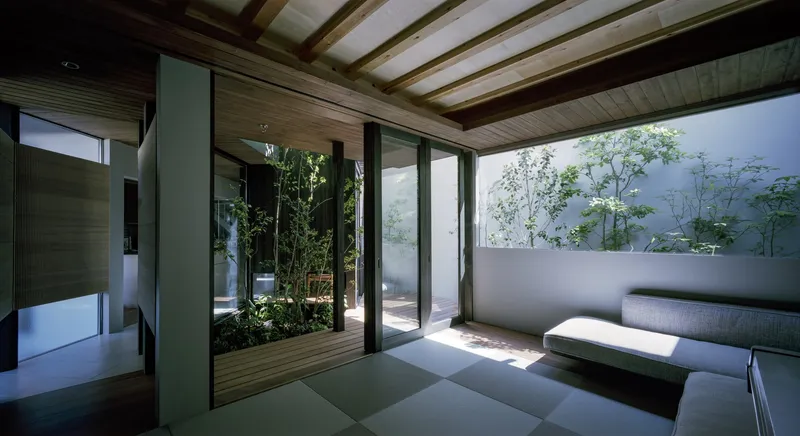
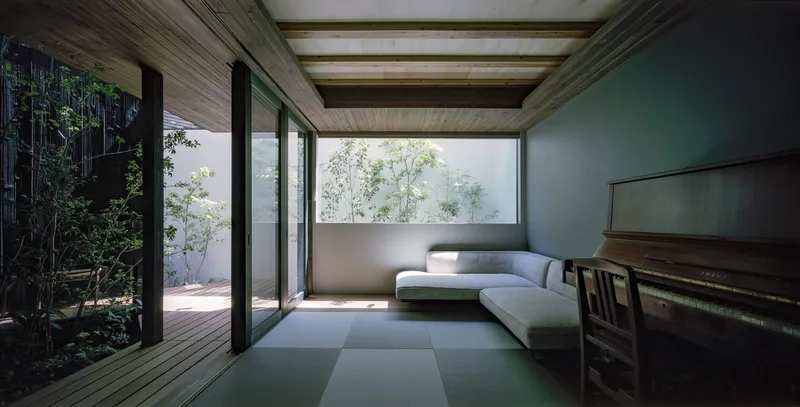
The courtyards are the real engine of the design. Planted with bamboo and small trees, framed by dark-stained timber columns, and open to the sky, they pull daylight and air deep into the plan where side windows alone could never reach. Because the house zigzags, these outdoor pockets appear at different points along the route, so the relationship between inside and outside is never static.
Tatami rooms open directly onto timber decks, with sliding glass doors that dissolve the wall plane entirely. The careful placement of bamboo means that even fully open, these rooms are screened from neighbors. Privacy is achieved through planting and geometry rather than curtains and blinds, a strategy that keeps the interiors feeling generous even when the boundaries of the lot are only a few meters away.
The decision to use multiple small courtyards instead of a single garden is critical. Each one serves a different room and offers a different quality of light. The effect is closer to a village than to a conventional house: you move between distinct territories, each with its own outdoor counterpart, rather than orbiting a single central void.
Material Shifts as Spatial Cues
FujiwaraMuro switch finishes deliberately at every zone change. Charred cedar on the exterior gives way to dark timber panels in the entrance and stair, which in turn yield to white walls in the more open communal areas. The flexible board used as pathway material has a matte, concrete-like texture that reads as a third register, neither warm timber nor cool plaster.
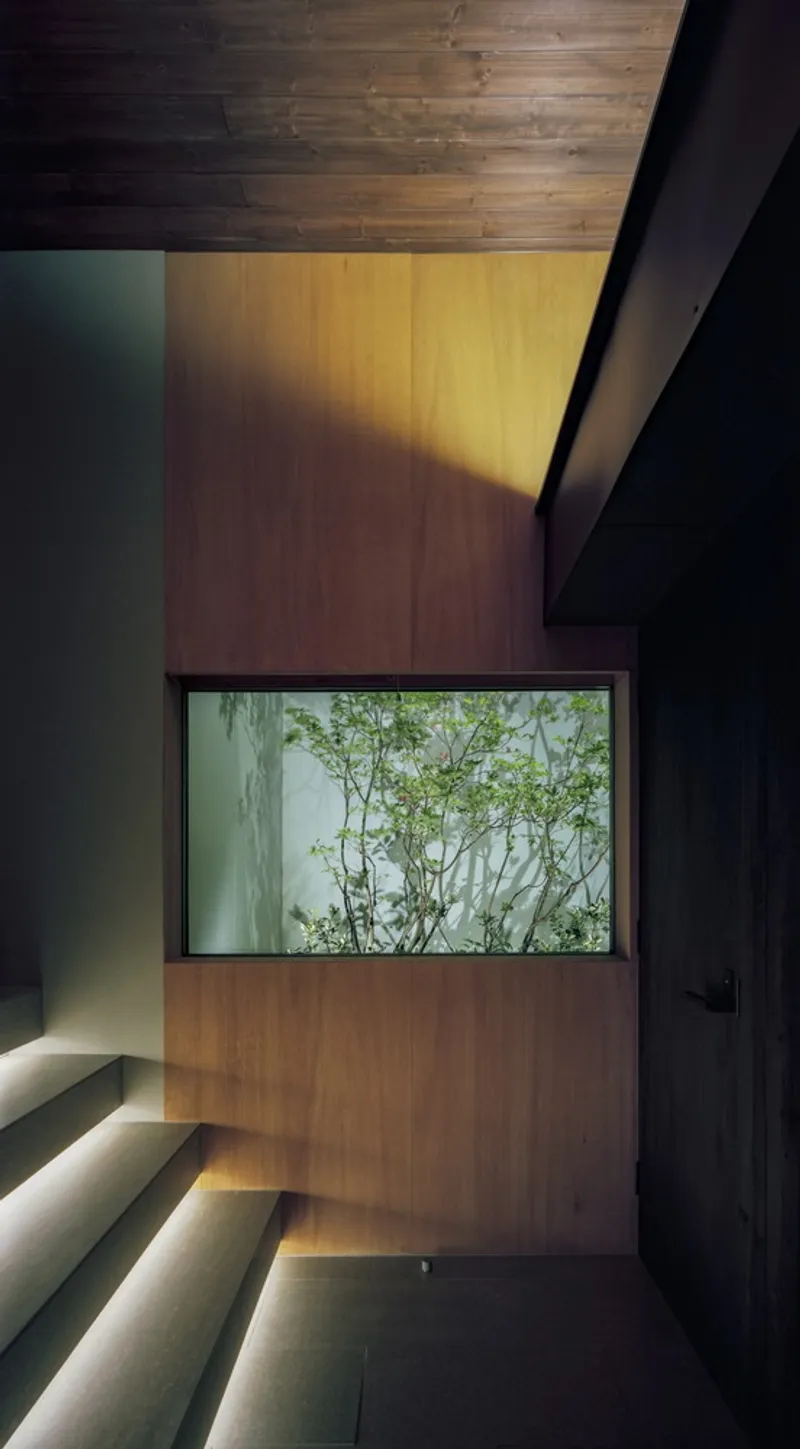
The staircase captures this strategy in miniature. Dark timber wraps the enclosure, but a horizontal window slices through the wall to frame green courtyard planting, and uplighting at night turns the slot into a lantern. You feel the compression of the stair and, simultaneously, the release offered by the glimpse of foliage. It is a small moment, but it demonstrates the architects' control over mood at every scale.
Why This Project Matters
The House in Fujiidera is a reminder that constraint is often the best client. An irregular, leftover plot in a dense suburb could easily have produced a defensive box. Instead, FujiwaraMuro treated every kink in the boundary as an opportunity to introduce a courtyard, rotate a sightline, or shift a material palette. The zigzag plan is not a stylistic choice; it is a direct response to the geometry of the land and the needs of a family that wants both togetherness and solitude.
More broadly, the project offers a convincing model for small-lot urban housing that refuses to sacrifice spatial richness for efficiency. By fragmenting the program into a cluster of volumes and weaving outdoor space through the gaps, the architects achieve a sense of depth and variety that many houses on far larger sites never manage. For anyone designing on tight, difficult land, this house is worth a long, careful look.
House in Fujiidera by FujiwaraMuro Architects. Located in Fujiidera, Osaka, Japan. Completed in 2023. Photography by Katsuya. Taira.
About the Studio
Share Your Own Work on uni.xyz
If projects like this are the kind of work you want to make, uni.xyz is a place to publish your own, find collaborators, and enter design competitions.




Popular Articles
Popular articles from the community


The Ocean Hive: Sustainable Architecture for a Self-Sufficient Civilization at Sea
The Ocean Hive imagines sustainable architecture at sea, where modular habitats, algae, wave power and ocean waste sustain a growing colony.

Hill & Cross Opera: Sculptural Opera House Architecture Shaped by Tallinn’s Landscape and Identity
Hill & Cross Opera reimagines opera house architecture in Tallinn through its sculptural hill, civic plaza, glass wave and a luminous cross.

EW PARK: Sustainable Architecture Reimagines the Future of Urban Parking
EW PARK reimagines city parking as a modular wooden tower combining automation, solar energy, electric mobility, and adaptable urban design.

Conexión: Biophilic Design Reimagines High-Rise Living in Hong Kong
Conexión reimagines high-rise living in Hong Kong through biophilic design, green facades, shared spaces, daylight, water and nature within.


Similar Reads
You might also enjoy these articles


Hodi-Mandai Geram
Project Function: Preservation and revitalization of the Intangible heritage and socio-spatial identity of the Hodi by Housing, Cultural Memory Center, Sacred Grove, landscape, local tourism economy


Olio Towers: A Mid-Rise for Performers That Fuses Housing, Rehearsal, and Stage
Located blocks from Houston's Theater District, this modular tower stacks living units around a central performance atrium.

Oasis: Modular Green Housing Carved into Dhaka's Urban Fabric
A shortlisted Plugin Housing entry reclaims unauthorized settlements in Dhaka with stepped concrete volumes, green roofs, and ventilation-driven design.

Black Hole: A Floating Megastructure for the Post-Physical Era
Emiliano Mazzarotto envisions a spherical, self-scaling arena where e-sports, digital hotels, and holographic stadiums replace traditional public space.


Explore Housing Competitions
Discover active competitions in this discipline



Challenge to reimagine the Iron Throne


Photograph architecture without architects


Illustrate the lost glory of Angkor Wat - Render Challenge


Design challenge to reuse E-waste
Comments (0)
Please login or sign up to add comments
No comments yet. Be the first to comment!