

AA. Arquitectos Splits a Coastal House into Two Strips on a Madeira Island Cliff
Perched 77 meters from the sea in Câmara de Lobos, a trapezoidal site becomes a study in orientation, material contrast, and ocean proximity.


Building on a cliff in Madeira is not a neutral act. The volcanic rock, the proximity to salt air, the precipitous drop to the Atlantic: everything about the site for House in Serrado da Adega in Câmara de Lobos demands that architecture negotiate rather than impose. AA. Arquitectos responded with a house organized as two parallel strips of different lengths, a formal move generated directly by the trapezoidal plot that sits just 77.5 meters from the sea. The longer volume runs west toward the hillside views; the shorter one lines the eastern edge near the road. Between and around them, the project stacks outdoor rooms, planted terraces, and deep porches that blur any clean line between house and landscape.
What makes the project worth studying is the economy of its decisions. The two-strip plan is not a stylistic gesture; it is a direct translation of the site's odd geometry into habitable logic. Every orientation choice, every material shift, every planted edge serves a legible purpose: capturing the south and west views, sheltering from the road, cooling the east facade, or anchoring the building to its volcanic base. The result is a house that reads as elemental from outside and warm from within.
A White Volume on Volcanic Rock
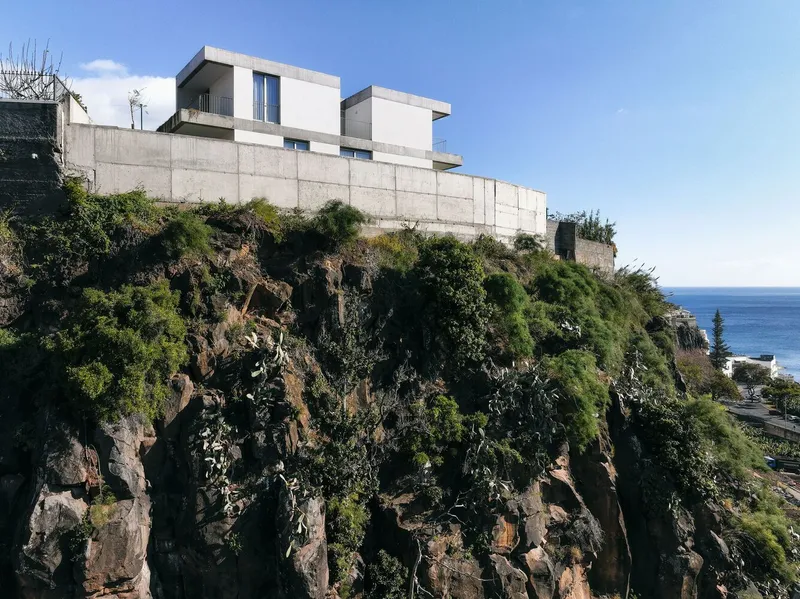
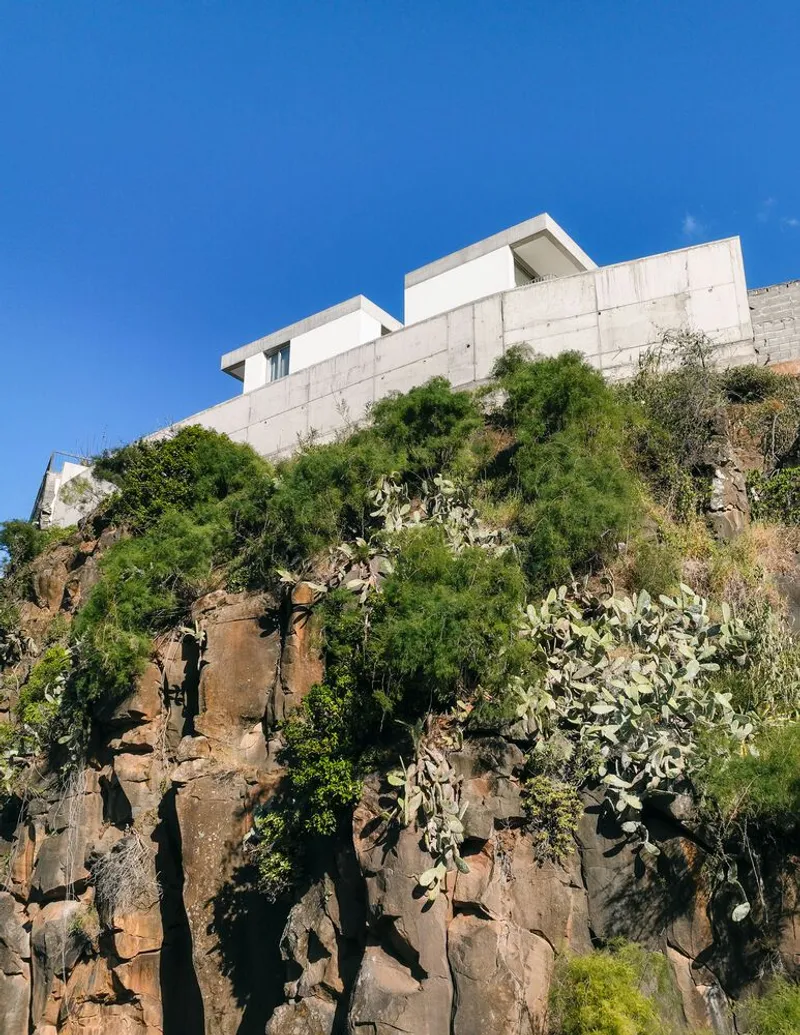
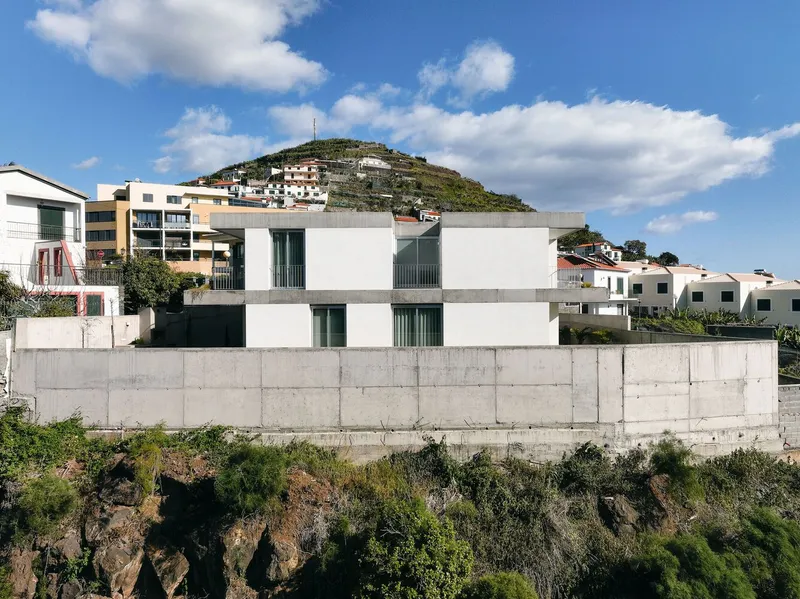
Seen from below, the house is an unapologetic white mass on a dark, craggy cliff. Cacti and wild vegetation cling to the volcanic rock, and the building appears to grow from the same geology rather than simply resting on top of it. Board-formed concrete retaining walls step down from the structure into the slope, mediating between the domestic scale of the house and the raw terrain. The white-painted thermal insulation system that wraps the exterior does double duty: it reflects Madeira's intense sun and gives the volumes a clean geometry that reads clearly against the textured hillside behind.
The contrast between the refined upper volumes and the rough exposed concrete at ground level is deliberate. Concrete appears in the slabs, the retaining walls, the parking pillar, and the planted flowerbeds. It is the material of connection, tying the house to its site. White paint is the material of separation, lifting the living spaces visually above the terrain.
Street Face and Arrival
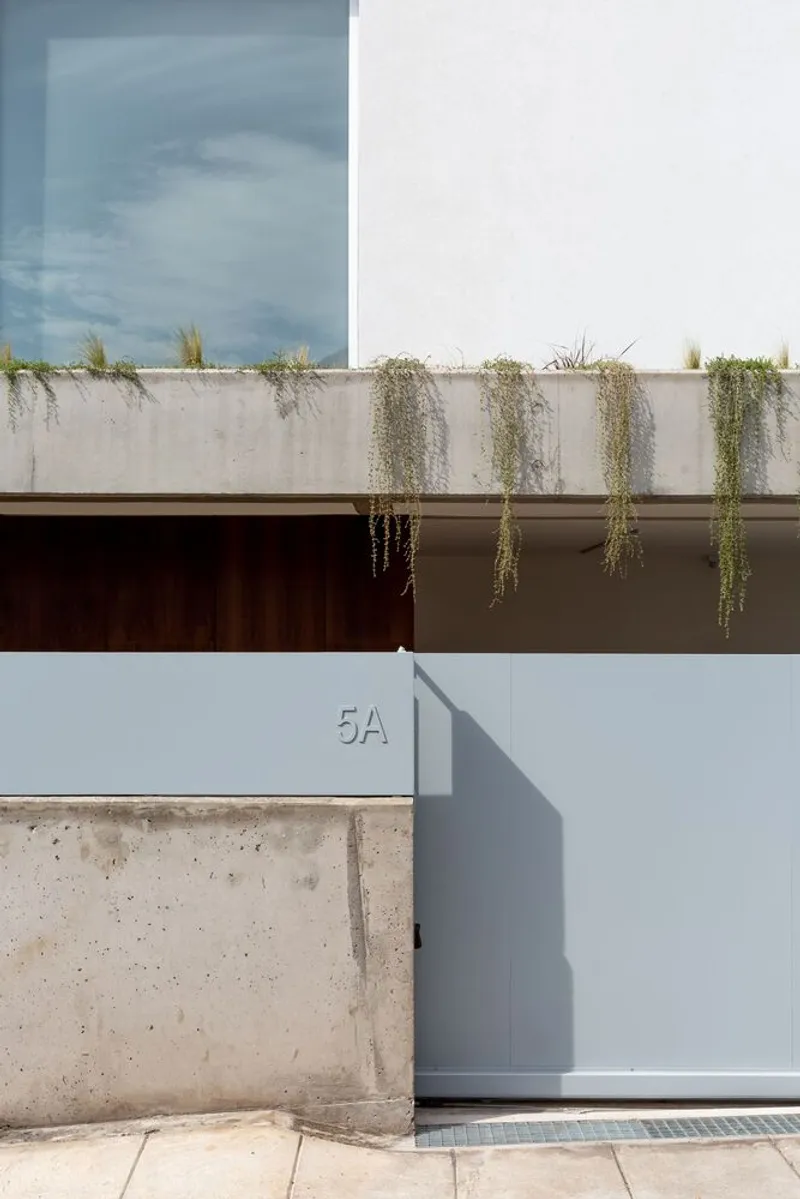


From the road to the east, the house is deliberately restrained. A concrete planter box trailing greenery overhangs a metal garage door, and the entry sequence is compressed and low. A covered carport with an exposed concrete soffit shelters the parking area before you reach the front door. At the junction of the carport and the entrance, panels of sucupira wood wrap the corner, introducing warmth exactly where you need it: at the threshold between vehicle and home. The wood conceals a storage compartment and a shoe cabinet tucked beneath the stair, so nothing clutters the transition.
The east facade is the house's most closed face, and that is the point. Road noise, neighbors, and utility zones are absorbed here. The real generosity is saved for the opposite side.
The Staircase as Vertical Garden
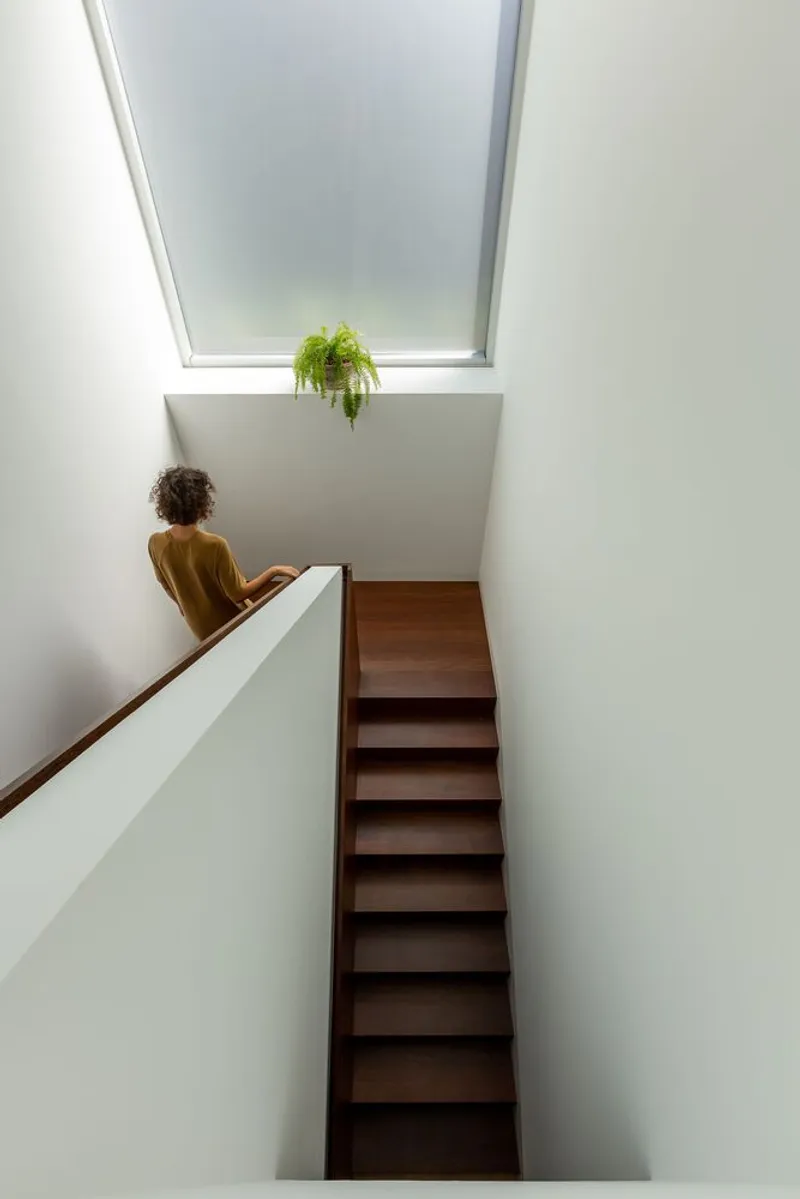
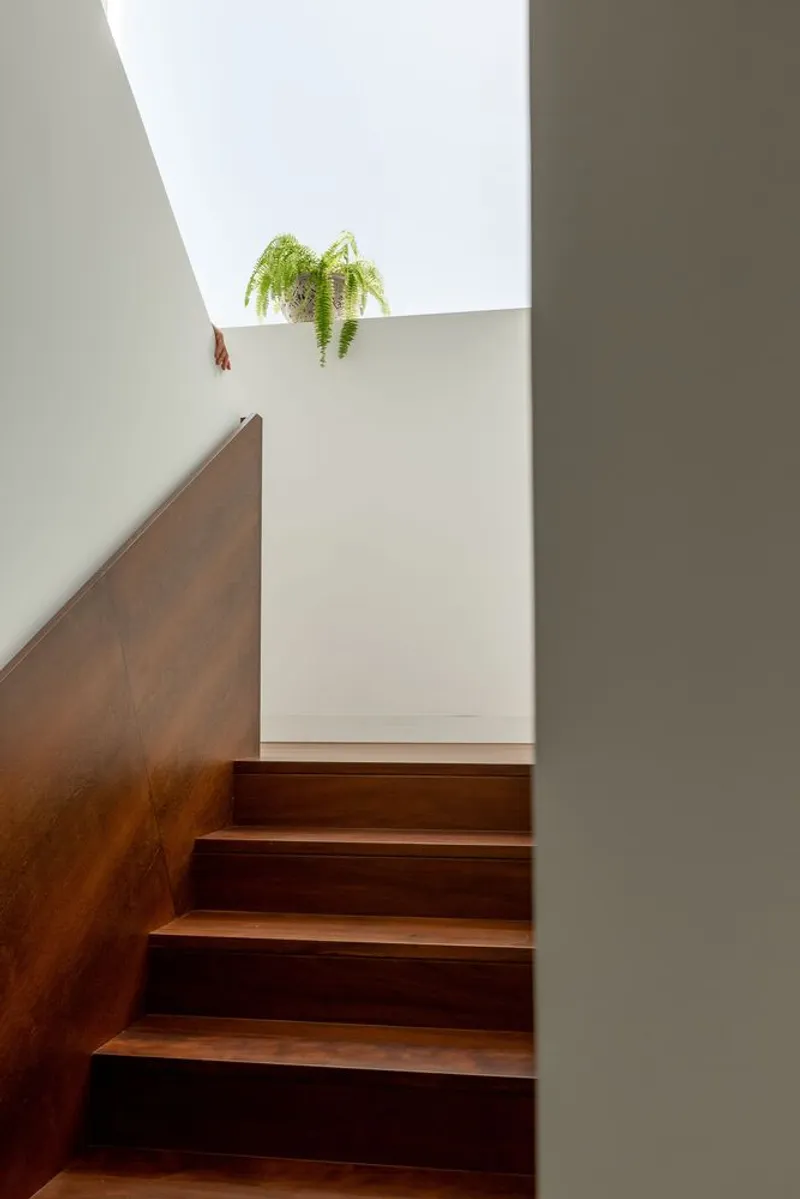

The central staircase is the hinge between the two strips and the two floors, and AA. Arquitectos treat it as something more than circulation. Dark timber treads rise between a white storage wall and a wood-paneled wall, and at the top a skylight pulls daylight down through the section. A hanging fern drops from the opening, turning the stair into a vertical garden that draws your eye upward. The effect is quietly theatrical: you climb toward light and greenery rather than simply toward a corridor.
A small vaulted ceiling with a white-framed window and a potted fern on the sill completes the sequence at the upper landing. Every surface here, timber, white plaster, cove lighting, plant life, is calibrated to make a narrow vertical space feel generous.
Interior Light and Curtain Walls


The open-plan living, dining, and kitchen zone on the ground floor's western strip benefits from floor-to-ceiling glazing that faces south and west toward the sea and the opposite hillside. Sheer curtains diffuse the strong Madeiran light, and cove lighting along the ceiling plane adds a softer wash after sunset. The rooms are not dramatically furnished; the architecture itself, white planes, deep reveals, and continuous floor surfaces, does the compositional work.
On the upper floor, the passage between bedrooms retains the same restraint. White walls, dark timber elements, and carefully placed openings create a rhythm that feels calm rather than minimal for its own sake.
Terraces, Planters, and the Outdoor Room


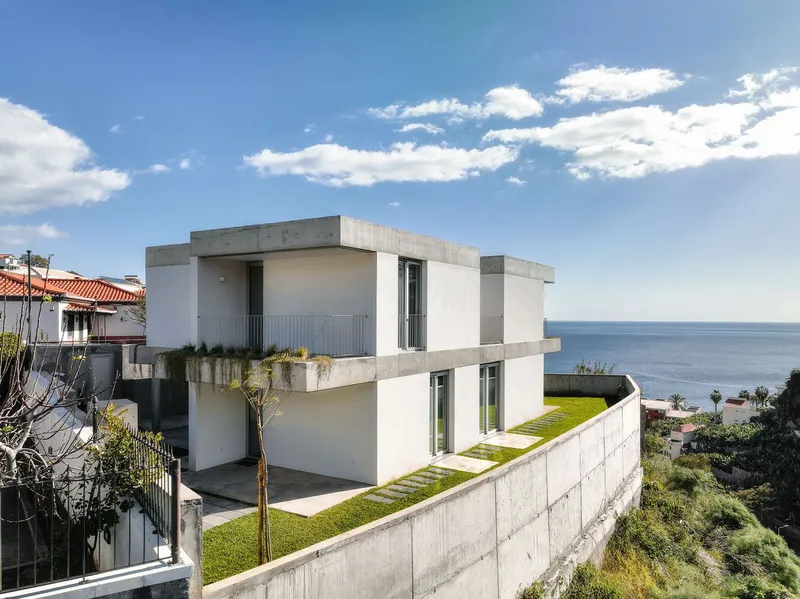
The project's most convincing move may be how it distributes planting across every level. Ground-floor porches open south and west from the living room; a second porch to the north and west frames a barbecue zone against the house's north wall. On the upper floor, balconies with integrated flowerbeds extend over the porches below, and cascading plants drape down the concrete terrace walls. A rooftop lawn with planted edges creates yet another outdoor room, this one with unobstructed views of the hillside settlement.
Tiered concrete retaining walls step down the slope with grass treads, turning the western descent toward the coast into a landscaped sequence rather than a mere grade change. Even functional elements, a dog shelter and a rubbish enclosure along the eastern wall, are folded into the planted perimeter. The effect is of a house that greens itself deliberately at every edge.
Material Details at Close Range

Up close, the material palette resolves into three clear components: white-painted insulated walls, raw concrete, and sucupira wood. A courtyard wall with trailing vines and potted plants shows how the concrete is left untouched where it meets soil and water, accepting weathering as part of the design. Where warm light washes the sucupira paneling at the entrance corner, the grain reads as a deliberate counterpoint to the concrete's aggregate texture. Nothing here is accidental, but nothing is precious either. The materials are chosen to age well in a marine climate.
Plans and Drawings
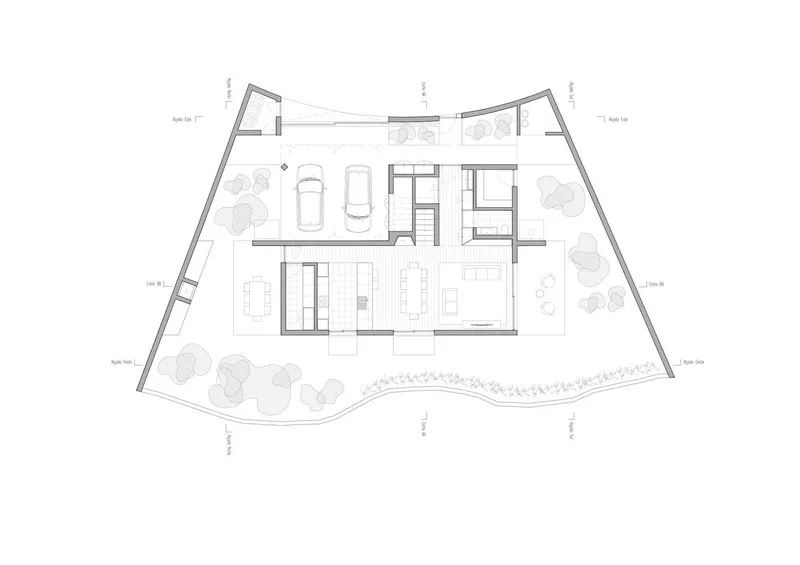
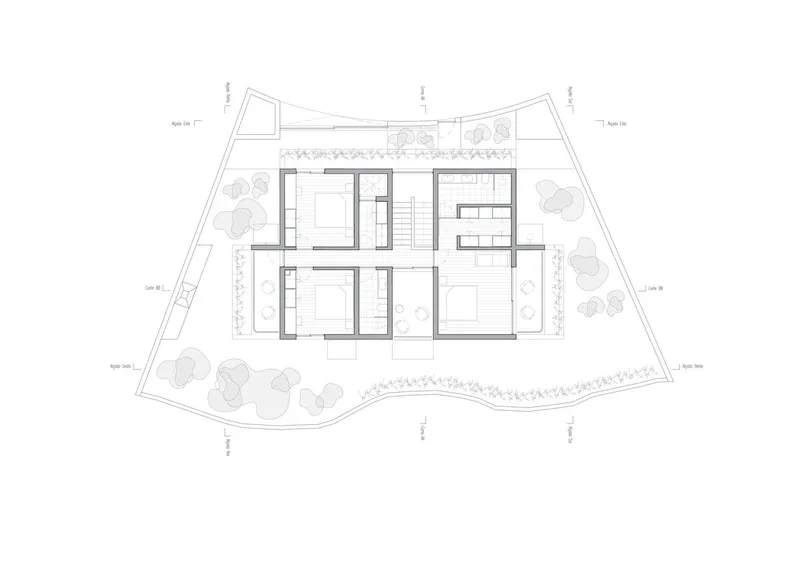


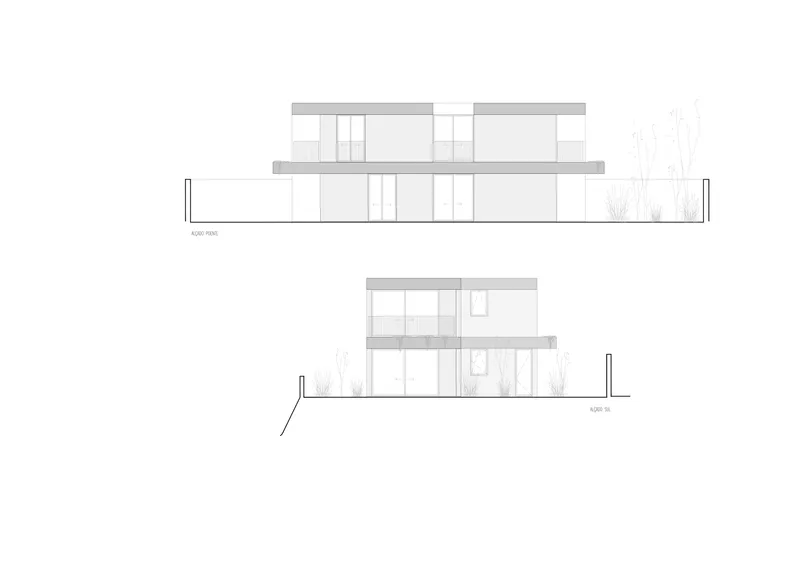
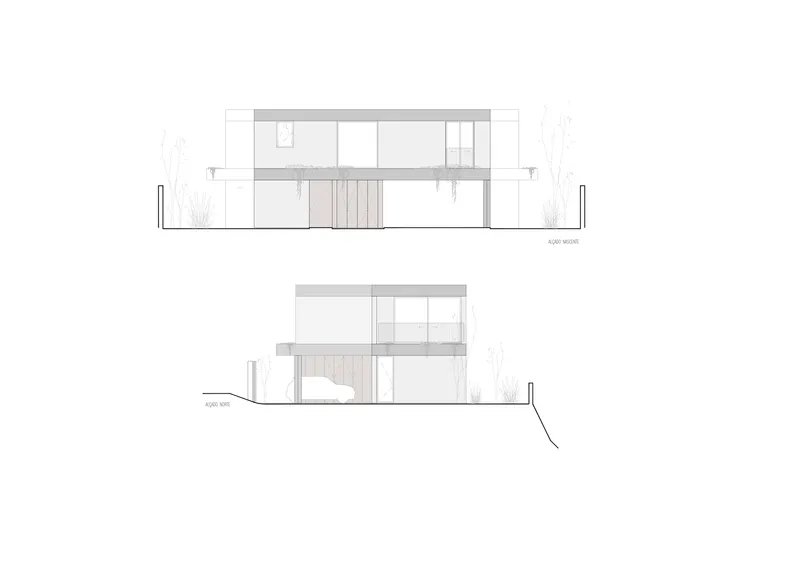
The ground-floor plan makes the two-strip logic legible at a glance: the eastern strip absorbs parking, storage, entry, and vertical circulation, while the western strip is a single open volume of living, dining, and kitchen with porches extending off its south and north edges. On the upper floor, the eastern strip holds a bedroom, laundry, and the suite's bathroom and walk-in closet; the western strip holds two more bedrooms and a shared bathroom. A planted linear courtyard runs along the rear edge, separating the private rooms from the retaining wall.
The sections reveal how the house steps with the terrain, raising the living level above the slope and allowing the parking zone to tuck beneath the upper volume on the east side. Elevation drawings confirm the horizontal emphasis: long bands of glazing, solid panels, and landscape planting work together to keep the building low against the hillside. The roof plan shows two rectangular volumes separated by planted strips and perimeter trees that will, in time, soften the house further into its context.
Why This Project Matters
House in Serrado da Adega is not trying to be iconic. Its value lies in the precision with which a simple organizational idea, two strips of different lengths, solves a complex set of site constraints at once: trapezoidal boundaries, a steep western slope, road exposure to the east, and the desire to capture both sea and hillside views. Every formal decision can be traced back to the plot, the climate, or the program, and that legibility is what separates a good small house from a merely adequate one.
For architects working on steep coastal sites, the project offers a useful lesson in material honesty and landscape integration. Concrete anchors the building to its geology; white walls lift it into the light; timber panels mark the threshold of domesticity. Planting is not decoration but infrastructure, cooling facades, softening retaining walls, and creating privacy between neighbors. On a volcanic cliff 77 meters from the Atlantic, that kind of discipline is the only luxury that matters.
House in Serrado da Adega by AA. Arquitectos, Câmara de Lobos, Madeira Island, Portugal, completed 2022. Photography by Nuno Serrão.
About the Studio
Share Your Own Work on uni.xyz
If projects like this are the kind of work you want to make, uni.xyz is a place to publish your own, find collaborators, and enter design competitions.


Popular Articles
Popular articles from the community


Juan García Correa, John González and Claudia Rueda Sink a Circular Amphitheater into a Manizales Engineering Building
On the La Nubia campus in Manizales, Colombia, the S1 Building folds labs and offices into a hillside of ramped lawns that double as a campus route.

David Ortega Stacks a Two-Story Mexico City Penthouse Around a Steel Stair and a Pergola-Shaded Roof Terrace
In Colonia Roma, a 300 m² penthouse uses oak joinery, a planted steel stair and a slatted roof pergola to make a new-build apartment feel like a house.

Jaramillo Van Sluys Arquitectura and Urbanismo Turn a Demolished Registry Lot in Quito into an Orchard Plaza
In Quito's Centro Histórico, a 2,800 m² plaza exposes the San Agustín convent wall and redraws its lost Augustinian orchard in volcanic stone.

longwave studio Reorganizes a 112 m² Tainan Apartment Around the Daily Routines of a Family and Two Cats
In Tainan, Taiwan, birch plywood, rust-red furniture and a freestanding plaster wall link arrival, storage, work and family life in one apartment.

Similar Reads
You might also enjoy these articles


Hodi-Mandai Geram
Project Function: Preservation and revitalization of the Intangible heritage and socio-spatial identity of the Hodi by Housing, Cultural Memory Center, Sacred Grove, landscape, local tourism economy


Olio Towers: A Mid-Rise for Performers That Fuses Housing, Rehearsal, and Stage
Located blocks from Houston's Theater District, this modular tower stacks living units around a central performance atrium.

Oasis: Modular Green Housing Carved into Dhaka's Urban Fabric
A shortlisted Plugin Housing entry reclaims unauthorized settlements in Dhaka with stepped concrete volumes, green roofs, and ventilation-driven design.

Black Hole: A Floating Megastructure for the Post-Physical Era
Emiliano Mazzarotto envisions a spherical, self-scaling arena where e-sports, digital hotels, and holographic stadiums replace traditional public space.

Explore Architecture Competitions
Discover active competitions in this discipline

Challenge to reimagine the Iron Throne

Photograph architecture without architects

Illustrate the lost glory of Angkor Wat - Render Challenge

Design challenge to reuse E-waste
Comments (0)
Please login or sign up to add comments
No comments yet. Be the first to comment!