

Daiber & Aceituno Lift a Red Metal House into the Eucalyptus Canopy of Puerto Varas
A corrugated metal volume on arched concrete pilotis disappears into Chile's southern forest while framing light and shadow.


In the lake district of southern Chile, where eucalyptus and native forest blur the boundary between settlement and wilderness, Daiber & Aceituno Arquitectos have planted a house that refuses to flatten its site. Raised on arched concrete foundations, the dwelling hovers among the trunks, its red corrugated metal skin catching the same dappled light that plays across bark and fern. The decision to go vertical rather than horizontal, to occupy the canopy layer rather than clear it, is the project's sharpest idea.
What makes the house genuinely interesting is not the color, though that helps. It is the structural logic: an arched concrete podium that lets the ground breathe underneath, supporting a timber-framed volume clad in standing-seam metal. The result is a building that touches the earth lightly but stakes a clear visual claim on its patch of forest. It reads simultaneously as cabin and pavilion, grounded and airborne.
A Red Signal in Green Density


The boldest move is the cladding. Red corrugated metal is not neutral; in a dense eucalyptus grove, it becomes a beacon. But the architects calibrate the effect carefully. From a distance the house reads as a single warm volume filtered through dozens of gray-white trunks, its gabled silhouette familiar enough to avoid shock. Up close, the corrugations catch raking light differently at every hour, so the facade shifts from deep crimson to almost copper depending on sun angle and cloud cover.
Windows are punched or ribboned rather than curtain-walled. The strategy preserves the opacity that makes the red surface work: too much glass would dissolve the volume, but too little would make it bunker-like. What we get instead is a selective framing exercise, where each opening pulls a different slice of forest into the rooms behind it.
The Arched Base: Ground Kept Intact
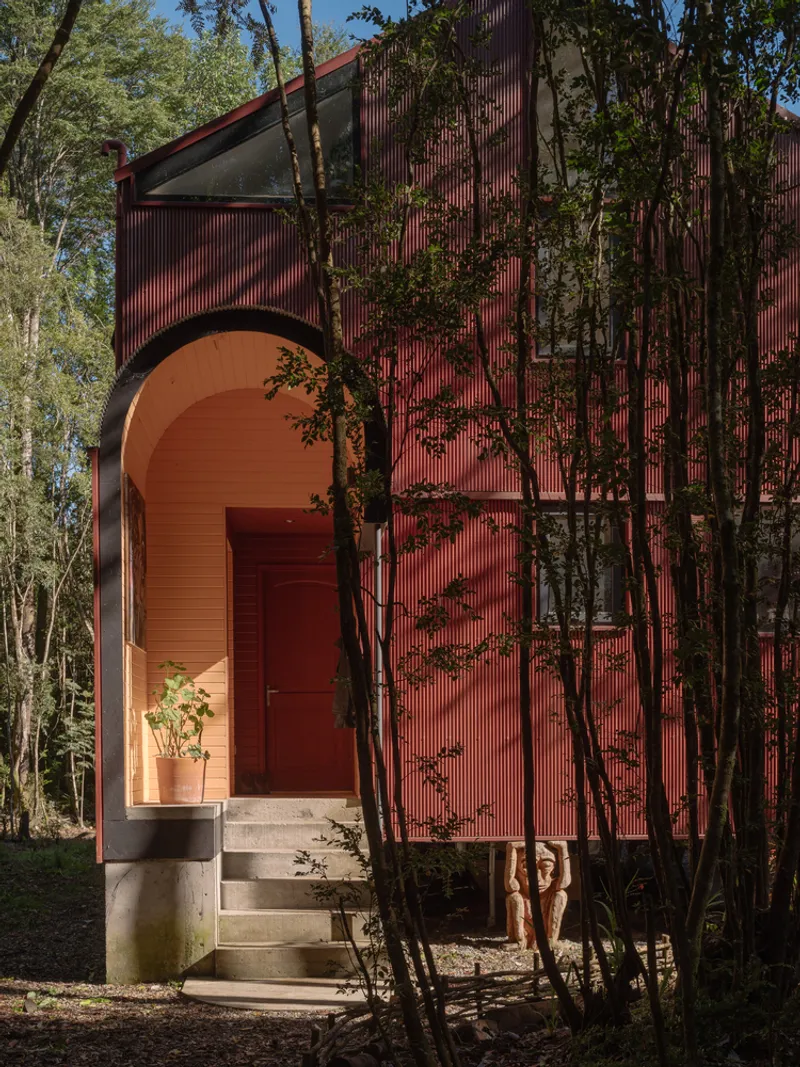
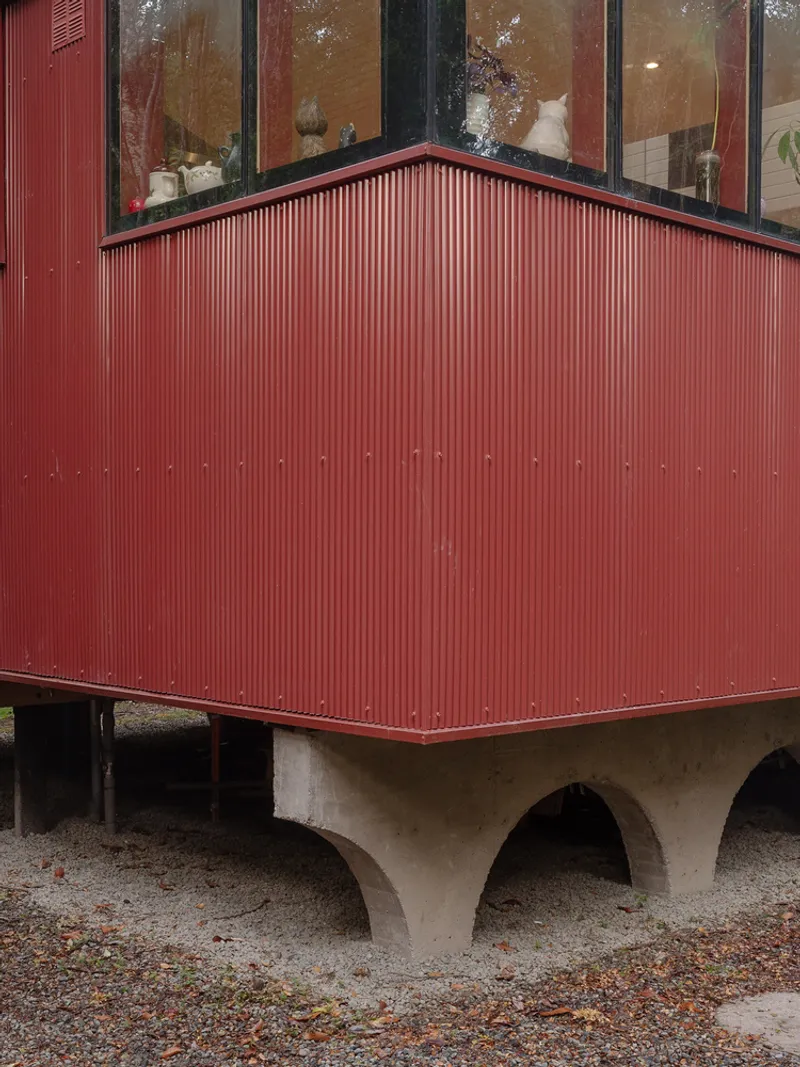
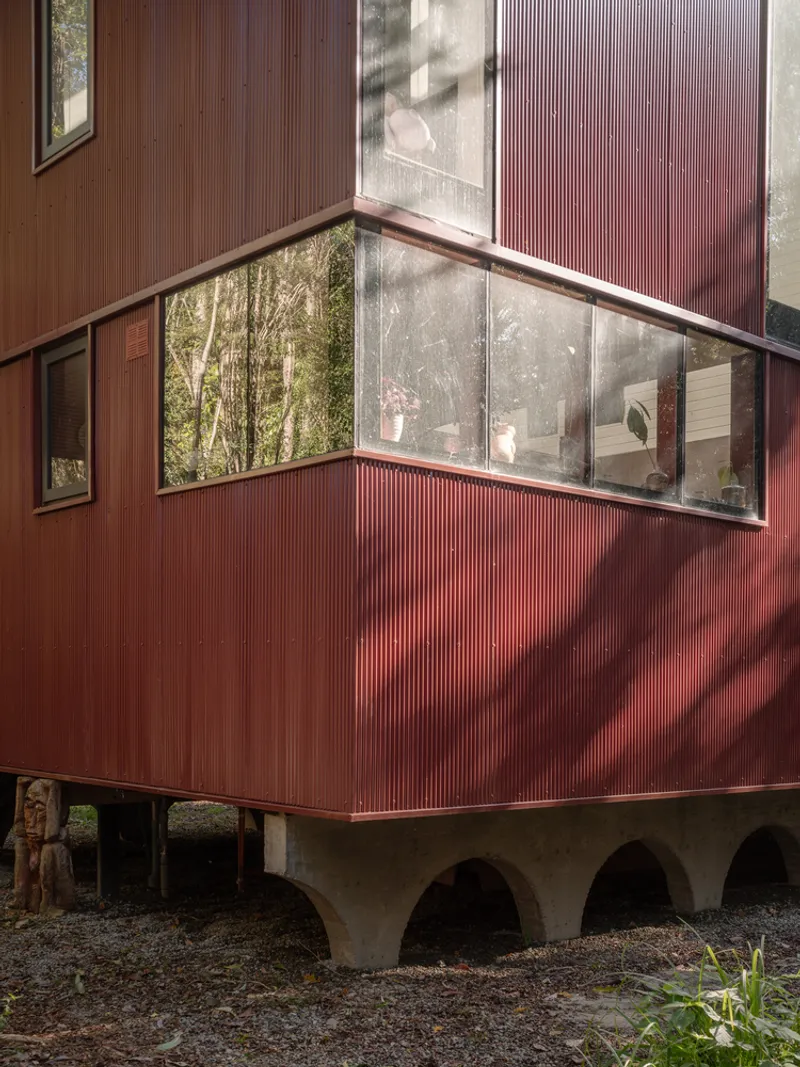
Lifting the house off the slope on arched concrete voids does several things at once. It manages stormwater and root protection, keeps the timber structure dry, and creates a generous threshold at the entrance. The arches are not decorative; they span the topographic irregularity of the hillside and let the forest floor continue beneath the building more or less undisturbed. It is a tactic more common in Brazilian modernism than in Chilean residential work, and it gives the project a tectonic specificity that a standard pile foundation would not.
The junction between rough concrete and precise metal cladding is handled cleanly. A horizontal datum separates the two materials, letting the arch read as landscape infrastructure and the volume above as habitable object. Corner details where glazed bays meet the curved base show careful resolution of competing geometries.
The Arched Threshold
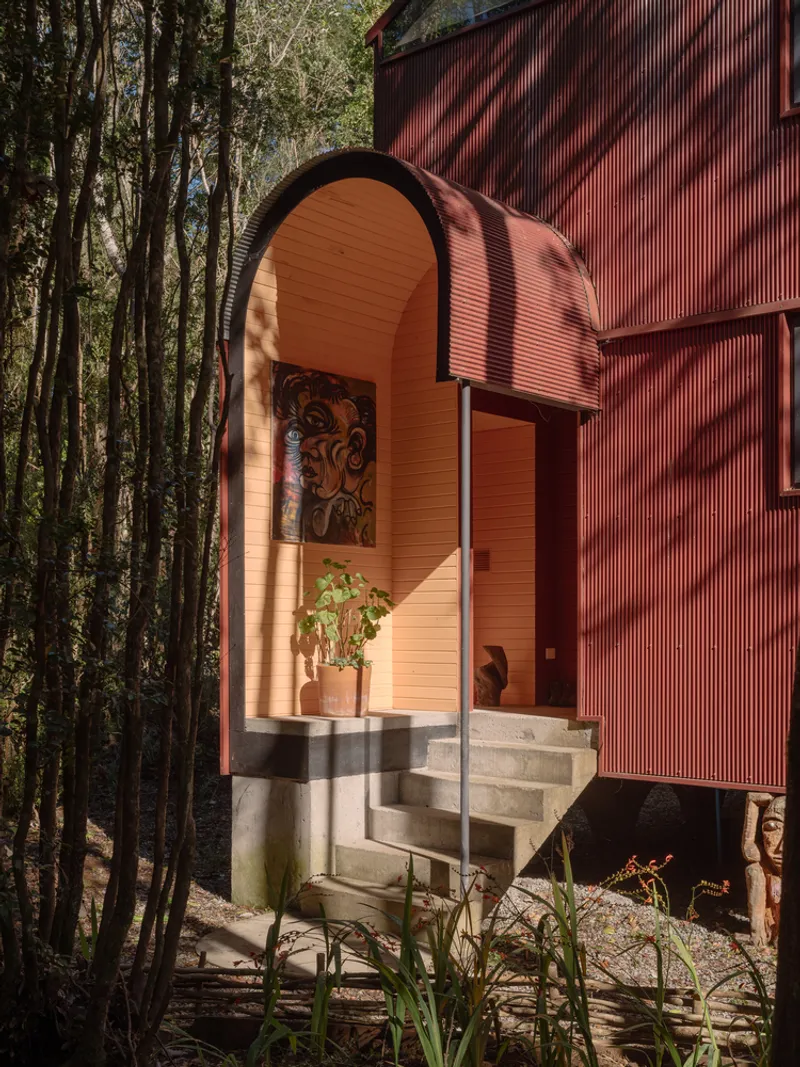


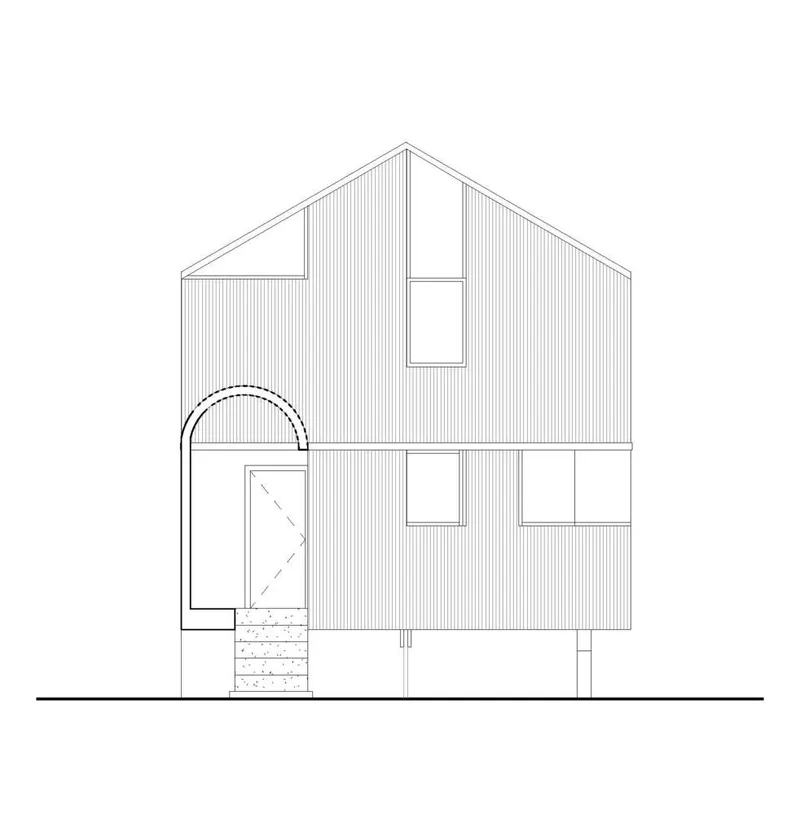
Arrival is choreographed through a portal that borrows the arch motif from the foundation and scales it to human passage. Concrete stairs climb under a corrugated metal canopy, timber handrails guiding you upward into a compressed opening that releases into the interior. At dusk, the threshold glows from within, framing artwork and sculpture in a composed tableau visible from the forest path. It is a small moment, but it converts the act of entering from functional to ceremonial.
Interior Light and the Double-Height Core

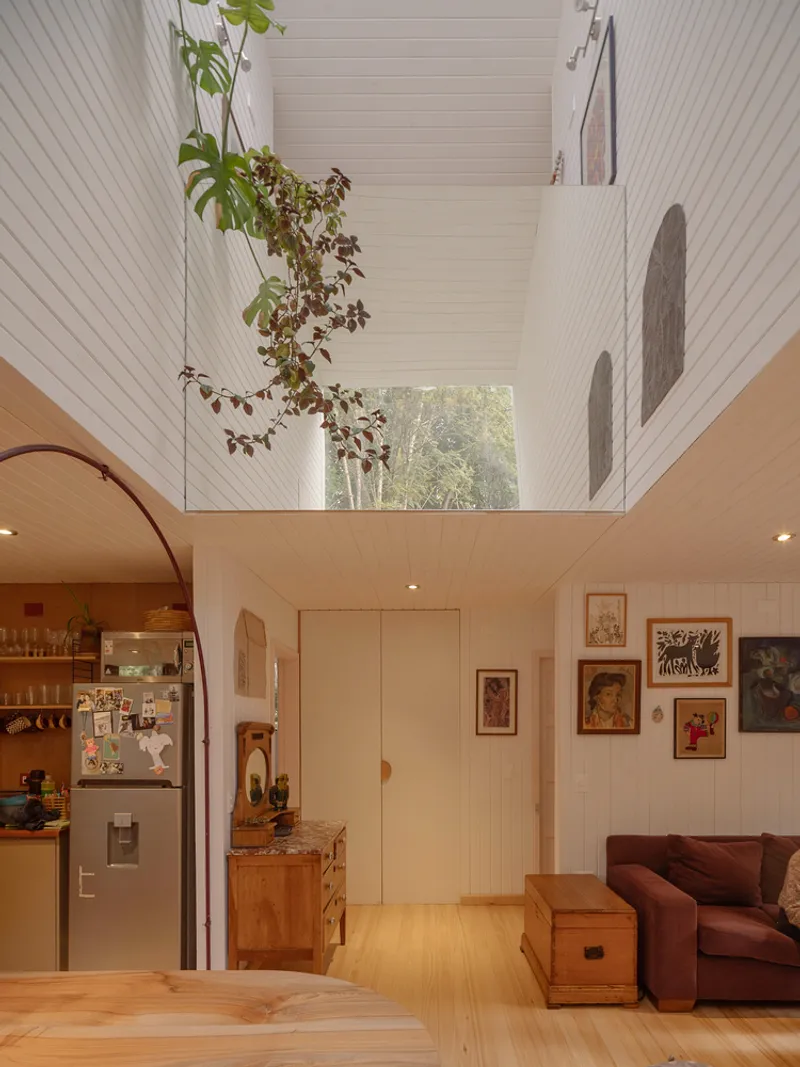
Inside, pale wood paneling and exposed timber ceilings create a warm, luminous shell that contrasts with the assertive exterior. The key spatial event is a double-height void at the center of the plan, where a skylight washes the dining area in indirect light and projects the shadow patterns of overhead branches onto interior walls. The effect collapses the distance between inside and canopy: you eat lunch under the same dappled conditions you would experience on the forest floor.
A climbing plant trails from an upper window into this void, a deliberate blurring of boundary that could read as precious but here feels earned. The plant grows because the light is real, not because a designer wanted a photograph. The restrained material palette, essentially one species of timber and white paint, lets these moments of green and shadow do the decorative work.
Facade Variations: Shadow, Ribbon, Bay

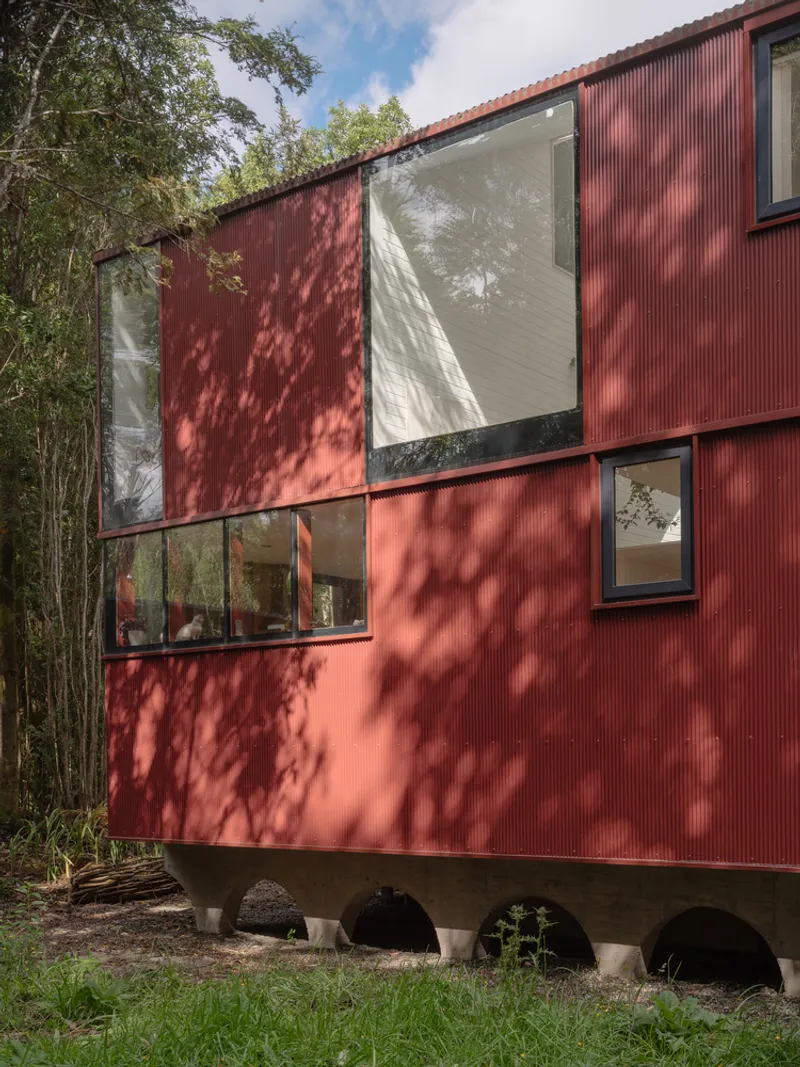
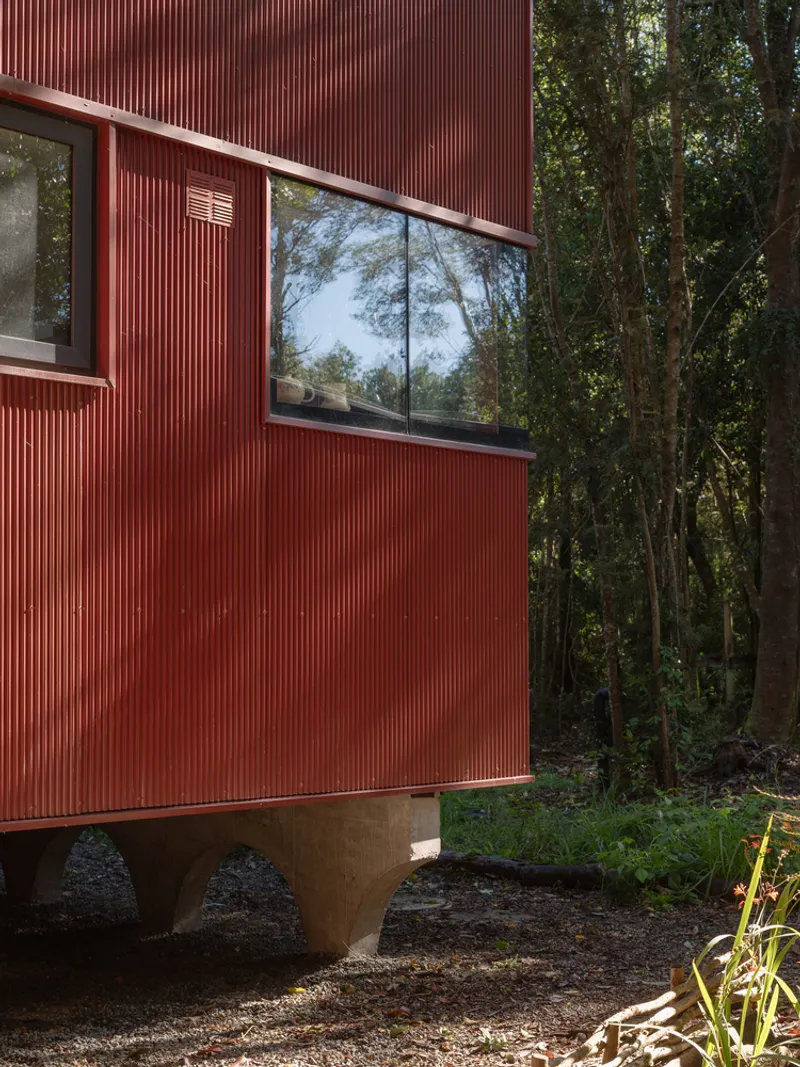
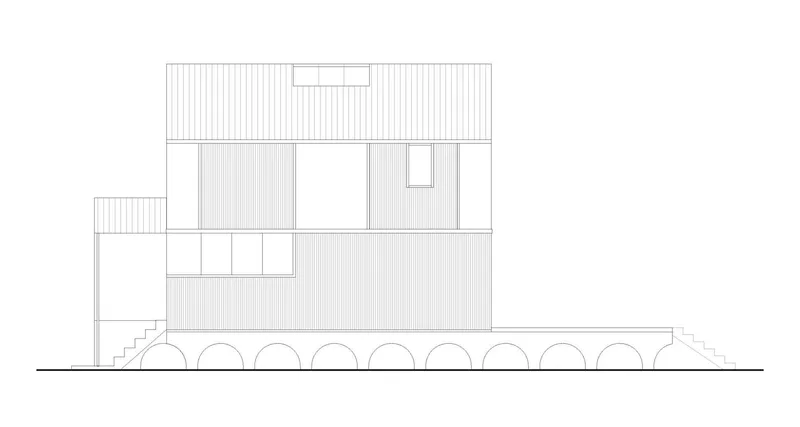
Each elevation plays a different game with its openings. The two-story facade facing the densest tree cover uses a scattering of rectangular punched windows, their proportions tall enough to frame individual trunks. A ribbon window on another face stretches horizontally, reflecting the canopy back at itself. A glazed bay projects outward to capture oblique views. The elevations are not identical, and they should not be; the forest is not uniform, and the house acknowledges that by tuning each wall to its specific outlook.
Tree shadows falling across the corrugated surface produce a constantly shifting moiré. The architects clearly anticipated this: the vertical orientation of the corrugations rhymes with the verticality of the trunks, so shadow and cladding reinforce rather than fight each other.
The Forest as Context

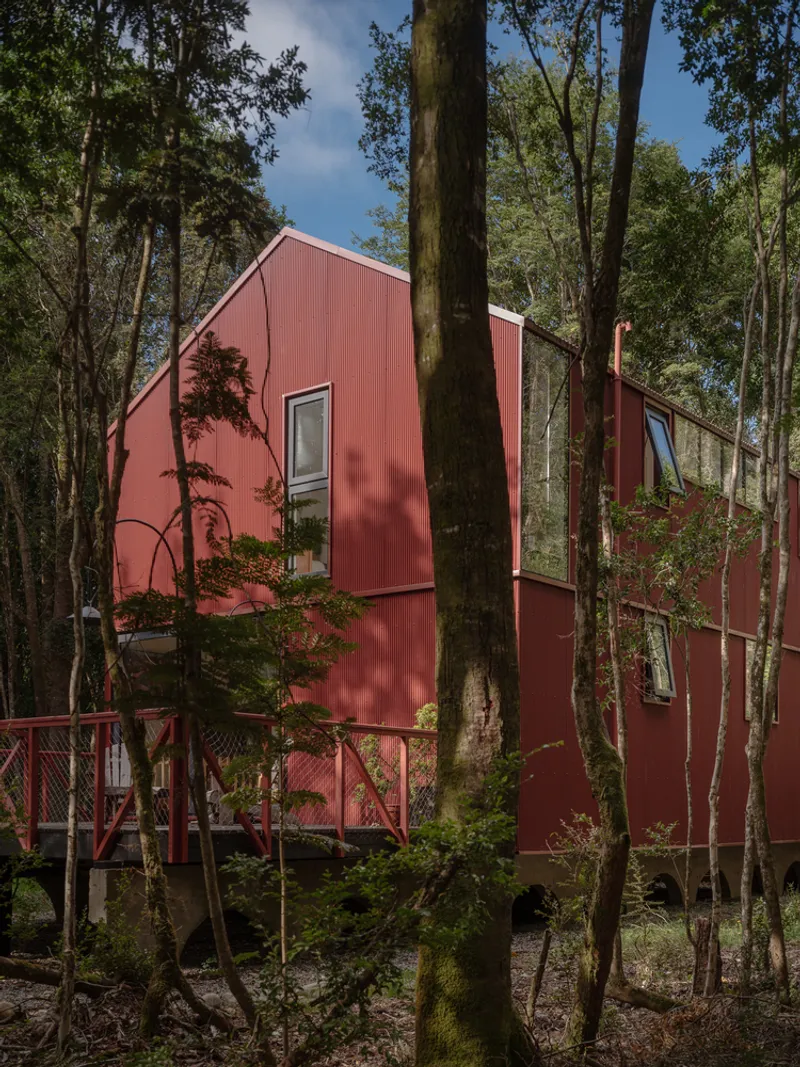
An aerial photograph at sunrise reveals just how deeply the house is embedded. The red roof is almost the only trace of human presence in a dense canopy, mist curling through the gaps between trees. From this vantage, the gabled form registers as a single domestic object, its footprint compact enough to leave the forest structure intact. The exterior stair and scattered windows seen from ground level confirm the impression: the house occupies a clearing barely larger than its own shadow.
Plans and Drawings

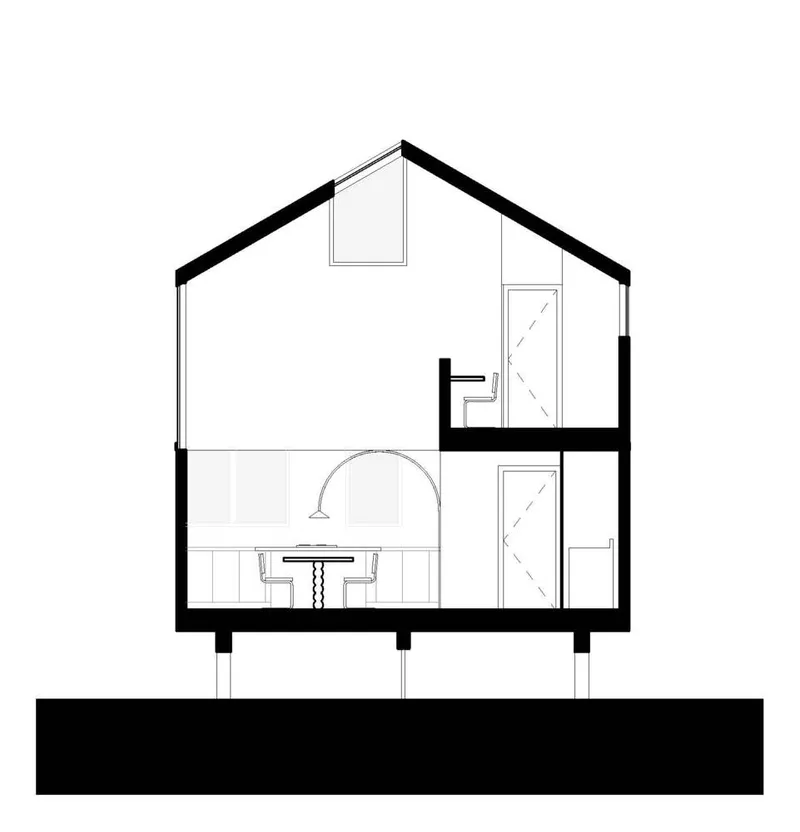

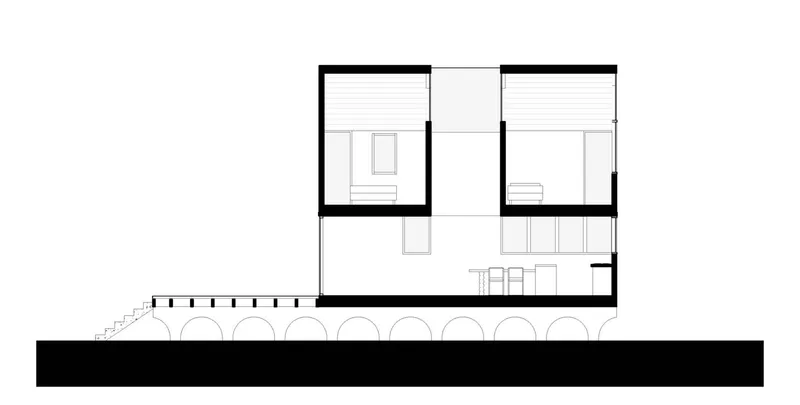


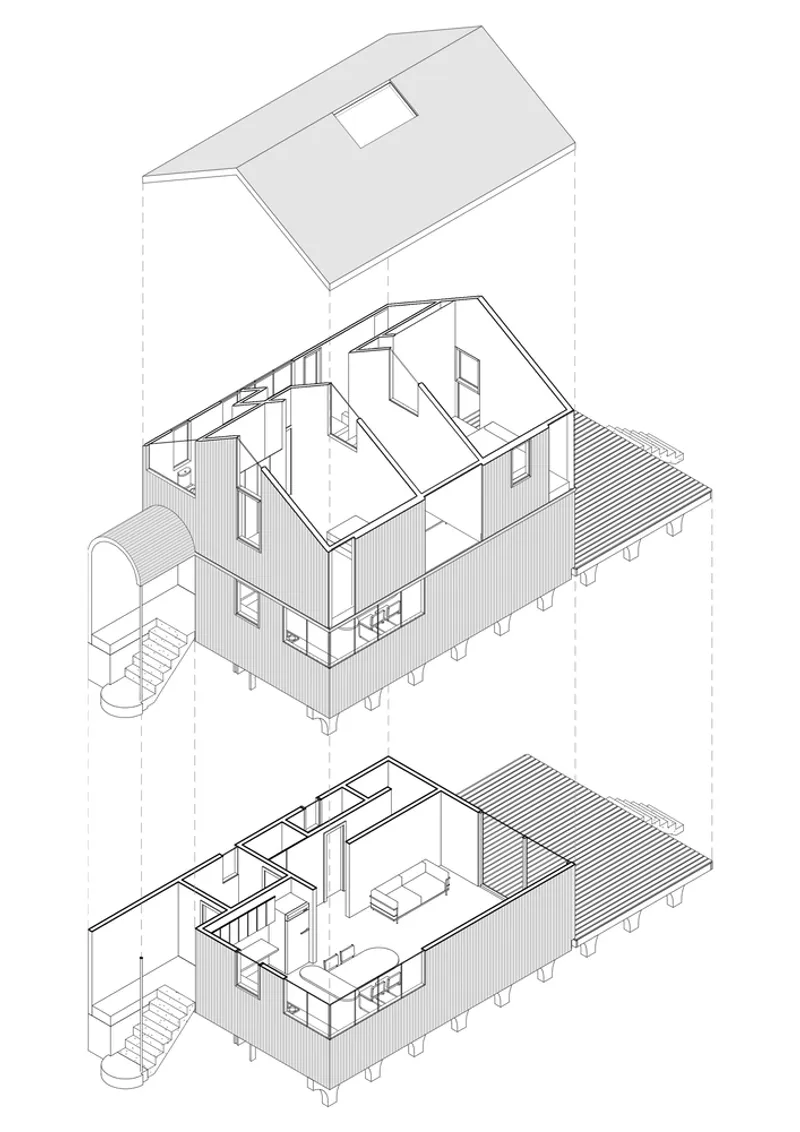
The floor plan confirms a compact organization around the central double-height void, with a stair connecting the two levels and rooms arranged to maximize perimeter contact with the surrounding trees. Sections reveal how the arched base absorbs grade changes and how the split-level strategy creates spatial variety within a tight envelope. Built-in furniture appears in several rooms, suggesting that the architects controlled the interior fit-out as tightly as the shell.
The four elevations, read together, document the shift in language from one face to the next: offset volumes, arched canopies, and stacked bays respond to orientation and view rather than following a single compositional rule. The axonometric exploded drawing is especially useful, pulling apart roof, upper floor, and ground level to expose the relationship between structural grid and inhabited space. It confirms that the complexity visible in photographs is not arbitrary but carefully organized.
Why This Project Matters
Houses in forests tend to fall into two camps: the glass box that dissolves into its setting or the heavy lodge that dominates it. Daiber & Aceituno have found a third position. Their house is unmistakably present, a red volume you cannot miss, yet it participates in the forest rather than competing with it. The arched base, the calibrated openings, and the double-height interior all serve a single argument: that architecture can be conspicuous and respectful at the same time.
For architects working on forested sites in southern Chile or anywhere with similar conditions, the project offers a clear lesson in tectonic honesty. The materials are common, the construction straightforward, and the spatial ideas legible without explanation. Nothing here depends on exotic technology or unlimited budget. What it depends on is judgment: where to place the void, how large to make the window, how high to lift the floor. That kind of judgment is harder to acquire than a software license, and it is what makes this house worth studying.
House in the Forest, Puerto Varas, Chile. Architect: Daiber & Aceituno Arquitectos. Photography by Marcos Zegers.
About the Studio
Share Your Own Work on uni.xyz
If projects like this are the kind of work you want to make, uni.xyz is a place to publish your own, find collaborators, and enter design competitions.


Popular Articles
Popular articles from the community


David Macias Steps a Doorless Stone and Plaster House Down a Tropical Colombian Hillside
In the humid hills of Colombia, Threshold House replaces the front door with an open void and terraces its 850 m² down the slope instead of fighting it.

Juan García Correa, John González and Claudia Rueda Sink a Circular Amphitheater into a Manizales Engineering Building
On the La Nubia campus in Manizales, Colombia, the S1 Building folds labs and offices into a hillside of ramped lawns that double as a campus route.

Cube Design Draws an Ecological Corridor Between Two Shenzhen Hills with the Nankai Building
Beside Shenzhen's container docks, the Nankai Building pairs stacked balconies with a climbing green screen to connect two hillsides across its height.

Architekt Andreas Gruber Scatters 23 Dark Timber Chalets Across a South Tyrolean Forest Edge
In Molini di Tures, Amonti Chalets breaks a resort into a hamlet of gabled timber houses, with parking, storage and services pushed into the slope.

Similar Reads
You might also enjoy these articles


Hodi-Mandai Geram
Project Function: Preservation and revitalization of the Intangible heritage and socio-spatial identity of the Hodi by Housing, Cultural Memory Center, Sacred Grove, landscape, local tourism economy


Olio Towers: A Mid-Rise for Performers That Fuses Housing, Rehearsal, and Stage
Located blocks from Houston's Theater District, this modular tower stacks living units around a central performance atrium.

Oasis: Modular Green Housing Carved into Dhaka's Urban Fabric
A shortlisted Plugin Housing entry reclaims unauthorized settlements in Dhaka with stepped concrete volumes, green roofs, and ventilation-driven design.

Black Hole: A Floating Megastructure for the Post-Physical Era
Emiliano Mazzarotto envisions a spherical, self-scaling arena where e-sports, digital hotels, and holographic stadiums replace traditional public space.

Explore Natural Forest Competitions
Discover active competitions in this discipline

Challenge to reimagine the Iron Throne

Photograph architecture without architects

Illustrate the lost glory of Angkor Wat - Render Challenge

Design challenge to reuse E-waste
Comments (0)
Please login or sign up to add comments
No comments yet. Be the first to comment!