
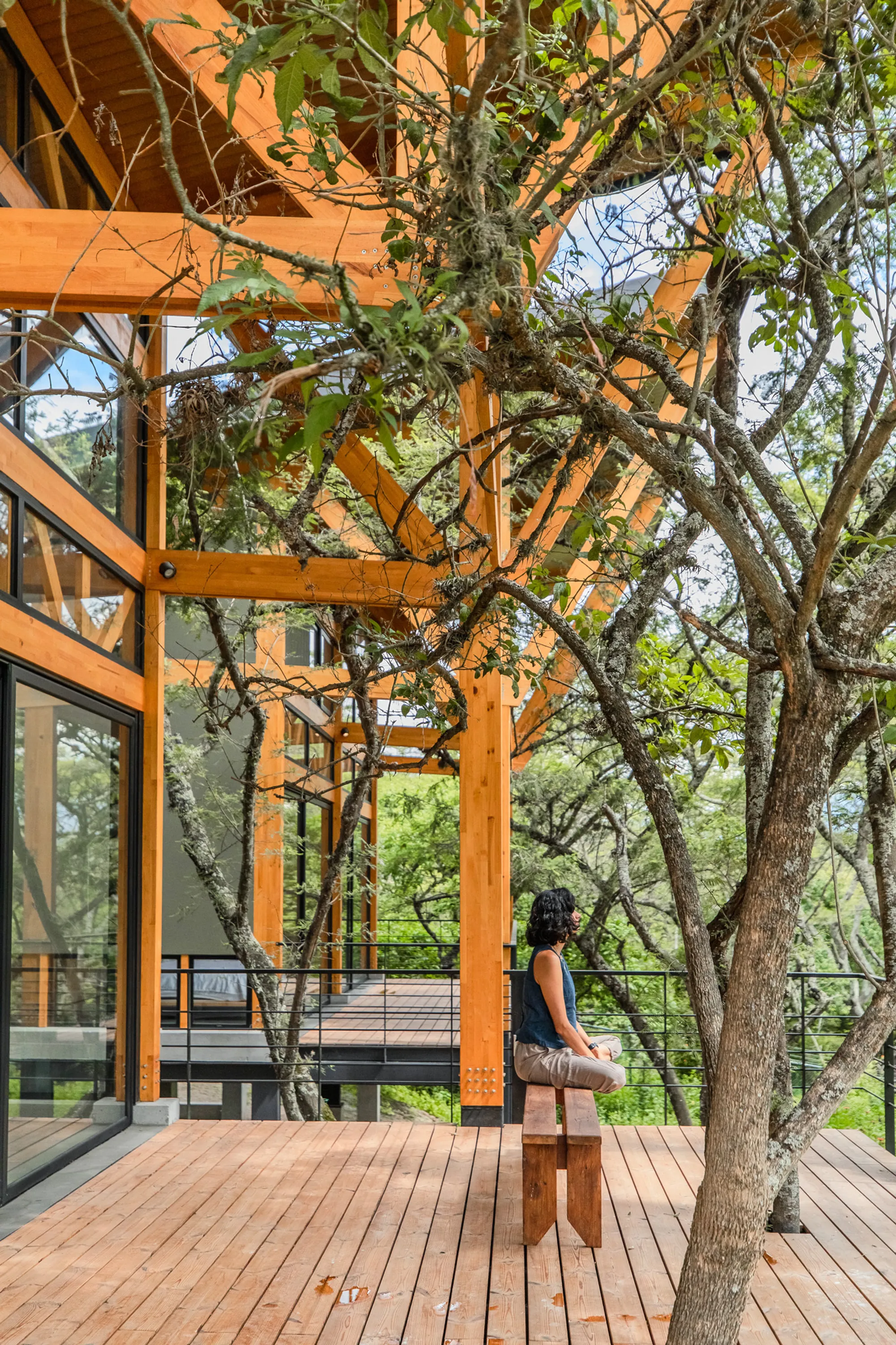
A Timber House That Yields to the Forest Around It
Espinoza Carvajal Arquitectos builds a 760 m² residence in the dry woodlands outside Quito that treats existing trees as structural collaborators.


Getting out of Quito is a process of decompression. The city's altitude, density, and concrete slowly thin as you climb into the dry hillsides that ring the valley. House in the Woods, completed in 2025 by Espinoza Carvajal Arquitectos in collaboration with Defrente and StudioUrbana, sits at the end of that transition: a 760 m² residence that disappears into a landscape of scattered trees and volcanic soil. It is not a retreat from the city so much as an argument for a different way of occupying the land altogether.
What makes this project worth studying is its refusal to clear a site. Mature trees grow through the decks. The building's two low volumes, angled slightly off axis from each other, appear to have been dropped into the gaps between trunks rather than imposed upon a blank canvas. The result is an architecture that reads less as a built object and more as an inhabitable grove, held together by exposed timber framing, rammed earth walls, and an almost obsessive commitment to transparency.
Settled Into the Slope


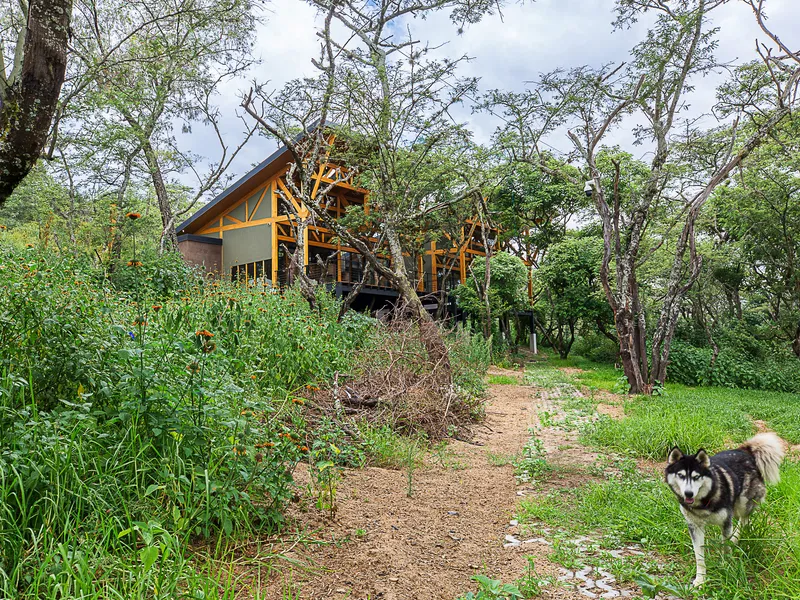
From the air, the house barely registers. Two corrugated metal roofs hug the hillside, their gabled profiles mimicking the pitch of the terrain itself. The volumes are oriented to avoid the largest trees and to catch the prevailing light without exposing too much surface area to the harsh midday sun. Natalia Gandarillas and Santiago Espinoza clearly started with the topography, not a plan, and let the contours dictate what went where.
The approach on foot reinforces this reading. A dirt path winds uphill through scrubby vegetation, and the house reveals itself gradually: first a roofline, then the warm tone of timber framing, then the full gabled profile nestled among bare branches. There is no grand facade to speak of. The architecture defers to the slope.
Trees as Collaborators
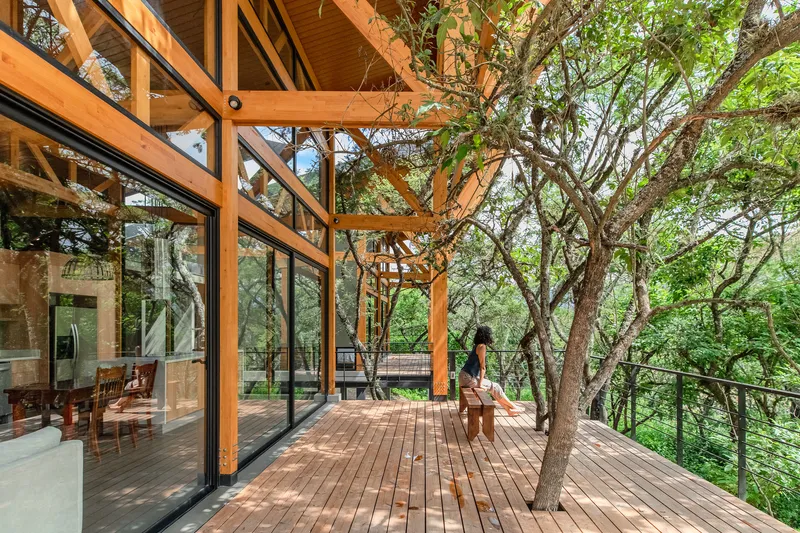

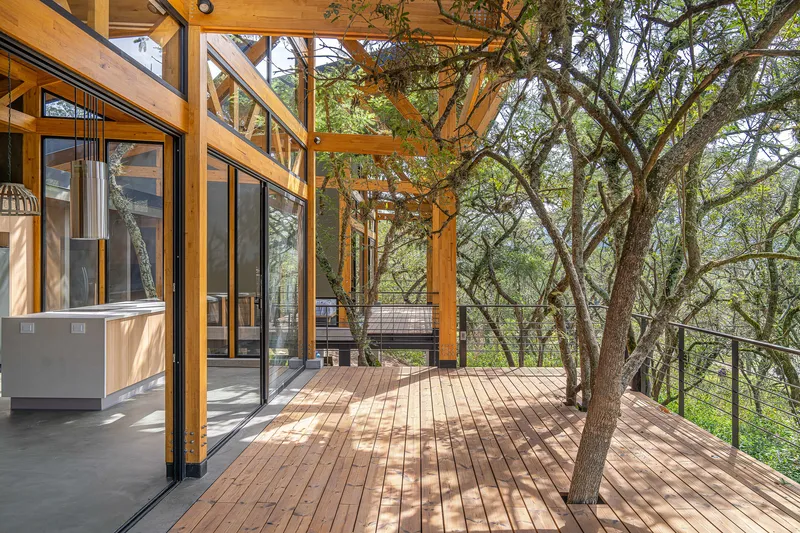
The decks are the project's most striking gesture. Timber platforms extend from the interior volumes into the canopy, and at several points, existing trees punch straight through the boards. Rather than treating these moments as obstacles to be framed or apologized for, the architects have made them the centerpiece of the outdoor rooms. You sit among the trunks, not beside them.
The post-and-beam structure that supports these decks is deliberately legible. Every connection, every joint is on display, creating a rhythm of vertical posts and horizontal beams that echoes the pattern of the surrounding trunks and branches. Cable railings keep the edges minimal, ensuring that the boundary between built platform and forest floor stays ambiguous.
Living Between Glass and Earth
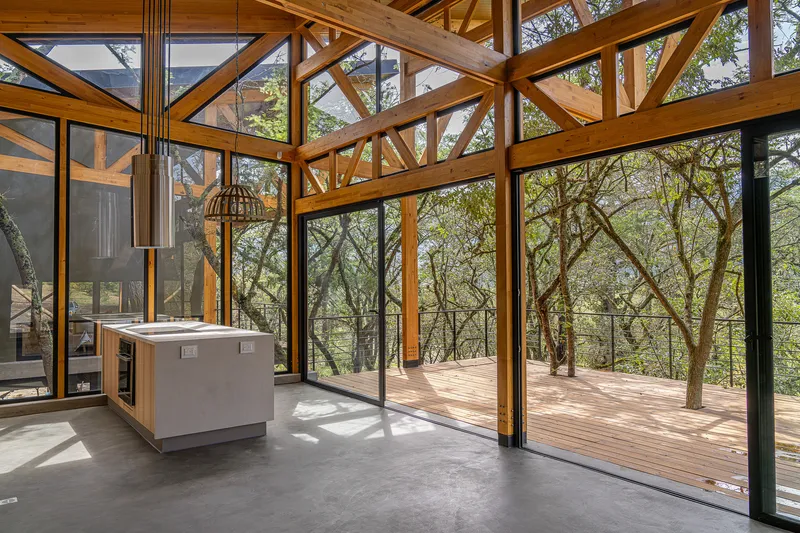
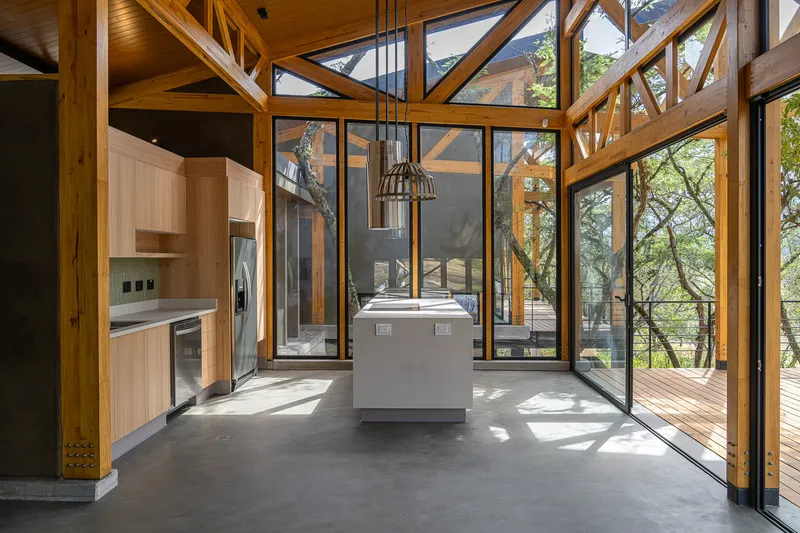

Inside, the kitchen and dining area operate as the heart of the house. A concrete island anchors the space while floor-to-ceiling glazing dissolves three of its four edges into the woodland. Exposed timber trusses overhead carry the eye upward, and the warmth of the wood palette keeps the room from feeling clinical despite its generous proportions.
A separate view through four tall glass doors frames a gravel courtyard where tree trunks stand like columns in a hypostyle hall. This is the most deliberately composed moment in the house: a threshold between the domestic interior and the wild landscape that feels almost sacred in its stillness. Dappled light shifts across the gravel throughout the day, turning the courtyard into a slow clock.
Material Honesty in the Private Rooms


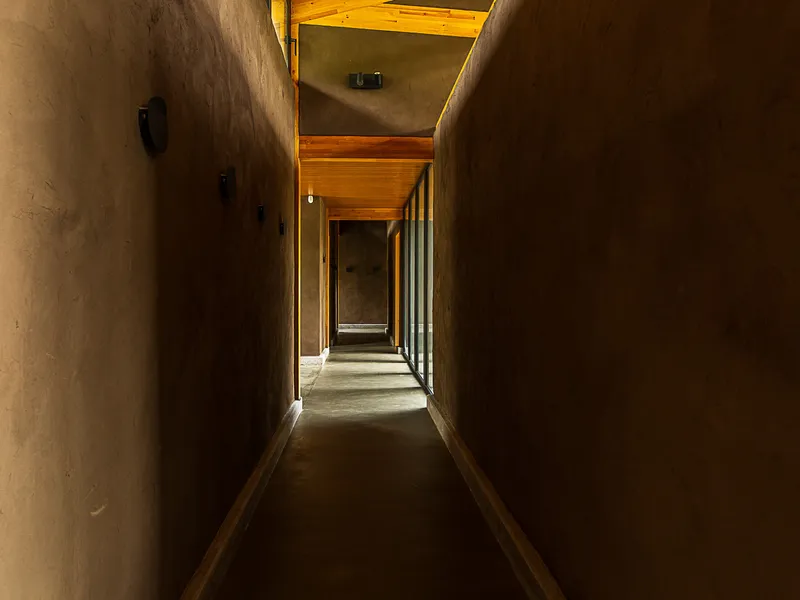
The bedrooms continue the logic of transparency but dial back the scale. Oriented strand board panels line the walls, offering a rougher, more economical texture than the milled timber used in the public areas. It is a deliberate choice: the private rooms are about comfort and enclosure, not spectacle. Polished concrete floors run continuously underfoot, connecting bedroom to bathroom through timber-framed doorways.
A narrow corridor of rammed earth walls provides one of the house's most tactile moments. The compressed soil registers as bands of ochre and sienna, lit by recessed fixtures overhead and a single window at the far end. Walking through this passage feels like moving through a geological section, a compressed record of the site's own ground.
Rituals of Bathing
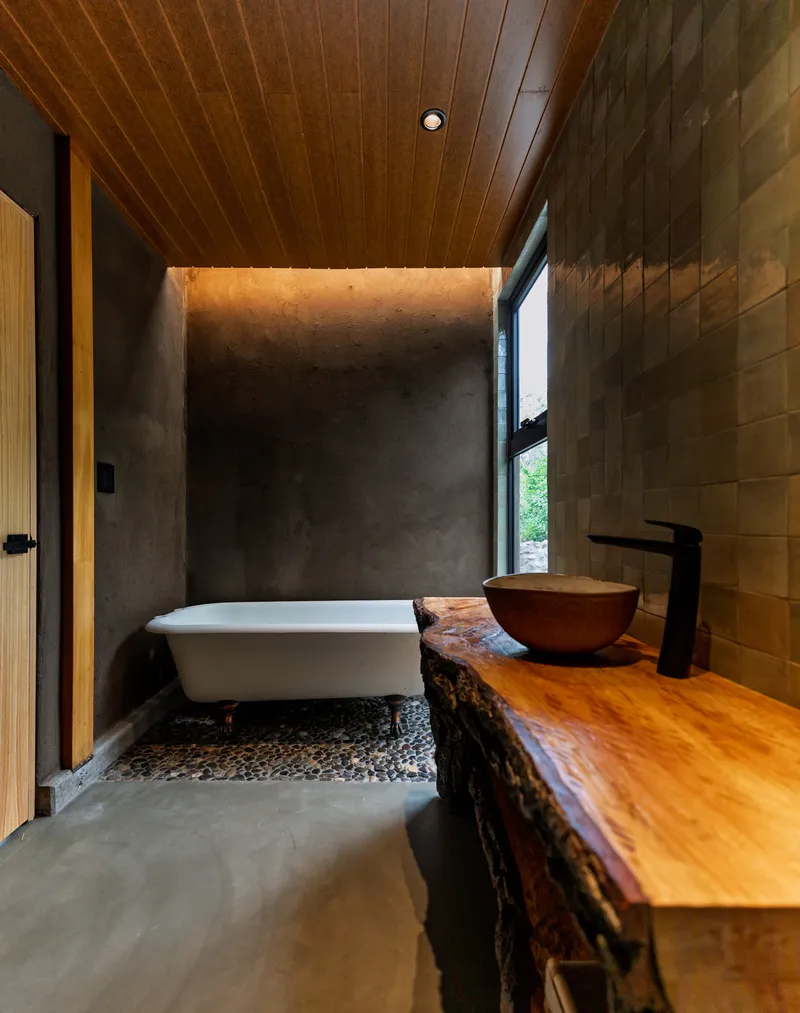
The bathroom deserves its own mention. A freestanding tub sits on a bed of river stones beneath a wood plank ceiling, flanked by a live-edge vanity that looks like it was pulled from the forest outside. It is the kind of space that could tip into rustic kitsch, but the proportions are restrained and the detailing is precise enough to keep it grounded. There is no excess here, just a careful orchestration of natural materials around the act of bathing.
Building the Frame


Construction photographs reveal a process that was as much assembly as building. Timber roof trusses were prefabricated and lifted by crane into position atop concrete slabs, a hybrid approach that combines the speed of off-site fabrication with the permanence of a poured foundation. Steel connectors join the timber members at critical nodes, a pragmatic detail that the finished house does not try to hide.


Close-up shots of the trusses laid across the slab show the scale of the framing clearly. These are substantial members, sized for the long spans required by the open-plan interiors. A physical model of the residence, with its two angled roofs perched on an elevated plinth, confirms that the massing strategy was worked out in three dimensions from the start.
Plans and Drawings


The site plan makes the relationship between the two volumes and the surrounding landscape explicit. Winding pathways connect the house to the broader terrain, reinforcing the impression that the building is one event among many on the hillside rather than its focal point. Section drawings show how the exposed timber structure spans between bearing walls, creating lofty interiors beneath the gabled roofs while maintaining a low exterior profile.


An axonometric section is particularly revealing. It peels away the roof to expose the spatial sequence from entry through living areas to the private wing, clarifying how the shift in roof angle generates different ceiling heights and interior atmospheres. Birds drawn overhead in the sections are a small touch, but they anchor the drawings in the site's ecology rather than in pure abstraction.
Why This Project Matters
House in the Woods is not the first project to let trees grow through its decks, and it will not be the last. But what sets it apart is the consistency with which that idea permeates every scale of the design, from the massing on the hillside down to the river stones under the bathtub. There is no moment where the architects seem to have run out of patience with the site and defaulted to a generic solution. Every detail is calibrated to the specific landscape it occupies.
For Quito, a city whose rapid expansion routinely levels the terrain around it, this house offers a quiet counterargument. It demonstrates that density and development do not require erasure, and that a timber frame, some concrete, and a willingness to work around what already exists can produce something far more compelling than a cleared lot and a blank slate ever could.
House in the Woods by Espinoza Carvajal Arquitectos + Defrente + StudioUrbana, led by Natalia Gandarillas and Santiago Espinoza. Quito, Ecuador. 760 m². Completed 2025. Photography by Silueta, Mateo Barrera, SAJAESCA, and Juan Sebastián Pérez.
About the Studio
Share Your Own Work on uni.xyz
If projects like this are the kind of work you want to make, uni.xyz is a place to publish your own, find collaborators, and enter design competitions.




Popular Articles
Popular articles from the community


AL-JANNAH: Sustainable Architecture and Permaculture for Afghan Widows
AL-JANNAH uses sustainable architecture and permaculture to create resilient oasis of housing, learning, work and renewal for Afghan widows.

Co-Life: Senior Housing Design That Reconnects Older Adults With the City
Co-Life reimagines senior housing design through healing gardens, shared streets, workshops, and a sustainable community across generations.
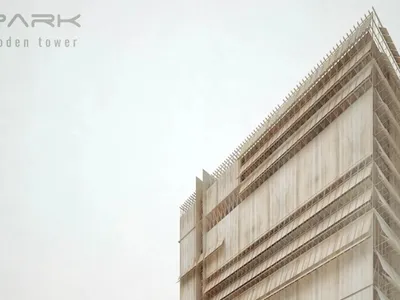
EW PARK: Sustainable Architecture Reimagines the Future of Urban Parking
EW PARK reimagines city parking as a modular wooden tower combining automation, solar energy, electric mobility, and adaptable urban design.

The Musturak Paradise: Senior Living Architecture for a Connected Future in Temara, Morocco
The Musturak Paradise reimagines senior living architecture in Temara via private homes, social spaces, culture, community, and shared care.


Similar Reads
You might also enjoy these articles

Bao Huynh Watercolor Atelier: A Serene Art Retreat in Hội An
Bao Huynh Watercolor Atelier in Hội An blends multifunctional art spaces, sustainable design, local materials, and family-friendly living in a serene environment.

Atelier Macri Concept Store Interior Design by CASE-REAL
Atelier Macri store features a "ko" counter, walnut wood details, cork displays, blending retail, gallery, and seamless customer experiences.

Manuel Vargas Izquierdo Stadium and High-Performance Sports Center: Architectural Excellence in Jalpa de Méndez
The Manuel Vargas Izquierdo Stadium blends sustainable design, inclusive sports facilities, and cultural-inspired architecture, revitalizing Jalpa de Méndez’s public spaces.

KAKR Buluh Awar Hall: Revitalizing Community and Ecology Through Bamboo Architecture
Community built bamboo hall revitalizes Buluh Awar village, empowering youth, restoring ecology, celebrating vernacular craftsmanship through sustainable architecture and culture.


Explore Residential Building Competitions
Discover active competitions in this discipline


Challenge to design mud housing for contemporary communities


Design challenge to reuse E-waste
Comments (0)
Please login or sign up to add comments
No comments yet. Be the first to comment!