
Camarim Arquitectos Unfolds a Lisbon Townhouse into Layered Stone, Walnut, and Marble
House No. 7 in Avenidas Novas compresses four stories of generous living into a narrow plot between heritage neighbors.


Lisbon's Avenidas Novas district is a place of contradictions: wide boulevards laid out with Haussmann-like ambition, but behind the frontages, plots pinch into awkward slivers governed by diagonal property lines and party walls in varying states of repair. House No. 7 by Camarim Arquitectos occupies one of these slivers, a four-story residence that manages to feel both compact and extravagant. The street facade reads as a civic object, its stacked stone cladding and deeply recessed windows sitting comfortably in a row of 19th-century neighbors. Step behind it, though, and the building breaks open into terraces, courtyards, and a material world that pivots from rough hewn to polished in the span of a single landing.
What makes this project genuinely interesting is how it handles the vertical section. Rather than stacking identical floor plates, Camarim shifts each level back from the rear facade, creating a cascade of planted terraces that bring daylight deep into the plan and give every floor a private outdoor room. The result is a stepped massing that mediates between the taller heritage building next door and the lower neighbors on the other side. It is a house designed from the section outward, and the interior craftsmanship, from the walnut-clad stair core to the book-matched marble bathrooms, rewards that sectional ambition at every turn.
A Street Facade That Holds the Line
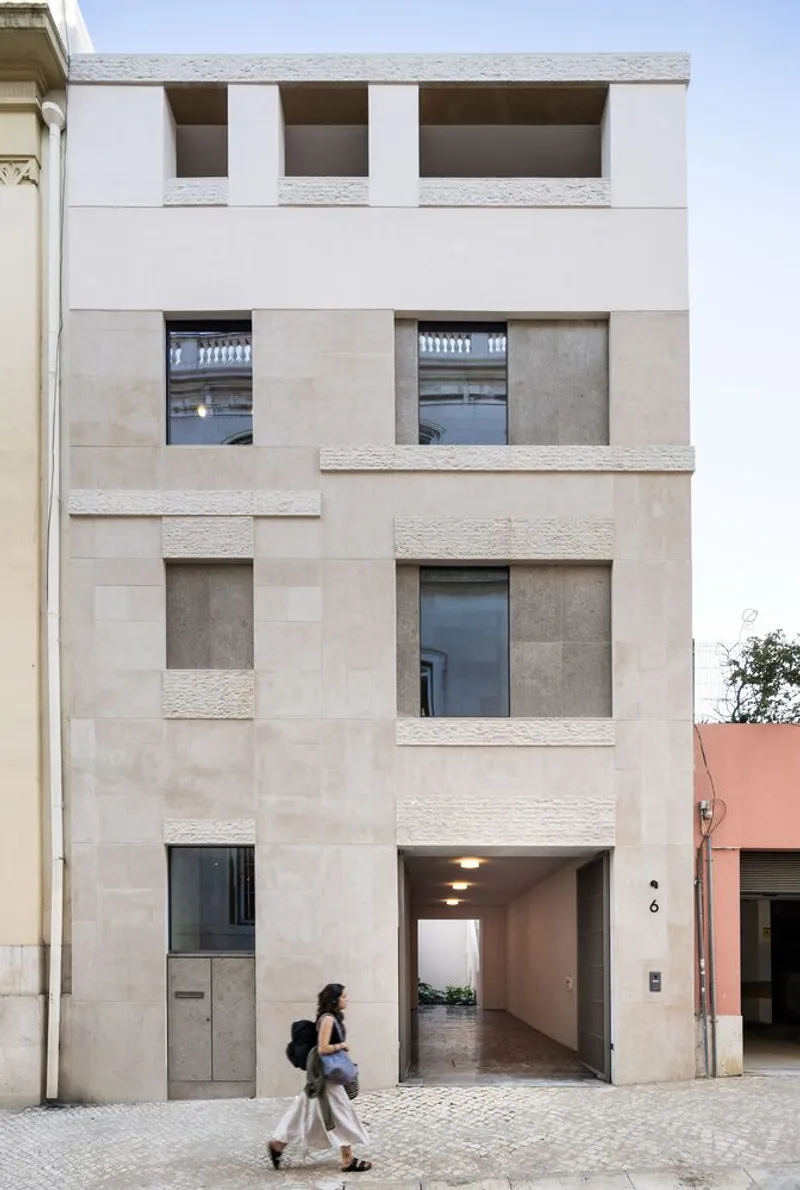
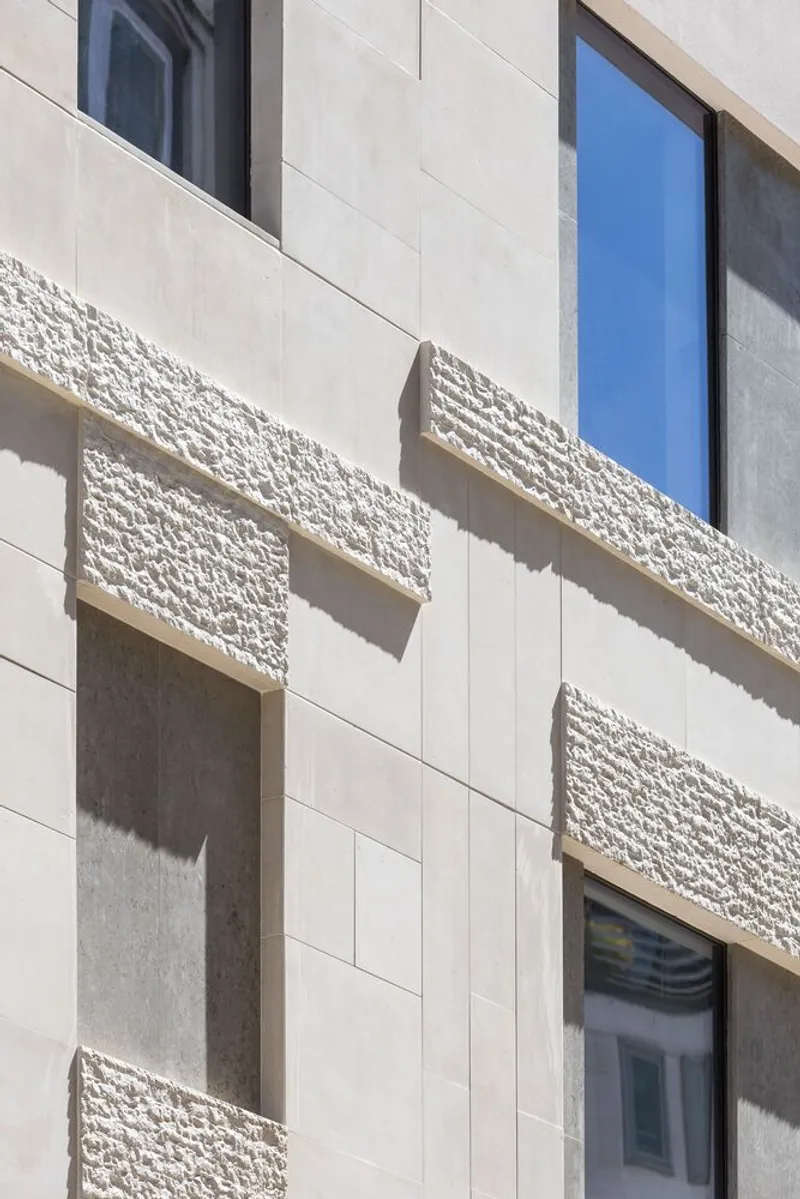
The front elevation is the most restrained move in the project, and deliberately so. Textured stone panels wrap the facade in a grid of deep reveals, giving the windows a fortified quality that rhymes with the heavy masonry of the adjacent buildings. The material choice reads as both contemporary and geological, as though the architects peeled back the plaster of the surrounding 19th-century stock to expose what was always underneath.
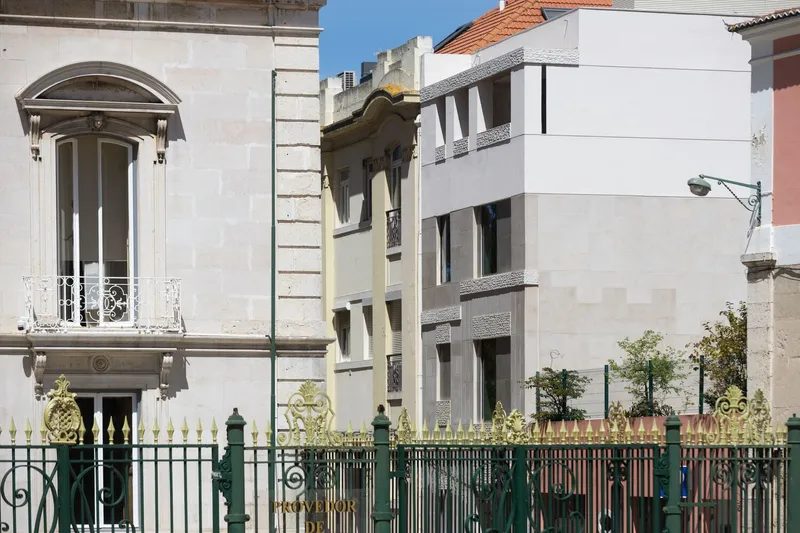
Seen from further down the street, the stone bands merge into the rhythm of ornamental ironwork and classical moldings without competing for attention. The restrained palette lets the depth of the reveals do most of the expressive work, catching raking daylight and creating shadows that change character throughout the day. It is a lesson in how a new insertion can assert its own identity while refusing to shout.
Stepping Back: The Terraced Rear
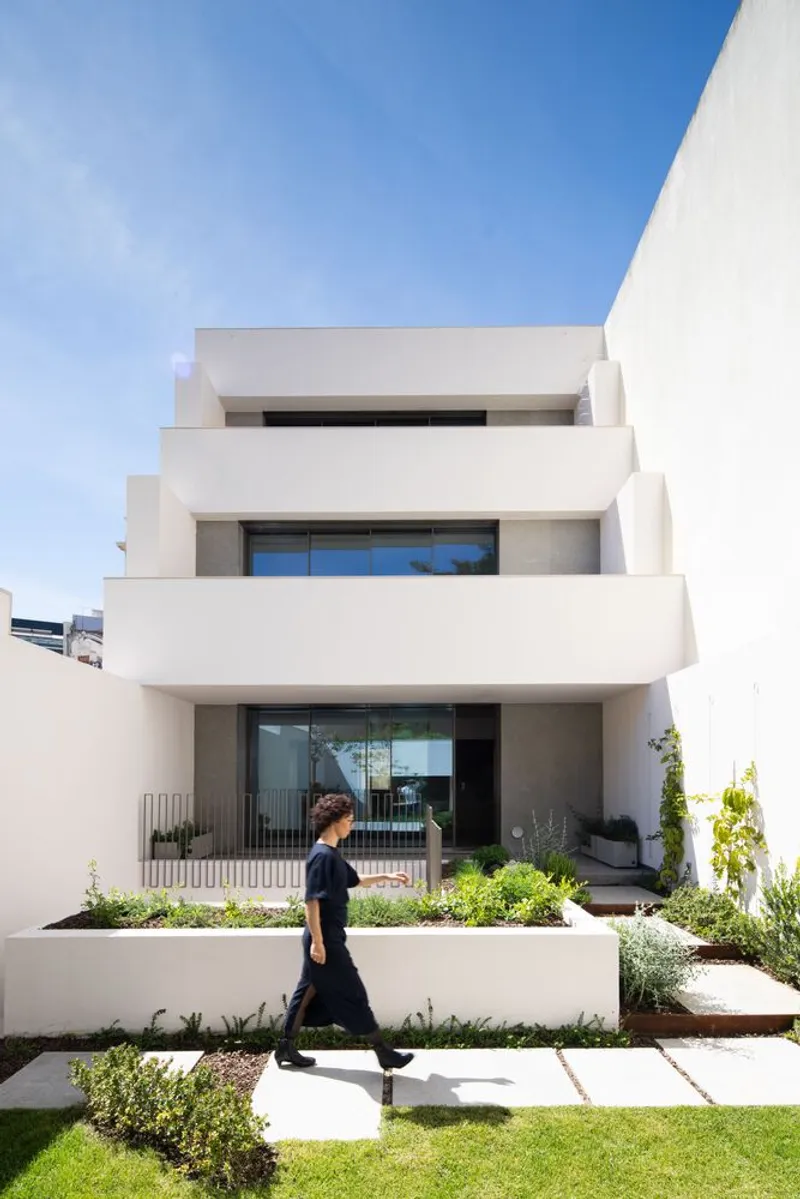
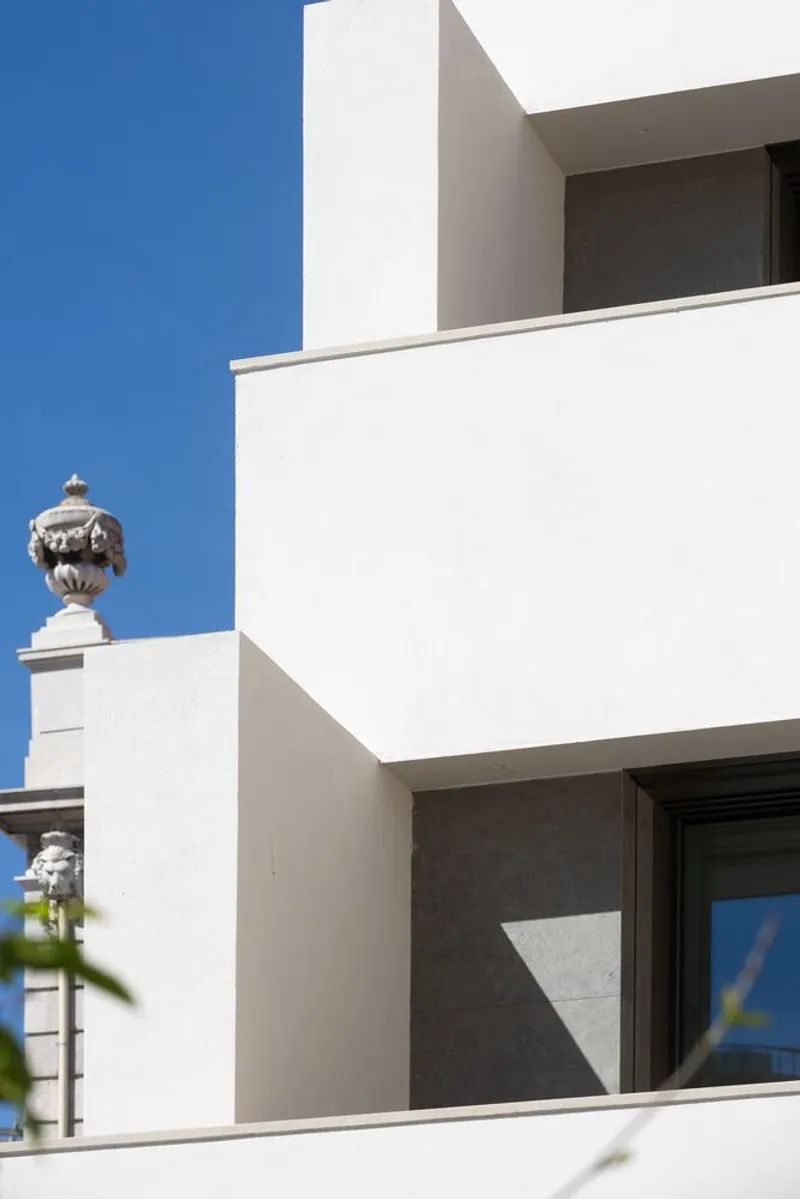
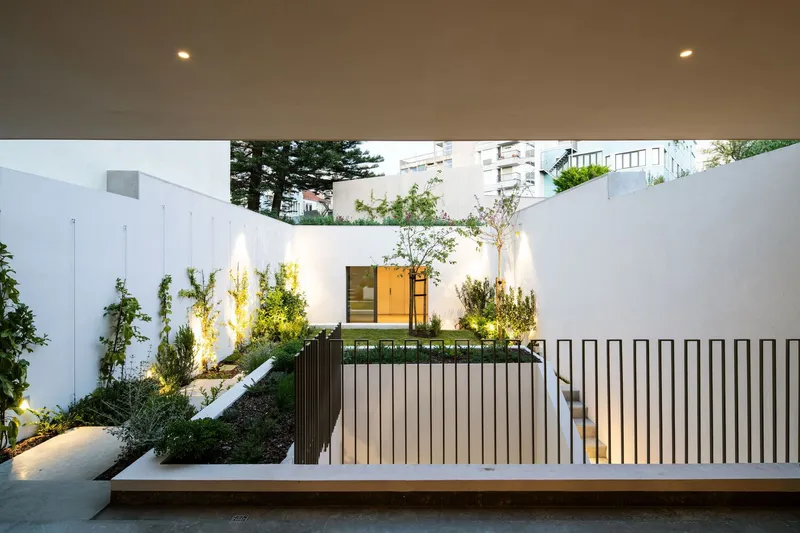
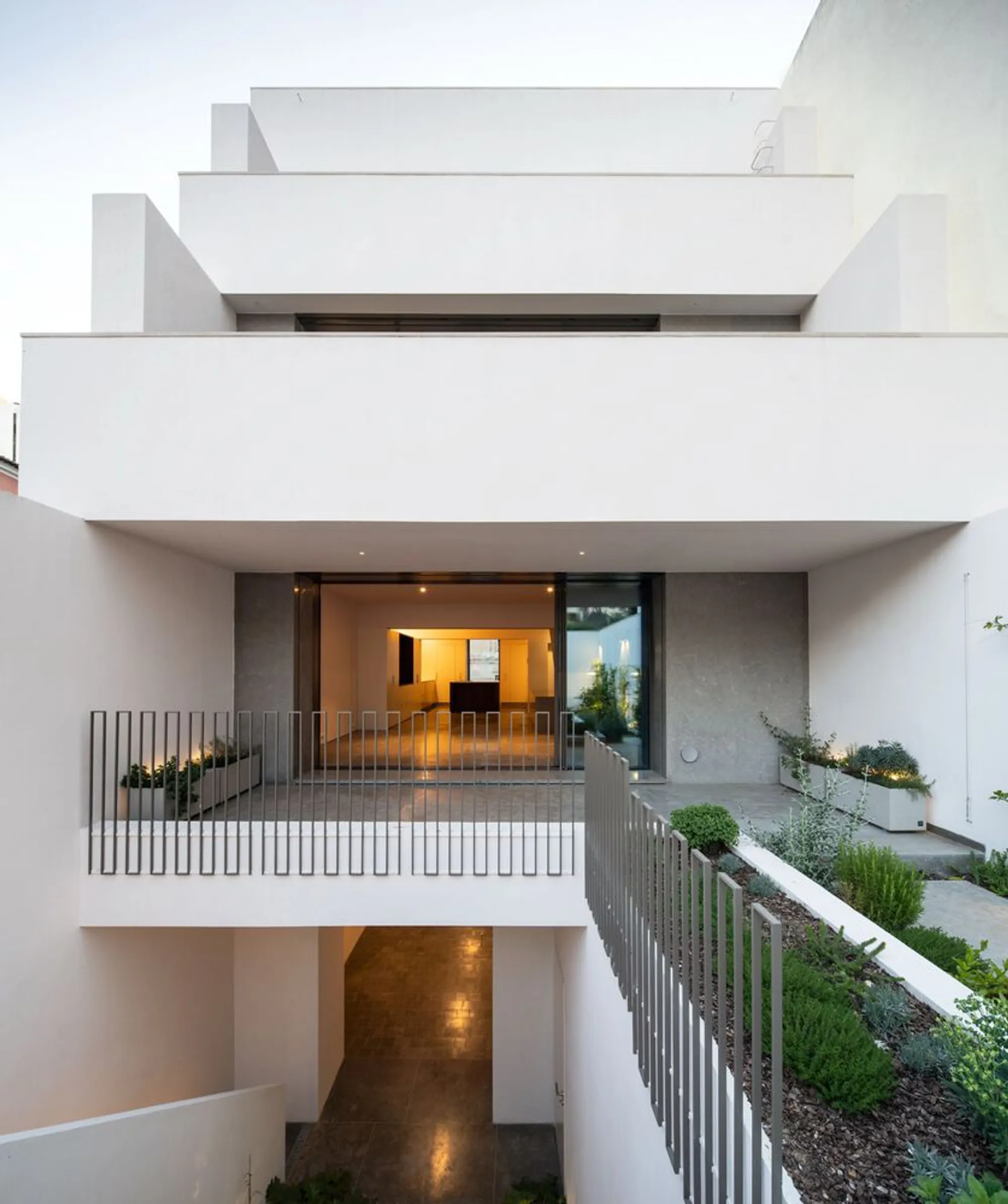
The rear of the building is where the section strategy becomes legible. White stucco balconies step back level by level, each one planted with low beds that soften the hard geometry and create a vertical garden effect when viewed from the courtyard below. The proportions are generous enough that these are not token balconies but genuine outdoor rooms, each one shielded from above by the cantilever of the floor above.
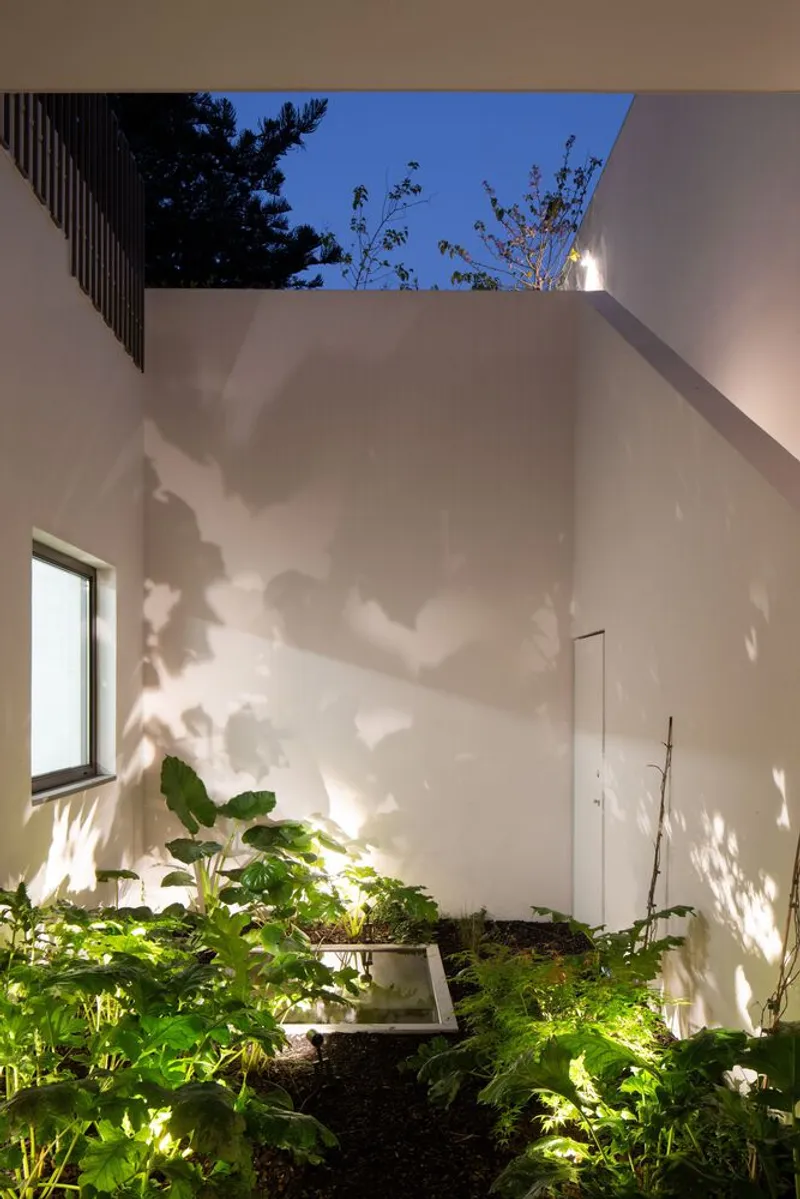
At dusk, the courtyard comes alive through uplighting and the warm glow escaping through glazed openings. A planted slope at ground level and vertical slat railings maintain privacy without closing off sightlines. The contrast with the tight, stone-clad street facade is intentional: one face addresses the public city, the other tends to the intimate life of the household.
The Walnut Core
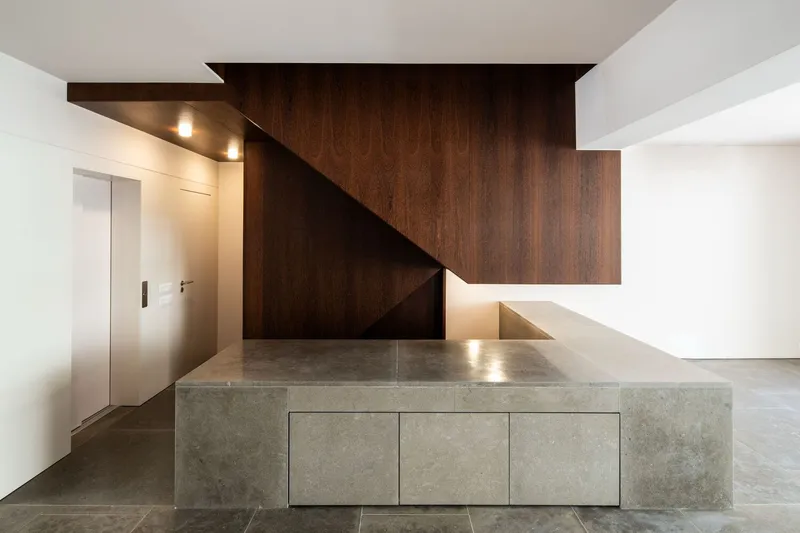
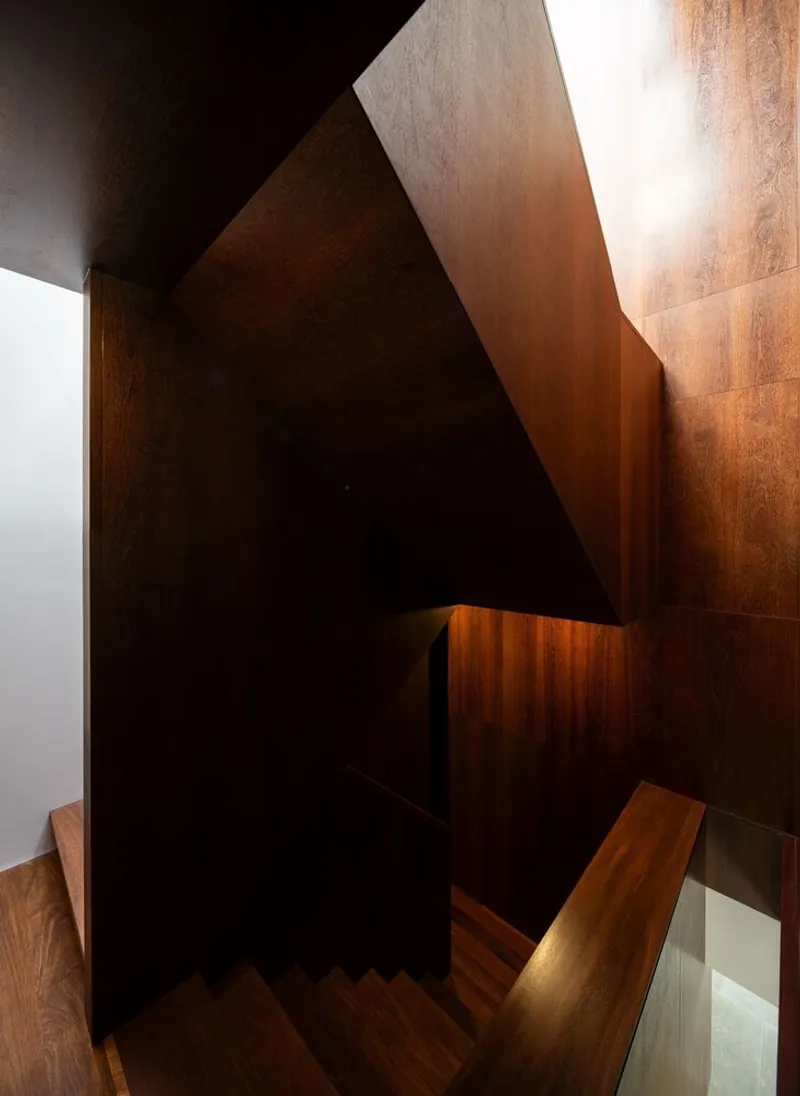
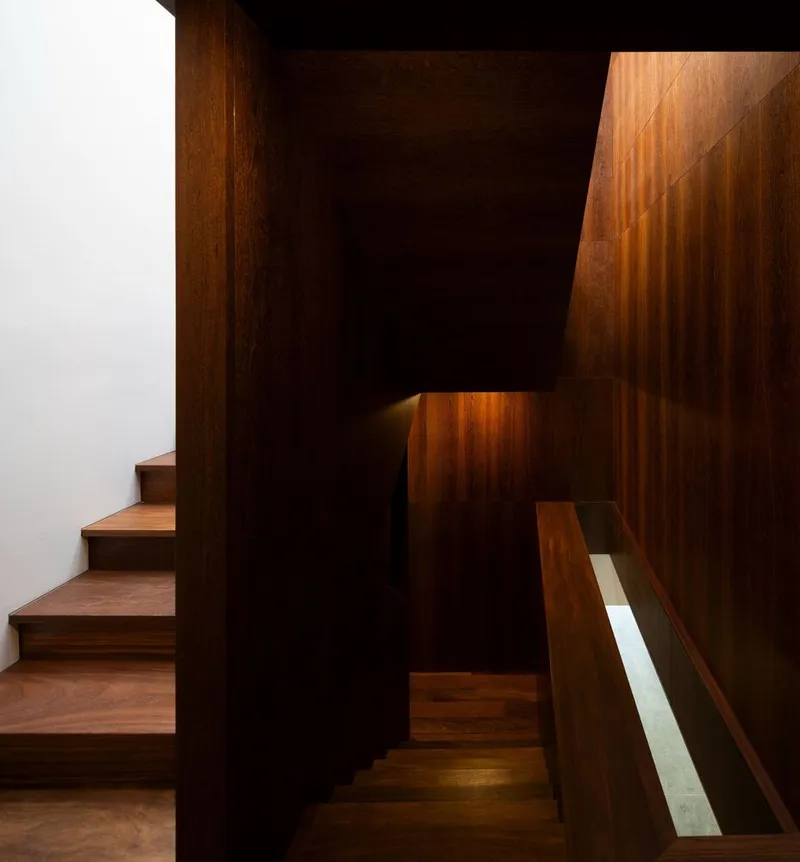
Running through the center of the house like a spine is a walnut-clad staircase volume that connects all four levels. It is the single most characterful element of the interior. Dark timber panels wrap the stair walls, treads, and landings in a continuous surface that absorbs light and concentrates the experience of vertical movement into something almost cinematic. Warm indirect lighting grazes the wood grain from below, making each ascent feel like passage through a piece of furniture rather than a corridor.
Viewed from below, the angular geometry of the stair volumes reads as sculptural against the surrounding white walls. The decision to contrast a single rich, dark material against an otherwise neutral envelope gives the house a strong organizing logic: walnut marks circulation and service elements, while white plaster and grey stone define the living spaces around them.
Living Spaces and the Sliding Wall
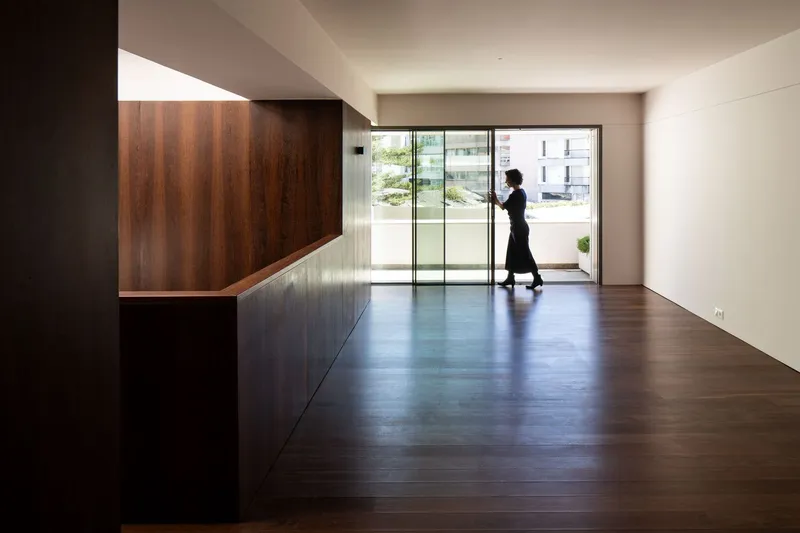
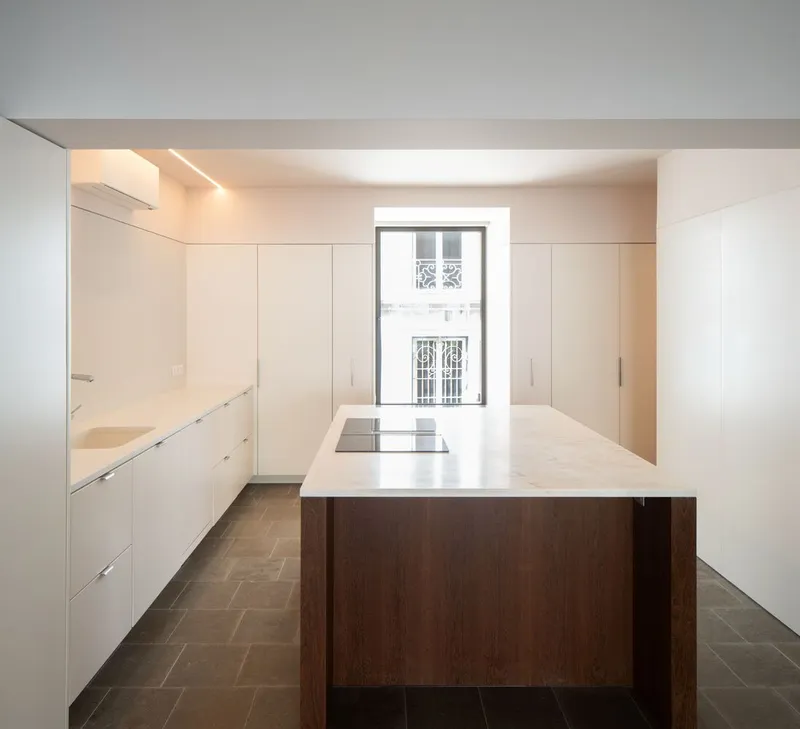
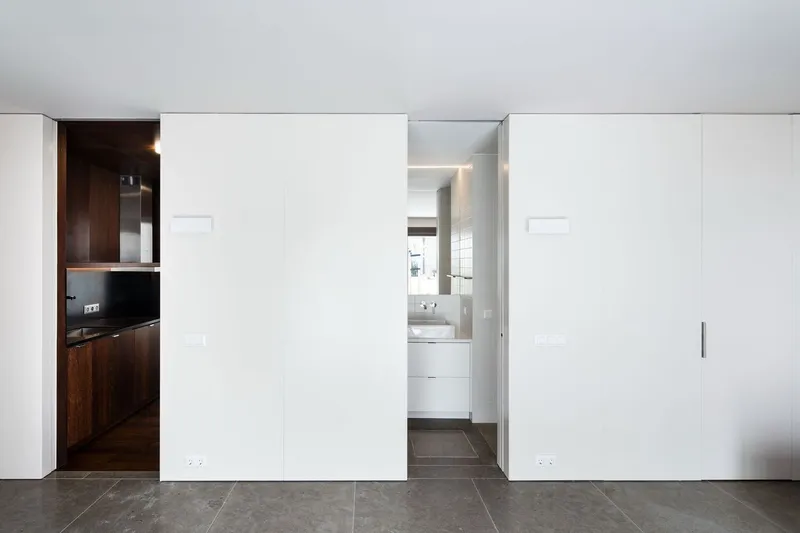
The open-plan living areas are organized around the walnut millwork volume, which houses storage, a kitchen wall, and various service functions behind flush panels. Timber flooring extends toward full-height glazing that opens onto the rear terraces, blurring the boundary between inside and out. The kitchen itself pairs white cabinetry with a dark wood island and stone flooring, a restrained material trio that recurs throughout the house.
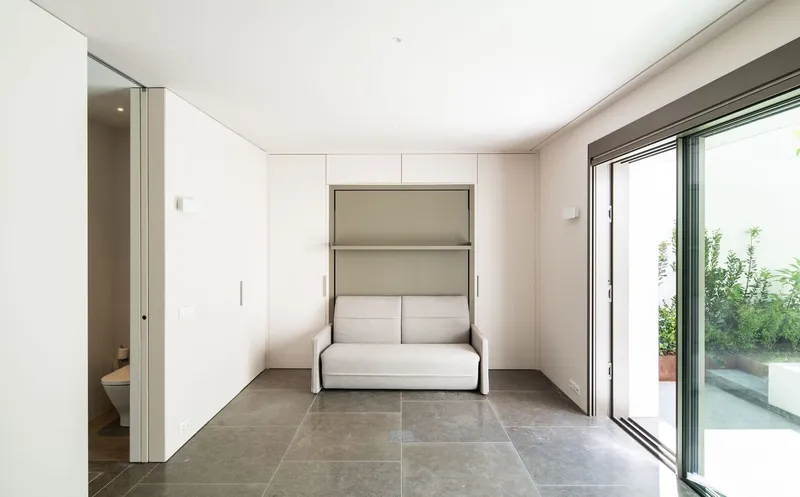
White sliding panels conceal entire functional zones, a kitchen, a bathroom, turning the plan from compartmentalized to loft-like with a single gesture. It is a clever response to the narrow site: rather than building more rooms, Camarim built fewer rooms that can behave as many. The grey tile flooring beneath these sliding walls provides a neutral ground plane that unifies the concealed and revealed portions of the plan.
Stone and Marble: The Bathing Rooms
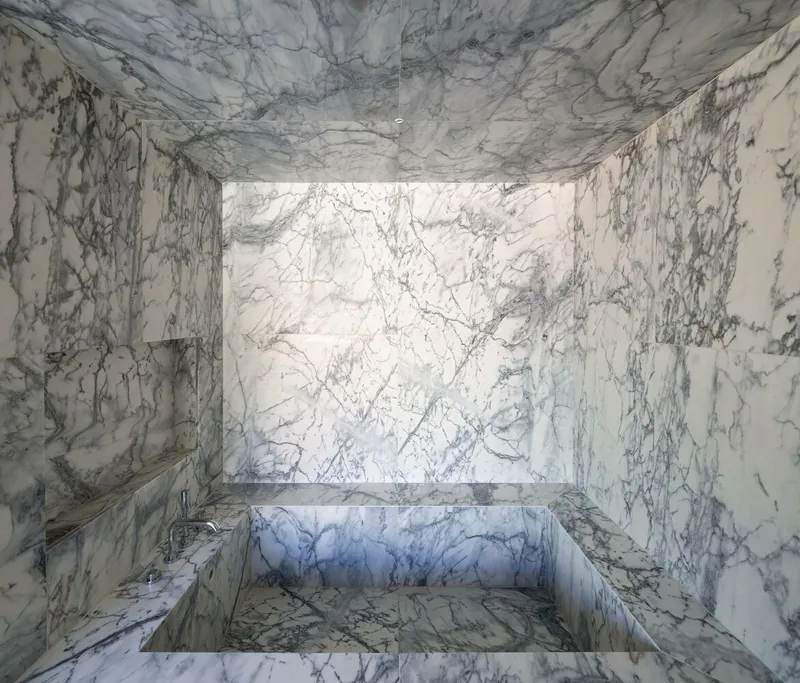
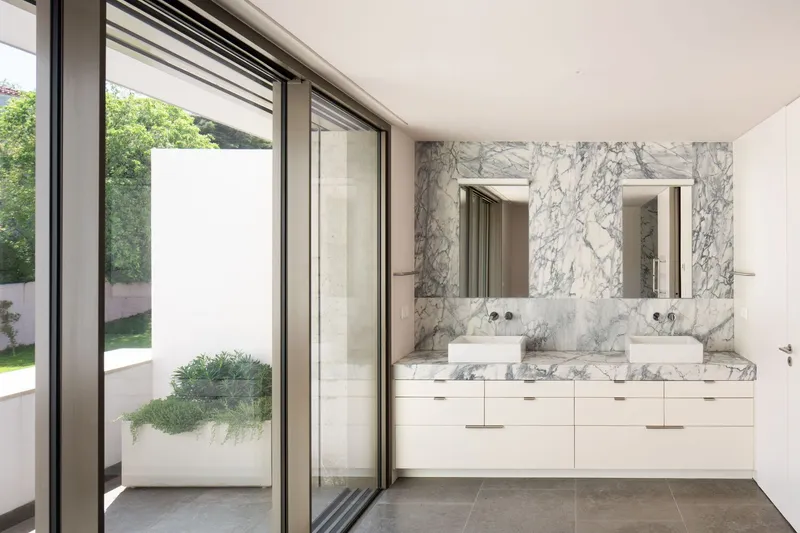
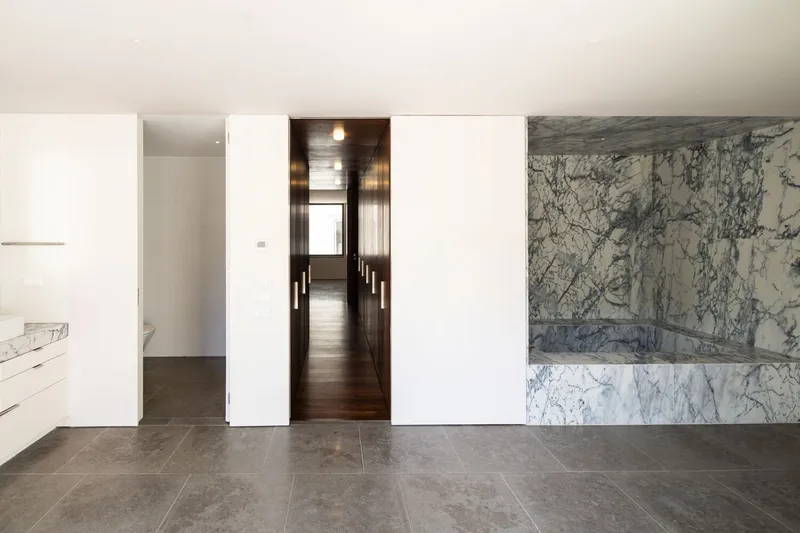
If the walnut staircase is the heart of the house, the marble bathrooms are its most indulgent moments. A sunken tub wrapped in book-matched veined stone, walls and ceiling included, turns an ordinary bathing function into something approaching a Roman thermal fragment. The stone selection is bold: large-format slabs with dramatic figuring, matched across seams so the veining reads as continuous.
Elsewhere, dual sinks set in a marble vanity open directly to a courtyard garden, collapsing the line between grooming ritual and landscape. The grey-veined marble reappears around a freestanding tub in another room, this time framed by white sliding doors that can close it off or integrate it with the bedroom. These are bathrooms designed as destinations, not service spaces.
Light from Above
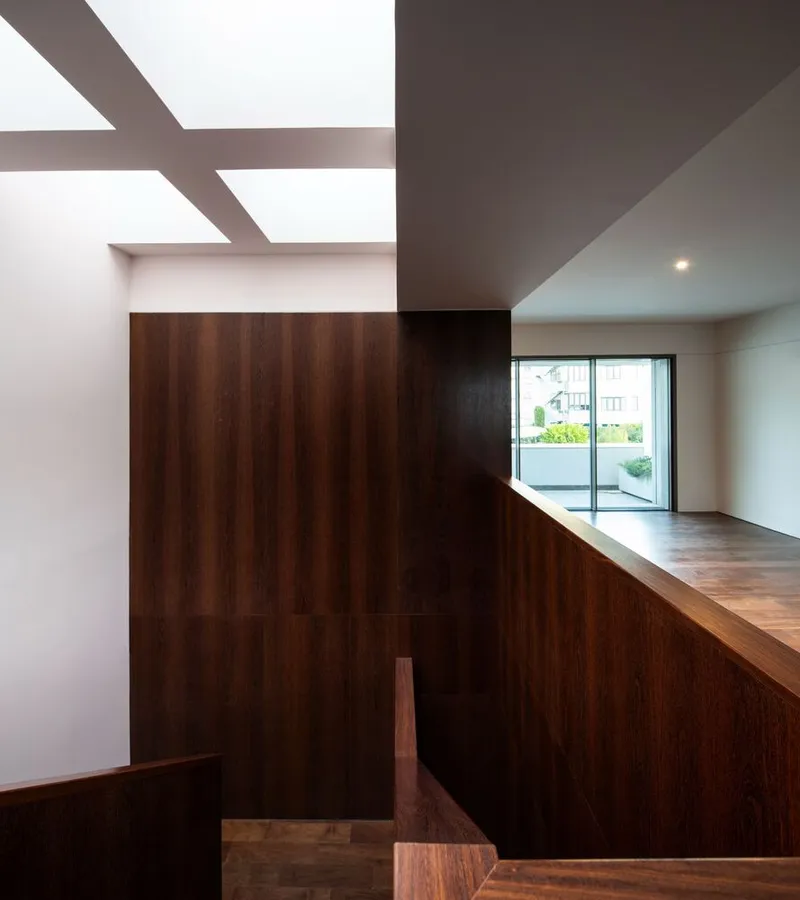
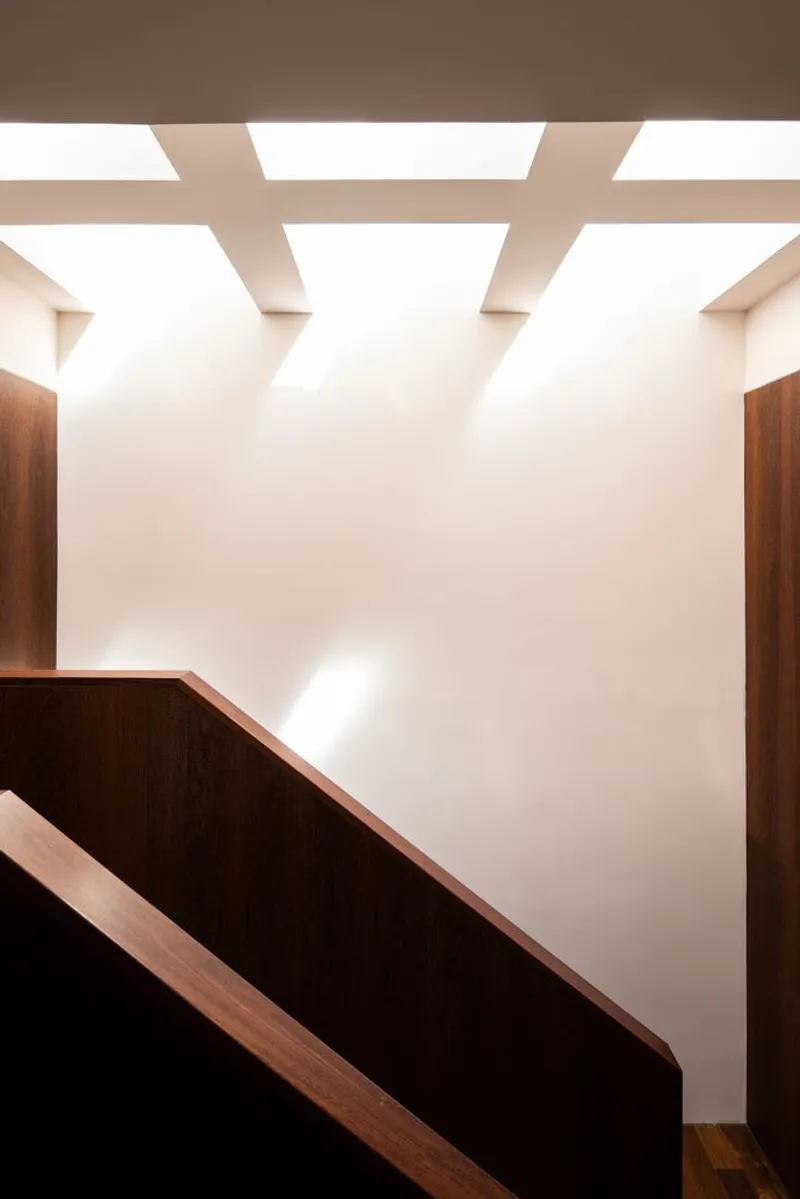
At the upper levels, a grid of skylights floods the stair landing with diffuse daylight, casting cross-hatched shadows onto white walls and the walnut volume below. The skylights are the payoff of the stepped massing: by pulling the upper floors back from the rear facade, the architects freed the roof plane for overhead light, a resource that narrow urban sites rarely enjoy.
The interior courtyard reinforces this strategy at ground level. Tree shadows play across white plaster walls at dusk, and the planted bed provides a pocket of greenery visible from several rooms. Together, the skylights and courtyard ensure that no part of this deep, narrow plan is more than a room away from natural light.
Twilight and the Double Life of the Facade
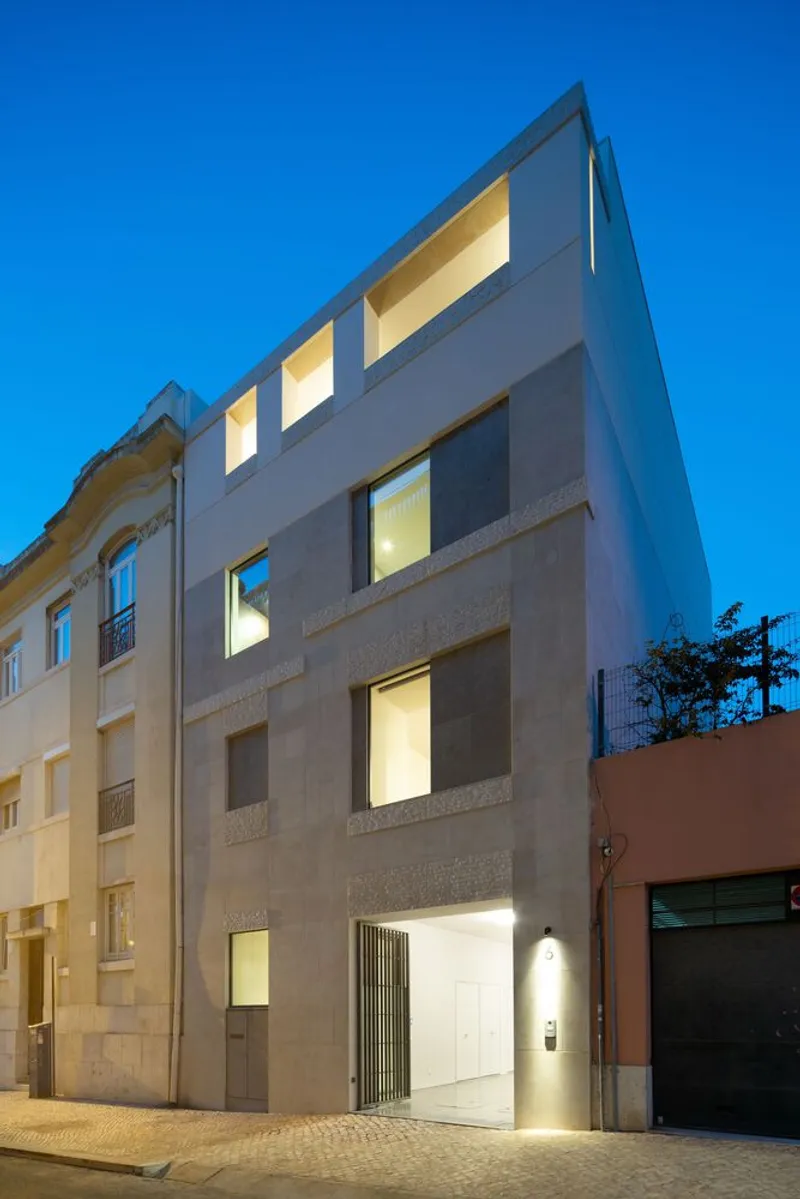
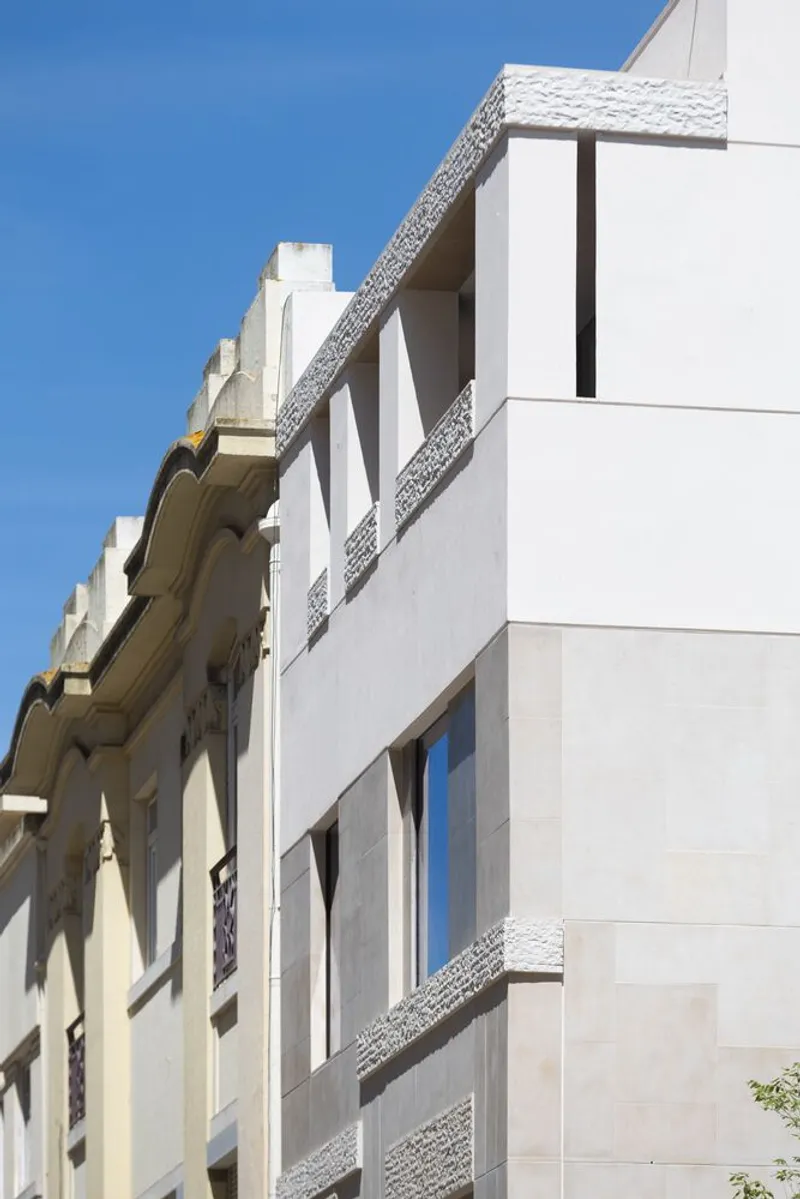
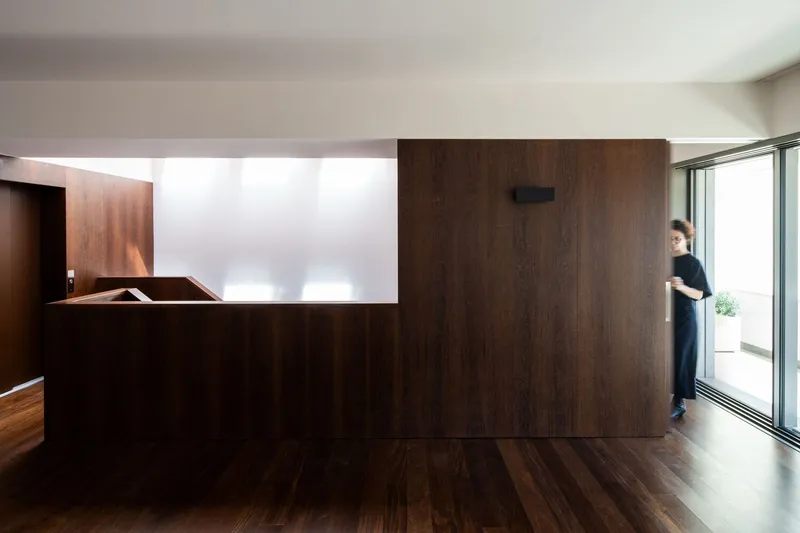
At twilight the building reveals its double life. The deeply recessed windows that appeared as dark voids during the day become glowing frames at night, advertising the warm interiors behind the stone mask. From inside, a figure standing at the glazed terrace opening reads against the fading sky, a reminder that this is a house designed to be lived in, not just looked at.
The street view at night also clarifies the building's relationship to its neighbors. The white facade and textured stone bands meet the older masonry next door without mimicry, the joint between old and new legible but not aggressive. It is a building that knows its place in the urban block and still manages to be the most interesting thing on the street.
Plans and Drawings
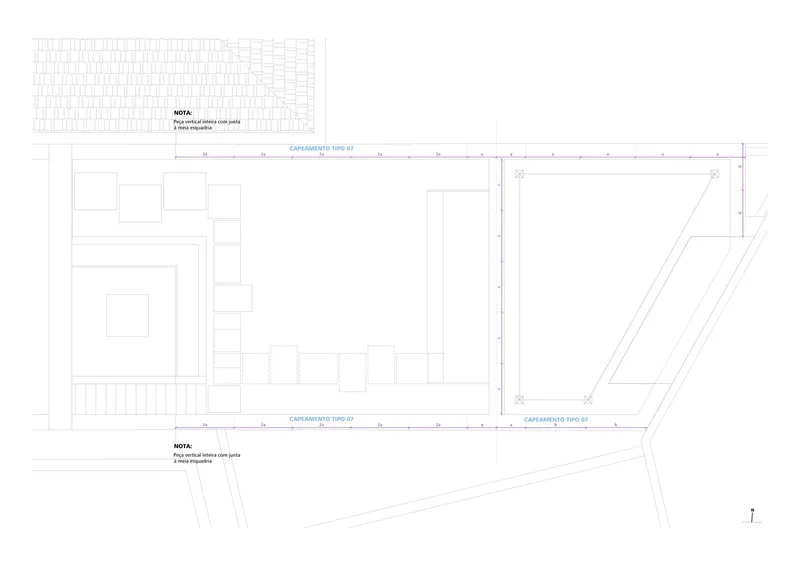
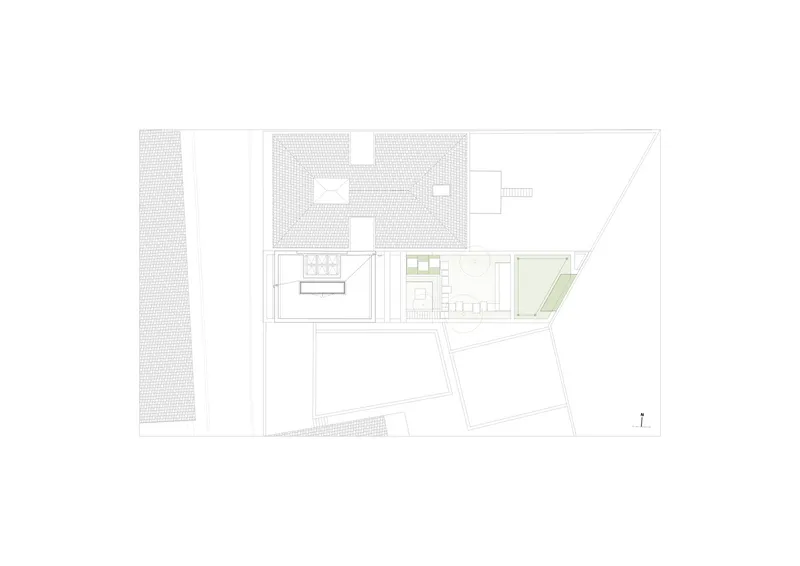
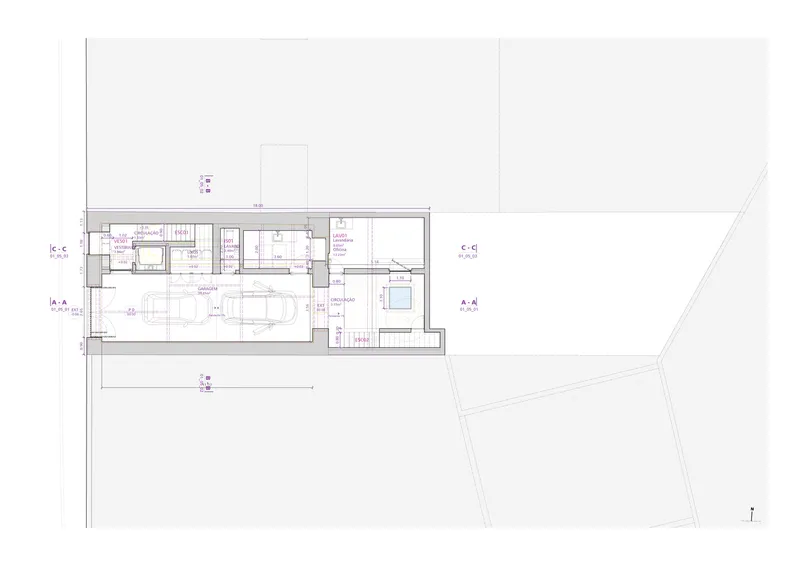
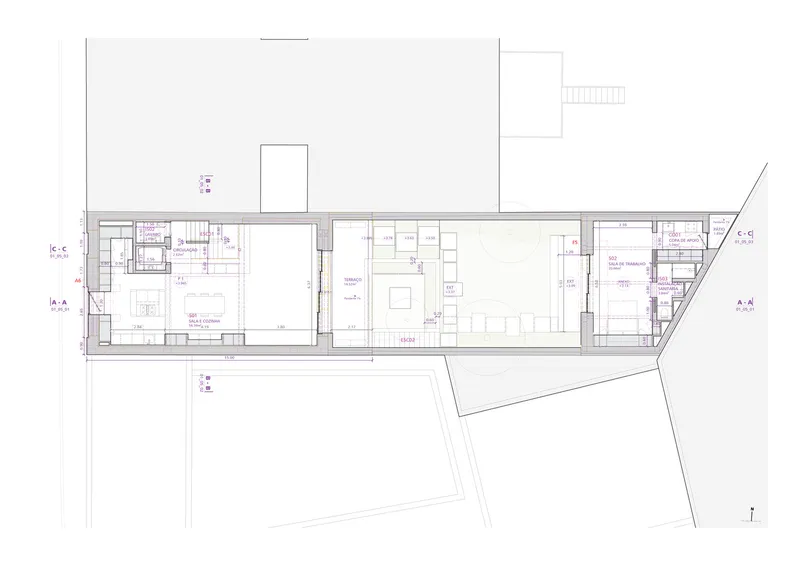
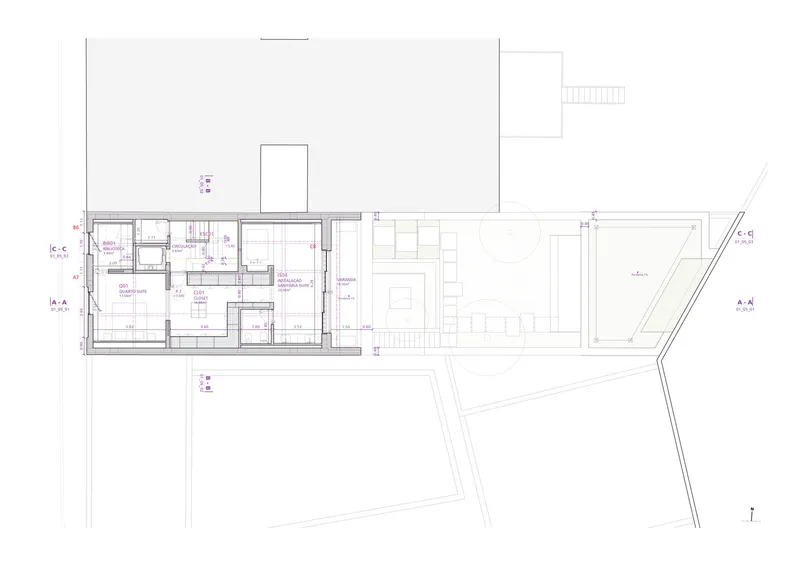
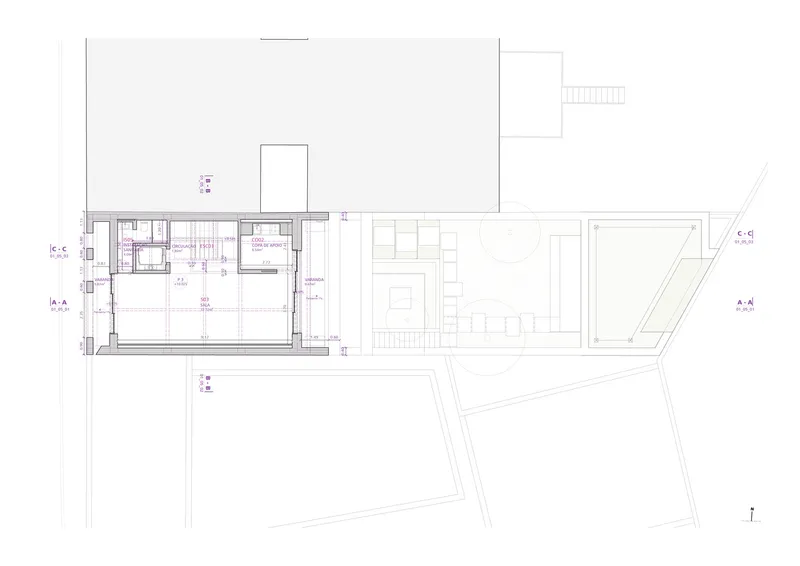
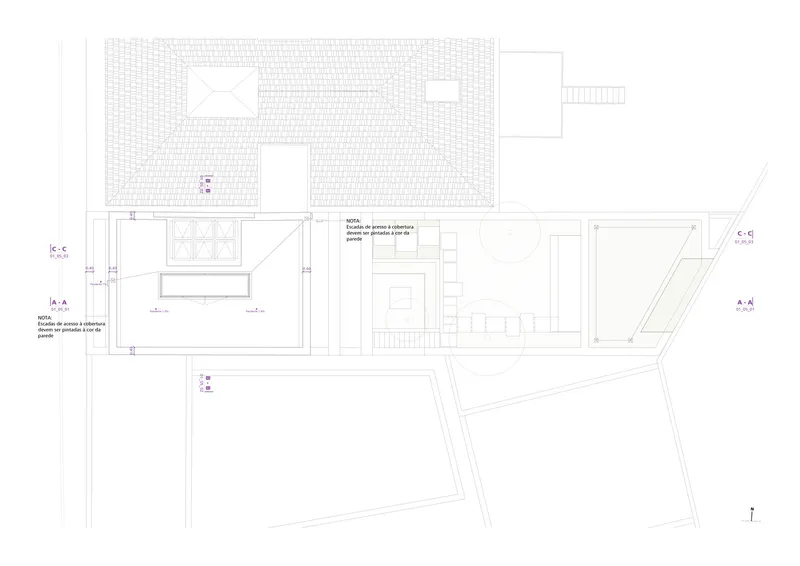
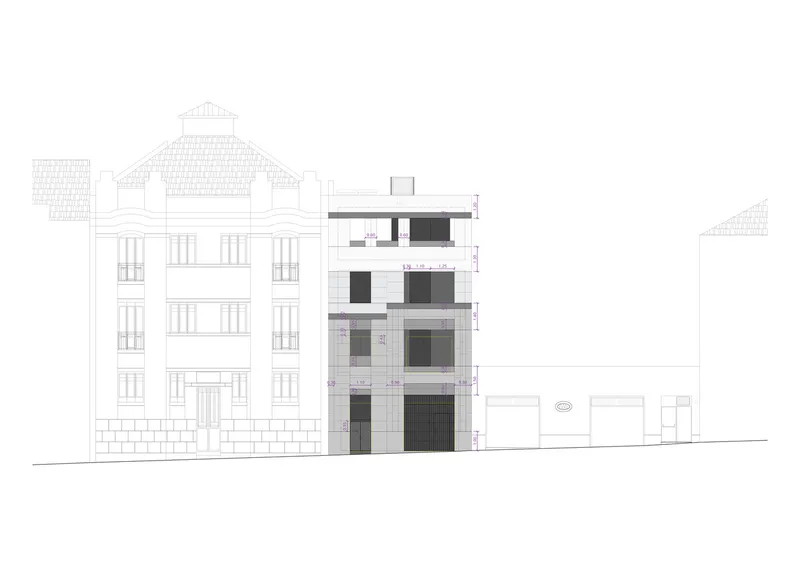
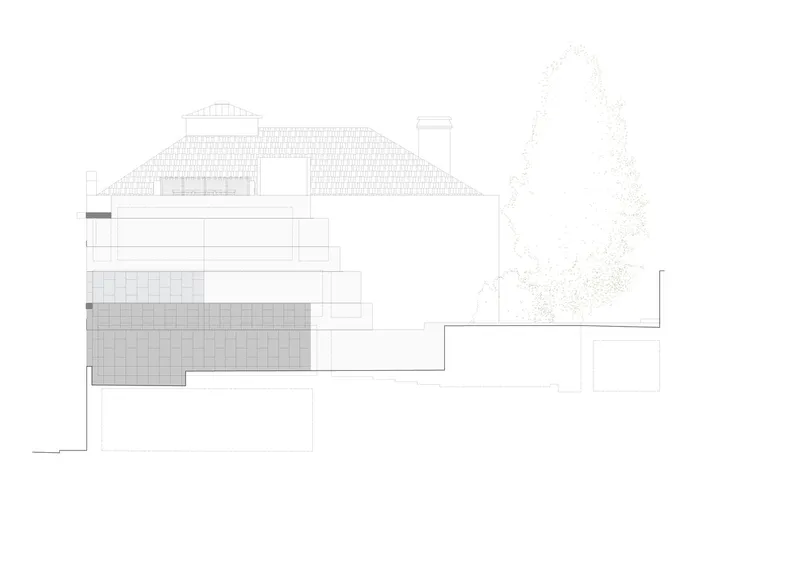
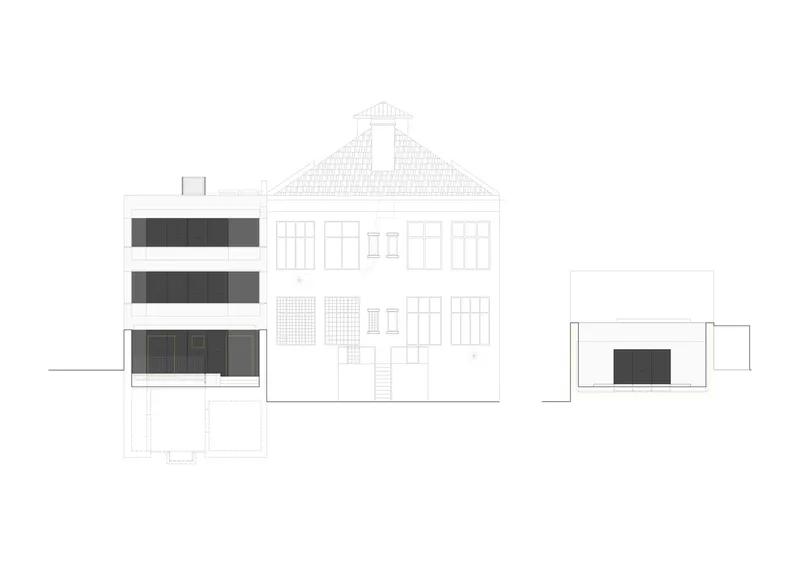
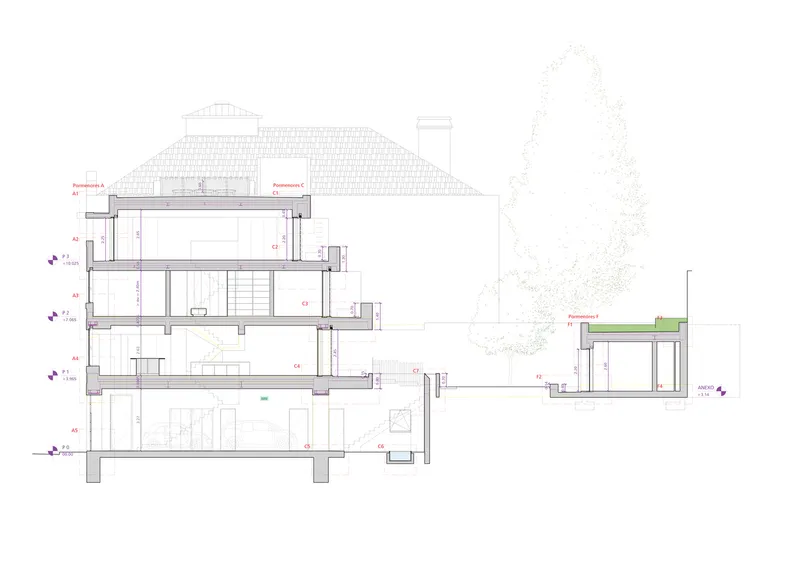
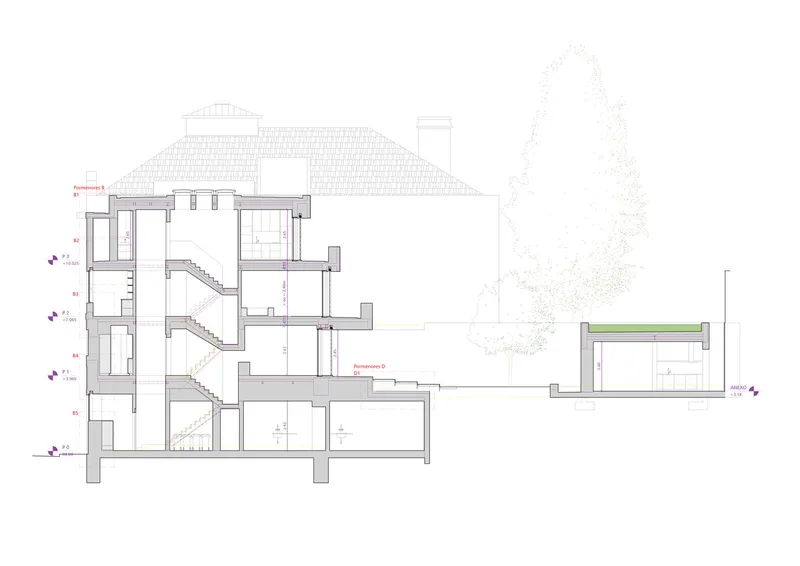
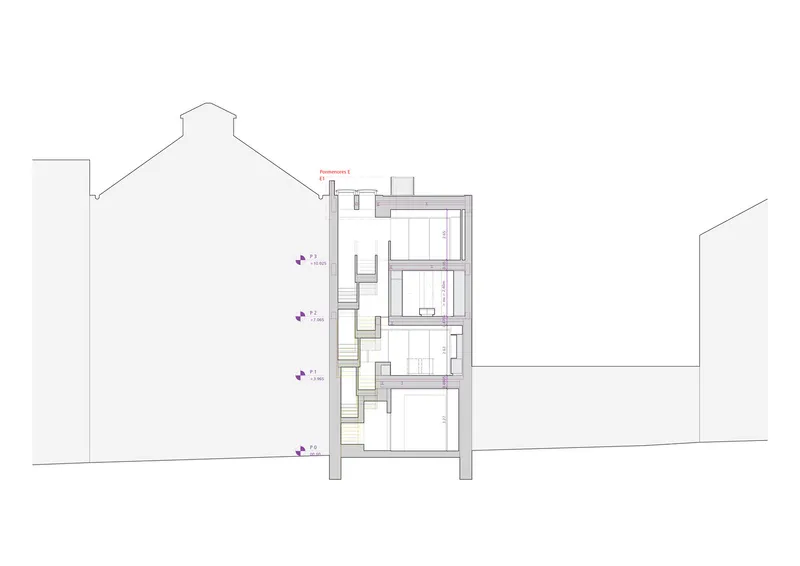
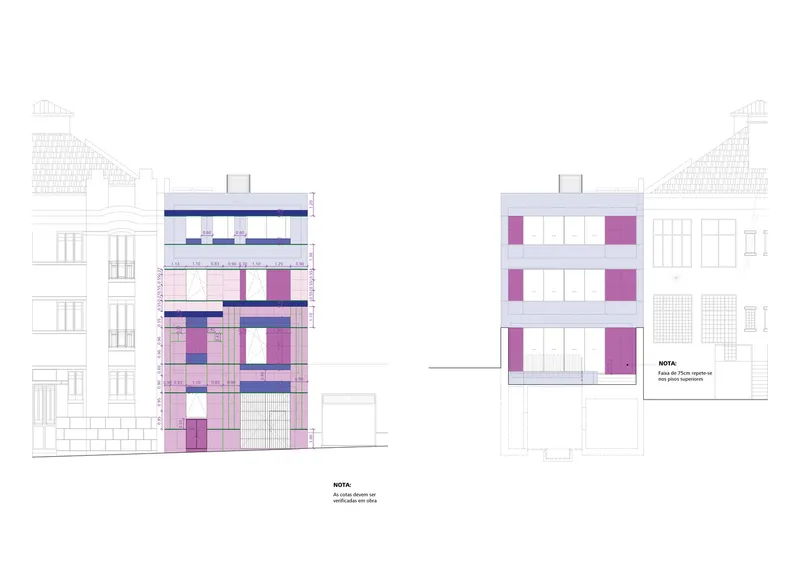
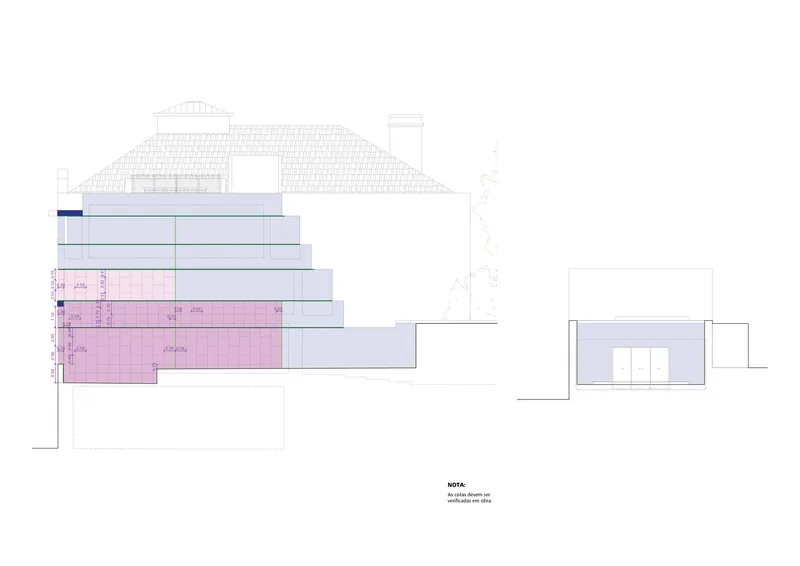
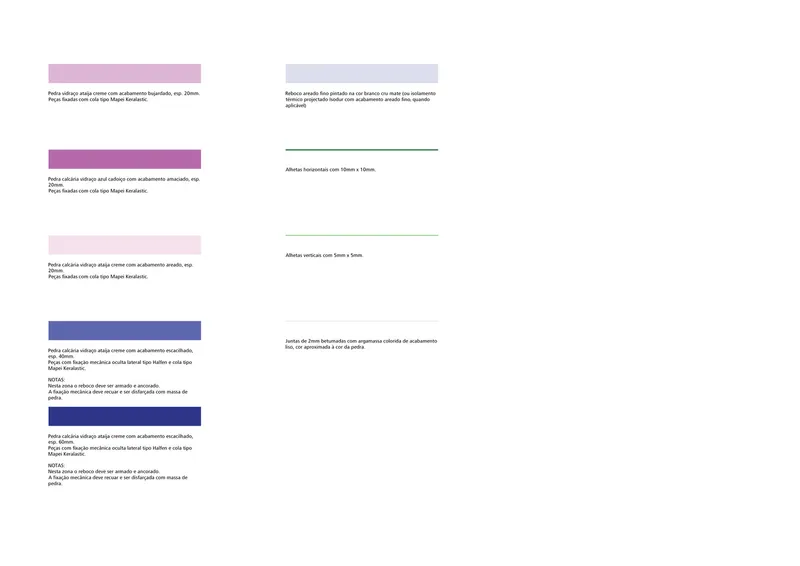
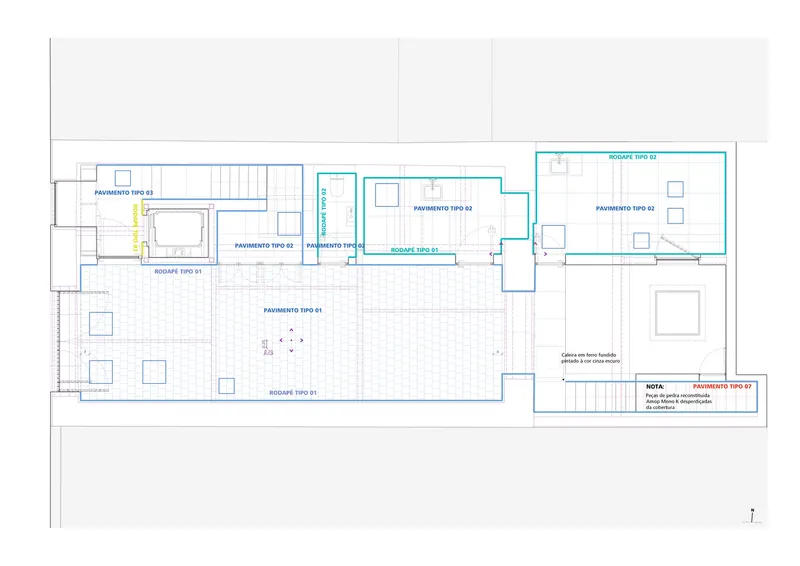
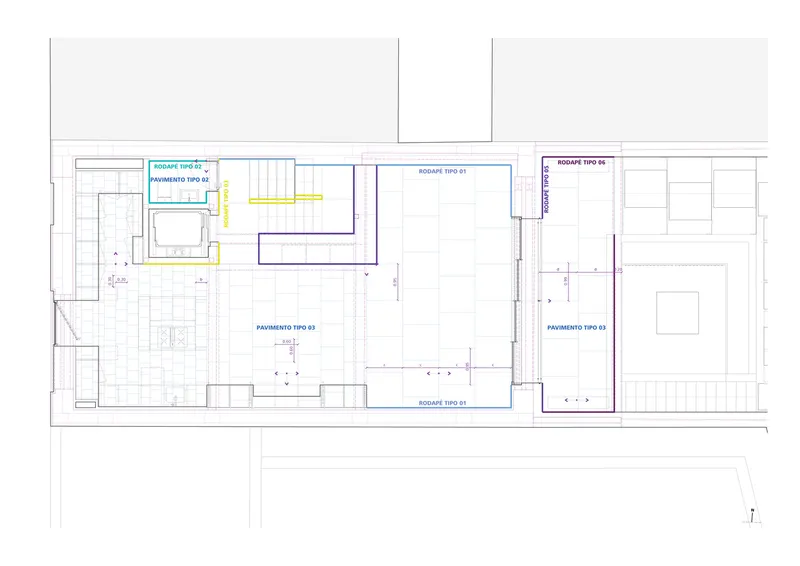
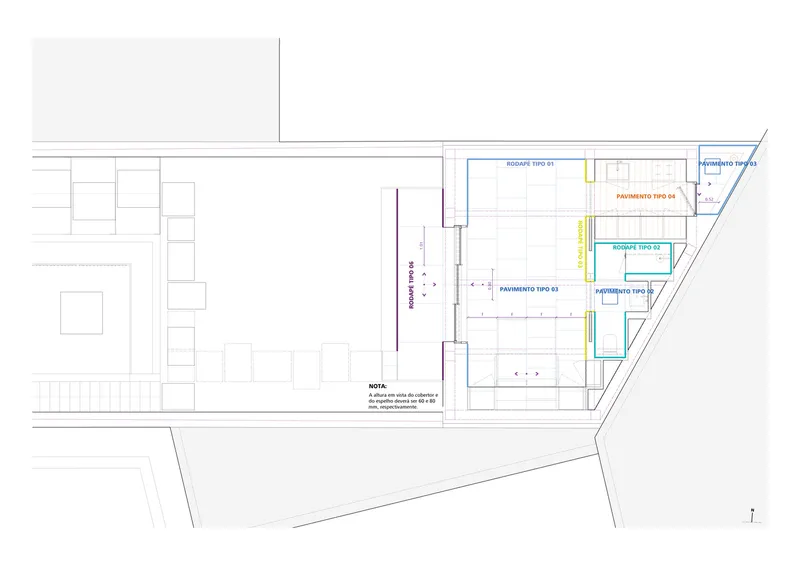
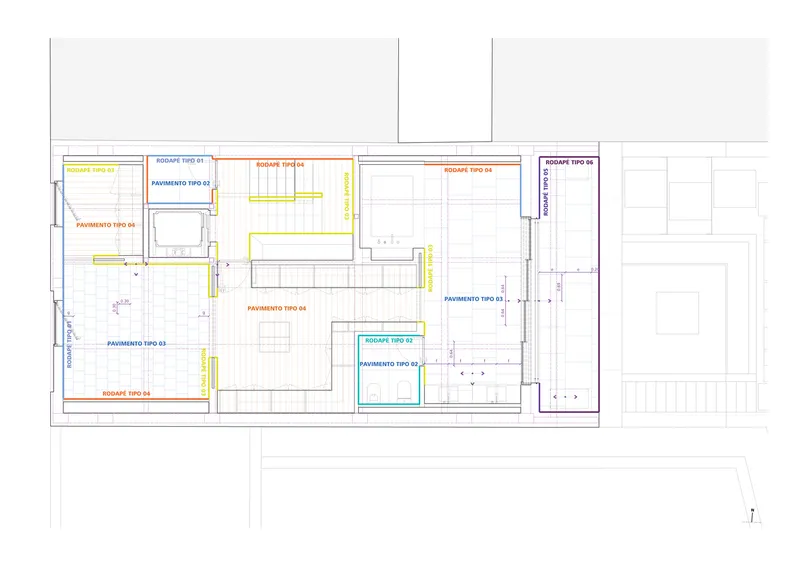
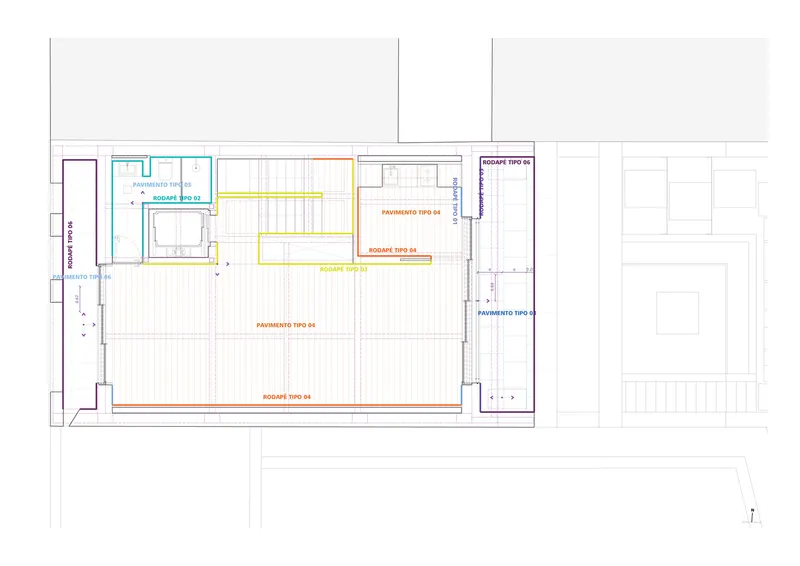
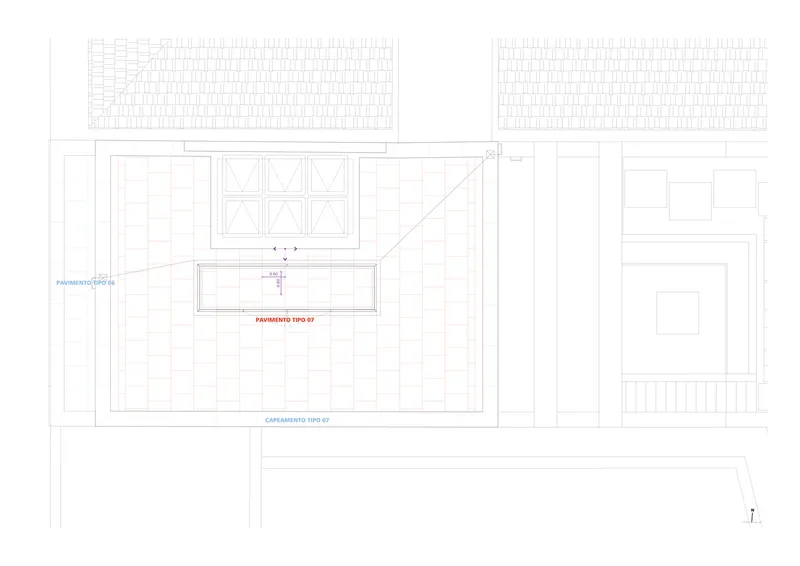
The drawing set makes the sectional strategy explicit. Floor plans reveal how the diagonal property line forces the plan into a tapered geometry, with rooms arrayed along one side and circulation concentrated along the party wall. The sections show four staggered floor plates under a pitched roof, with a single-story green-roofed pavilion extending into the courtyard. Color-coded material drawings specify finishes zone by zone, documenting the transition from stone at the front to walnut at the core to marble in the bathrooms with a precision that matches the built result.
The elevation drawings are equally telling. Front and rear facades reveal the full extent of the stepping, with the street face holding a consistent four-story height while the courtyard side cascades down to meet the scale of the neighboring pitched-roof house. The colored elevation studies, with their pink, purple, and blue zones, map material territories onto the massing in a way that clarifies how each facade operates as a distinct composition rather than a simple extrusion.
Why This Project Matters
House No. 7 is a reminder that the most rewarding residential architecture often happens under the tightest constraints. A narrow plot, heritage neighbors, diagonal boundaries: these are the conditions that force architects to think in section, to treat every square meter as a design problem worth solving. Camarim Arquitectos responded not with minimalism or self-effacing deference but with material ambition and spatial generosity, proving that a house squeezed between party walls can be as rich and varied as a freestanding villa.
The project also offers a persuasive model for urban infill in historic European neighborhoods. The street facade is new but neighborly, the rear facade is expressive but disciplined by the stepped massing, and the interior is luxurious without being ostentatious. It is architecture that takes its site seriously, works the section relentlessly, and trusts good materials to do the talking. In a city where so much new residential construction defaults to anonymous white boxes, that commitment to craft and specificity is worth celebrating.
House No. 7 in Avenidas Novas, designed by Camarim Arquitectos, Lisbon, Portugal. Photography by Nelson Garrido.
About the Studio
Share Your Own Work on uni.xyz
If projects like this are the kind of work you want to make, uni.xyz is a place to publish your own, find collaborators, and enter design competitions.




Popular Articles
Popular articles from the community


The Ocean Hive: Sustainable Architecture for a Self-Sufficient Civilization at Sea
The Ocean Hive imagines sustainable architecture at sea, where modular habitats, algae, wave power and ocean waste sustain a growing colony.

Conexión: Biophilic Design Reimagines High-Rise Living in Hong Kong
Conexión reimagines high-rise living in Hong Kong through biophilic design, green facades, shared spaces, daylight, water and nature within.

Co-life: Sustainable Architecture for Age-Friendly Community Living
Co-life reimagines sustainable architecture for seniors through courtyards, rammed earth, shared gardens, and spaces designed for belonging.

Play: Fragments of Their World
Familiar architecture becomes modular playground design, creating safe spaces where displaced children can learn, connect, imagine and play.


Similar Reads
You might also enjoy these articles


Hodi-Mandai Geram
Project Function: Preservation and revitalization of the Intangible heritage and socio-spatial identity of the Hodi by Housing, Cultural Memory Center, Sacred Grove, landscape, local tourism economy


Olio Towers: A Mid-Rise for Performers That Fuses Housing, Rehearsal, and Stage
Located blocks from Houston's Theater District, this modular tower stacks living units around a central performance atrium.

Oasis: Modular Green Housing Carved into Dhaka's Urban Fabric
A shortlisted Plugin Housing entry reclaims unauthorized settlements in Dhaka with stepped concrete volumes, green roofs, and ventilation-driven design.

Black Hole: A Floating Megastructure for the Post-Physical Era
Emiliano Mazzarotto envisions a spherical, self-scaling arena where e-sports, digital hotels, and holographic stadiums replace traditional public space.


Explore Architecture Competitions
Discover active competitions in this discipline



Challenge to reimagine the Iron Throne


Photograph architecture without architects


Illustrate the lost glory of Angkor Wat - Render Challenge


Design challenge to reuse E-waste
Comments (0)
Please login or sign up to add comments
No comments yet. Be the first to comment!