

Estudio Estudio Peels Back Decades of Neglect to Revive a 1930s Mexico City House
In the Hipódromo Condesa neighborhood, a heritage dwelling rediscovers its Art Deco bones through careful restoration and rooftop expansion.


Renovation projects often wrestle with a core tension: how much of the past to keep and how much to replace. At House Y27, Estudio Estudio, led by Inés Benítez and Nuria Benítez, decided the answer was to subtract rather than add. Built in the 1930s in Mexico City's Hipódromo Condesa district, the stucco-clad dwelling had accumulated decades of careless modifications that buried its original Art Deco character. The architects' primary move was archaeological: peeling away layers of ill-considered interventions to expose ornamental elements and spatial proportions that had been there all along.
What makes House Y27 genuinely compelling is the discipline of its restraint. On a tight 195-square-metre site, the project manages to grow from a neglected relic to a 376-square-metre, three-level residence with a rooftop studio, an onsen, and a working rainwater harvesting system. Yet none of these additions feel imposed. The material palette of oak, stucco, pigmented concrete tiles, and cotton canvas reads as a continuation of the house's original language rather than a contemporary intrusion. The client, a social entrepreneur and collector of Mexican craftwork, clearly found the right collaborators.
Arches as Connective Tissue
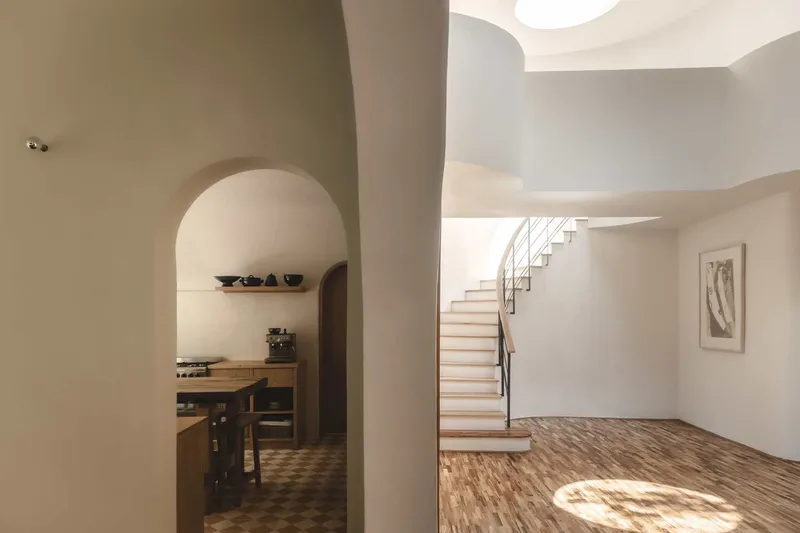
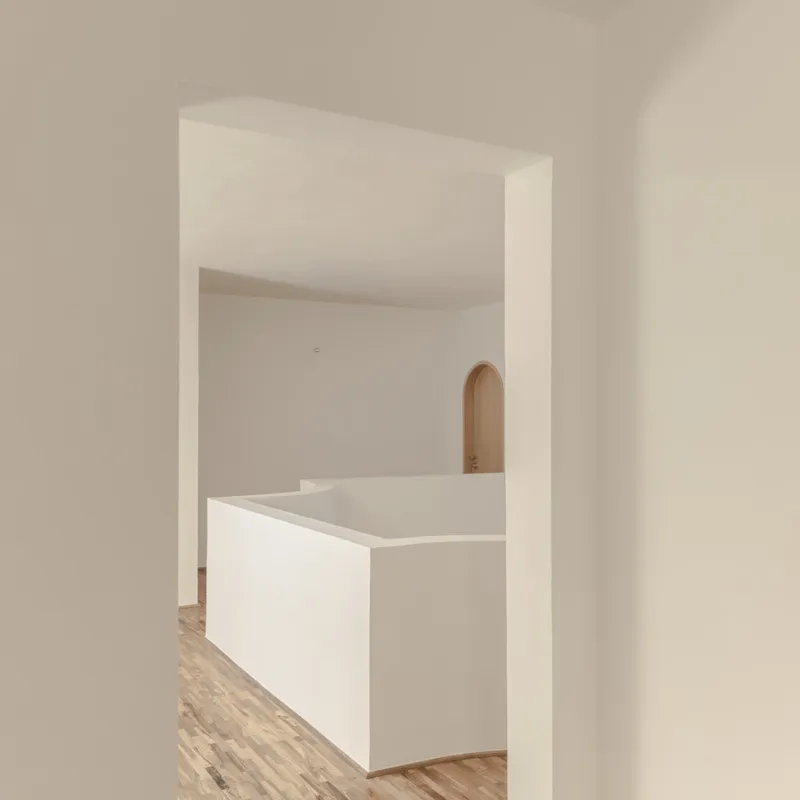
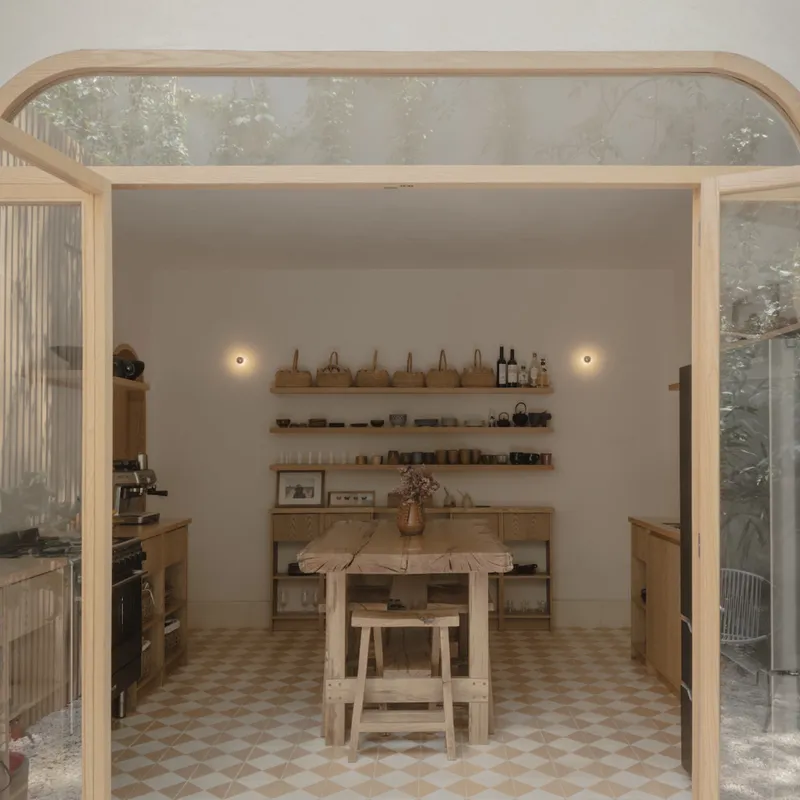
One of the most visible design decisions is the expanded arch motif that recurs throughout the ground floor. Inspired by an original kitchen doorway discovered during demolition, Estudio Estudio replicated the shape at multiple openings to create a rhythmic continuity between rooms. Timber-framed arches connect the kitchen to the living area, the lobby to the staircase, and the dining zone to the service spaces. The effect is less about stylistic nostalgia and more about spatial generosity: the arches pull sightlines through the plan, making a compact footprint feel larger than its dimensions suggest.
In the kitchen, the arched openings frame a scene that pairs checkered pisos de pasta, a pigmented concrete tile tradition common in older homes across Mexico City and the southwest, with warm ambient lighting. A local craftsman replicated the tiles from a surviving sample found on site, a detail that captures the project's ethos: when possible, restore; when necessary, recreate with local hands.
A Vertical Core of Light
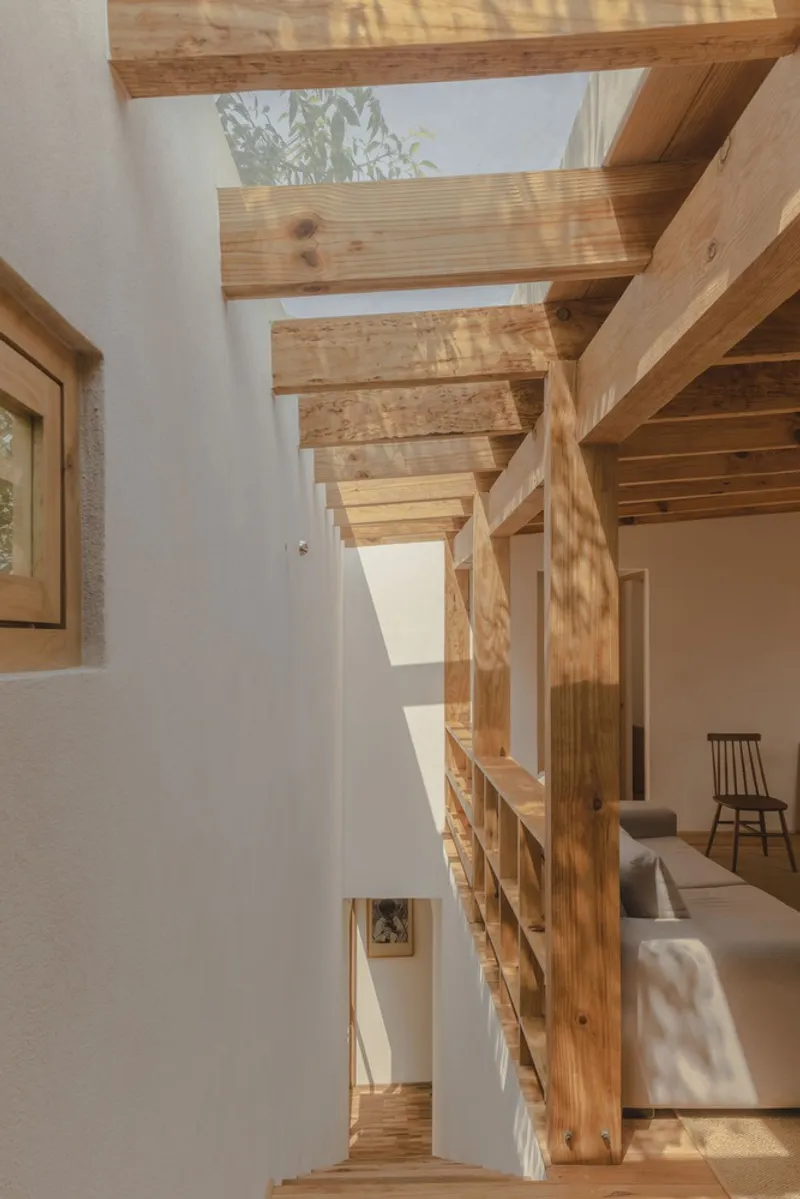
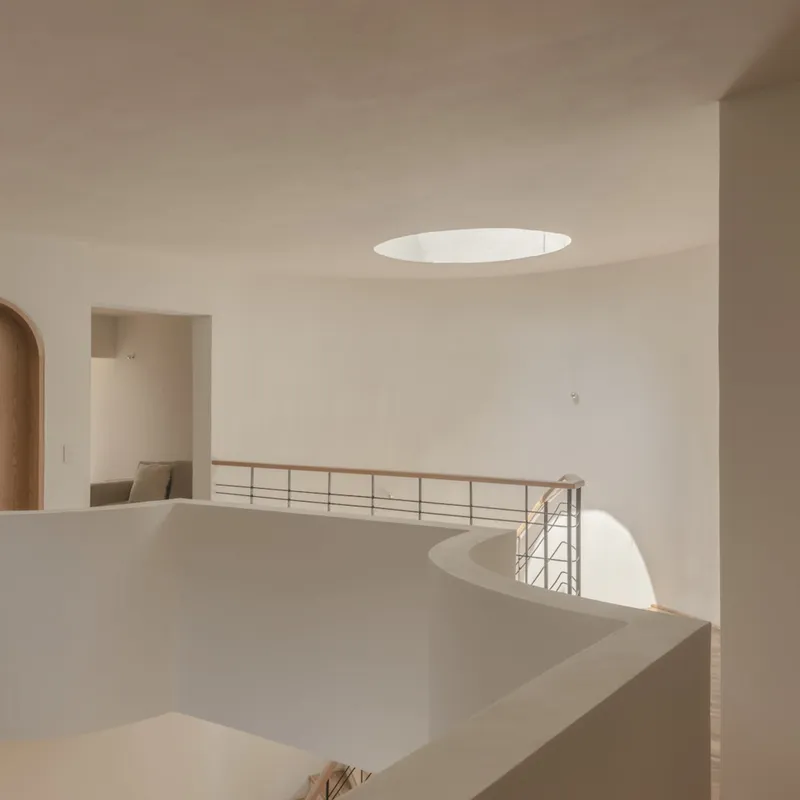
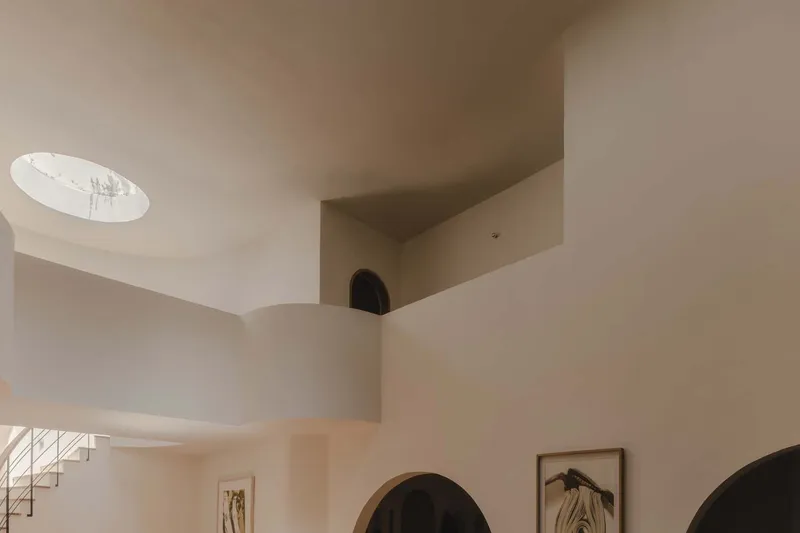
The double-height void at the heart of the house is its most dramatic spatial gesture. Looking up from the ground floor, exposed timber beams and joists form a warm ceiling plane, while a circular skylight punches filtered daylight deep into the section. The void works as a thermal chimney, encouraging cross-ventilation that reduces reliance on mechanical cooling, but its real power is perceptual. It anchors the vertical circulation and makes every level aware of the others.
On the upper landing, a slender metal railing and the curved balcony edge allow occupants to look down into the living spaces below, reinforcing a sense of shared domesticity across floors. Lighting designer Luca Salas collaborated on custom fixtures that supplement the daylight strategy after dark, calibrating brightness for ambiance rather than mere function. The result is a house that feels warm and inhabited at every hour.
Living Between Books and Fire
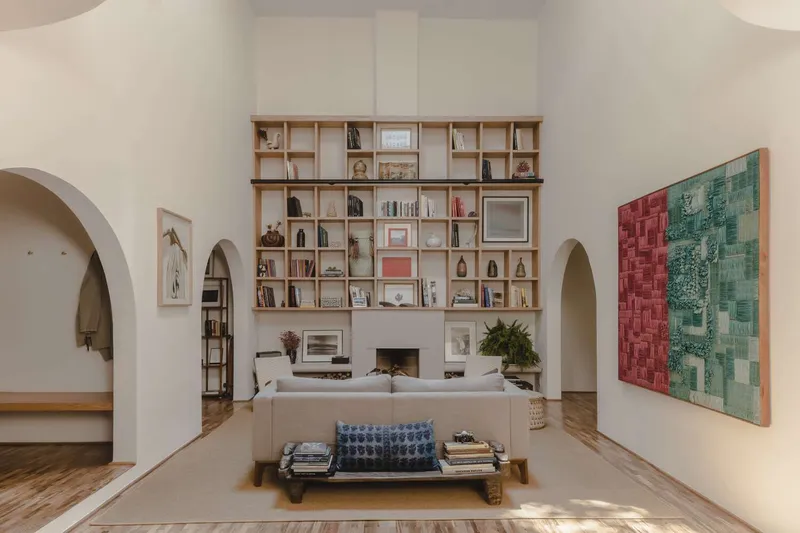
The living room anchors the ground floor with a floor-to-ceiling timber bookshelf flanking a central fireplace, a composition that is both functional and architecturally confident. Arched doorways at either side connect to the rest of the plan without closing the room off, maintaining the fluidity that defines the renovation. Oak parquet flooring runs continuously from this space through the kitchen and lobby, giving the ground level a unified material base.
The choice to foreground timber, from window frames and kitchen cabinets to the bookshelf joinery by woodworker Luis Gil, is strategic. Oak ages gracefully, patinating in a way that will bring the new interventions closer to the 1930s fabric over time. For a house owned by a collector of Mexican craftwork, the material commitment to handmade woodwork and artisan-produced tiles is more than aesthetic preference. It is a working philosophy about how buildings should be made.
Water, Shade, and the Rooftop
Where the original building had only a small storage room on the roof, the renovation inserts a 70-square-metre studio with a private bathroom and access to a terrace featuring an onsen-style soaking tub. An American sweetgum tree canopy provides natural shade, and modular terracotta flooring supports the surrounding planting designed by landscape architect Juan Diego Lebrija. The terrace is not merely recreational: it serves as the primary rainwater collection surface, channeling water through the building into a reservoir and filtration system buried beneath the back patio.
Integrating water management into the rooftop program turns a passive surface into an active environmental asset. In a city that oscillates between flood events and water scarcity, a residential project that harvests and filters its own rainwater is more than a nice detail. It is a small but meaningful act of urban resilience.
Plans and Drawings
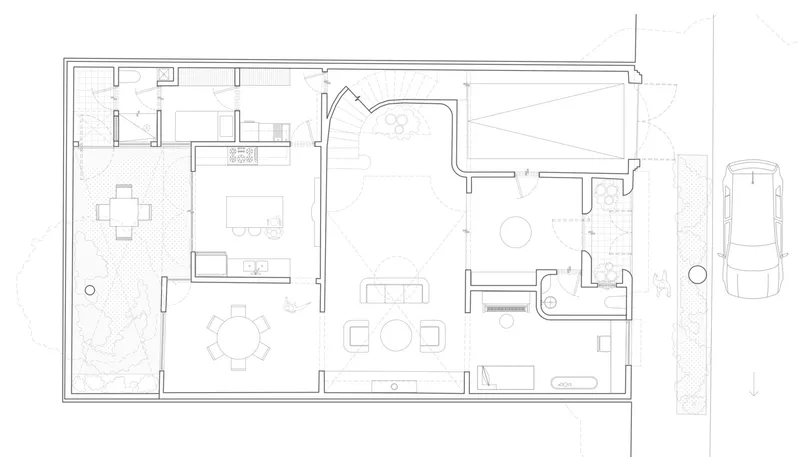
The floor plan confirms what the photographs suggest: the layout is organized as a sequence of interconnected rooms along the narrow, rectangular site, with the staircase and double-height void acting as the spatial hinge between front and rear zones. Parking is accommodated at grade without dominating the street facade, and the service areas are tucked along the party wall. The plan reads as efficient rather than generous, a reminder that the house's sense of spaciousness comes from section, light, and material rather than raw square footage.
Why This Project Matters
House Y27 is a case study in what happens when architects listen to a building before deciding what it needs. Rather than grafting a contemporary identity onto a historical shell, Estudio Estudio took the slower, harder path: investigating original finishes, commissioning local craftspeople to reproduce lost elements, and reserving bold gestures for the rooftop expansion where they would not compete with the existing fabric. The outcome is a house that feels simultaneously old and new, which is the highest compliment a renovation can earn.
For Mexico City's densely built heritage neighborhoods, the project also offers a practical model. It demonstrates that a 1930s building on a modest site can grow to accommodate a studio, a rainwater system, and a rooftop garden without compromising its street presence or structural integrity. In a real estate market that often treats heritage houses as teardown opportunities, that is a genuinely important argument to have on the record.
House Y27 by Estudio Estudio, Hipódromo Condesa, Mexico City, Mexico. 376 m². Landscape design by Juan Diego Lebrija. Custom woodwork by Luis Gil. Lighting design by Luca Salas.
About the Studio
Share Your Own Work on uni.xyz
If projects like this are the kind of work you want to make, uni.xyz is a place to publish your own, find collaborators, and enter design competitions.


Popular Articles
Popular articles from the community


U.GA Architects Wraps an Oval Rooftop Pool in Curved Board-Formed Concrete on Busan's Jeollidan-gil
In Busan's Jeonpo-dong, a 454 m² mixed-use block stacks a neighborhood facility, guest rooms and an oval rooftop pool inside spiraling concrete walls.

Architekt Andreas Gruber Scatters 23 Dark Timber Chalets Across a South Tyrolean Forest Edge
In Molini di Tures, Amonti Chalets breaks a resort into a hamlet of gabled timber houses, with parking, storage and services pushed into the slope.

longwave studio Reorganizes a 112 m² Tainan Apartment Around the Daily Routines of a Family and Two Cats
In Tainan, Taiwan, birch plywood, rust-red furniture and a freestanding plaster wall link arrival, storage, work and family life in one apartment.

David Ortega Stacks a Two-Story Mexico City Penthouse Around a Steel Stair and a Pergola-Shaded Roof Terrace
In Colonia Roma, a 300 m² penthouse uses oak joinery, a planted steel stair and a slatted roof pergola to make a new-build apartment feel like a house.

Similar Reads
You might also enjoy these articles


Hodi-Mandai Geram
Project Function: Preservation and revitalization of the Intangible heritage and socio-spatial identity of the Hodi by Housing, Cultural Memory Center, Sacred Grove, landscape, local tourism economy


Olio Towers: A Mid-Rise for Performers That Fuses Housing, Rehearsal, and Stage
Located blocks from Houston's Theater District, this modular tower stacks living units around a central performance atrium.

Oasis: Modular Green Housing Carved into Dhaka's Urban Fabric
A shortlisted Plugin Housing entry reclaims unauthorized settlements in Dhaka with stepped concrete volumes, green roofs, and ventilation-driven design.

Black Hole: A Floating Megastructure for the Post-Physical Era
Emiliano Mazzarotto envisions a spherical, self-scaling arena where e-sports, digital hotels, and holographic stadiums replace traditional public space.

Explore Mexican Design Competitions
Discover active competitions in this discipline

Challenge to reimagine the Iron Throne

Photograph architecture without architects

Illustrate the lost glory of Angkor Wat - Render Challenge

Design challenge to reuse E-waste
Comments (0)
Please login or sign up to add comments
No comments yet. Be the first to comment!