
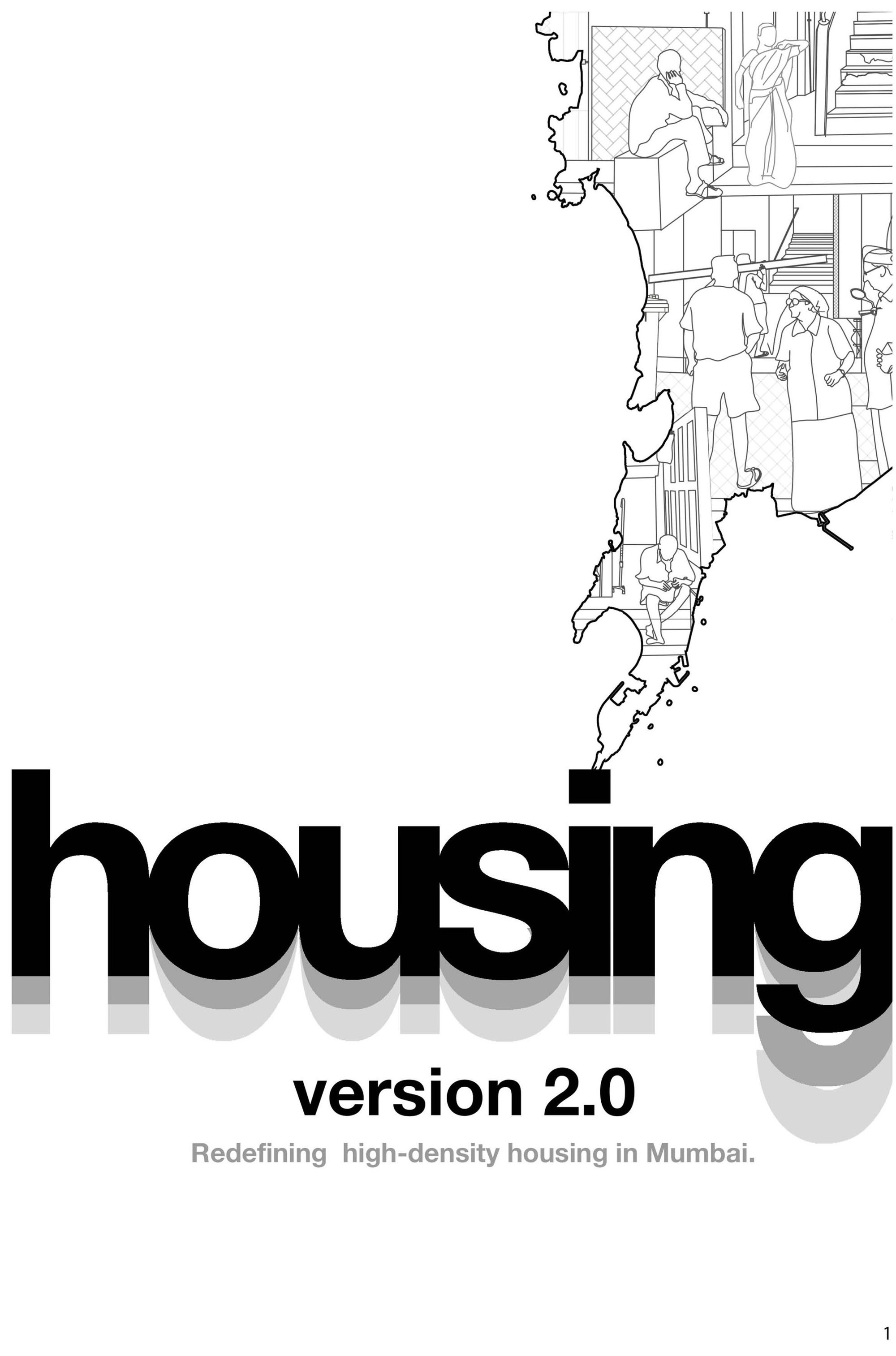
Housing Version 2.0: Rethinking High-Density Housing Design in Mumbai
A reimagined high-density housing design in Mumbai that integrates community, flexibility, and urban connectivity beyond conventional apartment living.

Housing Version 2.0 by Aishwarya Parab is a critical exploration of high-density housing design in Mumbai, one of the most complex urban environments in the world. The project challenges the rigid and repetitive typologies that dominate contemporary apartment living in South Asian megacities and proposes a more adaptive, socially responsive, and spatially diverse model.
Mumbai’s housing crisis is not only about quantity but also about quality. Conventional apartment blocks prioritize efficiency and maximum occupancy, often at the cost of social interaction, environmental responsiveness, and spatial flexibility. This thesis interrogates these shortcomings and proposes an alternative architectural framework that redefines how density can coexist with livability.
Urban Context and Site Strategy
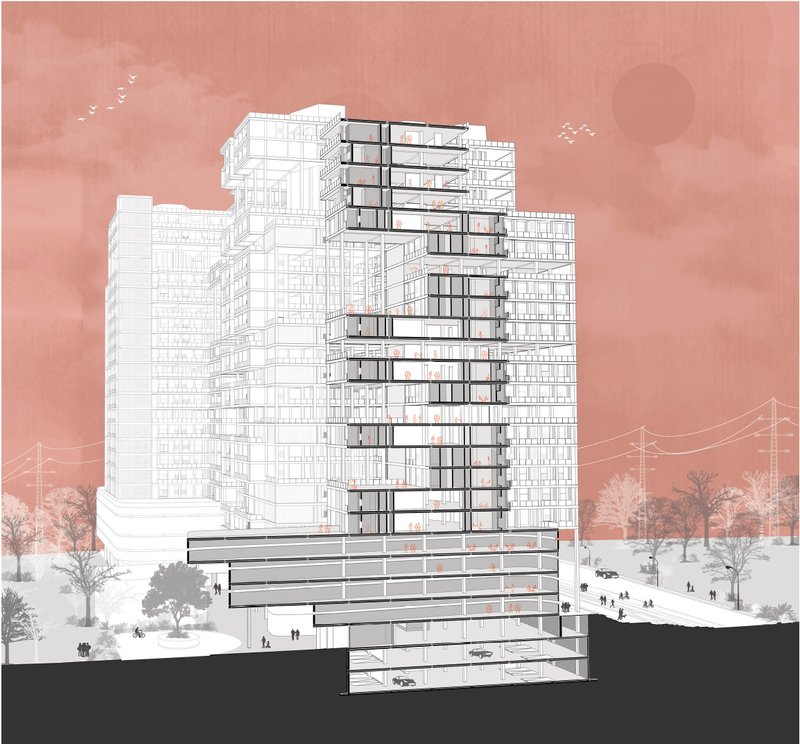
Located along Khairani Road, the project situates itself within a dense urban fabric characterized by mixed-use developments, informal settlements, and infrastructural pressures. The site plan reveals a deliberate strategy of permeability and accessibility. Instead of isolating the building as a singular object, the proposal integrates open spaces, circulation paths, and public interfaces that extend the urban realm into the project.
The ground plane is treated as an ակտիվ urban surface, where commercial zones, pedestrian movement, and community activities intersect. This approach ensures that the high-density housing design is not disconnected from its surroundings but actively contributes to the city’s social and spatial networks.
Programmatic Zoning and Spatial Hierarchy
The project introduces a layered zoning strategy that moves beyond the binary of public and private. The ground floor accommodates commercial functions and service cores, activating the street edge and supporting everyday urban life. Above this, transitional community spaces act as buffers between the public realm and residential units.
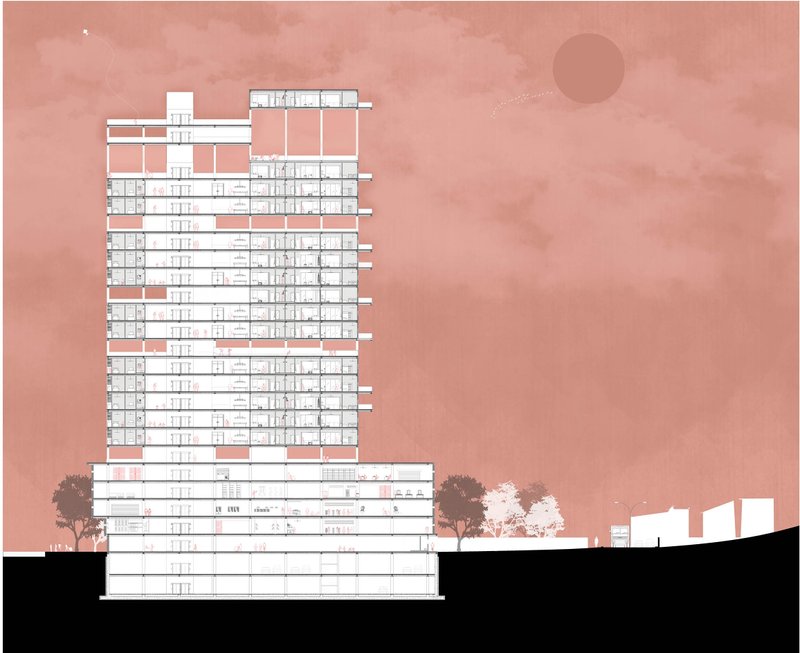
Residential zones are organized vertically, but instead of uniform stacking, they are articulated through shifting volumes and interlocking modules. This creates a dynamic spatial hierarchy where communal spaces, semi-private areas, and individual units are interwoven.
The inclusion of double-height spaces and shared terraces enhances spatial quality while maintaining density. These elements foster interaction and provide visual and physical connections across different levels of the building.
Sectional Innovation in High-Density Housing Design
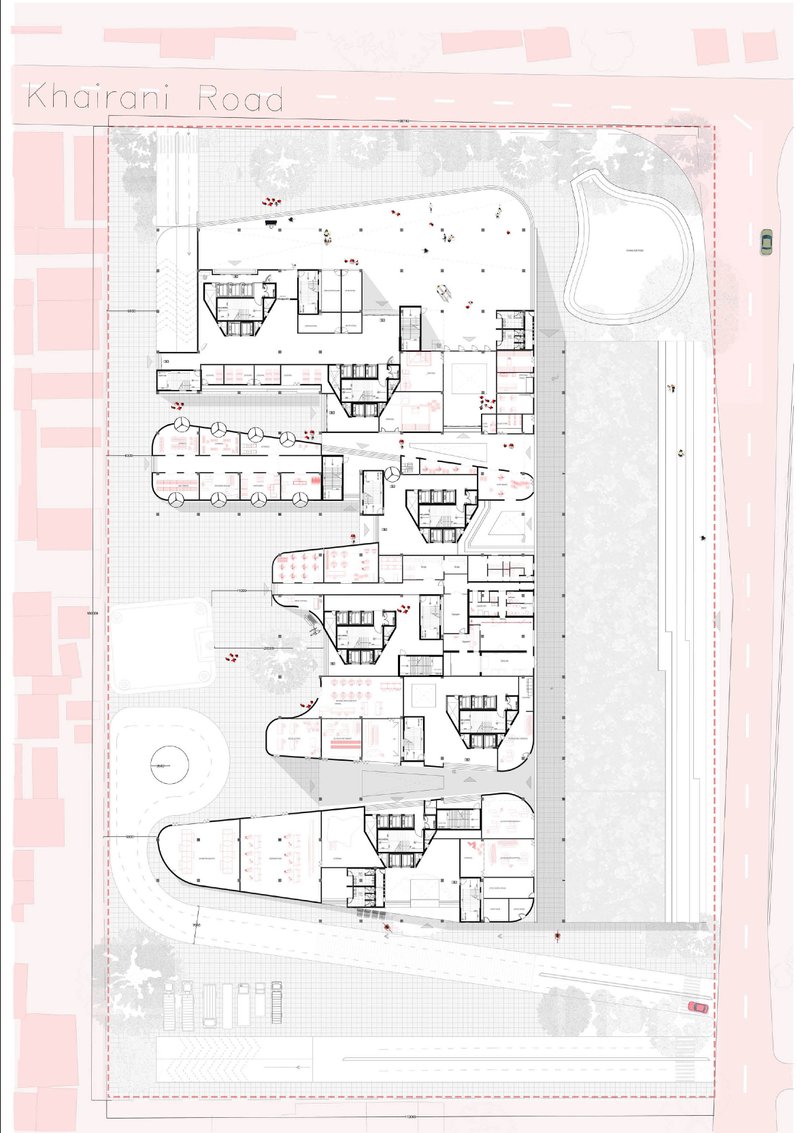
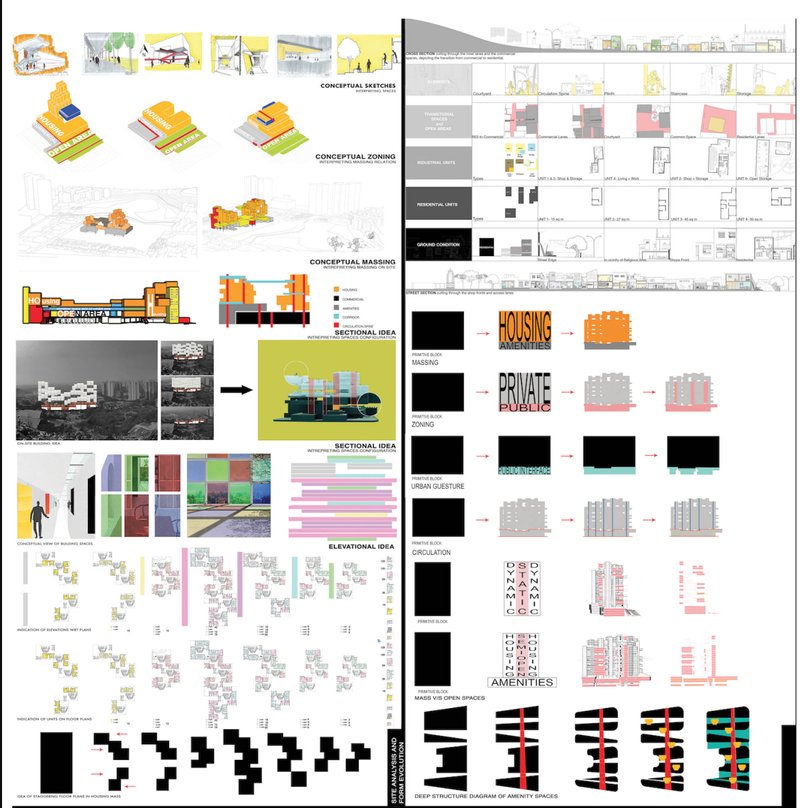
The sectional axonometric drawings highlight the core strength of the proposal. Rather than treating floors as repetitive horizontal slabs, the design introduces vertical porosity and sectional variation. This results in a building that operates as a three-dimensional network of spaces rather than a stack of isolated units.
Commercial zones at the lower levels transition into residential spaces through intermediate community platforms. These transitional layers serve as social condensers, enabling interaction among residents and creating a sense of collective living.
The sectional strategy also allows for better light penetration, ventilation, and spatial diversity. By breaking away from conventional slab-based construction, the project demonstrates how high-density housing design can achieve both efficiency and experiential richness.
Modular System and Flexibility
At the core of the project lies a modular system that enables adaptability. The housing units are not fixed in a rigid configuration but are designed as flexible modules that can respond to changing user needs.
This modularity is reflected in the process diagrams, which illustrate the evolution from primitive blocks to complex aggregations. The system supports variations in unit size, orientation, and spatial configuration, allowing the building to accommodate diverse demographics.
The concept of "housing as a system" replaces the idea of "housing as a product." This shift is crucial in addressing the dynamic nature of urban populations in cities like Mumbai.
Community-Centric Design Approach
A defining aspect of this high-density housing design is its emphasis on community. The project integrates shared amenities, circulation corridors, and open spaces as active social environments rather than residual areas.
Circulation is not merely functional but becomes an experiential element that encourages interaction. Corridors expand into communal nodes, and vertical connections are designed to enhance visual connectivity.
Amenities are distributed throughout the building instead of being confined to a single level. This decentralization ensures that community spaces are accessible and integrated into daily life.
Architectural Expression and Urban Identity
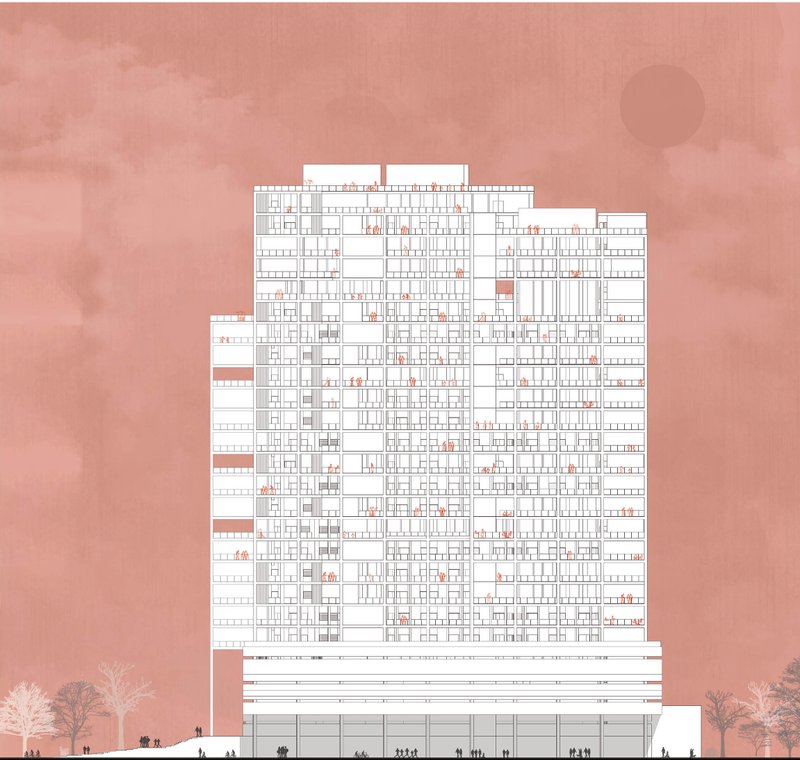
The elevation reveals a complex interplay of volumes, voids, and articulated facades. The building avoids monotony by introducing variation in massing and facade treatment, reflecting the internal diversity of spaces.
Double-height commercial fronts at the street level establish a strong urban presence, while the upper residential volumes create a textured skyline. The design balances density with identity, ensuring that the building contributes meaningfully to the city’s architectural character.
Redefining Density in Mumbai
Housing Version 2.0 ultimately redefines what high-density housing design can achieve in a city like Mumbai. It moves away from efficiency-driven repetition and towards a model that prioritizes human experience, adaptability, and urban integration.
By rethinking zoning, introducing sectional complexity, and embracing modular flexibility, the project presents a compelling alternative to conventional housing typologies. It demonstrates that density does not have to compromise quality but can instead enhance it when approached through thoughtful architectural design.
Aishwarya Parab’s Housing Version 2.0 is not just a housing proposal but a critical framework for future urban living. It challenges architects to reconsider the fundamentals of high-density housing design and to create environments that are socially inclusive, spatially dynamic, and contextually responsive.
In the context of rapidly growing cities, this project offers a blueprint for how architecture can mediate between density and livability, transforming constraints into opportunities for innovation.



Popular Articles
Popular articles from the community

Milan Crossover: Sustainable Architecture for a New Fashion Culture in Milan
Milan Crossover transforms fashion culture through sustainable architecture, linking material libraries, remake studios, and public runways.

Stanton Architects Sculpts a Curving Family Home into Sydney's Inner West Fabric
Five Dock House uses cantilevers, curved concrete, and layered courtyards to carve out privacy on a tight suburban lot in Sydney.
PLATAFORMArq Folds a Concrete Roof Over the Portuguese Mountains in House #474
A 220-square-meter residence in Teixoso, Portugal, wraps board-formed concrete into an angular canopy that frames the Serra da Estrela foothills.
The Faith: Modular Architecture for Play, Learning, and Hope in Kutupalong Refugee Camp
A modular playground architecture project in Bangladesh where play, learning, safety, and hope rebuild childhood inside a refugee camp anew.

Similar Reads
You might also enjoy these articles
Eco Chapel: A Green Architecture Pavilion Designed in Symbiosis with the Forest
Eco Chapel uses green architecture to weave prayer, learning and reuse into a forest pavilion shaped by modular hexagonal canopies for life.
Kaffeebühnen: Coffee Shop Architecture Designed as a Civic Stage Between Vienna’s City and Park
Kaffeebühnen turns coffee shop architecture into a civic stage, linking Vienna’s park edge, urban life, warm timber yards, and coffee craft.
Healing Façade: Sustainable Architecture for Reforestation, Community, and Sacred Ecology in Ethiopia
Healing Façade reimagines sustainable architecture as a living wall that restores soil, catches water and renews Ethiopia's forest churches.


Urban Forest: A Vertical Ecosystem for 5,000 Workers in Singapore's Changi Business Park
Radially stacked pods and layered green decks turn a 7-acre plot into 47 acres of ecological workspace projected for 2040.

Explore Urban Design Competitions
Discover active competitions in this discipline




The International Standard for Design Portfolios


The Global Benchmark for Architecture Dissertation Awards


The Global Benchmark for Graduation Excellence


Challenge to design public laboratory
Comments (0)
Please login or sign up to add comments
No comments yet. Be the first to comment!