

HUE: A Desert Monument That Turns Litmus Chemistry into a Visible Climate Warning
A lattice tower above an inverted underground pyramid, where visitor-poured litmus reagent colors the structure to register atmospheric pollution.


Climate change has a visibility problem. Carbon does not glow, acidity has no colour, and a warming atmosphere looks the same from one day to the next. HUE proposes a blunt and theatrical correction: take the chemistry of the air, run it through a pool of litmus reagent, and push the resulting colour up the spine of a monument tall enough to be read across a desert. The result is a building that works less as shelter and more as an instrument, one that registers the state of the atmosphere and broadcasts it.
Designed by 葳 白, HUE was shortlisted in the Hourglass competition. The project sits in a vast desert landscape and pairs a slender vertical tower with a subterranean system shaped as an inverted pyramid. Its ambition is explicitly behavioural: rather than offering a functional fix for global warming, it asks visitors to take part in making environmental data visible, positioning architecture as a medium of communication rather than a passive performer.
A Thin Frame That Reveals Itself on Approach


From a distance, HUE reads as almost nothing: a minimal lattice frame standing on a flat horizon, as the dusk presentation board shows with only a crescent moon for company. The daylight view behind the sand dunes reinforces that restraint. Against a pale sky the tower is a thin vertical mark, more surveying pole than spectacle. This is a deliberate choice. In a landscape with no competing objects, a slender frame commands attention without needing mass.
The design leans on distance as a narrative device. Perception shifts as visitors approach, and layers of transformation emerge that are invisible from afar, culminating at night in a luminous pyramid of light. Sequencing the encounter this way turns a walk across sand into the first chapter of the experience, and it frames the visitor as a participant who has to close the gap before the monument fully explains itself.
A Gas Column as the Tower's Nervous System

The closer view exposes what the lattice is for. A red column runs through the core of the gridded tower, rising above angular roof wings set into hazy scrubland. The grid acts as a container and display case, while the core carries the colour shifts generated below ground. The tower becomes a vertical gauge, its reading legible from far away.
The behaviour of the structure changes with time of day. In daylight it delivers subtle information as a minimal monument; at night it emits light forming a pyramid that extends into the sky. Crucially, the design ties intensity to condition: as environmental quality worsens, the colour and intensity of the light increase, turning the object into a warning beacon rather than a decorative landmark. The idea that a monument should become more alarming as the planet gets worse is the sharpest move in the scheme.
An Inverted Pyramid Where Visitors Trigger the Reaction

The section is where HUE earns its conceptual weight. Beneath the tower lies an inverted pyramid that mirrors the light pyramid projected above, setting up a clear duality between seen and unseen, surface and depth. Visitors descend through a sequence of controlled spaces into this buried volume, and the circular detail views trace both the route and the reaction process that drives the whole system.
Inside, visitors introduce a litmus reagent into a designated pool. As it interacts with atmospheric gases, the reagent changes chemically, and the resulting colour variations travel upward through the monument. The spectrum maps acidity and alkalinity, standing in for levels of pollution and degradation. Litmus is a crude indicator compared with real atmospheric monitoring, but that crudeness is partly the point: it is a reaction most people remember from school, instantly readable, and here it is scaled up to the size of a landscape. The pairing of a hands-on act underground with a public signal overhead gives individual gestures a collective consequence.
Stele, Core Tube and Two Basement Floors in Plan

The site plan lays the stele, the core tube and two basement floor plans over a rust-coloured desert aerial, with a river band cutting across the sheet. Read together, they show how compact the above-ground footprint is relative to the infrastructure beneath it. The core tube is the hinge of the project, connecting the reaction spaces in the basement levels to the visible column above.
This distribution of programme matters. By burying the interactive and infrastructural work, the design keeps the desert surface almost untouched and lets the tower carry the symbolic load alone. The plan confirms that HUE is fundamentally a vertical diagram: an act in the ground, a conduit, and a signal in the sky.
Why This Project Matters
Most sustainable architecture argues its case through invisible metrics: energy savings, embodied carbon, operational efficiency. HUE takes the opposite route and makes environmental condition the visible subject of the building. Its value lies in reframing a monument, a typology traditionally devoted to commemorating the past, as a live readout of the present that grows louder when conditions deteriorate.
There are open questions about how literally a litmus reaction can track atmospheric quality, and the scheme would benefit from clarifying how chemical readings and environmental data combine. Yet as a competition proposition, it lands a memorable idea with economy: a thin frame, a buried mirror, and a colour that anyone can read. In asking visitors to physically trigger the warning they then watch rise into the sky, 葳 白 turns climate awareness from a statistic into a shared, embodied event.
View the Full Project
About the Designers
Designer: 葳 白
Enter a Design Competition on uni.xyz
uni.xyz runs architecture and design competitions year-round that reward proposals with spatial conviction and real site intelligence.
Project credits: HUE by 葳 白 Hourglass (uni.xyz).


Popular Articles
Popular articles from the community


longwave studio Reorganizes a 112 m² Tainan Apartment Around the Daily Routines of a Family and Two Cats
In Tainan, Taiwan, birch plywood, rust-red furniture and a freestanding plaster wall link arrival, storage, work and family life in one apartment.

Cube Design Draws an Ecological Corridor Between Two Shenzhen Hills with the Nankai Building
Beside Shenzhen's container docks, the Nankai Building pairs stacked balconies with a climbing green screen to connect two hillsides across its height.

GROUP A Strips a 1969 Rotterdam Harbor Headquarters to Its Frame and Wraps It in Timber Louvers
In Rotterdam's M4H harbor district, Ferro Offices reuses a 1969 frame, adds one timber storey and reaches BREEAM-NL Outstanding.

U.GA Architects Wraps an Oval Rooftop Pool in Curved Board-Formed Concrete on Busan's Jeollidan-gil
In Busan's Jeonpo-dong, a 454 m² mixed-use block stacks a neighborhood facility, guest rooms and an oval rooftop pool inside spiraling concrete walls.

Similar Reads
You might also enjoy these articles
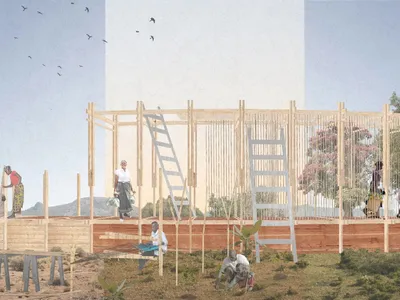
Healing Façade: A Modular Chapel System That Restores Ethiopia's Sacred Forests
Winner of the Eco-Chapel competition, this circular timber façade collects water from air to rebuild soil and reforest degraded Ethiopian landscapes.
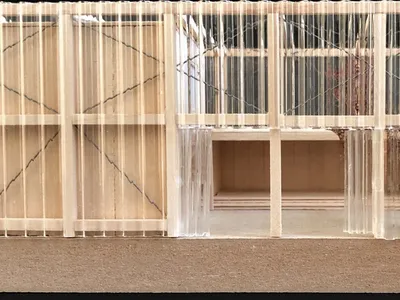
Kaffeebühnen: Where Coffee Shop Architecture Becomes a Civic Stage in Vienna
A linear sequence of timber boxes, transparent shells, and open yards turns the Viennese café tradition into a public performance space.
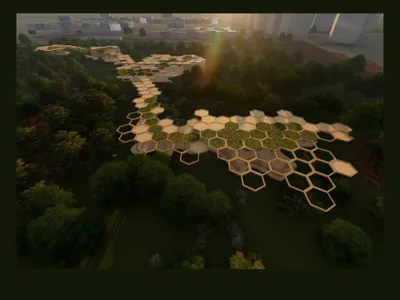
Eco Chapel: A Modular Forest Pavilion That Grows Like the Landscape It Protects
Hexagonal timber modules weave through existing trees, turning a chapel into a living system for prayer, education, and reforestation.

Urban Forest: A Vertical Ecosystem for 5,000 Workers in Singapore's Changi Business Park
Radially stacked pods and layered green decks turn a 7-acre plot into 47 acres of ecological workspace projected for 2040.

Explore Architecture Competitions
Discover active competitions in this discipline

Challenge to reimagine the Iron Throne

Photograph architecture without architects

Illustrate the lost glory of Angkor Wat - Render Challenge

Design challenge to reuse E-waste
Comments (0)
Please login or sign up to add comments
No comments yet. Be the first to comment!