![[i]da Arquitectos Stacks Two Volumes on the Portuguese Silver Coast to Frame the Atlantic](https://img.uni.xyz/eyJidWNrZXQiOiJ1bmktYmxvZyIsImtleSI6IjQ3L2NkNzA4NTdjLTYzNzgtNDVjZC04ZWRmLTgzOTFkZjhjNjMwYi91bmllZGl0b3JpYWwyMjAyNi0wNS0yMlQxMi01Mi0zMS0xMjIzNjIuanBnIiwiZWRpdHMiOnsicmVzaXplIjp7IndpZHRoIjo1MH0sImpwZWciOnsicXVhbGl0eSI6MTB9LCJ3ZWJwIjp7InF1YWxpdHkiOjEwfSwiZmxhdHRlbiI6ZmFsc2UsIm5vcm1hbGlzZSI6ZmFsc2V9fQ==)
![[i]da Arquitectos Stacks Two Volumes on the Portuguese Silver Coast to Frame the Atlantic](https://img.uni.xyz/eyJidWNrZXQiOiJ1bmktYmxvZyIsImtleSI6IjQ3L2NkNzA4NTdjLTYzNzgtNDVjZC04ZWRmLTgzOTFkZjhjNjMwYi91bmllZGl0b3JpYWwyMjAyNi0wNS0yMlQxMi01Mi0zMS0xMjIzNjIuanBnIiwiZWRpdHMiOnsicmVzaXplIjp7IndpZHRoIjoyMDAwLCJmaXQiOiJpbnNpZGUifSwianBlZyI6eyJxdWFsaXR5Ijo4MH0sIndlYnAiOnsicXVhbGl0eSI6ODB9LCJmbGF0dGVuIjpmYWxzZSwibm9ybWFsaXNlIjpmYWxzZX19)
[i]da Arquitectos Stacks Two Volumes on the Portuguese Silver Coast to Frame the Atlantic
Near the cliffs of Praia D'El Rey in Óbidos, a house of overlapping solids and voids negotiates wind, ocean, and domestic shelter.


Building a house on the edge of the Atlantic requires a negotiation most residential projects never face. The wind is relentless, the views are immense, and the temptation to simply open up every wall to the ocean can produce spaces that are exhilarating for an afternoon and exhausting to live in. [i]da arquitectos, led by Ivan de Sousa and Inês Antunes, confronts this tension head-on at the Falésia D'El Rey House near Óbidos, Portugal, treating the 2,370-square-meter coastal site as a problem of mediation between landscape grandeur and domestic calm.
The result, completed in 2023, is a composition of two overlapping volumes that generate a network of sheltered courtyards, shaded thresholds, and open terraces. Rather than one heroic gesture toward the horizon, the house offers a sequence of calibrated outdoor rooms, each with a different relationship to light, wind, and the Berlengas archipelago visible in the distance. At 814 square meters of built area, it is a generous house, yet it reads as a series of interlocking fragments rather than a single mass.
Two Volumes, One Dialectic
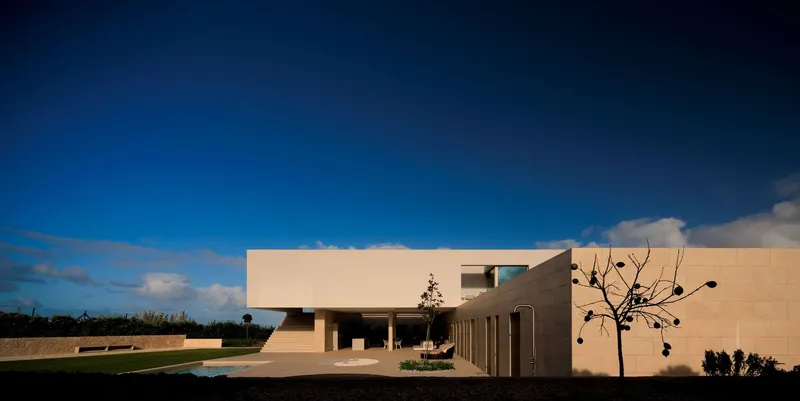
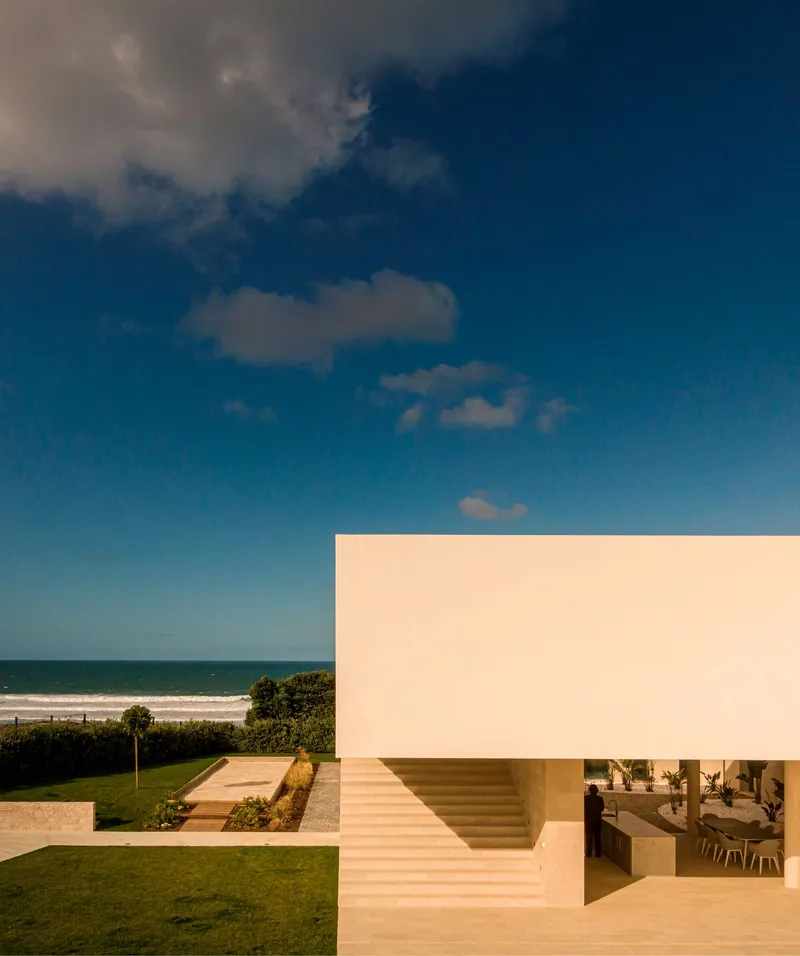
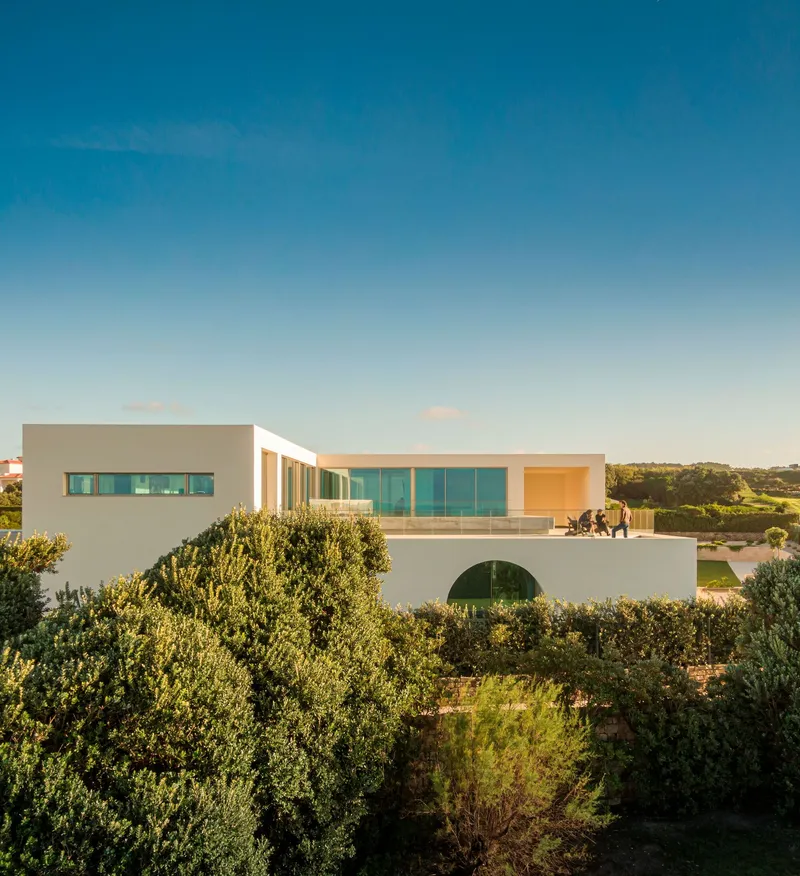
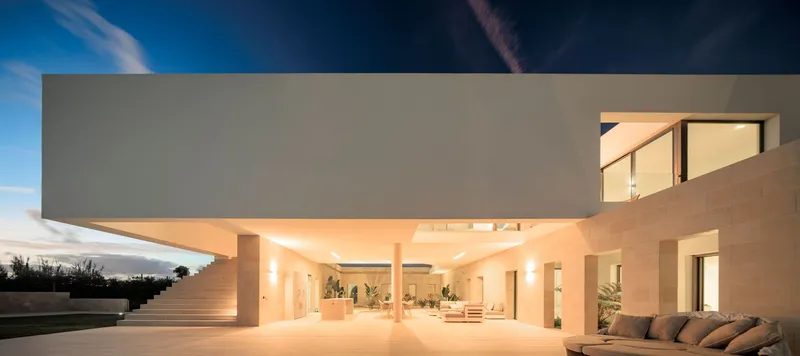
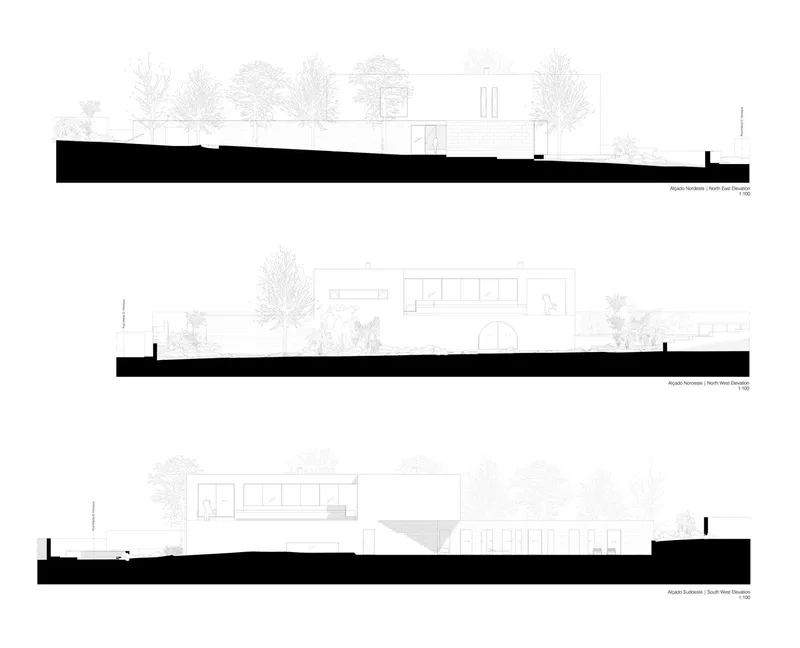
The organizing principle is clear in elevation: a sand-colored lower plinth hugs the ground and defines the protected outdoor zones, while an L-shaped upper volume, rendered white, lifts above it. The upper piece is where the primary living spaces sit, with expansive glazing toward the ocean. The lower piece holds guest bedrooms and leisure areas, its solidity doing the hard work of shielding the courtyards from coastal gusts.
Where the two volumes overlap, a shaded transitional zone emerges. It is neither fully inside nor out, functioning as the connective tissue between the southern garden and the central patio. This in-between space is arguably the most architecturally interesting part of the house: a carved-out void that the building itself produces, rather than something applied after the fact.
The Staircase as Event
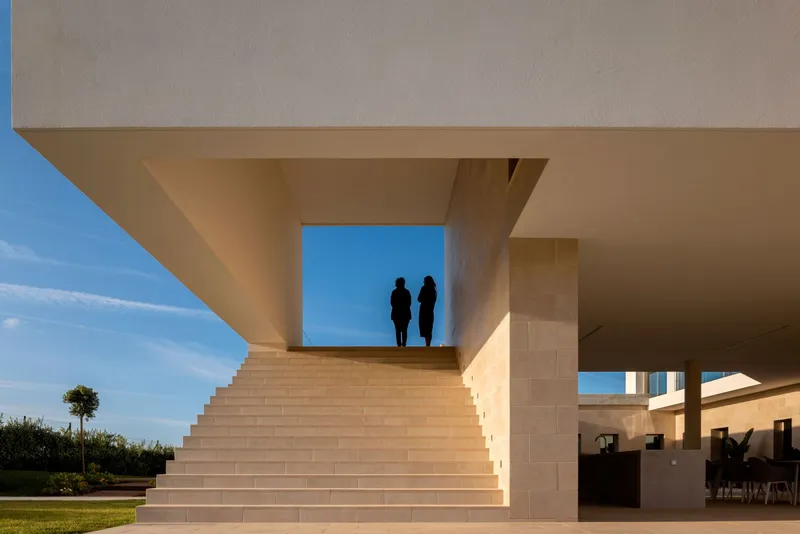
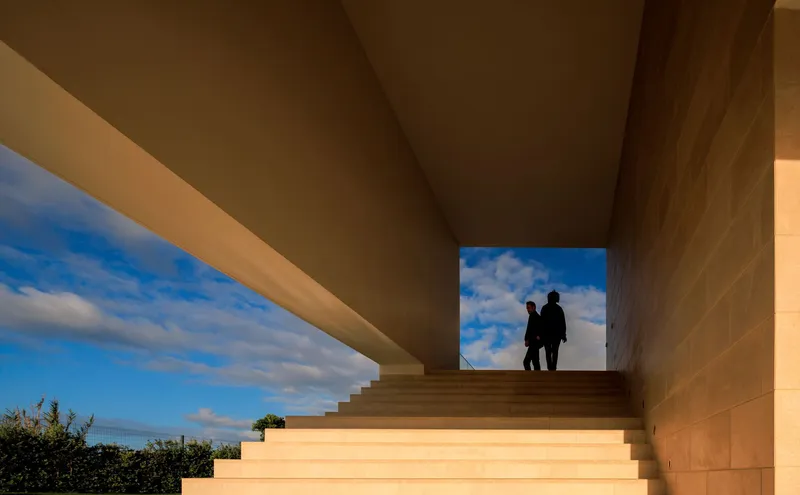
A wide stone staircase runs from the east-facing entrance up through the cantilevered upper volume and out to a west-facing terrace that acts as a belvedere. It is massively oversized for mere circulation. With the sky framed above and two silhouetted figures ascending against blue, it becomes a kind of processional ramp, a device borrowed more from civic or sacred architecture than from residential convention.
The architects describe this stair as an expression of celebration of the Atlantic's beauty, and the claim holds up. Arriving from the street side, you move through a compressed, sheltered threshold and then ascend into open sky and ocean panorama. The staircase is the moment of release in a house otherwise preoccupied with containment.
Courtyards and Outdoor Rooms
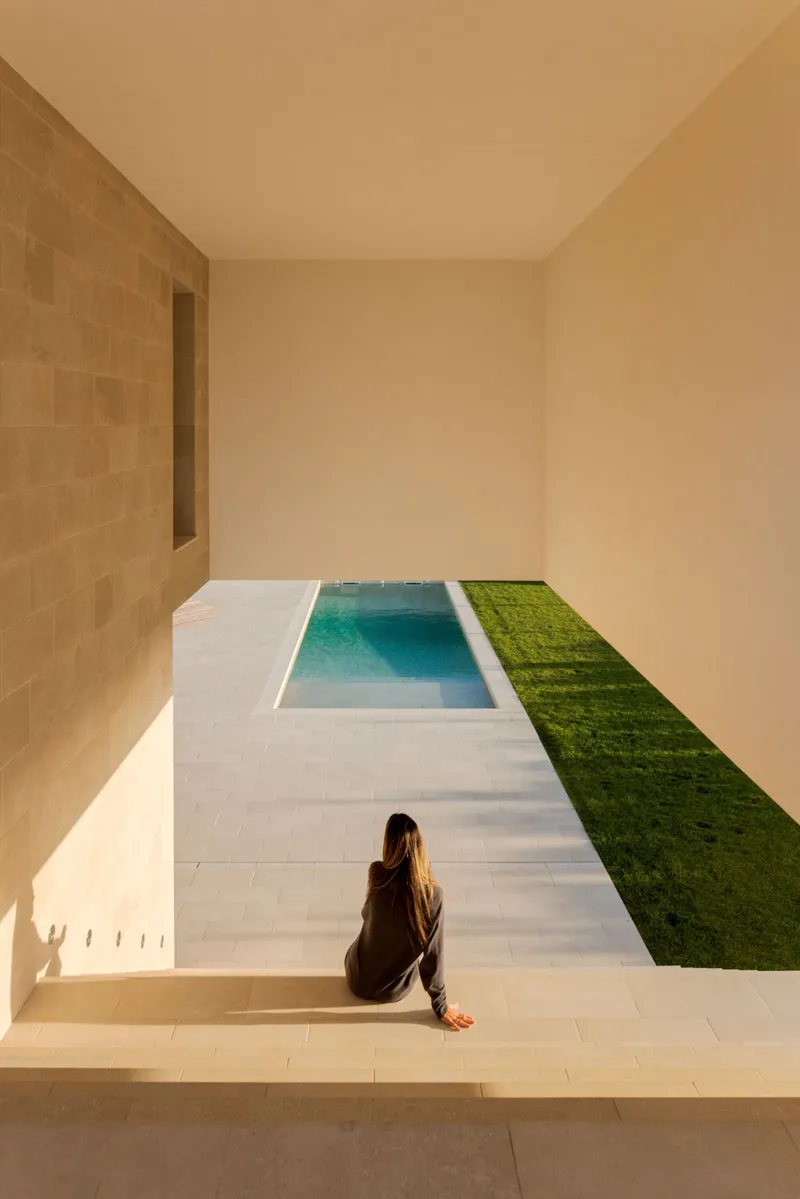
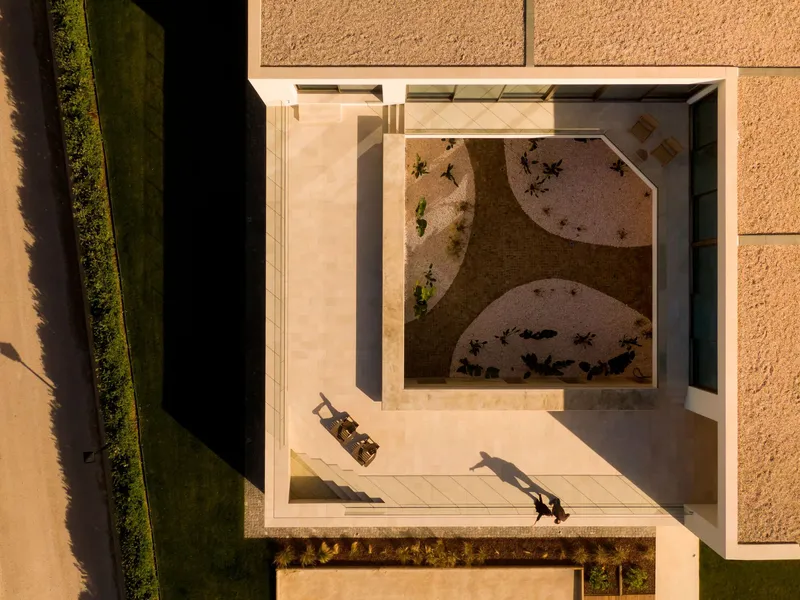

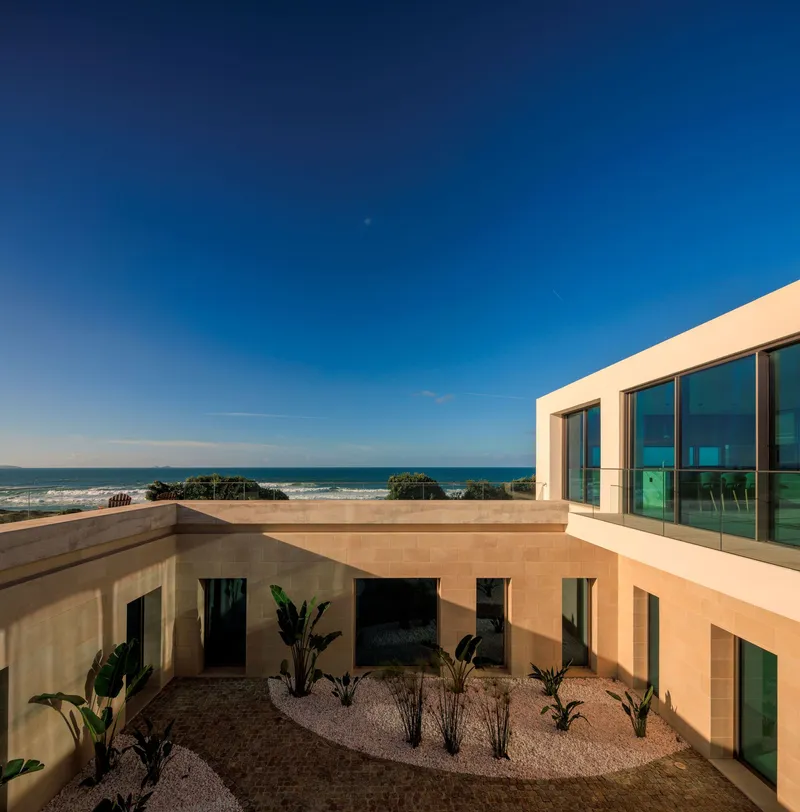
The site is large enough that [i]da could have spread the program thin and relied on setback distances for privacy. Instead, the strategy is denser and more deliberate: a 10-by-10-meter central patio anchors the plan, and secondary courtyards with curved planted beds and circular planters distribute across the plot. Pool, solarium, and garden flow in continuity with the staircase axis, producing a sequence of outdoor zones that move from fully enclosed to fully exposed.
The landscape design, handled by Inês Antunes, treats each courtyard as a distinct microclimate. Dense vegetation buffers the perimeter, while the inner courts receive more measured planting. Afternoon shadows from the volumes above fall across pale stone terraces, producing patterns that shift through the day. The overhead views reveal just how much of the house's area is, in fact, open air.
Living on the Upper Level
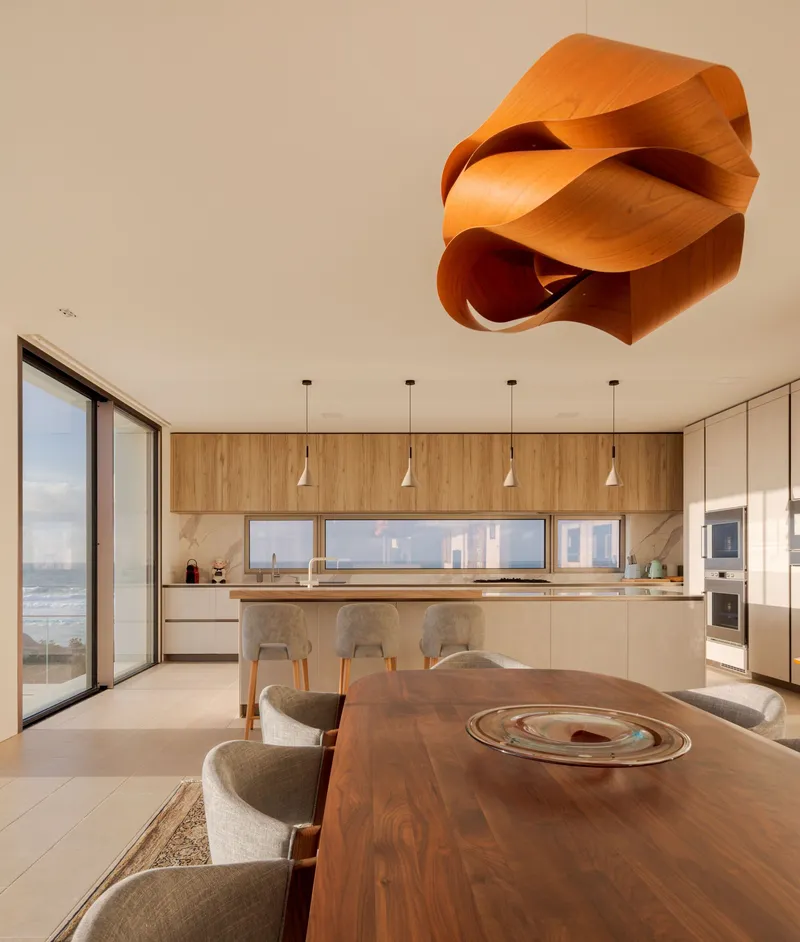
The upper floor houses the main living spaces, and the kitchen and dining area is where the house makes its most direct bid for the view. A glass-wrapped corner opens to the ocean, while a sculptural wood pendant light provides a warm center of gravity for the dining table. The proportions are generous without being cavernous, and the materiality, concrete, wood, glass, metal, is kept restrained so the landscape does the visual work.
At dusk, the cantilevered upper volume creates a luminous frame over the open-air living space below, turning the terrace into a lantern visible from the garden. The interplay between the lit interior and the dimming coastline gives the house a cinematic quality that Fernando Guerra's photographs capture without embellishment.
Rooftop and Horizon
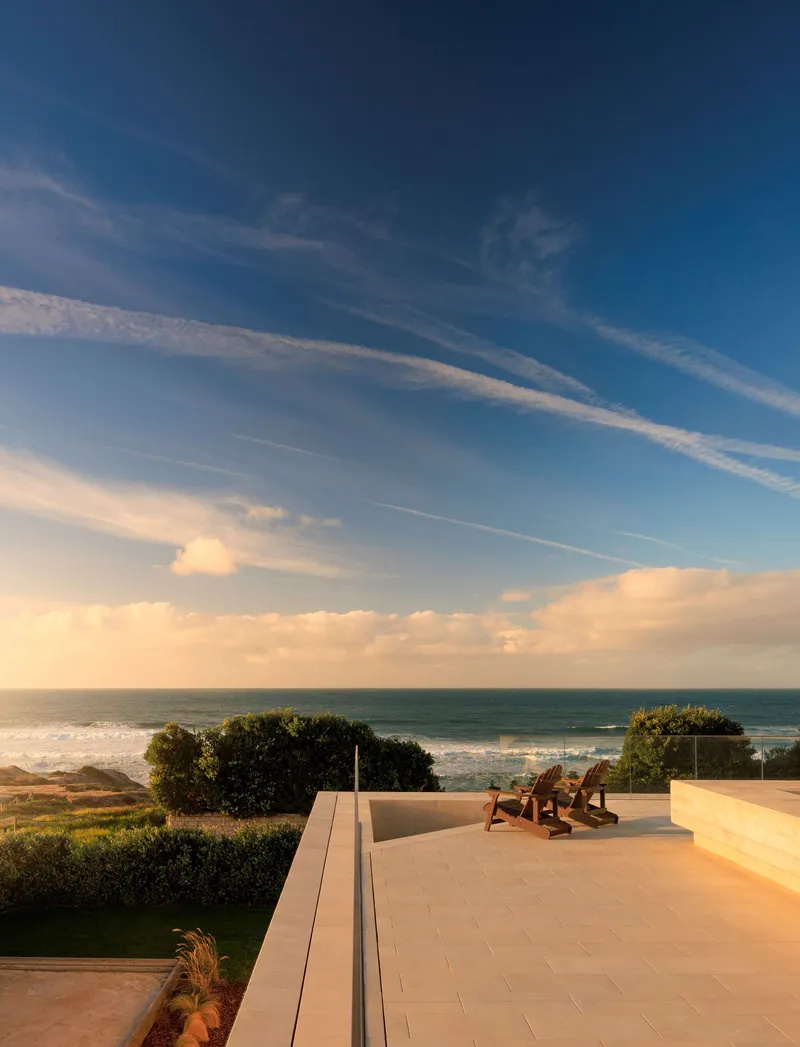
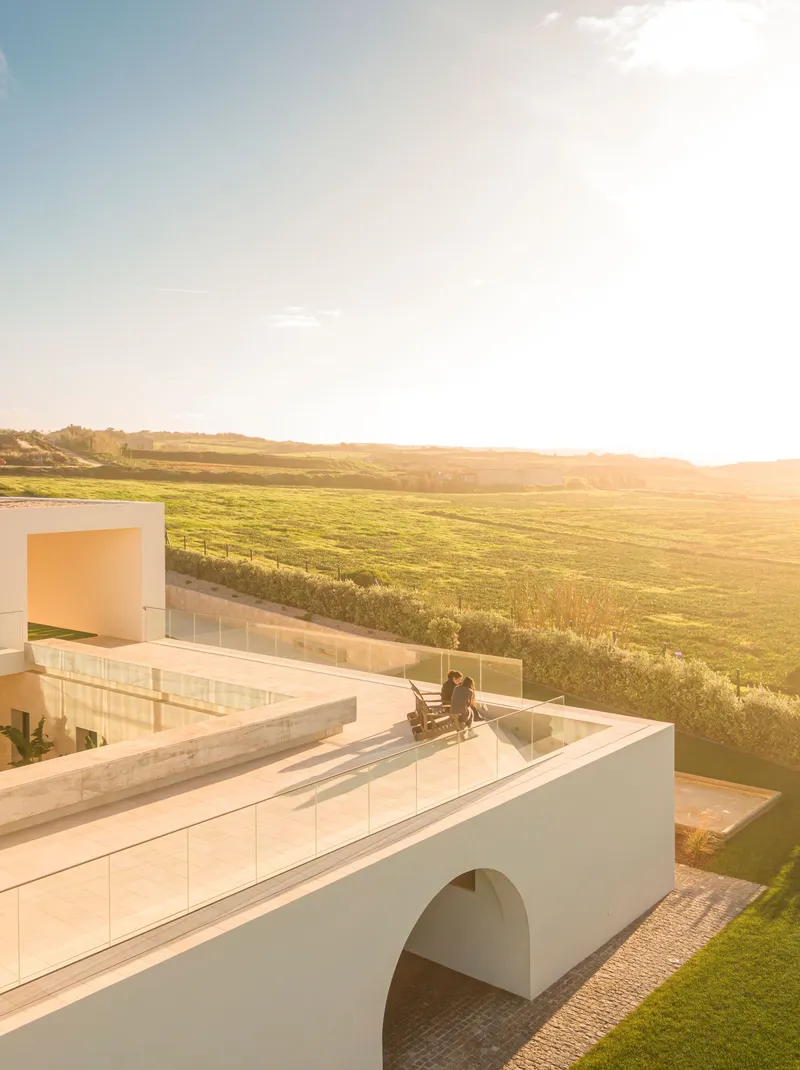
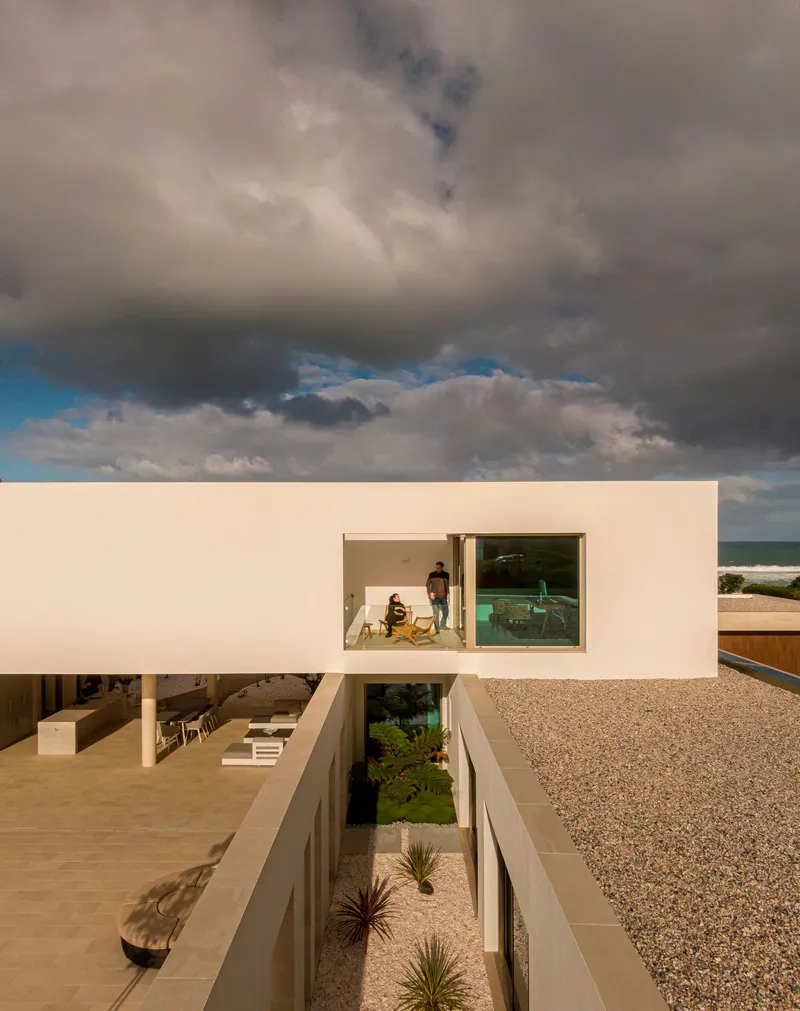
A rooftop terrace with wooden loungers faces the sea, turning the top of the house into a final destination rather than dead space. A glass balustrade keeps the guardrail nearly invisible, and at golden hour the gravel surface catches warm light while the green farmland stretches inland behind. Under storm clouds or at sunset, this terrace oscillates between exposed observatory and intimate retreat.
What makes the roof level work is that it is not the only place to be outside. Because the house distributes its outdoor program across multiple levels and orientations, the rooftop is a choice rather than a necessity. You can be on the pool terrace, in the patio, under the shaded overhang, or up top. The house never forces you into a single relationship with the elements.
The Coastal Edge
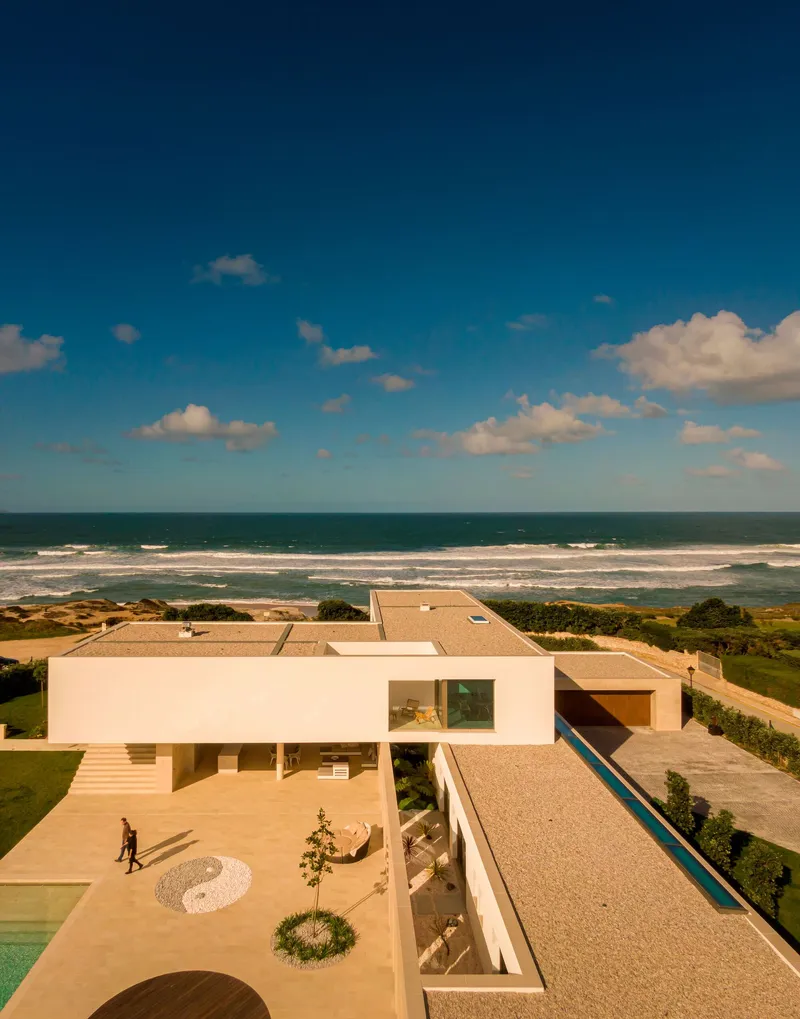
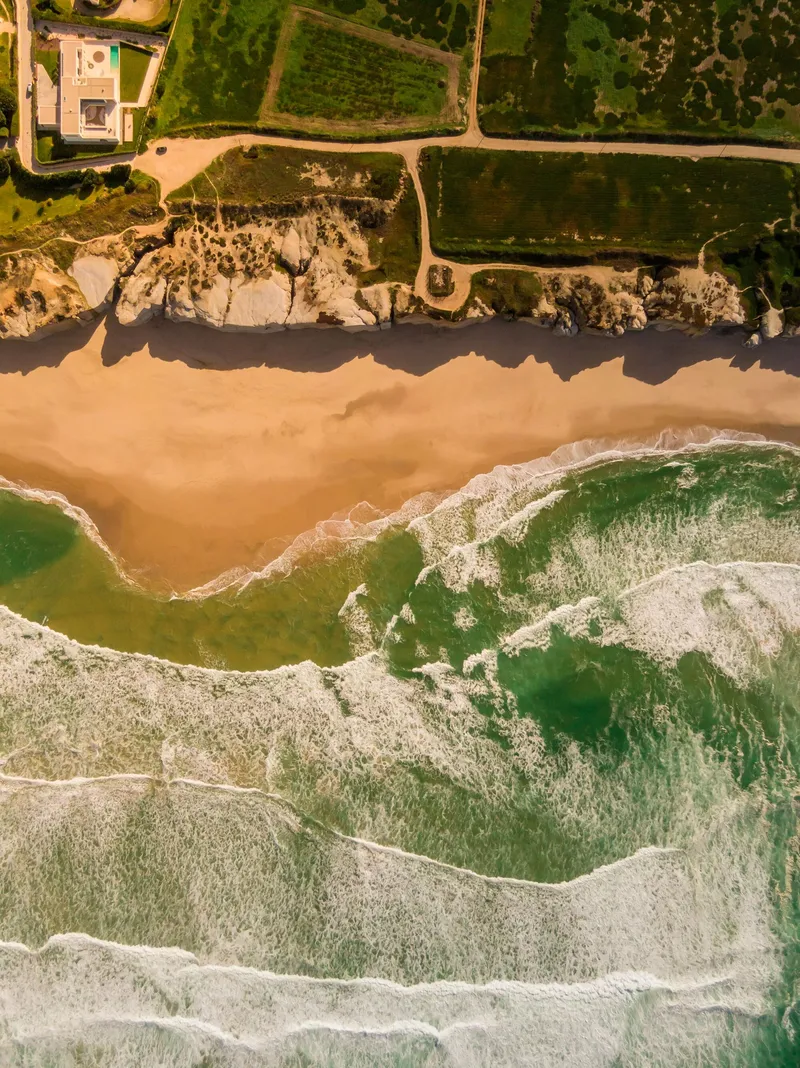
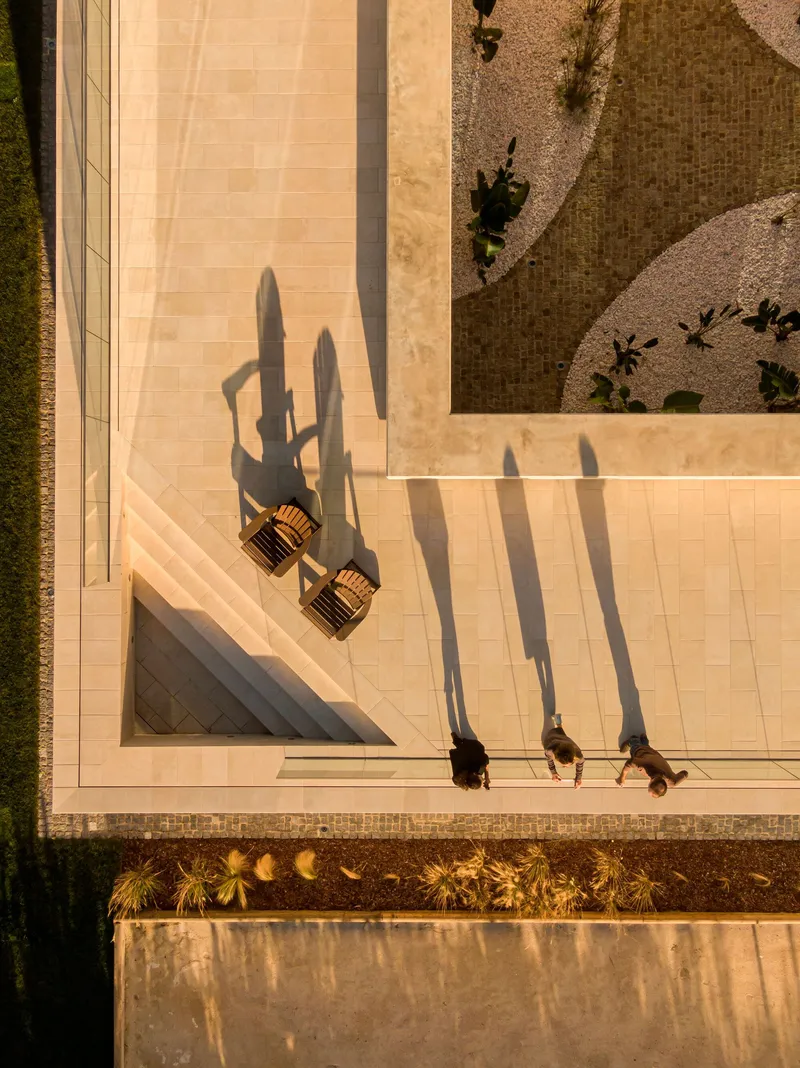
Aerial views reveal the house's relationship to its site with startling clarity. The terraced courtyards and lap pool stretch toward the ocean, the perimeter planting creates a green buffer, and the white sand beach below meets green Atlantic waves. The building sits parallel to the coastline, a deliberate orientation that maximizes the ocean-facing facade while presenting a more closed face to the street.
On the ground, the street facade reads as a fortified threshold: a limestone block wall and timber-clad garage greet visitors with restraint, withholding the expansiveness that waits on the other side. It is a classic architectural move, compression before release, but it is well executed here because the contrast between arrival and ocean side is dramatic without being theatrical.
Plans and Drawings

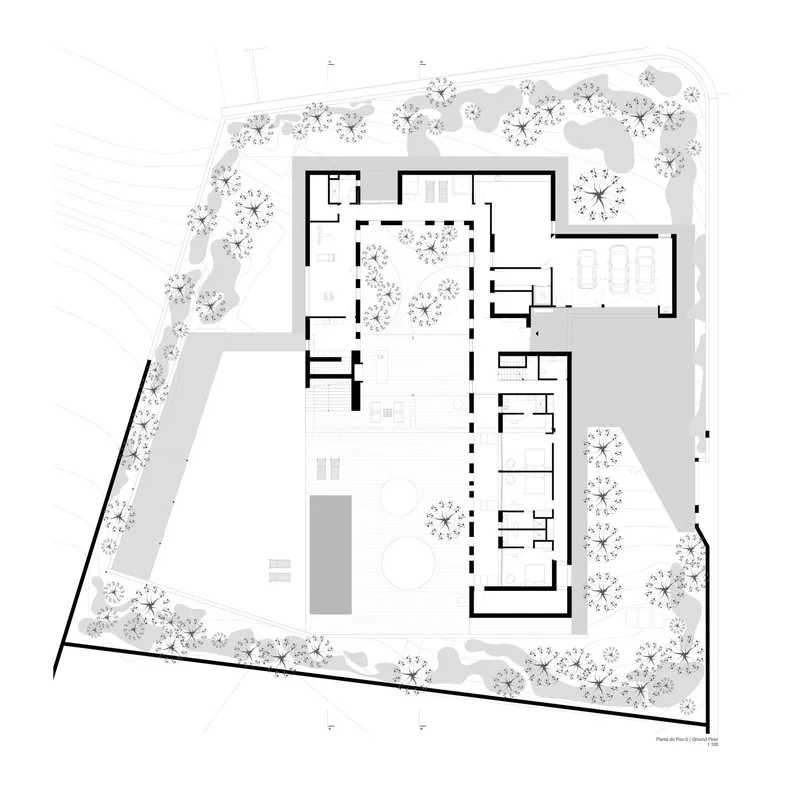
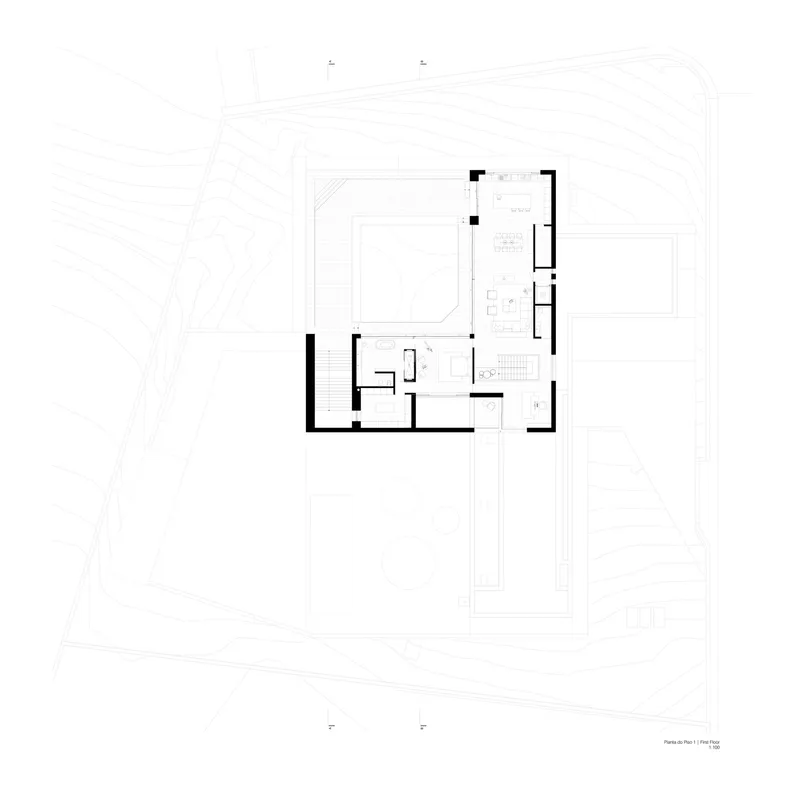



The site plan confirms what the aerials suggest: the building footprint is surrounded by a deliberate buffer of perimeter trees, creating a green room within which the house operates. The ground floor plan shows how the central courtyard organizes circulation and how the pool axis aligns with the staircase. The upper floor plan reveals a more compact arrangement of bedrooms and bathrooms arranged around the entry stair.
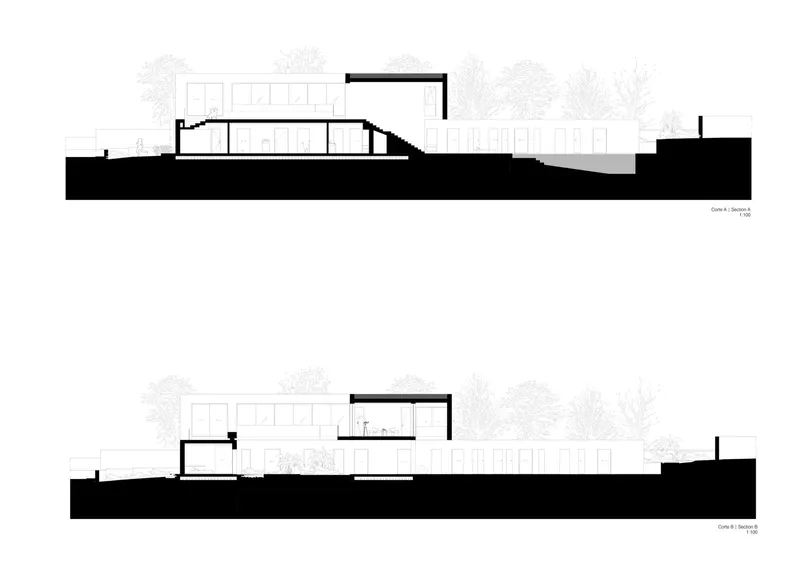
The section drawings are perhaps the most revealing documents. One shows the structure perched dramatically on a cliff edge above water, clarifying why the architects worked so hard to create sheltered zones: this is a genuinely exposed site. The elevation drawings place the low-slung volumes among surrounding vegetation, illustrating how the house stays below the tree canopy and avoids dominating the landscape. Early sketches of a curved roof canopy extending over terraced levels suggest that the design evolved significantly, with the final scheme opting for crisper geometries and more decisive massing.
Why This Project Matters
Coastal houses in Portugal's tourist corridors tend to fall into two camps: the hermetic concrete box that treats the ocean as a postcard to be framed, or the glass pavilion that dissolves the boundary between inside and out until the house barely registers as shelter. [i]da's Falésia D'El Rey House proposes a third path, one where the building is an active mediator. It blocks wind in one zone and channels views in another, creates shade where the sun is punishing and opens up where the breeze is welcome. The architecture does real climatic and spatial work rather than striking a pose.
The overlapping-volume strategy is not new, but its application here is unusually rigorous. Every void has a purpose, every cantilever creates a sheltered zone below, and the sequence from street to ocean is paced with the care of a much more public building. For a private residence on the Silver Coast, that degree of architectural ambition is worth noting.
Falésia D'El Rey House by [i]da arquitectos (Ivan de Sousa, Inês Antunes). Óbidos, Portugal. 814 m². Completed 2023. Photography by Fernando Guerra | FG+SG.
About the Studio
Share Your Own Work on uni.xyz
If projects like this are the kind of work you want to make, uni.xyz is a place to publish your own, find collaborators, and enter design competitions.




Popular Articles
Popular articles from the community


Conexión: Biophilic Design Reimagines High-Rise Living in Hong Kong
Conexión reimagines high-rise living in Hong Kong through biophilic design, green facades, shared spaces, daylight, water and nature within.

Hill & Cross Opera: Sculptural Opera House Architecture Shaped by Tallinn’s Landscape and Identity
Hill & Cross Opera reimagines opera house architecture in Tallinn through its sculptural hill, civic plaza, glass wave and a luminous cross.

Co-Life: Senior Housing Design That Reconnects Older Adults With the City
Co-Life reimagines senior housing design through healing gardens, shared streets, workshops, and a sustainable community across generations.
EW PARK: Sustainable Architecture Reimagines the Future of Urban Parking
EW PARK reimagines city parking as a modular wooden tower combining automation, solar energy, electric mobility, and adaptable urban design.


Similar Reads
You might also enjoy these articles

Bao Huynh Watercolor Atelier: A Serene Art Retreat in Hội An
Bao Huynh Watercolor Atelier in Hội An blends multifunctional art spaces, sustainable design, local materials, and family-friendly living in a serene environment.

Atelier Macri Concept Store Interior Design by CASE-REAL
Atelier Macri store features a "ko" counter, walnut wood details, cork displays, blending retail, gallery, and seamless customer experiences.

Manuel Vargas Izquierdo Stadium and High-Performance Sports Center: Architectural Excellence in Jalpa de Méndez
The Manuel Vargas Izquierdo Stadium blends sustainable design, inclusive sports facilities, and cultural-inspired architecture, revitalizing Jalpa de Méndez’s public spaces.

KAKR Buluh Awar Hall: Revitalizing Community and Ecology Through Bamboo Architecture
Community built bamboo hall revitalizes Buluh Awar village, empowering youth, restoring ecology, celebrating vernacular craftsmanship through sustainable architecture and culture.


Explore Residential Building Competitions
Discover active competitions in this discipline


Challenge to design mud housing for contemporary communities


Challenge to reimagine the Iron Throne


Photograph architecture without architects


Illustrate the lost glory of Angkor Wat - Render Challenge
Comments (0)
Please login or sign up to add comments
No comments yet. Be the first to comment!