
IDIN Architects Grows a Coffee Shop Out of the Jungle Beside Bangkok's Busiest Motorway
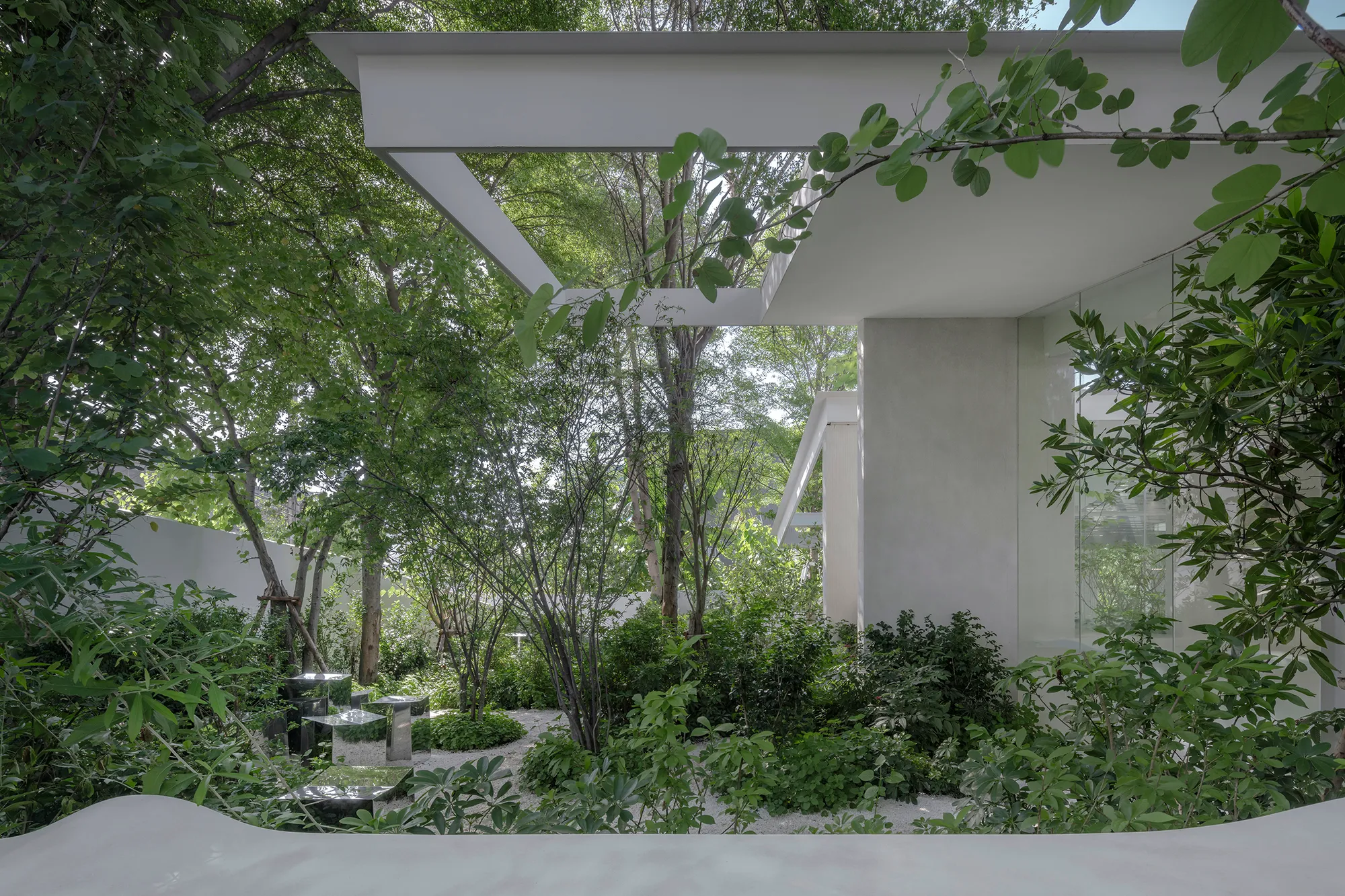
Three mono-pitched steel pavilions extend an old gabled house into a dense tree canopy in Bang Na, Thailand, turning coffee into landscape.


A two-story gabled house on a plot thick with mature trees, right next to Bangkok's Bangna-Trad motorway: not exactly the setting you'd associate with a destination coffee experience. But IDIN Architects saw exactly that potential in the site for NANA Coffee Roasters' Bangna branch. Rather than demolish the existing structure, they modified it and bolted on three narrow, mono-pitched steel pavilions that reach into the canopy like fingers. The result is a 250-square-meter café that feels less like a building and more like a clearing in a forest, one where the coffee counter is the campfire.
What makes this project worth studying is the precision with which architecture, interior, and landscape collapse into a single proposition. The landscape architect, TROP: Terrains + Open Space, didn't just plant around the buildings. Greenery infiltrates the gaps between the three new masses, flows through glass corridors, and pushes into the interiors themselves. The café's counters, with their undulating surfaces inspired by the northern Thai mountain range where NANA's beans are grown, reinforce the idea that every design decision points back to coffee and its origins. It won a DEmark Award in 2022 for interior design, but calling it an interior project undersells what's actually happening here.
Three Pavilions in the Canopy

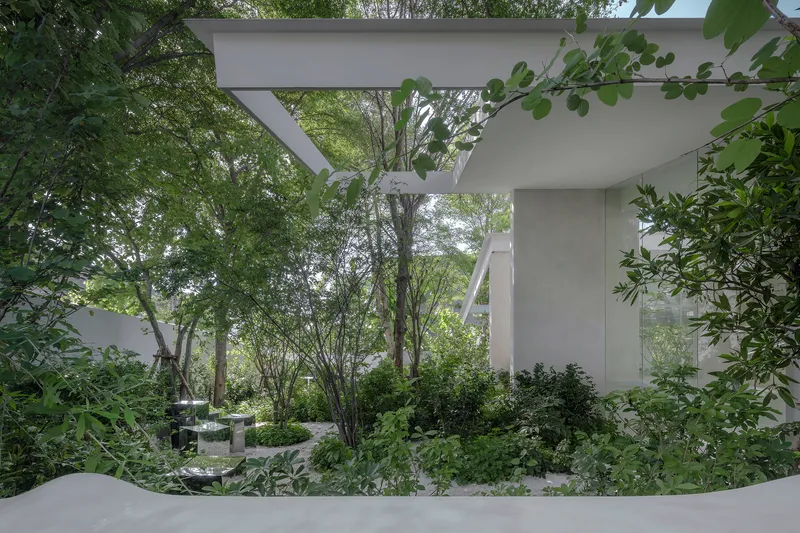
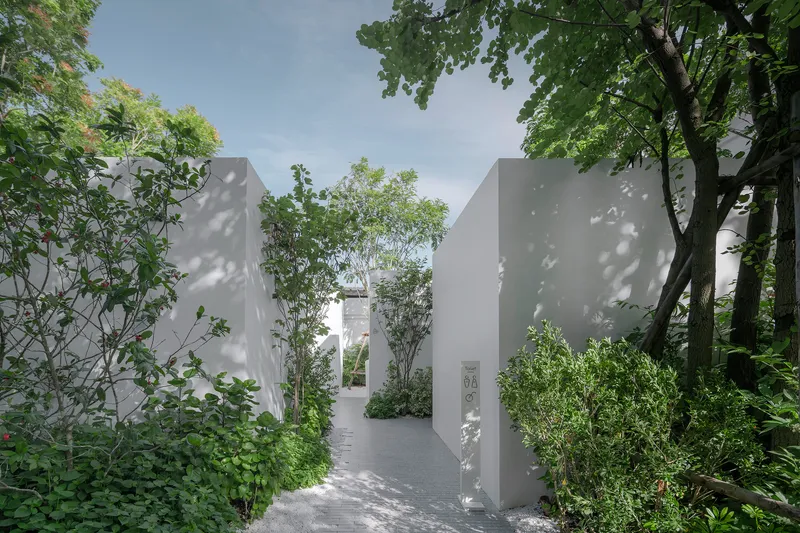
The three new volumes are deliberately narrow, their slanted rooflines picking up the pitch of the original gabled house and stretching it into something more angular and contemporary. White steel frames and white concrete walls act as a neutral backdrop, and this neutrality is the point. As sunlight filters through the tree canopy, the walls become projection screens for shifting shadow patterns throughout the day. It's an effect that requires discipline: the architecture has to stay quiet enough to let the landscape perform.
The oversized roofs extend well beyond the building envelope to shelter external terraces, a pragmatic move in Bangkok's climate that also dissolves the threshold between inside and out. Sitting beneath one of these canopies, surrounded by planting on three sides, you'd struggle to say whether you're in the building or next to it.
Landscape as Primary Material
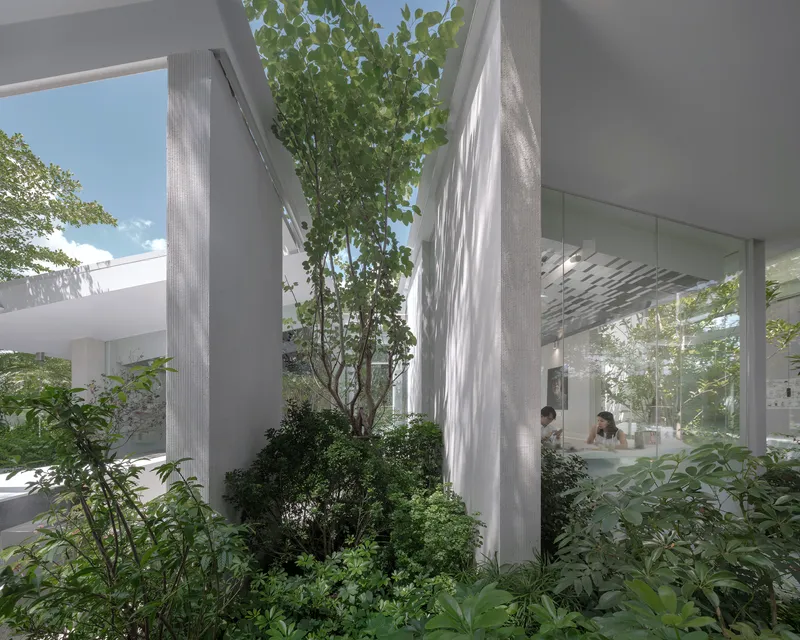

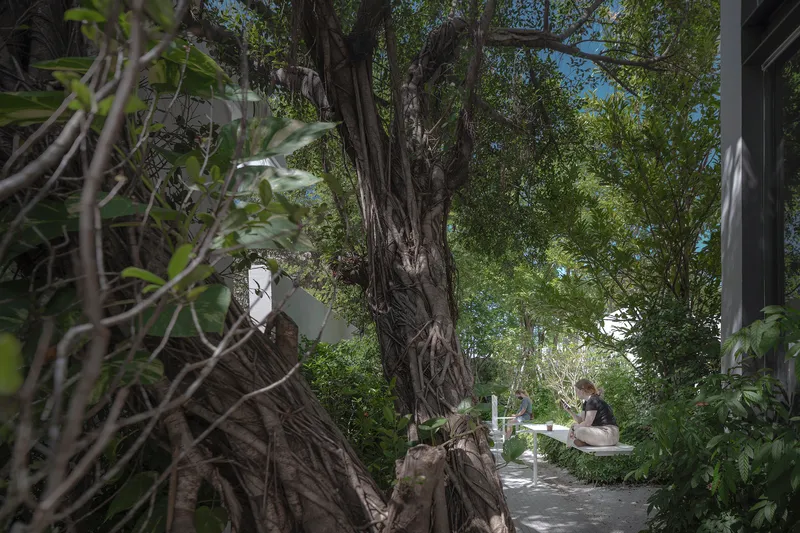
TROP's landscape strategy treats the existing trees not as obstacles but as the project's real structural framework. Gravel paths wind through gnarled trunks wrapped in aerial roots, planted beds of low shrubs soften the base of every building, and the gaps between the three pavilions are generous enough to feel like outdoor rooms rather than service alleys. The planting also serves a functional role: dense greenery screens the interior from the adjacent motorway, creating what IDIN describes as an oasis condition.
Restrooms are pushed to the back of the site as independent pods surrounded by landscape, which means even the most utilitarian program element becomes an excuse to walk through the garden. It's a small decision with outsized effect. Every trip through the café reinforces the sense that the landscape is the experience, not decoration around it.
Where the Counter Becomes Terrain

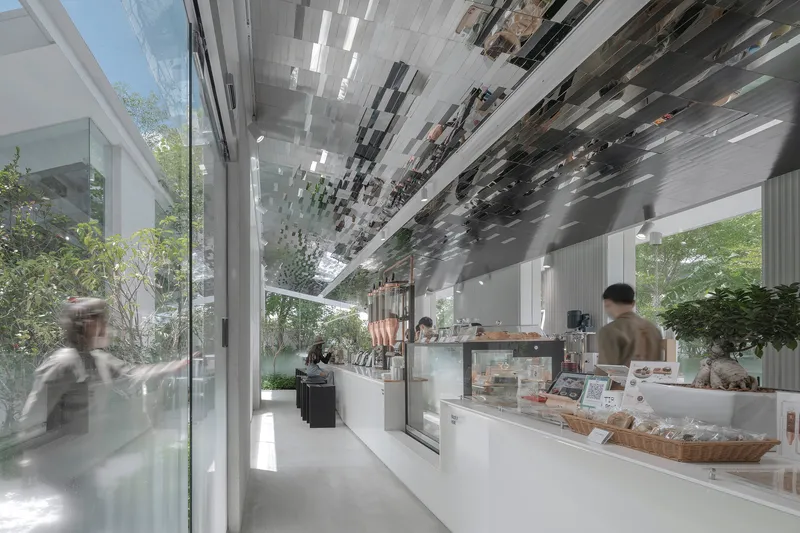
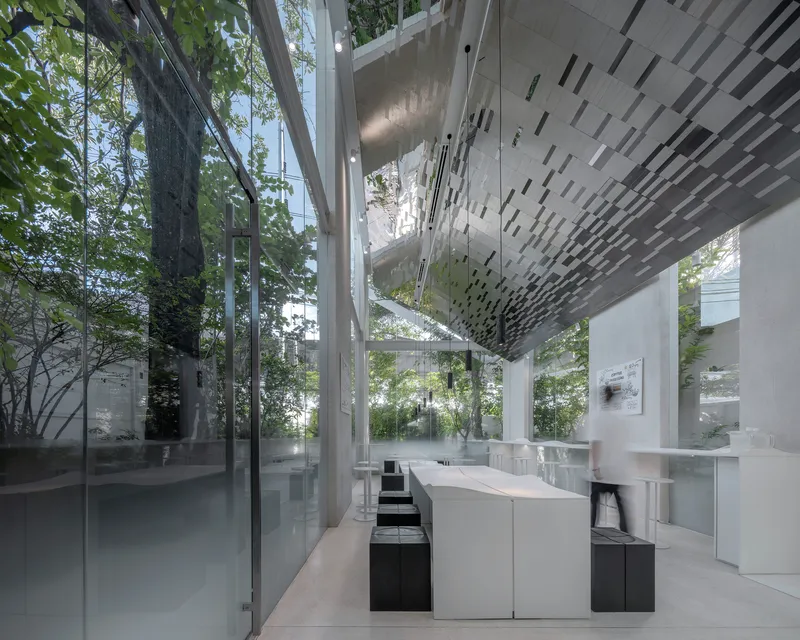
IDIN's acronym stands for Integrating Design into Nature, and the café counters are where that motto gets most literal. The surfaces undulate with contoured profiles that reference the mountain ridges of northern Thailand, where NANA sources its beans. It's a poetic move, sure, but it also works spatially: the uneven topography of the counters creates natural zones for different interactions, from standing espresso pulls to seated slow-brew rituals.
One counter continues straight through a glass end wall to become an external table supported on mirrored legs, a detail that neatly captures the project's refusal to separate inside from outside. Reflective glass mosaics on the ceiling above the service zone bounce fragments of the exterior garden into the interior, adding a shimmer of green overhead that reinforces the immersive quality of the space.
Interior Atmosphere and the Reflective Ceiling
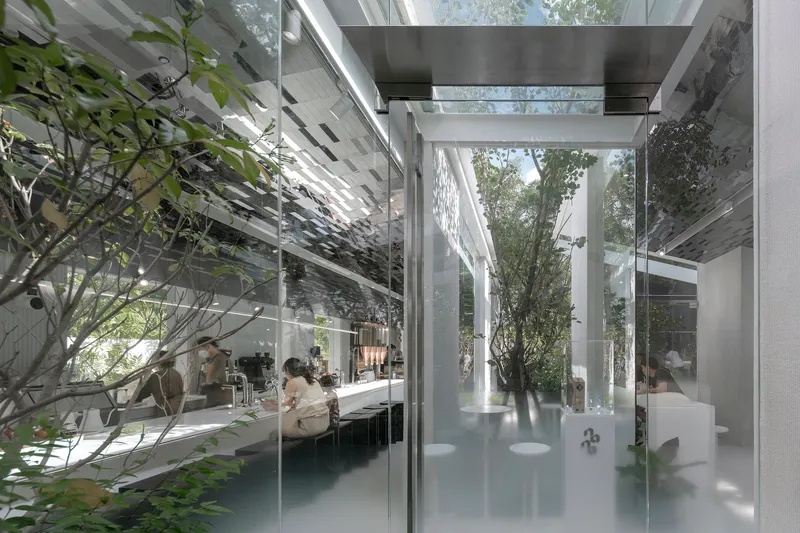


The palette inside is deliberately restrained: white surfaces, black stools, concrete, and glass. Against this monochrome canvas, the ceiling treatment becomes the protagonist. Panels of reflective glass mosaic fragment the tree canopy overhead into a kaleidoscopic pattern, pulling nature into the room without the weight of actual planting. It's a controlled illusion, and it works because the surrounding reality of actual trees visible through floor-to-ceiling glazing keeps it honest.
Seating is arranged to prioritize views outward rather than inward. Counters wrap the perimeter of rooms so that every seat faces greenery, and the long communal tables in the glass-enclosed courtyard zone place visitors directly alongside trees that grow through openings in the structure. The effect is closer to a greenhouse than a café, which is exactly the intention.
The Outdoor Rooms


Some of the best seating in the café isn't inside at all. Elevated concrete walkways flanked by planted beds lead to long tables set beneath the intersecting beam structure of the canopy extensions. At dusk, the white frames glow against the darkening foliage, and the space takes on a quality that's more garden pavilion than commercial F&B. These outdoor rooms carry no air conditioning, no artificial ceiling treatment, just structure, planting, and the sound of traffic reduced to a murmur behind the green wall of trees.
The courtyard with its multi-trunked tree growing through openings in the white walls is the project's most photogenic moment, but it also reveals the structural logic at work. The buildings yield to the trees, not the other way around. When a trunk needed space, the wall stepped aside.
Glass Corridors as Spatial Connectors

Small glass link corridors stitch the three seating pavilions together, creating a circulation loop that constantly alternates between enclosed and exposed conditions. Walking through the café, you pass from air-conditioned interior to glass corridor to covered terrace to open garden and back again. It's a sequence borrowed more from resort planning than typical retail design, and it ensures that the 250 square meters feel considerably larger than they are.
Plans and Drawings


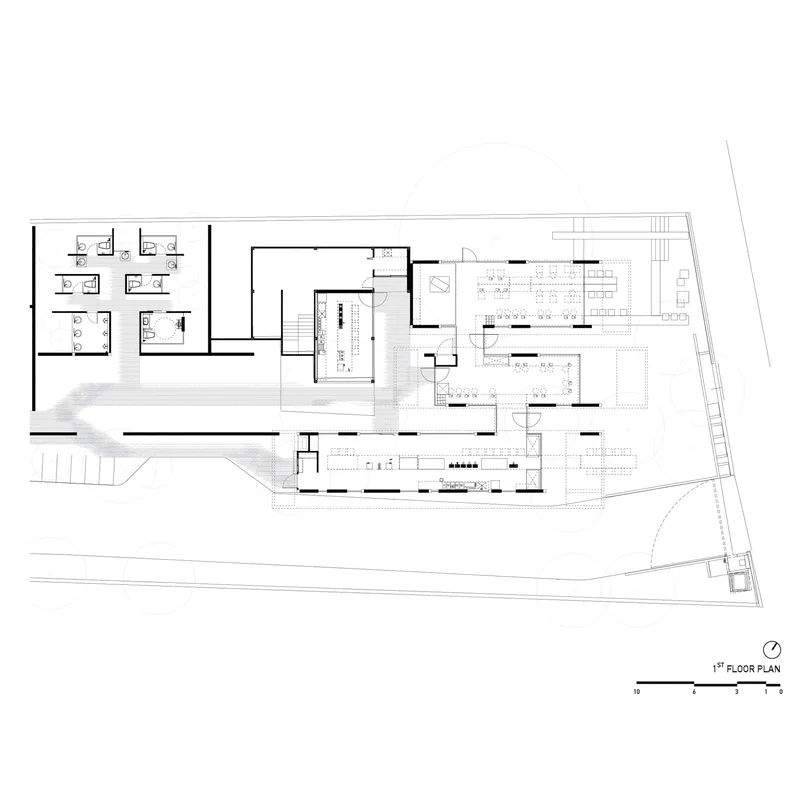
The axonometric diagrams reveal IDIN's process clearly: the existing building provides a spine, and three new volumes extend from it in parallel, with landscape filling every interstitial space. The isometric counter studies, with red figures indicating where users congregate, show how wrapping the counter around the room perimeter distributes visitors evenly rather than concentrating them at a single bar. The site plan confirms the challenge: a narrow, angled lot pressed against a major road, with parking consuming the front portion. Everything interesting happens behind that buffer.
The floor plan shows how the curved outdoor terrace at the rear resolves the angular geometry of the lot, while the kitchen and office spaces are tucked into the modified existing building where ceiling heights are more conventional. The new pavilions are given over entirely to the customer experience, free of back-of-house clutter.
Why This Project Matters
Coffee shops are among the most designed typologies on earth right now, and most of them rely on the same playbook: raw concrete, terrazzo, warm wood accents, an Instagram wall. NANA Coffee Roasters Bangna sidesteps that formula entirely by making the landscape the design. The architecture serves as a scaffold for nature rather than a container decorated with it. That distinction matters. It produces a space that changes with the time of day, the season, and the weather, something no amount of curated material palette can achieve.
More practically, the project demonstrates how to intervene in an existing structure without erasing it. The old gabled house remains legible, its black steelwork contrasting with the white frames of the new pavilions. IDIN and TROP prove that a 250-square-meter café on a compromised site next to a highway can become a genuine destination, not through spectacle but through the patient integration of building and ground. The trees were already there. The architects just figured out how to sit among them.
NANA Coffee Roasters Bangna, designed by IDIN Architects with landscape by TROP: Terrains + Open Space. Bang Na, Bangkok, Thailand. 250 m². Completed 2022. Photography by W-Workspace.
About the Studio
Share Your Own Work on uni.xyz
If projects like this are the kind of work you want to make, uni.xyz is a place to publish your own, find collaborators, and enter design competitions.




Popular Articles
Popular articles from the community

EW PARK: Sustainable Architecture Reimagines the Future of Urban Parking
EW PARK reimagines city parking as a modular wooden tower combining automation, solar energy, electric mobility, and adaptable urban design.
AL-JANNAH: Sustainable Architecture and Permaculture for Afghan Widows
AL-JANNAH uses sustainable architecture and permaculture to create resilient oasis of housing, learning, work and renewal for Afghan widows.

Conexión: Biophilic Design Reimagines High-Rise Living in Hong Kong
Conexión reimagines high-rise living in Hong Kong through biophilic design, green facades, shared spaces, daylight, water and nature within.

The Musturak Paradise: Senior Living Architecture for a Connected Future in Temara, Morocco
The Musturak Paradise reimagines senior living architecture in Temara via private homes, social spaces, culture, community, and shared care.


Similar Reads
You might also enjoy these articles

Bao Huynh Watercolor Atelier: A Serene Art Retreat in Hội An
Bao Huynh Watercolor Atelier in Hội An blends multifunctional art spaces, sustainable design, local materials, and family-friendly living in a serene environment.

Atelier Macri Concept Store Interior Design by CASE-REAL
Atelier Macri store features a "ko" counter, walnut wood details, cork displays, blending retail, gallery, and seamless customer experiences.

Manuel Vargas Izquierdo Stadium and High-Performance Sports Center: Architectural Excellence in Jalpa de Méndez
The Manuel Vargas Izquierdo Stadium blends sustainable design, inclusive sports facilities, and cultural-inspired architecture, revitalizing Jalpa de Méndez’s public spaces.

KAKR Buluh Awar Hall: Revitalizing Community and Ecology Through Bamboo Architecture
Community built bamboo hall revitalizes Buluh Awar village, empowering youth, restoring ecology, celebrating vernacular craftsmanship through sustainable architecture and culture.

Comments (0)
Please login or sign up to add comments
No comments yet. Be the first to comment!