
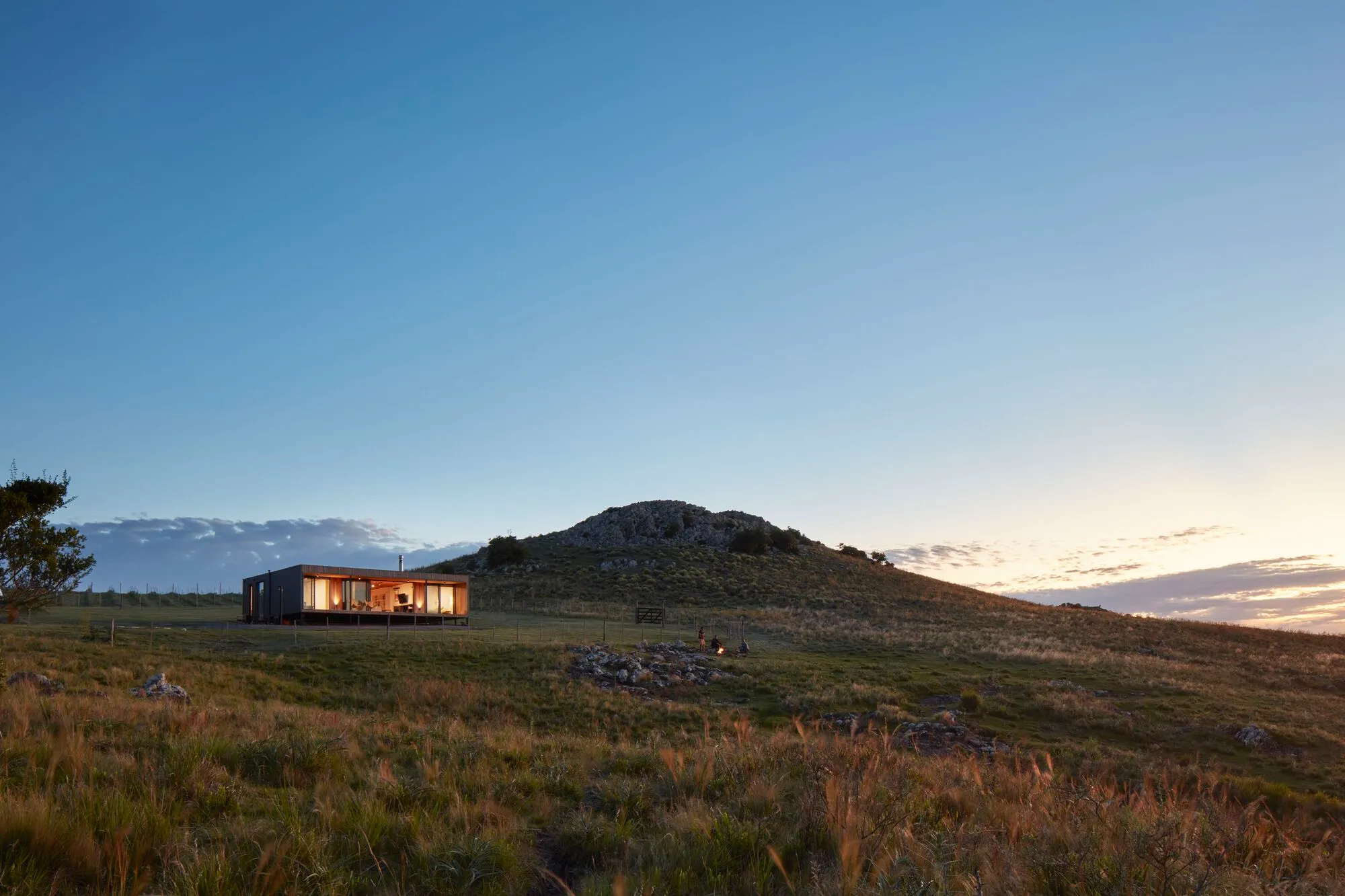
iHouse Estudio Prefabricates a Steel-Framed Home and Drops It onto Uruguay's Rocky Sierra
House Mael is a 124-square-meter prefabricated dwelling anchored to the rugged slopes of Sierra de Minas, framing open pasture and low mountains.


Building a permanent home on the rocky, sloping terrain of Uruguay's Sierra de Minas is not a straightforward exercise. Traditional construction methods struggle with the rugged ground, the remoteness, and the exposure. iHouse estudio, led by Andrés García and Marcelo Mederos, sidestepped these problems entirely by fabricating House Mael offsite in their own plant facility and transporting the finished modules to the hillside. The result is a 124-square-meter galvanized steel-frame volume that appears to have simply landed on the landscape, hovering over boulders and dry grass like an observation instrument pointed at the horizon.
What makes this project genuinely interesting is the tension between its industrial means and its deeply site-specific intentions. The house was designed for a couple relocating from city to countryside, and the brief asked the architects to merge comfort, work, and nature into a single daily rhythm. Rather than imposing a domestic object on the terrain, iHouse treated the house as a permeable frame: a low, horizontal bar that continues the lines of the low mountains behind it and opens almost entirely to the pastures below. The building is meant to be lived from outside in, and its covered gallery cantilevers over the slope to make that idea literal.
A Volume That Reads the Terrain

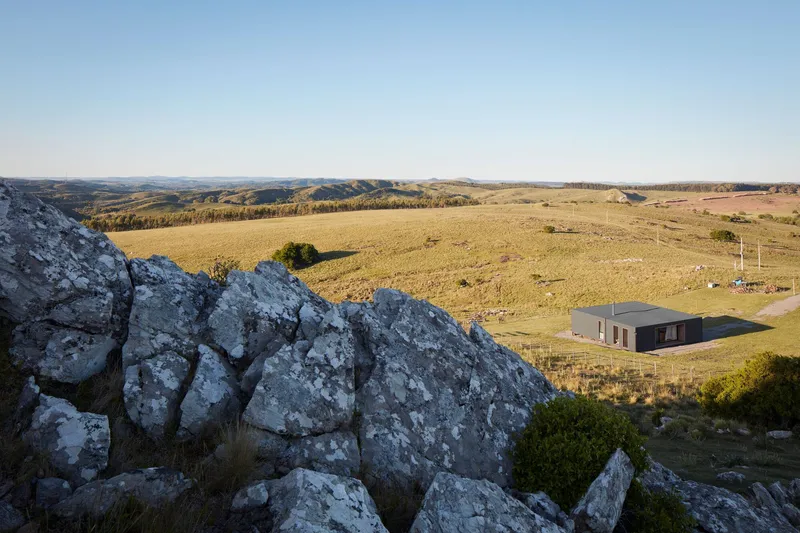
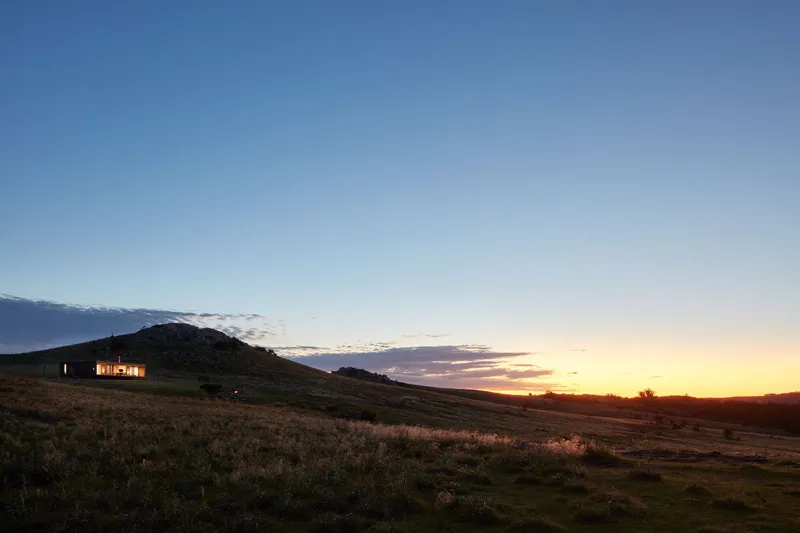
From a distance, House Mael registers as a dark, corrugated bar resting on a rocky outcrop, its horizontality echoing the rolling ridgeline behind it. The architects describe the volume as a "gazer interpreting the horizontality of the landscape," and the dusk photographs make the analogy clear: the house continues the slope's upper contour without interrupting it, holding its roofline just below the crest so that the structure reads as geology rather than architecture.
The siting is deliberate. By embedding the house at the higher level of the terrain, iHouse keeps the floor plate close to grade on the uphill side while allowing the downhill edge to float free. The rocky, mountainous soil that would torment a conventional foundation becomes a design asset: the house barely touches the ground, and the boulders and native grasses continue beneath and around it uninterrupted.
Corrugated Skin, Precise Openings
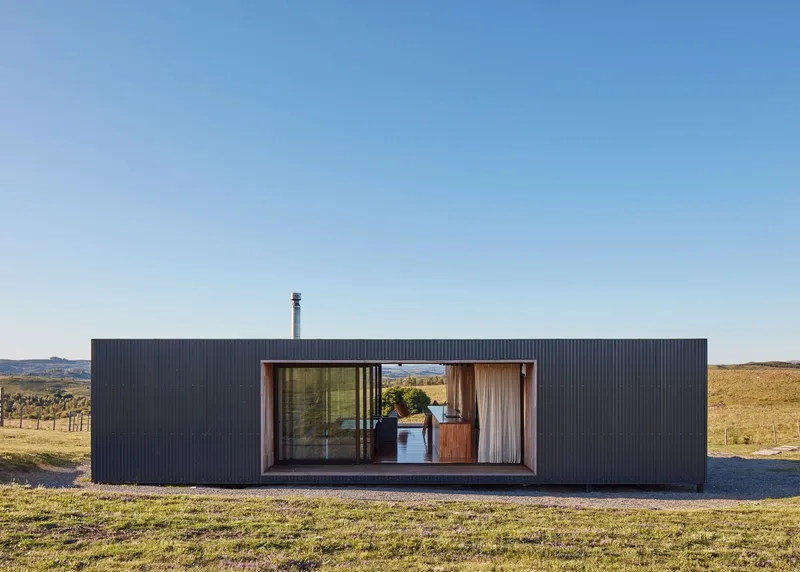

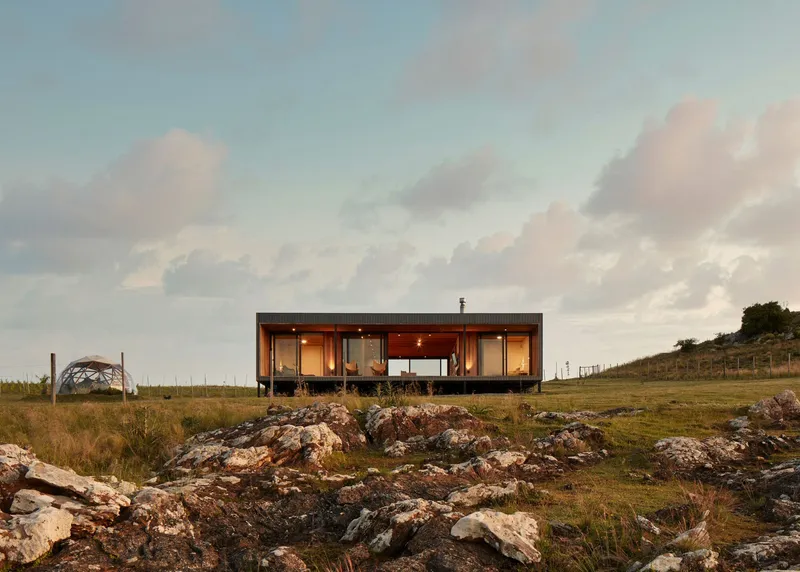
The exterior cladding is vertical corrugated metal, a material choice that is functional before it is aesthetic. The galvanized steel frame underneath determines the structural logic; the corrugated panels wrap it tightly, offering weather resistance and a degree of thermal mass without adding weight to a building that had to be trucked to an isolated hillside. The dark tone absorbs into the landscape at dusk and reads as a crisp, abstract form in daylight.
Where the cladding opens, it opens decisively. A central timber-framed glazed bay on the front elevation acts as the primary threshold between gravel terrace and interior. On the long facade facing the pasture, glass runs nearly unbroken from floor to ceiling, turning the living space into a vitrine. The restraint on the closed elevations makes the transparency on the open ones feel earned rather than gratuitous.
The Gallery as Extension
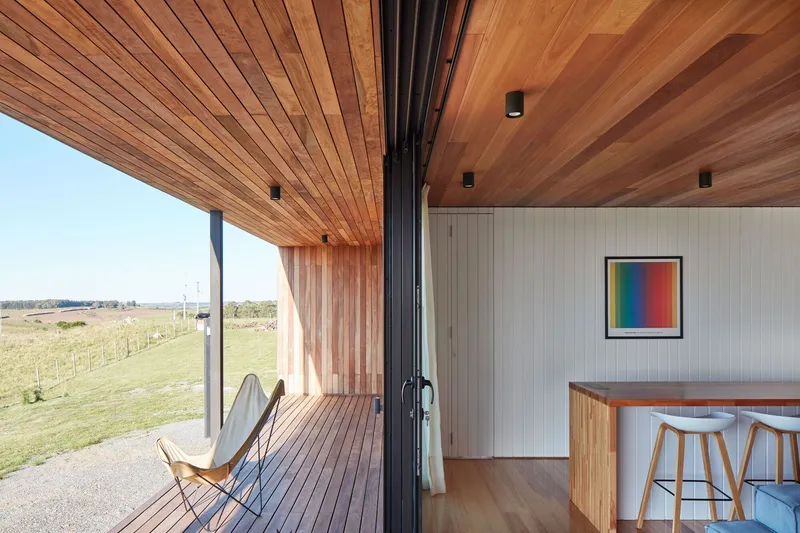
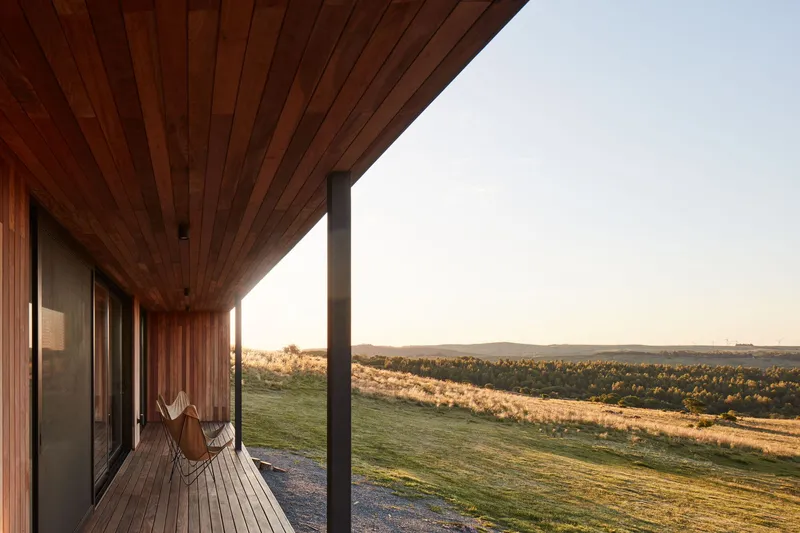
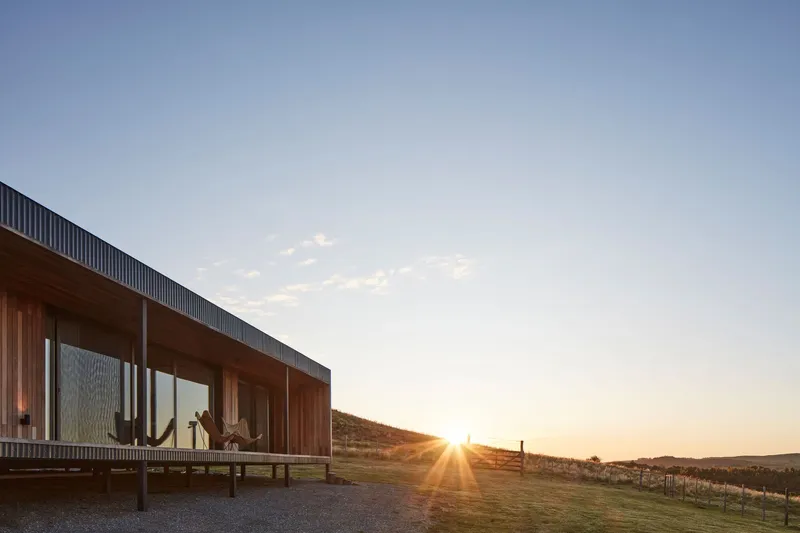
A covered timber deck runs along the view-facing elevation, acting as an outdoor room that cantilevers over the falling terrain. Folding glass doors collapse the boundary between this gallery and the living space, and a slatted timber ceiling overhead filters light while maintaining a sense of shelter. A single steel column marks the structural logic without cluttering the view.
The gallery is the key move in iHouse's argument that the house should be lived from outside toward inside. It extends the usable area of a compact 124-square-meter plan without adding conditioned space, and it frames the distant hills with the precision of a camera viewfinder. At golden hour, the low sun rakes across the timber deck and catches the corrugated parapet above, turning the outdoor space into the most desirable room in the house.
Timber-Lined Interior and Radiating Ceiling
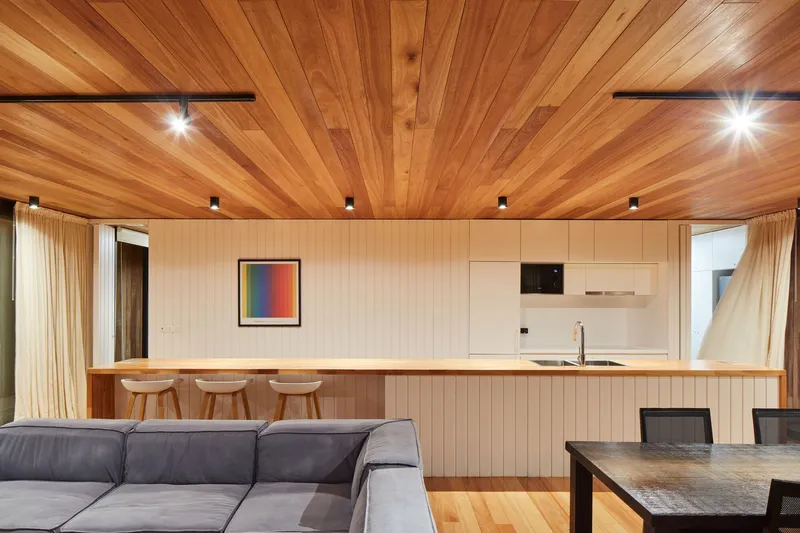
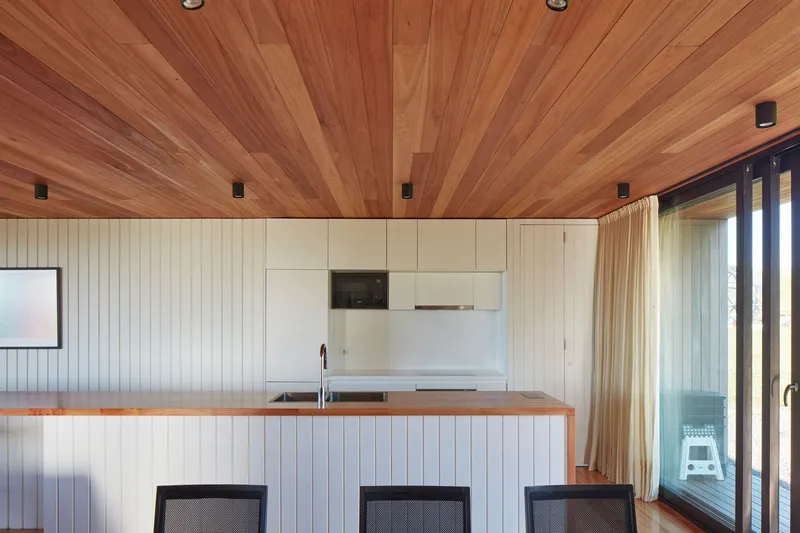
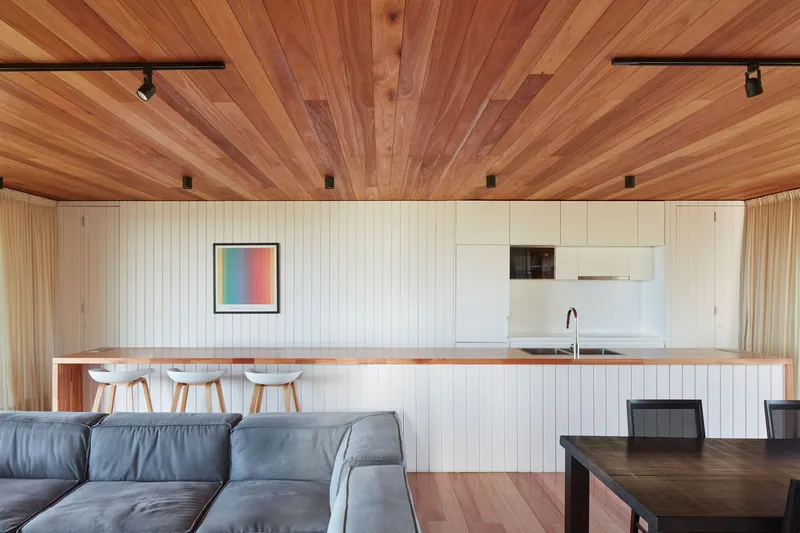
Inside, the material palette shifts from industrial to warm. Timber flooring and ceiling planks run throughout, and the ceiling boards radiate outward from a central spine beam, creating a visual rhythm that draws the eye toward the glazed walls. Black track lighting mounted to steel rails follows the same lines, keeping the services legible and integrated rather than hidden.
The kitchen occupies one side of the open-plan living zone, its counter integrated beneath the radiating ceiling so that cooking, working, and looking out at the landscape all happen within the same spatial volume. A vertical-panelled wall behind the kitchen provides a solid backdrop, anchoring the room against the expansive glazing opposite. The palette is deliberately limited: timber, black steel, corrugated metal. Nothing competes with the view.
Framing the View from Every Room

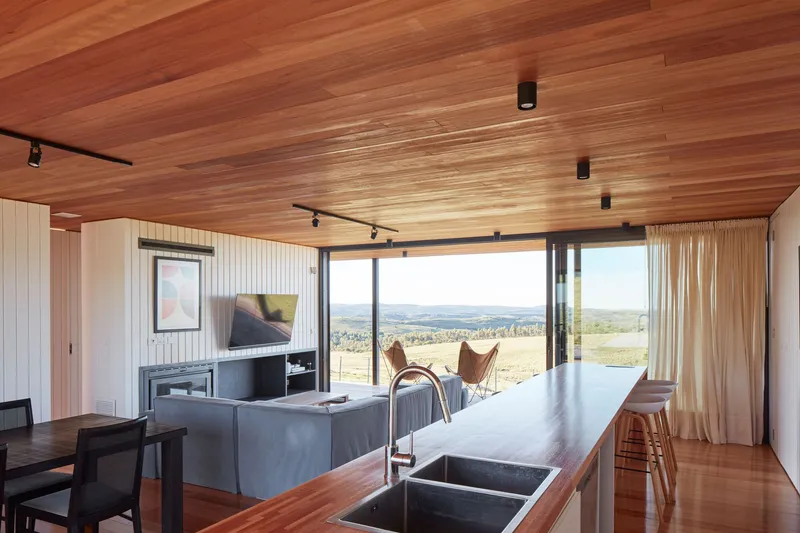
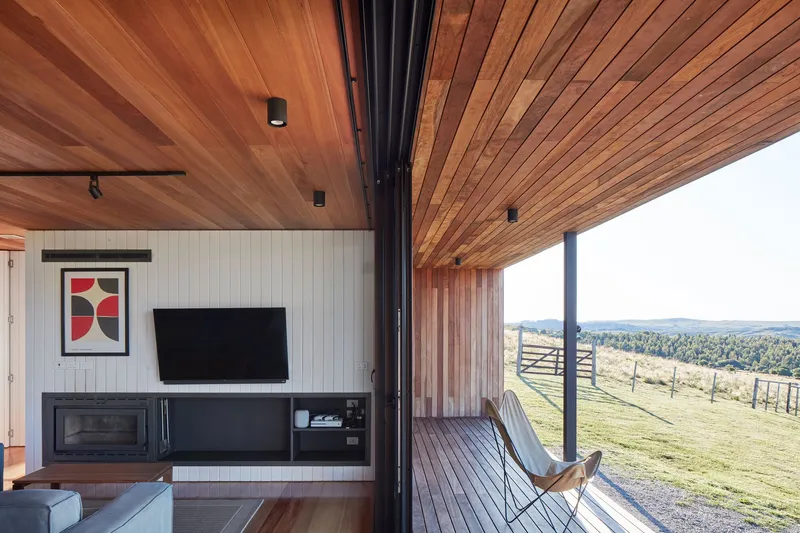
The architects organized the plan so that the main views are framed from every programmatic zone. Two solid blocks at each end of the rectangular volume contain the bedrooms, partitioning the plan while keeping the central living space open and through-connected. Corner windows in the private rooms offer oblique views across the fenced pasture and distant hills, ensuring that even the most enclosed spaces maintain contact with the landscape.
The open-plan living and kitchen area gets the most generous glazing, with full-height glass on the long wall turning the rolling farmland into a panoramic backdrop. The spatial sequence is simple but effective: solid, private rooms at the edges compress the experience, then the central volume releases outward through glass toward the horizon.
Dusk and the Glowing Box
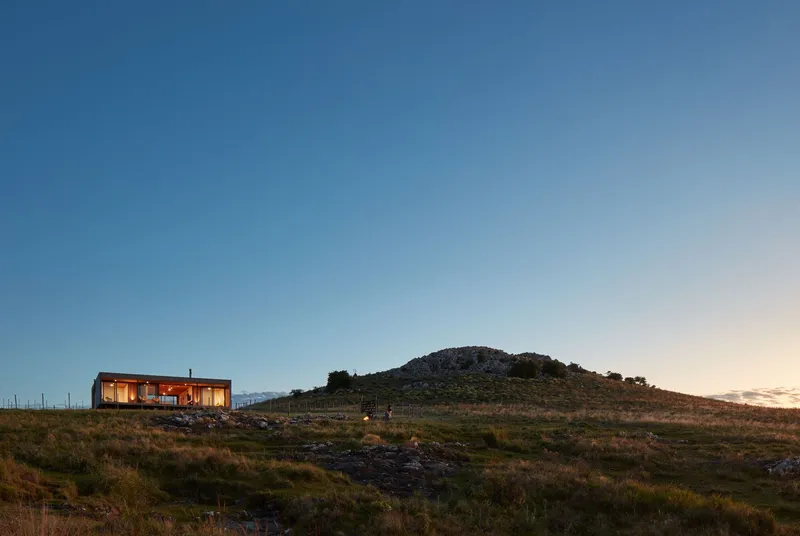
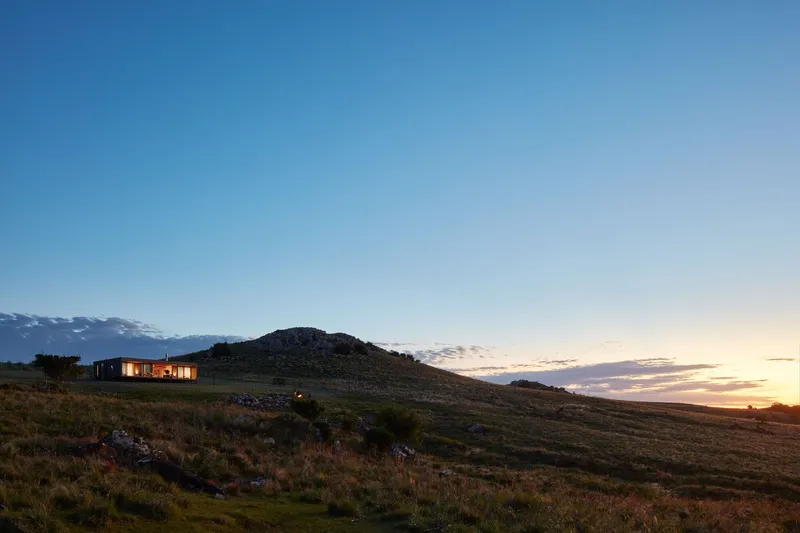
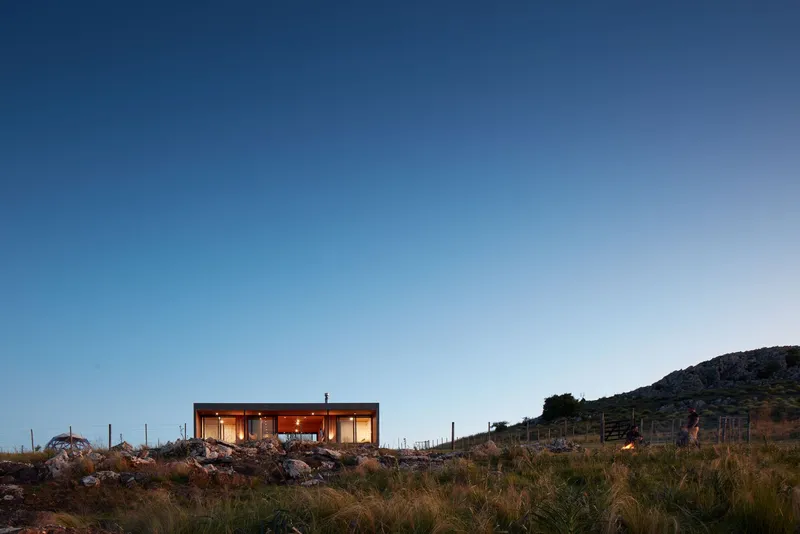
The twilight photographs reveal something the daytime views do not: with interior lights on and the sky still holding color, House Mael becomes a luminous object set against the dark mass of the hillside. The corrugated metal disappears into shadow, and the glazed facades glow, making the house appear weightless. Native grasses and limestone boulders in the foreground ground the composition, reminding us that this is not a gallery installation but a home embedded in a working landscape.
There is a quiet confidence in these images. The house does not shout; it simply occupies its position on the slope and lets the landscape do the work. The prefabricated construction makes this restraint possible: because the building arrived essentially finished, the site disturbance was minimal, and the relationship between structure and terrain feels like coexistence rather than conquest.
Plans and Drawings
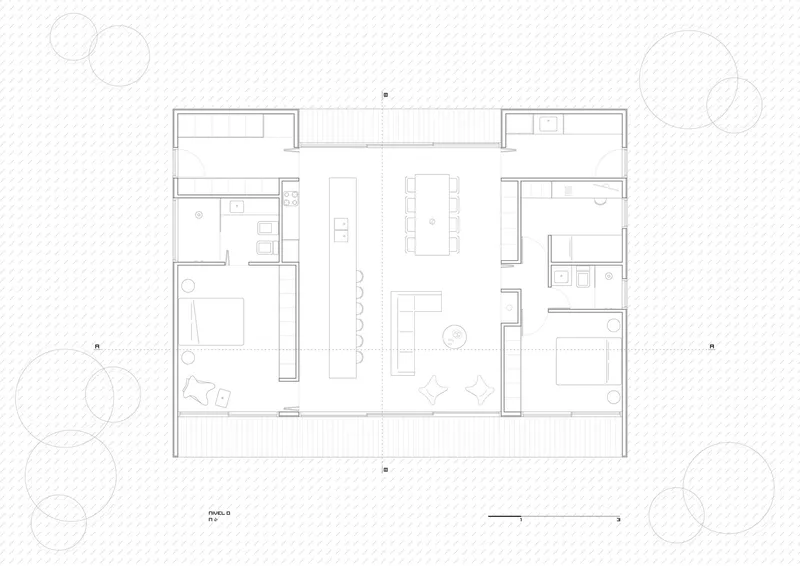
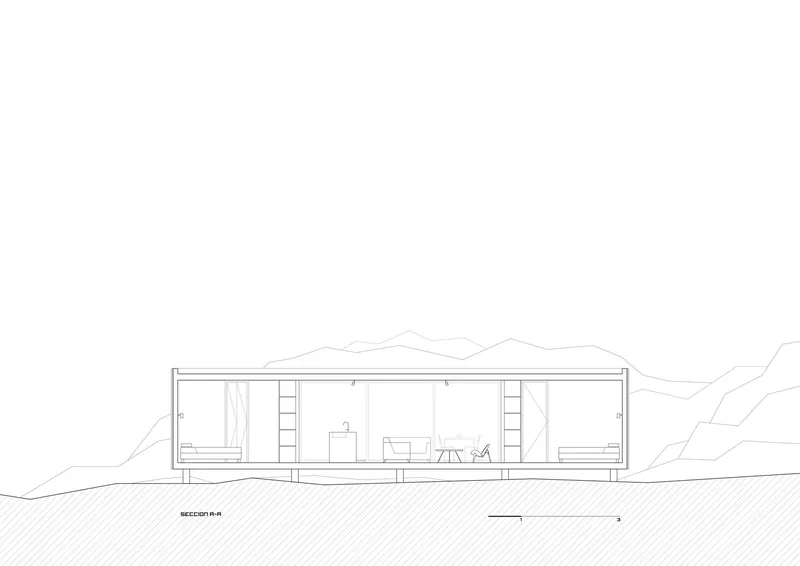
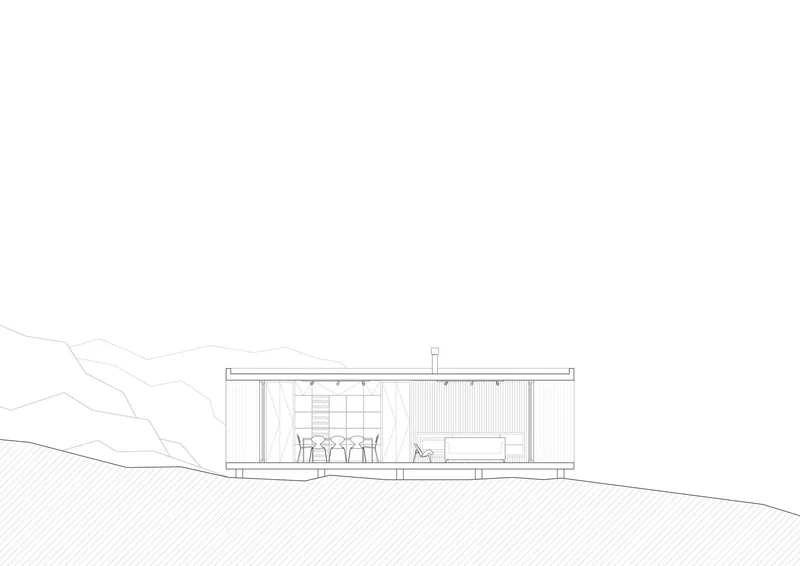
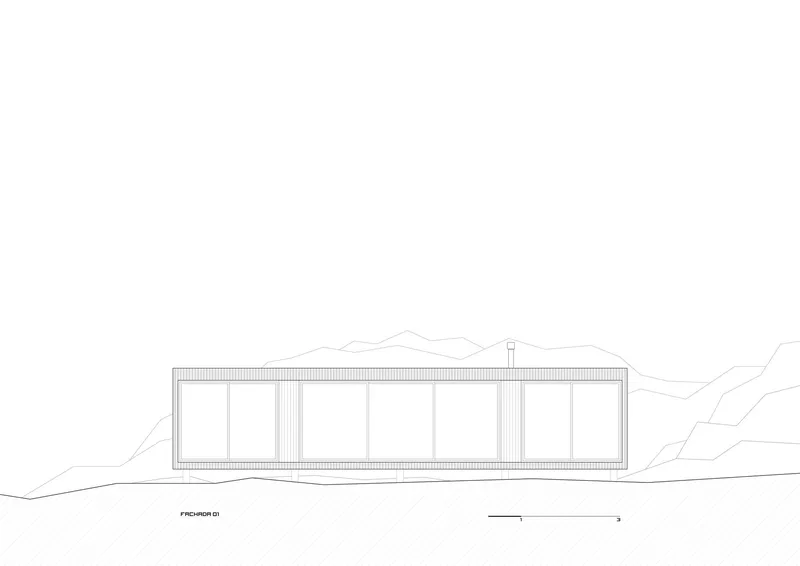
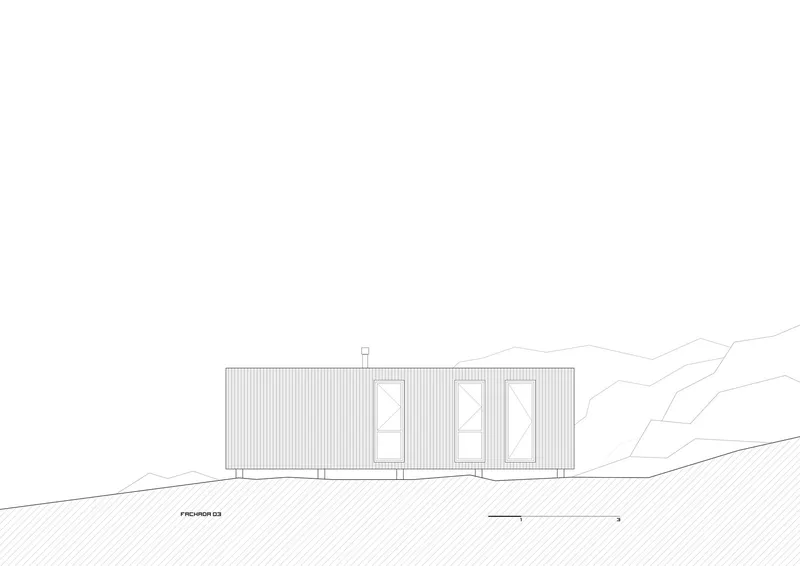


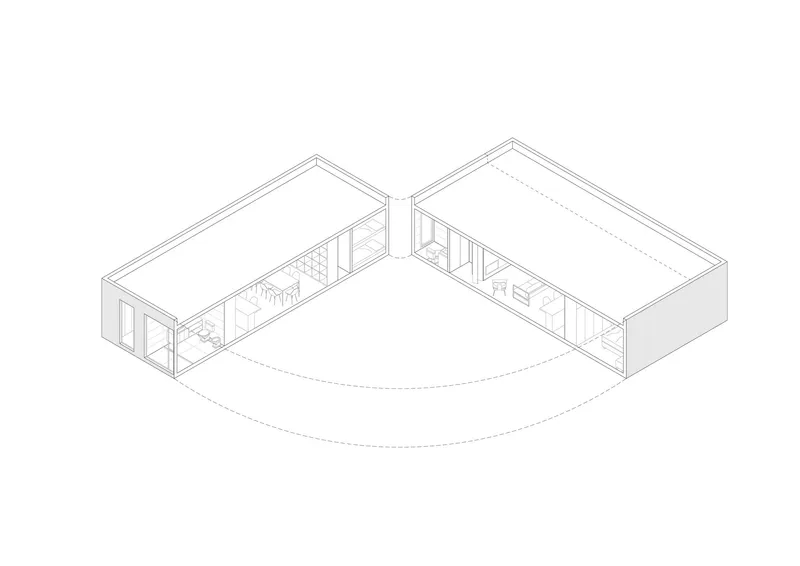
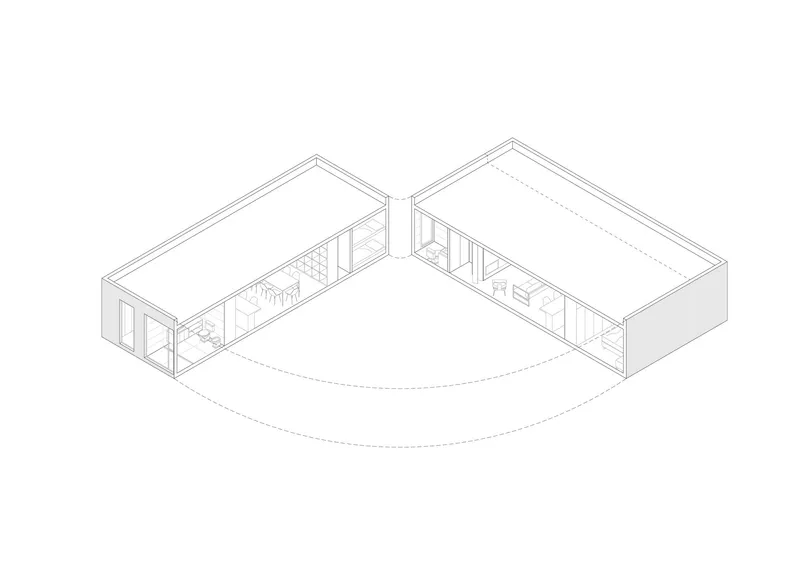
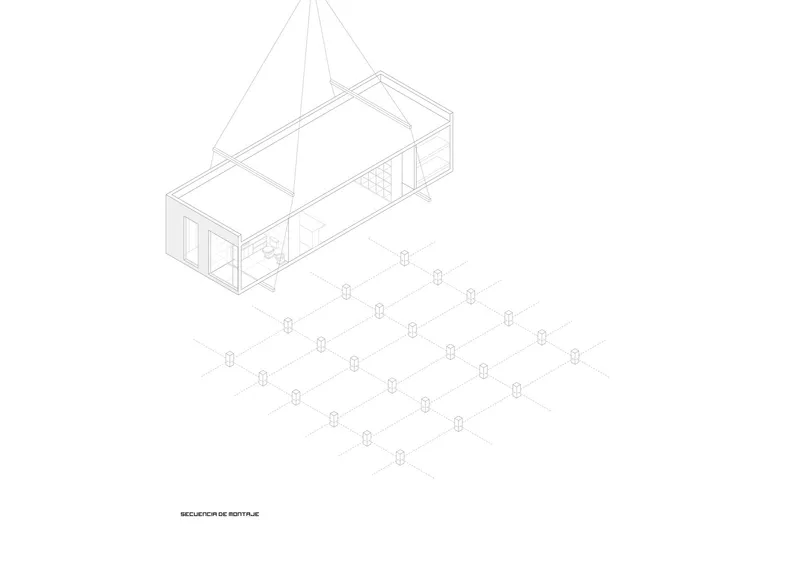
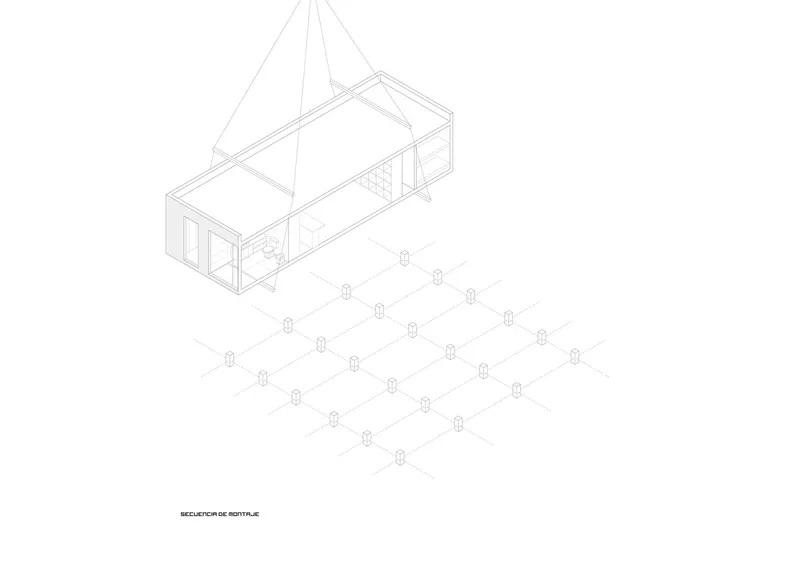


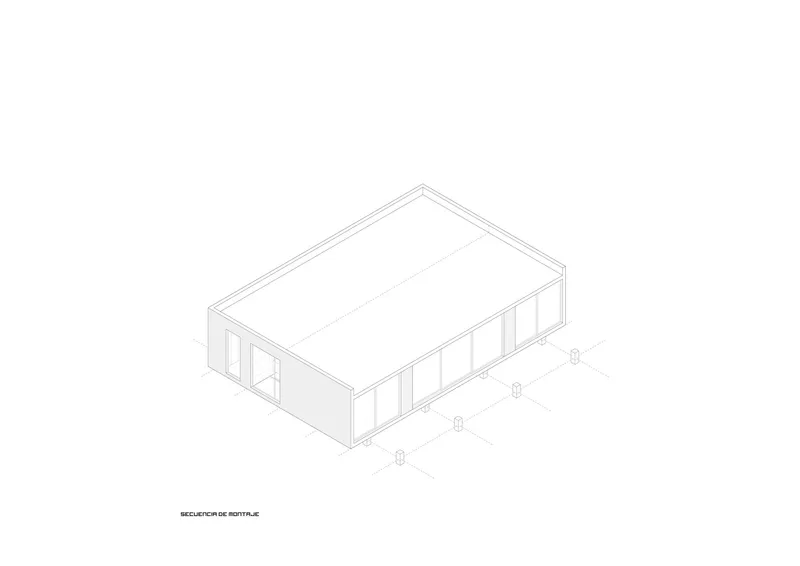
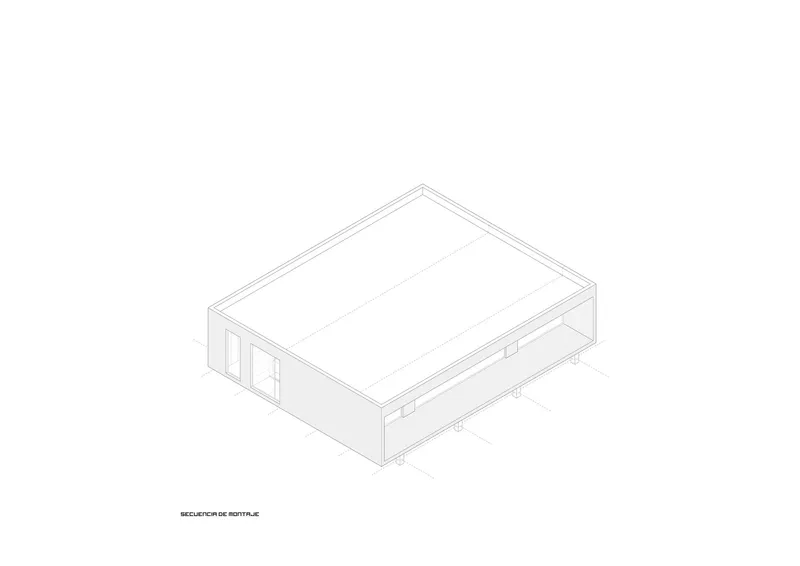
The floor plan confirms the straightforward parti: a single rectangular volume divided into three zones, with bedrooms at each end and an open living, kitchen, and dining area in the center. The section drawing reveals how the flat roof sits just above the slope's crest, embedding the house into the terrain without excavation. Elevation drawings show the interplay between opaque corrugated panels and generous glazed bays, while the exploded axonometric diagram is the most telling drawing of all: it illustrates the roof structure lifting away from the modular base, which itself sits on a point-loaded foundation grid. This is the prefabrication logic made visible, each layer discrete and transportable.
The isometric sequence walks through the construction narrative: foundation points set into rocky soil, a rectangular steel-frame volume assembled, glazed facades inserted, a deck platform extended on one side, and finally the whole assembly rigged and lifted into position. These drawings are not just representational; they are an instruction manual for a building method that iHouse has refined as a practice-wide approach to difficult sites.
Why This Project Matters
House Mael is a small project, 124 square meters for two people, but it tackles a problem that is only growing more relevant: how to build well in remote, ecologically sensitive, and topographically challenging sites without the environmental and logistical costs of traditional construction. By fabricating the house offsite and minimizing ground contact, iHouse estudio turns prefabrication from a cost-saving shortcut into a genuine design strategy. The rocky, sloping terrain that would have driven up the budget and complexity of a poured-concrete house becomes an asset when the building barely needs to touch it.
The larger lesson here is about proportion between ambition and means. The architects did not try to make a heroic gesture on the hillside. They made a quiet, well-proportioned box with good materials, precise openings, and an outdoor room that extends the footprint into the landscape. The timber ceiling, the cantilevered gallery, the radiating planks: these are modest moves executed with care. For a couple reinventing their daily life in the countryside, that discipline is exactly right. The house does not perform wildness or rusticity. It simply sits on the hill, frames what is already there, and gets out of the way.
House Mael by iHouse estudio (Andrés García, Marcelo Mederos, with Agustín Sica, Luciana Cano, and Lucas Toledo). Sierra de Minas, Uruguay. 124 m². Completed 2021. Photography by Aldo Lanzi.
About the Studio
Share Your Own Work on uni.xyz
If projects like this are the kind of work you want to make, uni.xyz is a place to publish your own, find collaborators, and enter design competitions.



Popular Articles
Popular articles from the community


Riyadh For All: Intergenerational Urban Design for Active Aging in Rabat
Riyadh For All reimagines urban design in Rabat with intergenerational co-living, adaptive courtyards, and Moroccan cultural exchange today.

Co-life: Sustainable Architecture for Age-Friendly Community Living
Co-life reimagines sustainable architecture for seniors through courtyards, rammed earth, shared gardens, and spaces designed for belonging.

Co-Life: Senior Housing Design That Reconnects Older Adults With the City
Co-Life reimagines senior housing design through healing gardens, shared streets, workshops, and a sustainable community across generations.

The Earth Pod: 3D Printed Homes for Resilient Refugee Communities
The Earth Pod reimagines refugee housing through 3D printed homes made from clay, combining resilience, self-sufficiency, and rapid shelter.

Similar Reads
You might also enjoy these articles

Bao Huynh Watercolor Atelier: A Serene Art Retreat in Hội An
Bao Huynh Watercolor Atelier in Hội An blends multifunctional art spaces, sustainable design, local materials, and family-friendly living in a serene environment.

Atelier Macri Concept Store Interior Design by CASE-REAL
Atelier Macri store features a "ko" counter, walnut wood details, cork displays, blending retail, gallery, and seamless customer experiences.

Manuel Vargas Izquierdo Stadium and High-Performance Sports Center: Architectural Excellence in Jalpa de Méndez
The Manuel Vargas Izquierdo Stadium blends sustainable design, inclusive sports facilities, and cultural-inspired architecture, revitalizing Jalpa de Méndez’s public spaces.

KAKR Buluh Awar Hall: Revitalizing Community and Ecology Through Bamboo Architecture
Community built bamboo hall revitalizes Buluh Awar village, empowering youth, restoring ecology, celebrating vernacular craftsmanship through sustainable architecture and culture.

Explore Residential Building Competitions
Discover active competitions in this discipline


Challenge to design mud housing for contemporary communities


Challenge to reimagine the Iron Throne


Photograph architecture without architects


Illustrate the lost glory of Angkor Wat - Render Challenge
Comments (0)
Please login or sign up to add comments
No comments yet. Be the first to comment!