

IJboulevard Underwater Bike Parking by VenhoevenCS – A Landmark of Sustainable Urban Mobility in Amsterdam
IJboulevard Underwater Bike Parking transforms Amsterdam’s waterfront with 4,000 bicycle spaces, sustainable design, public boulevard, and nature-inclusive ecological features.


In February 2023, VenhoevenCS architecture+urbanism, together with Van Hattum en Blankevoort and DS Landschapsarchitecten, unveiled one of Amsterdam’s most innovative infrastructure projects — the IJboulevard Underwater Bike Parking. Strategically located next to Amsterdam Central Station, this pioneering facility redefines urban mobility by combining sustainable transport solutions, public space creation, and nature-inclusive design.
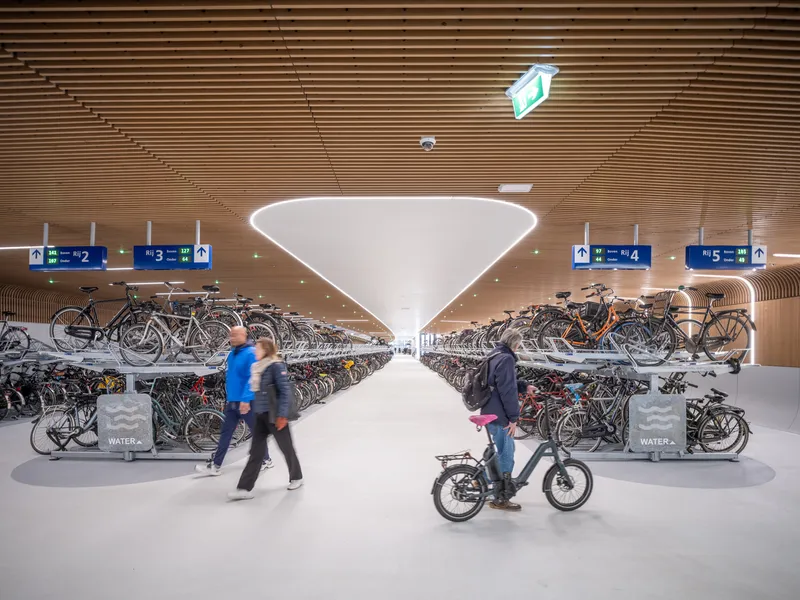

A Smart Urban Mobility Solution
The IJboulevard Underwater Bike Parking provides secure space for more than 4,000 bicycles, directly addressing the high demand for cycling infrastructure in one of Europe’s busiest transportation hubs. By relocating bicycle parking below water level, the project freed up over 6,000 m² of public space above ground, creating a new pedestrian-friendly boulevard that reconnects the city to the river IJ. This approach not only organizes chaotic urban flows of trains, trams, buses, taxis, and cyclists but also enhances the experience of both commuters and visitors.

A New Public Boulevard
The roof of the parking structure forms a vibrant new urban promenade along the waterfront. The IJboulevard features spacious walkways, seating areas, and panoramic river views, creating an inviting gathering space for residents and tourists alike. This transformation highlights Amsterdam’s commitment to prioritizing pedestrian comfort and sustainable transportation, while simultaneously enhancing the city’s waterfront identity.

Seamless Interior and Exterior Design
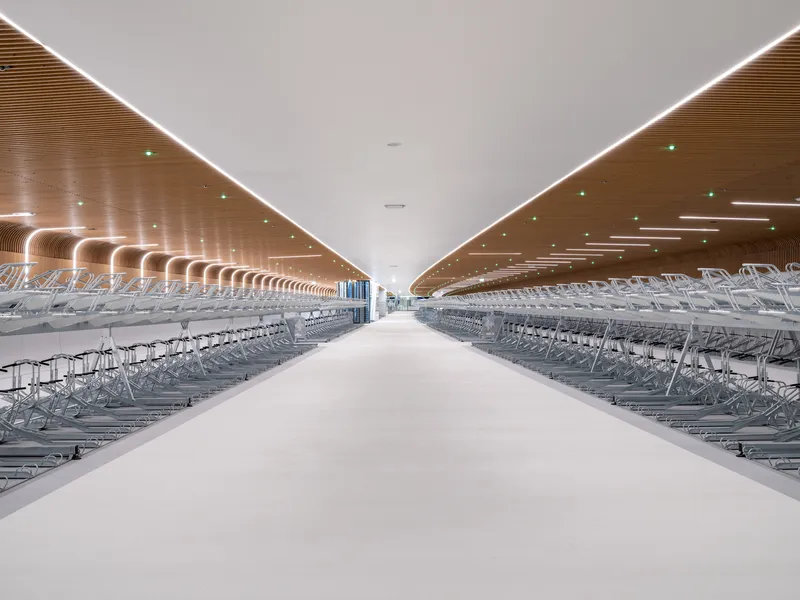
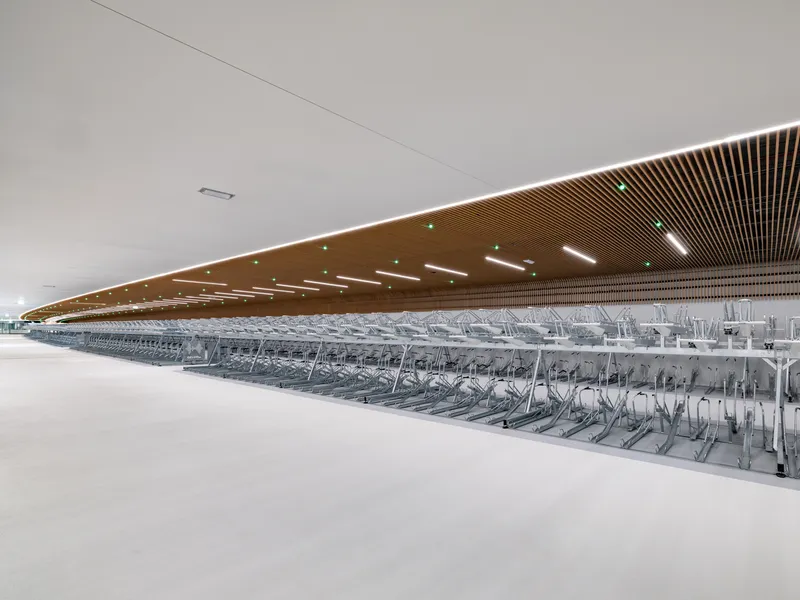
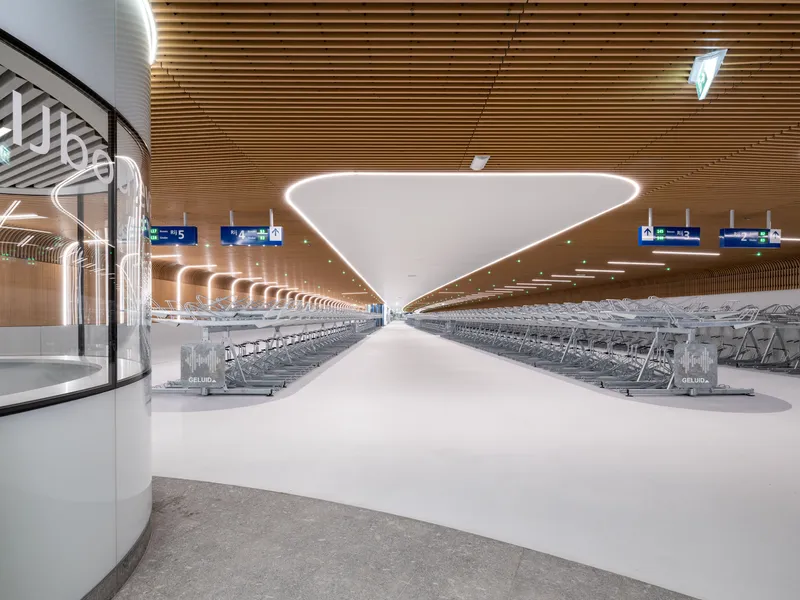
Inside, the bike parking facility offers a bright, safe, and user-friendly environment. The design embraces fluid lines and rounded architectural forms, softened with wooden wall finishes, warm lighting, and a calming palette that ensures intuitive wayfinding. The entrances, clad in dark gray natural stone, create a visual and material connection with the boulevard above. Large glass stairwells invite natural daylight into the interior, maintaining transparency and a sense of safety. Column-free spaces, clear sightlines, and a prominently located manager’s office contribute further to a secure and welcoming atmosphere for cyclists.
Sustainability and Nature-Inclusive Design
Beyond mobility, the IJboulevard is a benchmark for sustainable infrastructure design. The facility uses low-energy systems, durable materials, and innovative ecological strategies that extend into the surrounding water. Features such as bio huts, coconut mats, porous concrete, and wooden structures around underwater pile supports provide habitats for fish and aquatic plants, actively encouraging biodiversity within the river ecosystem. By integrating these nature-inclusive solutions, the project not only supports cycling culture but also contributes to the ecological health of the IJ River.
A Model for Future Cities
With its 4270 m² of built area, the IJboulevard Underwater Bike Parking demonstrates how urban infrastructure can go beyond utility to become public space, ecological intervention, and cultural landmark. By uniting mobility, sustainability, and placemaking, VenhoevenCS and their partners have set a new standard for climate-resilient and people-oriented city design.

All Photographs are works of Ossip van Duivenbode


Popular Articles
Popular articles from the community


Opera on the Sea: Driftwood Logic Shapes a Timber Opera House on Estonia's Coast
Trevor Orgill's opera house translates the entangled drift of floating timber into a civic building where wood, water, and music converge.

Manzana Morphosis: Stretching Barcelona's Grid into a Living Landscape for 2050
A radical reworking of the Eixample manzana turns density into a tool for generous public space, vertical ecology, and environmental performance.

Opera by the Sea Estonia: Three Shells Dissolving Architecture into Tallinn's Coastline
A winning opera house proposal replaces monumental form with interconnected shells that blur the boundary between building, park and Baltic Sea.
Extended Shell: Retrofitting Kolkata's Balconies as Living Urban Thresholds
A modular retrofit system recovers the social and environmental intelligence of Kolkata's historic verandas for contemporary Park Street residents.

Similar Reads
You might also enjoy these articles


Hodi-Mandai Geram
Project Function: Preservation and revitalization of the Intangible heritage and socio-spatial identity of the Hodi by Housing, Cultural Memory Center, Sacred Grove, landscape, local tourism economy


Olio Towers: A Mid-Rise for Performers That Fuses Housing, Rehearsal, and Stage
Located blocks from Houston's Theater District, this modular tower stacks living units around a central performance atrium.

Oasis: Modular Green Housing Carved into Dhaka's Urban Fabric
A shortlisted Plugin Housing entry reclaims unauthorized settlements in Dhaka with stepped concrete volumes, green roofs, and ventilation-driven design.

Black Hole: A Floating Megastructure for the Post-Physical Era
Emiliano Mazzarotto envisions a spherical, self-scaling arena where e-sports, digital hotels, and holographic stadiums replace traditional public space.

Explore Amsterdam Competitions
Discover active competitions in this discipline

Challenge to reimagine the Iron Throne

Photograph architecture without architects

Illustrate the lost glory of Angkor Wat - Render Challenge

Design challenge to reuse E-waste
Comments (0)
Please login or sign up to add comments
No comments yet. Be the first to comment!