
Iki Builds Stacks Rammed Earth Vaults into a Cascading Landscape Home on the Deccan Plateau
Aurva Illam in Telangana, India, rejects glass-and-marble luxury in favor of local soil, terracotta vaults, and passive cooling.


Sixty kilometers from the expanding edge of Hyderabad, on a corner plot bordered by roads on three sides and a public park to the west, Iki Builds has completed a house that argues forcefully against the imported glass-and-marble villas spreading across Telangana's peri-urban belt. Aurva Illam, a name bridging the Sanskrit Aurva (of the earth) and the Tamil Illam (home), is constructed almost entirely from soil excavated on site, local quarry waste, and terracotta tile. Architects Vamshidhar Reddy and Mounica Reddy treat these materials not as nostalgic gestures but as the raw logic of a building that achieves complete thermal comfort without mechanical cooling.
What makes the project genuinely interesting is its refusal to treat sustainability and spatial ambition as separate conversations. The stepped, vaulted volumes read from afar as a geological outcropping, a deliberate echo of the rugged rock formations that define the Deccan Plateau. Up close, the architecture resolves into a surprisingly sophisticated sequence of courtyards, double-height halls, and light cannons that stack passive ventilation strategies into every section. At 5,660 square feet, it is a comfortable family house. In attitude, it is a prototype for what a regional modern luxury could look like when it stops importing its aesthetic and starts digging it from the ground.
A Geological Silhouette
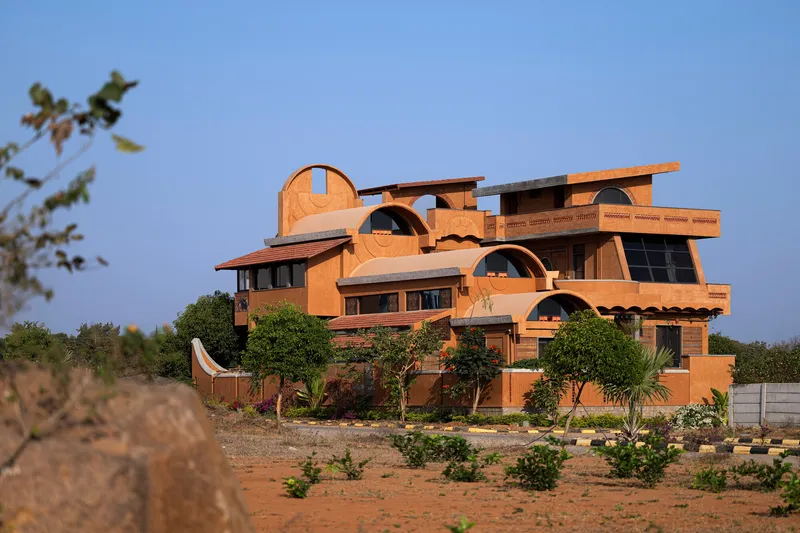
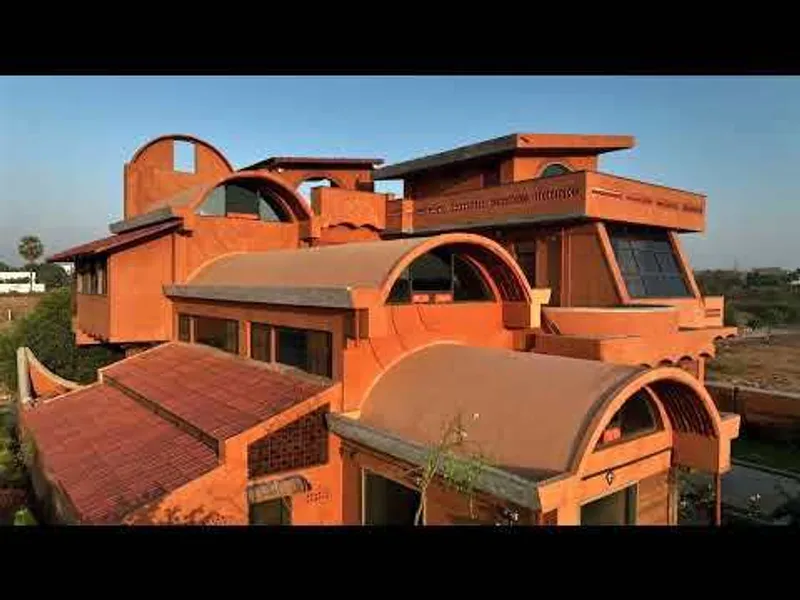
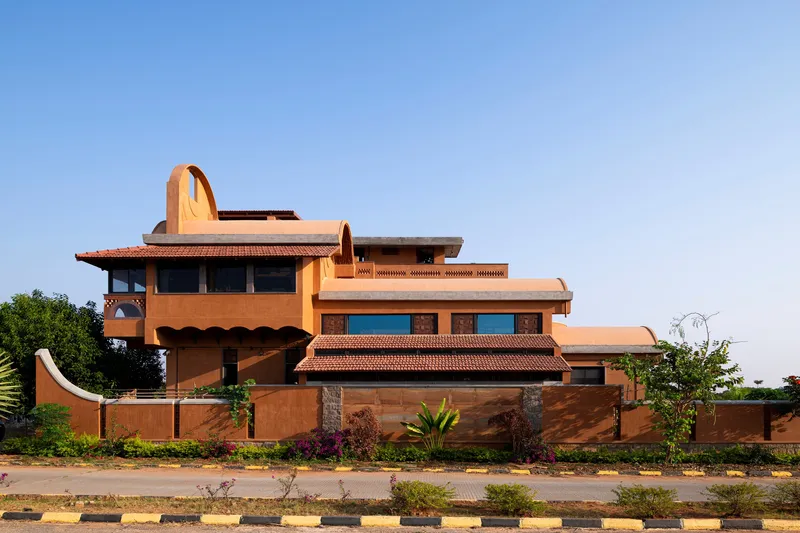
Seen from the adjacent planted fields at dusk, Aurva Illam presents itself as a series of ascending barrel vaults in terracotta tones, a silhouette that could be mistaken for a natural ridge line rather than a residential address. The massing is deliberate: each vault corresponds to a distinct room or zone inside, and the staggering creates terraces, roof gardens, and clerestory gaps that do serious environmental work. From the street, the terraced volumes step back with planted beds along the curb, softening the boundary between architecture and ground.
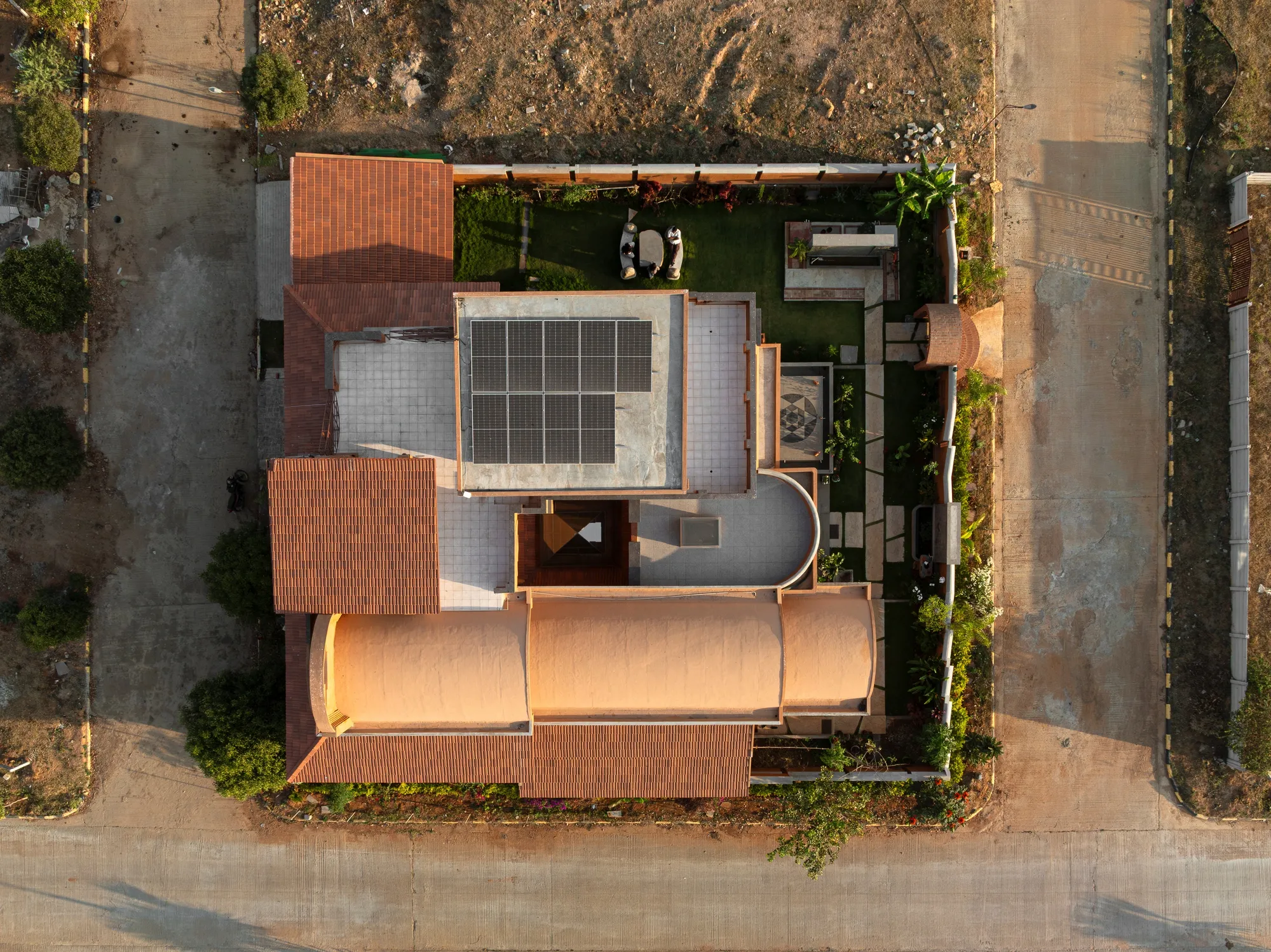
The aerial perspective confirms the strategy. Vaulted terracotta roof volumes cluster around a central courtyard, their curved profiles broken by flat canopy planes that provide shade for the upper terraces. The palette, a single spectrum from raw earth to fired tile, gives the building a material coherence that most contemporary houses in this region lack entirely.
Rammed Earth as Structure and Surface
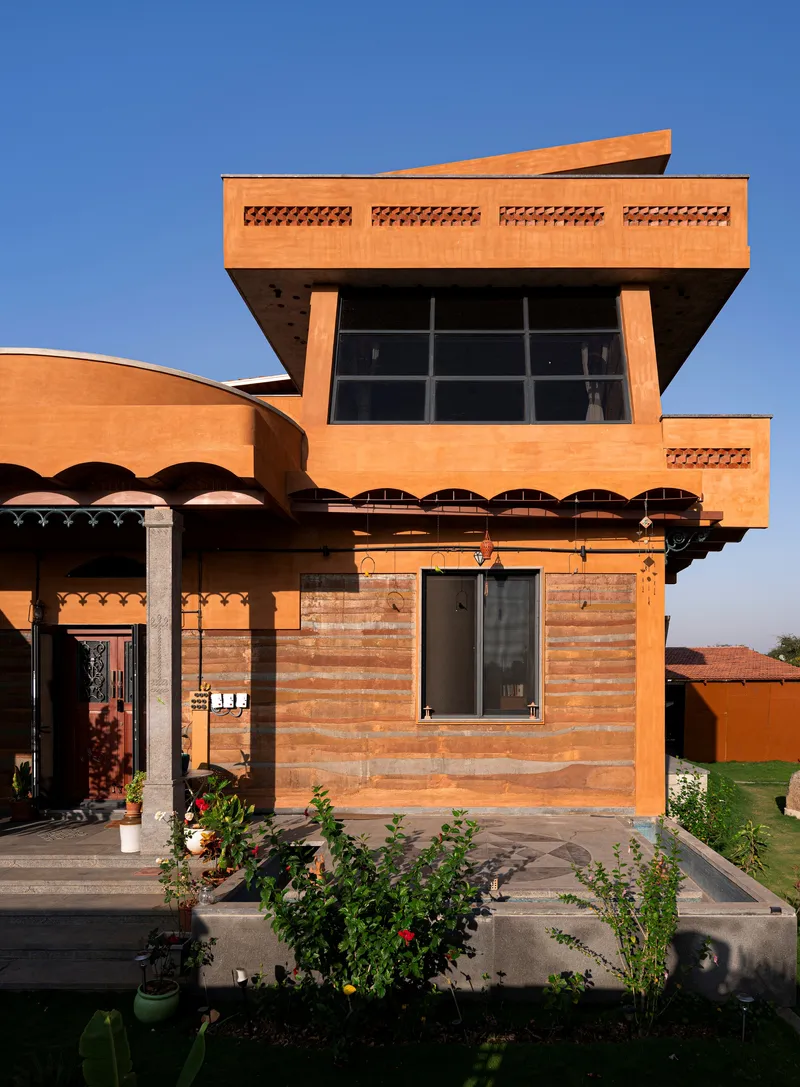
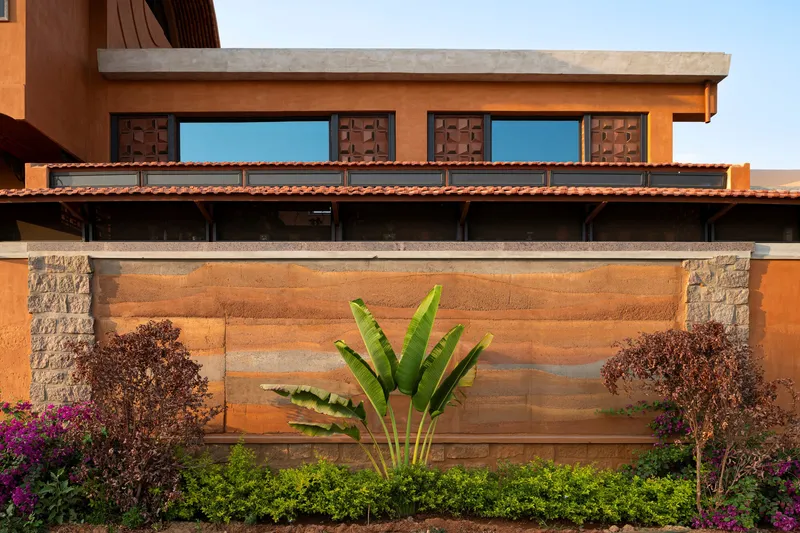
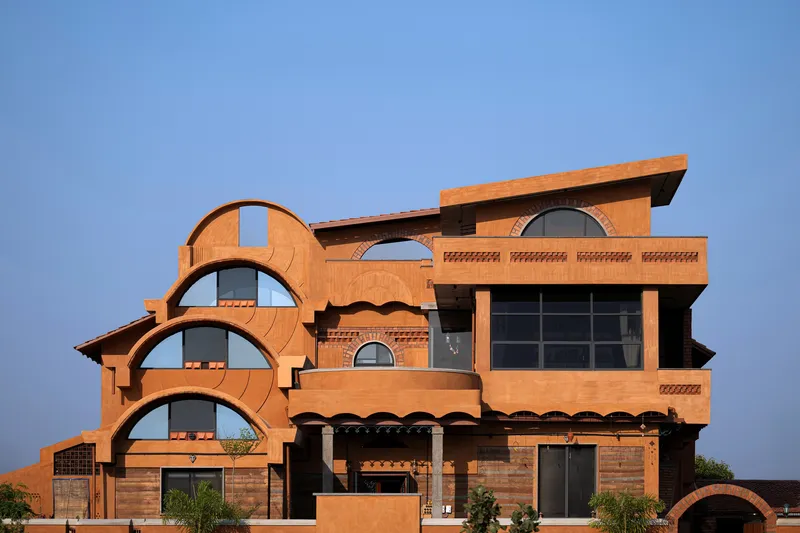
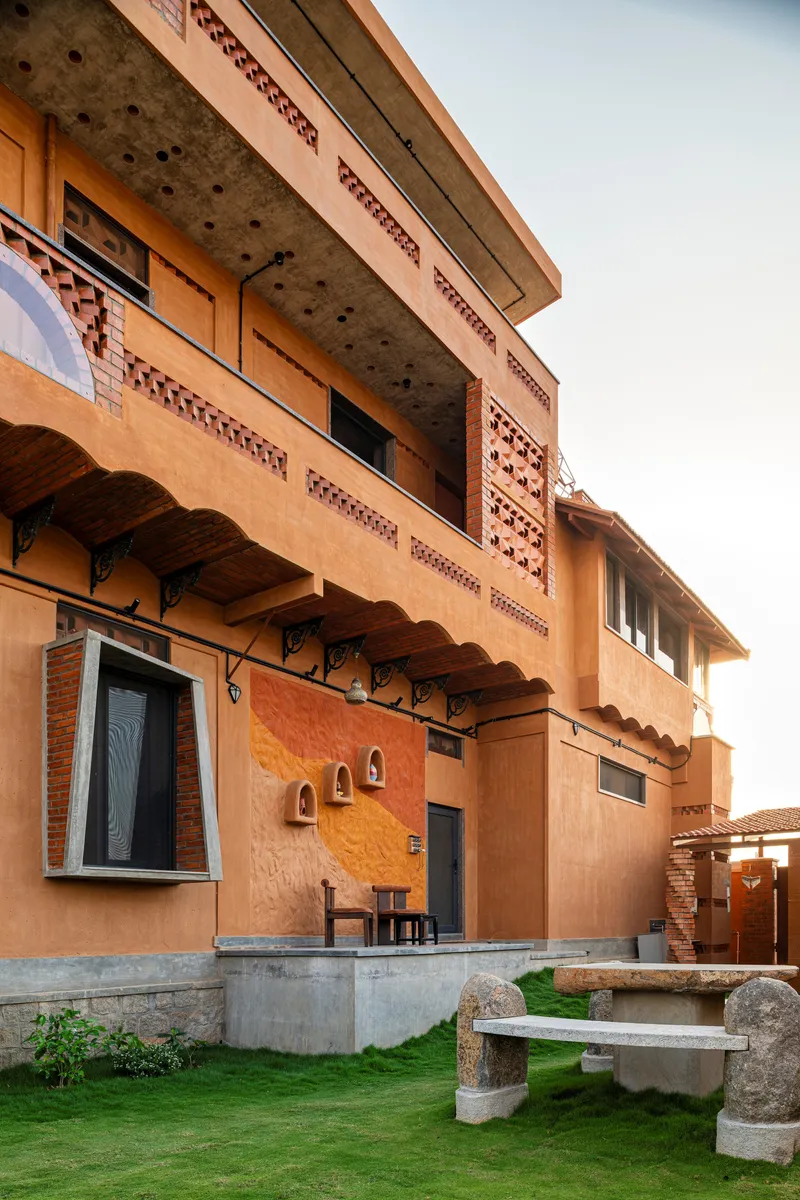
The facades reward close reading. At the ground floor, walls are exposed rammed earth: raw, striated, and unapologetically thick. These are load-bearing walls doing real structural duty, framing the vaulted spaces above. Higher up, the exterior shifts to a terracotta-toned earth plaster that smooths the texture without abandoning the color family. Stone piers interrupt the horizontal banding, grounding the composition and nodding to the granite outcrops of the surrounding landscape.
The front facade stacks circular arched openings beneath a cantilevered flat roof plane, a composition that is both bold and surprisingly controlled. Scalloped overhangs along the upper volume catch shadow and channel rainwater, while perforated brick screens on the side elevations allow air movement without exposing interiors to direct sun. Every surface decision here is simultaneously aesthetic and thermodynamic.
The Courtyard as Climate Engine
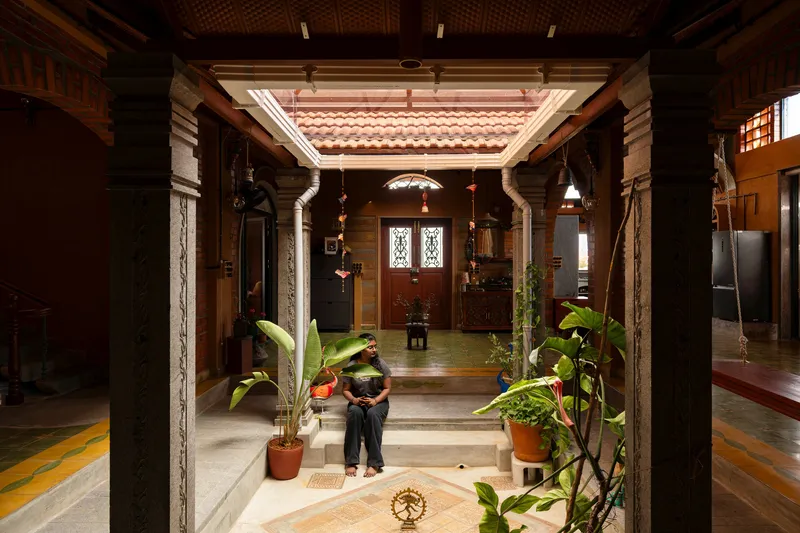
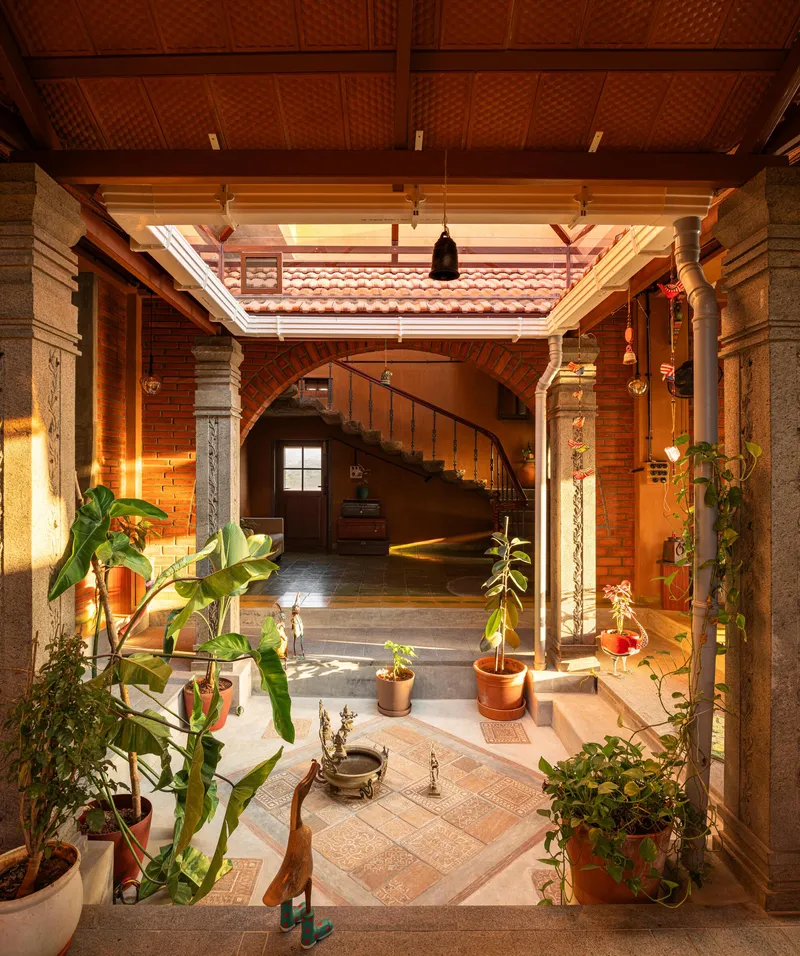
The central courtyard, based on the traditional mutram typology, is the spatial and environmental heart of the house. Stone columns frame views to potted banana plants and a tiled skylight overhead. A curved staircase rises through the space, its woven bamboo ceiling softening the light. The courtyard is not decorative; it is an active cooling device. Cool air pools here and is drawn through the surrounding rooms by the stack effect as hot air rises through the ascending vaults and escapes through terracotta jaalis at the apex.
The covered terrace extends this logic outward, with its exposed brick vaulted ceiling and niche wall ornaments creating a transitional zone between the courtyard's microclimate and the garden. Concrete seating on the lawn and a perforated brick parapet define the edge loosely, keeping the relationship between inside and outside deliberately porous.
Vaulted Interiors and Light Cannons
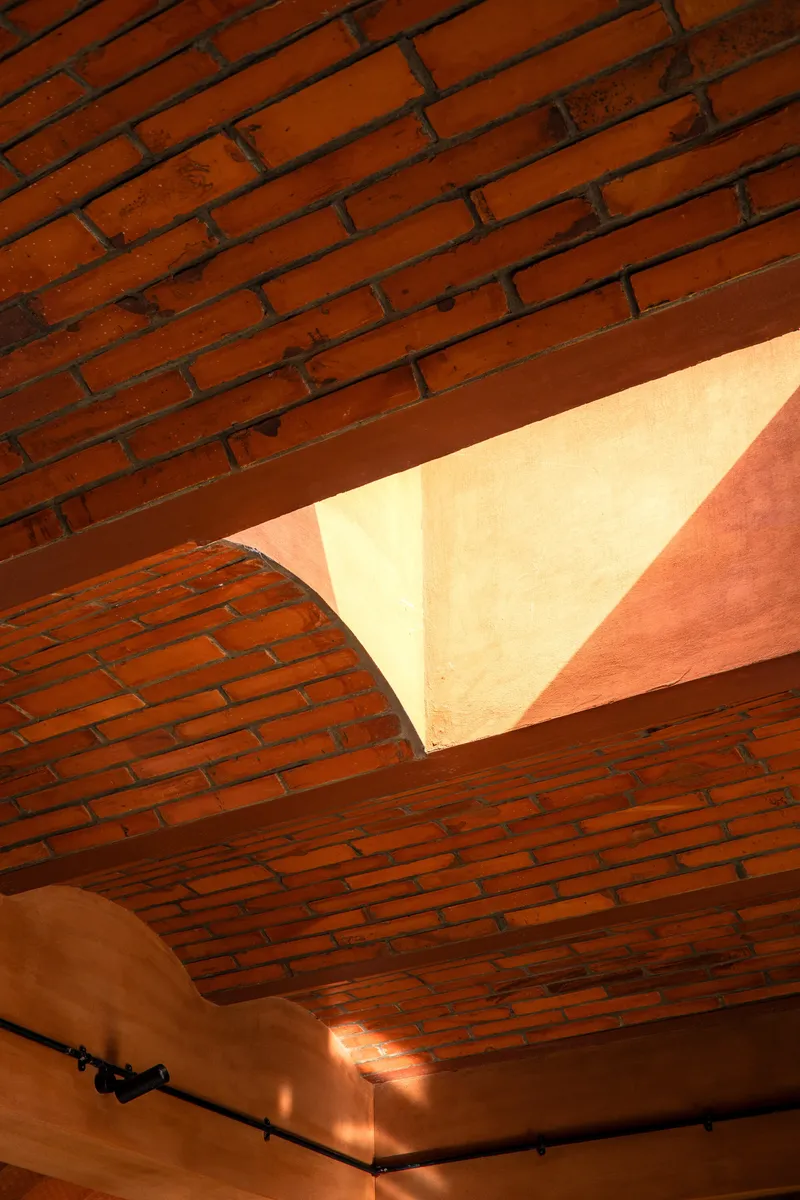
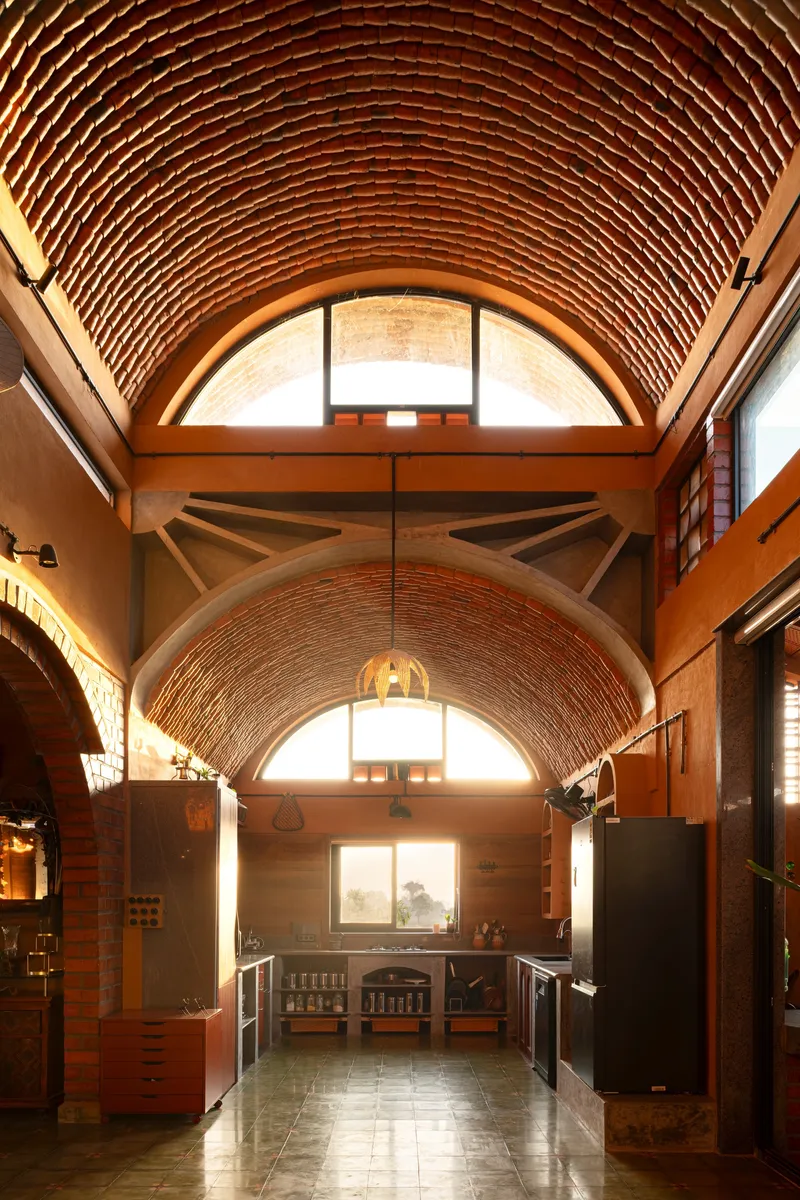
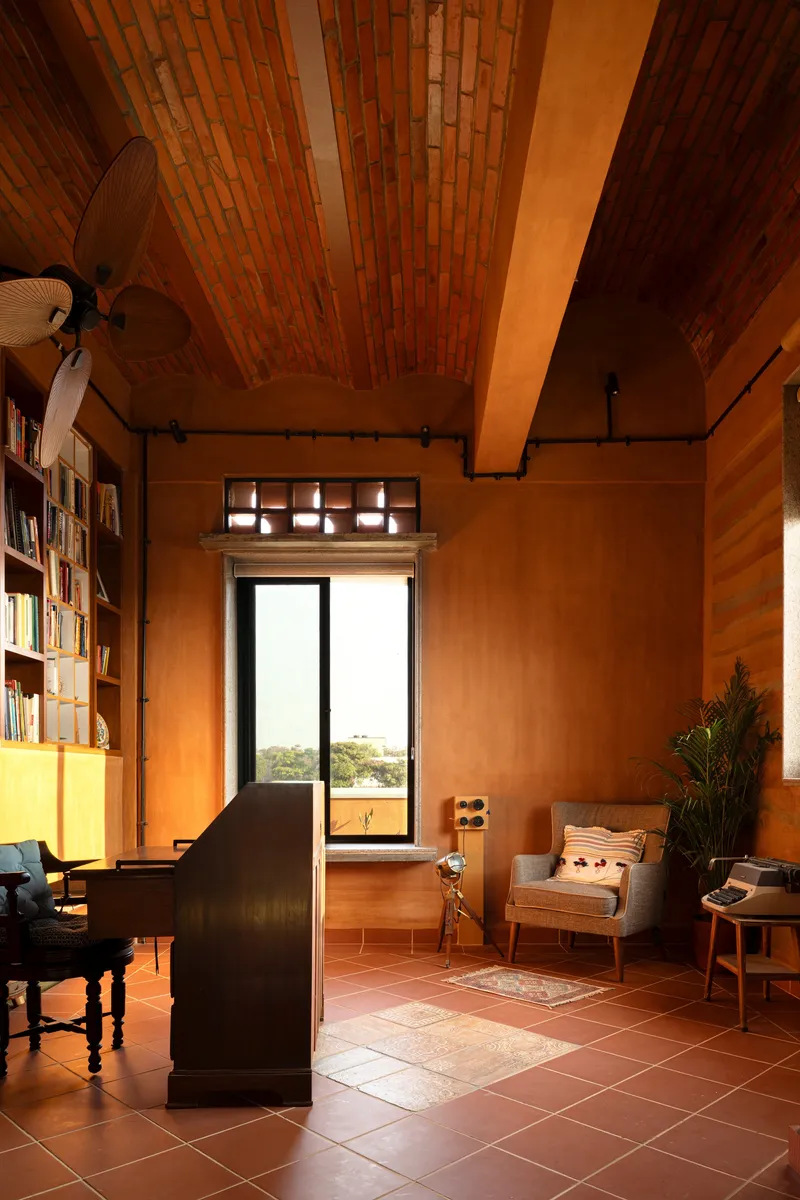
Inside, the barrel vaults are the dominant spatial experience. Warm sunlight streams through skylight openings at their crowns, illuminating the exposed brick ribs with a quality of light that feels almost ecclesiastical. The double-height living hall flanking the courtyard uses clerestory windows to pull daylight deep into the plan, while the kitchen deploys what the architects describe as a massive lunette light cannon that directs morning sun into the workspace.
The library is perhaps the most atmospheric room: a brick barrel vault frames a tall window that opens to the landscape at golden hour, turning the act of reading into a confrontation with the Deccan sky. Corridors repeat the vaulted section at a tighter scale, with red brick arches marching into depth and green tile flooring providing a cool counterpoint to the warm overhead surfaces.
Craft Details and Material Honesty
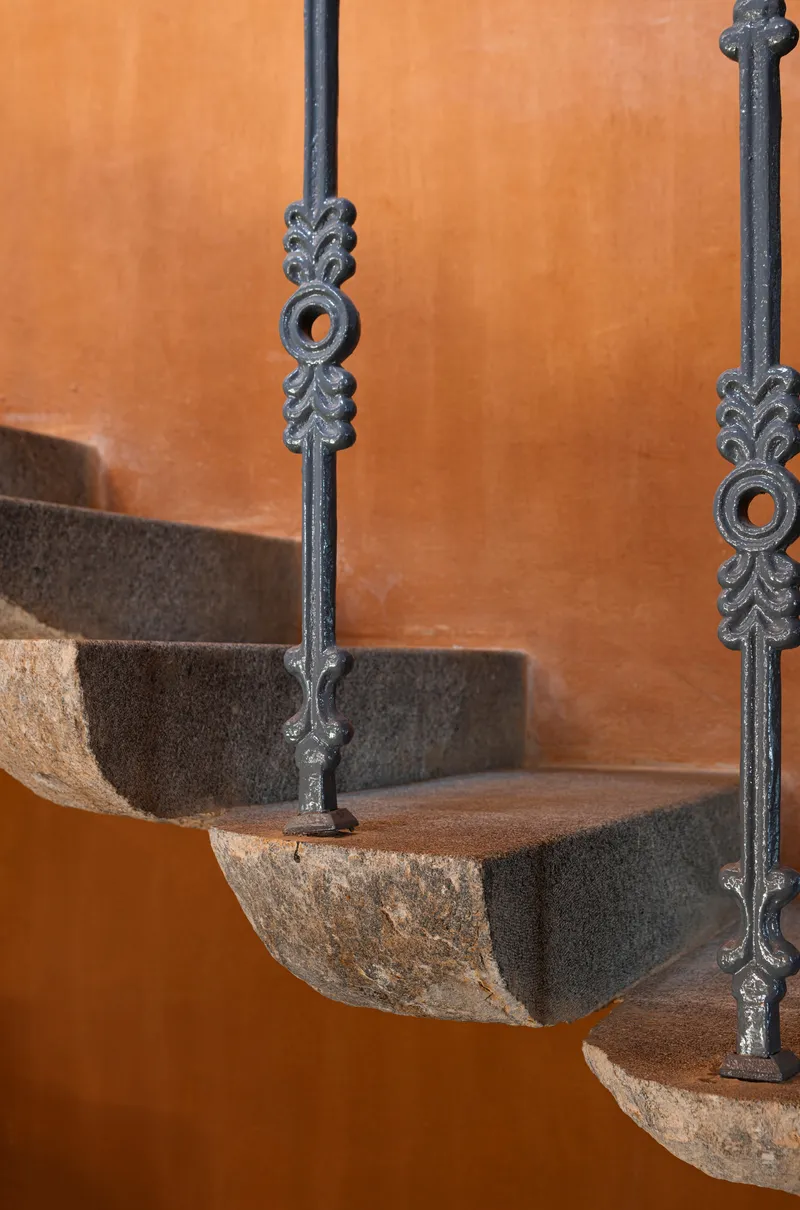
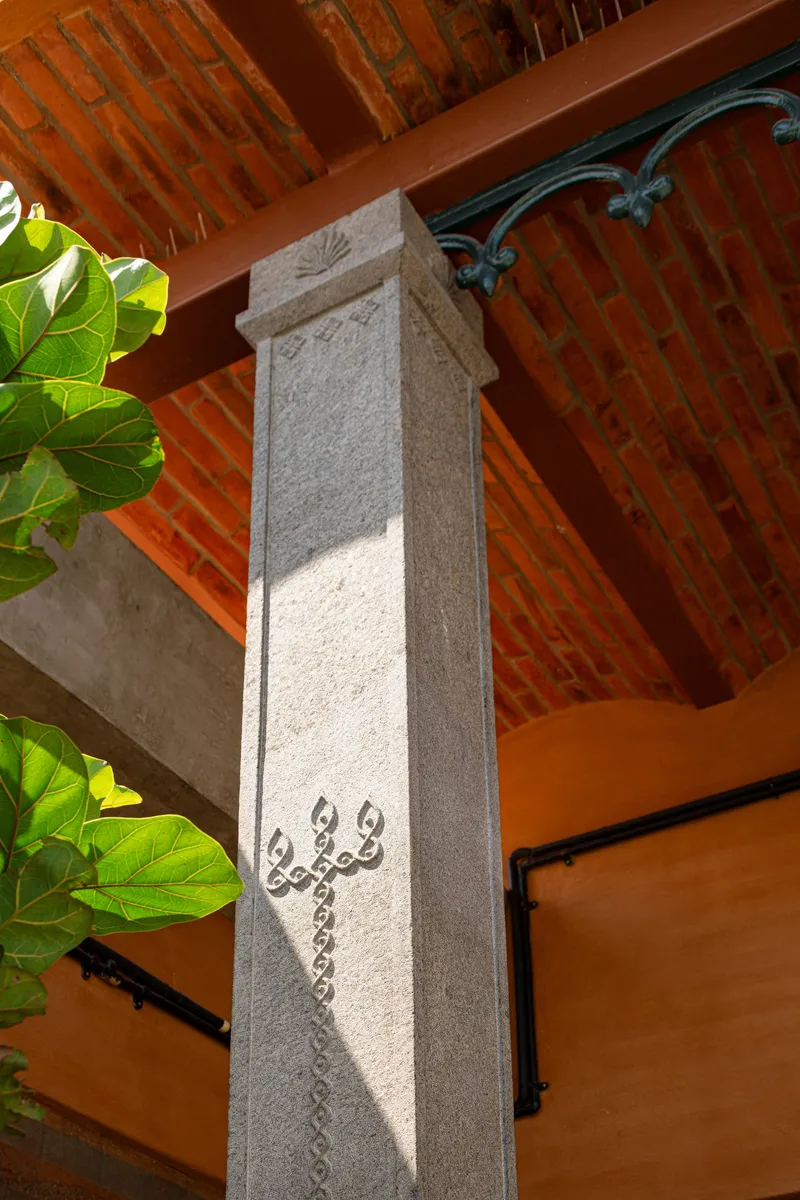
The staircase is a standout element: rough-cut granite treads with ornate cast-iron balusters, ascending beneath a brick vaulted ceiling that catches warm evening light. The iron work is not reproduction; it reads as something between industrial heritage and local blacksmithing tradition. A carved stone column with inscribed script and a wrought iron bracket speaks to the architects' interest in embedding narrative into structural elements.
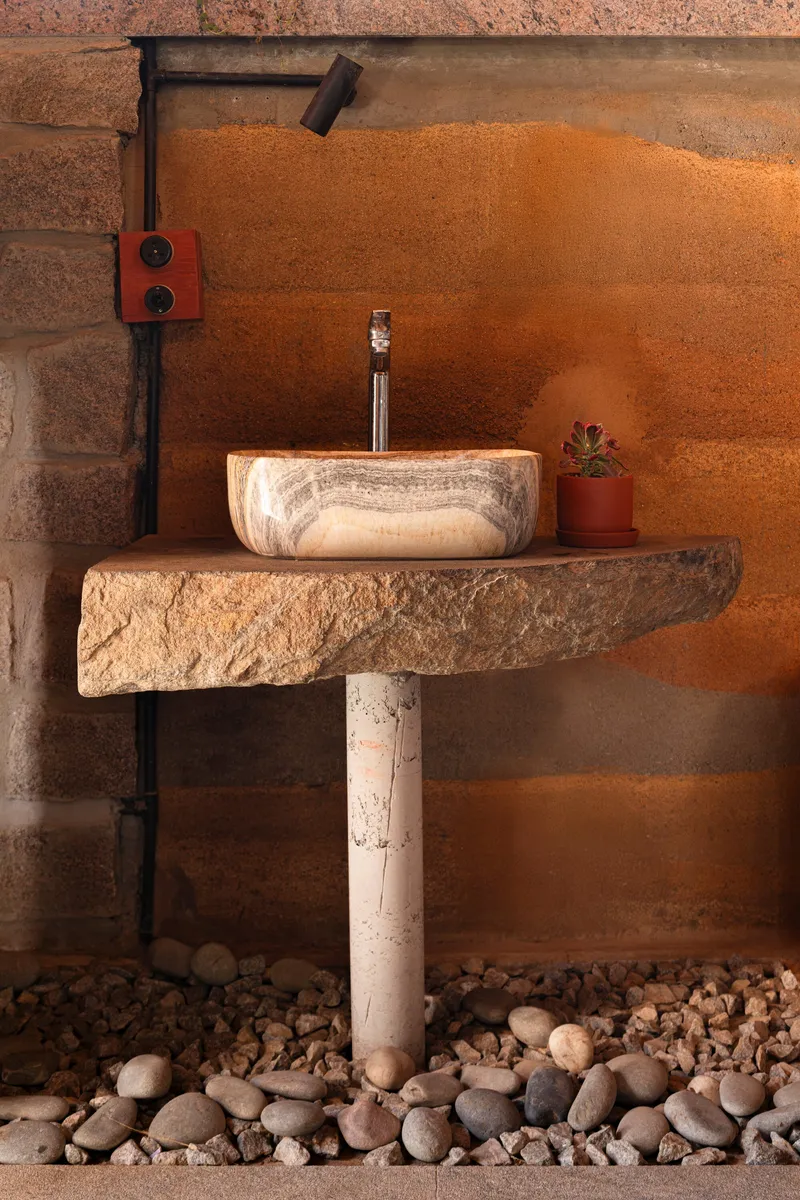
In the bathrooms, a stone vessel sink sits on a rough-edged counter above river pebble flooring, with exposed plumbing and a terracotta wall behind it. Handmade Athangudi floor tiles appear throughout the house, their geometric patterns providing a deliberate contrast to the organic textures of the rammed earth. These are not curated finishes; they are the natural vocabulary of a building that refuses to separate craft from construction.
Private Rooms Above the Earth
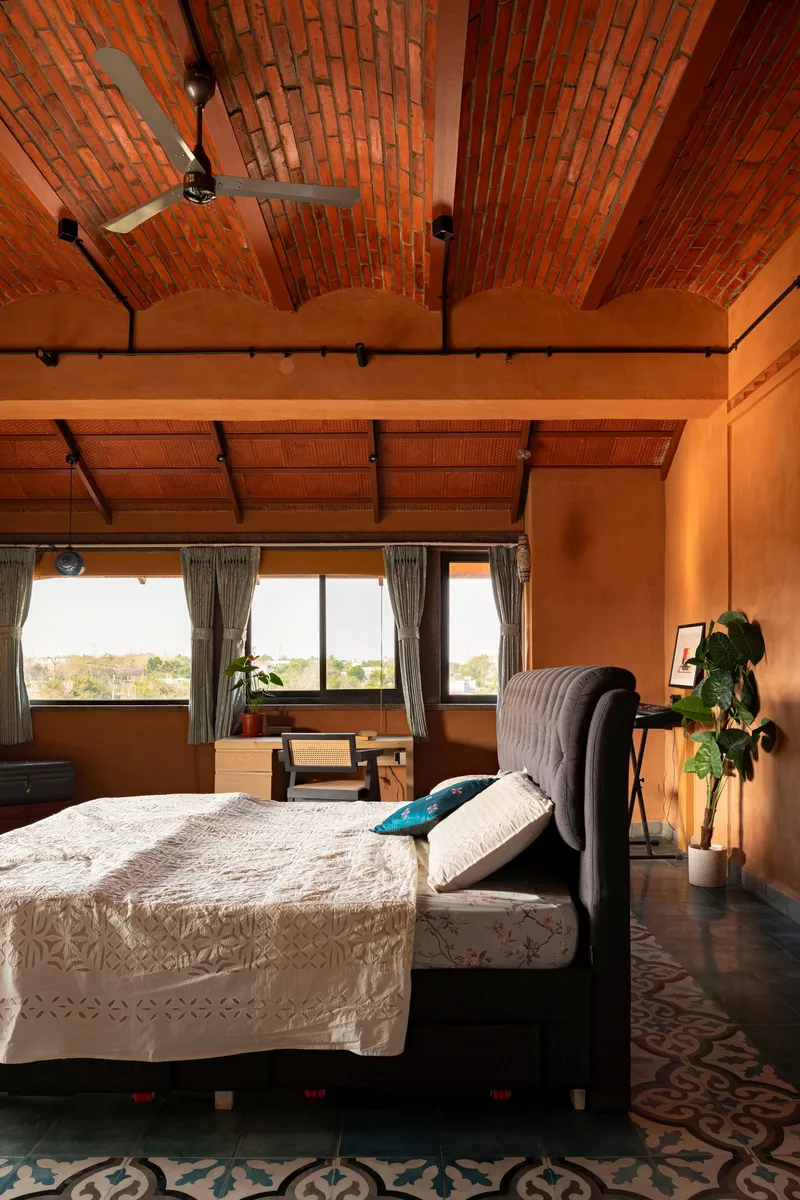
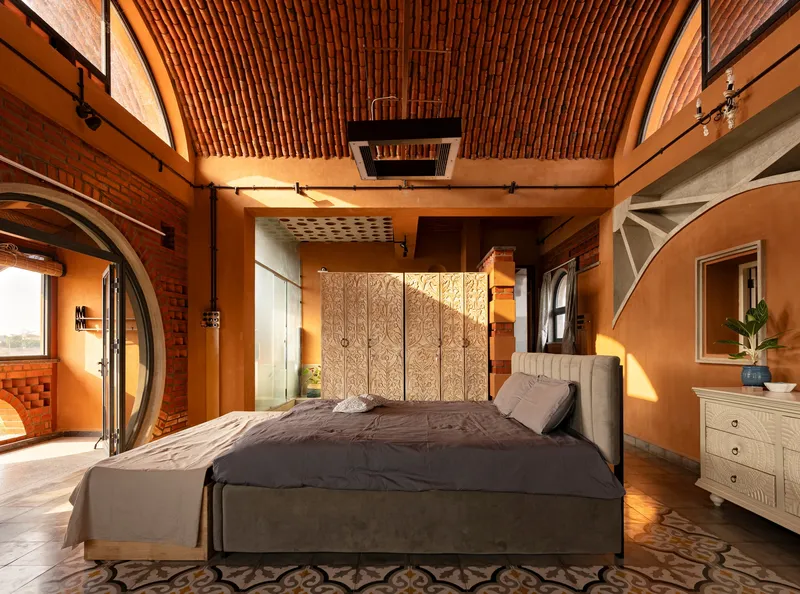
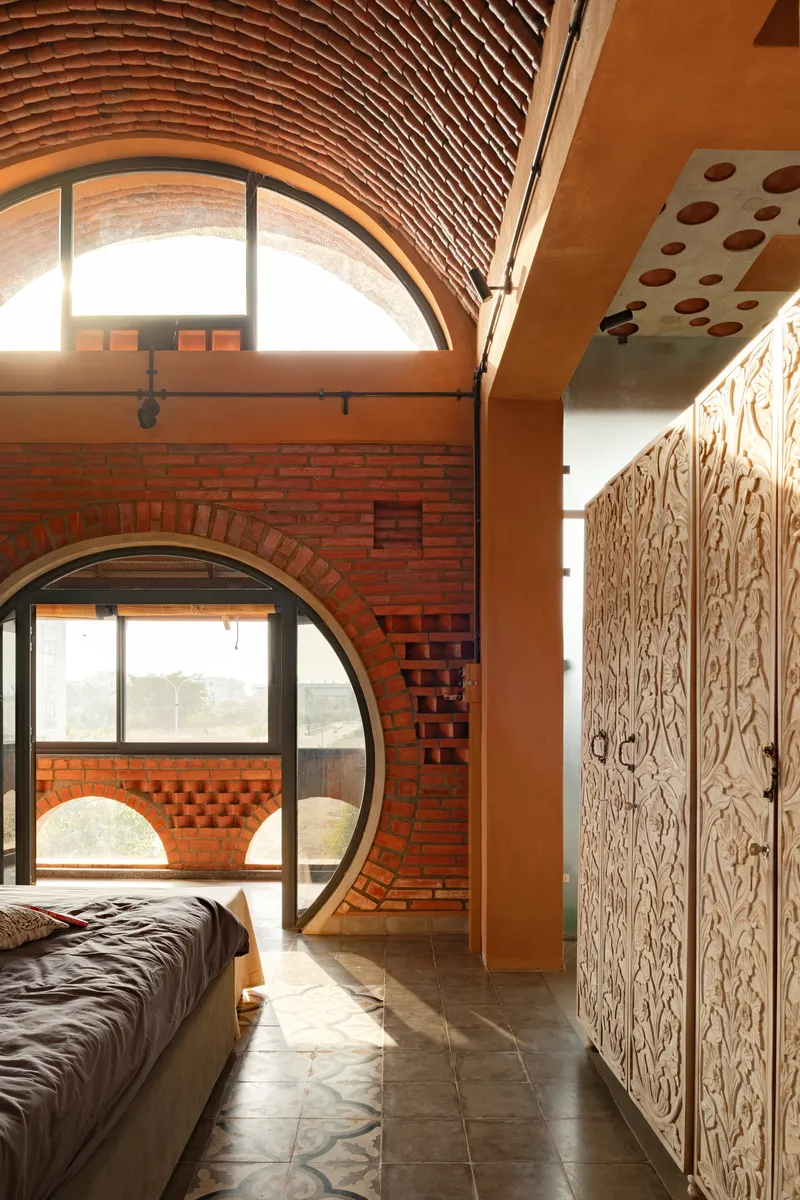
The upper level positions bedrooms and private study spaces atop the communal ground floor, each room capped by its own vault. Horizontal ribbon windows frame distant landscape views, connecting the sleeper to the plateau rather than the neighboring development. One bedroom features an exposed concrete zigzag ceiling, a deliberate tectonic shift from the brick vaults that signals a different structural logic overhead.
Ornate wooden screen panels and carved timber wardrobe doors introduce a craft register that is distinctly South Indian, while circular brick archways between rooms maintain visual continuity with the vaulted language below. The reading nook, tucked beneath a perforated brick ceiling panel that filters afternoon sunlight into a stippled pattern, is the kind of space that justifies an entire house.
Thresholds, Canopies, and the Roof
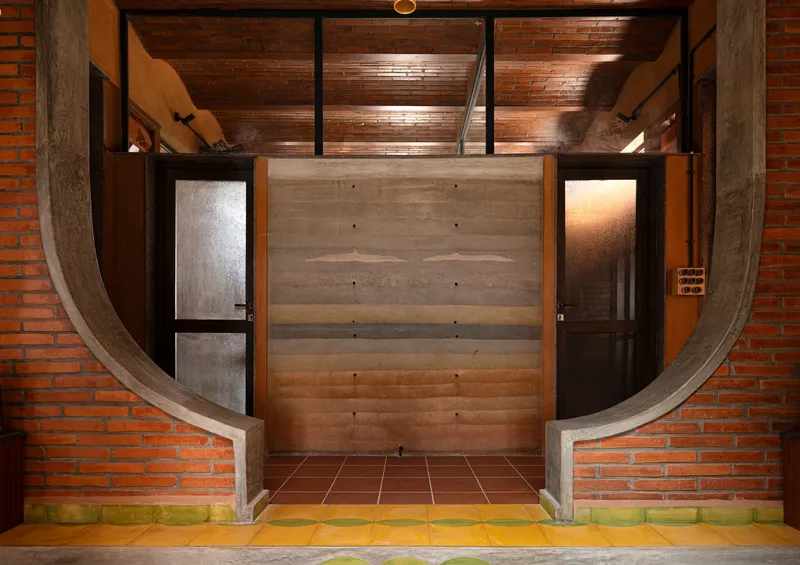
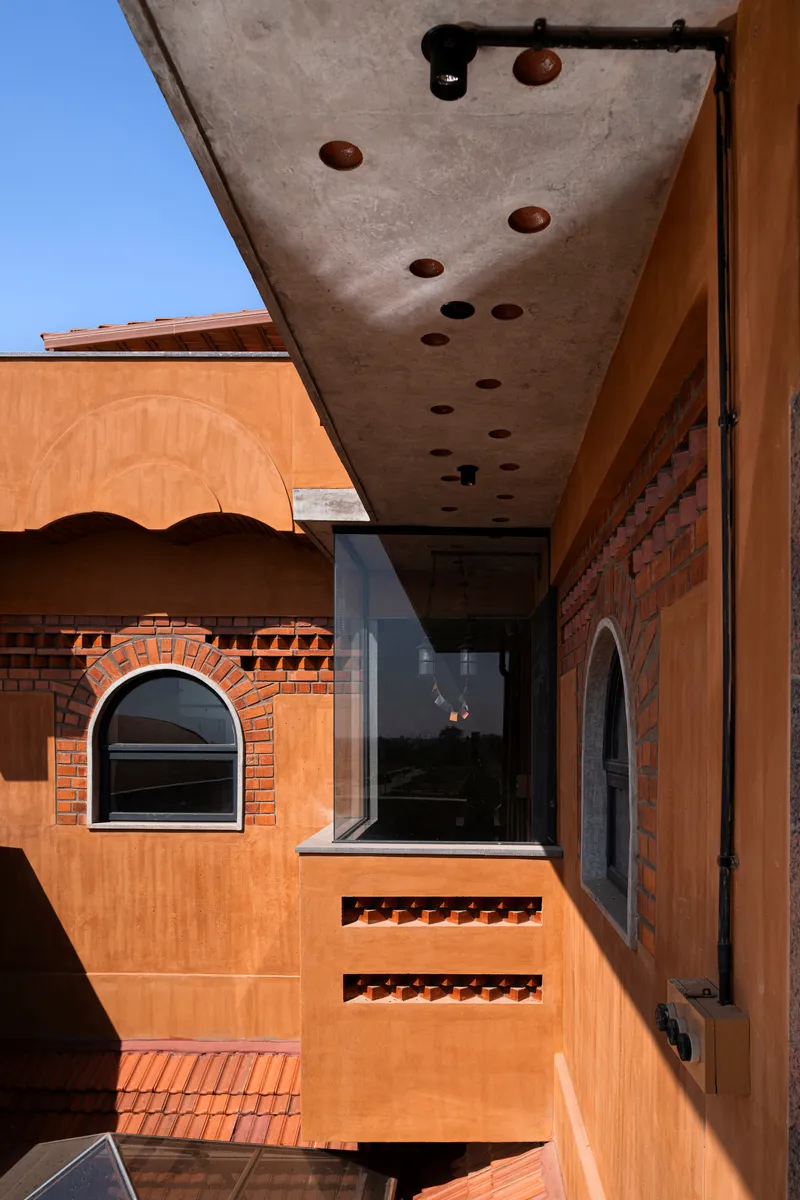
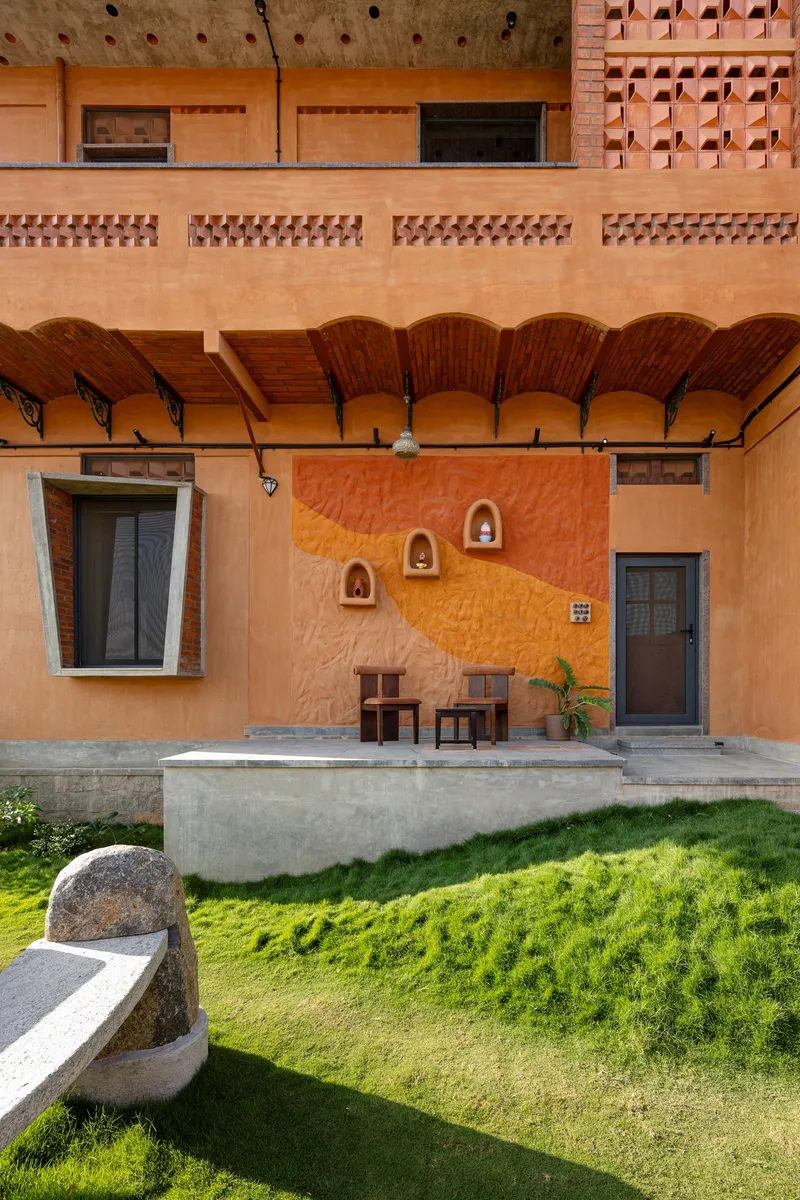
The entrance sets the tone: a curved concrete frame wraps a layered timber door flanked by frosted glass panels, compressing the arrival sequence before the courtyard opens it up. Overhead, a concrete canopy with circular perforations filters light onto the terrace below, creating a shadow pattern that shifts through the day. The building's exposed ferrocement gutters are a particularly honest detail. Rather than concealing the rainwater collection infrastructure, the architects make it legible, channeling runoff visibly into underground harvesting tanks.
Plans and Drawings
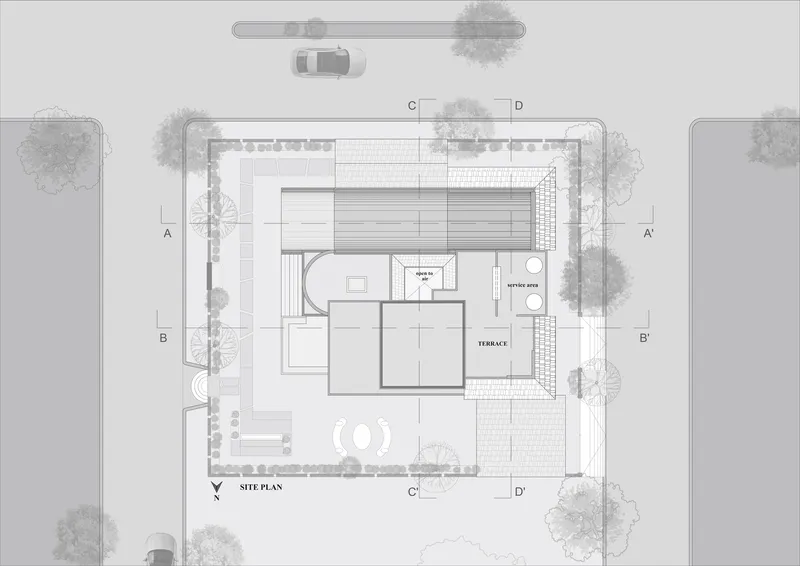
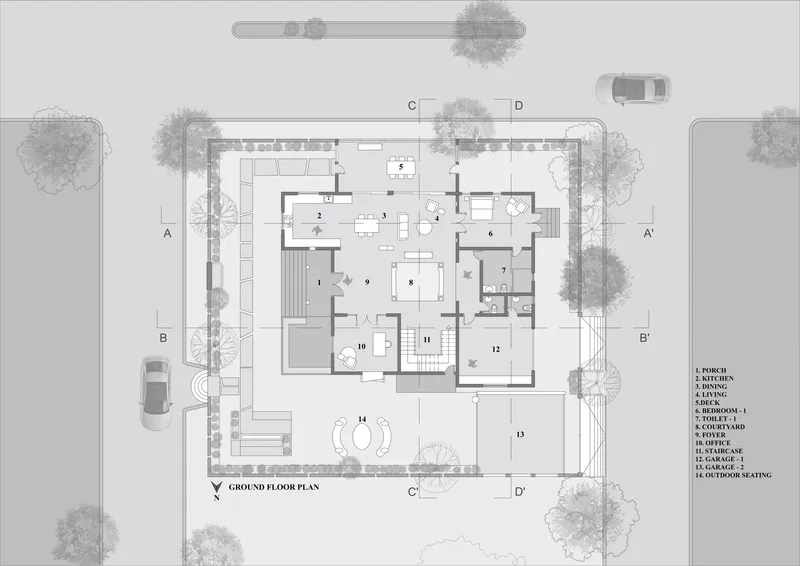
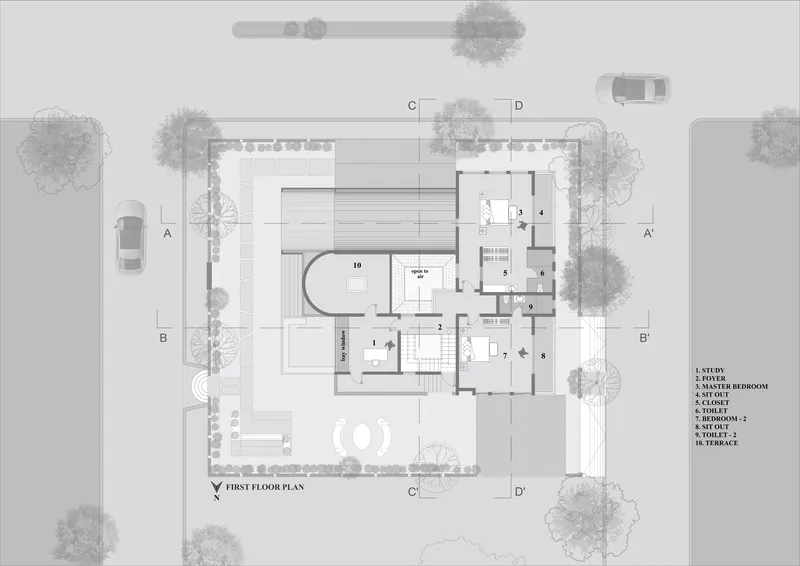
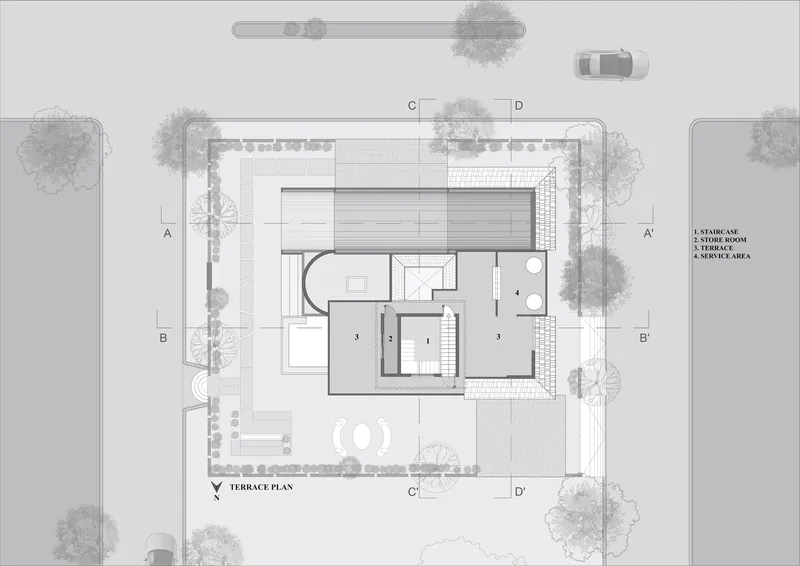
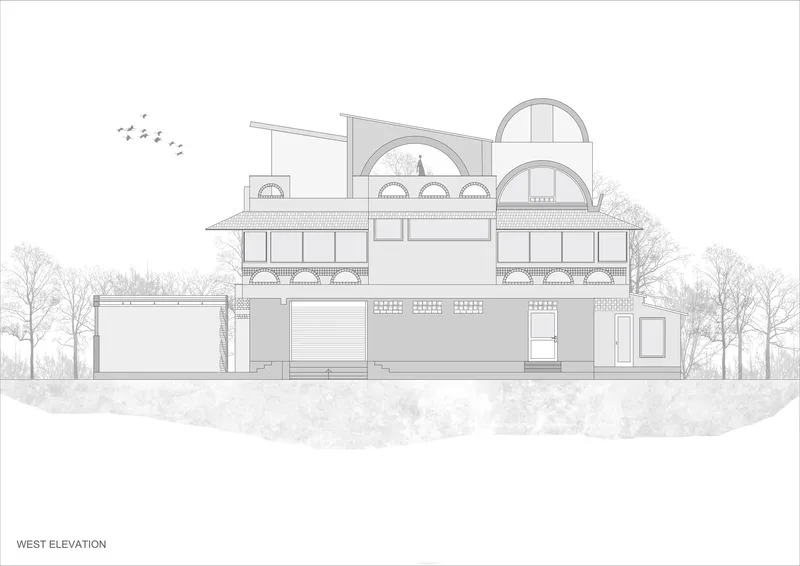
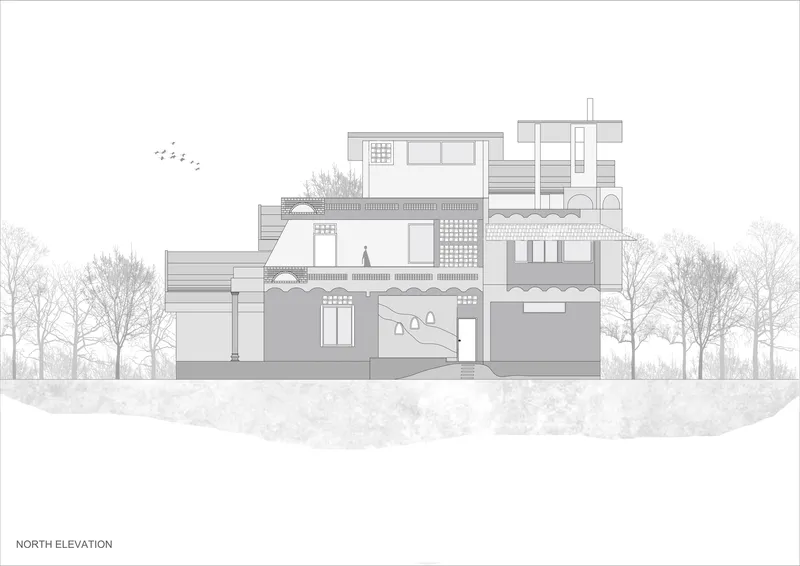
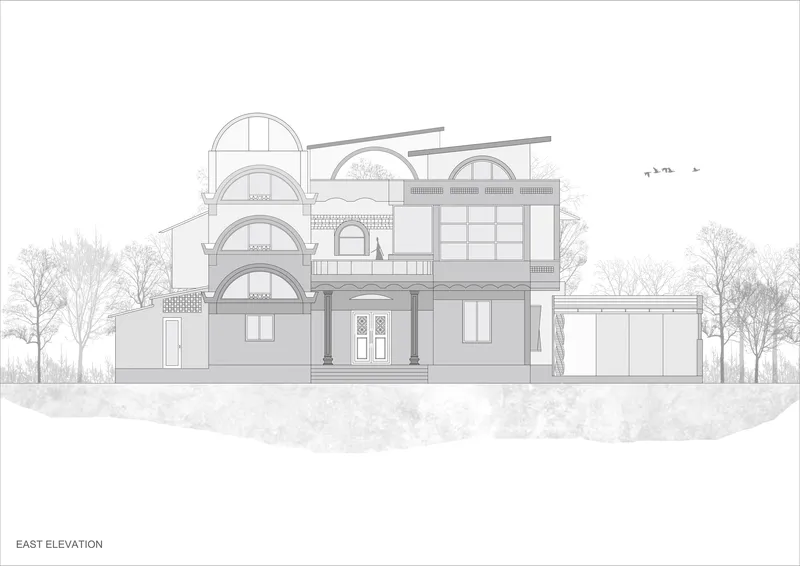
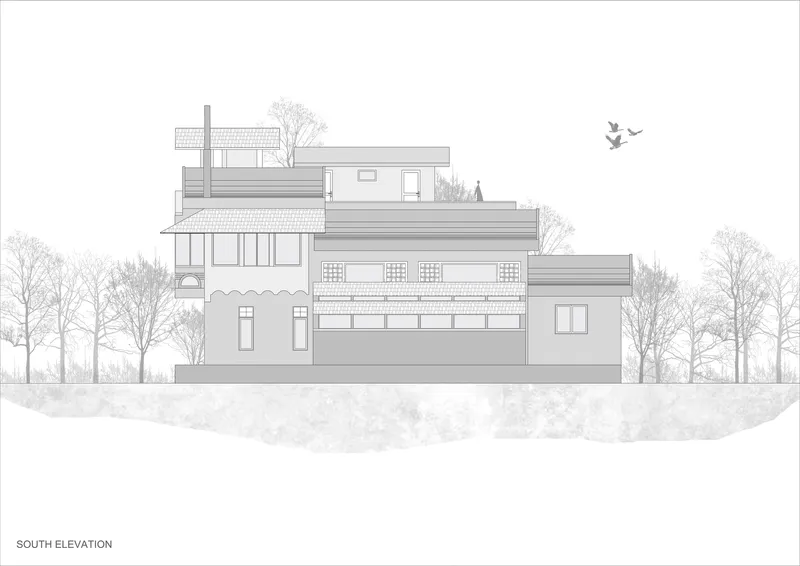
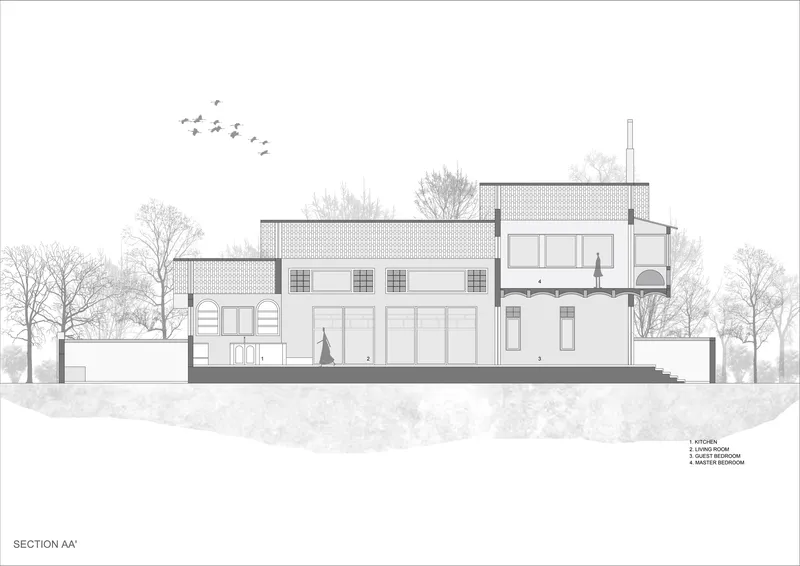
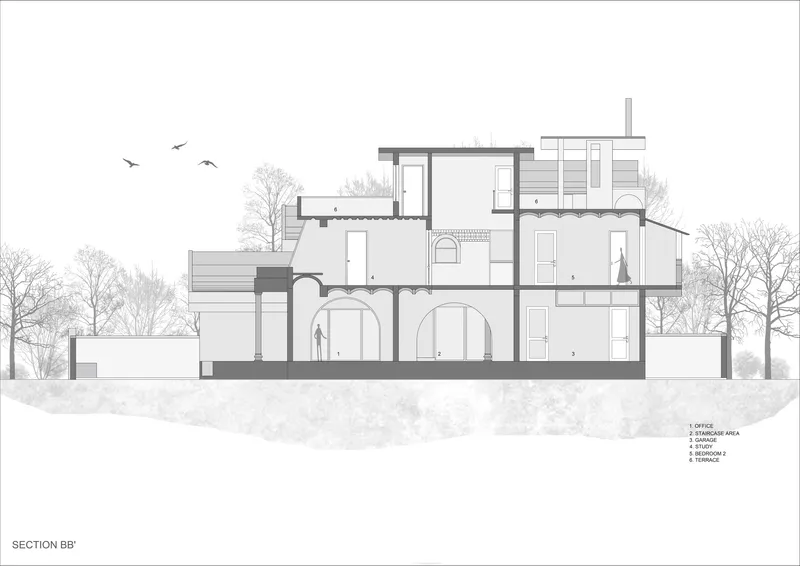
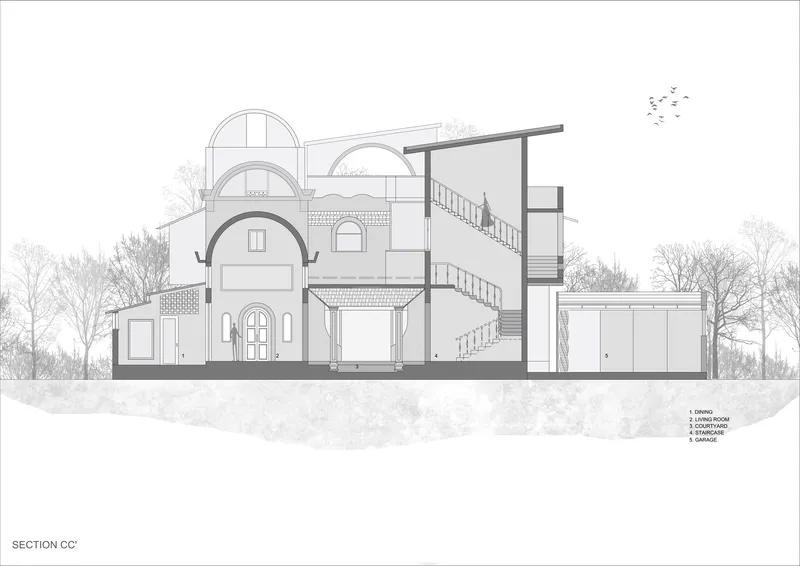
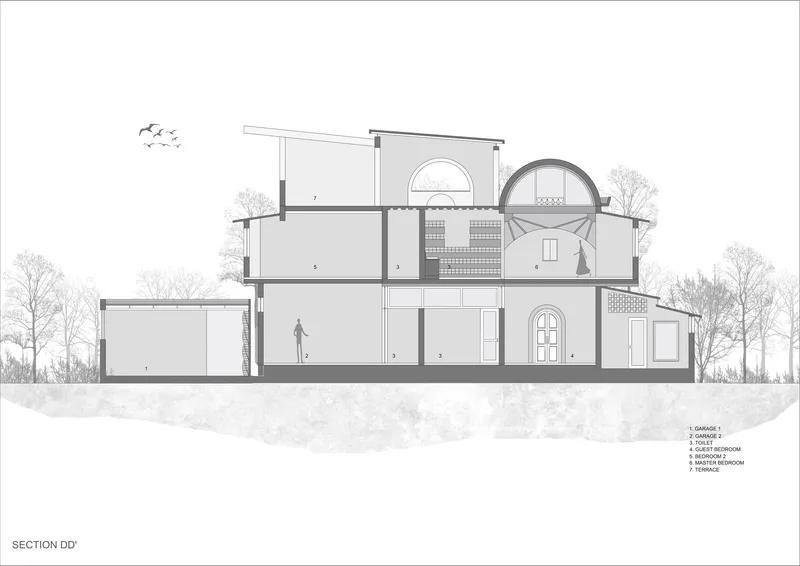
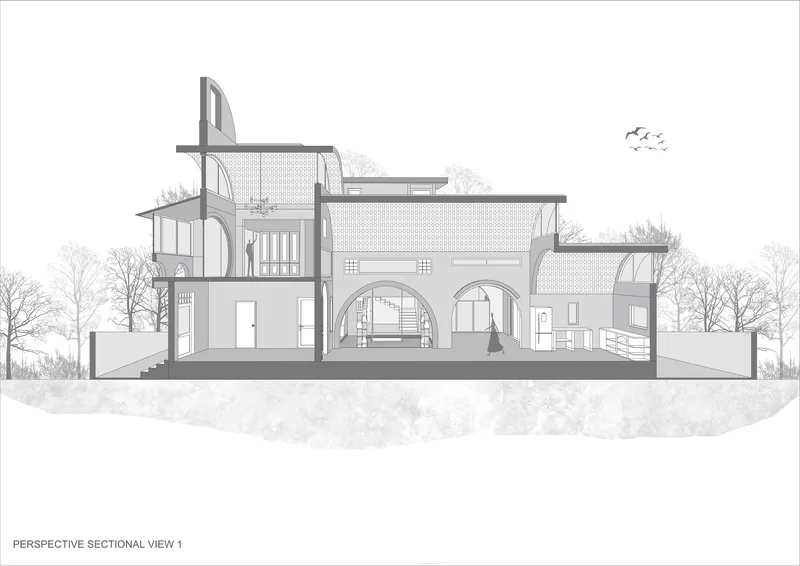
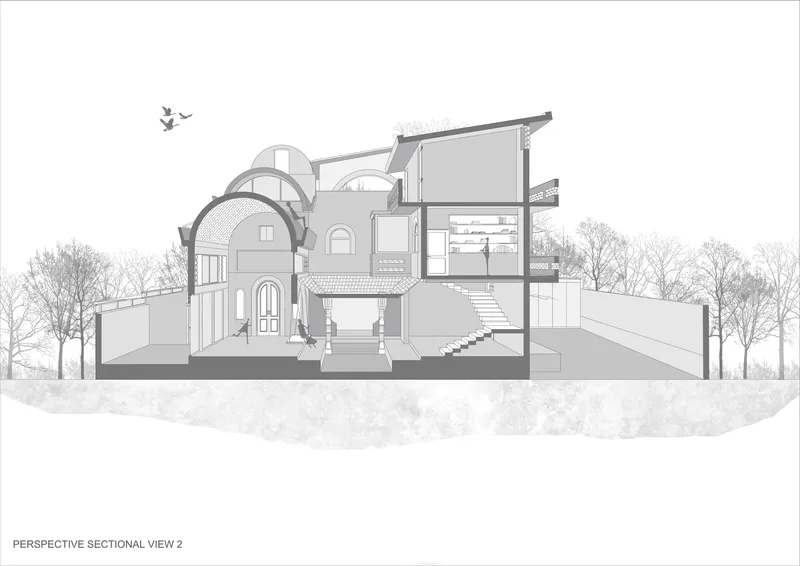
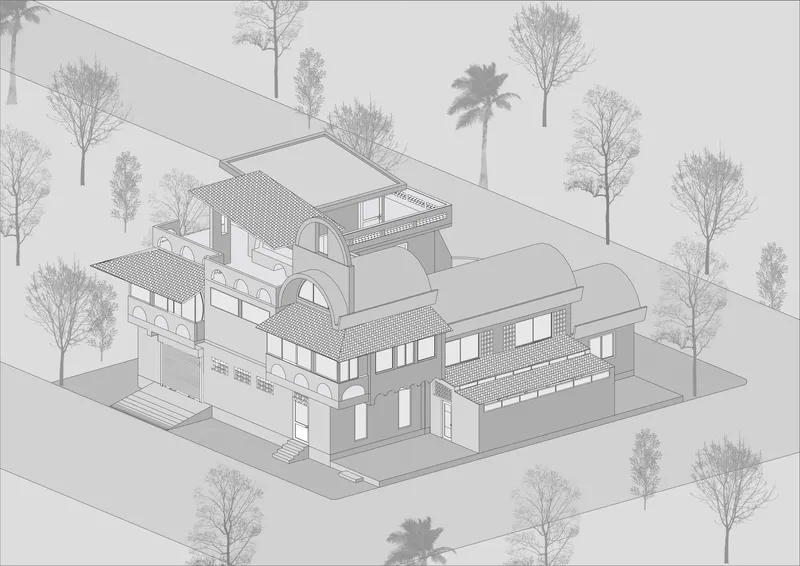
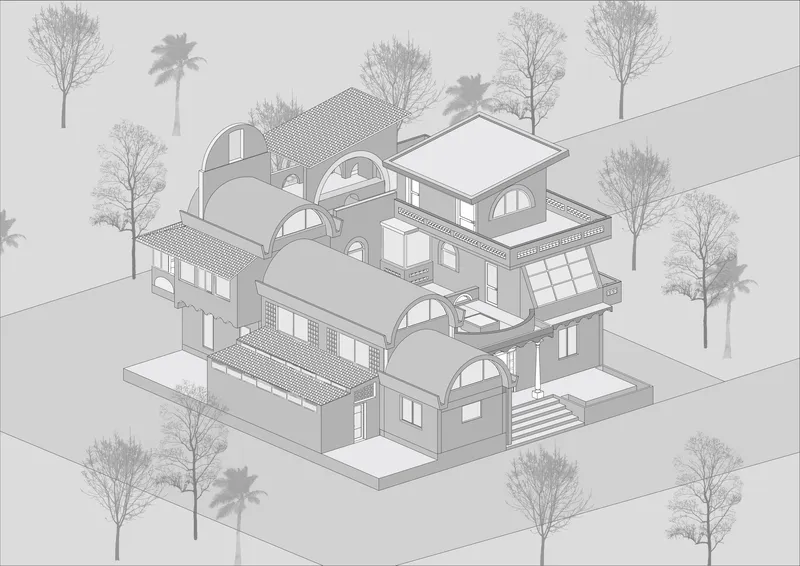
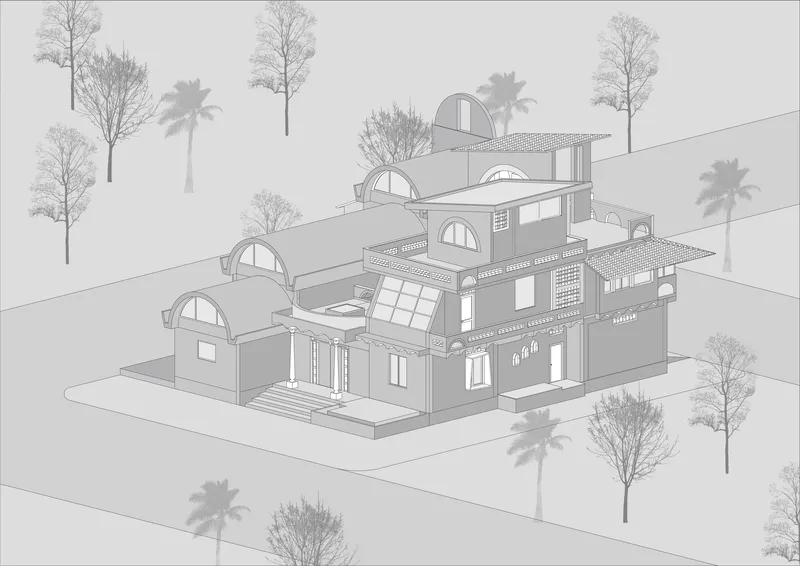
The drawings reveal the full ambition of the spatial organization. The site plan shows the building occupying its corner plot tightly, with the courtyard as a void carved from the center. Ground floor plans confirm the mutram as the organizing principle, with living, kitchen, and dining zones radiating from it. The first floor plan stacks bedrooms and terraces above, while the terrace plan reveals a rooftop landscape complete with a circular water feature. Four elevations and multiple sections expose the cascading vault strategy: ascending volumes that harness the stack effect, clerestory gaps that admit daylight without solar gain, and a layered massing that reads as landscape from every angle.
The perspective sections are particularly revealing, showing how the central atrium connects all levels and how the vaults of different scales nest within the overall composition. The axonometric drawings, drawn with surrounding palms and deciduous trees, make explicit the architects' intention to embed the house in its site rather than impose it. Birds populate every section drawing, a representational choice that, intentionally or not, suggests the porosity and openness the building offers to its environment.
Why This Project Matters
Aurva Illam matters because it offers a credible, built alternative to the default mode of residential construction spreading across India's peri-urban frontiers. Where most developer-led projects import their material palettes and spatial models wholesale, Iki Builds has produced a house that is literally made from its own ground. The rammed earth walls contain the site's excavated soil. The terracotta tiles are locally fired. The passive cooling strategy is tuned to the specific climate of the Deccan Plateau. None of this is performative austerity; the interiors are generous, the craft is skilled, and the spatial sequence from entrance to courtyard to vault is genuinely pleasurable.
The deeper lesson is about what luxury means when you stop measuring it in imported square meters of marble. Aurva Illam achieves thermal comfort without air conditioning in a region where summer temperatures routinely exceed 40°C. It harvests its own rainwater. It employs local artisans for its Athangudi tiles, its cast-iron balusters, its carved stone columns. The result is not a compromise but a provocation: a house that is more comfortable, more specific, and more materially honest than its air-conditioned, glass-clad neighbors. That is the argument worth paying attention to.
Aurva Illam House by Iki Builds (Lead architects: Vamshidhar Reddy, Mounica Reddy). Kadthal, Telangana, India. 5,660 sq ft. Completed 2024. Photography by Vivek Eadara.
About the Studio
Share Your Own Work on uni.xyz
If projects like this are the kind of work you want to make, uni.xyz is a place to publish your own, find collaborators, and enter design competitions.



Popular Articles
Popular articles from the community


Riyadh For All: Intergenerational Urban Design for Active Aging in Rabat
Riyadh For All reimagines urban design in Rabat with intergenerational co-living, adaptive courtyards, and Moroccan cultural exchange today.

Co-Life: Senior Housing Design That Reconnects Older Adults With the City
Co-Life reimagines senior housing design through healing gardens, shared streets, workshops, and a sustainable community across generations.

The Earth Pod: 3D Printed Homes for Resilient Refugee Communities
The Earth Pod reimagines refugee housing through 3D printed homes made from clay, combining resilience, self-sufficiency, and rapid shelter.

Co-life: Sustainable Architecture for Age-Friendly Community Living
Co-life reimagines sustainable architecture for seniors through courtyards, rammed earth, shared gardens, and spaces designed for belonging.


Similar Reads
You might also enjoy these articles

Bao Huynh Watercolor Atelier: A Serene Art Retreat in Hội An
Bao Huynh Watercolor Atelier in Hội An blends multifunctional art spaces, sustainable design, local materials, and family-friendly living in a serene environment.

Atelier Macri Concept Store Interior Design by CASE-REAL
Atelier Macri store features a "ko" counter, walnut wood details, cork displays, blending retail, gallery, and seamless customer experiences.

Manuel Vargas Izquierdo Stadium and High-Performance Sports Center: Architectural Excellence in Jalpa de Méndez
The Manuel Vargas Izquierdo Stadium blends sustainable design, inclusive sports facilities, and cultural-inspired architecture, revitalizing Jalpa de Méndez’s public spaces.

KAKR Buluh Awar Hall: Revitalizing Community and Ecology Through Bamboo Architecture
Community built bamboo hall revitalizes Buluh Awar village, empowering youth, restoring ecology, celebrating vernacular craftsmanship through sustainable architecture and culture.


Explore Residential Building Competitions
Discover active competitions in this discipline


Challenge to design mud housing for contemporary communities


Design challenge to reuse E-waste
Comments (0)
Please login or sign up to add comments
No comments yet. Be the first to comment!