
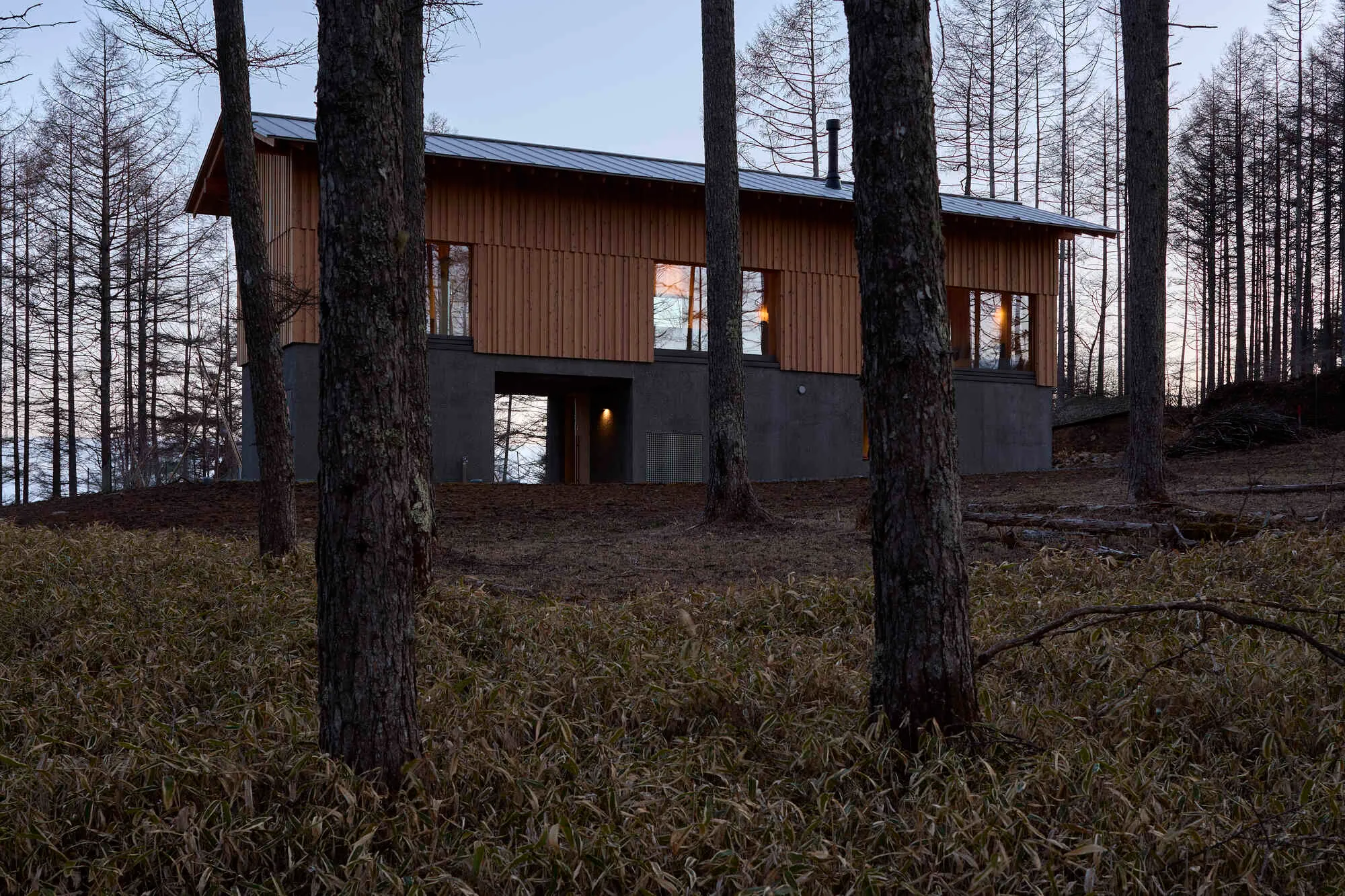
Imajo Design Plants a Timber Retreat at 1,600 Meters on Japan's Kirigamine Plateau
A compact 85-square-meter mountain house in Suwa, Nagano, endures minus-twenty winters while framing views of Mt. Fuji and the Yatsugatake range.


Building at altitude demands a different kind of respect for context. At over 1,600 meters on Japan's Kirigamine plateau, imajo design has completed a compact mountain house that must reconcile two very different realities: the gentle coolness of a highland summer and the punishing cold of winters that plunge to minus twenty degrees Celsius. The result, finished in 2025, is a taut 85-square-meter volume that reads as both shelter and observation post, its vertical timber cladding echoing the bare larch trunks that surround it.
What makes this project genuinely interesting is how it manages to feel both fortified and transparent. The house sits on a concrete plinth that anchors it to the sloping terrain, while punched windows and deep recesses turn the thick envelope into a series of framed landscapes. To the north lies the Kirigamine wetland; to the south, Mt. Fuji and the Yatsugatake Mountains. Every opening is calibrated to a specific view, transforming a small house into a kind of optical instrument tuned to its extraordinary site.
A Volume Among the Larches
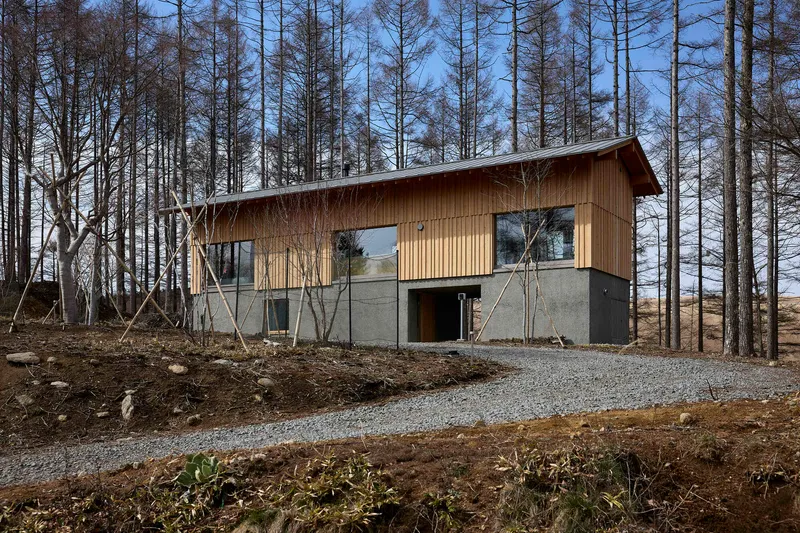
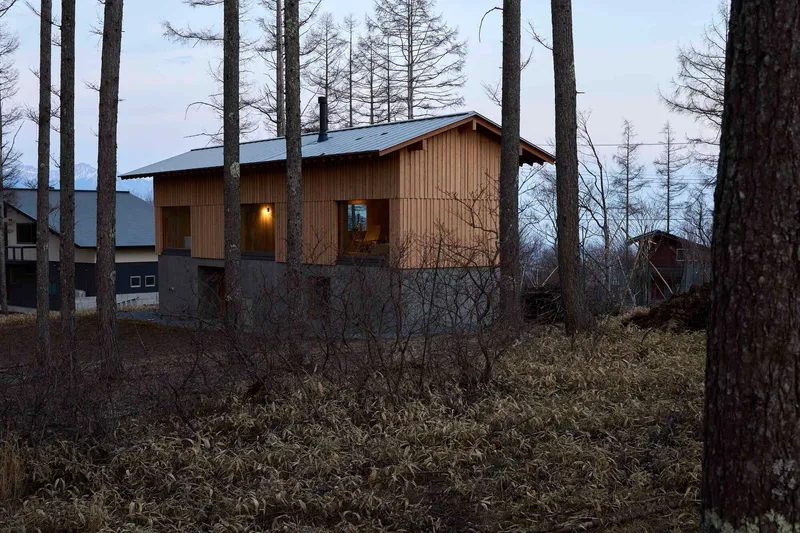
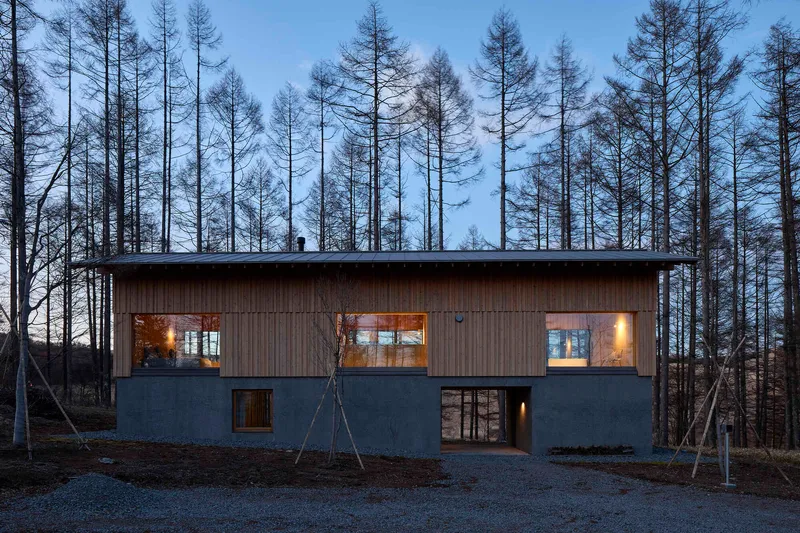
Seen from the gravel approach, the house presents itself as a two-story timber-clad box lifted on a concrete base, its proportions modest enough to avoid dominating the sparse forest clearing. The vertical cladding picks up the rhythm of the surrounding larch trunks, blurring the line between structure and landscape, particularly at dusk when interior light spills through the punched openings and the building glows against the darkening plateau.
The concrete plinth is not just a foundation detail. It visually grounds the lighter timber volume while managing the stepped terrain and providing thermal mass at ground level, a practical move in a climate where subzero temperatures persist for months. The transition from concrete to timber reads as a shift from earth to forest, from weight to warmth.
Facade and Material Logic
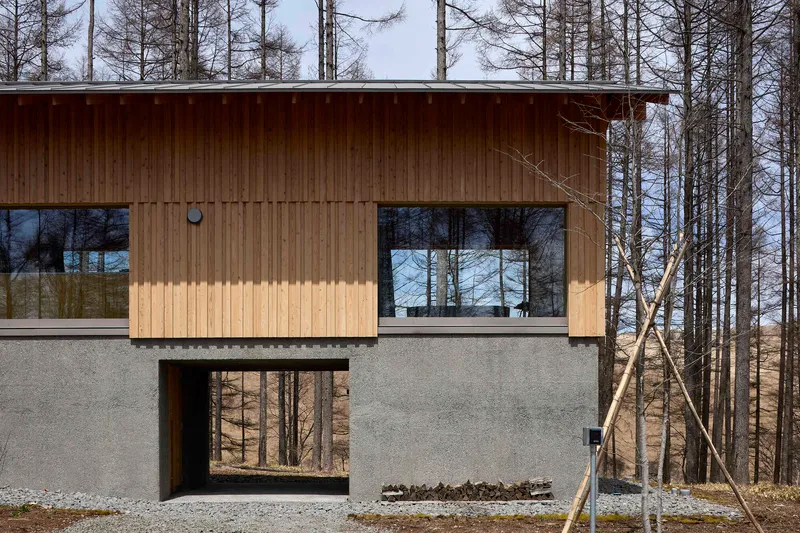
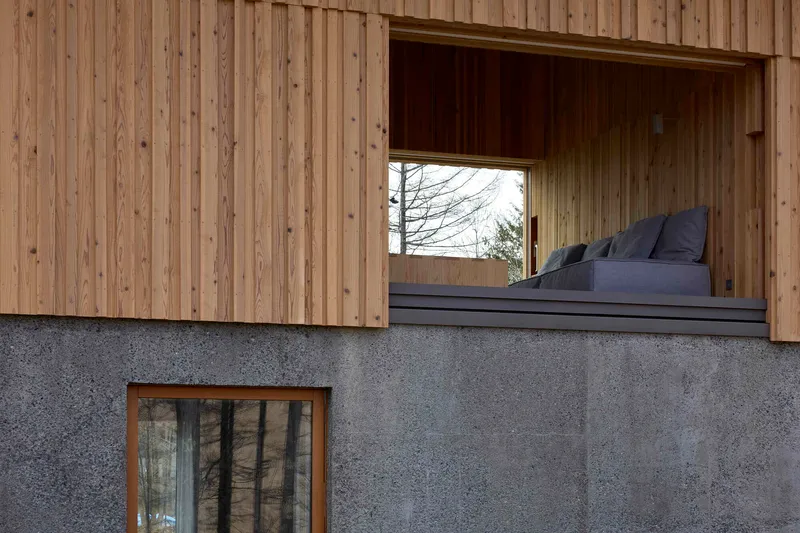
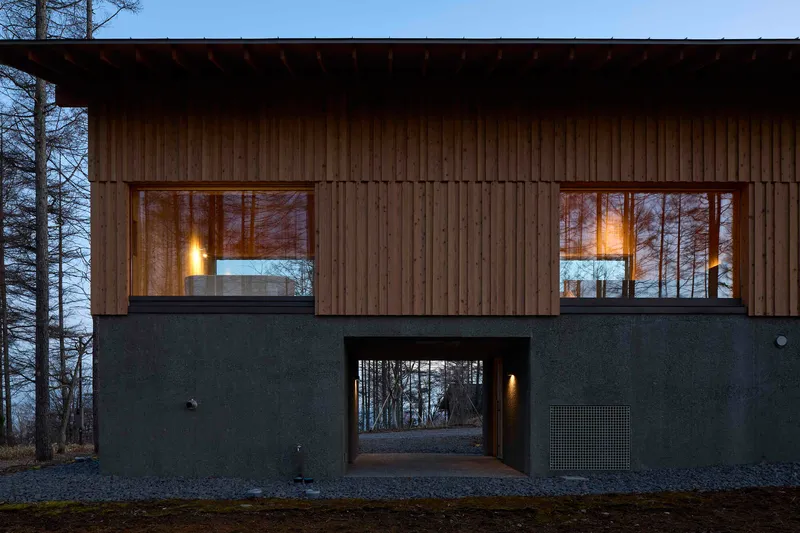
Up close, the facade reveals its discipline. Vertical timber boards are tightly jointed, creating a uniform surface that weathers predictably at this altitude. The concrete base, left exposed or finished with a dark plaster, absorbs and re-radiates heat in a climate where every passive thermal strategy counts. A covered passageway at the ground level, visible in the dusk views, provides a transitional zone between the raw plateau and the insulated interior.
Windows are punched rather than curtain-walled, a deliberate constraint that limits heat loss while making every view feel composed. The deep recesses around each opening reveal the true thickness of the building envelope, a silent advertisement for the insulation required at this elevation. Young saplings staked near the front facade suggest a longer-term landscape strategy, one that will eventually soften the building's edges as it settles into its site.
Framing the Forest
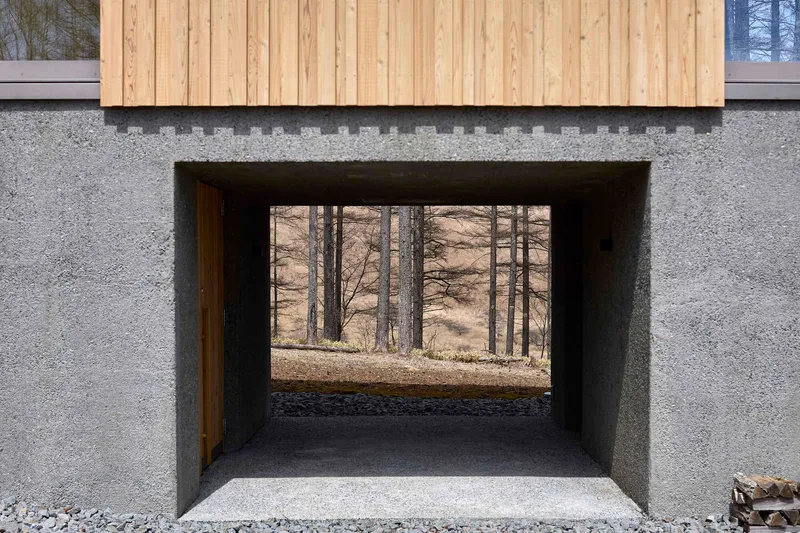
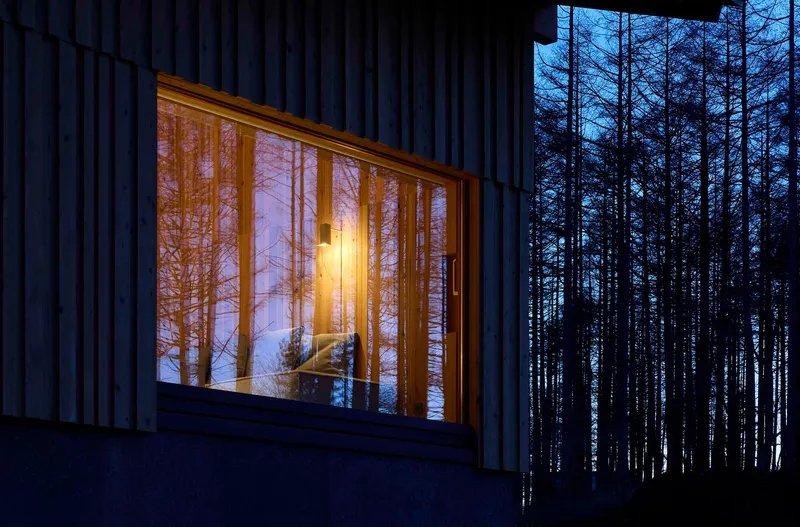
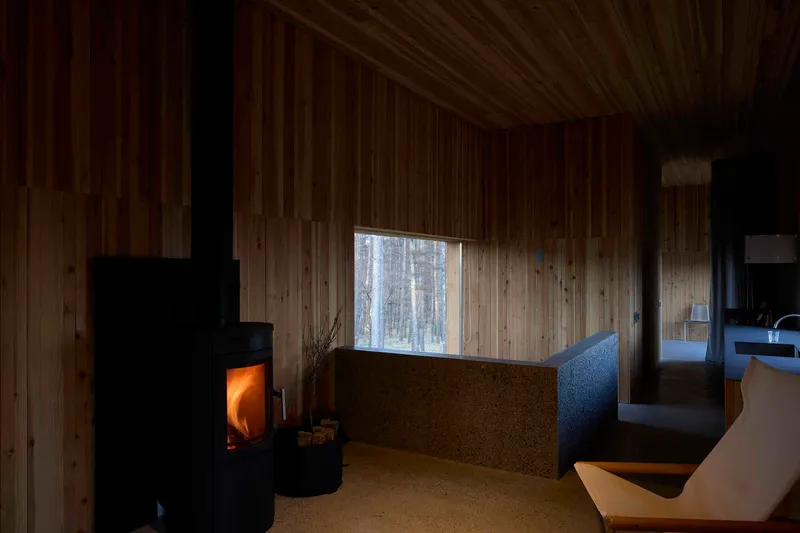
The deep window recesses deserve attention on their own. Where the concrete walls are thickest, the openings become tunnels of light that frame the forest floor at close range, turning a patch of ground cover or a single tree trunk into a composed scene. At night the effect reverses: interior warmth and light project outward through the timber-framed openings, making the house a lantern among the pines.
In the main living space, a black wood-burning stove sits near a window that frames a stand of birch trees. The stove is both pragmatic and atmospheric, the primary heat source on the coldest days and a focal point that anchors the room. The juxtaposition of the dark cast iron against the pale timber walls is one of the house's strongest interior moments.
Timber Interiors and Concrete Corridors
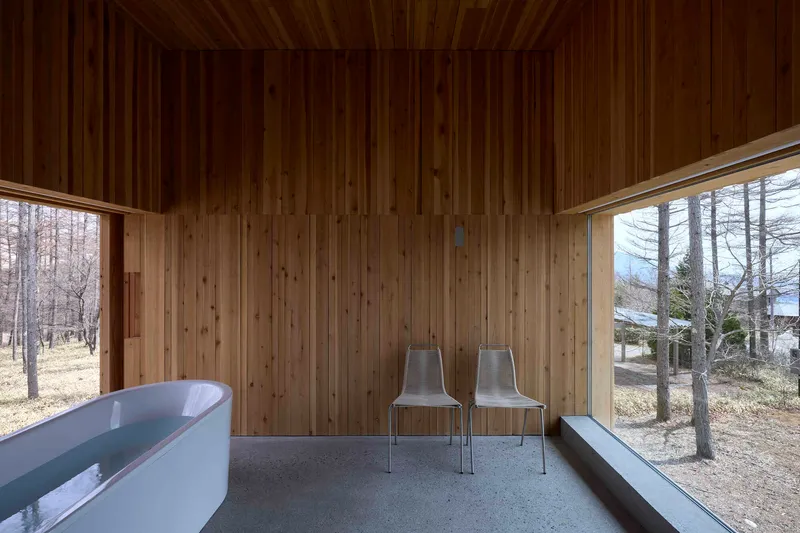
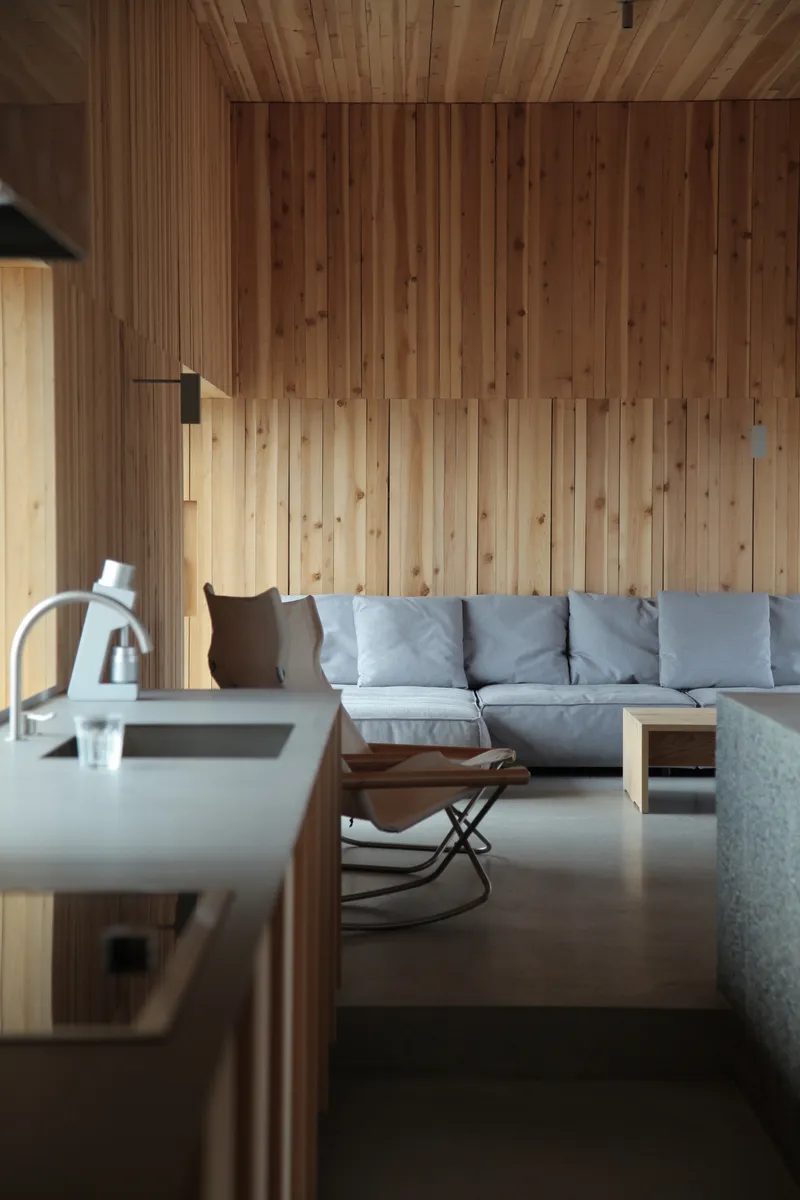
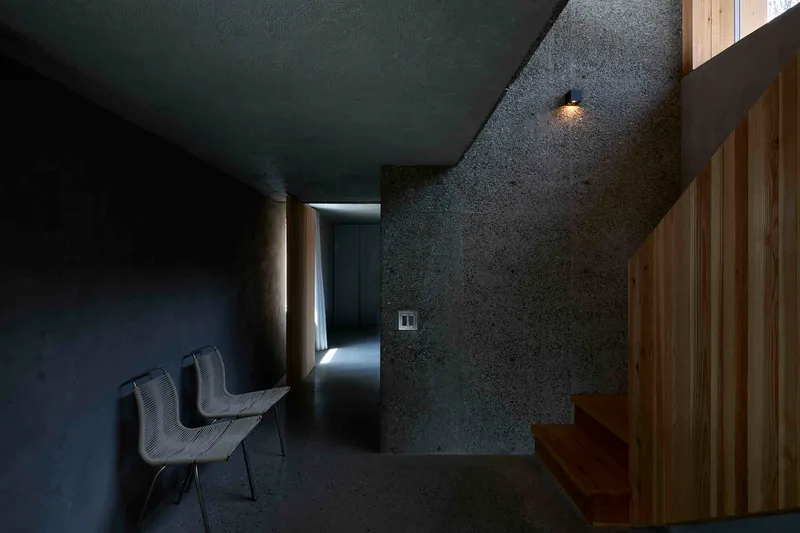
Inside, the material palette narrows to two voices: timber and concrete. The upper living spaces are entirely wrapped in vertical timber paneling on walls and ceiling, with polished concrete or terrazzo underfoot. Two corner windows in the main room punch through this timber shell at precisely the points where opposing views intersect, filling the space with a quiet, omnidirectional light that shifts with the seasons.
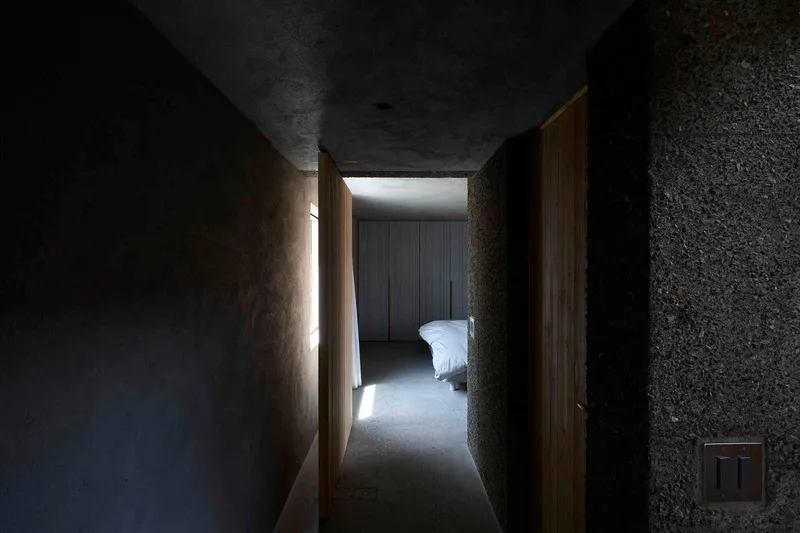
The corridors tell a different story. Where the upper levels are warm and enveloping, the circulation spaces at the base use exposed, dark-textured concrete to create a compressed, almost subterranean mood. A recessed wall sconce and a timber partition provide the only relief in these passages, heightening the sense of release when you arrive in the daylit rooms above.
Living at Altitude
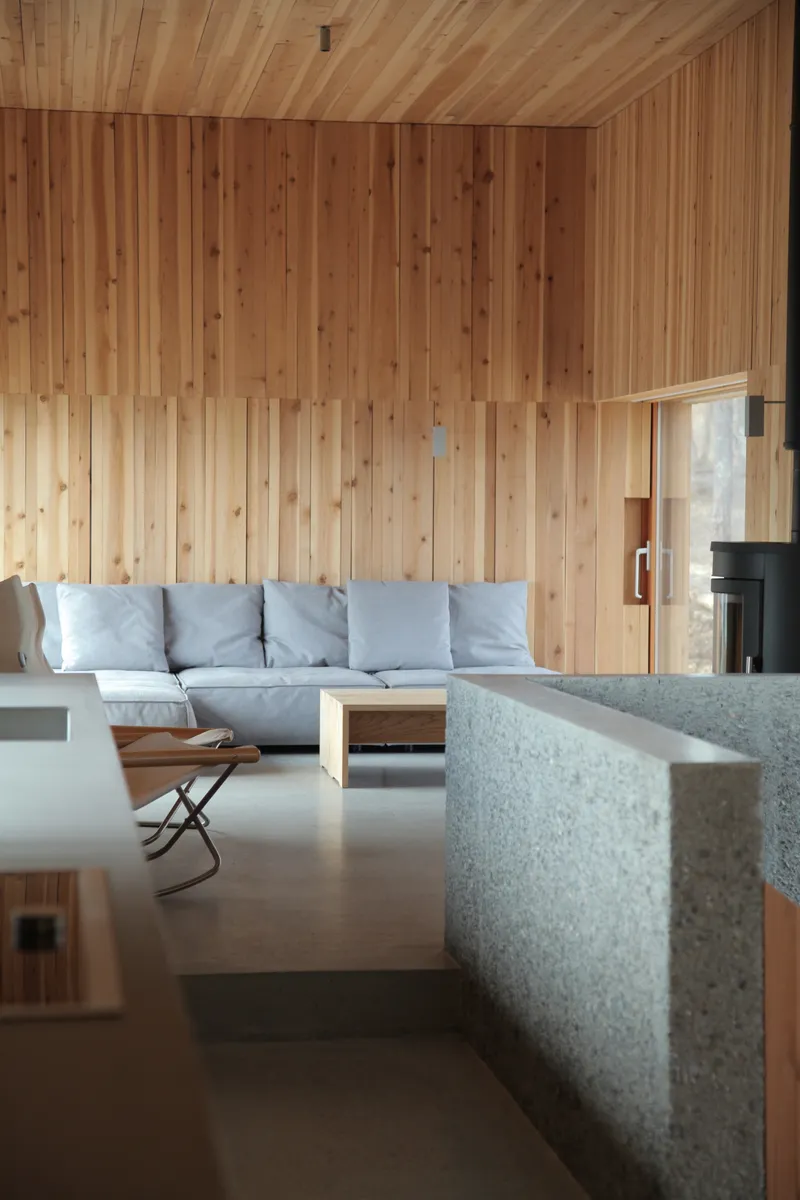
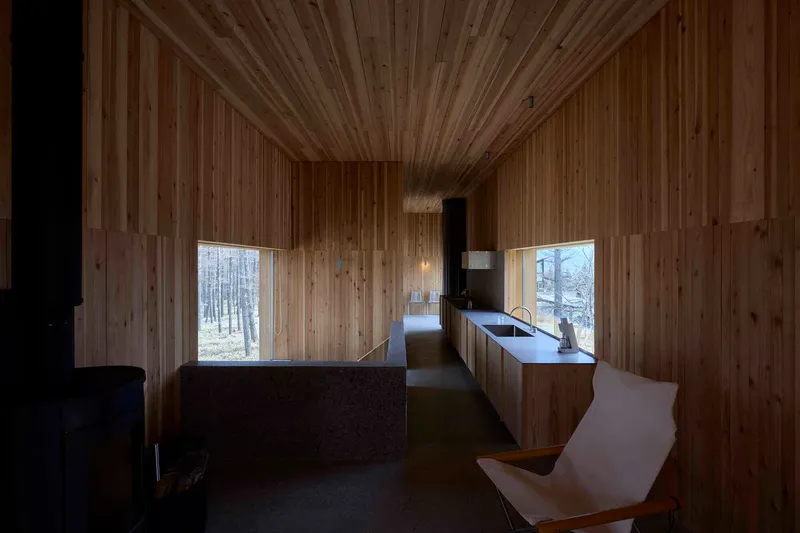
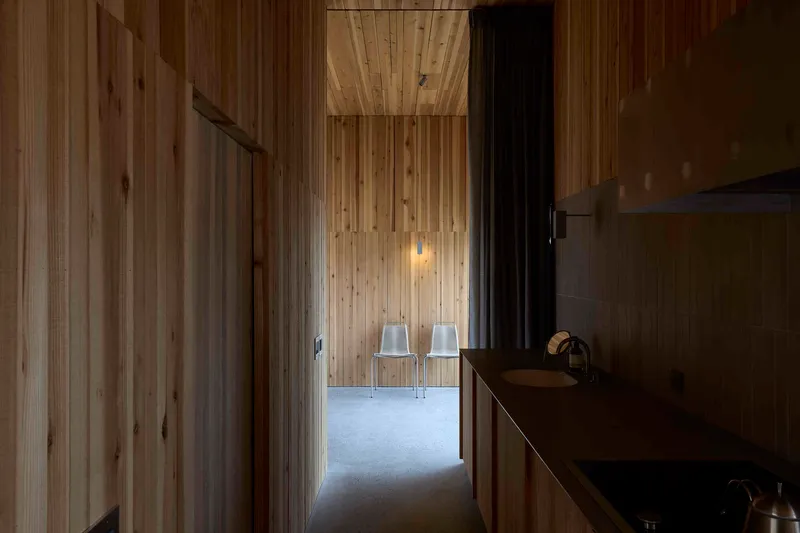
The kitchen and living areas are organized as a continuous sequence of timber-lined spaces, with the terrazzo counter edge of the kitchen island marking the threshold between cooking and dwelling. Punched windows along the corridor frame the winter forest at eye level, so that even the act of preparing a meal becomes a confrontation with the landscape. It is a house where you are never fully indoors.
A pendant light marks the transition from corridor to a secondary sitting area furnished with two white chairs, a detail that suggests this retreat is designed as much for solitary contemplation as for shared life. The proportions are deliberately compact; at 85 square meters, there is no wasted space, only carefully considered thresholds between one room and the next.
Bathing with a View
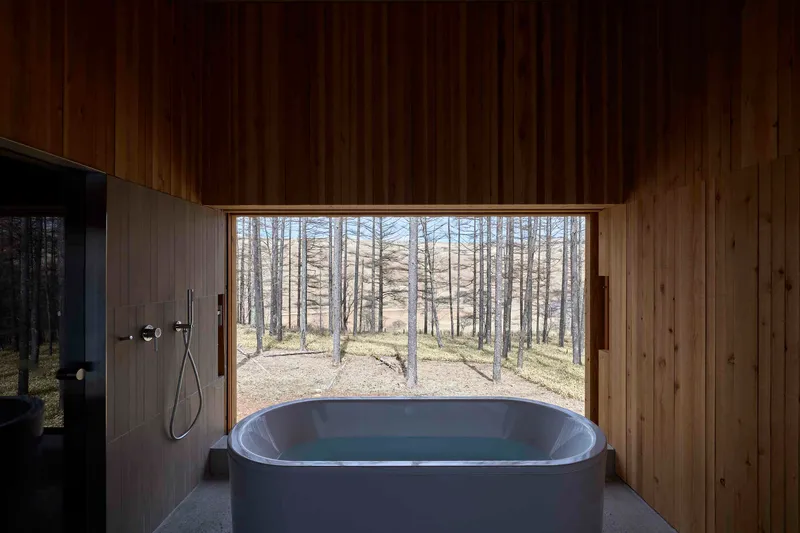
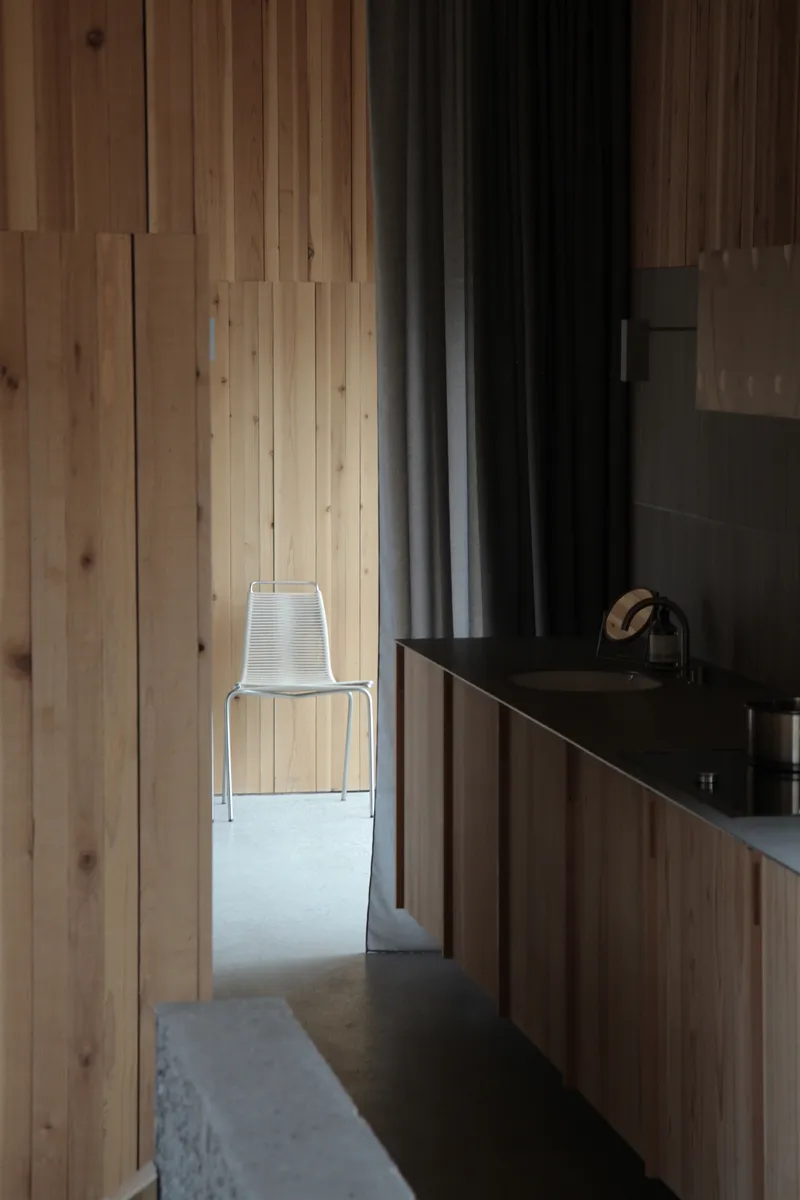
The freestanding bathtub positioned beneath a horizontal window overlooking the sparse forest is the house's most unapologetically luxurious moment. It is a mountain-retreat cliché done right: the window is low and wide enough to connect bather to landscape without sacrificing privacy, and the timber cladding wraps the narrow bathroom corridor to create a warm cocoon against the subzero air outside.
A narrow passage with textured concrete walls and a timber door frames the bedroom beyond, where a clerestory window delivers a band of sky. These sequences of compression and release, dark passage to bright room, narrow corridor to open view, give the small house a spatial richness that belies its modest footprint.
Dusk and the Plateau
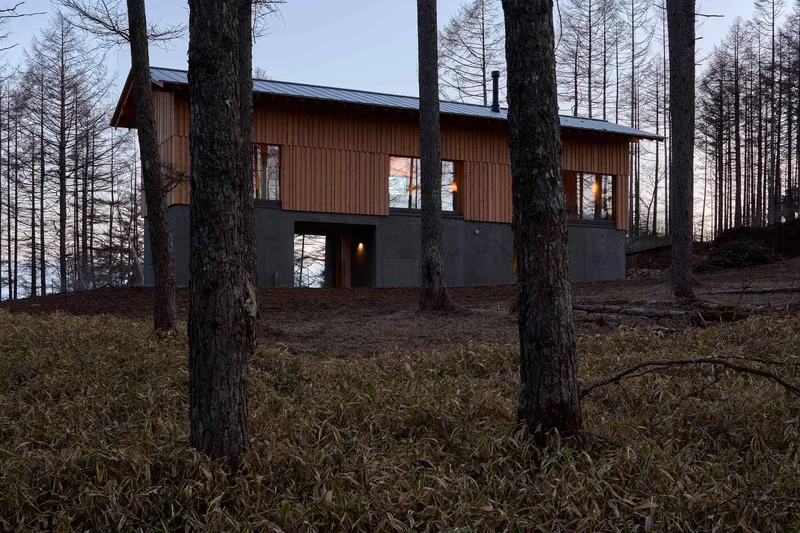
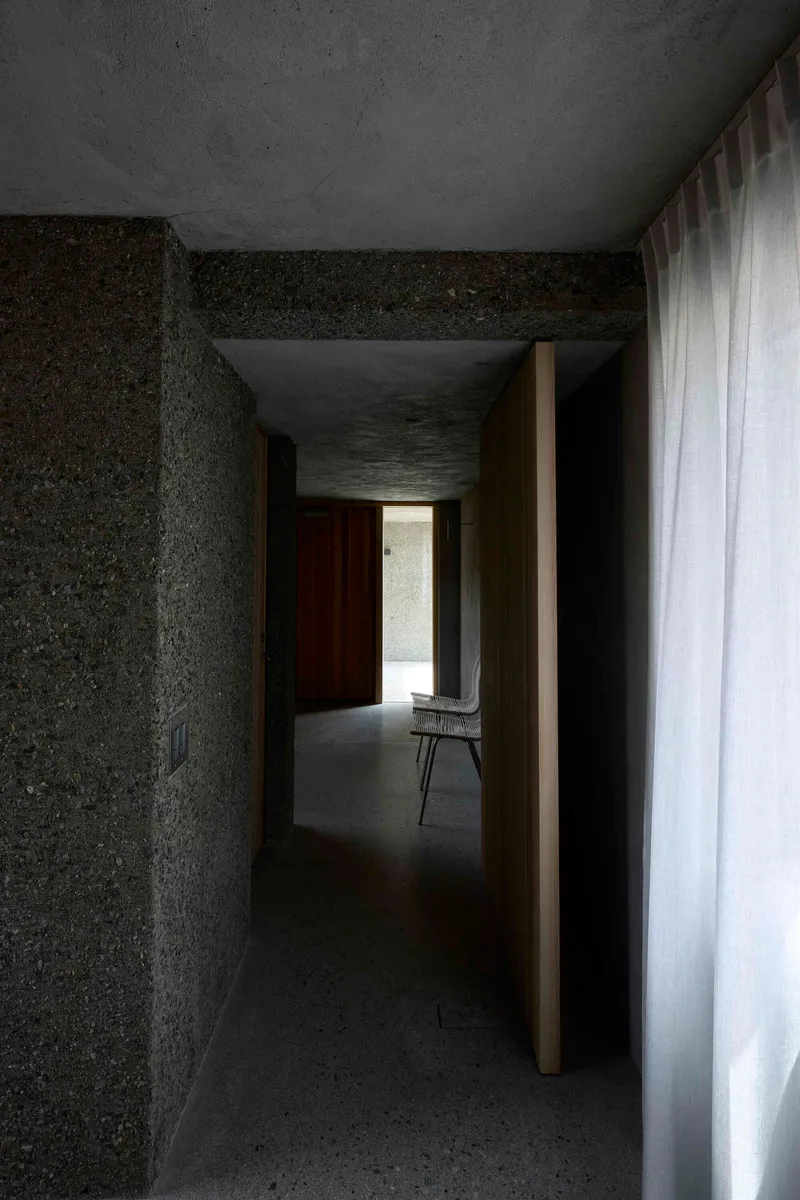
The dusk photographs are revelatory. Elevated among the bare larch trunks, the house becomes an abstraction: a glowing timber box suspended between the concrete earth and the darkening sky. The silhouetted chair in a daylit opening, caught in one interior shot, captures the essential promise of the project. It is a house designed for the act of looking outward, for the slow registration of weather and light at a place where both change with dramatic intensity.
Plans and Drawings
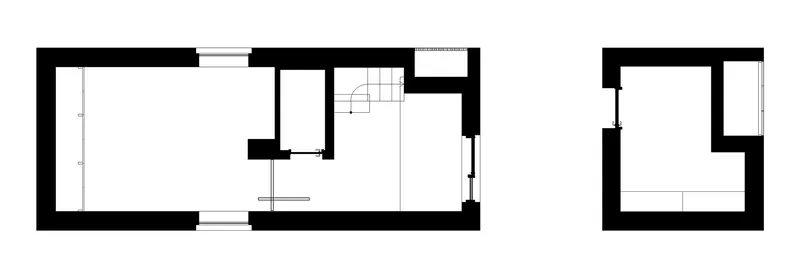
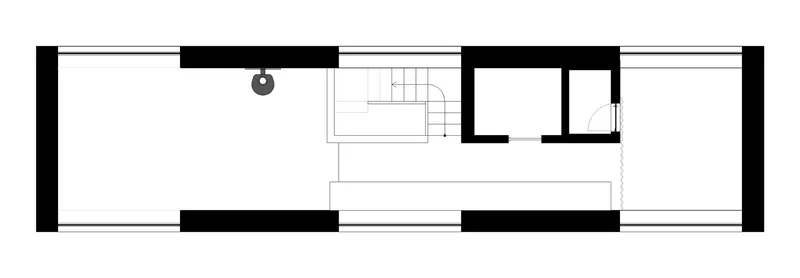
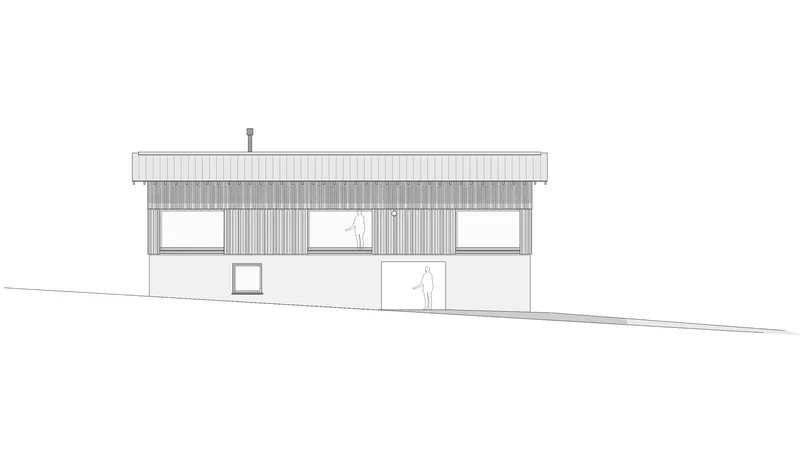
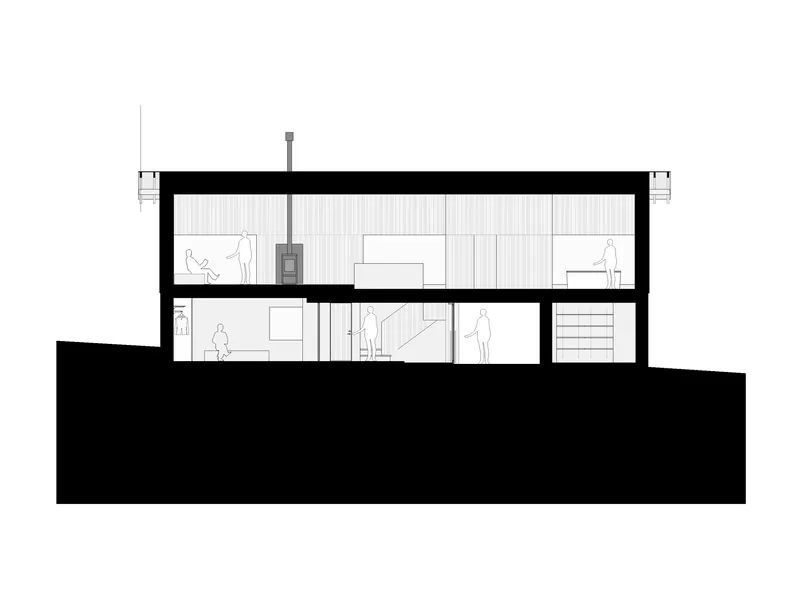
The floor plans reveal a rectangular organization with a central staircase connecting two distinct spatial conditions: a lower level of enclosed concrete rooms and an upper open plan arranged around the wood-burning stove. A small adjacent volume, possibly a storage annex or entry porch, extends the footprint without inflating it. The section drawing confirms what the photographs suggest: the house steps down with the terrain, embedding its concrete base into the slope while the timber living spaces float above the tree line.
The elevation drawing shows the three upper windows as the facade's primary compositional gesture, spaced unevenly to avoid symmetry and to respond to the interior program. The vertical cladding runs continuously from base to eave, unifying the two stories into a single surface. It is a house that reads as simple from outside but reveals its internal complexity only in section.
Why This Project Matters
Mountain retreats too often fall into one of two traps: overbuilt alpine chalets that treat nature as decoration, or minimal glass boxes that ignore the thermal realities of altitude. House in Kirigamine avoids both. Its thick envelope, punched openings, and material honesty respond directly to a climate that swings from summer cool to deep winter cold, while the carefully framed views ensure that the landscape remains the protagonist. At 85 square meters, the house proves that restraint and generosity are not opposites.
For imajo design, this project is a demonstration of how compact architecture can hold real spatial complexity. The corridors, thresholds, and framed views create a sequence of experiences that a larger house might dilute. On a plateau where Mt. Fuji appears on the southern horizon and the Kirigamine wetland stretches to the north, a small house with the right openings can contain an entire landscape.
House in Kirigamine by imajo design. Located in Suwa, Nagano, Japan. 85 m². Completed in 2025. Photography by Akinobu Kawabe.
About the Studio
Share Your Own Work on uni.xyz
If projects like this are the kind of work you want to make, uni.xyz is a place to publish your own, find collaborators, and enter design competitions.


Popular Articles
Popular articles from the community


Hill & Cross Opera: Sculptural Opera House Architecture Shaped by Tallinn’s Landscape and Identity
Hill & Cross Opera reimagines opera house architecture in Tallinn through its sculptural hill, civic plaza, glass wave and a luminous cross.

Play: Fragments of Their World
Familiar architecture becomes modular playground design, creating safe spaces where displaced children can learn, connect, imagine and play.

Lunar Spiral: Space Architecture Shaped by the Mathematics of the Universe
Lunar Spiral reimagines space architecture through Fibonacci geometry, lunar regolith, levitating habitats, and self-sustaining Moon living.

The Musturak Paradise: Senior Living Architecture for a Connected Future in Temara, Morocco
The Musturak Paradise reimagines senior living architecture in Temara via private homes, social spaces, culture, community, and shared care.


Similar Reads
You might also enjoy these articles

Bao Huynh Watercolor Atelier: A Serene Art Retreat in Hội An
Bao Huynh Watercolor Atelier in Hội An blends multifunctional art spaces, sustainable design, local materials, and family-friendly living in a serene environment.

Atelier Macri Concept Store Interior Design by CASE-REAL
Atelier Macri store features a "ko" counter, walnut wood details, cork displays, blending retail, gallery, and seamless customer experiences.

Manuel Vargas Izquierdo Stadium and High-Performance Sports Center: Architectural Excellence in Jalpa de Méndez
The Manuel Vargas Izquierdo Stadium blends sustainable design, inclusive sports facilities, and cultural-inspired architecture, revitalizing Jalpa de Méndez’s public spaces.
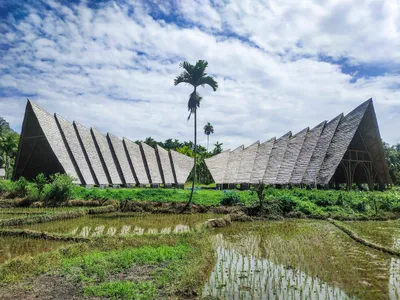
KAKR Buluh Awar Hall: Revitalizing Community and Ecology Through Bamboo Architecture
Community built bamboo hall revitalizes Buluh Awar village, empowering youth, restoring ecology, celebrating vernacular craftsmanship through sustainable architecture and culture.




Comments (0)
Please login or sign up to add comments
No comments yet. Be the first to comment!