
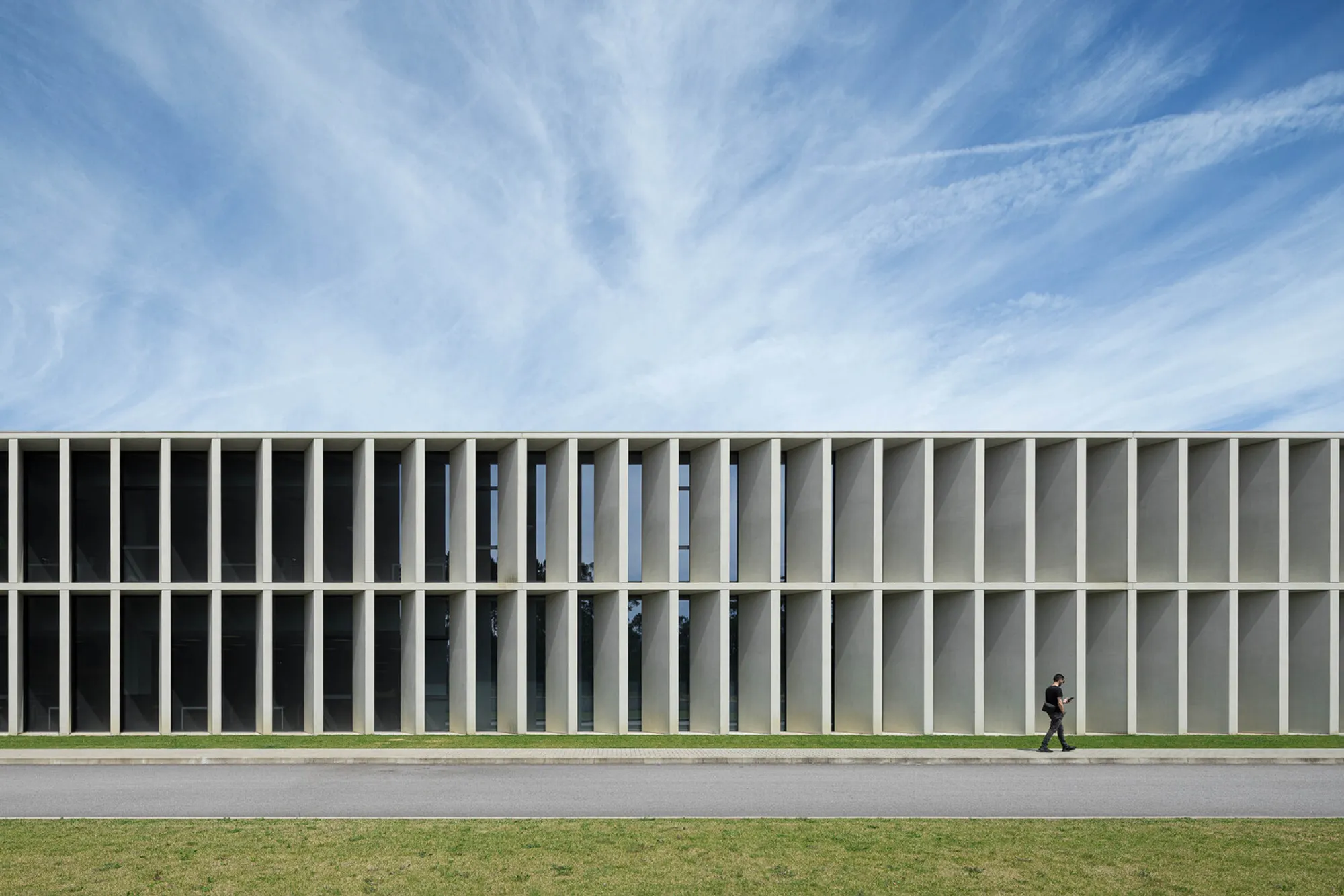
Multiprojectus Wraps a Portuguese Factory in a Relentless Rhythm of Concrete Fins
BW II in Viana do Castelo turns the industrial shed typology into an exercise in civic generosity and tectonic precision.


Industrial architecture rarely gets the chance to be more than a box beside a highway. BW II, designed by Multiprojectus in Viana do Castelo, takes that chance and runs with it. The building is a long, ground-hugging production facility set between forested hillsides in Portugal's northern Minho region, and its defining gesture is an unbroken screen of vertical concrete fins that wraps the entire public perimeter. From a distance the fins read as a single textile, almost like a woven panel laid over an industrial shed. Up close they modulate light, frame the mountains, and give an enormous structure a surprisingly intimate grain.
What makes the project interesting is how seriously it takes the idea that a factory can contribute to its street. The fins are not decorative appliqué; they organize shade, privacy, and ventilation across a facade that could easily have been corrugated steel. Behind them, a sequence of lobbies, staircases, and office floors is finished with the kind of attention to daylight and material that you would expect in a headquarters building, not a manufacturing plant. The result is a project where production and representation coexist without one cheapening the other.
A Facade That Works Like a Veil
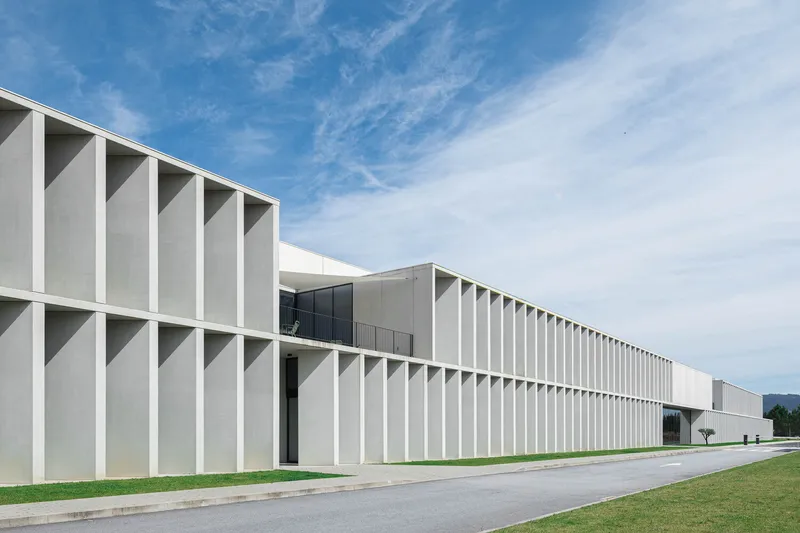
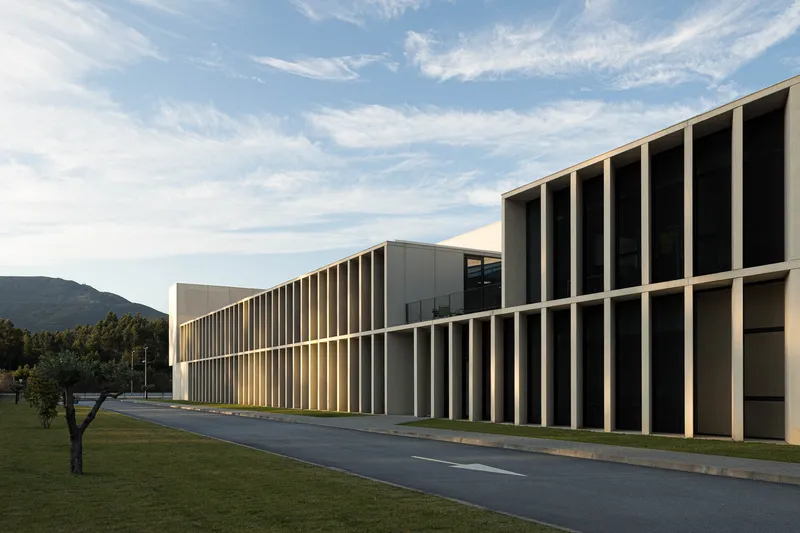
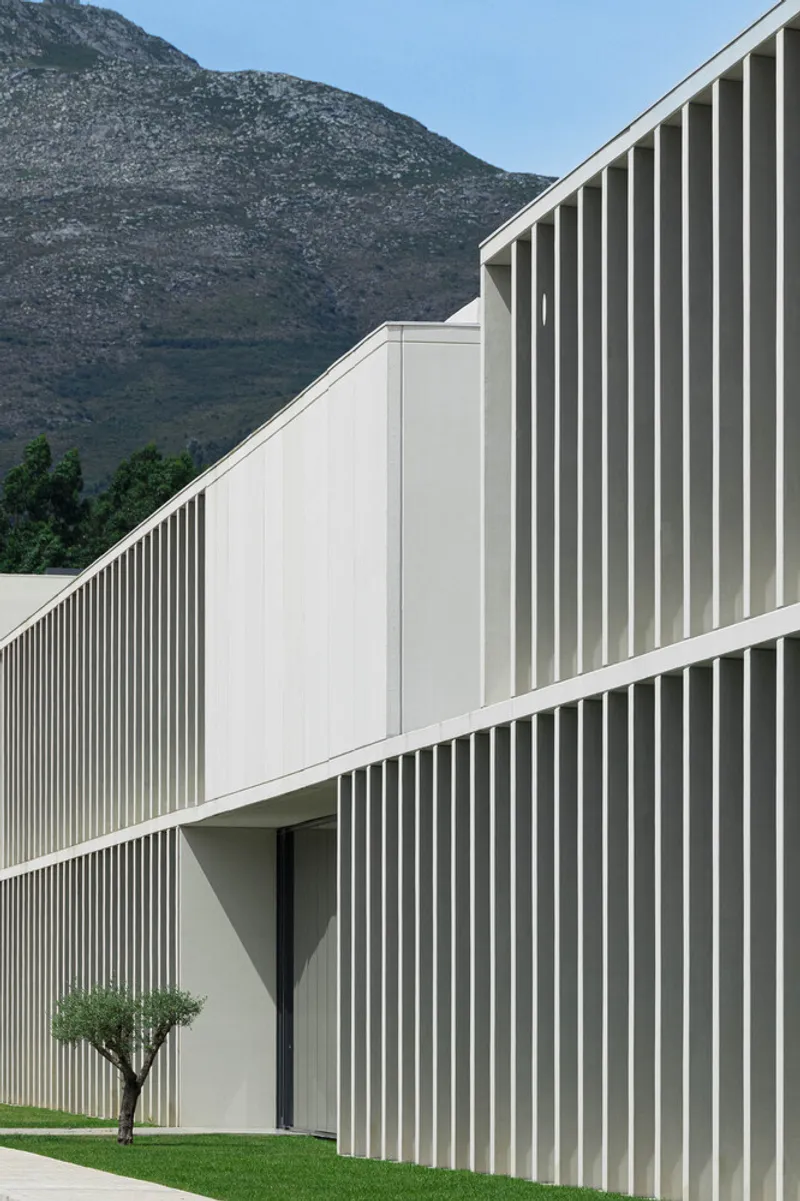
The vertical fin system is the project's signature and its hardest-working element. Seen along the full length of the building, the fins compress perspective into a moiré pattern that shifts as you drive or walk past. They are deep enough to shade the glazing behind them during summer but spaced widely enough to let northern light flood the offices year-round. In a region where the mountain backdrop is the dominant visual asset, the fins frame it in rhythmic slices rather than blocking it out.
Crucially, the system is consistent. It wraps corners without changing pitch, turns from one volume to the next, and holds the entire facade together as a single composition. At the building's junction points, where a smooth white panel volume meets the louvered portion, the contrast makes the logic legible: behind the fins sits the public-facing program, and behind the flat panels sits production.
The Courtyard as Threshold
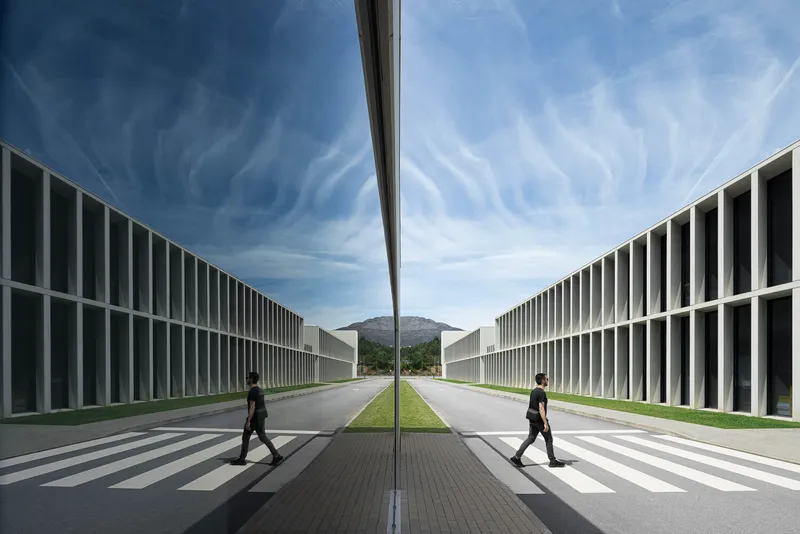
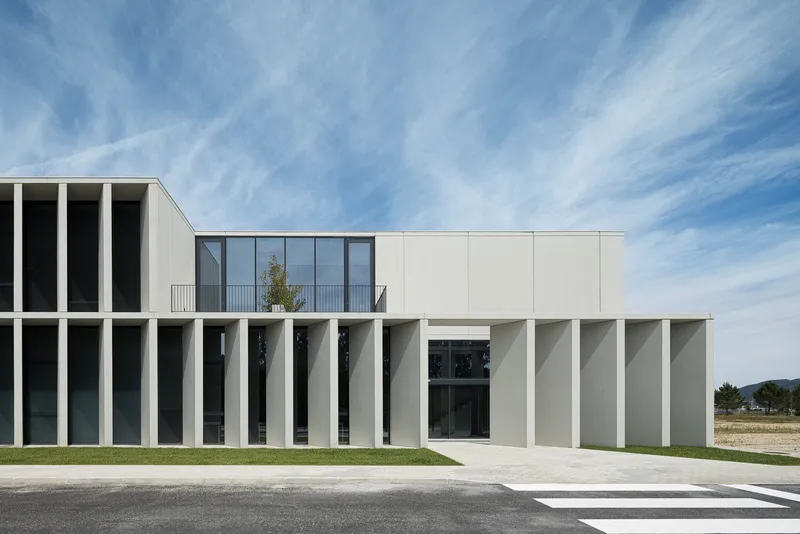
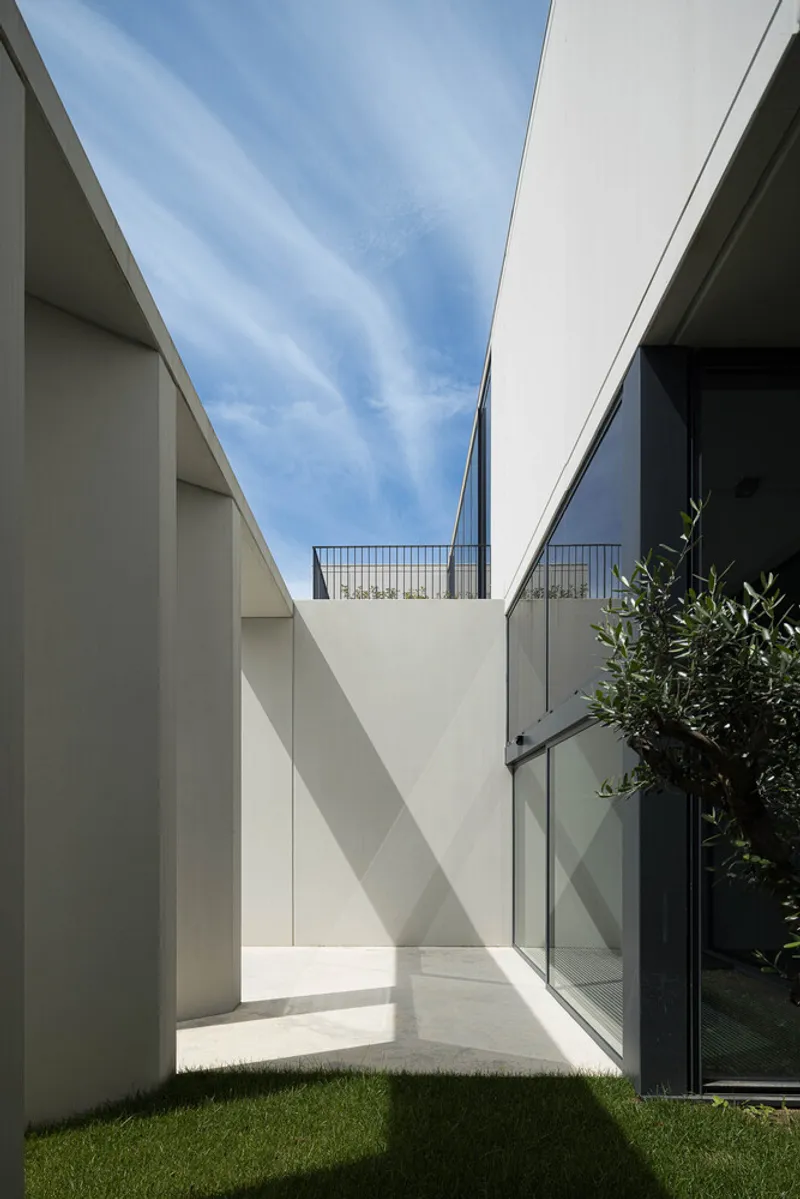
BW II organizes its entrance around a symmetrical courtyard carved between two flanking volumes. Zebra crossings, low lawns, and the flanking fin walls create a kind of civic forecourt that slows you down before you enter. It is a generous move for a building type that usually defaults to a parking lot and a roller door. The courtyard also pulls daylight deep into the plan, giving the glazed upper volume a double exposure that the surrounding offices benefit from throughout the day.
Concrete Colonnades and Corner Towers
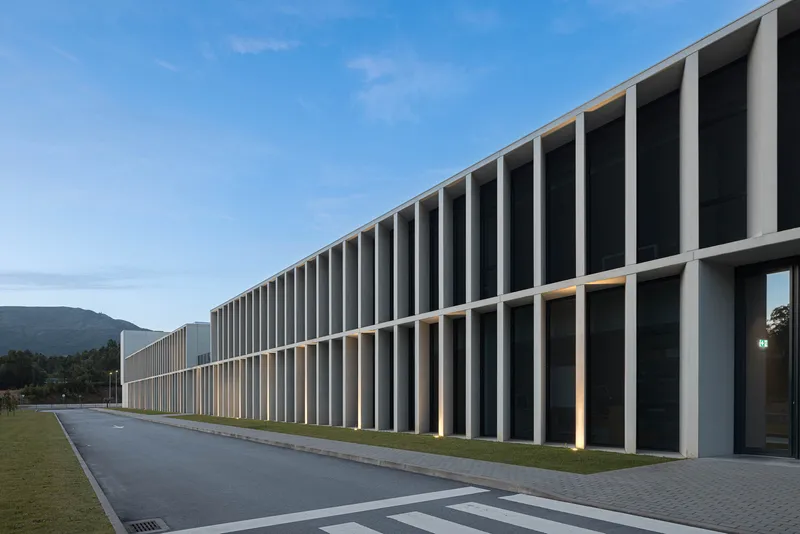
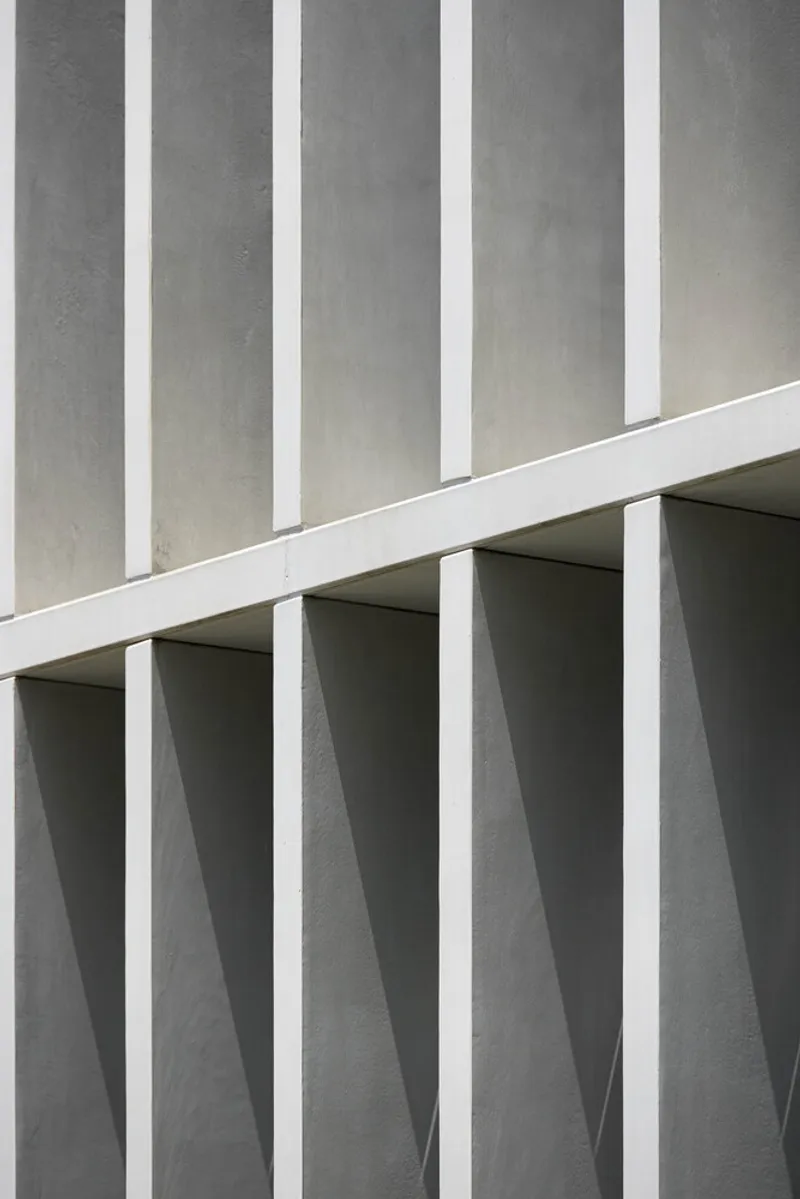
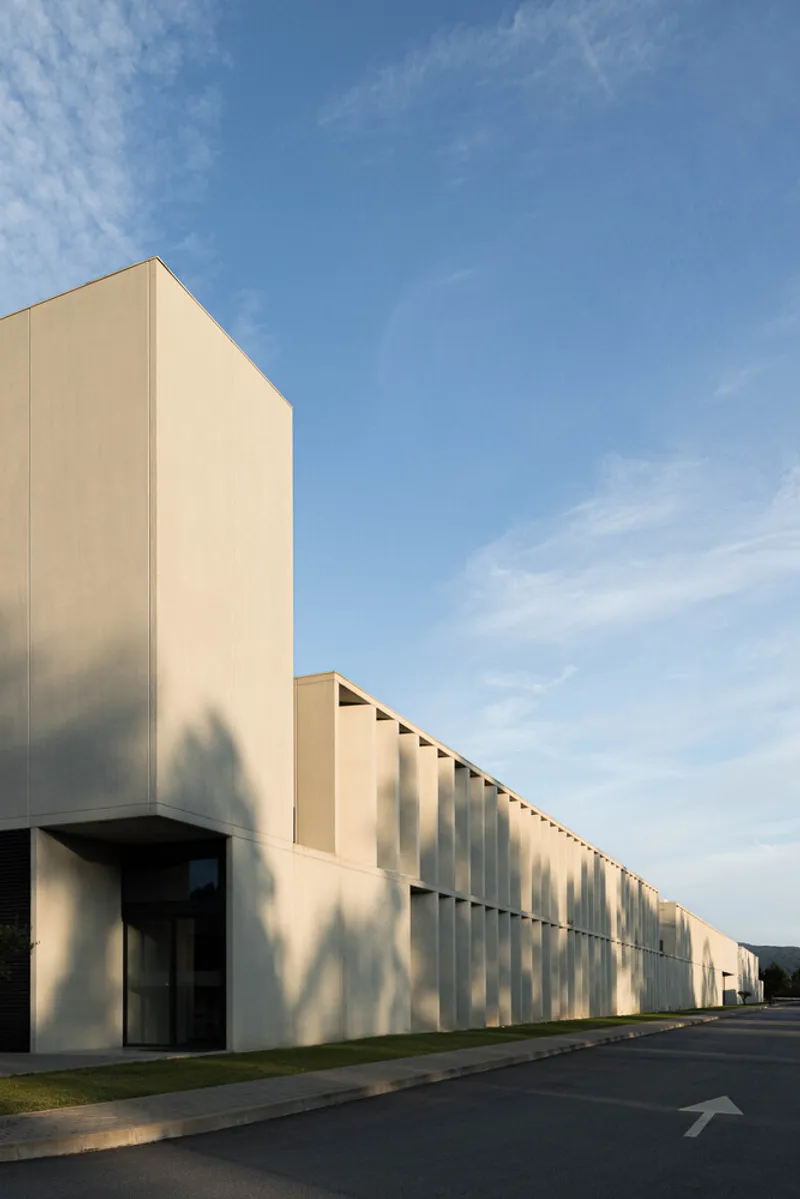
Not every elevation relies on the fin system. On several faces, Multiprojectus switches to a colonnade of vertical concrete piers with deep recessed openings that read almost like a Renaissance loggia in section. The depth of these recesses creates strong shadow lines that change character through the day: crisp and geometric in the morning, soft and warm by late afternoon. A corner tower punctuates the composition, catching the last light and anchoring the building on the street.
The interplay between the louvered surfaces and the solid colonnade keeps the building from becoming monotonous over its considerable length. Each portion of the facade corresponds to a different interior condition, so the exterior honesty is not just aesthetic but genuinely functional.
Entry and Arrival Sequence
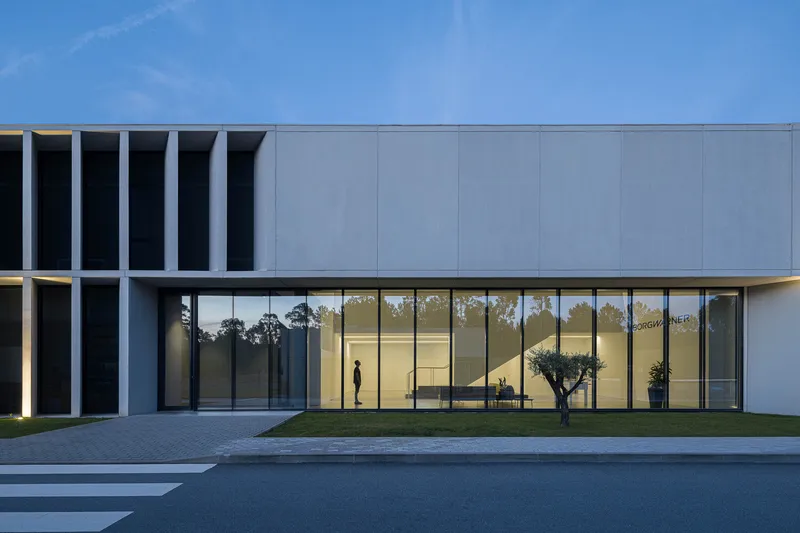
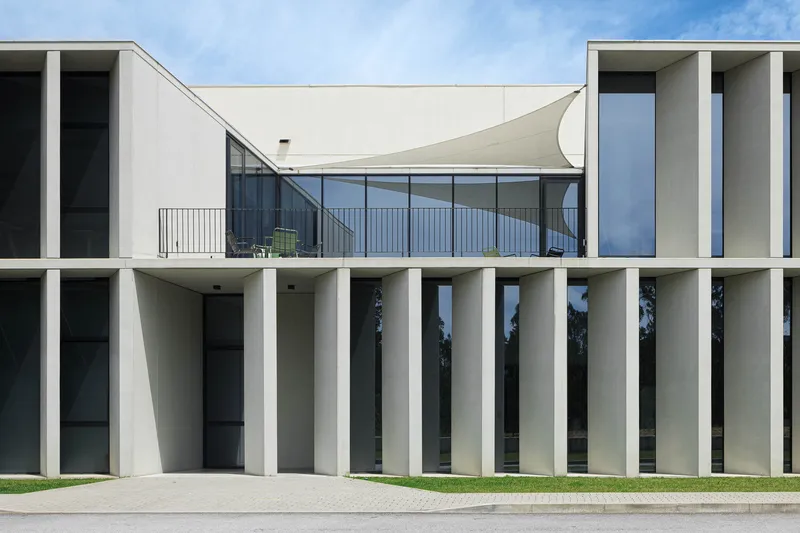
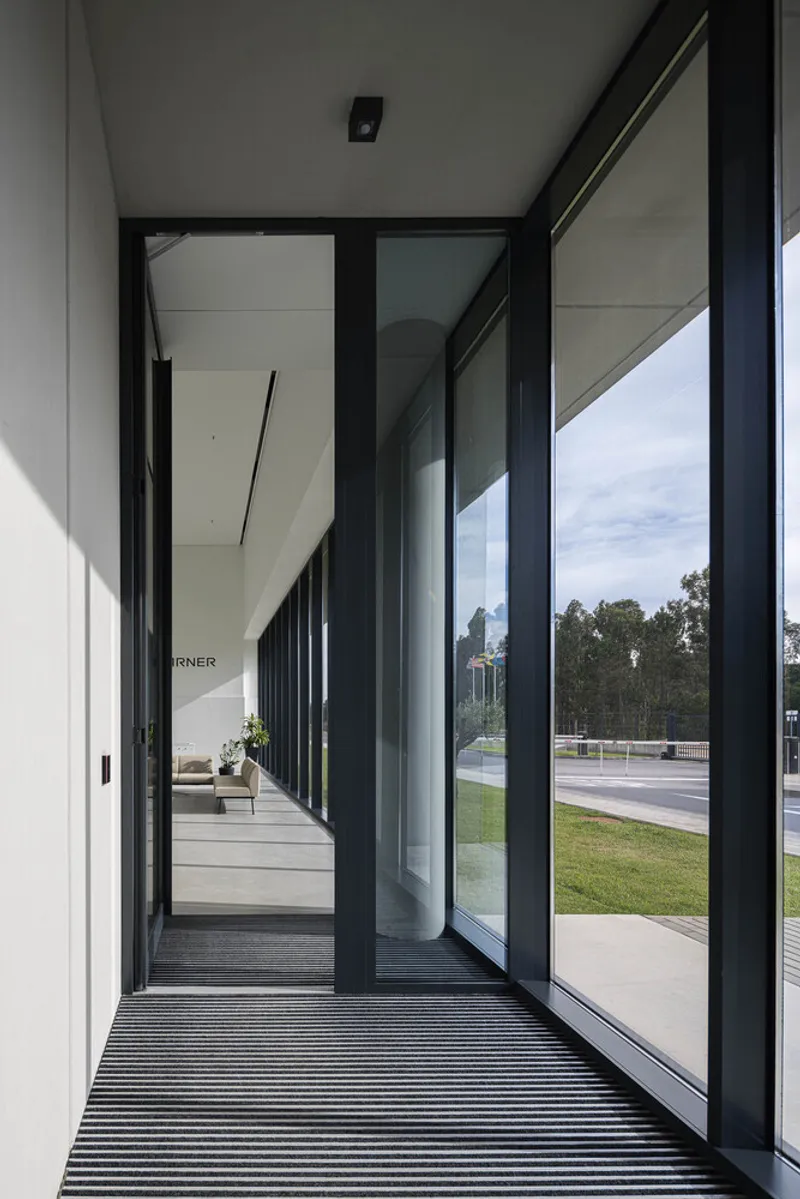
The main entrance is a floor-to-ceiling glass wall that glows at dusk, turning the foyer into a lantern visible from the street. A curved tensile canopy stretches over the glazing like a pulled fabric, its geometry in deliberate tension with the rectilinear concrete columns below. The entrance matting, the aluminum mullions, the view through to the lawn: every element is calibrated so that the transition from exterior to interior feels gradual rather than abrupt.
Staircases as Light Instruments
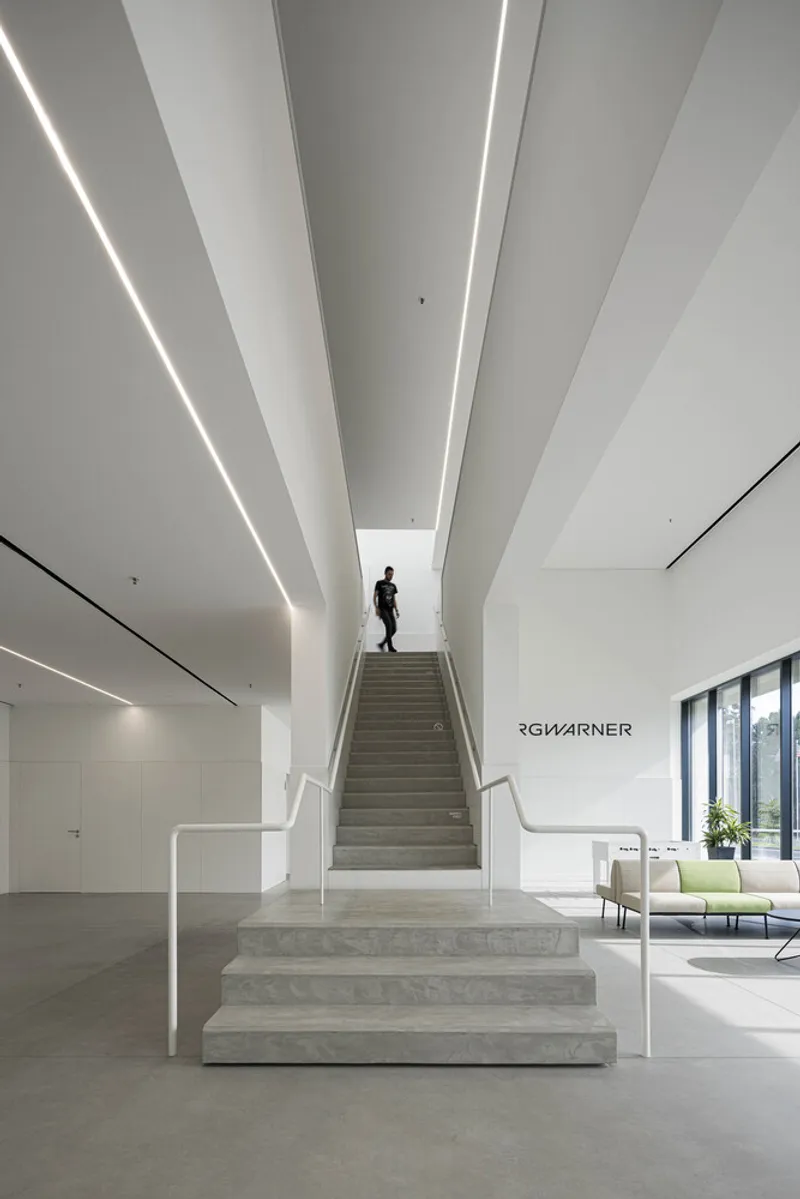
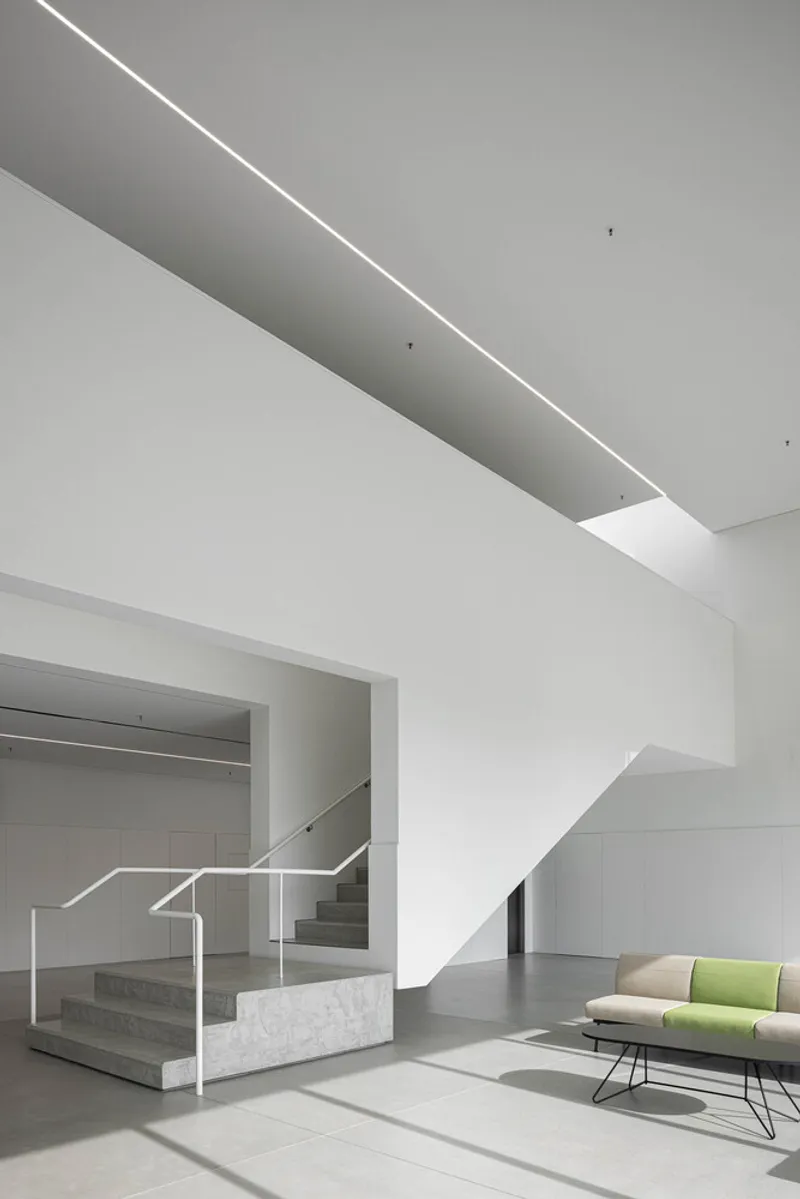
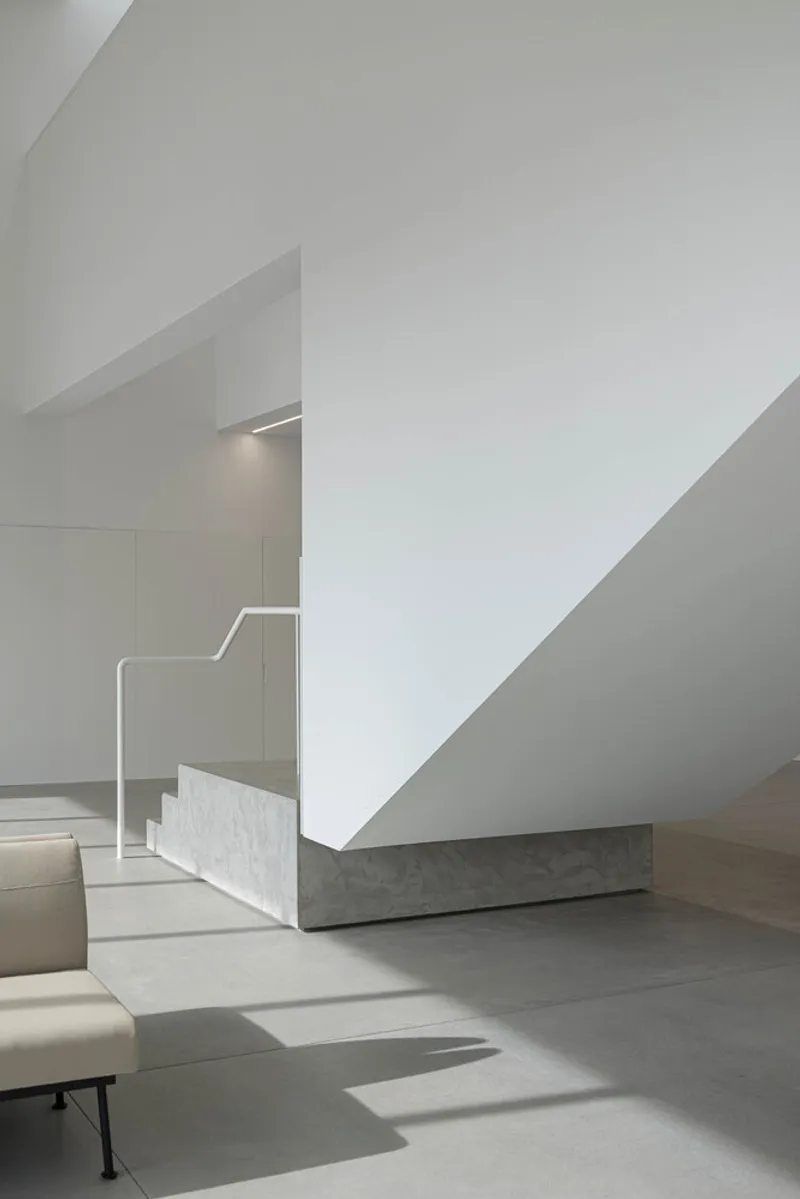
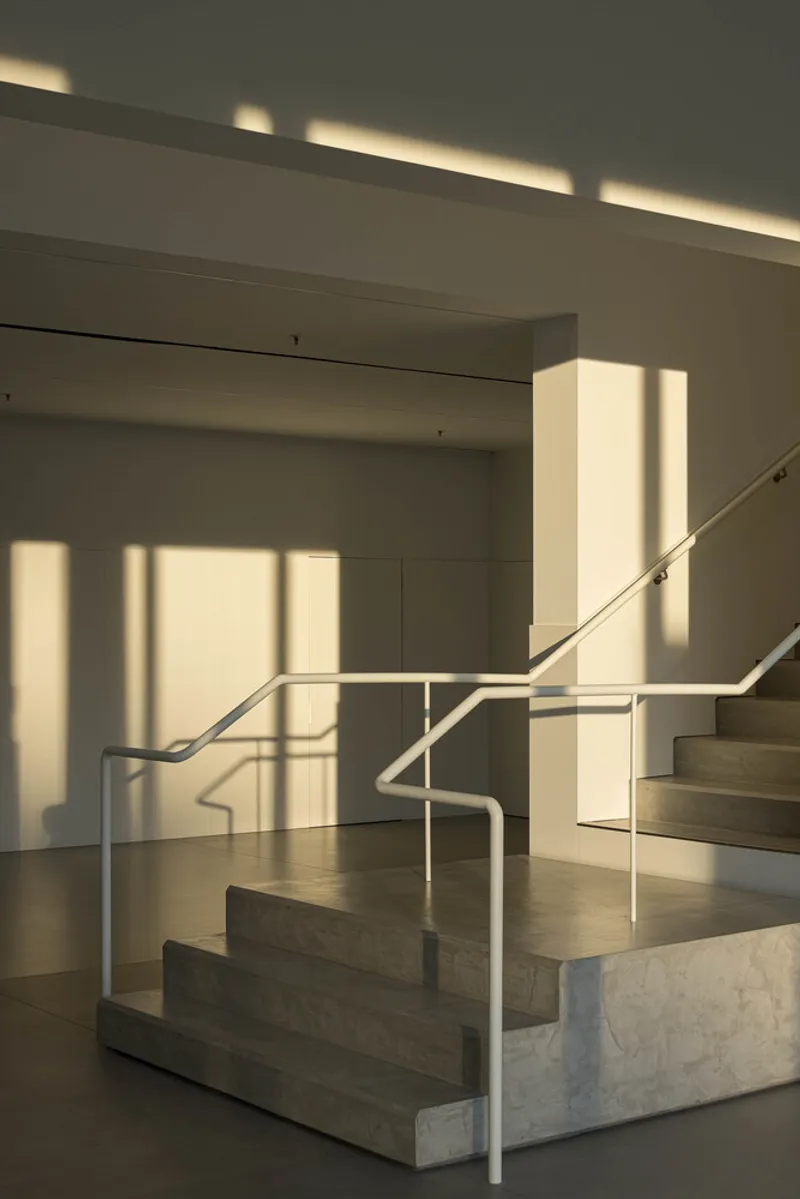
Multiprojectus treats the staircases as the building's primary light instruments. Linear skylights run along the stair shafts, casting diagonal shadows that migrate across the marble treads as the day progresses. The angular ceiling beams in one staircase rhyme with the angled handrails in another, and the palette is kept tight: white walls, pale stone, tubular steel rails. The result is a series of vertical moments that give an otherwise horizontal building its spatial drama.
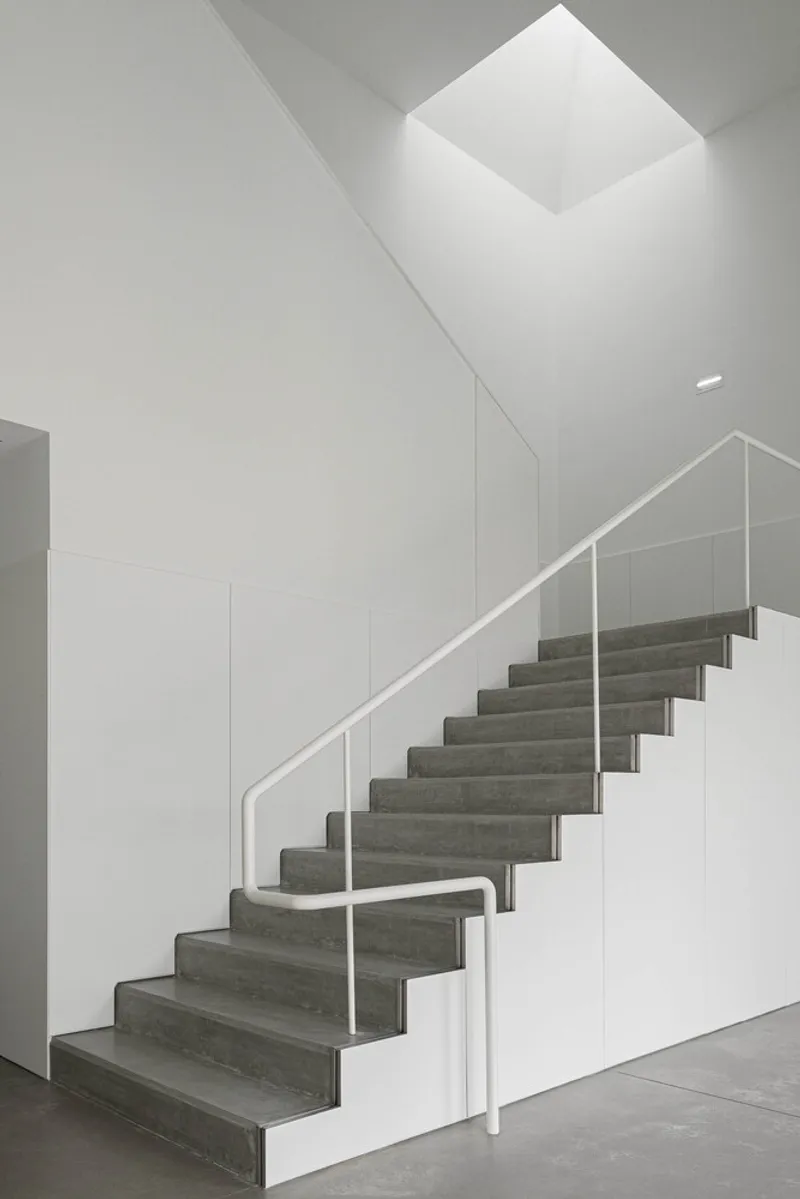
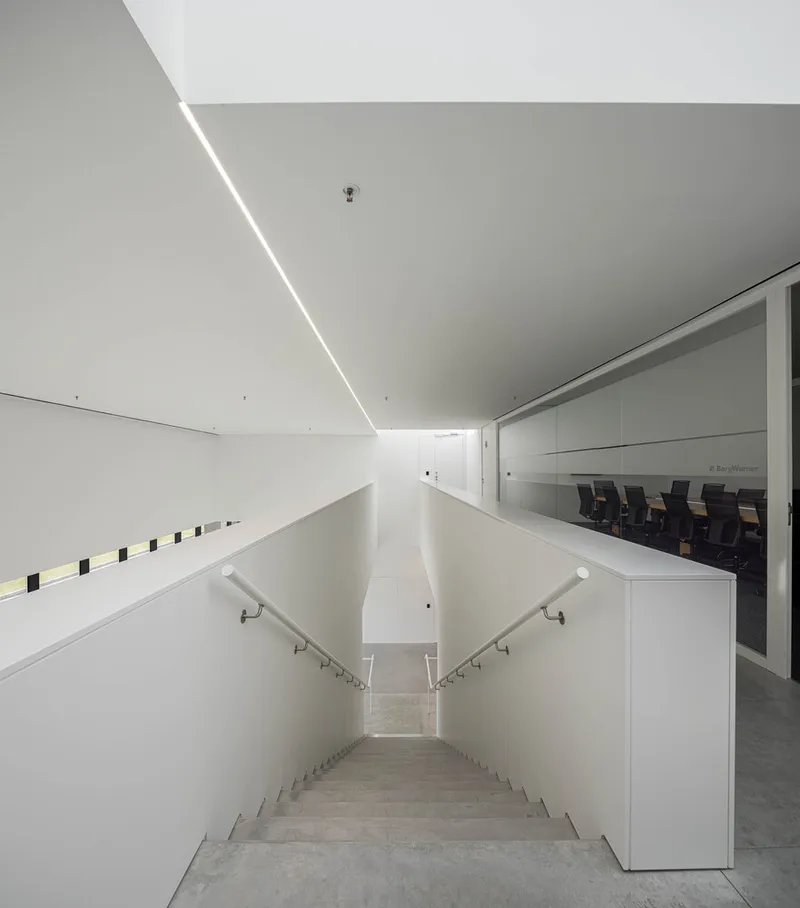
A square skylight crowns one staircase, centering light on the descent. Another stair is flanked by twin white walls and illuminated by a continuous ceiling strip that draws the eye downward. These are not expensive materials or complex geometries; they are careful proportions and precise apertures. The lesson is worth remembering: good light design costs almost nothing, but it transforms everything.
Office and Production Interiors
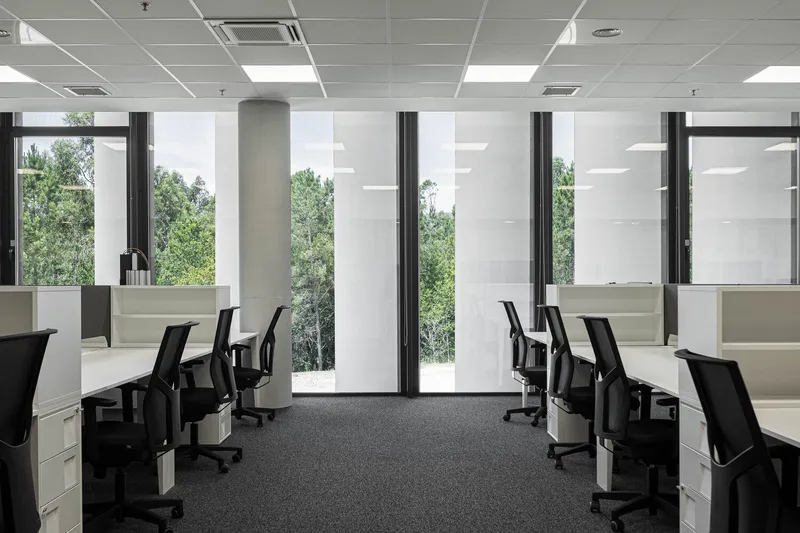
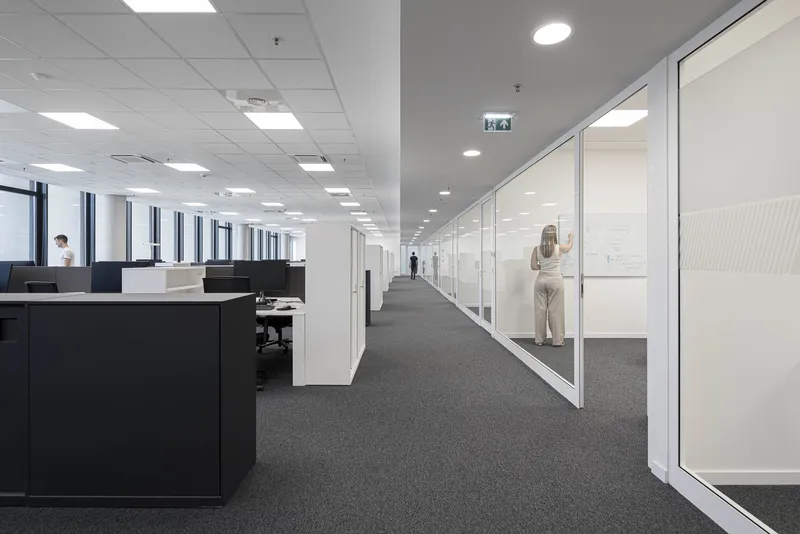
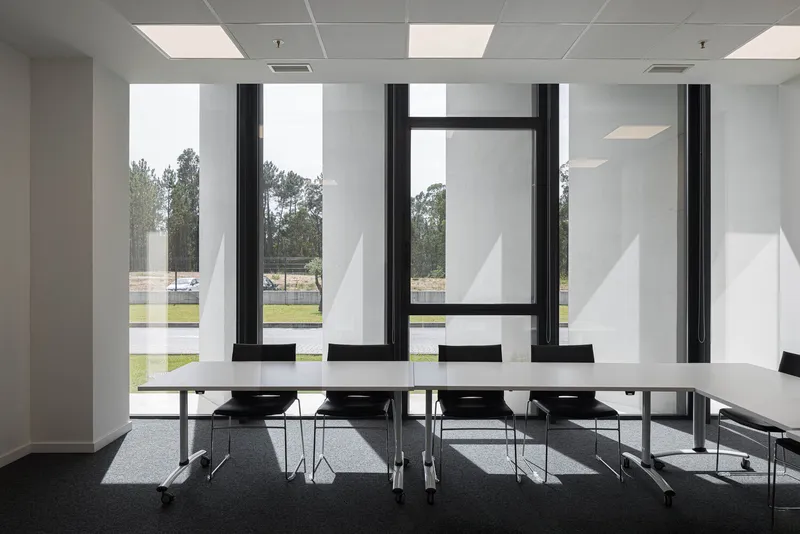
The office floors sit behind the fin facade, so every workstation looks out through the vertical slats to the landscape beyond. Concrete columns punctuate the open plan, and the vertical panel windows create a steady cadence of light and shade that avoids both glare and gloom. Glass-walled meeting rooms line the corridors, and a conference room at the upper level is finished in white surfaces with tall vertical windows that echo the exterior rhythm at a tighter scale.
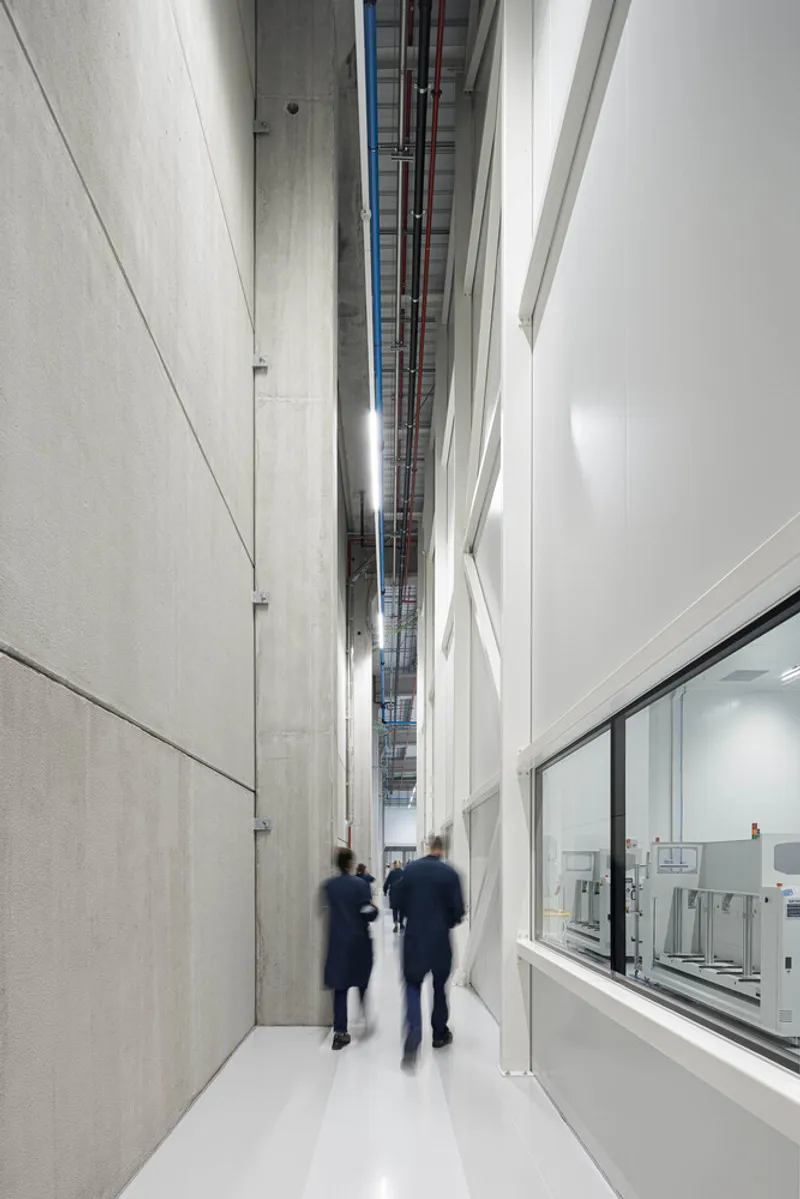
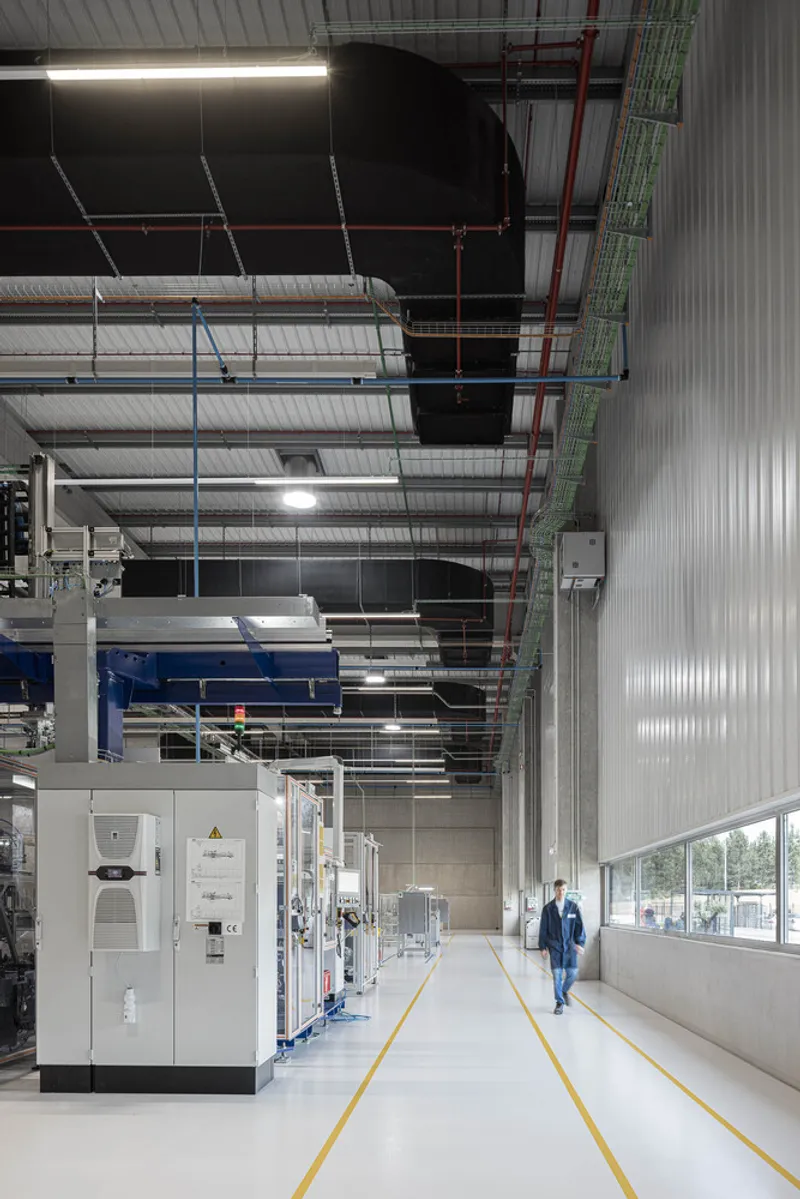
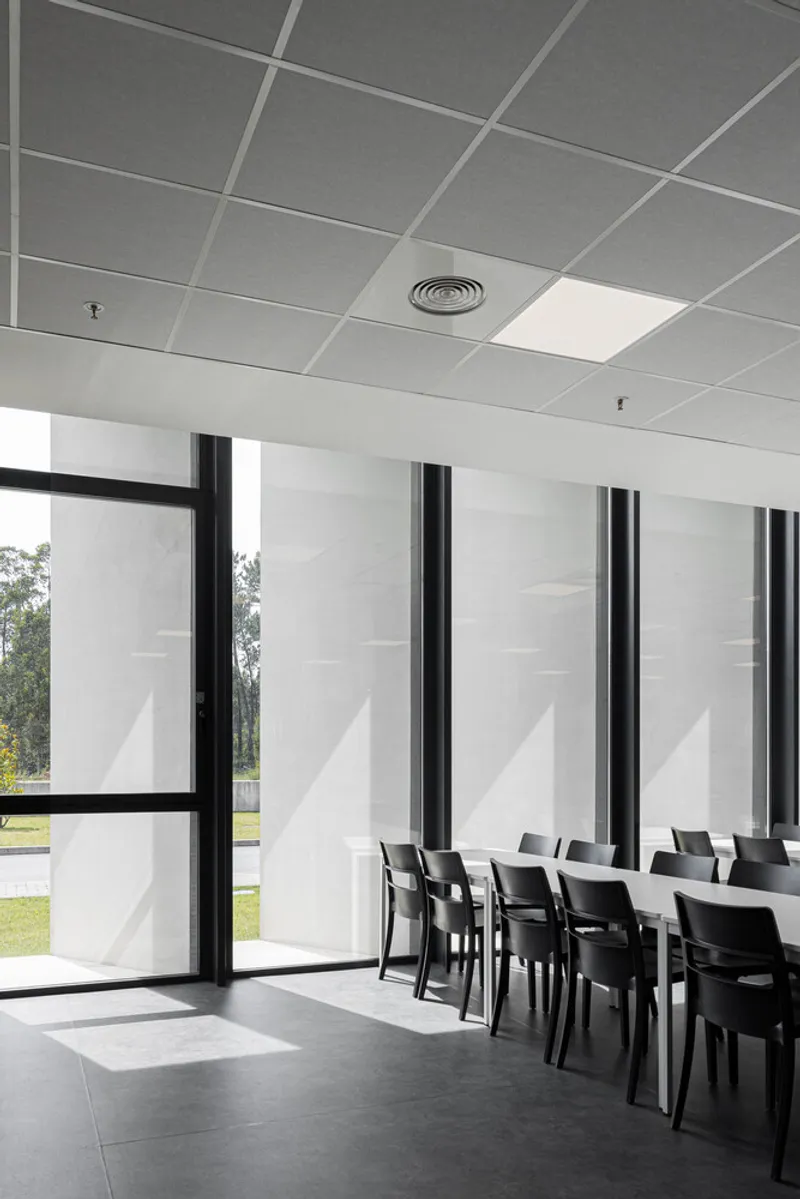
The production floor is deliberately honest: exposed ceiling ducts, corrugated metal panels, machinery in full view. It does not pretend to be a gallery. But it is well lit, well organized, and spatially legible, which is exactly what a working factory floor needs. The dining area, with its acoustic ceiling tiles and window wall, is one of those spaces where the architect clearly thought about the daily experience of the people who eat lunch there, not just the client who signs the check.
Landscape and Site
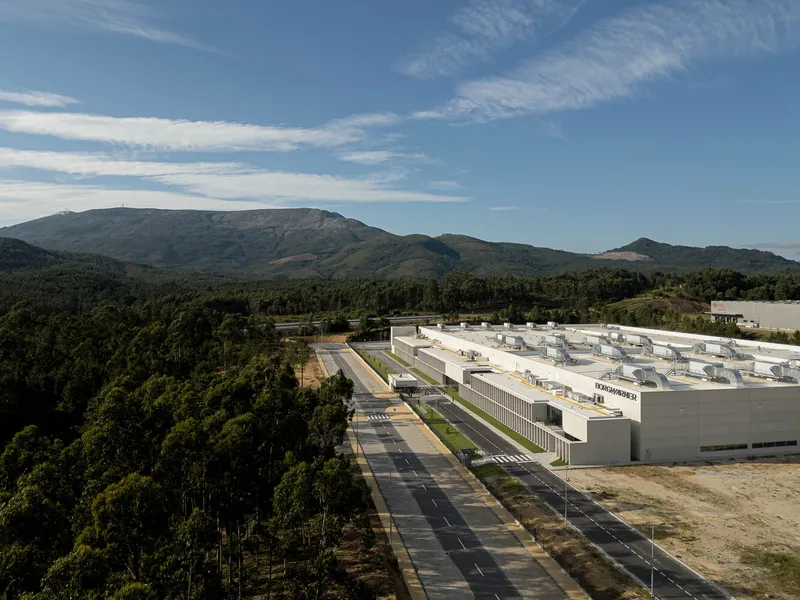
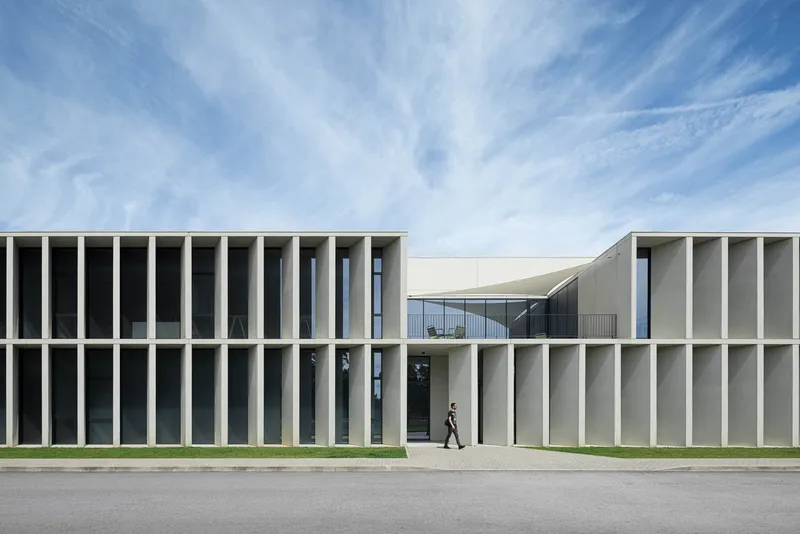
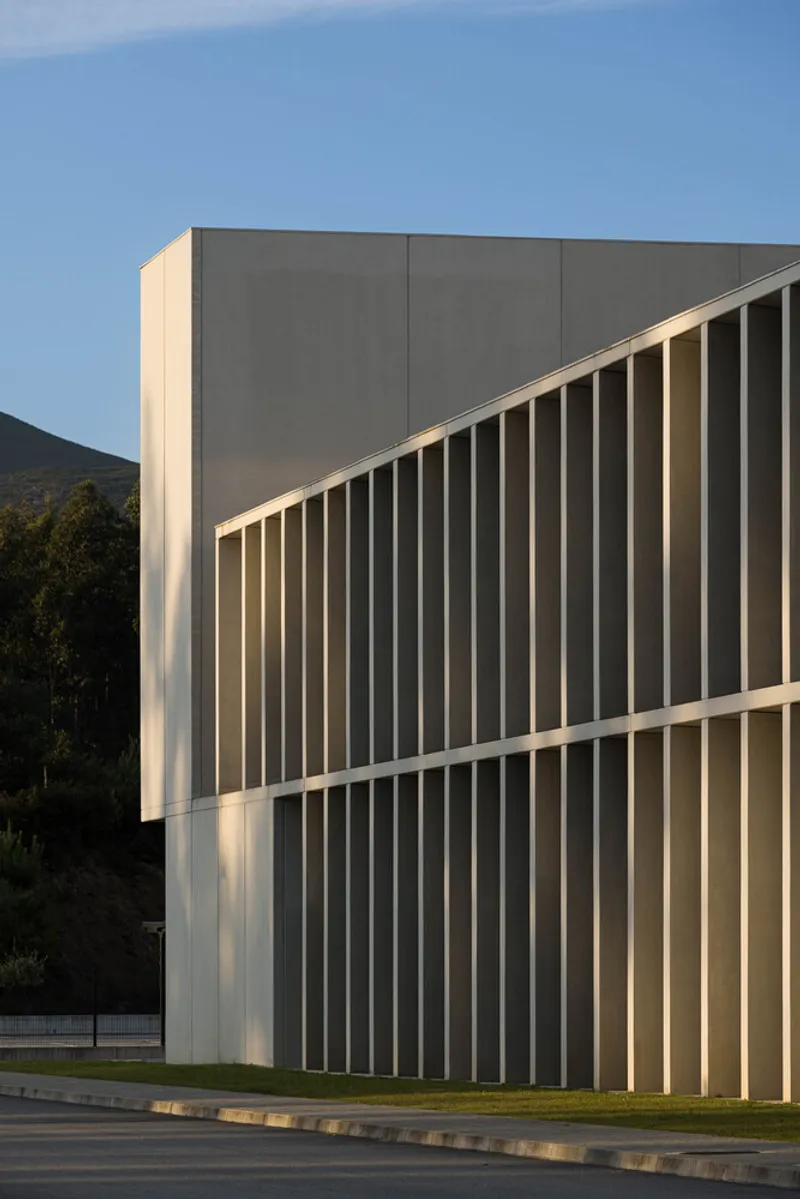
From the air, BW II reads as a long white bar inserted into a valley between forested slopes. Its orientation and proportions suggest a deliberate effort to sit with the topography rather than against it. At street level, the building meets the road with its fin facade, which acts as a permeable boundary: not a wall but a threshold. At dusk, the concrete fins catch the last mountain light, and the entire facade shifts from white to warm gold in a matter of minutes.
Lobby, Balcony, and Transitional Spaces
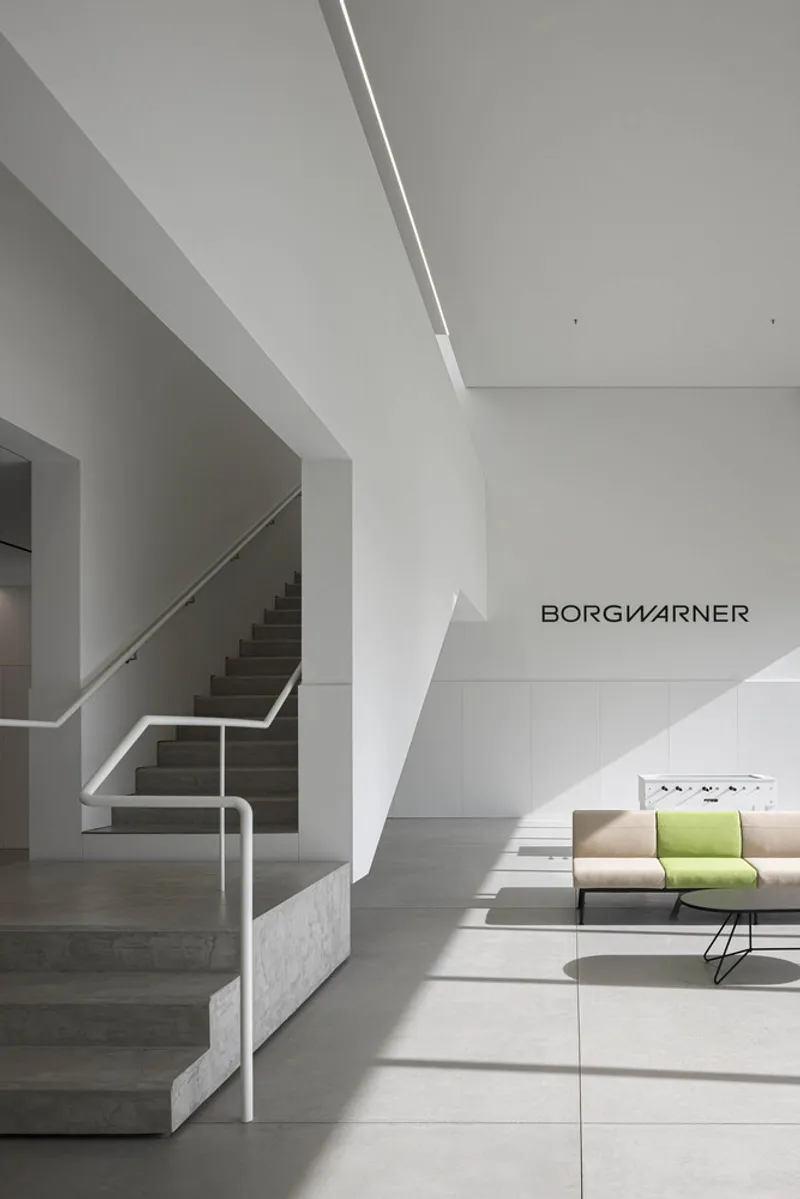
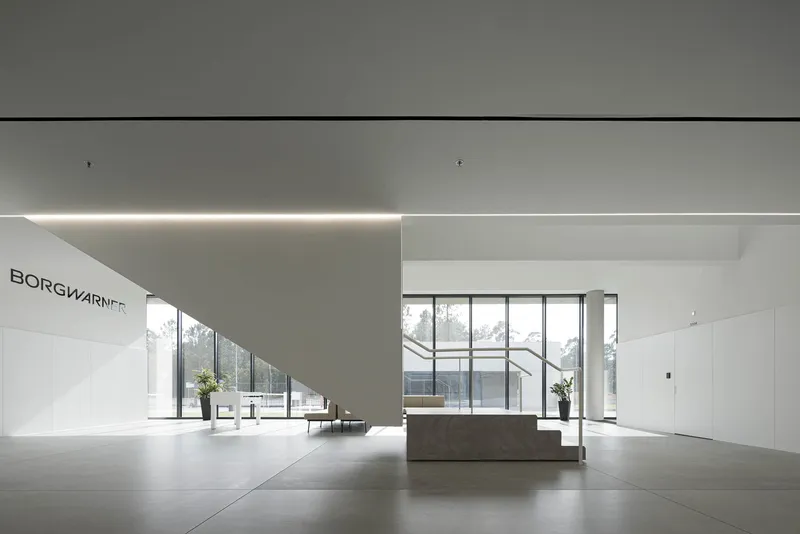
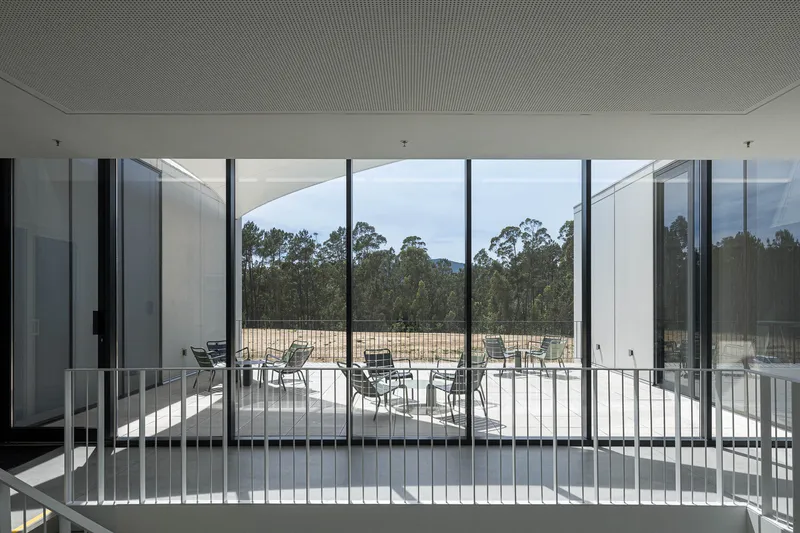
The lobby is anchored by a central stone reception desk backed by floor-to-ceiling windows overlooking a tree line. An interior balcony with white metal railings opens onto an outdoor terrace, blurring the line between conditioned and unconditioned space. The seating areas under the angular ceiling planes feel more like a hotel than a factory, which is the point: the people who work here spend eight or more hours a day inside, and Multiprojectus clearly designed for that duration, not just for a photograph.
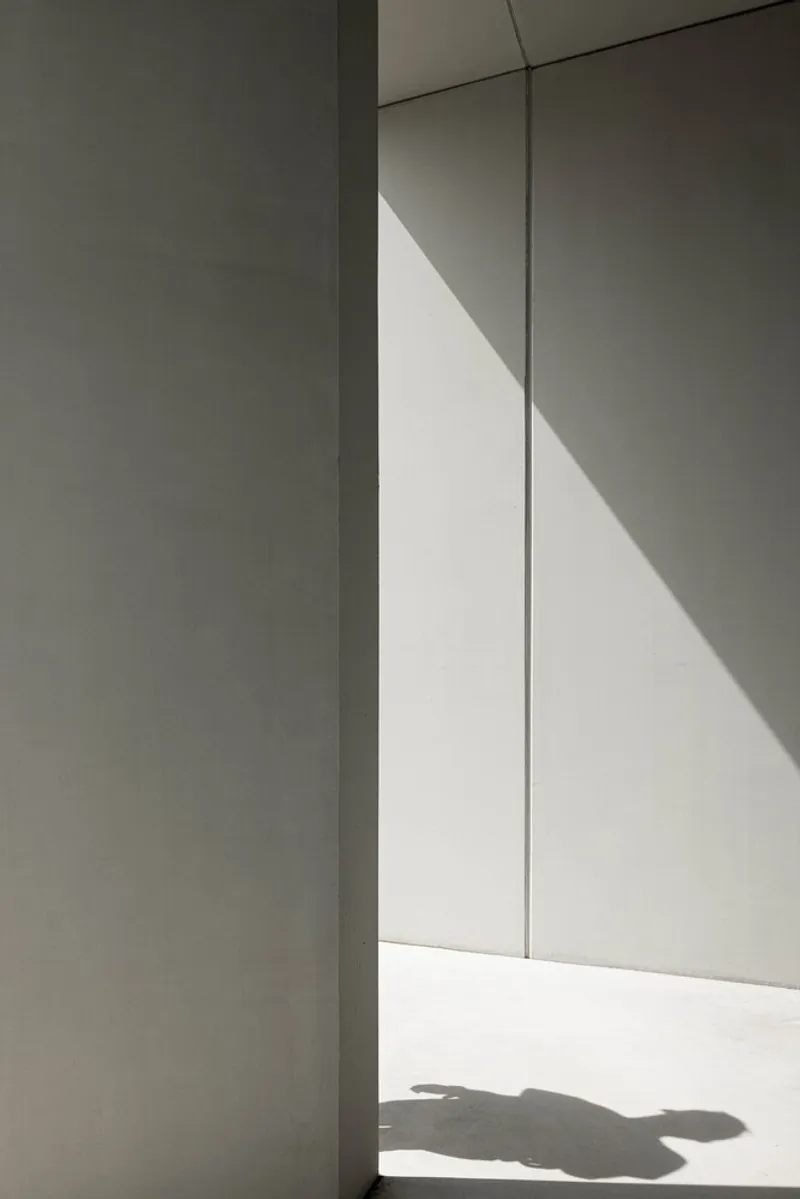
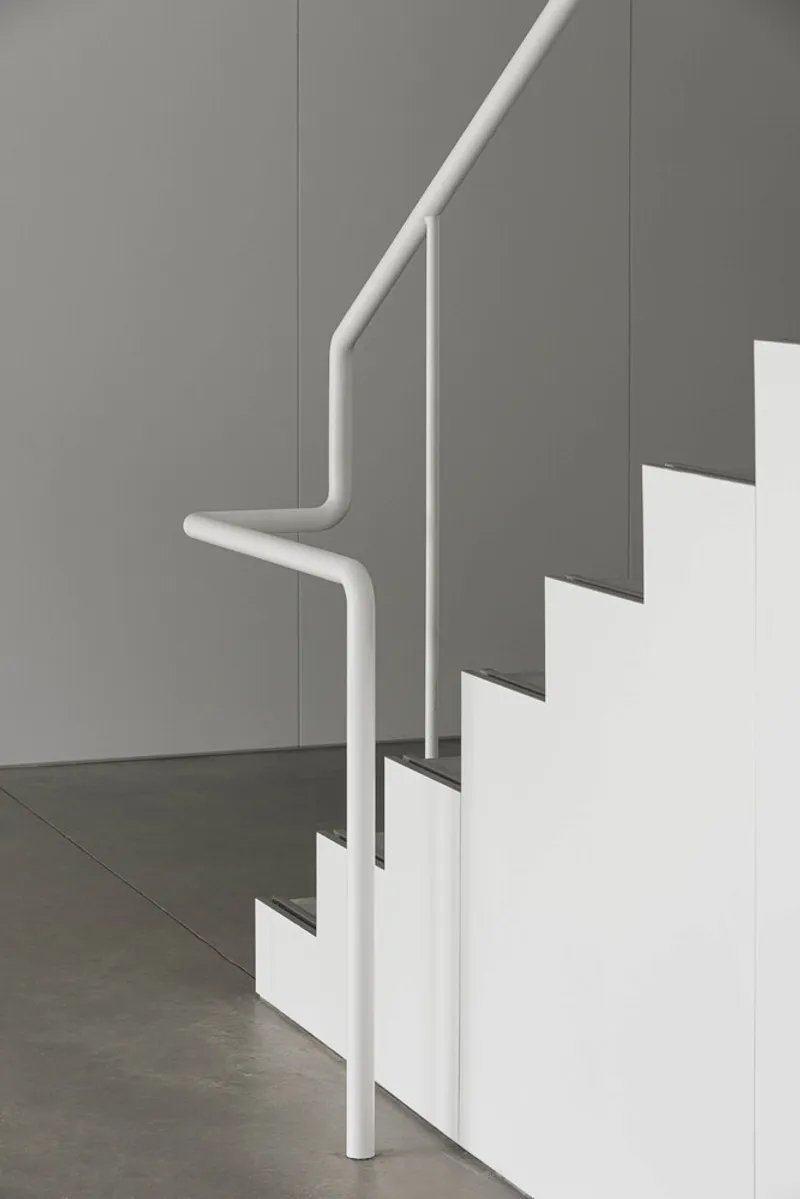
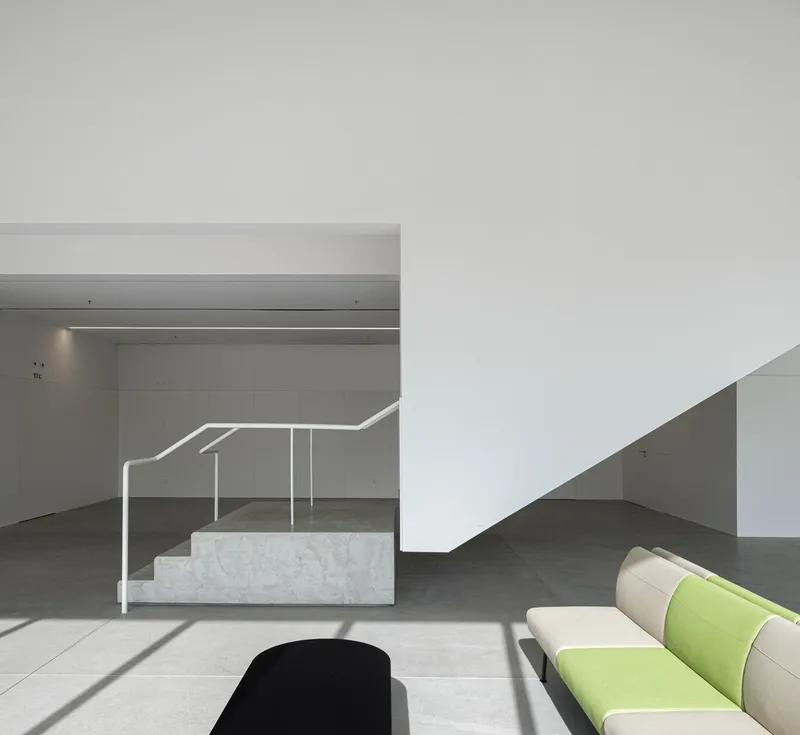
Small details accumulate. A sharp shadow on a white plaster wall. A tubular handrail bending around a corner. A seating nook with green cushions bathed in morning sun. None of these gestures is heroic, but together they build a texture of care that distinguishes the project from the generic industrial box it could have been.
Plans and Drawings
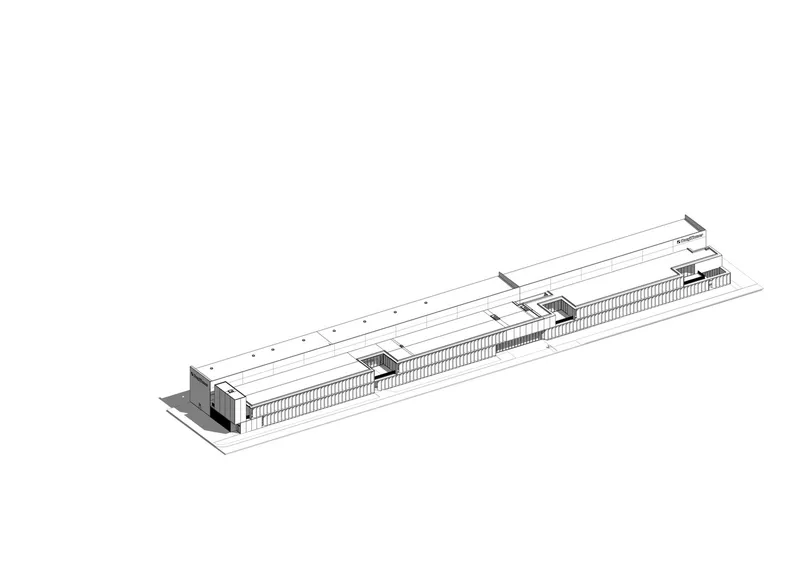
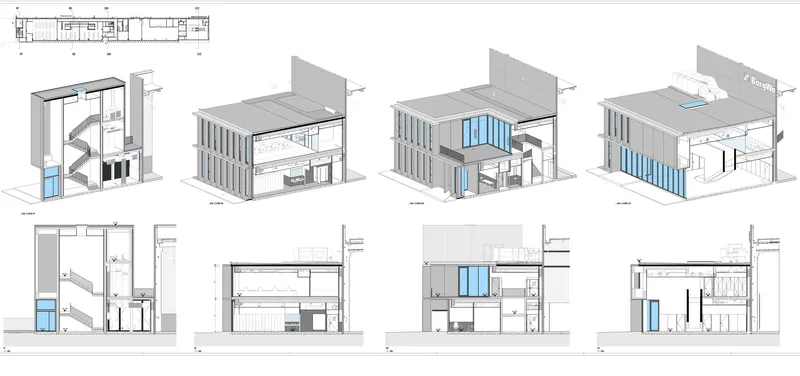
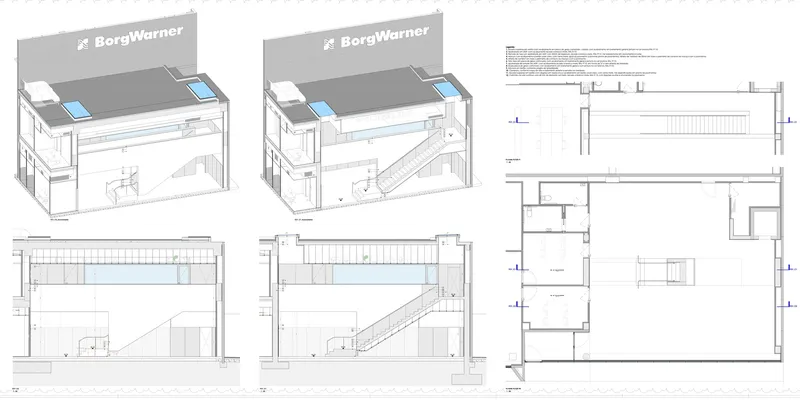
The axonometric drawings reveal the building's organizational logic: a long linear bar with a slatted facade and stepped rooftop volumes that accommodate different ceiling heights for office versus production zones. The section drawings show how the double-height spaces are threaded through the plan, with the stair tower acting as a vertical hinge between the two main programs. A floor plan and axonometric sections illustrate the circulation routes and the relationship between signage, public lobbies, and the deeper production bays.
Why This Project Matters
BW II matters because it demonstrates that industrial architecture does not have to surrender ambition at the front door. The building is a factory, and it looks like a factory, but it is also a civic object that engages its street, frames its landscape, and provides its occupants with spaces worth inhabiting. The fin facade is not a mask; it is a working element that regulates light, creates identity, and gives the long elevation a human rhythm. That is more than most office buildings achieve, let alone industrial sheds.
In a discipline that increasingly treats industrial commissions as second-tier work, Multiprojectus shows what happens when the same care applied to a museum or a residence is directed at a production facility in a Portuguese valley. The answer is a building that proves its type wrong, not by disguising what it is but by insisting that what it is deserves architecture.
BW II by Multiprojectus, Viana do Castelo, Portugal. Photography by Ivo Tavares Studio.
About the Studio
Share Your Own Work on uni.xyz
If projects like this are the kind of work you want to make, uni.xyz is a place to publish your own, find collaborators, and enter design competitions.



Popular Articles
Popular articles from the community


The Ocean Hive: Sustainable Architecture for a Self-Sufficient Civilization at Sea
The Ocean Hive imagines sustainable architecture at sea, where modular habitats, algae, wave power and ocean waste sustain a growing colony.

Co-life: Sustainable Architecture for Age-Friendly Community Living
Co-life reimagines sustainable architecture for seniors through courtyards, rammed earth, shared gardens, and spaces designed for belonging.

Co-Life: Senior Housing Design That Reconnects Older Adults With the City
Co-Life reimagines senior housing design through healing gardens, shared streets, workshops, and a sustainable community across generations.

The Earth Pod: 3D Printed Homes for Resilient Refugee Communities
The Earth Pod reimagines refugee housing through 3D printed homes made from clay, combining resilience, self-sufficiency, and rapid shelter.
Similar Reads
You might also enjoy these articles


Hodi-Mandai Geram
Project Function: Preservation and revitalization of the Intangible heritage and socio-spatial identity of the Hodi by Housing, Cultural Memory Center, Sacred Grove, landscape, local tourism economy


Olio Towers: A Mid-Rise for Performers That Fuses Housing, Rehearsal, and Stage
Located blocks from Houston's Theater District, this modular tower stacks living units around a central performance atrium.

Oasis: Modular Green Housing Carved into Dhaka's Urban Fabric
A shortlisted Plugin Housing entry reclaims unauthorized settlements in Dhaka with stepped concrete volumes, green roofs, and ventilation-driven design.

Black Hole: A Floating Megastructure for the Post-Physical Era
Emiliano Mazzarotto envisions a spherical, self-scaling arena where e-sports, digital hotels, and holographic stadiums replace traditional public space.
Explore Office Building Competitions
Discover active competitions in this discipline



Challenge to reimagine the Iron Throne


Photograph architecture without architects


Illustrate the lost glory of Angkor Wat - Render Challenge


Design challenge to reuse E-waste
Comments (0)
Please login or sign up to add comments
No comments yet. Be the first to comment!