

TasteSpace Cracks Open a Bangkok Concrete Box to Build Factory Coffee's Translucent HQ
A confined two-storey structure in Wang Thonglang becomes a polycarbonate-wrapped coffee headquarters that doubles as an education hub.


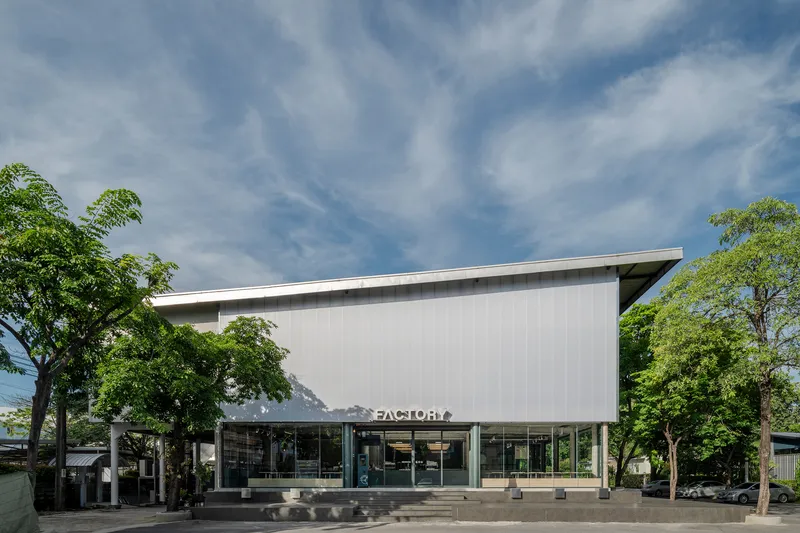
Most coffee shops that lean on the word "industrial" stop at exposed ductwork and Edison bulbs. Factory Coffee HQ, designed by TasteSpace Co., Ltd. in Bangkok's Wang Thonglang district, goes further by taking a genuinely industrial move: gutting the walls and floors of a closed, confined concrete building, then wrapping the skeleton in frosted polycarbonate so the whole structure glows like a lantern beside the Chalong Rat Expressway. Completed in 2024, the project sits in the Phlabphla area north of central Bangkok, where mature trees soften a landscape of elevated highways and low-rise commercial fabric.
What makes the project worth studying is not the aesthetic category it claims but the actual spatial surgery it performs. Three of the building's original walls were demolished and replaced with translucent cladding. A section of the second floor was removed to carve out a double-height atrium. The result is a building that functions simultaneously as a retail café, a coffee roasting facility, and an operational headquarters for the Factory Coffee brand. That combination of openness, production transparency, and programmatic density is where the design earns its name.
Peeling Back the Skin


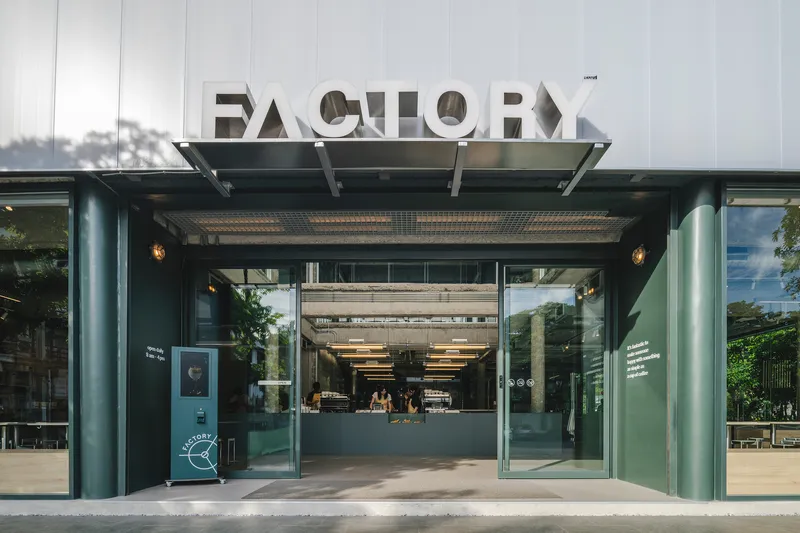
From the street, the building reads as a white volume lifted on slender concrete columns, set behind a screen of mature trees. The frosted polycarbonate cladding that replaced the original masonry walls is the single most consequential material decision in the project. It filters Bangkok's intense sunlight into a soft, even interior glow while providing a degree of thermal insulation that a fully glazed envelope could not. At ground level, teal-framed glass panels open the entrance, injecting brand color into an otherwise restrained palette of white, grey, and concrete.
The surrounding plaza, paved simply and shaded by existing trees, creates a decompression zone between the expressway and the café interior. It is a modest landscape move, but it matters: the trees do the heavy lifting of making this roadside location feel approachable.
The Atrium as Engine
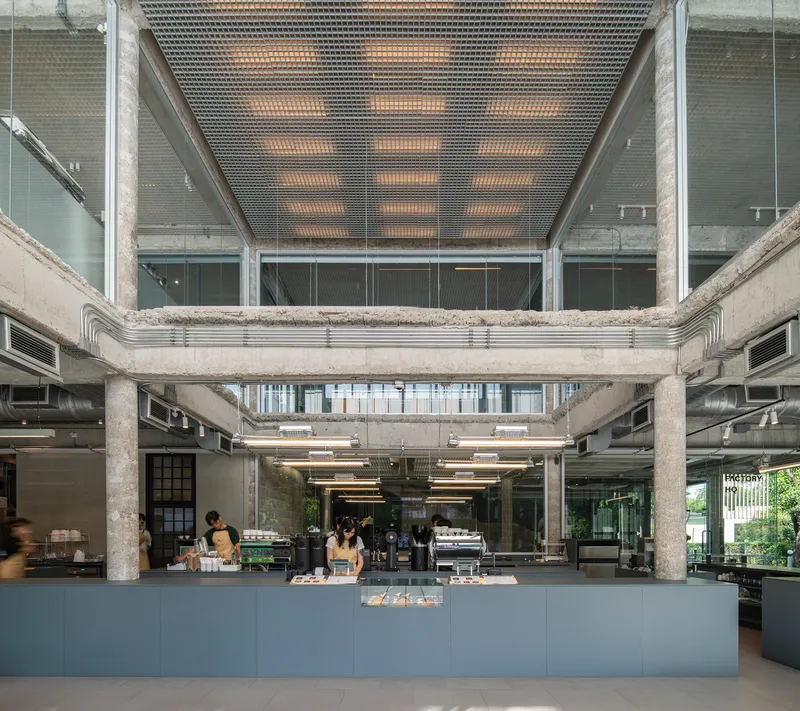


Demolishing a portion of the second floor to create a double-height void is the project's most dramatic interior gesture. The atrium allows natural light from the polycarbonate walls to cascade down to the ground floor, eliminating the dark, boxed-in character of the original structure. Perforated metal ceiling panels run overhead, filtering light further and giving the upper edge of the space a textured, almost textile quality.
The void also establishes a visual connection between the café's public ground floor and the workshop level above. Standing at the counter, you can look up and see people working with coffee machines on the mezzanine. Standing on the mezzanine, you look down into the choreography of baristas and customers. TasteSpace uses the section, not just the plan, to tell Factory Coffee's story about production and education being inseparable from consumption.
Ground Floor: Counter, Roastery, Stage


The centrally placed service counter anchors the ground floor. It is a long, clean bar lined with metal stools, positioned beneath exposed concrete beams and suspended industrial light fixtures. The counter's placement is deliberate: it sits at the intersection of the café seating area and the glass-walled coffee roasting room at the rear of the building. Customers seated at the bar face directly into the roasting workspace, where staff operate equipment against a backdrop of concrete block walls under fluorescent tubes.
Making the roastery visible through glass is not new, but doing it in the same building that also serves as the company's headquarters collapses the distance between brand storytelling and actual operations. The roasting room is not a showpiece behind decorative glass; it is a working production space that happens to be transparent. That honesty is what keeps the industrial language from feeling like costume.
Upstairs: Workshop, Office, Laboratory
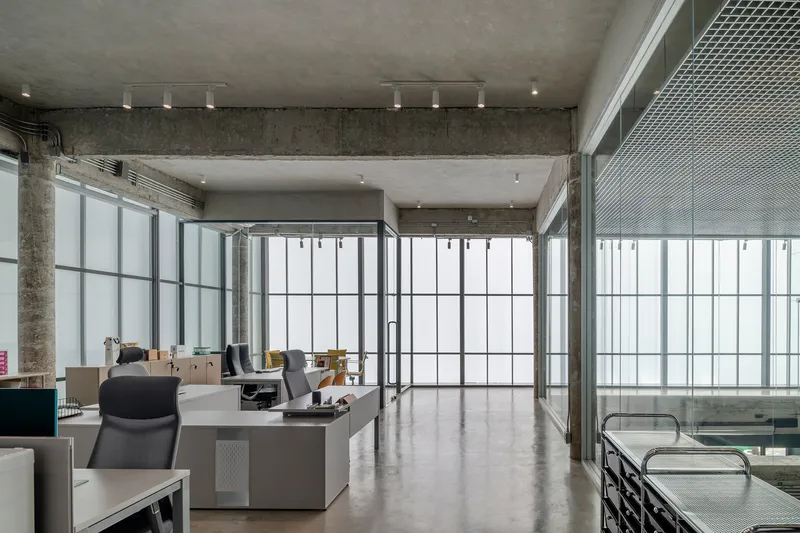


The second floor splits into a workshop area outfitted with coffee machines and a more conventional office and meeting zone. Gridded translucent glazing along the exterior walls bathes the workspace in diffused daylight, while polished concrete floors keep the material language continuous with the level below. Signage in the concrete block stairwell directs visitors toward the "laboratory" and office spaces, reinforcing the idea that this is a place of research as much as commerce.
A conference room at the far end features a timber slat ceiling and gridded windows, paired with orange chairs that provide one of the few bursts of saturated color in the building. It is a compact, focused room that trades the open drama of the atrium for intimacy. The glass-walled corridor leading to it, framed in black metal, maintains sightlines across the floor and prevents the upper level from feeling partitioned.
Material Honesty and Brand Color
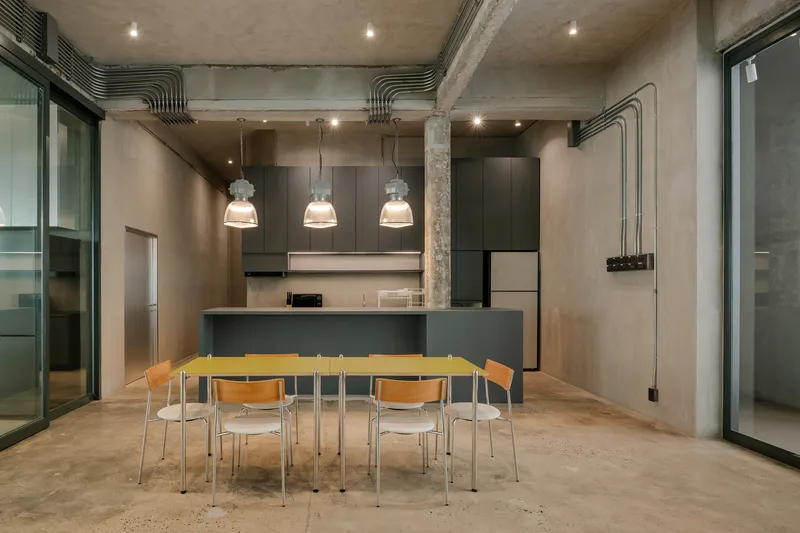

TasteSpace's material palette is disciplined: exposed concrete structure, concrete block, compact laminate surfaces, and polycarbonate. Nothing is clad to look like something else. The firm also integrated furniture made from recycled aluminum foil waste and coffee chaff through the Betterism Collection's PlasCoff Latte line, a detail that extends the project's sustainability logic from the envelope to the furniture scale.
Green accents, visible in steel frames and select surfaces, are calibrated to the Factory Coffee brand identity without overwhelming the neutral concrete backdrop. In the open kitchen and dining areas, pendant lights and yellow-toned tables inject warmth into what could otherwise be a relentlessly grey interior. The color strategy is restrained enough that each accent reads as intentional rather than decorative.
Why This Project Matters
Factory Coffee HQ succeeds because TasteSpace treated the brief as an architectural problem, not a branding exercise. The decision to demolish three walls and a section of floor, to replace masonry with polycarbonate, and to stack a café, roastery, workshop, and office into a single two-storey shell produces a building whose spatial experience is genuinely different from the standard specialty coffee fit-out. The translucent envelope, the carved atrium, and the visible roasting room are structural and programmatic decisions that generate atmosphere as a byproduct, not as a goal.
The project also demonstrates that a café headquarters does not need to choose between public hospitality and private operations. By making production, education, and consumption coexist within a single open section, Factory Coffee HQ argues that transparency is not just a design gesture but a business model. For a coffee brand positioning itself as an educational hub, the architecture does exactly what it should: it teaches you something about how the place works the moment you walk in.
Factory Coffee HQ by TasteSpace Co., Ltd., located in Wang Thonglang, Bangkok, Thailand. Completed in 2024. Photography by Mr. Jinnawat Borihankijanan.
About the Studio
Share Your Own Work on uni.xyz
If projects like this are the kind of work you want to make, uni.xyz is a place to publish your own, find collaborators, and enter design competitions.


Popular Articles
Popular articles from the community


LT2A and OPEN Architectes Thread a Brick and Glass High School Through a Wooded Belgian Campus
In Braine-l'Alleud, a 3,000 m² wing for Collège Cardinal Mercier pairs pale brick with a glazed colonnade, deferring to a small chapel and a dense wood.

Architekt Andreas Gruber Scatters 23 Dark Timber Chalets Across a South Tyrolean Forest Edge
In Molini di Tures, Amonti Chalets breaks a resort into a hamlet of gabled timber houses, with parking, storage and services pushed into the slope.

Juan García Correa, John González and Claudia Rueda Sink a Circular Amphitheater into a Manizales Engineering Building
On the La Nubia campus in Manizales, Colombia, the S1 Building folds labs and offices into a hillside of ramped lawns that double as a campus route.

U.GA Architects Wraps an Oval Rooftop Pool in Curved Board-Formed Concrete on Busan's Jeollidan-gil
In Busan's Jeonpo-dong, a 454 m² mixed-use block stacks a neighborhood facility, guest rooms and an oval rooftop pool inside spiraling concrete walls.

Similar Reads
You might also enjoy these articles


Hodi-Mandai Geram
Project Function: Preservation and revitalization of the Intangible heritage and socio-spatial identity of the Hodi by Housing, Cultural Memory Center, Sacred Grove, landscape, local tourism economy


Olio Towers: A Mid-Rise for Performers That Fuses Housing, Rehearsal, and Stage
Located blocks from Houston's Theater District, this modular tower stacks living units around a central performance atrium.

Oasis: Modular Green Housing Carved into Dhaka's Urban Fabric
A shortlisted Plugin Housing entry reclaims unauthorized settlements in Dhaka with stepped concrete volumes, green roofs, and ventilation-driven design.

Black Hole: A Floating Megastructure for the Post-Physical Era
Emiliano Mazzarotto envisions a spherical, self-scaling arena where e-sports, digital hotels, and holographic stadiums replace traditional public space.

Explore Coffee Shop Competitions
Discover active competitions in this discipline

Challenge to reimagine the Iron Throne

Photograph architecture without architects

Illustrate the lost glory of Angkor Wat - Render Challenge

Design challenge to reuse E-waste
Comments (0)
Please login or sign up to add comments
No comments yet. Be the first to comment!