
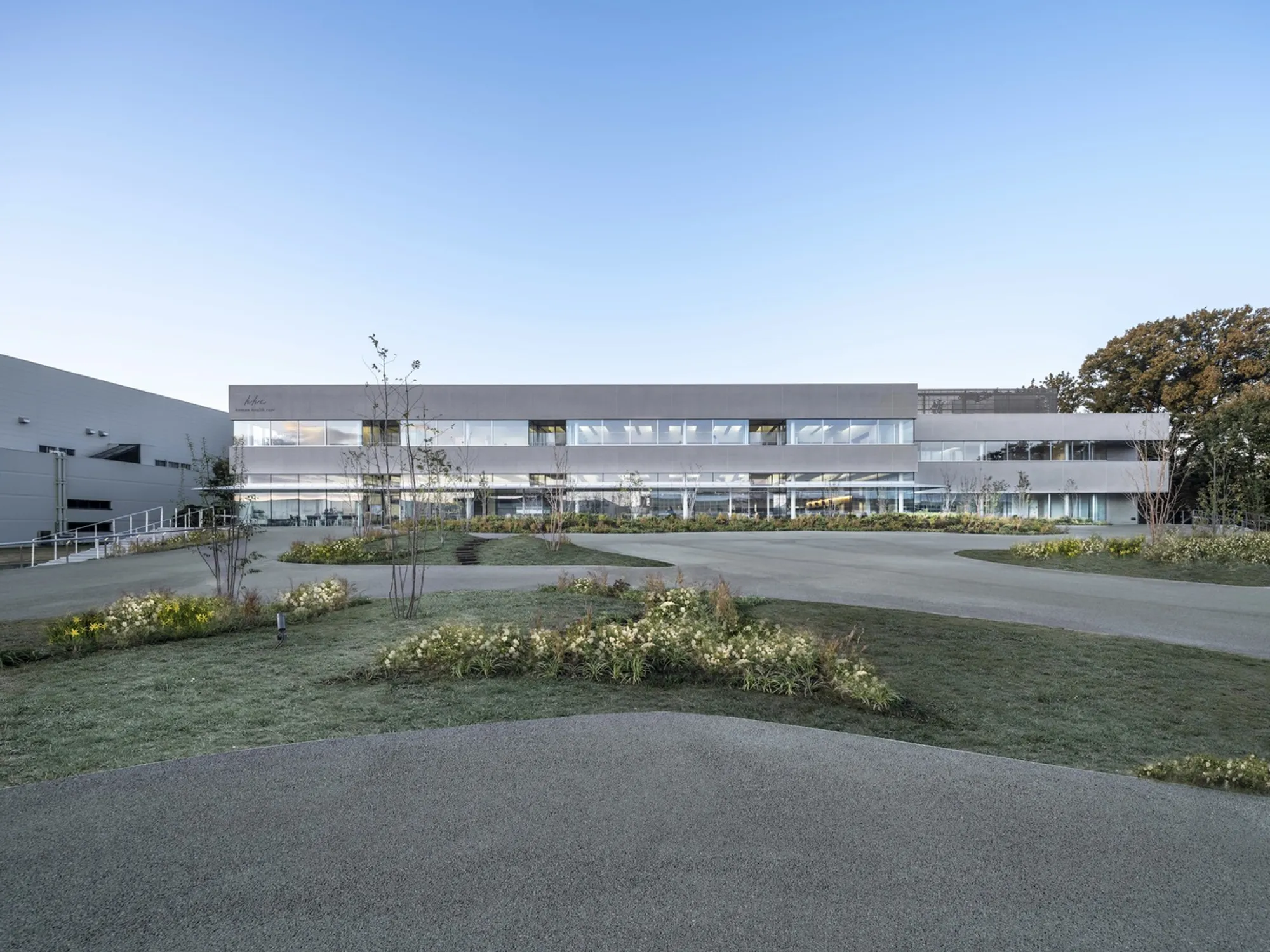
TAISEI DESIGN Replaces an Aging Industrial Cafeteria with a Wellness-Driven Campus in Gifu
On a sandbar between the Kiso River and a primeval forest, a pharmaceutical company's employees get a building that breathes.


When Eisai Co., the Tokyo-headquartered pharmaceutical giant, decided to rebuild the employee cafeterias at its Kawashima Industrial Park in Kakamigahara, Gifu Prefecture, the brief could have produced another sealed box. The original facilities, dating back to the park's 1966 opening, were windowless enclosures that treated nature as something to keep out. TAISEI DESIGN Planners Architects & Engineers took the opposite position entirely, delivering a building that treats the surrounding primeval forest and river landscape as its primary interior finish.
What makes this project worth studying is the discipline of its environmental stance. Rather than deploying a single green gesture, the architects organized every structural axis, every ceiling baffle, every window band along a north-south orientation that physically pulls the surrounding landscape into the building. The result is a hybrid cafeteria and office that functions as a wellness infrastructure: a space calibrated to daylight, ventilation, seasonal views, and flood resilience simultaneously. It is industrial architecture that refuses to feel industrial.
A Facade Built from Horizon Lines
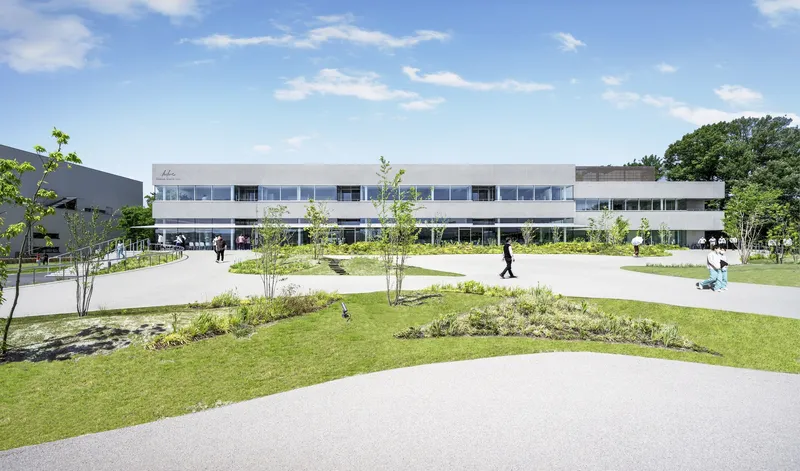
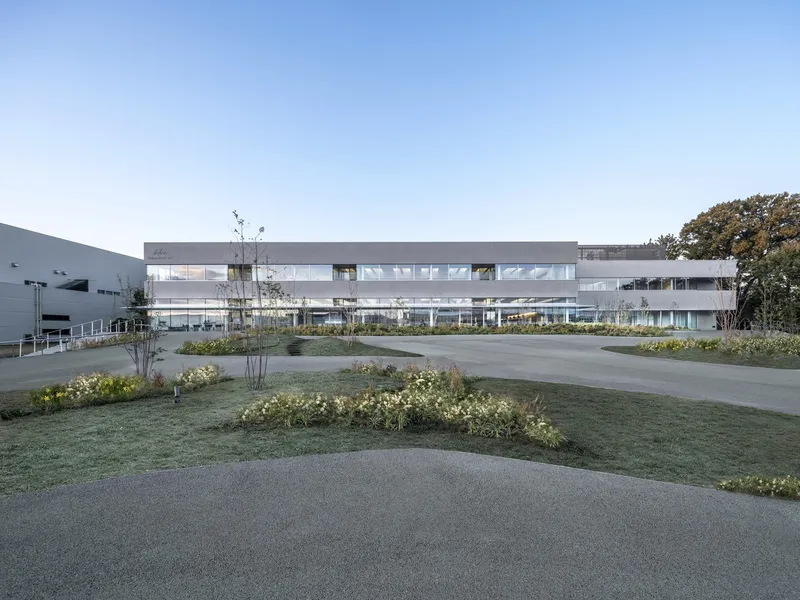
The building reads as a stack of continuous horizontal bands: concrete slabs, ribbon glazing, slender mullions, and cantilevered canopies layered in a calm rhythm. At dusk, the window bands glow against the long, low profile, making the structure look almost weightless despite its reinforced concrete and steel hybrid frame. The curving pathways and sculpted landscape mounds in the forecourt soften what would otherwise be a strictly linear composition, lending the approach the quality of a garden promenade rather than a corporate arrival sequence.
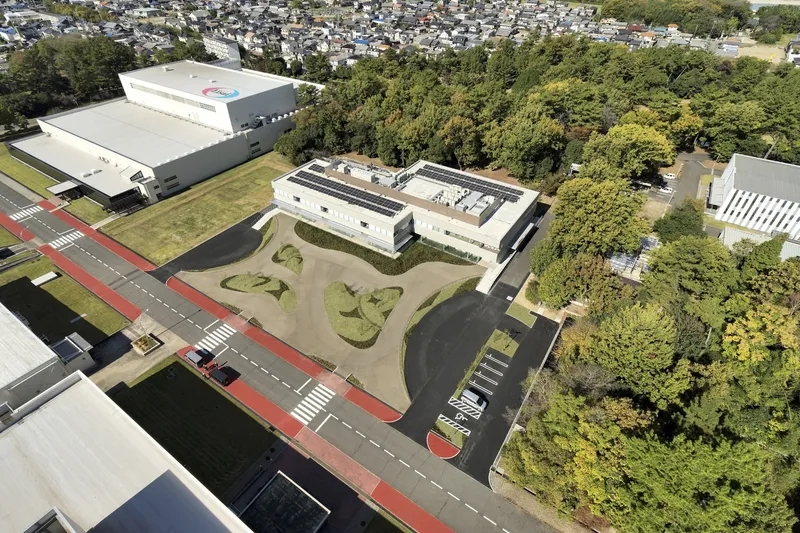
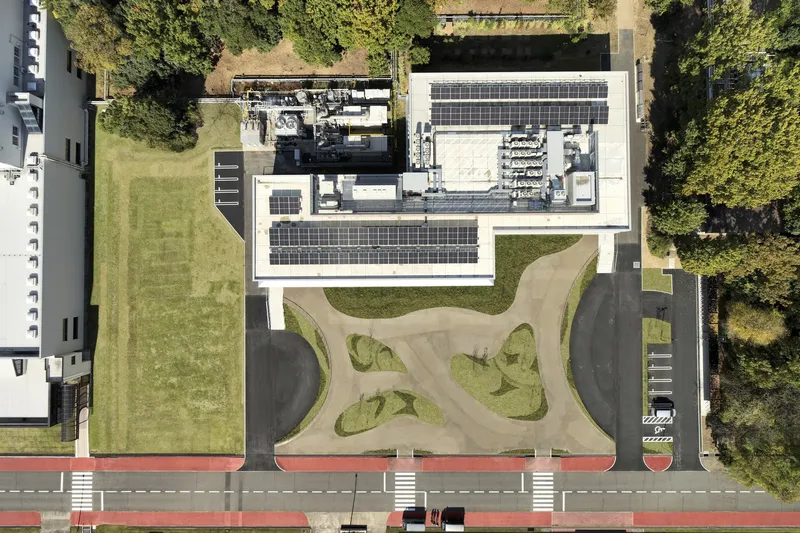
The aerial view confirms how carefully the building sits within its context. The white roof, fitted with solar panels, floats between mature tree canopy to the north and a new garden to the south. The architects clearly treated the roof as a fifth elevation, knowing it would be visible from surrounding factory buildings.
Dining Between Forest and Garden
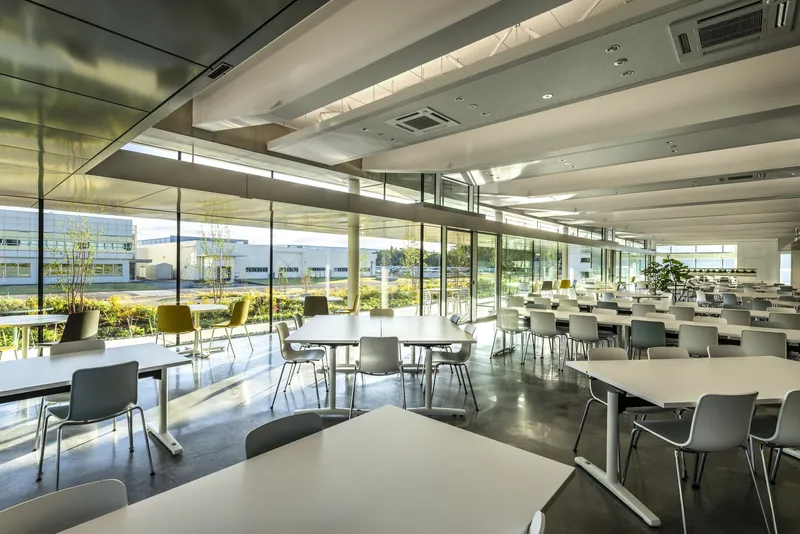
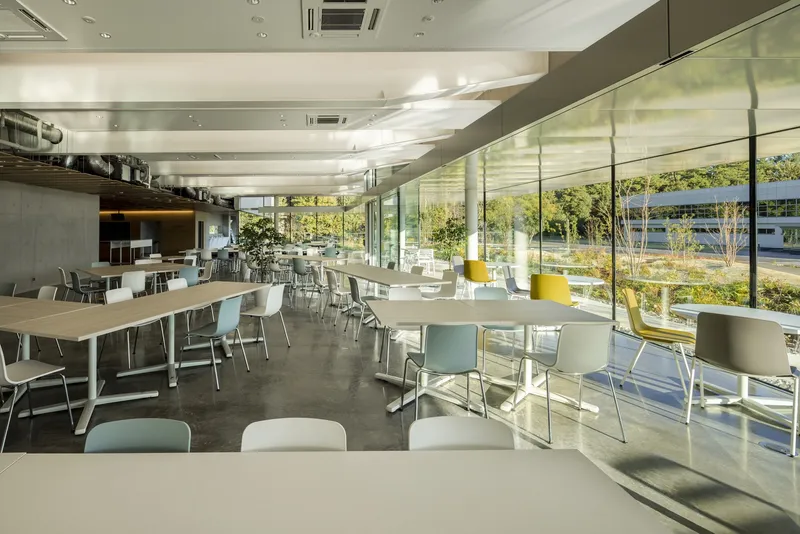
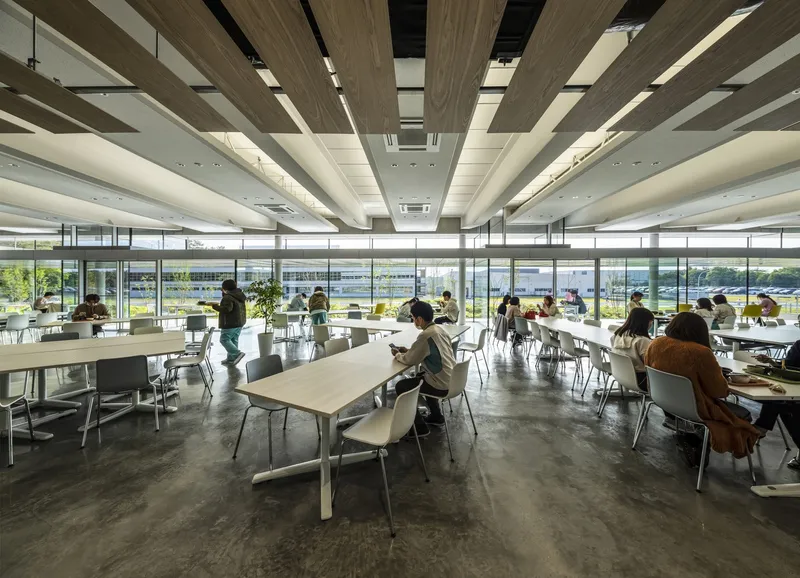
The first-floor cafeteria splits into two distinct atmospheres. On the south side, a bright dining hall opens through floor-to-ceiling glazing onto planted courtyards flooded with daylight. White tables and chairs sit beneath linear ceiling beams that reinforce the north-south axis, directing the eye outward toward greenery. On the north side, the mood shifts: waist-high walls frame views of the primeval forest, creating quieter zones suited for focused meals or solitary work.
The polished concrete floors and restrained material palette keep the cafeteria from drifting into the overly domestic territory that plagues many corporate wellness interiors. There is warmth here, but it comes from light and landscape, not from decorative excess.
The Courtyard as Connector
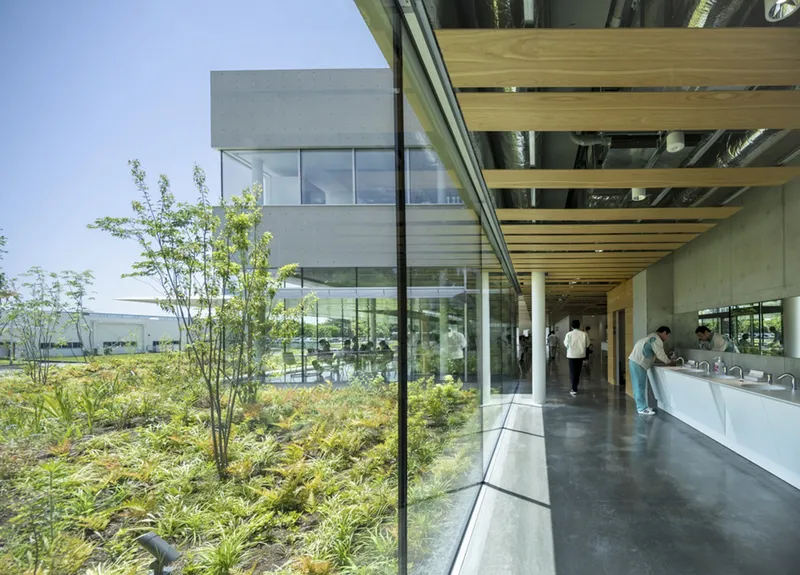
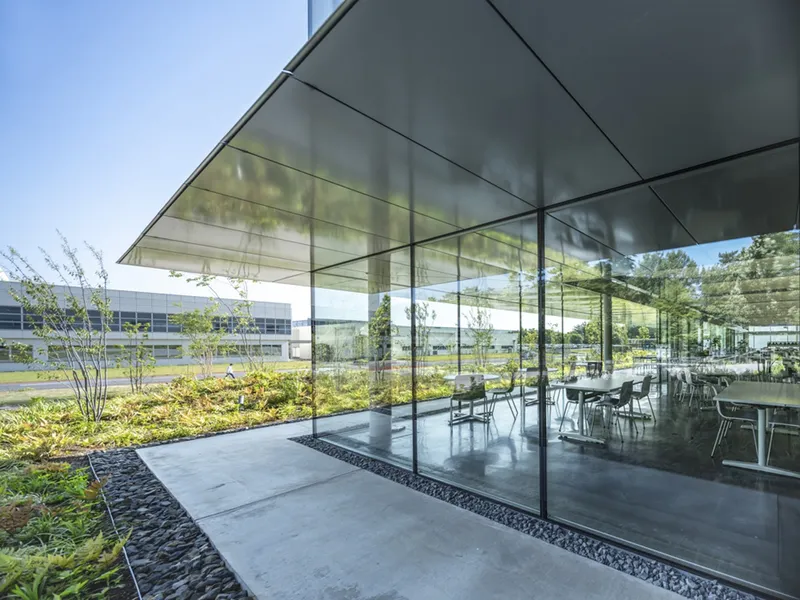
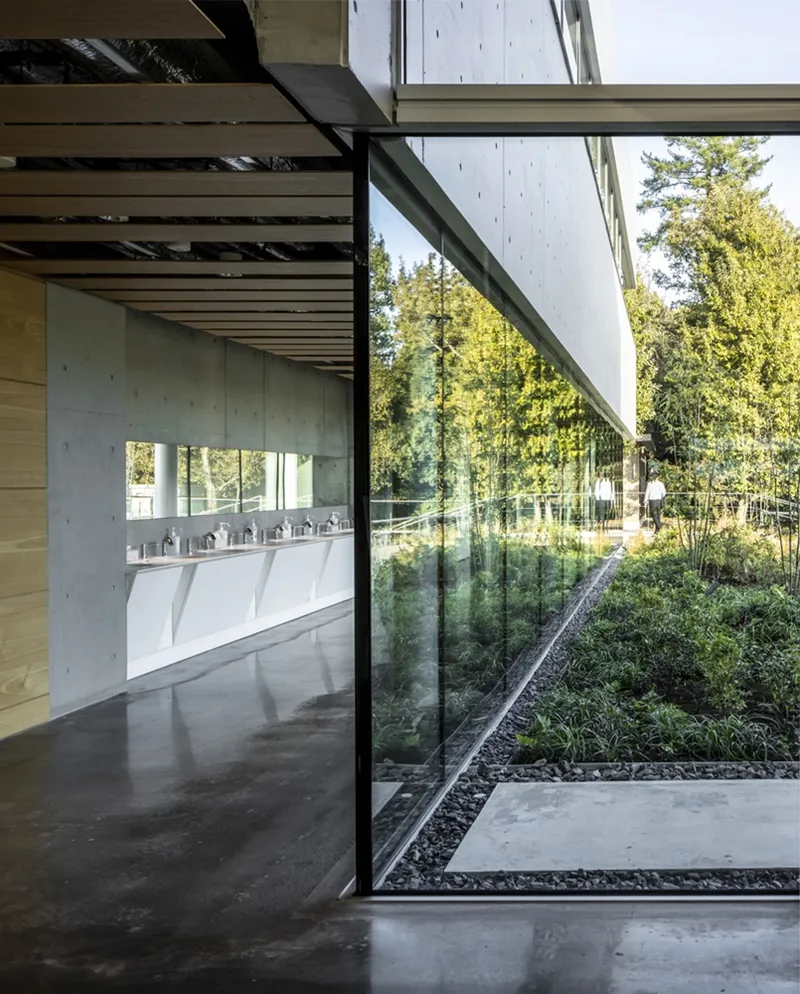
A planted courtyard at the heart of the plan does the heavy lifting of spatial organization. Corridors with floor-to-ceiling glass overlook it, turning what would be dead circulation into the most pleasant moments in the building. Timber ceiling beams and exposed ductwork run overhead without pretending to be something they are not. The honesty of the services is part of the aesthetic: clean, directional, purposeful.
A glass threshold between the interior washroom and the courtyard captures the project's ethos in a single frame. Even the most utilitarian passage gets a view. The cantilevered canopy along the south facade extends this logic outdoors, creating a covered terrace bordered by pebble strips and young plantings that will thicken over time. The architecture is designed to improve with age rather than calcify.
Terraces and Thresholds That Blur the Edge
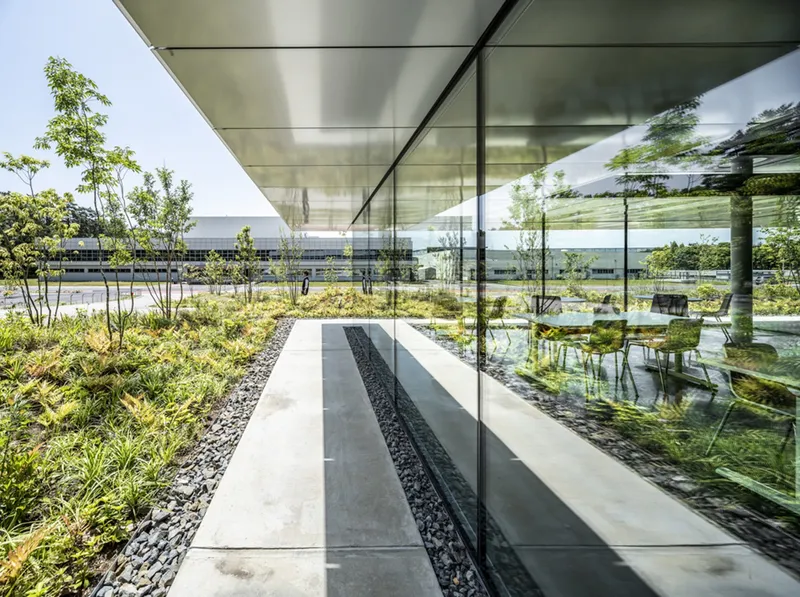
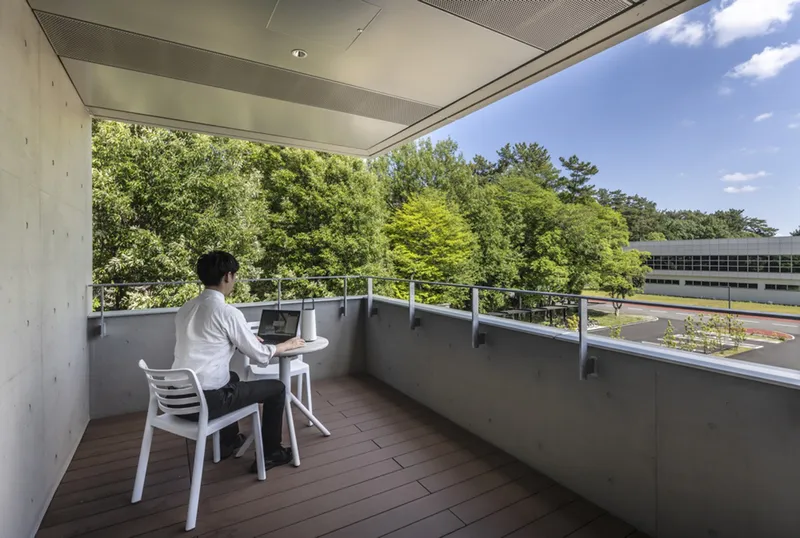
Several outdoor terraces punctuate the building's perimeter. A ground-level terrace features a concrete water channel running through black gravel, an understated nod to the Kiso River that borders the site. On the upper floor, a timber-decked balcony offers a single occupant a private workstation overlooking the forest canopy. These are not decorative gestures; they are functional extensions of the interior program, designed to give employees genuine choices about where and how they spend their time.
The flood risk from the Kiso River is addressed without visual drama. The first floor is elevated roughly one meter above grade, a pragmatic move that simultaneously creates a subtle plinth, lifting the building just enough to establish its presence without dominating the landscape.
An Office Without Corridors
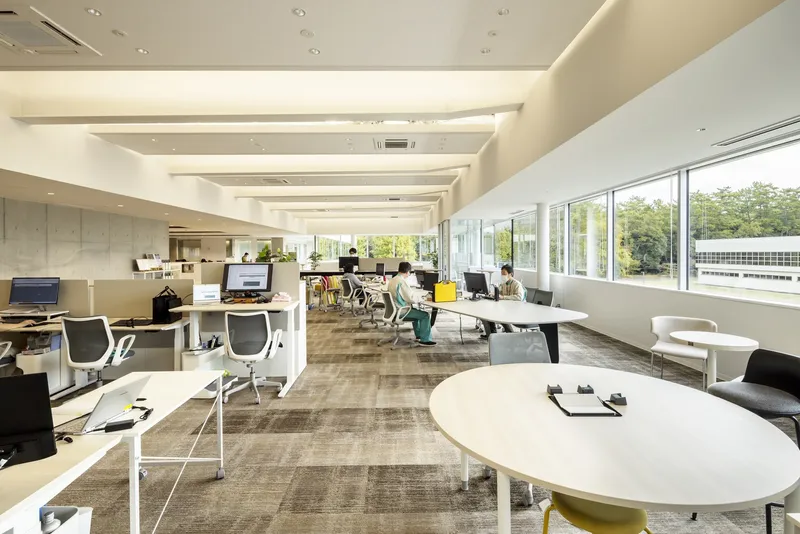
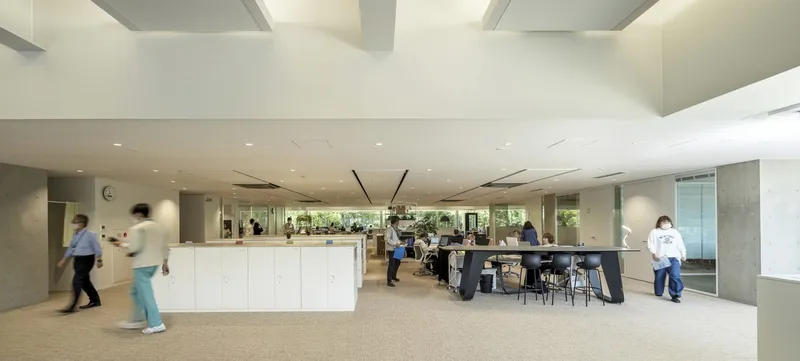
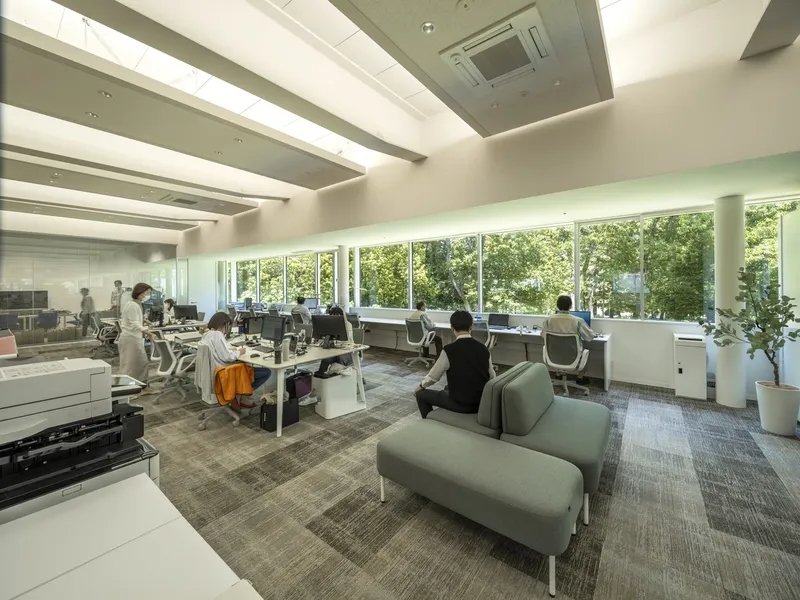
The second floor houses an open-plan office that eliminates traditional corridors in favor of a central circulation zone flanked by workstations on both sides. Exposed ceiling coffers with integrated lighting create a rhythmic overhead plane, and continuous horizontal windows ensure every desk has a relationship to the tree canopy outside. The sectional logic is clear: the building is narrow enough that daylight reaches deep into the plan from both north and south facades.
Breakout areas with white storage islands and carpeted zones provide informal meeting points without the forced quirks of Silicon Valley office culture. Exposed concrete columns are left unfinished, reinforcing the building's industrial heritage while supporting a layout that feels decidedly non-industrial in use.
Flexible Interior Zones
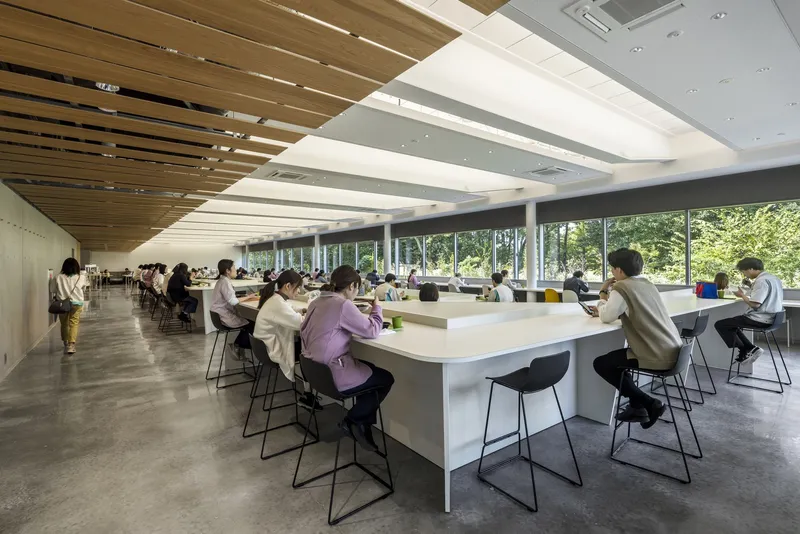
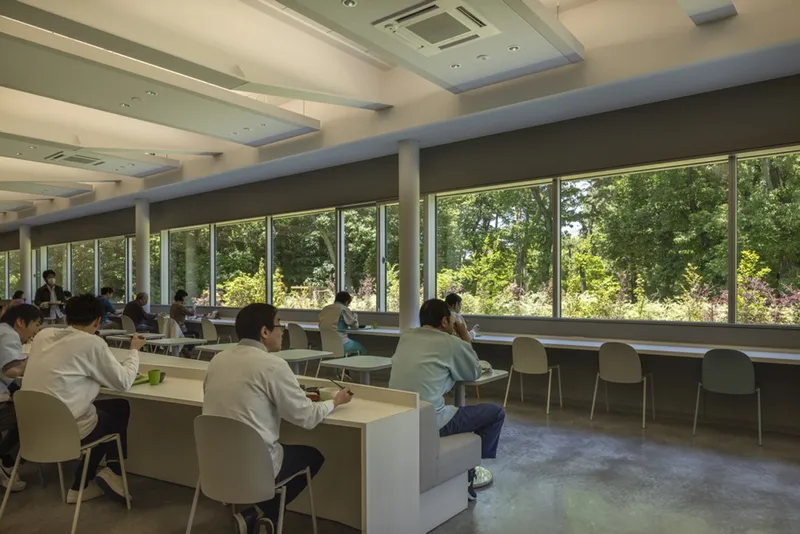
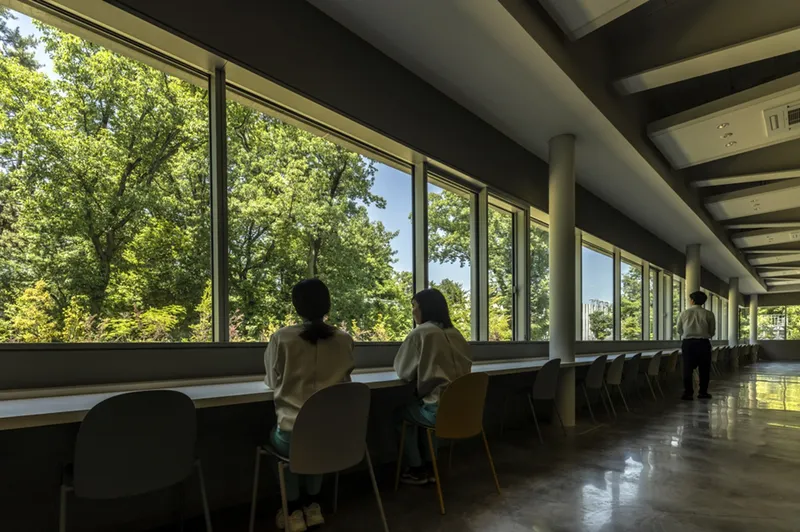
Reading rooms and study halls occupy quieter pockets of the program. Timber ceiling baffles modulate acoustics and light in a library-like reading room where shared tables encourage parallel work. Elsewhere, ribbon windows frame the upper canopy at seated eye level, a deliberate calibration that connects workers to nature without exposing them to glare or distraction at desk height.
A long reading counter along a window wall is perhaps the most generous spatial move in the building: two people sit side by side looking directly into the forest, the counter narrow enough to feel personal, the glass expansive enough to dissolve the wall. It is a detail that costs almost nothing and delivers enormous psychological value.
Collaboration and Retreat
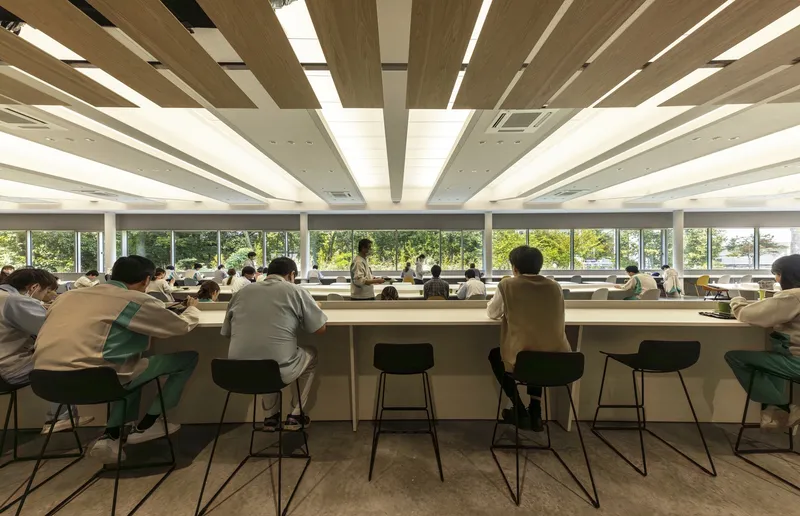
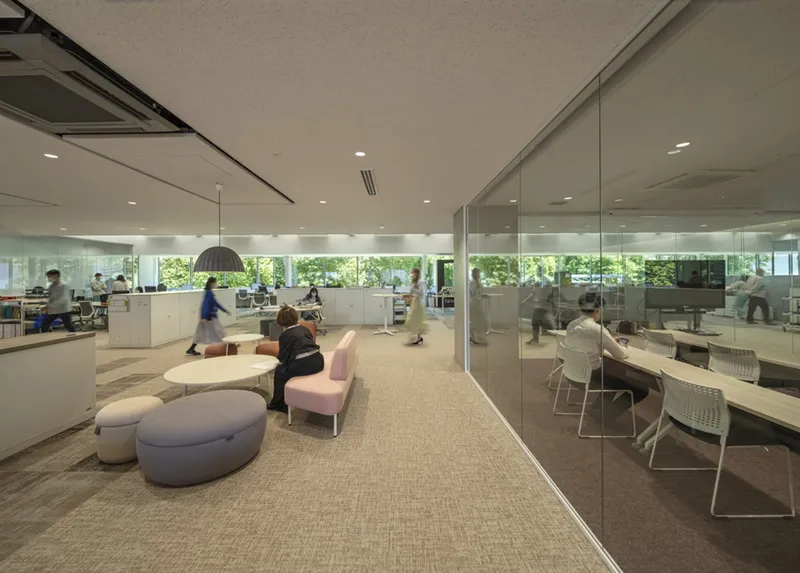
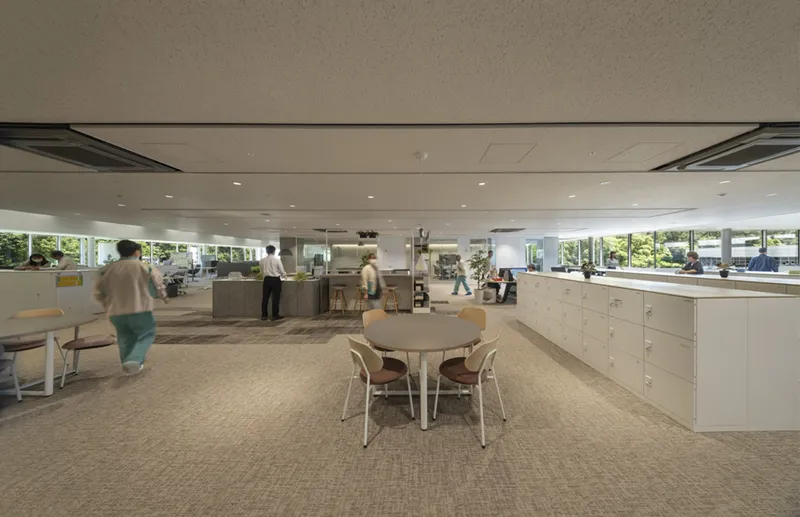
The building offers a spectrum of social intensity. A study hall with alternating timber and white ceiling slats seats students and researchers at long counters under carefully integrated lighting. Nearby, a lounge zone with upholstered ottomans sits adjacent to a glass-walled meeting room, giving teams a place to decompress between formal sessions. Smaller collaborative workspaces with round tables and suspended climate units handle quick stand-ups and informal brainstorms.
This gradient from public to private, from loud to quiet, is the real innovation of the plan. The building does not impose a single mode of work. It provides an ecosystem of spatial options and trusts employees to navigate them.
Plans and Drawings
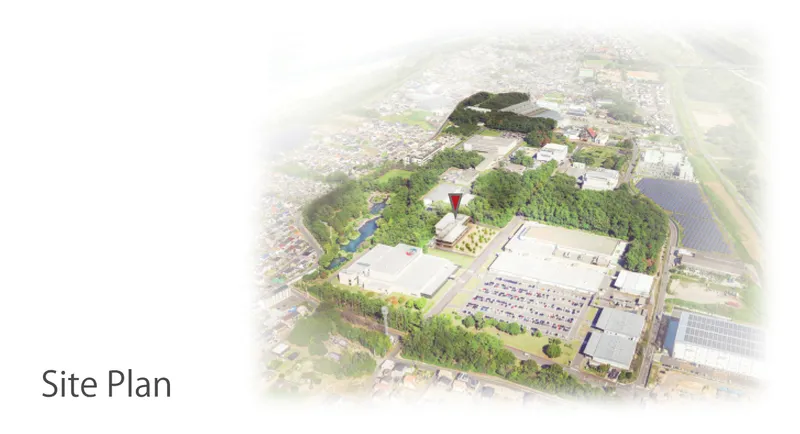
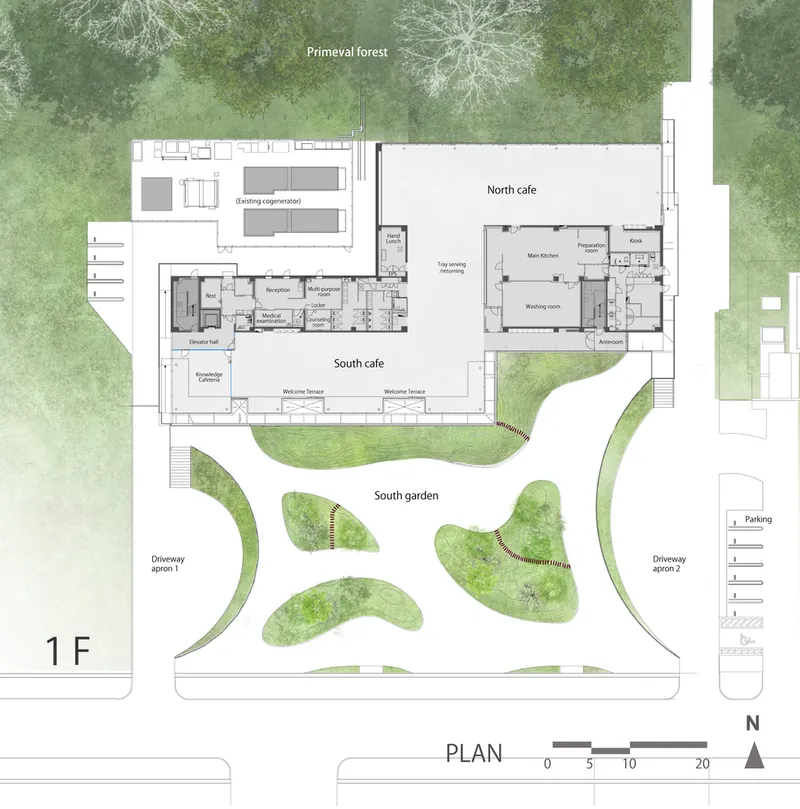
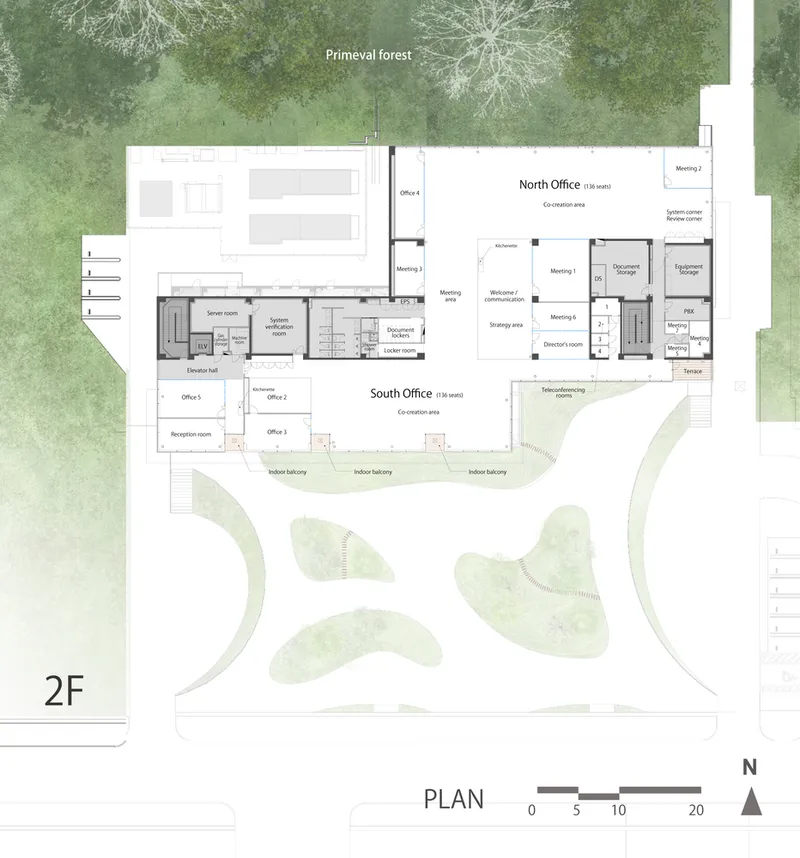
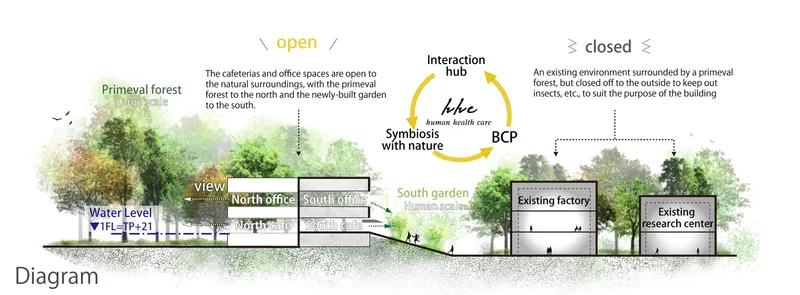
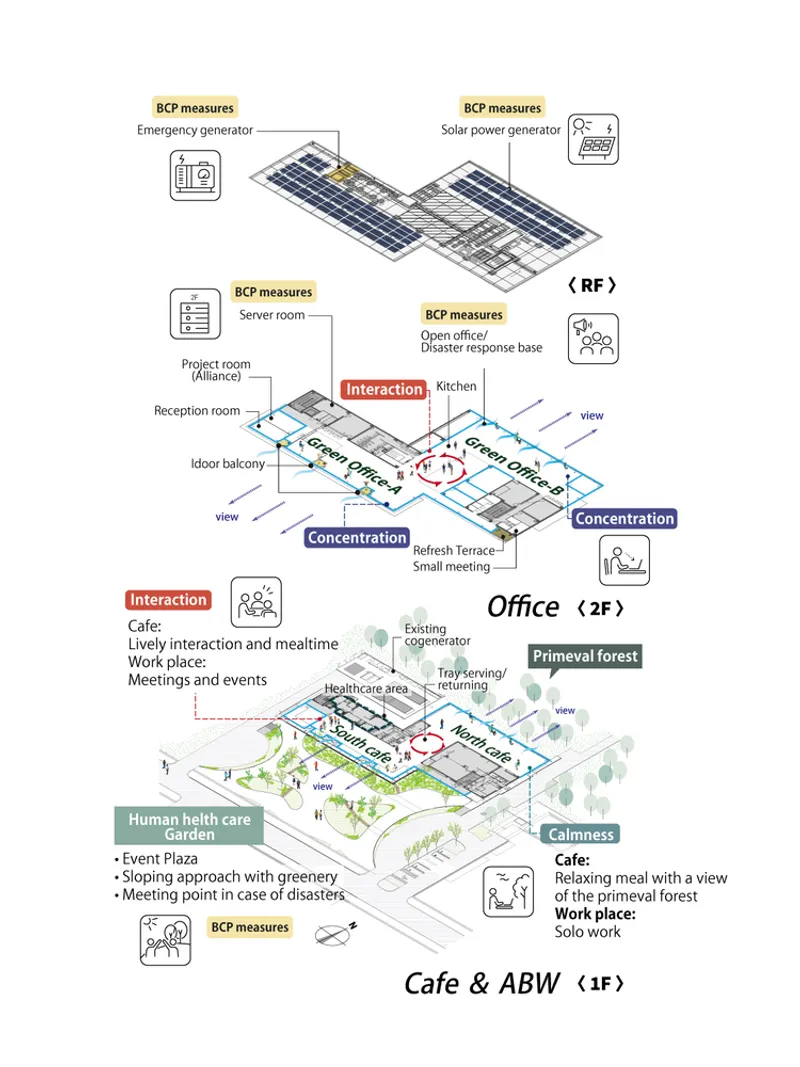
The site plan reveals the building's position between existing factory buildings and the primeval forest, with organic planting beds mediating the transition. The first-floor plan shows north and south cafes flanking a central entry garden, a symmetry that gives each dining zone its own character while maintaining a shared heart. The second-floor plan mirrors this logic with north and south office zones, meeting rooms facing the courtyard below.
The section diagram is the most instructive drawing. It illustrates how the building negotiates the relationship between the existing factory, the new program, and the forest edge. The exploded axonometric clarifies the three-level stacking: cafeteria below, offices above, solar array on top. Every layer has a distinct environmental role. The aerial view of the rooftop solar installation confirms that sustainability here is not symbolic but operational, covering a significant portion of the roof area.
Why This Project Matters
Industrial parks are among the most neglected building typologies in contemporary architecture. They tend to be designed for process efficiency, not human experience. The Eisai Kawashima Cafeteria and Office demonstrates that these priorities are not in conflict. By orienting every axis toward the landscape, elevating the ground floor against flooding, eliminating corridors in favor of open circulation, and providing a genuine range of work and rest environments, TAISEI DESIGN has produced a model for how production campuses can support the people who operate them.
The project also makes a quiet argument about time. The primeval forest to the north has been growing since long before the industrial park opened in 1966. The new garden to the south will take years to mature. By building between these two landscapes, one ancient and one nascent, the architects position the building as part of a longer ecological narrative rather than an isolated intervention. That kind of temporal awareness is rare in corporate architecture, and it gives the project a resonance that outlasts its material novelty.
Eisai Kawashima Cafeteria and Office, designed by TAISEI DESIGN Planners Architects & Engineers, Kakamigahara, Gifu Prefecture, Japan. Photography by aifoto.
About the Studio
Share Your Own Work on uni.xyz
If projects like this are the kind of work you want to make, uni.xyz is a place to publish your own, find collaborators, and enter design competitions.



Popular Articles
Popular articles from the community


Riyadh For All: Intergenerational Urban Design for Active Aging in Rabat
Riyadh For All reimagines urban design in Rabat with intergenerational co-living, adaptive courtyards, and Moroccan cultural exchange today.

The Musturak Paradise: Senior Living Architecture for a Connected Future in Temara, Morocco
The Musturak Paradise reimagines senior living architecture in Temara via private homes, social spaces, culture, community, and shared care.

Hill & Cross Opera: Sculptural Opera House Architecture Shaped by Tallinn’s Landscape and Identity
Hill & Cross Opera reimagines opera house architecture in Tallinn through its sculptural hill, civic plaza, glass wave and a luminous cross.

Conexión: Biophilic Design Reimagines High-Rise Living in Hong Kong
Conexión reimagines high-rise living in Hong Kong through biophilic design, green facades, shared spaces, daylight, water and nature within.


Similar Reads
You might also enjoy these articles


Hodi-Mandai Geram
Project Function: Preservation and revitalization of the Intangible heritage and socio-spatial identity of the Hodi by Housing, Cultural Memory Center, Sacred Grove, landscape, local tourism economy


Olio Towers: A Mid-Rise for Performers That Fuses Housing, Rehearsal, and Stage
Located blocks from Houston's Theater District, this modular tower stacks living units around a central performance atrium.

Oasis: Modular Green Housing Carved into Dhaka's Urban Fabric
A shortlisted Plugin Housing entry reclaims unauthorized settlements in Dhaka with stepped concrete volumes, green roofs, and ventilation-driven design.

Black Hole: A Floating Megastructure for the Post-Physical Era
Emiliano Mazzarotto envisions a spherical, self-scaling arena where e-sports, digital hotels, and holographic stadiums replace traditional public space.

Explore Tetsuo Kobori Architects Competitions
Discover active competitions in this discipline



Challenge to reimagine the Iron Throne


Photograph architecture without architects


Illustrate the lost glory of Angkor Wat - Render Challenge


Design challenge to reuse E-waste
Comments (0)
Please login or sign up to add comments
No comments yet. Be the first to comment!