
Infinite Typing: A Modular Space Architecture Vision for Asteroid Mining and Human Expansion
Infinite Typing reimagines space architecture as a self-sufficient asteroid mining habitat grown from modular water molecule logic in orbit.

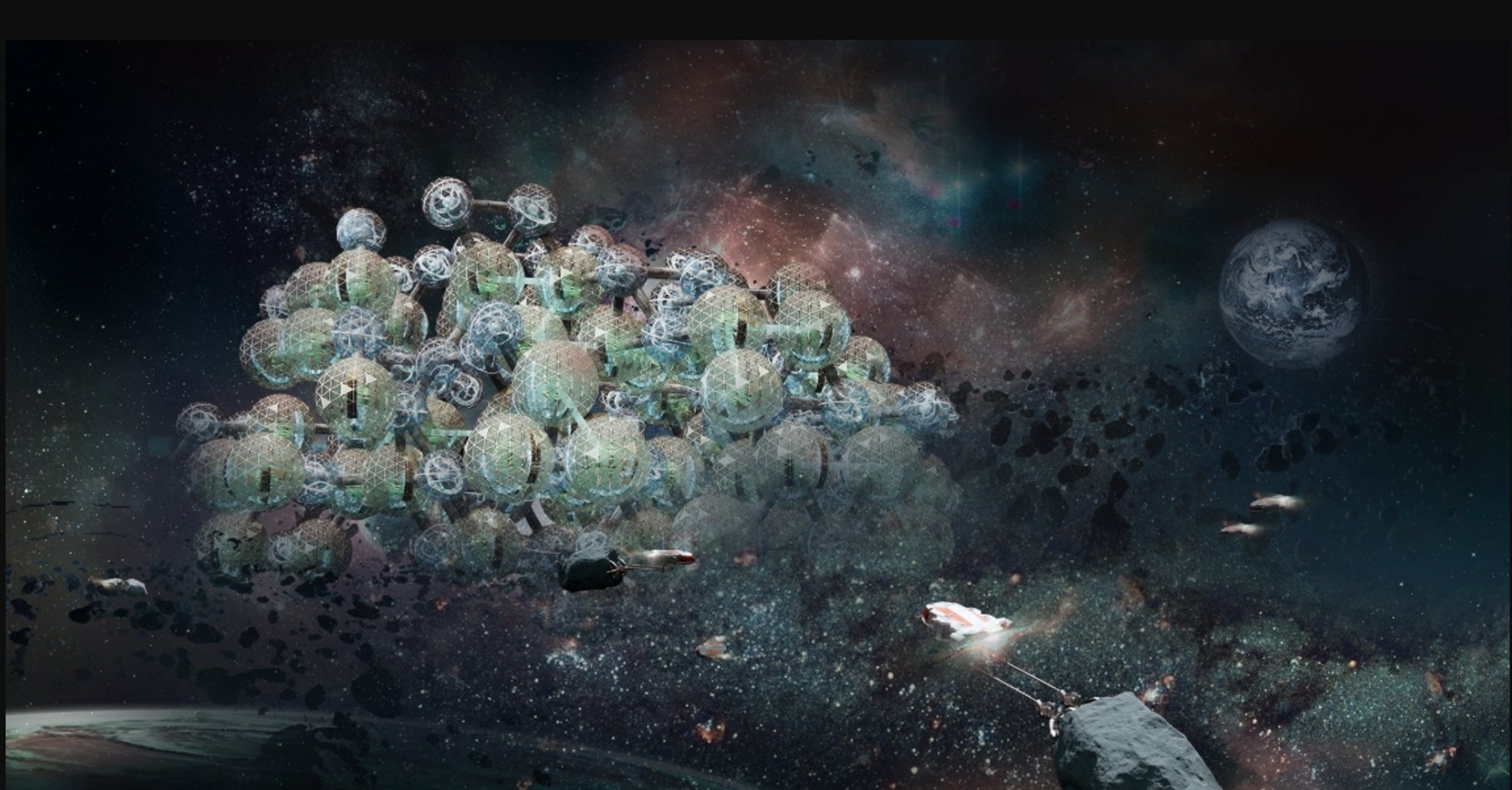
Infinite Typing is a speculative space architecture project that imagines how humanity may build, inhabit, mine, and expand beyond Earth through a self-sufficient modular system. Instead of treating the Leap mission as a single temporary space operation, the project transforms it into the beginning of a long-term orbital civilization. It asks a powerful architectural question: what if a mining mission could become the seed of an expanding space habitat?
The proposal is built around two primary modules: the habitat module and the production module. These modules are supported by a linking device that transfers energy, materials, resources, and functional units across the system. Together, they create an iterative structure inspired by the molecular logic of water. Just as a water molecule is formed through linked hydrogen and oxygen bonds, Infinite Typing uses linked spherical modules to create a growing spatial network in space.
This approach makes the project more than a futuristic image of living in orbit. It is a system of production, habitation, extraction, circulation, and growth. Through its module-based logic, Infinite Typing presents space architecture as a living infrastructure that can adapt to changing resources, asteroid types, mining opportunities, and human requirements.
The Core Idea: Water Molecule Logic as Spatial Prototype
The form of Infinite Typing is derived from the structure and behavior of water molecule typing. The design uses spherical modules as a primary architectural prototype because a sphere responds well to non-directional spatial conditions. In space, where conventional ideas of ground, verticality, and orientation are disrupted, the sphere becomes a flexible and efficient form for circulation, habitation, and expansion.
The project uses three main devices: a linking device, a production module, and a habitat module. The linking device acts as the first operational connector. It is sent into space to begin the mission, launch mining vehicles, process extracted materials, and fabricate the first batch of living and production units. Once the system becomes operational, it triggers the construction of larger spherical production modules. These modules then fabricate living units, creating a repeating cycle of resource use, construction, and expansion.
This circular logic is central to the project. Infinite Typing does not propose a fixed space station. It proposes an evolving organism. Each module can support the creation of new modules, and each new module can extend the settlement further. The result is a theoretical space mining city complex that grows through repetition, connection, and adaptation.
Asteroid Mining as an Architectural Driver
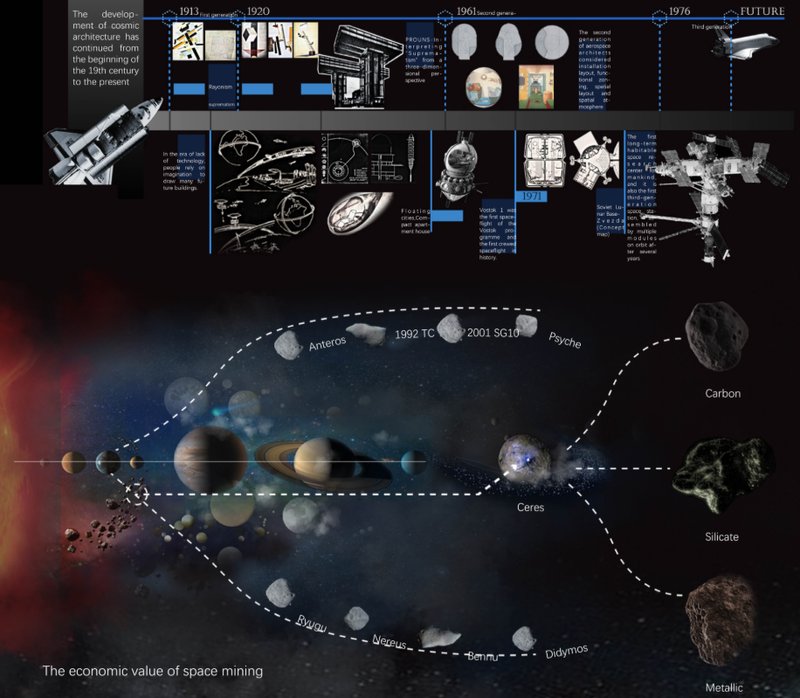
A major strength of Infinite Typing lies in how it connects asteroid mining with space architecture. The project identifies different asteroid types as drivers for different spatial functions. C-type asteroids are associated with water-rich resources that can support life, agriculture, and environmental systems. S-type and M-type asteroids are associated with metals and construction materials that can support production, manufacturing, and structural development.
This resource-based division gives the project its two-module strategy. The habitat module specializes in mining C-type asteroids to extract water for living systems, aquaponic and aeroponic farms, fuel production, and other life-support requirements. The production module specializes in processing S-type and M-type asteroids to extract metals and materials for mining infrastructure, construction units, structural elements, and fabrication systems.
Through this logic, the architecture is not separated from its environment. It grows according to what the cosmic environment provides. The proportion of living modules and production modules can shift based on the available asteroid types. If water-rich asteroids dominate the surrounding context, habitat growth becomes more prominent. If metallic and silicate asteroids are more available, production capacity can expand. This gives the project an adaptive and ecological framework for deep-space construction.
The Metrocyte: Beginning the Orbital System
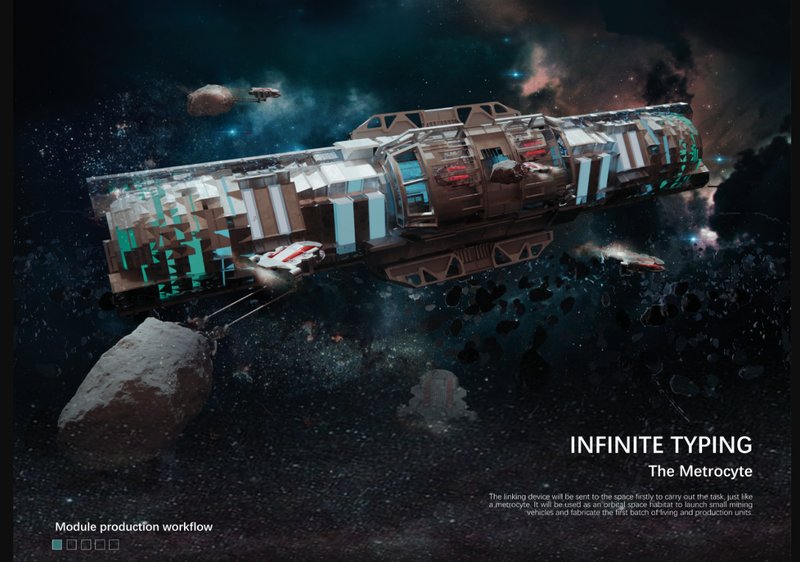
The first major operational element is described as the Metrocyte. It functions like a seed vessel that begins the entire construction process. The Metrocyte carries out the first mission tasks, launches mining vehicles, crushes and processes ore, transports materials, and fabricates the earliest living and production units.
The sectional drawings reveal the Metrocyte as a long cylindrical infrastructure divided into operational zones. It includes a central operation space, work areas, production spaces, cargo lifts, engine rooms, mineral processing areas, and inhabitable zones. Its internal arrangement is highly functional, with elevators and vertical circulation connecting processing, living, and service areas.
The Metrocyte is important because it shows how the project begins at a small scale. Infinite Typing does not require an entire city to be launched from Earth. It begins with a device that can produce, assemble, and support future growth. This makes the project more convincing as a space architecture proposal because it addresses construction sequence, not only final form.
The Mining Bond: From Extraction to Production
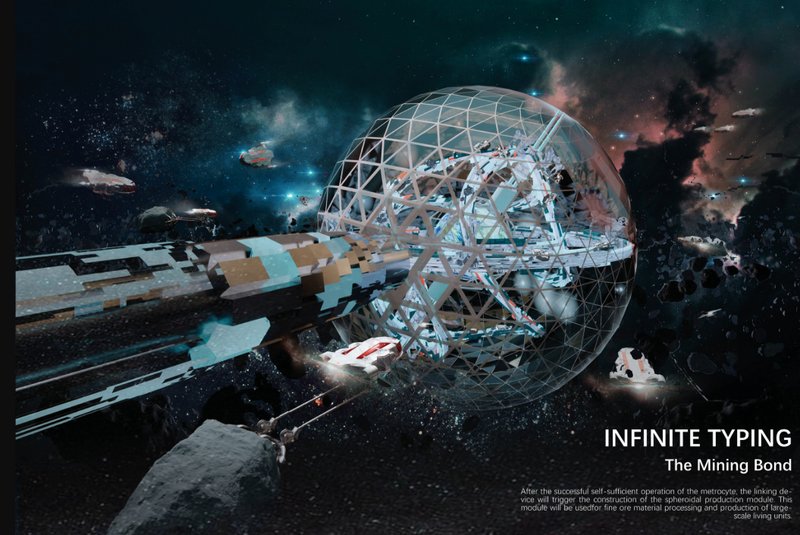
After the Metrocyte establishes basic self-sufficient operation, the next stage is the Mining Bond. This stage triggers the construction of the spheroidal production module. The production module is used for ore refinement, material processing, energy transfer, and the fabrication of larger living units.
The Mining Bond contains robotic arms, workflow systems, energy transport pipes, protective layers, communication systems, maintenance routes, circulation systems, and production spaces. Its axonometric drawings show a stratified spatial organization where facade, energy protection, transmission tubes, robotic machinery, workflow space, and core power systems operate as one integrated structure.
This stage shows a mature understanding of aerospace architecture. The project does not imagine habitation without labor, maintenance, or risk. It includes safe escape routes, equipment systems, energy cores, ore processing workflows, and communication infrastructure. The architecture is designed as a machine for survival and construction, not merely as a symbolic object in space.
The Living Bond: Human Life in Orbital Space
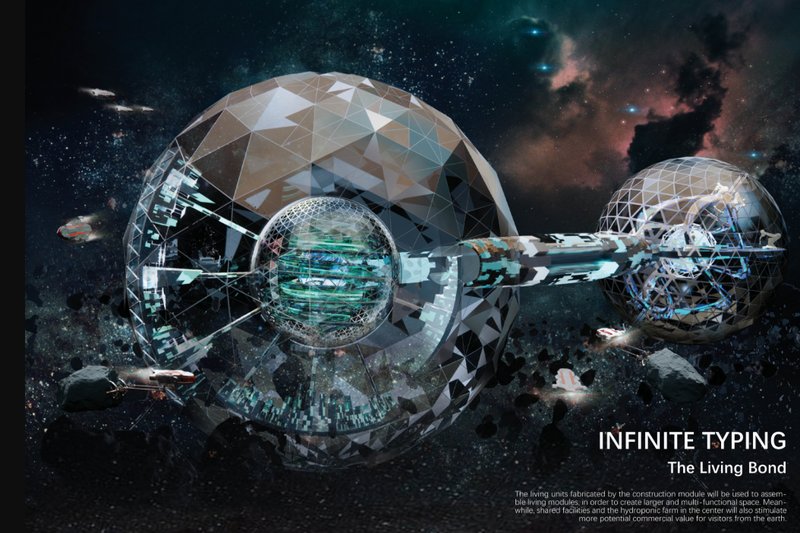
The Living Bond is the stage where production units begin to assemble larger and more multifunctional habitat modules. These living units create residential, recreational, research, agricultural, medical, and service environments for crews working in the space mining system.
The habitat module is organized around boards with different functions. The living board provides accommodation and recreation for crew members. The research board supports scientists, astrophysicists, engineers, observation platforms, structural experiments, and astronomical research. The service and maintenance board provides medical support, emergency help, administration, daily service, communication facilities, control spaces, and maintenance units.
The module also uses rotation to generate artificial gravity. Three boards rotate around the center of the habitat module, creating a dynamic spatial system where the architecture is not static but constantly active. Solar panels are placed along the back of boards, while aquaponic and aeroponic farms, shared spaces, recreational activities, and vertical greenery are integrated into the living environment.
This gives the project a strong human dimension. Infinite Typing is not only about extracting value from asteroids. It also imagines how people may live, work, rest, move, grow food, conduct research, and maintain community in a distant space environment.
Shared Facilities and Internal Life
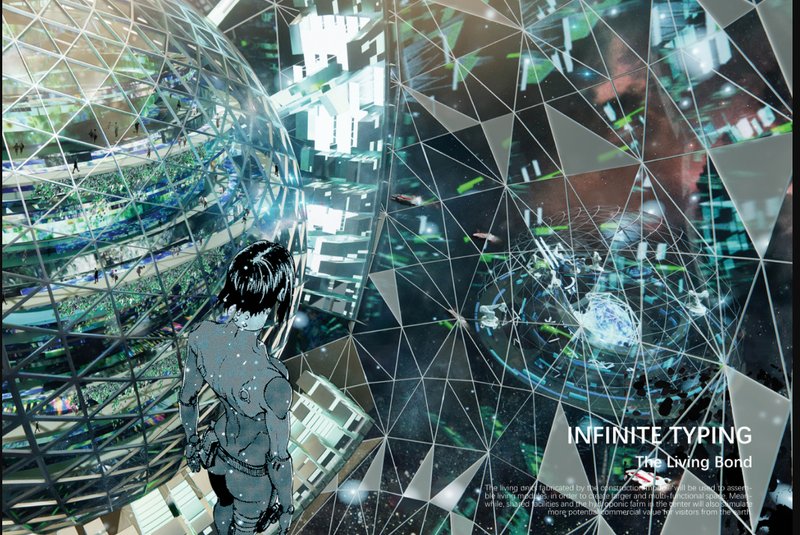
The interior perspective of the Living Bond shows a highly layered habitat. Transparent geodesic shells, orbital structures, gardens, recreation zones, hydroponic farms, public infrastructure, and vertical greenery form a complex spatial experience. The imagery suggests a city within a sphere, where architecture, ecology, machinery, and human presence are held together by a structural lattice.
The shared facilities are especially important. In a closed space environment, architecture must support physical survival and psychological endurance. By including exercise areas, business spaces, recreation areas, farms, green spaces, public infrastructure, and observation zones, the design recognizes that future space habitats cannot be reduced to technical capsules. They must become complete environments for living.
The use of greenery also softens the mechanical nature of the space station. It introduces a biological layer into the technological system. This creates a stronger architectural balance between machine, ecology, and human experience.
Iterative Cell Typing: A Growing Space Mining City
The final stage of Infinite Typing is iterative cell typing. Through a bottom-up design method, different module types continue to expand according to ore quantity, energy supply, environmental change, and spatial demand. The system grows through proliferation, forming a highly adaptive modular network.
The diagrams show multiple generations of expansion. Generation one begins with a production module. Later generations introduce combinations of habitat and mining modules, creating larger clusters. The growth pattern follows a hexagonal crystal system, where potential locations, construction restrictions, and type decisions guide future development.
This is where the project becomes a vision of a future space mining city. It is not planned as a single complete object but as an expanding ecosystem. Damaged or outdated modules can be demolished, recycled, or replaced. Production modules can reduce later construction time. Habitat modules can support human life. Linking devices can keep resources moving. The whole system becomes a framework for continuous orbital urbanism.
A Self-Sufficient Ecosystem in Space
Infinite Typing proposes a closed-loop system in which production modules and habitat modules exchange energy, material, waste, water, and functional units. Ore materials move from production units to the center of the living module. Hydroponic agricultural products and domestic waste from living modules are transmitted back to production modules for recycling and reuse. Airships and mining craft continuously supply ore energy to the connectors, which then distribute energy to each module.
This strategy creates a theoretically self-sufficient ecosystem. The project understands that long-term space architecture cannot depend only on supply from Earth. It must develop internal cycles of production, consumption, recycling, repair, and growth. By combining asteroid mining, modular fabrication, habitat construction, agricultural production, and energy distribution, Infinite Typing outlines a possible future for autonomous space settlement.
Architectural Significance
Infinite Typing is significant because it treats space architecture as both a technical and cultural project. It studies the history of aerospace design, recognizes the economic value of asteroid mining, and then develops an architectural system capable of turning extraction into habitation.
The visual language of the project is ambitious and cinematic, but the logic beneath it is systematic. The Metrocyte starts the mission. The Mining Bond processes resources and produces larger modules. The Living Bond supports human life and research. Iterative cell typing expands the system into a larger orbital settlement. Each stage is connected to the next, creating a clear sequence of growth.
The project also shifts the idea of space mining from a purely industrial activity to a civic and architectural activity. It asks how mining infrastructure can become a habitat, how production can become settlement, and how a mission can become a city.
Infinite Typing by LULIN HE, Li yuanjun, chen zhang, and DAN LIANG, shortlisted entry of Leap, is a bold exploration of future space architecture. It transforms asteroid mining into a modular, self-sufficient, and continuously expanding habitat system.
By using the water molecule as a spatial prototype, the project creates a flexible architectural logic for linking production modules, habitat modules, and resource systems. By separating C-type asteroid mining from S/M-type asteroid processing, it gives each module a specialized role. By designing living boards, research boards, service boards, farms, rotating spaces, and shared facilities, it gives the future of space habitation a human-centered dimension.
Infinite Typing ultimately imagines that humanity’s expansion into space will not happen through one monumental station, but through many connected cells. Each module becomes a unit of survival, production, research, and growth. Together, they form an evolving space mining city, a new architecture for life beyond Earth.



Popular Articles
Popular articles from the community

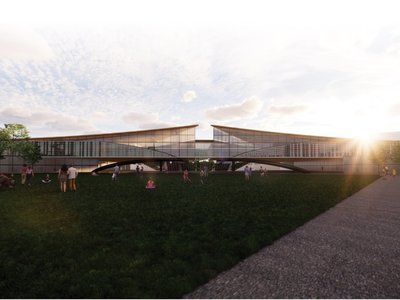
Kawasaki Olympic Sports Center: Sports Complex Architecture Rooted in Community, Tradition, and Movement
Kawasaki Olympic Sports Center reimagines sports complex architecture as a civic park where tradition, training, and community meet locally.

Eco Chapel: A Green Architecture Pavilion Designed in Symbiosis with the Forest
Eco Chapel uses green architecture to weave prayer, learning and reuse into a forest pavilion shaped by modular hexagonal canopies for life.
Reincarnation Weaves a Three-Story Retreat into the Green Landscape of Rural Bangladesh
Ara Manor in Narsingdi dissolves the line between domestic architecture and its lush surroundings through screens, courtyards, and planted rooftops.
IKC de Geluksvogel: Sustainable School Architecture Designed for Free Movement and Digital Learning
IKC de Geluksvogel turns sustainable school architecture into a flexible Maastricht campus for digital learning, nature, and free movement.


Similar Reads
You might also enjoy these articles
Eco Chapel: A Green Architecture Pavilion Designed in Symbiosis with the Forest
Eco Chapel uses green architecture to weave prayer, learning and reuse into a forest pavilion shaped by modular hexagonal canopies for life.
Kaffeebühnen: Coffee Shop Architecture Designed as a Civic Stage Between Vienna’s City and Park
Kaffeebühnen turns coffee shop architecture into a civic stage, linking Vienna’s park edge, urban life, warm timber yards, and coffee craft.
Healing Façade: Sustainable Architecture for Reforestation, Community, and Sacred Ecology in Ethiopia
Healing Façade reimagines sustainable architecture as a living wall that restores soil, catches water and renews Ethiopia's forest churches.


Urban Forest: A Vertical Ecosystem for 5,000 Workers in Singapore's Changi Business Park
Radially stacked pods and layered green decks turn a 7-acre plot into 47 acres of ecological workspace projected for 2040.






Comments (0)
Please login or sign up to add comments
No comments yet. Be the first to comment!