

Kilo / Honc Carves a Landscape of In-Between Spaces from an 80 m² Slovak Apartment
The Pink Mill Apartment in Piešťany, Slovakia, trades corridor-bound developer logic for layered openness and a timber loft.


Developer apartments come with a familiar contract: corridor, bedroom, corridor, bathroom, living room. The sequence is efficient and entirely predictable, and it turns 80 square metres into a series of boxes. When Kilo / Honc took on a standard-layout flat in Piešťany, Slovakia, they broke that contract. The Pink Mill Apartment, completed in 2023, strips away the dark hallways and sealed-off rooms of the original plan, replacing them with a spatial landscape where function is suggested rather than assigned.
What makes the project genuinely interesting is not merely the addition of a mezzanine, though the extra 17 square metres of living area gained from 3.5-metre ceilings is significant. It is the way the architects treat ambiguity as a design tool. Rooms here resist precise definition. A reading nook doubles as a balcony overlooking the living space; a corridor becomes a gallery; a bathroom opens up beneath exposed timber joists as though it were another room, not a utility closet. The result is an apartment that feels substantially larger than its footprint, not through tricks but through a refusal to partition experience.
Vertical Expansion Under Concrete Skies
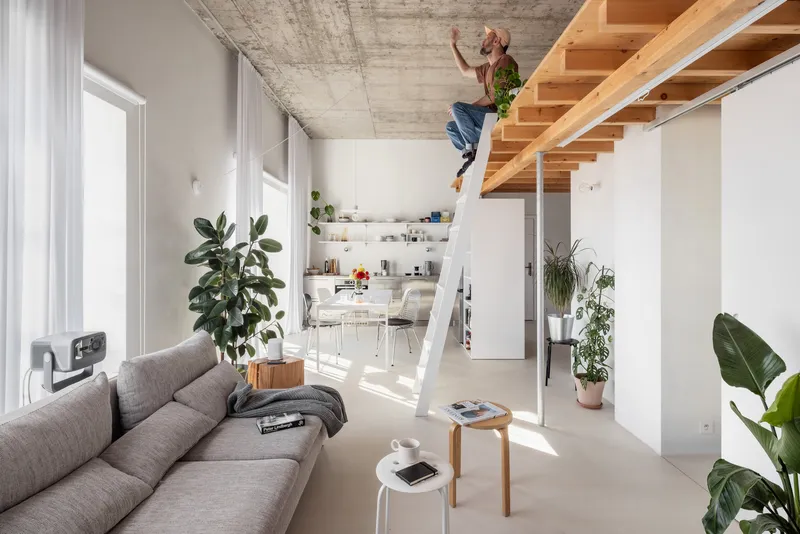
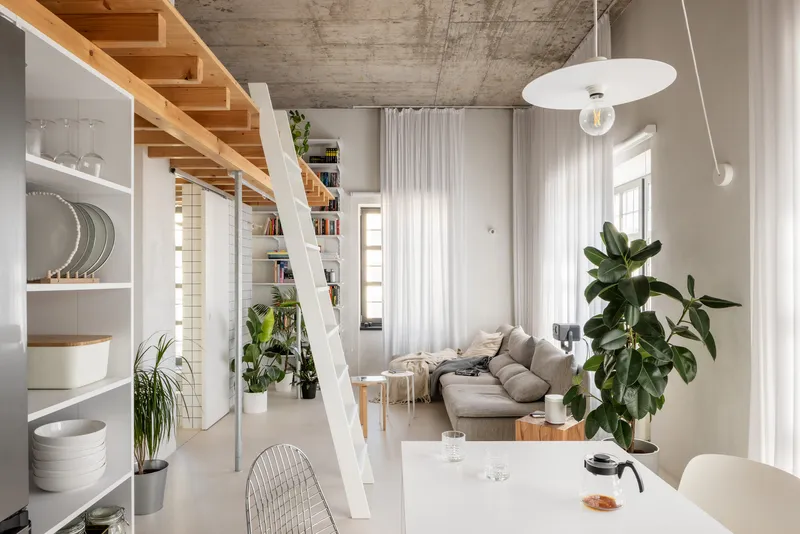

The raw concrete ceiling, left exposed, does double duty. It provides an honest datum line that registers the full 3.5-metre height of the original volume, and it acts as a textural counterweight to the light timber structure inserted below it. White ship ladders rise to the mezzanine platform, their slender profiles keeping sightlines open across the double-height living space. The ladders are deliberately minimal: they invite ascent without visually chopping the room in half.
By suspending a timber loft rather than building a conventional second floor, the architects preserve the sense of a single continuous volume. You are never fully upstairs or downstairs. You are somewhere in between, which is precisely the point.
The Timber Loft as Inhabited Furniture

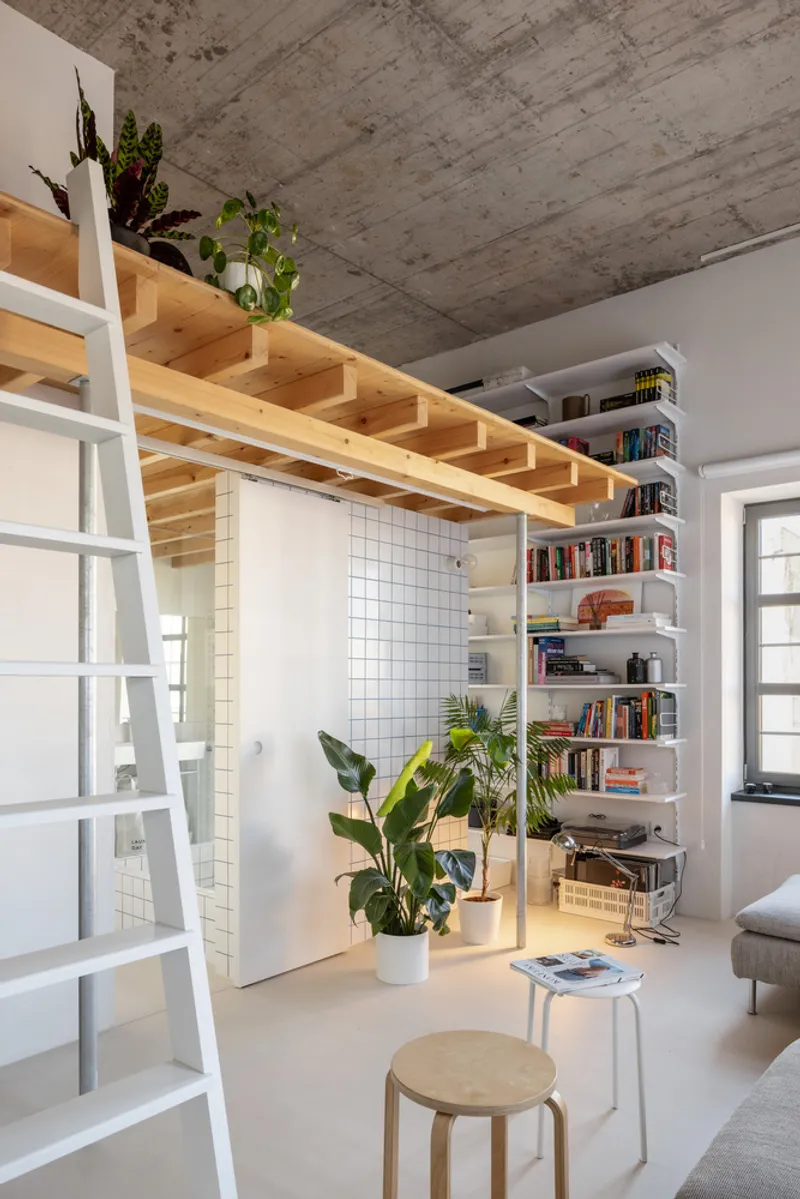

The mezzanine reads less like a floor and more like a large piece of furniture dropped into the apartment. Exposed timber joists give it a skeletal, workshop quality, and its edges are lined with bookshelves that serve as both storage and guardrail. Sitting on the platform with legs dangling over the edge, as one resident is photographed doing, turns the loft into a kind of domestic balcony. The boundary between circulation and habitation dissolves.
Potted plants colonize the platform's perimeter, softening the junction between rough concrete above and warm timber below. The planting is casual, not decorative: it reinforces the sense that this is a landscape to be occupied rather than a room to be furnished.
Kitchen and Living: Open Shelving as Spatial Filter
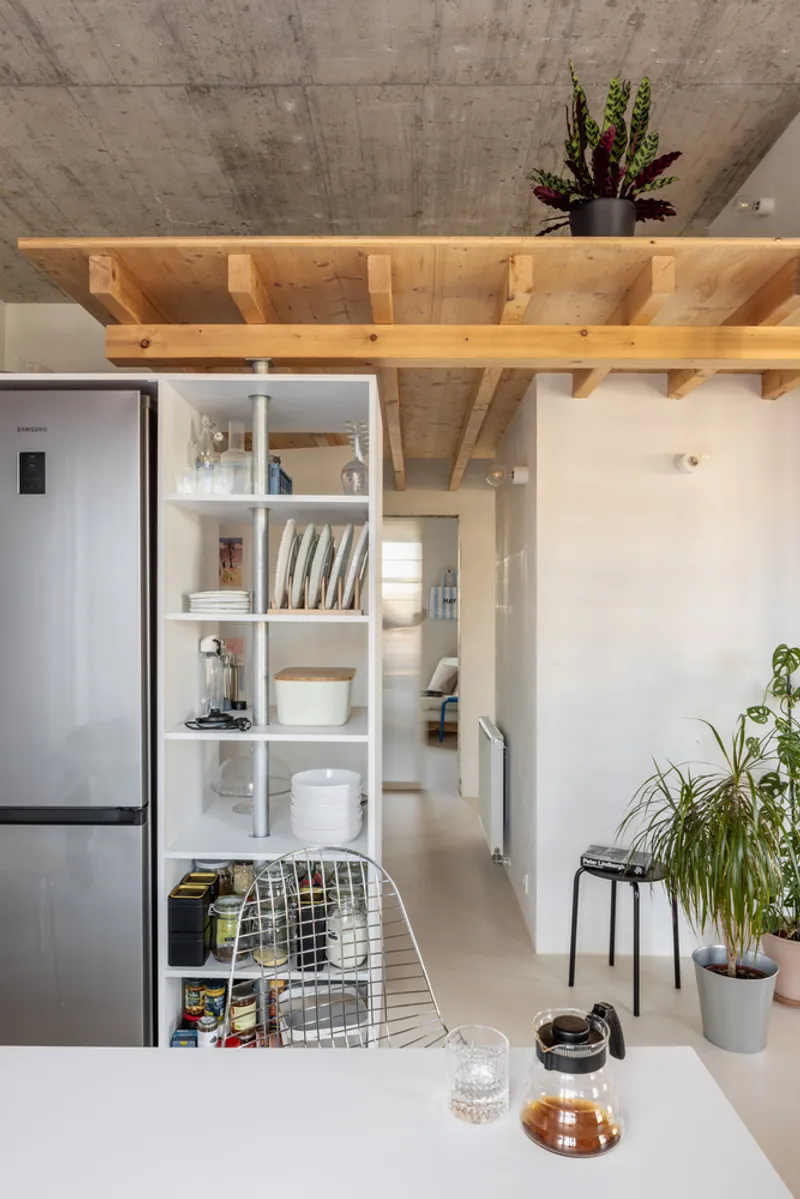
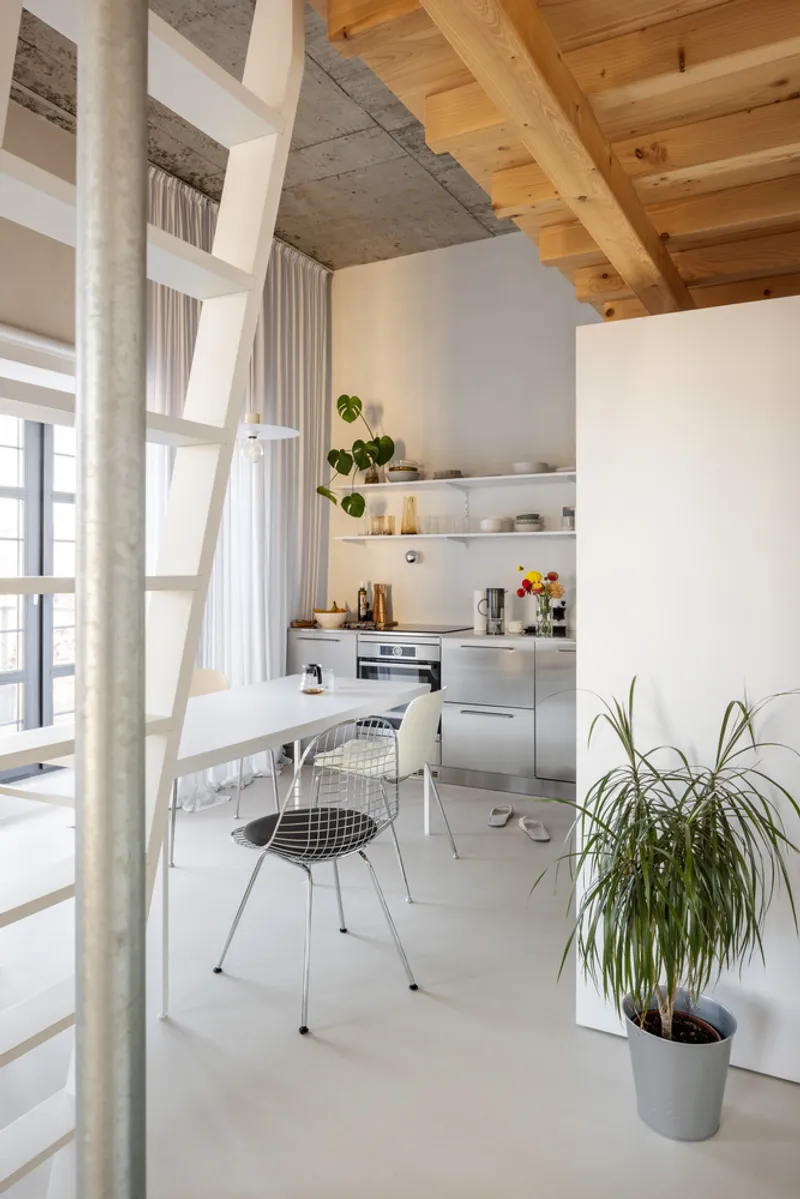
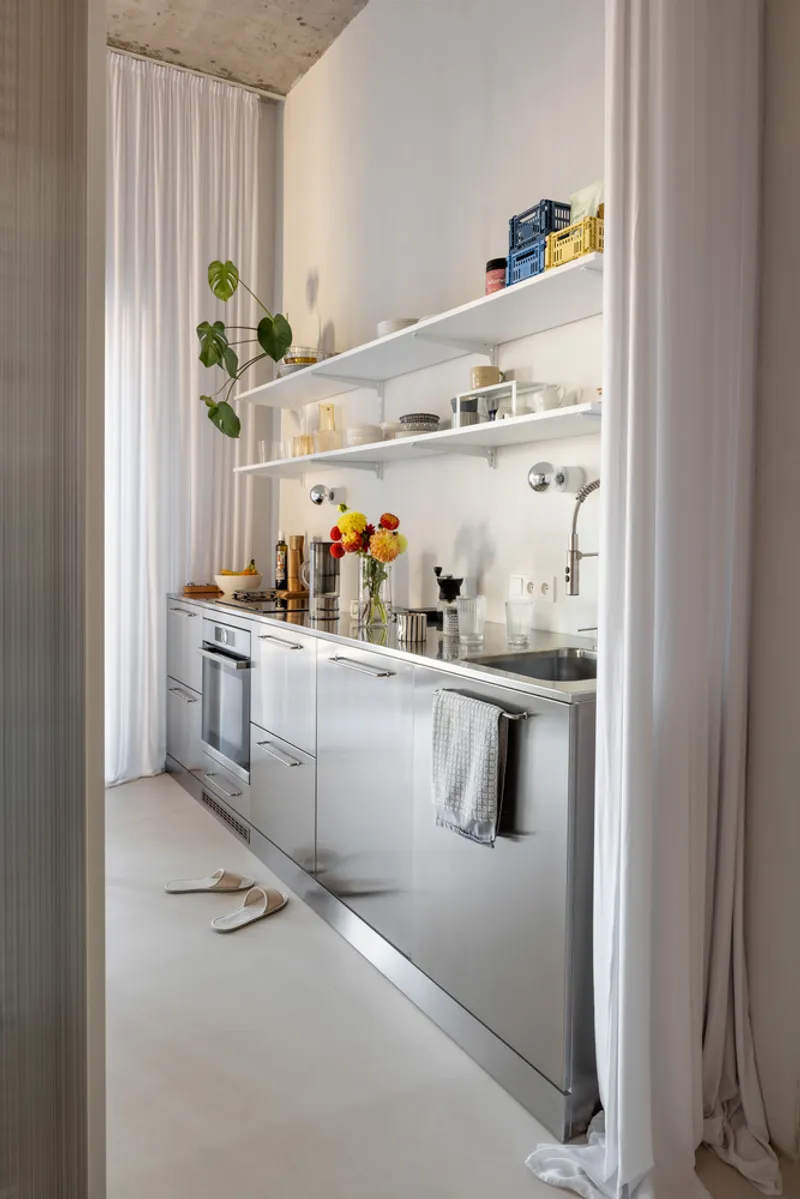
The kitchen sits within the open plan but is subtly zoned through an open shelving unit that frames views toward the loft structure above. Rather than a solid wall or even a half-height partition, the shelves act as a permeable membrane. Light, sound, and sightlines pass through; only objects stop. It is a smart move in a compact apartment, where any opaque barrier would immediately shrink the perceived volume.
Stainless steel cabinetry in the galley zone brings an industrial clarity that pairs well with the concrete ceiling, while sheer white curtains at the windows diffuse the light arriving from three cardinal orientations. The combination keeps the kitchen feeling utilitarian without being cold.
Corridors Reclaimed: Partitions and Thresholds
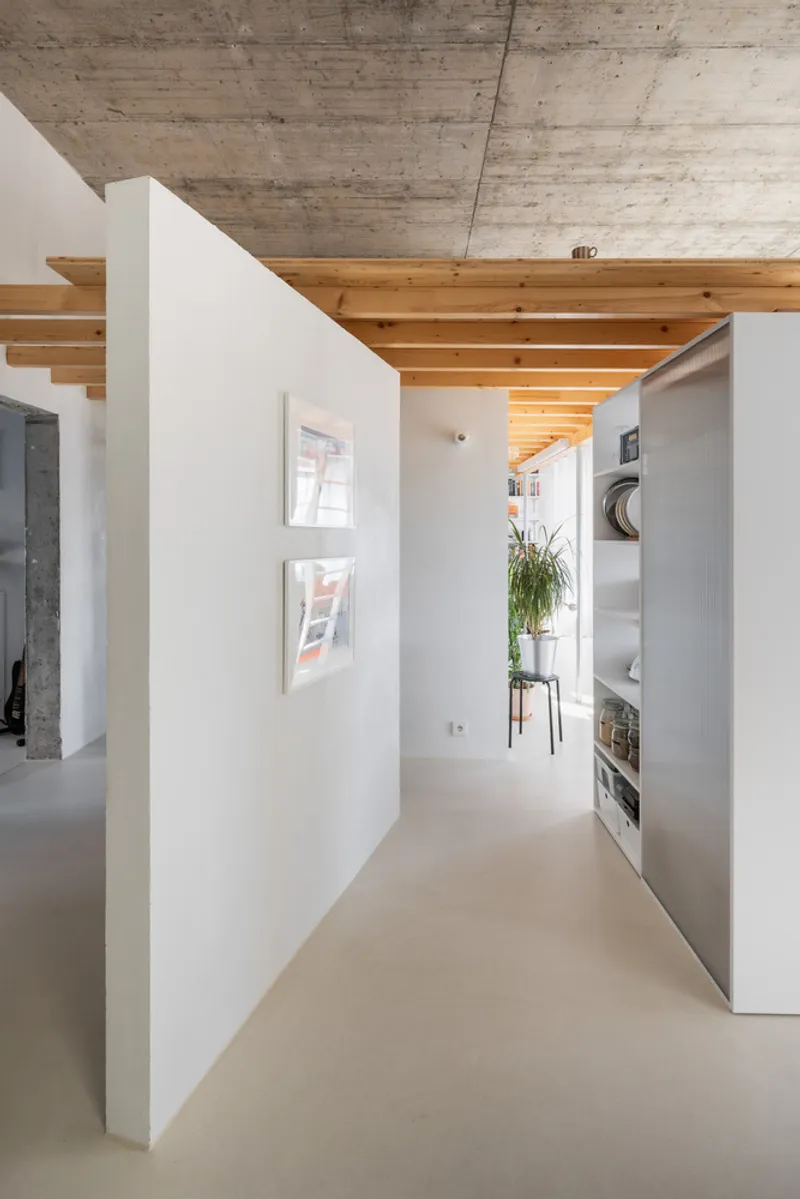


Where the original layout funnelled movement through narrow corridors, the renovation replaces walls with freestanding white partitions and translucent sliding panels. These elements suggest division without enforcing it. A coat rack mounted to an exposed column, a storage unit capped by timber beams: the circulation zones are treated as inhabitable space, not leftover square metres.
The pale resin floor runs continuously throughout, eliminating the material transitions that typically telegraph a change in room function. You move from entry to kitchen to bedroom without the floor ever telling you that you have crossed a threshold. That continuity is essential to the apartment's fluidity.
Bathroom as Room, Not Afterthought


The bathroom is one of the most resolved moments in the apartment. Exposed timber joists run overhead, connecting the wet zone to the material palette of the rest of the home rather than isolating it behind a glossy door. White grid tiles on the shower walls offer a geometric rhythm that feels deliberate without being fussy, and a raised shower platform creates a subtle level change that marks the wet area without needing a full enclosure.
A glass partition separates the shower from the double vanity, keeping the room visually open. Polished concrete floors ground the space, and the overall effect is closer to a well-appointed changing room than a typical apartment bathroom. It is generous in atmosphere even at a modest scale.
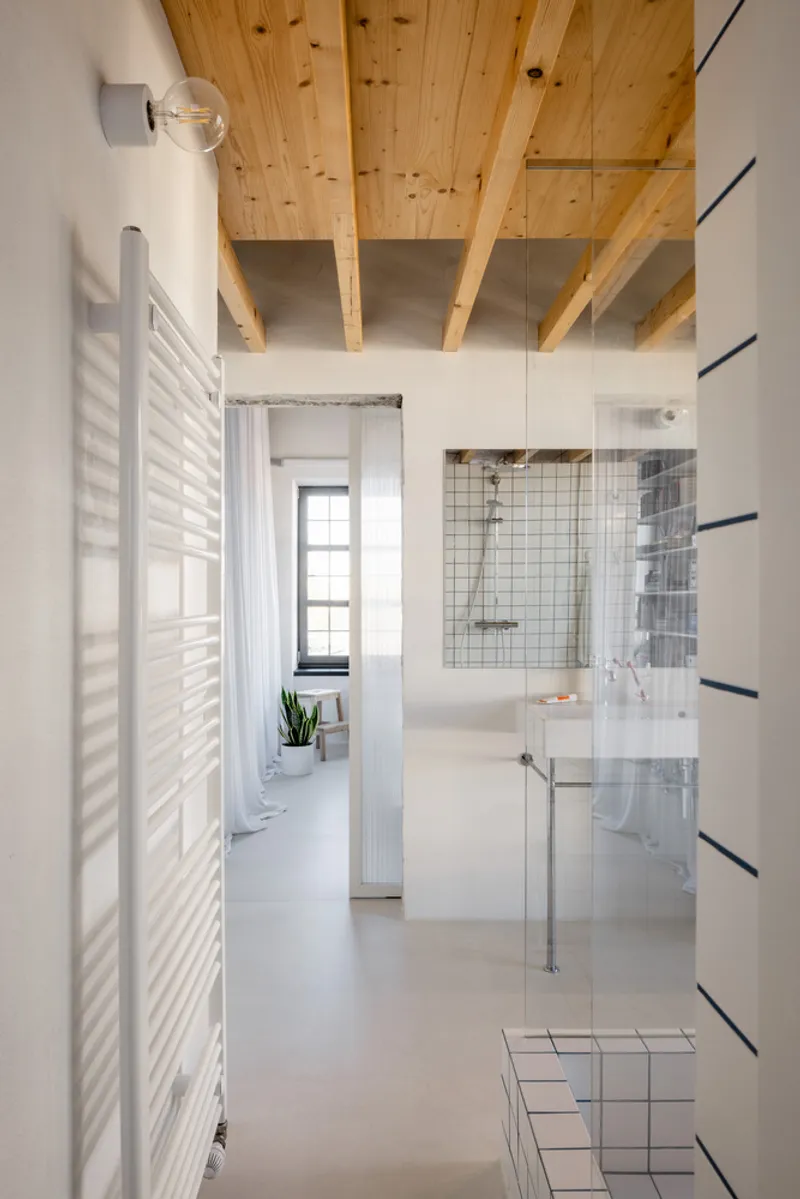


Secondary details reinforce the care taken here: open shelving for toiletries replaces mirrored cabinets, a white storage unit tucks beneath timber beams, and natural light filters in through the corridor. The bathroom is not hidden; it participates in the apartment's broader choreography of light and movement.
Bedroom and Quiet Moments


The bedroom is glimpsed through a doorway framed by an exposed concrete column and beam, a detail that gives the threshold a monumental quality disproportionate to the apartment's size. This is the one zone where enclosure is permitted, where intimacy wins over openness. Even so, the material continuity of concrete and timber links it back to the larger whole.
A corridor view past wall-mounted hooks and a radiator shows the apartment at its most domestic and understated. These quieter passages are just as considered as the double-height living space; they prove that the design ambition extends to every corner, not just the photogenic ones.
Before: The Developer Shell

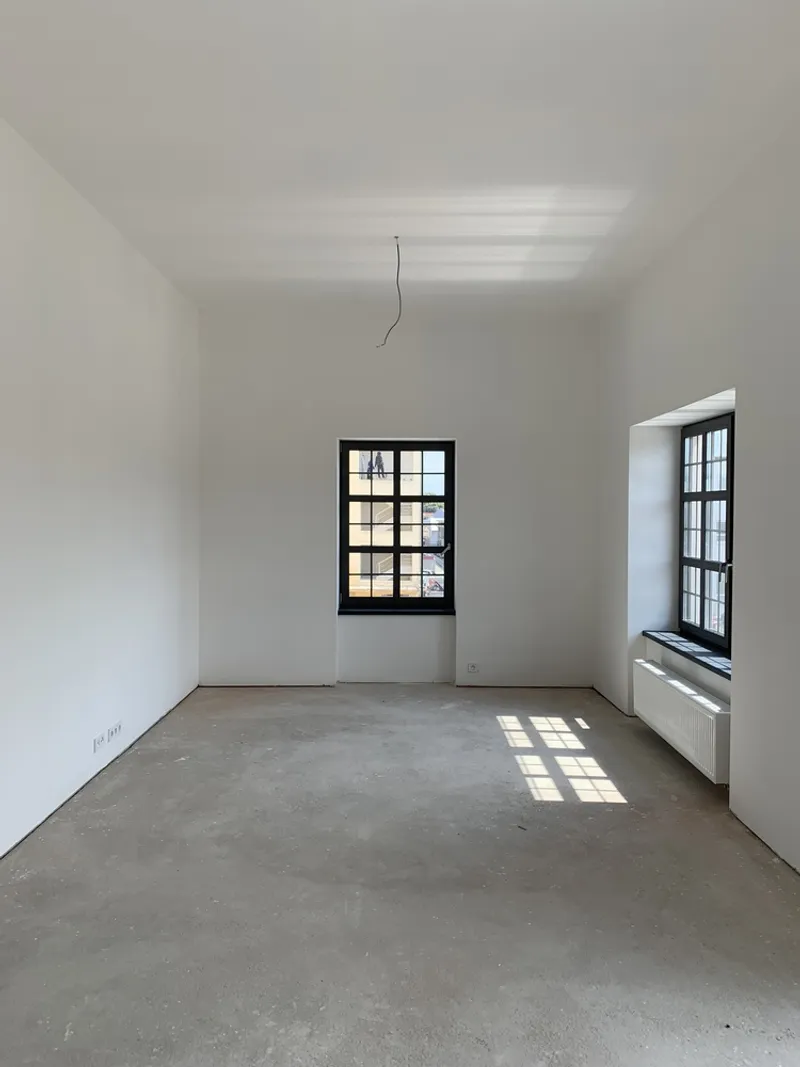

Construction photographs reveal the raw concrete shell that Kilo / Honc inherited. Black-framed windows cast sharp grid shadows across bare floors, and a corridor of concrete openings leads to a lone blue door. The images are a useful reminder of just how much spatial work went into the renovation. The bones were good, with generous ceiling height and light from multiple orientations, but the original layout did nothing to exploit them.
Plans and Drawings

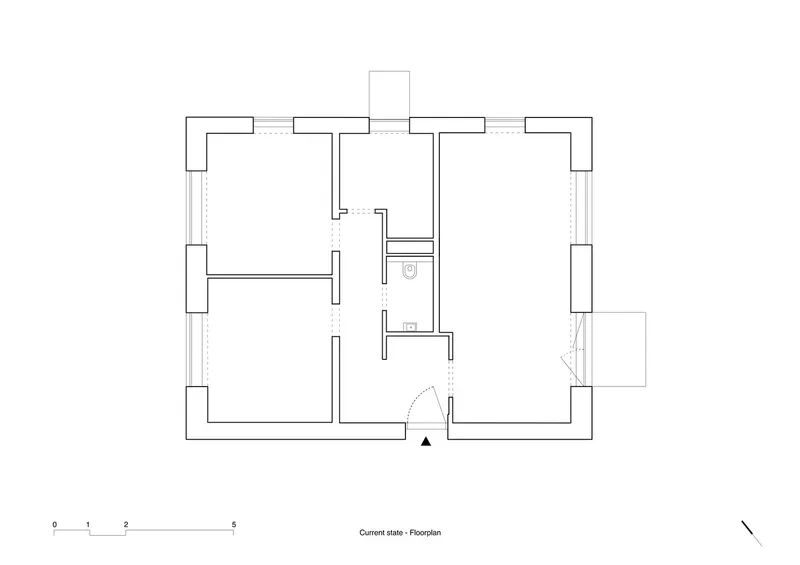


The axonometric drawing shows the apartment as a compact volume with a rooftop pavilion and courtyard, situating the project within its building context. Comparing the original floor plan to the renovated first and second floor plans makes the transformation legible: enclosed rooms and a central bathroom give way to an open field of activity with the mezzanine level floating above. The second-floor plan, with its planted elements, confirms that the greenery visible in the photographs is integral to the design rather than an afterthought.
Why This Project Matters
The Pink Mill Apartment matters because it demonstrates that spatial generosity is not a function of square metres. At 80 m², this is not a large home. But by refusing the corridor-and-box logic that developer layouts default to, Kilo / Honc extract a richness of experience that many apartments twice the size cannot offer. The added 17 square metres of loft area are meaningful, but the real gain is perceptual: the apartment feels like a place with depth, with moments of compression and release, with views that shift as you climb a ladder or round a partition.
The project also offers a replicable lesson for compact renovations anywhere. High ceilings are underused in most standard apartments. A mezzanine, a few open shelving units, and a commitment to material continuity can turn a generic flat into something specific and personal. Kilo / Honc did not need an exotic site or an extraordinary budget. They needed a clear idea about how space should feel, and the discipline to carry it through every room, every threshold, and every detail.
Pink Mill Apartment by Kilo / Honc. Piešťany, Slovakia. 80 m². Completed 2023. Photography by Matej Hakár.
About the Studio
Share Your Own Work on uni.xyz
If projects like this are the kind of work you want to make, uni.xyz is a place to publish your own, find collaborators, and enter design competitions.




Popular Articles
Popular articles from the community


The Ocean Hive: Sustainable Architecture for a Self-Sufficient Civilization at Sea
The Ocean Hive imagines sustainable architecture at sea, where modular habitats, algae, wave power and ocean waste sustain a growing colony.
EW PARK: Sustainable Architecture Reimagines the Future of Urban Parking
EW PARK reimagines city parking as a modular wooden tower combining automation, solar energy, electric mobility, and adaptable urban design.

AL-JANNAH: Sustainable Architecture and Permaculture for Afghan Widows
AL-JANNAH uses sustainable architecture and permaculture to create resilient oasis of housing, learning, work and renewal for Afghan widows.

The Musturak Paradise: Senior Living Architecture for a Connected Future in Temara, Morocco
The Musturak Paradise reimagines senior living architecture in Temara via private homes, social spaces, culture, community, and shared care.


Similar Reads
You might also enjoy these articles


Hodi-Mandai Geram
Project Function: Preservation and revitalization of the Intangible heritage and socio-spatial identity of the Hodi by Housing, Cultural Memory Center, Sacred Grove, landscape, local tourism economy


Olio Towers: A Mid-Rise for Performers That Fuses Housing, Rehearsal, and Stage
Located blocks from Houston's Theater District, this modular tower stacks living units around a central performance atrium.

Oasis: Modular Green Housing Carved into Dhaka's Urban Fabric
A shortlisted Plugin Housing entry reclaims unauthorized settlements in Dhaka with stepped concrete volumes, green roofs, and ventilation-driven design.

Black Hole: A Floating Megastructure for the Post-Physical Era
Emiliano Mazzarotto envisions a spherical, self-scaling arena where e-sports, digital hotels, and holographic stadiums replace traditional public space.


Explore Architecture Competitions
Discover active competitions in this discipline



Challenge to reimagine the Iron Throne


Photograph architecture without architects


Illustrate the lost glory of Angkor Wat - Render Challenge


Design challenge to reuse E-waste
Comments (0)
Please login or sign up to add comments
No comments yet. Be the first to comment!