

Inrestudio Folds a Single Sculptural Wall Through a Ho Chi Minh City Hair Salon
SONO Salon wraps green tile and raw concrete into a continuous terrain that turns 157 square meters into a garden without plants.


A hair salon is, at its core, a room full of mirrors, chairs, and sinks. The challenge is never the program but the atmosphere: how do you make a person feel cared for while sitting still for an hour? Inrestudio, led by Kosuke Nishijima, answers that question with a single architectural gesture. In SONO Salon, a two-story maisonette tucked into a quiet quarter of Ho Chi Minh City, one continuous wall of green tile and raw concrete threads through both floors, bending and arcing to carve out every space the salon needs. It is simultaneously structure, surface, furniture, and landscape.
The name "SONO" is Japanese for garden, and the design takes that literally without resorting to the obvious. There are no planter boxes crammed into corners, no living walls, no bamboo. Instead, the wall itself behaves like terrain, shifting direction and height the way a garden path meanders through topography. The result is a project where a single element does almost all of the spatial work, and does it with uncommon restraint for an interior that could easily have tipped into maximalism.
One Wall, Two Floors
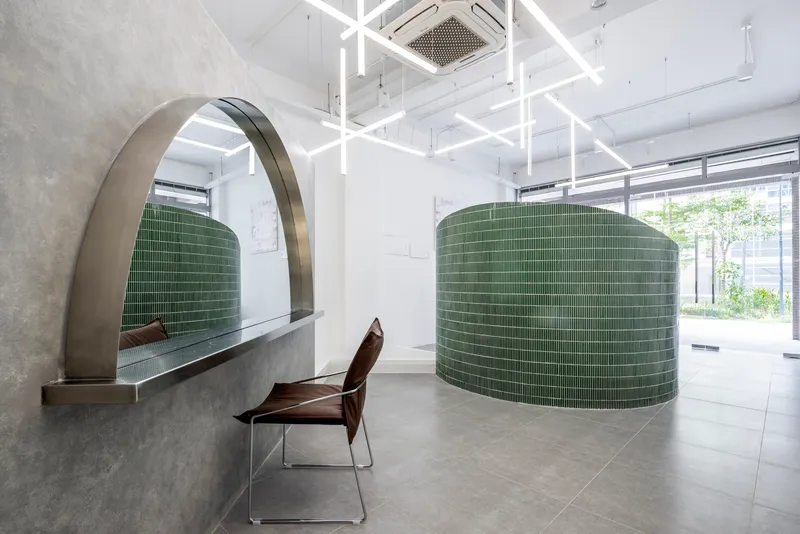


The defining move here is the continuous wall that snakes through the entire 157-square-meter interior. On one face it wears strips of green mosaic tile; on the other, it presents a raw grey concrete finish. That duality is not decorative: it tells you which side of the wall you are on and what activity is happening there. On the ground floor the wall runs in relatively restrained lines, organizing the waiting area, service counter, and styling stations into a legible sequence from the entrance to the rear.
Upstairs, the same wall loosens. Its arcs become more pronounced, curving to define four styling stations on one side and a shampoo area on the other. Inrestudio describes this shift as a response to the upper floor's "increased complexity of activity," which is a polite way of saying more things happen up there and the wall needs to work harder to separate them. The key insight is that the wall never breaks. It folds, turns, rises, and dips, but it remains legible as one continuous element from ground to ceiling.
Green Tile as Texture, Not Decoration
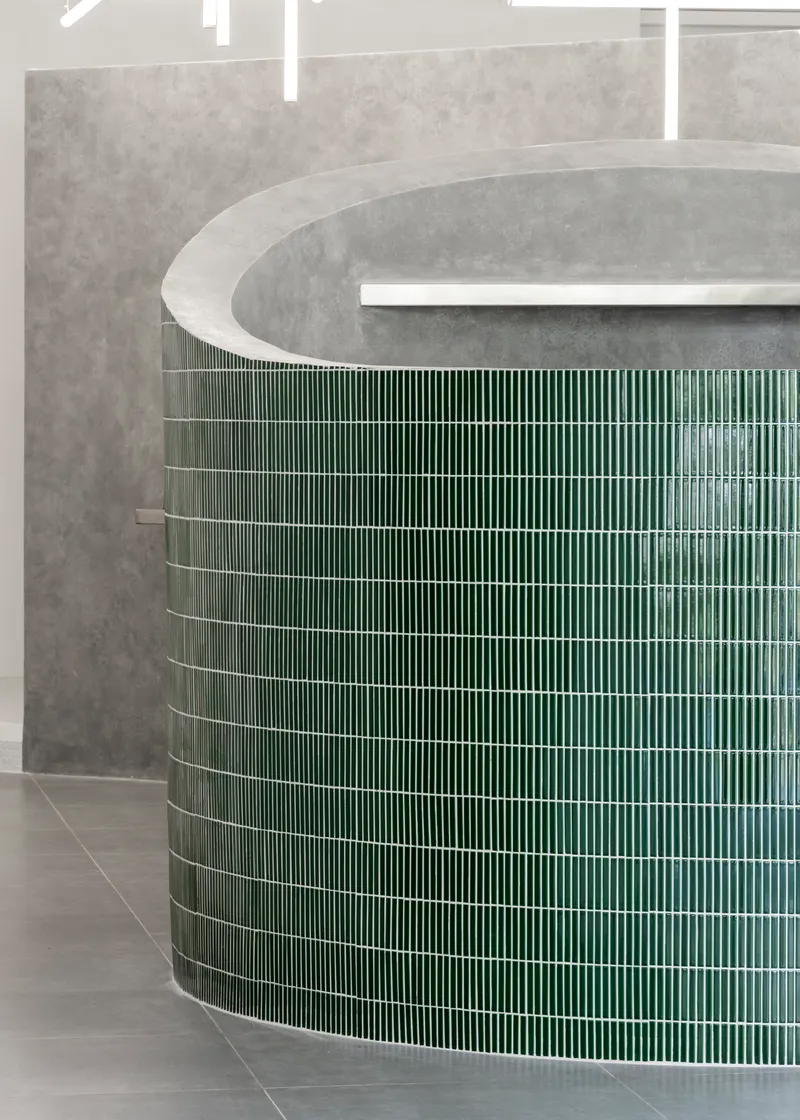


The green ceramic tile is doing a lot of heavy lifting in SONO. Applied in horizontal strips that follow the wall's curves, it reads as a material skin rather than an applied pattern. Up close, the slight irregularities in the glaze and the shadow lines between strips give the surface a tactile depth that photographs only partly convey. Against the existing white walls, which Inrestudio wisely left untouched, the green reads as something geological, almost mossy, reinforcing the garden metaphor without being literal about it.
The choice to clad only one side of the wall in tile is smart economy. It gives the space visual variety without introducing a second material system. You turn a corner and the world shifts from verdant glaze to austere concrete. That contrast organizes your experience as clearly as any signage would.
Arrival and Reception
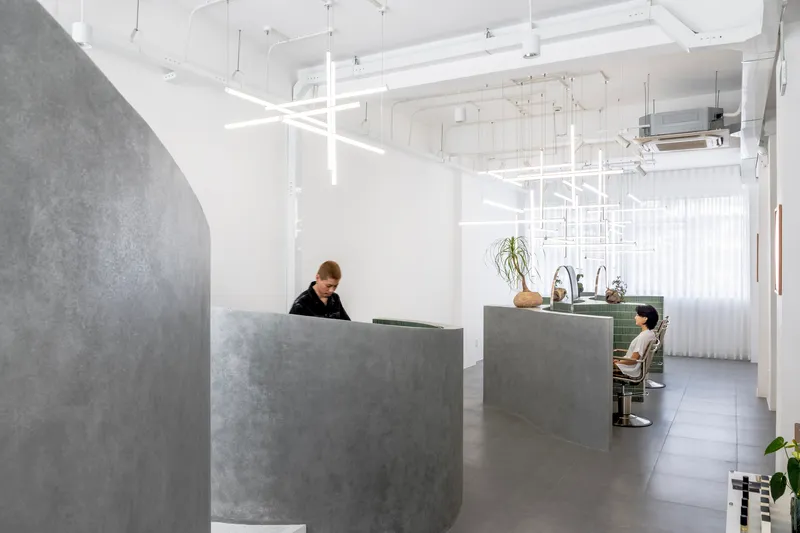
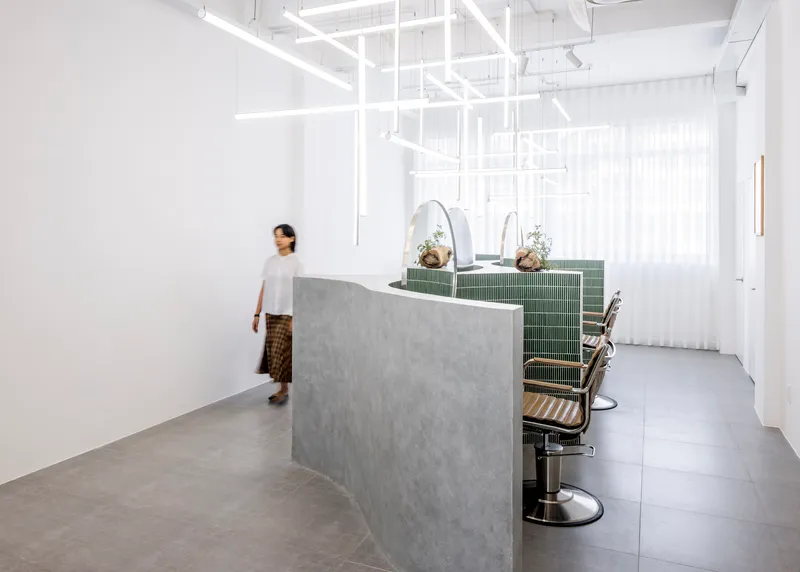

The ground floor reception sets the tone immediately. A curved concrete desk, finished with a white resin top, sits beneath a grid of suspended linear lights. Sheer curtains filter the daylight from the storefront, giving the space a diffused, soft quality that flatters both the architecture and anyone sitting in it. The arched opening in the grey concrete wall behind the counter frames the stairway and hints at the spatial complexity waiting on the upper level.
What stands out is how little else is in the room. A built-in bench, a low step that subtly divides zones, and the desk itself constitute almost all of the furniture. The wall does the rest. It is the kind of minimalism that only works when the single element you are relying on has real material presence, and here it does.
Styling Stations as Individual Landscapes
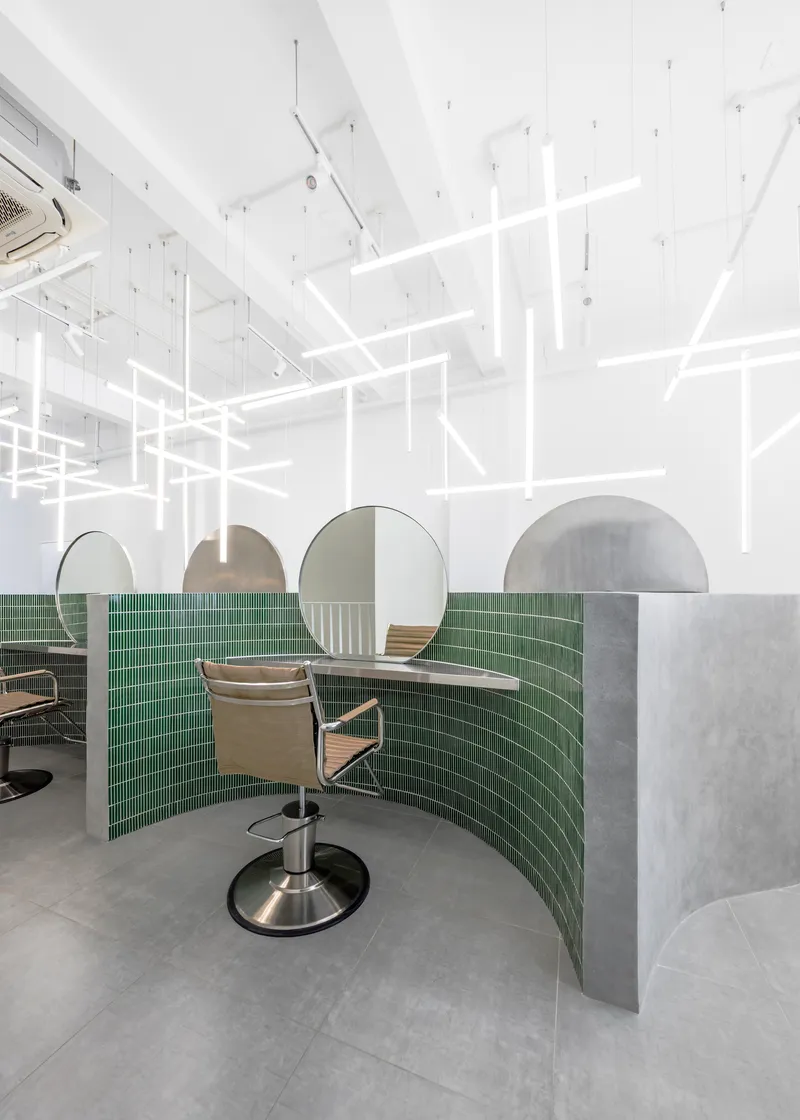
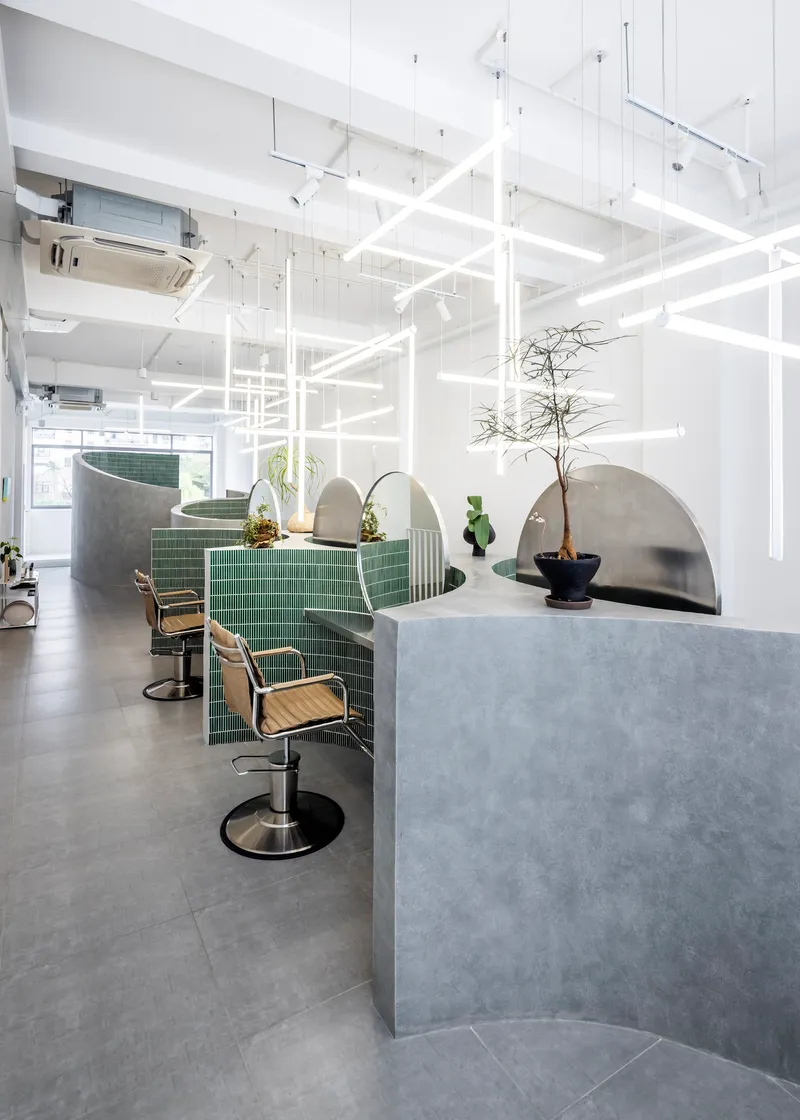
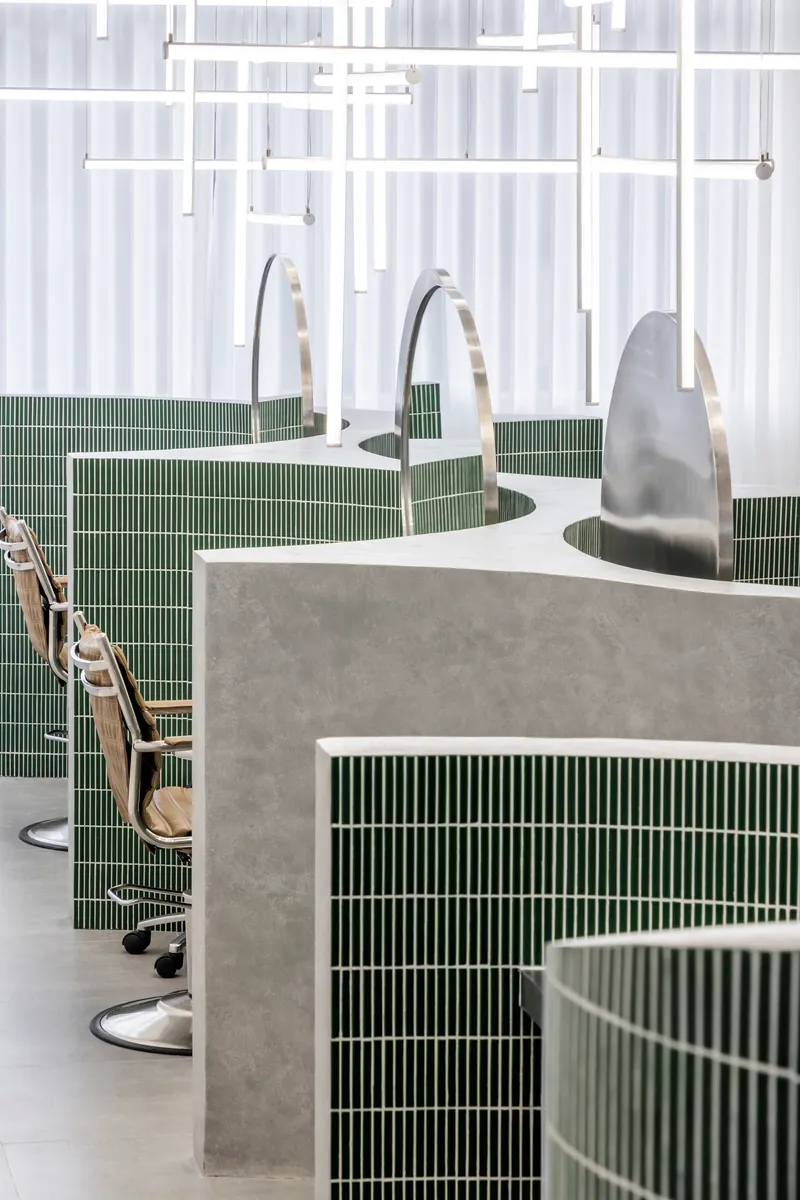
Each styling station feels like its own alcove, separated from its neighbor by the undulations of the tiled wall. Circular mirrors are mounted directly on the green surface, and the curved concrete partitions rise just high enough to offer visual privacy without isolating the client from the larger room. It is a precise calibration: you feel enclosed but not boxed in.
The overhead lighting grid, a white framework of linear fixtures, unifies the ceiling plane and prevents the curving walls below from becoming spatially chaotic. Translucent curtain panels hang at intervals, adding another soft layer that can be drawn for additional privacy during services. The overall effect is of a space that breathes, with layers of transparency and enclosure shifting depending on where you sit.
The Shampoo Area and Natural Light


The shampoo areas, positioned near windows on both floors, benefit from direct daylight. Black reclining chairs are arranged against the curved green wall in a configuration that turns what is usually the most utilitarian zone of a salon into one of its most pleasant. The ceiling here exposes its structural beams, a deliberate contrast to the finished grid lighting elsewhere, and the rawness overhead makes the tiled wall feel even more intentional.
Placing the shampoo stations against the window wall is a simple decision with a real payoff. Clients recline with their heads tilted back, facing the ceiling and the filtered light. It is one of those design choices that only makes sense when you think about the body in position, not just the floor plan.
Overhead Grid and Ambient Control

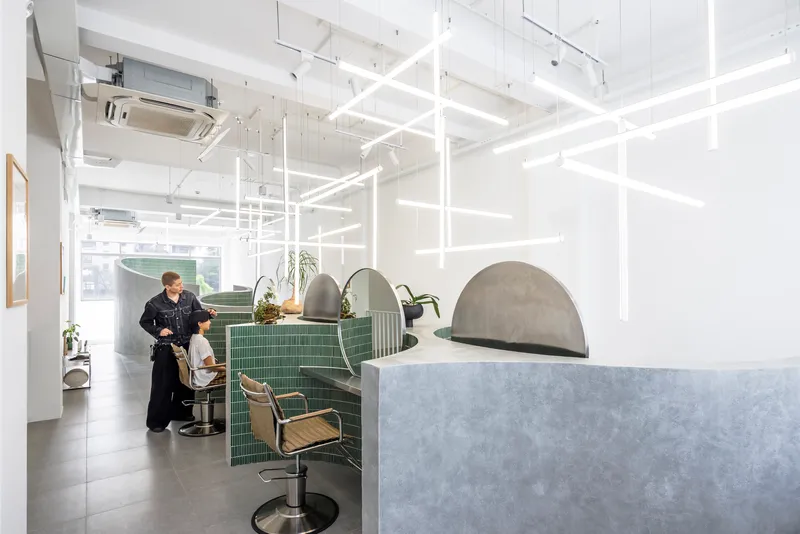
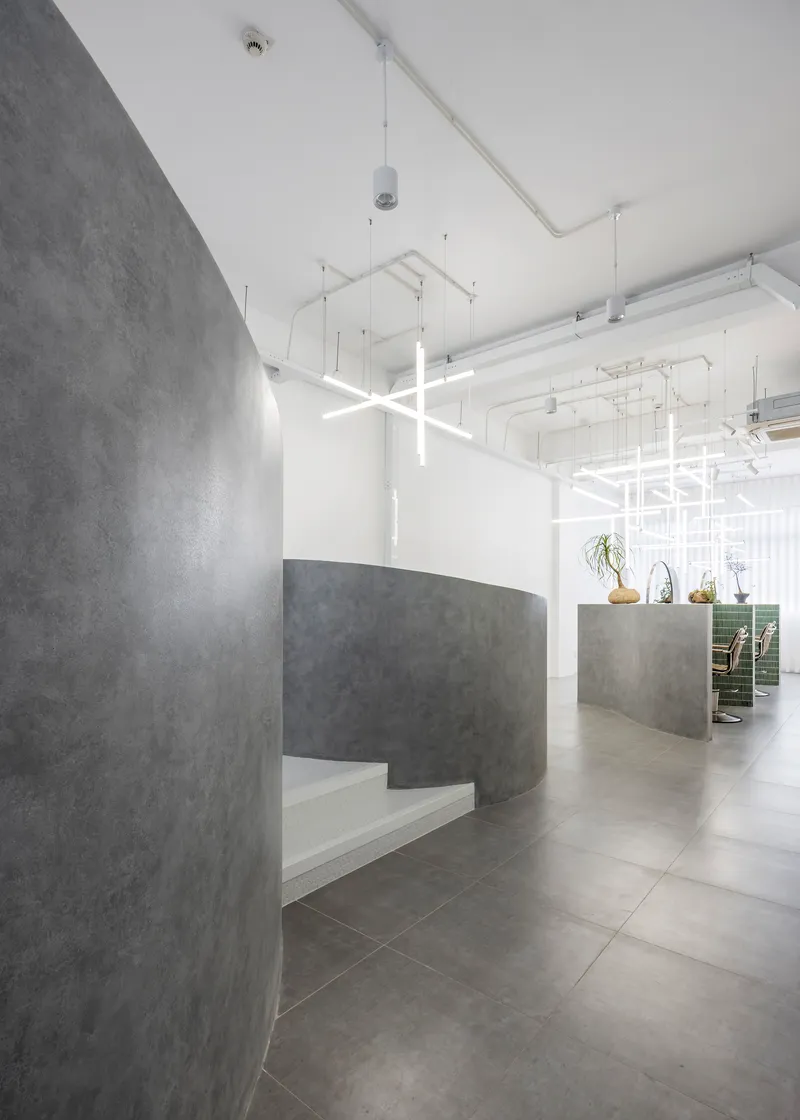
The suspended lighting grid deserves its own mention because it functions almost as a second architectural layer. Stretched across the ceiling in a white linear framework, it establishes a consistent datum that counterbalances the organic geometry of the walls below. The grid also conceals and organizes the mechanical systems, keeping the ceiling clean without resorting to a dropped ceiling that would compress the volume.
Practically, the grid delivers even, diffused light across the styling stations, which is critical in a salon where color accuracy matters. The interplay between the rigid overhead geometry and the fluid walls beneath gives SONO its visual tension: order above, terrain below.
Plans and Drawings
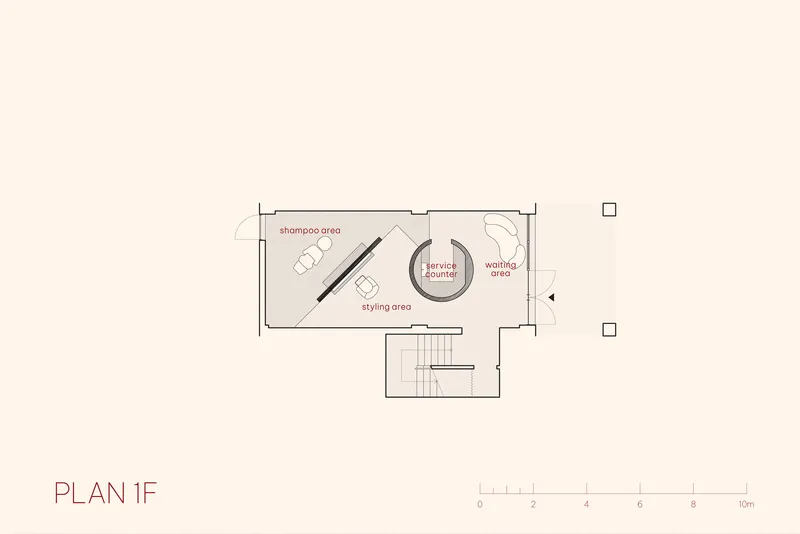


The floor plans reveal how methodically the wall organizes program. On the first floor, the sequence from entrance to rear reads as waiting, service counter, styling, and shampoo, all defined by the wall's path rather than by conventional partitions. The second floor plan shows the stair arriving near center, with four styling stations branching to the right and the shampoo zone to the left. Support rooms line the perimeter, tucked behind the wall's curves.
The section drawing is the most revealing. It shows how the arched openings in the wall connect the two levels visually, and how the wall's height varies from front to back. You can see the maisonette structure clearly: two compressed floors within what was likely a standard commercial shell. The section also confirms that the wall is not simply a partition but a three-dimensional object with thickness, overhang, and spatial consequence.
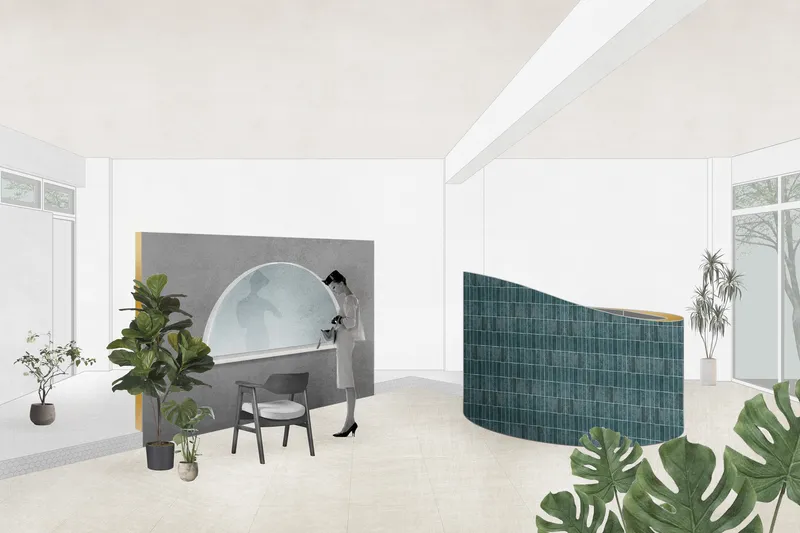

Early renderings hint at the conceptual origins. The serpentine ramp lined with teal-tiled planters in a gallery-like space suggests Inrestudio was thinking about the wall as landscape infrastructure from the outset. The final built version is more restrained than these studies, which is almost always a good sign.
Why This Project Matters
SONO Salon is a reminder that interior design does not require a catalog of gestures to be compelling. One wall, two materials, and a clear conceptual framework produce a space that feels genuinely distinct without straining for novelty. In a market flooded with salon interiors that lean on millwork, neon signage, or Instagram-ready accent walls, Inrestudio's decision to invest all of its design energy into a single continuous element is both disciplined and generous. It gives the client a space that is unmistakably theirs, not a template pulled from a mood board.
The project also demonstrates that the garden metaphor can operate at an abstract level and still land. You do not need to fill a room with plants to evoke the feeling of moving through a landscape. A wall that rises and falls, that shifts material from green glaze to grey concrete, that bends to create shelter and opens to admit light, can do that work on its own. Kosuke Nishijima and the Inrestudio team have built a small project with a big idea, and the idea holds.
SONO Salon by Inrestudio, lead architect Kosuke Nishijima with design team Nguyen Phuc Nguyen and Kana Matsuzawa. Ho Chi Minh City, Vietnam. 157 m². Completed 2026. Photography by Hiroyuki Oki.
About the Studio
Share Your Own Work on uni.xyz
If projects like this are the kind of work you want to make, uni.xyz is a place to publish your own, find collaborators, and enter design competitions.


Popular Articles
Popular articles from the community


Manzana Morphosis: Stretching Barcelona's Grid into a Living Landscape for 2050
A radical reworking of the Eixample manzana turns density into a tool for generous public space, vertical ecology, and environmental performance.

The Amber Palace Opera: A Geological Fiction Surfaces on Tallinn's Baltic Waterfront
Pierre Brillard reimagines a Baltic legend as a public landscape, opera house, and waterfront promenade rooted in Tallinn's coastal identity.

Faces of the Soviet Avant-Garde: Turning Moscow's Street Names into an Open-Air Museum
A network of sculptural installations across a Moscow residential district transforms forgotten architect names into spatial encounters with cultural memor

Cloaked Colonization: A Mobile Underwater Habitat That Moves Like a Fish
Micah Abaya's shortlisted EHC Pacific entry reimagines ocean settlement as a dispersed network of self-sustaining architectural organisms.

Similar Reads
You might also enjoy these articles

Pixel Gardens: One Repeated Module Stacked Into a Terraced Social Housing Tower for Famagusta
Salem Bader's shortlisted housing tower builds a vertical neighbourhood from one repeated module, offsetting units to carve terraces, light and air.

Bao Huynh Watercolor Atelier: A Serene Art Retreat in Hội An
Bao Huynh Watercolor Atelier in Hội An blends multifunctional art spaces, sustainable design, local materials, and family-friendly living in a serene environment.

Atelier Macri Concept Store Interior Design by CASE-REAL
Atelier Macri store features a "ko" counter, walnut wood details, cork displays, blending retail, gallery, and seamless customer experiences.

Manuel Vargas Izquierdo Stadium and High-Performance Sports Center: Architectural Excellence in Jalpa de Méndez
The Manuel Vargas Izquierdo Stadium blends sustainable design, inclusive sports facilities, and cultural-inspired architecture, revitalizing Jalpa de Méndez’s public spaces.

Explore Solar Fabric Competitions
Discover active competitions in this discipline

Challenge to reimagine the Iron Throne

Photograph architecture without architects

Illustrate the lost glory of Angkor Wat - Render Challenge

Design challenge to reuse E-waste
Comments (0)
Please login or sign up to add comments
No comments yet. Be the first to comment!