
Instant City: Archigram's Roaming Metropolis Rebuilt as a Fleet of Unfolding Cultural Modules
A fleet of autonomous modules unfolds from compact transport forms into stages, markets and cinemas, turning plazas into temporary cultural venues.


What if a city's cultural life arrived by road, unpacked itself overnight, and left by morning without a trace? Instant City takes that question seriously. Rather than proposing another theatre, gallery or museum anchored to a single plot, it imagines culture as an event in time and space: a distributed network of mobile modules that travel, unfold and recombine wherever an audience happens to be.
Designed by Shao Xueyan and recognised as an Editor's Choice entry in the Opera Truck competition, the project draws openly on the conceptual framework Archigram first proposed under the same name. Its ambition is more than nostalgic homage. It treats modular architecture as a tool for temporary urbanism, a city that is temporal, responsive and participatory rather than fixed.
Folded Pavilions on an Open Lawn: Culture Without Walls
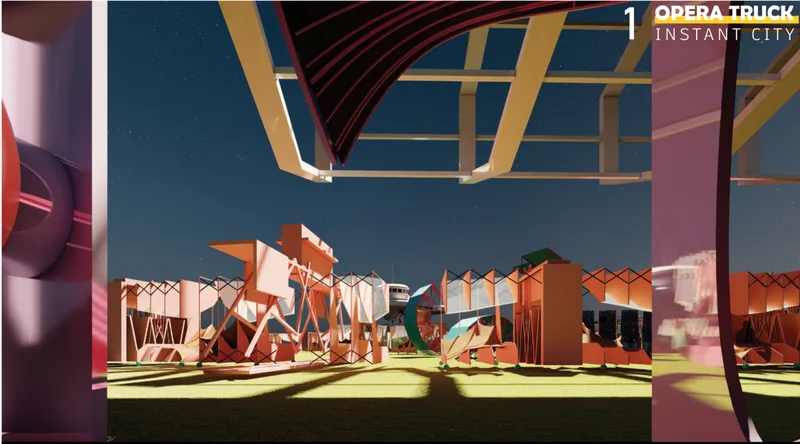
The opening image sets out the project's argument. Pink and orange folded timber pavilions spread across a lit lawn, framed by a steel structure and a starry sky. There is no lobby, no ticket hall, no threshold separating audience from art. The pavilions sit directly in the landscape, and that is the point.
Shao's critique targets the passive relationship that conventional cultural institutions create, where art stays confined within institutional boundaries and access is limited by design. By embedding performance and exhibition into public ground, the scheme reframes the city as an open cultural landscape. The steel frame overhead is the only hint of permanence, and even it reads as scaffolding for something temporary.
Trucks That Become Plazas: Mobility as an Urban Infrastructure
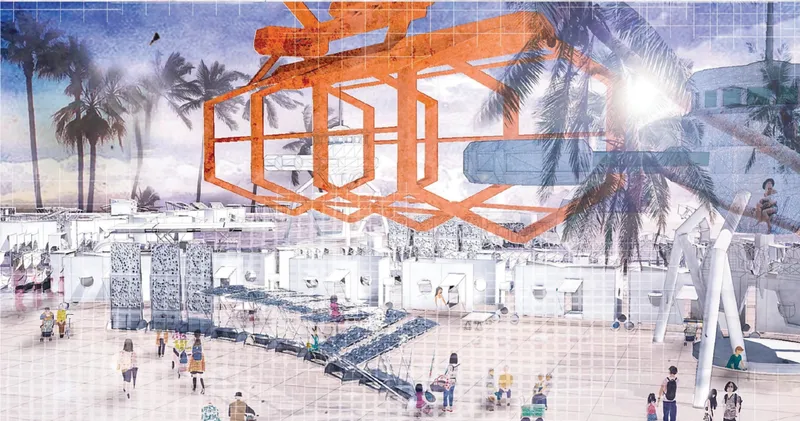
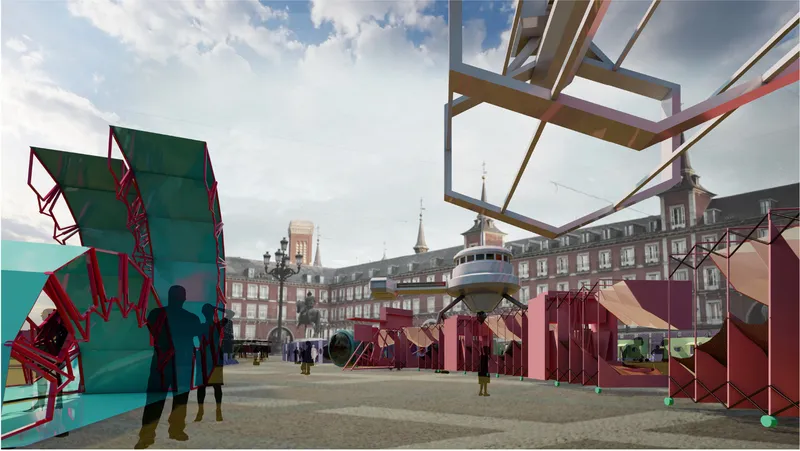
These two renderings show the system arriving in very different settings. In one, white kiosks gather beneath an orange hexagonal truss above a palm-lined plaza. In the other, teal and crimson tent-like pavilions occupy a historic arcaded square while a pod hovers overhead. The same kit of parts adapts to a contemporary civic space and a heritage setting alike.
The modules are designed to work collectively rather than as isolated objects. They travel along pre-programmed routes through an autonomous network and unfold from compact transport configurations into functioning spatial environments. This combination of mobility and modularity is what makes the framework scalable: a festival, a market or an exhibition can be staged without any permanent construction, and the network can shift as the city's needs change.
Spheres, Rings and Mirrored Roofs: A Vocabulary of Transformable Parts


Up close, the modules become a playful formal language. A glossy red sphere sits inside a pale pink frame beside ribbed red curves, and at dusk a mirrored-roof pavilion with circular cutouts glows among ring-shaped elements on a dark lawn. These are not decorative follies. Each piece is designed around transformable elements, including foldable panels, expandable structures and adaptable interiors, so it stays compact in transit and opens up on deployment.
The mirrored roof is a sharp choice for a structure meant to be temporary. It reflects its surroundings, lets the context dominate, and makes the pavilion feel like a guest on the site rather than an imposition. The geometry of spheres, rings and frames also suggests how parts might plug into one another, generating new spatial combinations each time the fleet is reassembled.
A Painted Skyline Behind Wireframe Trucks: Open-Source Urbanism
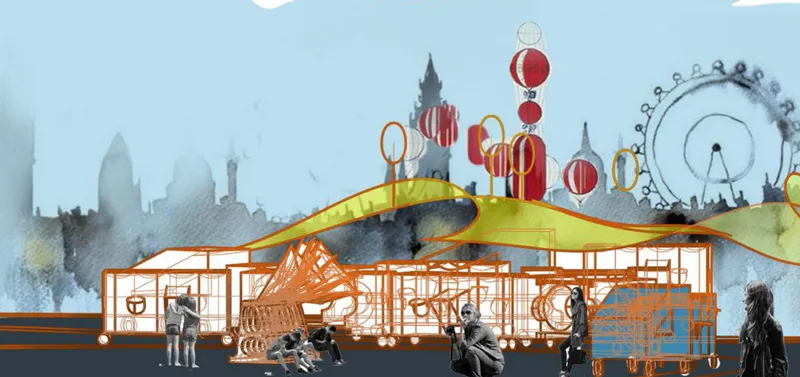
The elevation collage is the most legible image of the system in motion. Orange wireframe trucks carry a green wavy roof and red lanterns, set against a painted skyline with a Ferris wheel. The vehicles read simultaneously as infrastructure and as carnival, which suits a project rooted in the fairground spirit of Archigram's original proposal.
Beneath the imagery sits a planning idea. Shao frames Instant City as open-source urbanism, a collaborative model in which residents, artists, architects and planners all shape the urban experience. Bottom-up initiative replaces top-down programming, and communities gain a sense of ownership over spaces that would otherwise be curated for them. The trucks are the delivery mechanism; the content is meant to be co-authored.
Glowing Rings in an Arcaded Square: Transformation Without a Footprint

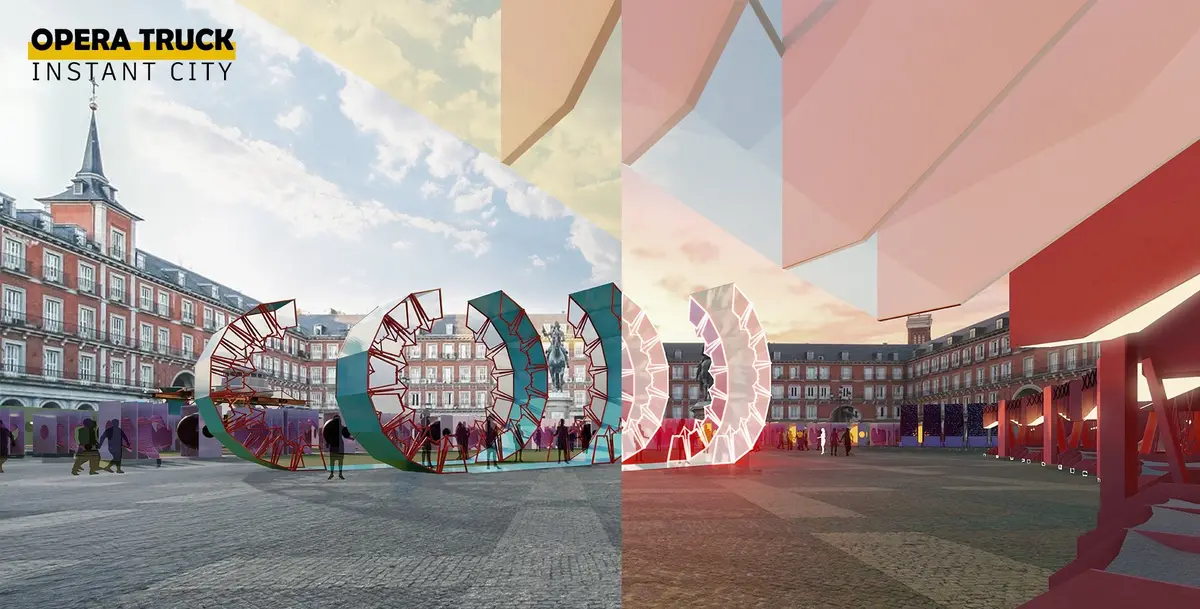
The final rendering returns to a cobbled arcaded plaza at dusk, now occupied by glowing ring-shaped pavilions under a faceted pink canopy, with a single figure standing among them. The historic fabric remains untouched. The intervention is luminous, legible and clearly reversible.
This is where the project's scenario thinking pays off. Plazas can turn into open-air cinemas, markets into performance arenas, vacant lots into active venues, all without permanently altering the site. Preserving the integrity of the urban context while expanding what it can host is a strong position, particularly in dense historic centres where new cultural buildings are rarely possible.
Why This Project Matters
Instant City revisits one of architecture's most famous provocations and asks what it means now, when autonomous logistics and flexible programming are no longer science fiction. Its value lies less in any single pavilion than in the system: a shared set of transformable modules, a route-based network, and a participatory model that treats the city as a stage rather than a container for institutions.
For a competition centred on the idea of an opera truck, Shao Xueyan's entry pushes the brief beyond a single touring stage toward a whole cultural infrastructure on wheels. Questions about governance, routing and how communities actually take part remain open, but the proposal makes a persuasive case that cultural access can be built through movement and adaptability rather than monuments.
View the Full Project
About the Designers
Designer: Shao Xueyan
Enter a Design Competition on uni.xyz
uni.xyz runs architecture and design competitions year-round that reward proposals with spatial conviction and real site intelligence.
Project credits: Instant City: Archigram's Roaming Metropolis Rebuilt as a Fleet of Unfolding Cultural Modules by Shao Xueyan Opera Truck (uni.xyz).


Popular Articles
Popular articles from the community


Cube Design Draws an Ecological Corridor Between Two Shenzhen Hills with the Nankai Building
Beside Shenzhen's container docks, the Nankai Building pairs stacked balconies with a climbing green screen to connect two hillsides across its height.

U.GA Architects Wraps an Oval Rooftop Pool in Curved Board-Formed Concrete on Busan's Jeollidan-gil
In Busan's Jeonpo-dong, a 454 m² mixed-use block stacks a neighborhood facility, guest rooms and an oval rooftop pool inside spiraling concrete walls.

David Macias Steps a Doorless Stone and Plaster House Down a Tropical Colombian Hillside
In the humid hills of Colombia, Threshold House replaces the front door with an open void and terraces its 850 m² down the slope instead of fighting it.

GROUP A Strips a 1969 Rotterdam Harbor Headquarters to Its Frame and Wraps It in Timber Louvers
In Rotterdam's M4H harbor district, Ferro Offices reuses a 1969 frame, adds one timber storey and reaches BREEAM-NL Outstanding.

Similar Reads
You might also enjoy these articles
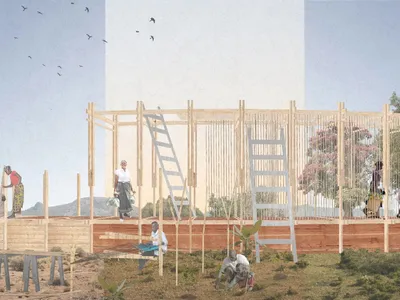
Healing Façade: A Modular Chapel System That Restores Ethiopia's Sacred Forests
Winner of the Eco-Chapel competition, this circular timber façade collects water from air to rebuild soil and reforest degraded Ethiopian landscapes.
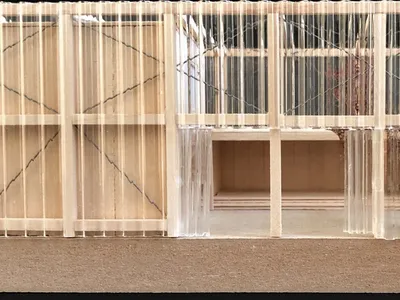
Kaffeebühnen: Where Coffee Shop Architecture Becomes a Civic Stage in Vienna
A linear sequence of timber boxes, transparent shells, and open yards turns the Viennese café tradition into a public performance space.
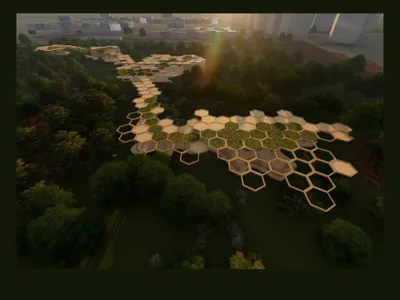
Eco Chapel: A Modular Forest Pavilion That Grows Like the Landscape It Protects
Hexagonal timber modules weave through existing trees, turning a chapel into a living system for prayer, education, and reforestation.


Urban Forest: A Vertical Ecosystem for 5,000 Workers in Singapore's Changi Business Park
Radially stacked pods and layered green decks turn a 7-acre plot into 47 acres of ecological workspace projected for 2040.

Explore Space Urbanism Competitions
Discover active competitions in this discipline

Challenge to visualize slums of 2080

Challenge to design a shop stop sunk in the city

Render competition to represent the city as a machine

Design challenge to equip cities with modern furniture
Comments (0)
Please login or sign up to add comments
No comments yet. Be the first to comment!