

Interconnected: Centralized Hubs for a Post-War Automated Society
A speculative urban typology merges automation zones, vertical housing, and hyper-loop transit into 24-hour community hubs after societal collapse.


What happens to the city after the machines win? Not in a dystopian, cinematic sense, but in the quietly devastating way that automation already hollows out entire labor sectors, concentrating wealth and displacing workers by the millions. Interconnected takes that question seriously, constructing a speculative timeline from 2018 to 2040 that traces the social fractures caused by machine intelligence and proposes an architectural typology designed to stitch communities back together: centralized, vertical hubs where production, housing, recreation, and transit collapse into a single, continuously active ecosystem.
The project is the work of designers Jesse Martyn and James Simpson. Their proposal imagines a post-conflict world, specifically the aftermath of what they term the 2030 Anti-Intellectual War, a societal rupture triggered by the unchecked rise of automation during the preceding "Second Machine Age." By 2035, government-led rebuilding efforts armed with advanced construction technologies promise displaced populations new jobs and housing. By 2040, the result is a radically reorganized city: vertical, interconnected, and running around the clock.
A Speculative Timeline Drawn in Elevation
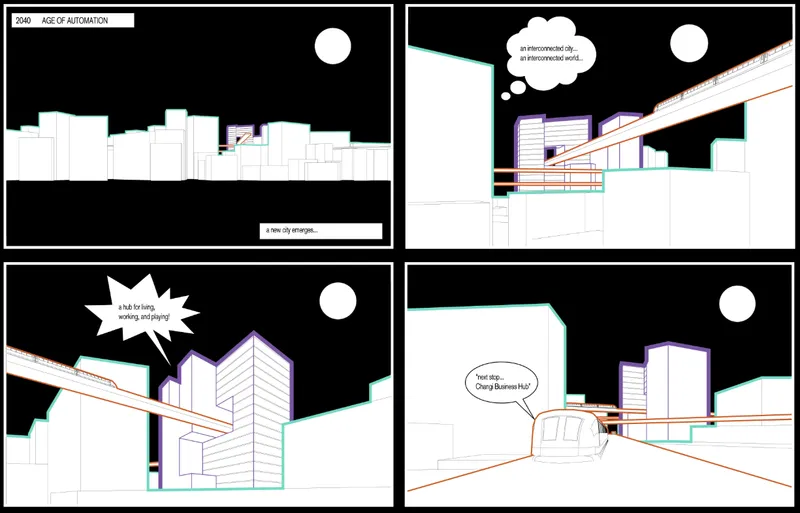
The opening series of elevation drawings, rendered as white volumes against a black sky with speech bubbles and a moon overhead, reads like a graphic novel panel sequence. Each frame corresponds to a phase in the project's timeline: the Age of Humans (2018), the Second Machine Age (2028), the Anti-Intellectual War (2030), post-war reconstruction (2035), and finally the Age of Automation (2040). The speech bubbles inject a narrative voice into what could otherwise be a dry chronology, grounding the speculative fiction in human conversation, debate, and anxiety. It is a clever representational choice, framing architecture not as an isolated formal exercise but as a consequence of political and social forces.
Programmatic Layering Around a Central Courtyard
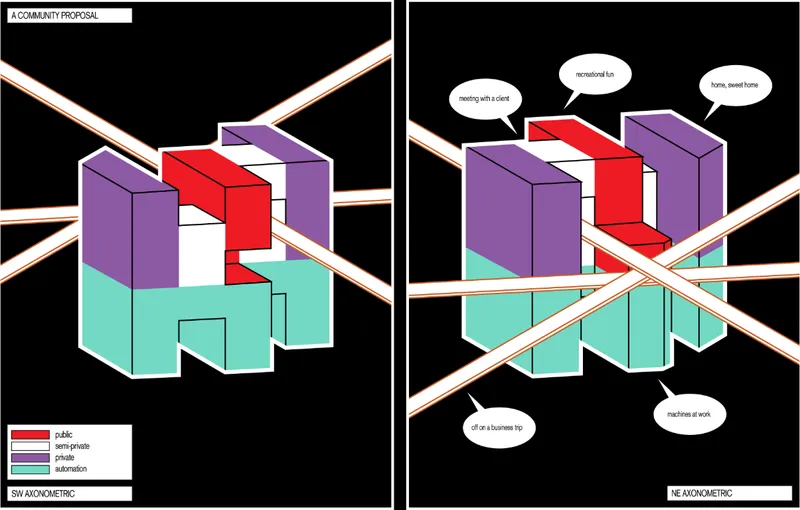
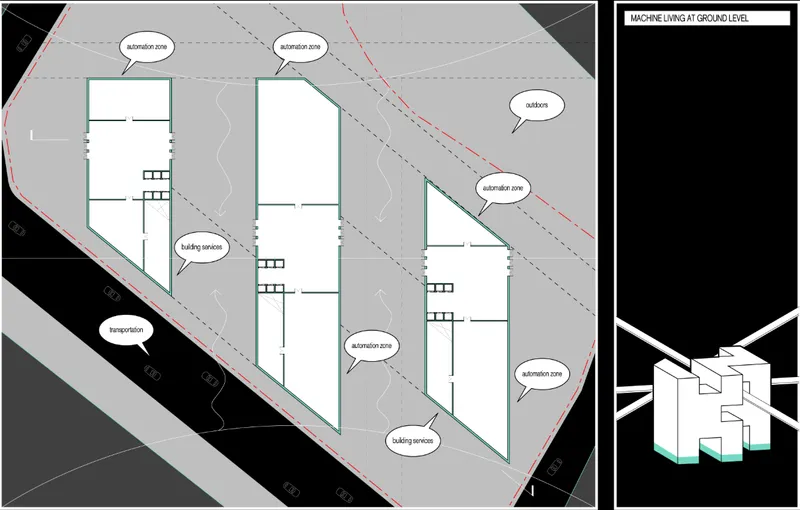
The axonometric drawing of the hub reveals its organizational logic: red and purple volumes cluster around a central courtyard, each annotated with programmatic labels identifying automation zones, service economies, housing, and recreation. The color coding is deliberate. Production and machine-driven labor occupy distinct zones, while human-facing programs, the care sectors, creative workspaces, and social gathering areas, layer vertically above and alongside them. The ground-level plan reinforces this reading, showing three rectangular building footprints with automation zones marked along diagonal site lines that establish the hub's relationship to broader infrastructure corridors.
Rather than segregating functions into isolated districts, the way twentieth-century zoning typically operated, the design merges them. The courtyard acts as a shared datum, a pressure-relief valve where the human and the automated can coexist in open air. It is a deliberate counter-move against the alienation that automation tends to produce: instead of pushing workers to the periphery, the architecture pulls community inward.
Diagonal Corridors as Connective Tissue

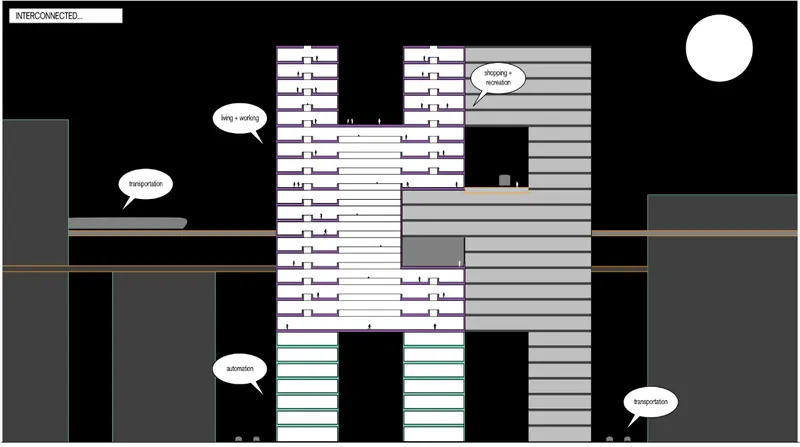
The axonometric section drawing cuts through the hub to expose its interior metabolism: elevated communities with working and living spaces organized along diagonal corridors. These diagonals are not decorative; they establish the primary circulatory system, connecting vertical layers of program in ways that a conventional stacking of floor plates could not achieve. Movement through the building becomes three-dimensional, encouraging chance encounters between residents, workers, and visitors operating on different schedules in a 24-hour architecture.
The elevation drawing extends this logic to the urban scale. Interconnected volumes with purple and teal horizontal banding span between transportation infrastructure, including hyper-loop lines and elevated rail systems that link individual hubs into a global network. The banding suggests structural or environmental performance zones, perhaps distinguishing between conditioned interior space and semi-outdoor transit corridors. What matters most is the ambition: these are not standalone buildings but nodes in a larger mesh, each hub dependent on and contributing to the others.
Living, Working, Playing Under a Night Sky
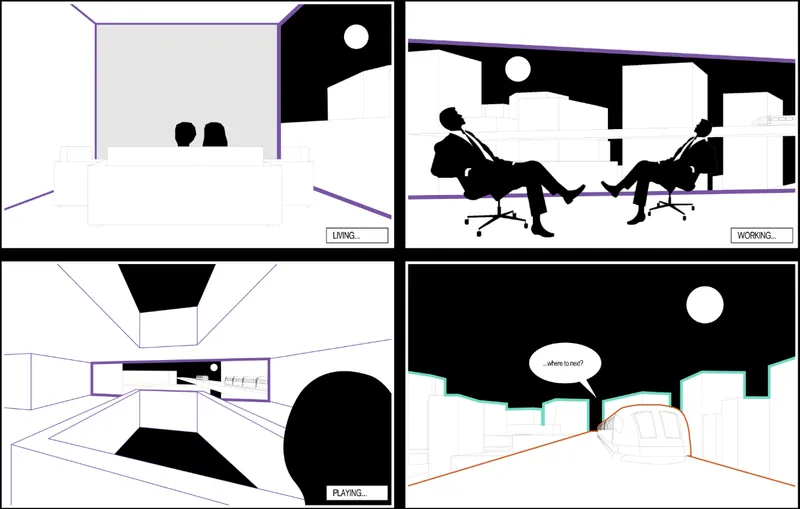
Four perspective sketches close the project by placing silhouetted human figures inside the hub's interior spaces, categorized as living, working, playing, and circulation. Each sketch is set under a night sky, reinforcing the proposition that these are environments designed for continuous occupation rather than the nine-to-five rhythms of the industrial city. The silhouettes are important: by rendering inhabitants as anonymous figures rather than specific characters, the designers suggest universality. These hubs are not luxury enclaves. They are proposed as collective infrastructure for displaced populations, designed to accommodate the service economies (relationships, creativity, care) that remain when machines take over repetitive labor.
Why This Project Matters
Interconnected sits in a lineage of speculative urbanism that includes Archigram's Plug-in City and Constant Nieuwenhuys's New Babylon, proposals that imagined radical restructuring of daily life in response to technological upheaval. What distinguishes Martyn and Simpson's work is the specificity of its political backstory. The Anti-Intellectual War is not a throwaway premise; it is a narrative device that forces the architecture to answer for the social costs of automation rather than simply celebrating its efficiencies. The hubs are presented not as utopian fantasies but as reconstruction projects, born from crisis and shaped by the need to reintegrate fractured communities.
The project's strength lies in its refusal to separate technology from social consequence. Every design decision, from the diagonal corridors that encourage unplanned interaction to the automation zones embedded within residential complexes rather than exiled to industrial parks, reflects a commitment to keeping human agency at the center of an automated world. As automation continues to reshape labor markets and urban geographies, the questions Interconnected raises about who benefits from technological progress and how architecture can mediate that distribution only become more urgent.
View the Full Project
About the Designers
Designers: Jesse Martyn, James Simpson
Enter a Design Competition on uni.xyz
uni.xyz runs architecture and design competitions year-round that reward proposals with spatial conviction and real site intelligence.
Project credits: Interconnected by Jesse Martyn, James Simpson.


Popular Articles
Popular articles from the community


Extended Shell: Retrofitting Kolkata's Balconies as Living Urban Thresholds
A modular retrofit system recovers the social and environmental intelligence of Kolkata's historic verandas for contemporary Park Street residents.

Tsunami Convergenics: Turning Catastrophic Ocean Forces into Underwater Housing Infrastructure
A speculative underwater settlement off the coast of Onagawa, Japan, treats tsunamis and typhoons as energy sources rather than threats.

Cloaked Colonization: A Mobile Underwater Habitat That Moves Like a Fish
Micah Abaya's shortlisted EHC Pacific entry reimagines ocean settlement as a dispersed network of self-sustaining architectural organisms.

Manzana Morphosis: Stretching Barcelona's Grid into a Living Landscape for 2050
A radical reworking of the Eixample manzana turns density into a tool for generous public space, vertical ecology, and environmental performance.

Similar Reads
You might also enjoy these articles

Play: Fragments of Their World: Remembered Architecture Rebuilt as a Modular Playground for Refugee Camps
Tom Gardner abstracts domes, arches and towers from the homelands of displaced families into a kit of child-scaled play parts for camp settlements.
REBIRTH: A Circular Settlement Where Afghan Widows and Their Children Rebuild Life Together
A shortlisted Resile entry turns the circle into a protective ring of timber and brick, gathering homes, classrooms and gardens around a shared landscape.
The Main Dream: A Recycled Plastic Kit That Lets Refugee Children Build Their Own Playground
Thirty-centimetre interlocking cubes that connect on three axes turn play into construction, letting children author the spaces they occupy.

Lunar Spiral: A Fibonacci-Driven Moon Settlement Rising from Shackleton Crater
Golden-spiral geometry organises buried infrastructure and orbiting habitable spheres into a lunar base designed to grow as life on the Moon expands.

Explore Interactive Architecture Competitions
Discover active competitions in this discipline

Challenge to reimagine the Iron Throne

Photograph architecture without architects

Illustrate the lost glory of Angkor Wat - Render Challenge

Design challenge to reuse E-waste
Comments (0)
Please login or sign up to add comments
No comments yet. Be the first to comment!