
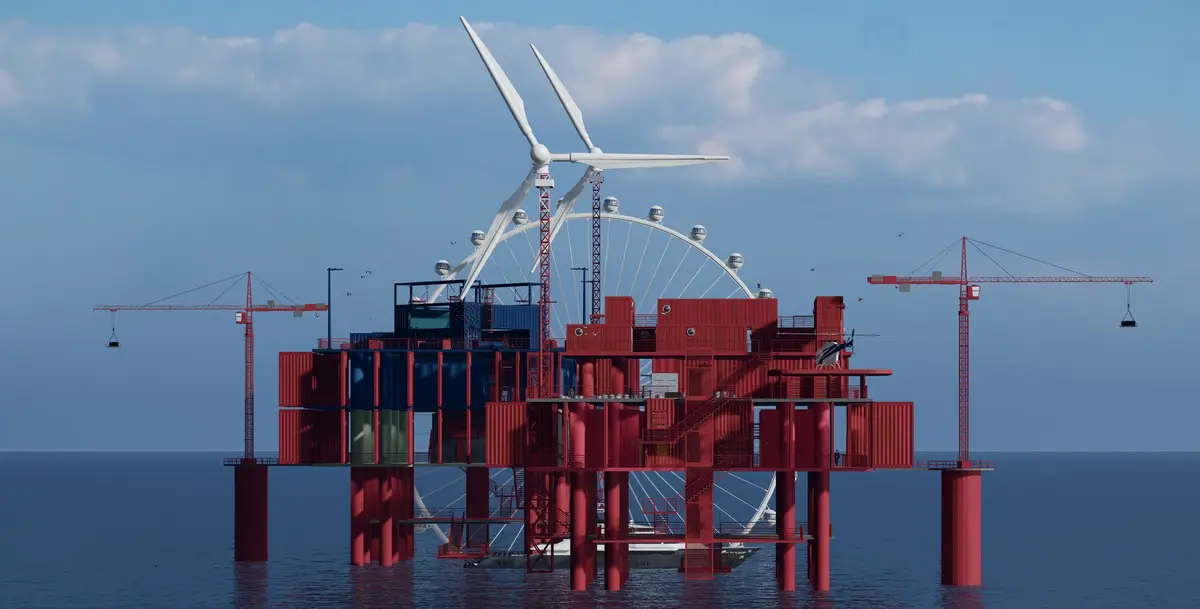
Old Creatures: A Decommissioned Oil Rig Recast as a Marine Community of Research and Living
Recycled containers, industrial barrels and a sail-like kinetic façade turn an abandoned oil rig into housing, labs and a public landmark at sea.


An offshore oil rig is built to take things out of the sea. Old Creatures asks what happens when that machine stops extracting and starts hosting. Instead of hauling the rig away or letting it rust, the proposal keeps the steel carcass in place and grafts a new community onto it: researchers, long-term residents and visitors living and working on a structure that once stood for fossil fuel dependence. The premise is blunt and persuasive. Nothing is wasted, and the industrial past is kept in view rather than erased.
The project received an Honorable Mention in Proximity Island 2019 and was designed by Mahta Aminali, HamidReza Esmailnazari, Amin Jamali and Ali Kharaghanian. Their site is the open ocean and an obsolete platform. Their material palette is whatever the industry left behind: the rig itself, recycled shipping containers and industrial barrels, reassembled into housing, laboratories, communal facilities and spaces for recreation.
A Steel Platform Treated as Found Ground
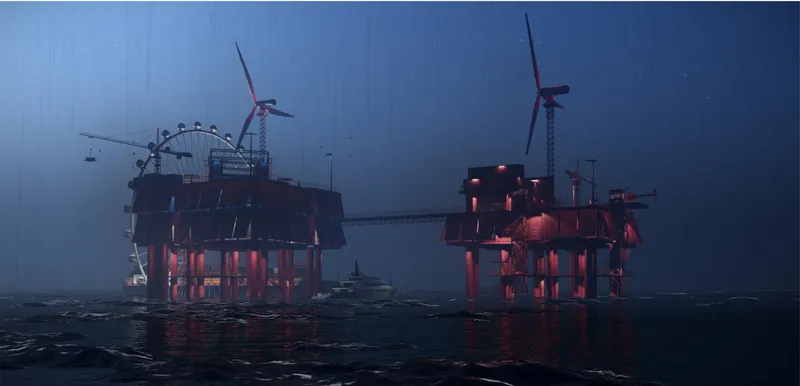
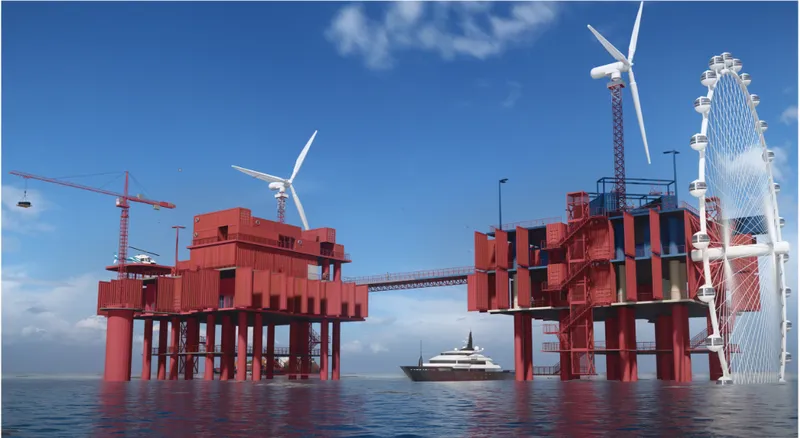
The team's first decision matters most. They read the rig as found ground, an existing artificial site in the middle of the water that already solves the hardest offshore problems of foundation and elevation. Everything new is placed on top of or inside that frame. Containers become rooms, barrels become components, and the rig's legs and decks become the organising grid. This is adaptive reuse in its strict sense: material consumption drops, the lifespan of an existing structure is extended, and demolition is avoided entirely.
What keeps the idea from being only a sustainability argument is its attitude toward memory. The designers want the rig to remain legible as an artifact, a record of how people have treated energy and the ocean. The new programme of learning, collaboration and ecological observation sits in deliberate contrast to the structure's original purpose, and that tension gives the project its narrative.
A Façade That Behaves Like a Ship's Sails
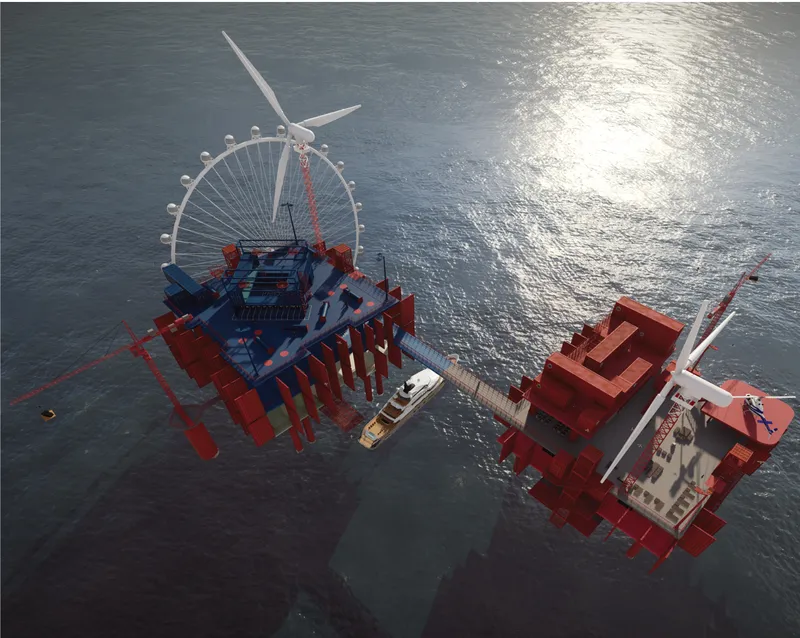

The most inventive element is what the designers call the "live façade", an envelope made from recycled container sheets that reconfigures itself to the weather. The sail analogy is apt. In storms the panels close down and shield interiors from marine exposure; on sunny days they open to draw in light and air; in rain, sections tilt out into canopies, creating sheltered outdoor ground while keeping sightlines to the ocean.
Offshore, climate is the primary design condition, and the façade turns that condition into a visible daily performance. The building's skin changes as conditions shift, so residents read the weather through their architecture. It also reuses the corrugated container panel, a material associated with global shipping, as a moving, responsive surface, which suits a project built around the idea of transformation.
An Observation Wheel Turns Infrastructure Into Destination
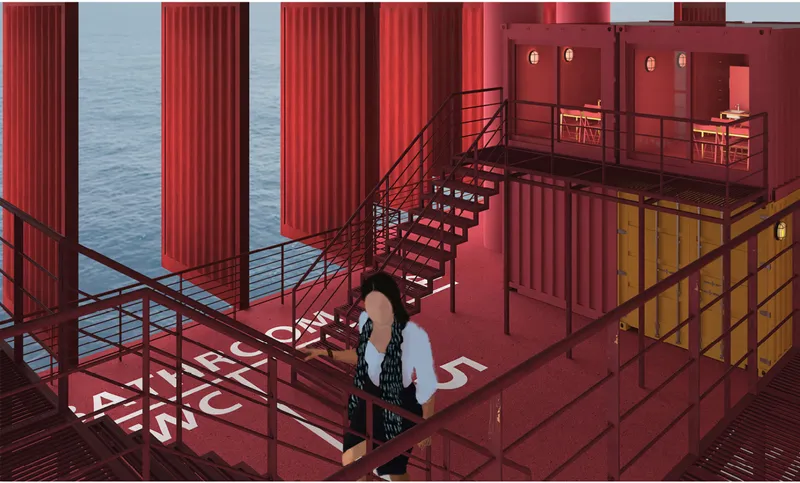
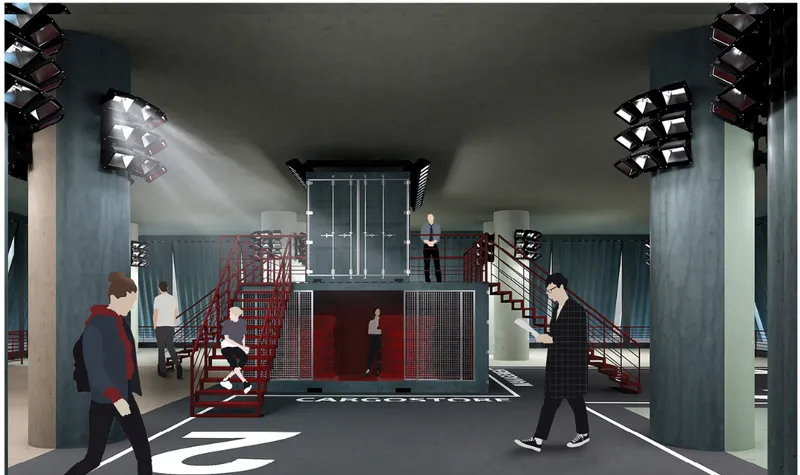
Oil rigs are typically isolated, restricted and illegible to the public. Old Creatures reverses that by adding a large observation wheel, a gesture that is part landmark, part viewing device. It marks the platform on the horizon and lifts visitors above the decks for elevated views of the surrounding seascape.
The wheel is the clearest sign of the project's social ambition. The designers frame the rig as a meeting point where visitors, scientists and residents overlap, with storytelling and education built into the programme. Using a fairground element on an industrial frame is a provocative choice, and it works because it shifts the rig's identity from extraction to connection in a single, readable move.
Container Homes Stacked Within the Old Frame


The interior views show how the rig's heavy structure becomes a backdrop for public life. One rendering depicts a dim hall of pale concrete columns lit by clustered floodlights, with two visitors looking up at a chrome balloon dog sculpture. The columns read as monumental remnants, and the art installation suggests the base of the platform could host exhibition and gathering rather than machinery.
The second view shifts to the residential and working layer: stacked blue shipping containers with glazed fronts, connected by steel stairs and a walkway, with a figure in a white coat standing above misty floor markings. For people staying on the platform for extended periods, the team proposes expandable container modules that adjust to changing occupancy. The glazing opens each box toward light and view, while the stair-and-walkway system gives the stack the feel of a vertical street rather than a storage yard.
Why This Project Matters
Thousands of offshore platforms face decommissioning, and the default response is removal. Old Creatures makes a credible case for an alternative: keep the structure, reuse the industry's own leftovers, and let a new programme of research, housing and public life move in. Its strength lies in coherence. The rig, the containers, the barrels and the kinetic façade all come from the same logic of salvage, so the proposal feels like a system rather than a collection of gestures.
The project also understands that reuse is cultural as well as technical. By keeping the rig recognisable and adding an observation wheel that invites the public in, the designers turn an object most people would rather forget into a place for collective reflection on energy and the ocean. As an Honorable Mention, it is a sharp reminder that the most sustainable building material is often the structure already standing.
View the Full Project
About the Designers
Designers: Mahta Aminali, HamidReza Esmailnazari, Amin Jamali, Ali Kharaghanian
Enter a Design Competition on uni.xyz
uni.xyz runs architecture and design competitions year-round that reward proposals with spatial conviction and real site intelligence.
Project credits: Old Creatures by Mahta Aminali, HamidReza Esmailnazari, Amin Jamali, Ali Kharaghanian Proximity Island 2019 (uni.xyz).


Popular Articles
Popular articles from the community


David Ortega Stacks a Two-Story Mexico City Penthouse Around a Steel Stair and a Pergola-Shaded Roof Terrace
In Colonia Roma, a 300 m² penthouse uses oak joinery, a planted steel stair and a slatted roof pergola to make a new-build apartment feel like a house.

U.GA Architects Wraps an Oval Rooftop Pool in Curved Board-Formed Concrete on Busan's Jeollidan-gil
In Busan's Jeonpo-dong, a 454 m² mixed-use block stacks a neighborhood facility, guest rooms and an oval rooftop pool inside spiraling concrete walls.

Architekt Andreas Gruber Scatters 23 Dark Timber Chalets Across a South Tyrolean Forest Edge
In Molini di Tures, Amonti Chalets breaks a resort into a hamlet of gabled timber houses, with parking, storage and services pushed into the slope.

David Macias Steps a Doorless Stone and Plaster House Down a Tropical Colombian Hillside
In the humid hills of Colombia, Threshold House replaces the front door with an open void and terraces its 850 m² down the slope instead of fighting it.

Similar Reads
You might also enjoy these articles
Healing Façade: A Modular Chapel System That Restores Ethiopia's Sacred Forests
Winner of the Eco-Chapel competition, this circular timber façade collects water from air to rebuild soil and reforest degraded Ethiopian landscapes.
Kaffeebühnen: Where Coffee Shop Architecture Becomes a Civic Stage in Vienna
A linear sequence of timber boxes, transparent shells, and open yards turns the Viennese café tradition into a public performance space.
Eco Chapel: A Modular Forest Pavilion That Grows Like the Landscape It Protects
Hexagonal timber modules weave through existing trees, turning a chapel into a living system for prayer, education, and reforestation.


Urban Forest: A Vertical Ecosystem for 5,000 Workers in Singapore's Changi Business Park
Radially stacked pods and layered green decks turn a 7-acre plot into 47 acres of ecological workspace projected for 2040.


Comments (0)
Please login or sign up to add comments
No comments yet. Be the first to comment!