

Interdisciplinary Education Building Design: The Transformation of Clifton Court Hall at the University of Cincinnati
This article explores the design and impact of Clifton Court Hall, a transformative interdisciplinary education building at the University of Cincinnati.


The Role of Interdisciplinary Education Buildings in Modern Architecture
In today's educational landscape, interdisciplinary education buildings play a crucial role in fostering collaboration and innovative learning. These architectural spaces bring together departments, faculties, and students from various fields, promoting interaction and the exchange of ideas. One prime example of this trend is Clifton Court Hall at the University of Cincinnati, designed by LMN Architects in collaboration with KZF Design. Completed in 2023, this state-of-the-art building exemplifies the transformative potential of interdisciplinary education building design.


The Vision Behind Clifton Court Hall
Clifton Court Hall was created to house six departments within the College of Arts and Sciences, including Political Science, Communication, Psychology, Journalism, German Studies, and Romance and Arabic Languages and Literatures. The building unites a diverse range of academic units that were previously scattered across campus, forming a central hub for education, collaboration, and research. The goal was to create a space that would encourage cross-departmental interaction and offer flexible, innovative learning environments.


Architectural Design: Blending Tradition and Innovation
Exterior Design and Campus Integration
The architectural design of Clifton Court Hall reflects a seamless integration with the surrounding campus while introducing a contemporary aesthetic. The building’s exterior is composed of terracotta panels that evoke the red brick tones of prominent nearby structures. This design choice acknowledges the rich architectural heritage of the University of Cincinnati while introducing a modern touch. The building’s massing steps at lower levels accommodate the sloping campus terrain, ensuring the structure complements pedestrian pathways and campus entry points.

A Welcoming Presence for the Off-Campus Community
Strategically located at the western edge of campus, Clifton Court Hall serves as a gateway between the active campus core and the adjacent urban neighborhood. Its architectural presence is welcoming and dynamic, helping to bridge the gap between the university and the surrounding community. The design encourages both academic engagement and public interaction, enhancing the building’s role as a community hub.


Interior Design: Fostering Collaboration and Learning
The Central Atrium: A Hub for Social Interaction
At the heart of Clifton Court Hall is a dynamic five-story atrium. This central space is designed to foster academic discourse, social exchange, and collaboration. Large north and south-facing windows fill the atrium with natural light, creating a vibrant and inviting environment. Skylights further enhance the space, ensuring that it remains bright and energizing throughout the day. The atrium serves as the focal point for the building, with various community and collaboration spaces positioned around it.
Red Stairway: A Symbol of Connection and Movement
One of the most striking features of the atrium is the sculptural red stairway that diagonally cuts through the space. This bold architectural element connects multiple floors, symbolizing the connection between disciplines and departments. The stairway is not just a functional element but a central pathway that encourages movement, interaction, and engagement. It acts as a visual and physical link between the diverse academic communities housed within the building.
Flexible Learning Spaces for Modern Education
Clifton Court Hall features over 1,000 classroom seats across a variety of learning spaces. These include flexible flat-floor classrooms, seminar rooms, and a collaborative auditorium designed to accommodate a range of teaching styles and activities. The building also supports non-classroom learning through specialized labs, study areas, and social spaces. The design emphasizes flexibility, allowing the space to evolve with the changing needs of both students and faculty.


Sustainability and Long-Term Flexibility
Sustainable Design Features
In addition to its innovative educational design, Clifton Court Hall is built with sustainability in mind. The use of natural light, energy-efficient systems, and sustainable building materials ensures that the building minimizes its environmental impact. These design elements help the university meet its sustainability goals while providing a comfortable and energy-efficient learning environment for students and faculty.
Long-Term Adaptability
The modular nature of Clifton Court Hall’s design ensures long-term program flexibility. As academic needs evolve, the building can adapt to new functions and requirements. This adaptability makes the building a sustainable investment for the future of the university and its community.


The Future of Interdisciplinary Education Building Design
Clifton Court Hall represents the future of interdisciplinary education building design. By creating a space that fosters collaboration, innovation, and community engagement, the building serves as a model for modern academic architecture. Through its integration of sustainable design, flexible learning spaces, and a welcoming atmosphere, Clifton Court Hall is a testament to the transformative power of thoughtful architectural design in education. It is not only a space for academic growth but a bridge that connects the university to its surrounding community, paving the way for a new era of interdisciplinary learning.


All Photographs are work of Tim Griffith


Popular Articles
Popular articles from the community


Jaramillo Van Sluys Arquitectura and Urbanismo Turn a Demolished Registry Lot in Quito into an Orchard Plaza
In Quito's Centro Histórico, a 2,800 m² plaza exposes the San Agustín convent wall and redraws its lost Augustinian orchard in volcanic stone.

David Macias Steps a Doorless Stone and Plaster House Down a Tropical Colombian Hillside
In the humid hills of Colombia, Threshold House replaces the front door with an open void and terraces its 850 m² down the slope instead of fighting it.

Architekt Andreas Gruber Scatters 23 Dark Timber Chalets Across a South Tyrolean Forest Edge
In Molini di Tures, Amonti Chalets breaks a resort into a hamlet of gabled timber houses, with parking, storage and services pushed into the slope.

David Ortega Stacks a Two-Story Mexico City Penthouse Around a Steel Stair and a Pergola-Shaded Roof Terrace
In Colonia Roma, a 300 m² penthouse uses oak joinery, a planted steel stair and a slatted roof pergola to make a new-build apartment feel like a house.

Similar Reads
You might also enjoy these articles


Hodi-Mandai Geram
Project Function: Preservation and revitalization of the Intangible heritage and socio-spatial identity of the Hodi by Housing, Cultural Memory Center, Sacred Grove, landscape, local tourism economy

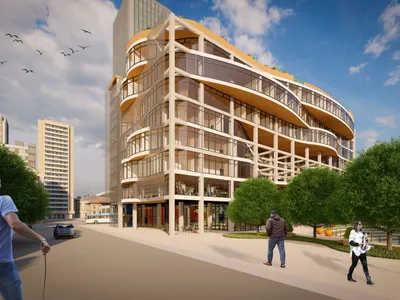
Olio Towers: A Mid-Rise for Performers That Fuses Housing, Rehearsal, and Stage
Located blocks from Houston's Theater District, this modular tower stacks living units around a central performance atrium.

Oasis: Modular Green Housing Carved into Dhaka's Urban Fabric
A shortlisted Plugin Housing entry reclaims unauthorized settlements in Dhaka with stepped concrete volumes, green roofs, and ventilation-driven design.

Black Hole: A Floating Megastructure for the Post-Physical Era
Emiliano Mazzarotto envisions a spherical, self-scaling arena where e-sports, digital hotels, and holographic stadiums replace traditional public space.

Explore Academic Building Competitions
Discover active competitions in this discipline

Challenge to design public laboratory

Challenge to reimagine the Iron Throne

Photograph architecture without architects

Illustrate the lost glory of Angkor Wat - Render Challenge
Comments (0)
Please login or sign up to add comments
No comments yet. Be the first to comment!