
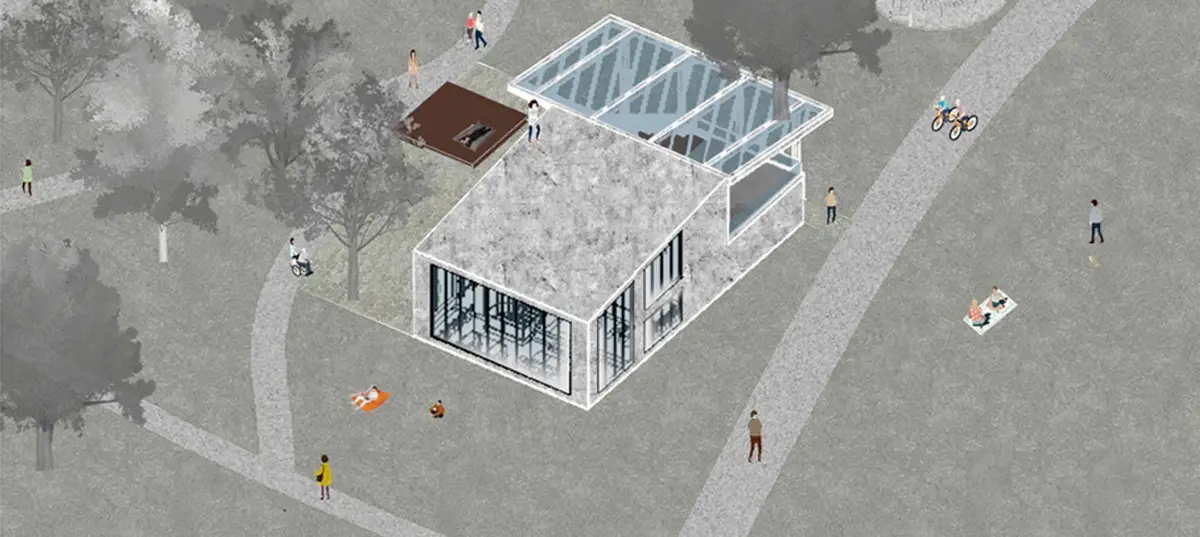
Intergenerational Learning Center: Architecture Against Loneliness in Munich's Park
A glazed pavilion nestled among university grounds reimagines the public park as a site for cross-generational exchange and aging with dignity.


Loneliness among the elderly is not a problem architecture typically claims to solve. But when a building is placed deliberately at the intersection of generations, when its ground floor opens onto a park and its program invites grandparents and students to share the same table, the spatial proposition becomes social infrastructure. The Intergenerational Learning Center in Munich does exactly that: it treats a glazed pavilion in a public park not as a cultural amenity but as a prescription against isolation.
Designed by Sanzhidma Radnaeva and shortlisted in the Huddle competition, the project occupies a strategic site within a public park surrounded by universities. The choice of location is itself the first design move. Rather than sequestering elderly residents in a care facility on the city's periphery, Radnaeva drops them into the most energetic demographic corridor Munich offers: a landscape of students, joggers, and young families. The architecture then does the work of turning proximity into connection.
A Building That Belongs to the Trees
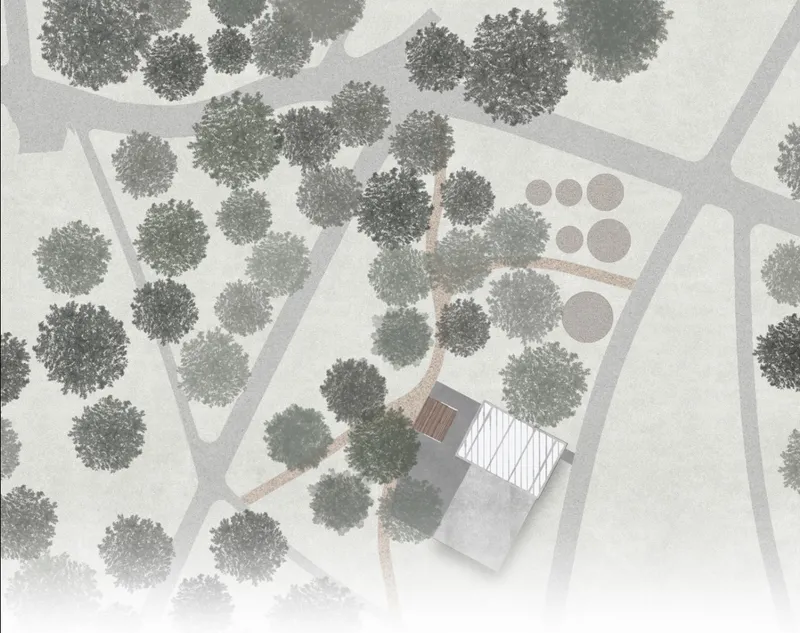
The site plan reveals a building that does not dominate its park setting but negotiates with it. The structure is nestled among mature trees, with diagonal pathways feeding into circular gathering spaces that function as outdoor rooms. These paths do not simply lead to the building; they create a gradient of publicness, moving from the open park through semi-sheltered zones into the interior. The circular nodes along the way offer seating and pause points where intergenerational encounters can happen without the pressure of a formal program. It is landscape design doing the heavy lifting of social choreography.
Ground Floor as Common Ground
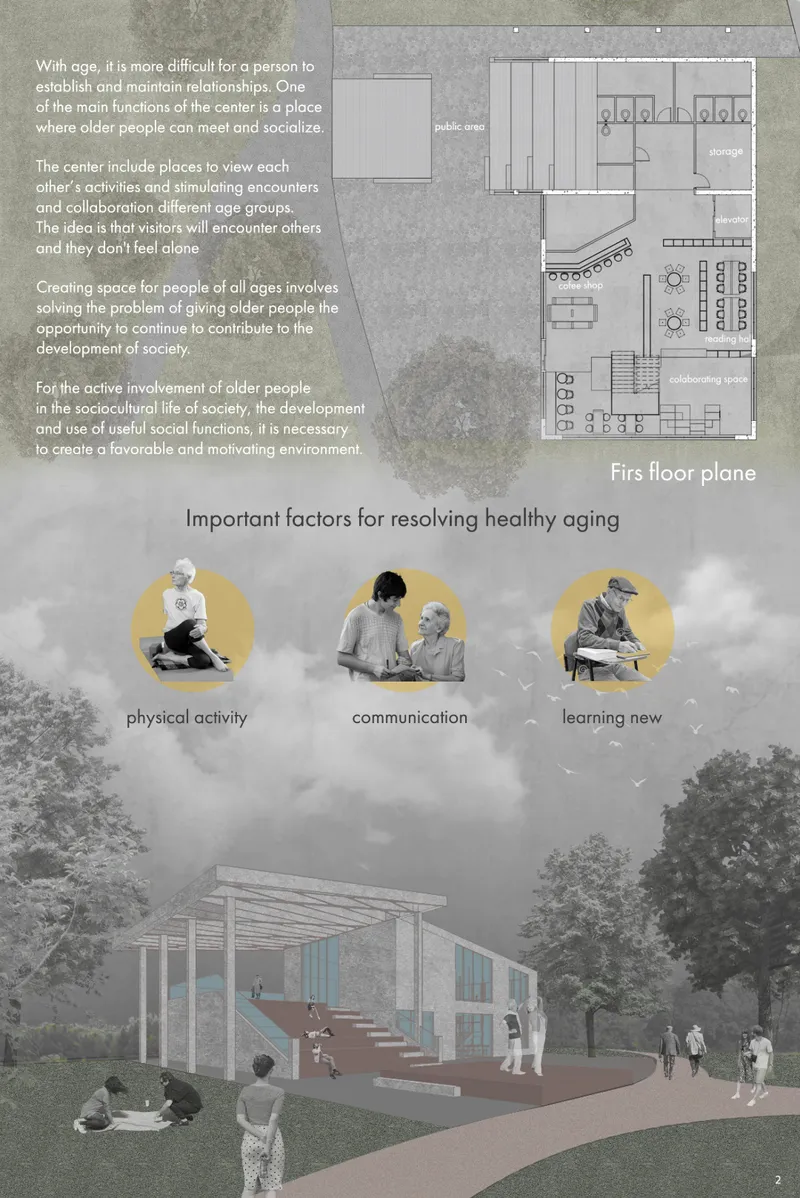
The first floor plan and accompanying rendering show a glazed pavilion whose transparency is both literal and programmatic. The ground floor houses a coffee shop, reading hall, and collaborative zones designed for informal dialogue and learning. A generous outdoor area connects these indoor activities seamlessly to the surrounding park, collapsing the boundary between structured engagement and spontaneous encounter. The first floor adds multipurpose rooms for events, classes, and exhibitions, ensuring the building can host everything from a chess lesson between a child and a retiree to a student listening to firsthand historical narratives.
What matters here is the refusal to separate audiences. The coffee shop is not "for seniors" and the reading hall is not "for students." Every space is designed to be occupied by anyone, at any age, with the architecture gently encouraging overlap rather than segregation. The elderly are positioned not as passive recipients of care but as active contributors to the cultural and social vibrancy of the city.
The Pavilion in Its Park: Transparency as an Invitation
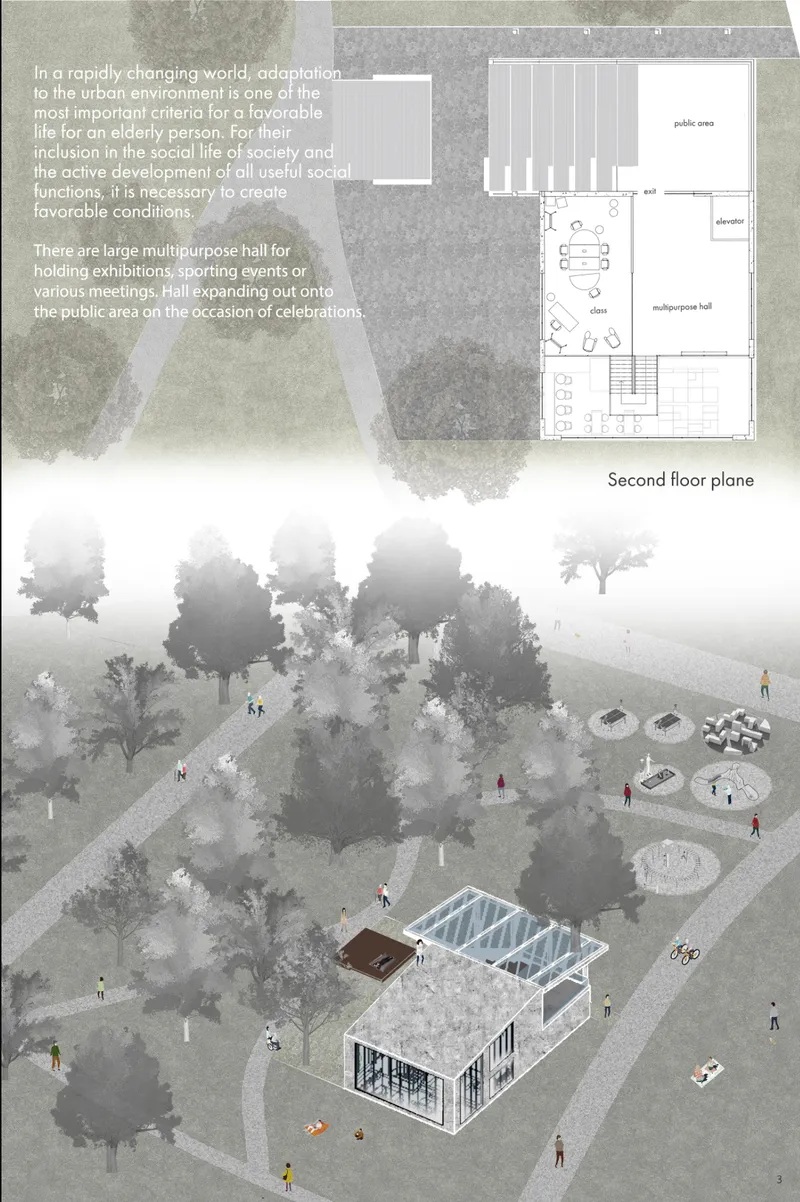
The axonometric drawing makes the relationship between building and landscape legible at a glance. The glazed pavilion sits lightly in the park, its walls dissolved into glass so that the activities inside become visible to passersby. Scattered visitors and trees occupy the same drawing with equal weight, reinforcing the idea that the building is an extension of the park rather than an interruption of it. The transparency serves a psychological purpose as well: for an elderly person hesitant to enter an unfamiliar institution, being able to see life happening inside before stepping through the door lowers the threshold of participation considerably.
Three Pillars Against Decline
Radnaeva organizes the project's mission around three pillars that address the psychological and physical needs of aging individuals: physical activity, communication, and lifelong learning. The architecture supports all three without resorting to clinical typologies. Walking through the park to reach the building counts as physical activity. Sharing a table in the coffee shop counts as communication. Attending a class or exhibition on the first floor counts as lifelong learning. The building does not announce these benefits; it simply makes them inevitable through spatial proximity and programmatic overlap.
Why This Project Matters
As cities across Europe confront aging populations and fractured communities, the default response has been to build more care homes and senior centers, facilities that formalize the very segregation they claim to address. Radnaeva's proposal challenges that reflex. By embedding a learning center for all ages within a university park, the project argues that the best antidote to elderly isolation is not specialized architecture but shared architecture, buildings where generations collide by design.
The Intergenerational Learning Center is not a radical formal experiment. Its power lies in the clarity of its social proposition and the restraint of its architectural means: a transparent pavilion, a generous ground floor, a park that does not end at the front door. In a discipline increasingly drawn to spectacular gestures, this kind of quiet, purposeful design deserves attention. It demonstrates that the most impactful buildings are sometimes the ones that simply refuse to exclude anyone.
View the Full Project
About the Designers
Designer: Sanzhidma Radnaeva
Enter a Design Competition on uni.xyz
uni.xyz runs architecture and design competitions year-round that reward proposals with spatial conviction and real site intelligence.
Project credits: Intergenerational Learning Center by Sanzhidma Radnaeva Huddle (uni.xyz).


Popular Articles
Popular articles from the community


David Ortega Stacks a Two-Story Mexico City Penthouse Around a Steel Stair and a Pergola-Shaded Roof Terrace
In Colonia Roma, a 300 m² penthouse uses oak joinery, a planted steel stair and a slatted roof pergola to make a new-build apartment feel like a house.


Opera on the Sea: Driftwood Logic Shapes a Timber Opera House on Estonia's Coast
Trevor Orgill's opera house translates the entangled drift of floating timber into a civic building where wood, water, and music converge.

FCC Arquitectura Expands a Portuguese Granite House with a Board-Marked Concrete Wing
In Portugal, JV House pairs a cleaned-up whitewashed and granite dwelling with a timber-shuttered concrete extension, courtyards and a garden pool.

Aquadapt: An Underwater Habitat That Rewrites Its Rooms by the Hour
Curved modules ring the seabed while one shell shifts from breakfast room to cinema, farm and football pitch as residents' needs change.

Similar Reads
You might also enjoy these articles

Vereda Arquitetos Renovates a 40-Square-Meter Apartment Inside Niemeyer's Copan Building
A compact unit in São Paulo's most iconic residential tower gets a material overhaul that pairs exposed concrete with bold blue Formica.

Shakur's House: Exposed Brick as an Interior Organiser in a 168 m² Mashhad Residence
Brick moves indoors in this Mashhad residence, where masonry walls, glass partitions and teal planes sequence a compact home without closing it off.

Day and Night Park: A Time-Based Urban Newsstand in Beijing
A temporary urban newsstand in Beijing blending travel, light, and reading through poetic colors, compact form, and community-focused design.

Modernist Patio Renovation in El Masnou, Barcelona by Oliver Segura Arquitectura + Cebrià Arquitectura
Modernist patio renovation blending tradition and innovation with a movable pool, leveled floors, and Catalan materials in El Masnou.


Comments (0)
Please login or sign up to add comments
No comments yet. Be the first to comment!