

Glashaus: Wrapping the Bauhaus in Glass to Rethink Architectural Education
A transparent steel and glass canopy envelops the iconic Dessau campus, housing a rotating cohort of 24 international architecture students.


What happens when you take one of the most studied buildings in modern architecture and literally encase it in a new skin? Glashaus proposes exactly that: a transparent steel-and-glass framework draped over the existing Bauhaus campus in Dessau-Roßlau, Germany, turning the entire complex into both a living exhibit and a functioning school. The enclosure is not decorative. It is a pedagogical device, forcing students to inhabit the space between historical construction and contemporary sustainable design, reading one through the other every day for two months before rotating to the next institution in a global network.
Designed by Tim Hardeman and Diana Kuzina, Glashaus was shortlisted in the Bauhaus Neue competition. The brief asked entrants to reimagine the Bauhaus for the future, and this proposal answers with a dual argument: that the original building's industrial design philosophy still has lessons to teach, and that those lessons are best absorbed when students from different cultures share living and working space without ethnic or cultural separation. Twenty-four international students cycle through the program every two months, studying remarkable architecture at each host institution before carrying those insights to the next stop.
A Transparent Frame Over a White Icon
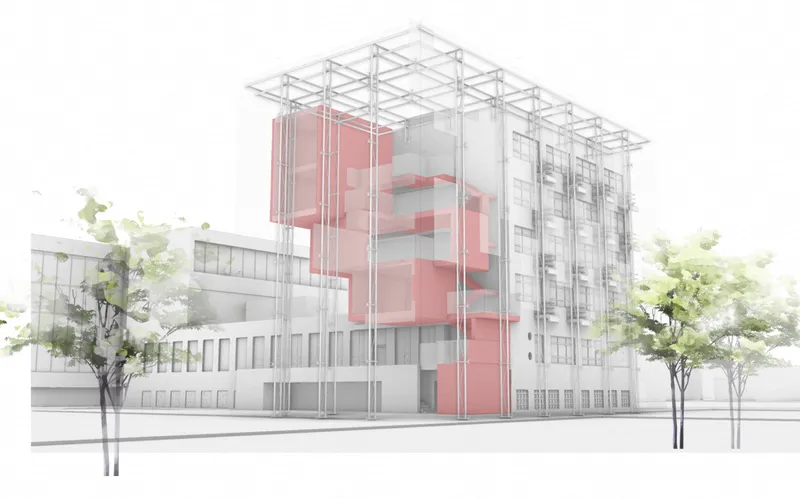
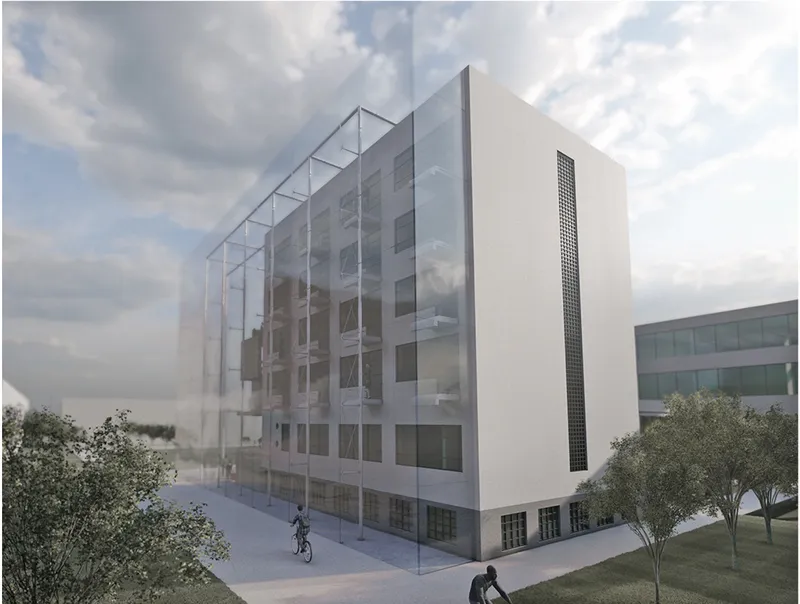
The renderings make the core move legible at a glance. A lightweight steel frame canopy extends well beyond the footprint of the original white Bauhaus facade, creating a covered public zone at street level while preserving clear sightlines to the building's signature horizontal windows and the distinctive red volumes that punctuate the composition. The transparent scrim reads almost like scaffolding, a deliberate choice that keeps the intervention visibly provisional, respecting the landmark without competing with it. Cyclists and pedestrians move freely through the plaza beneath, suggesting that the canopy doubles as civic infrastructure, not just an educational wrapper.
The juxtaposition is the point. Modular glass components echo the Bauhaus' own expansive glazing, but the new structure uses contemporary sustainable building technologies, including passive strategies for natural lighting and ventilation, to demonstrate how those original ambitions can be fulfilled with today's tools. Students see the contrast daily: early twentieth-century industrial aesthetics on one side, energy-efficient material assemblies on the other.
Board-Formed Concrete and Red Chairs: Interiors That Provoke Dialogue
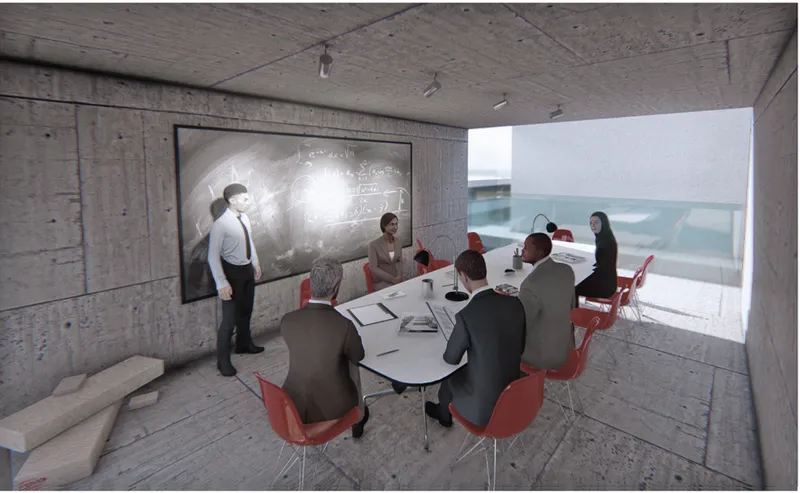
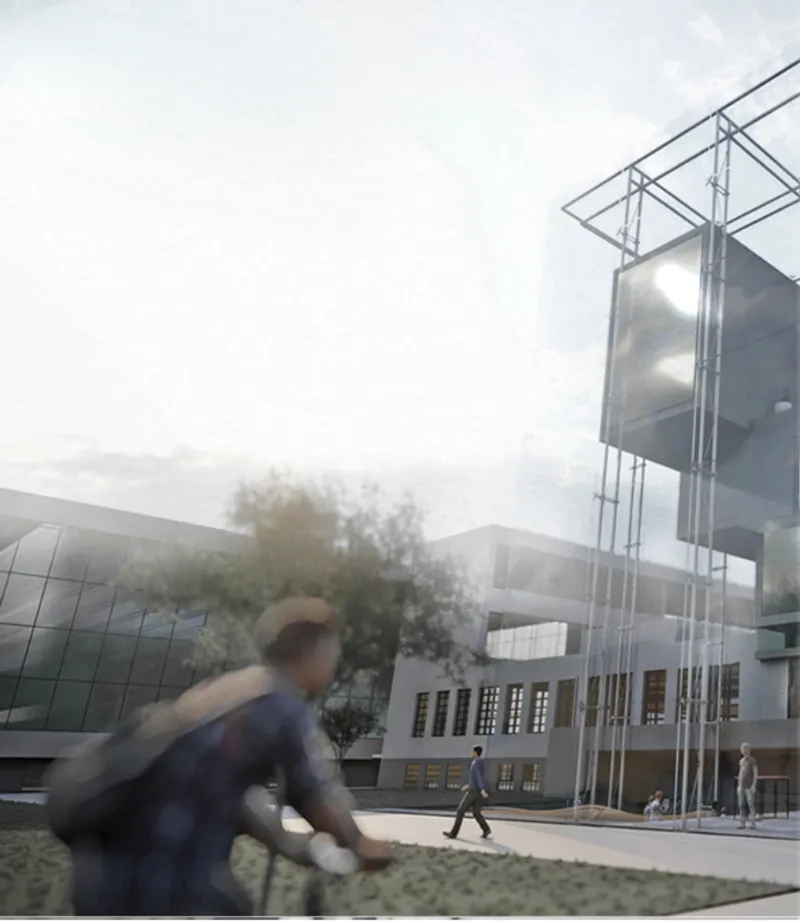
Inside, the material palette shifts to board-formed concrete walls that carry the texture of their formwork, paired with bold red furniture. The conference room shown here seats a small group around a single table, a space scaled for the kind of focused critique sessions that architecture education depends on. The rough concrete and the precise red chairs set up a tactile tension that reinforces the project's broader theme: old construction techniques sitting alongside deliberate, contemporary insertions.
At street level, mature trees line the edge of the steel frame canopy, and pedestrians pass through without obstruction. The boundary between campus and city is intentionally porous, signaling that the educational exchange happening inside is meant to radiate outward. The canopy's proportions keep the ground plane generous and shaded, a practical benefit in summer and a spatial cue that the Glashaus belongs to the public as much as to its rotating student cohort.
The Atrium as Social Engine
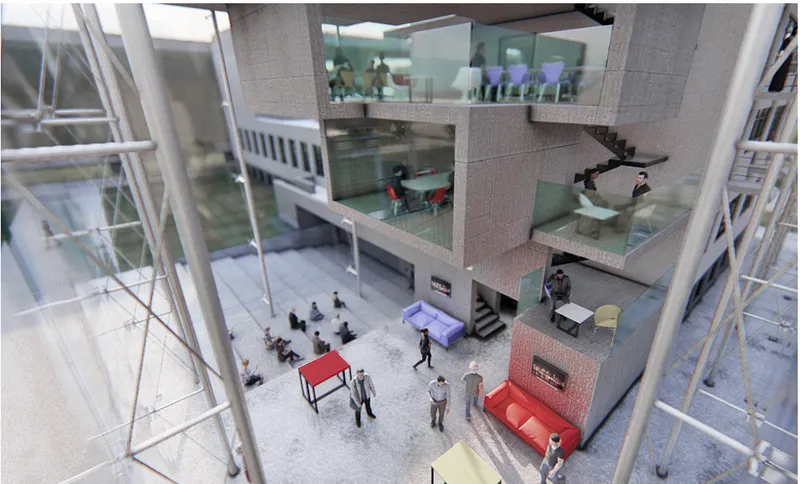
The multi-level atrium is the heart of the scheme's social ambition. Circulation bridges cross at various heights, and red furniture clusters draw people into informal gathering points visible from every floor. The spatial organization is designed to channel movement toward these collaborative zones, making chance encounters between students of different backgrounds almost unavoidable. It is a deliberate rejection of the corridor-and-classroom model, replacing it with a continuous field of interaction.
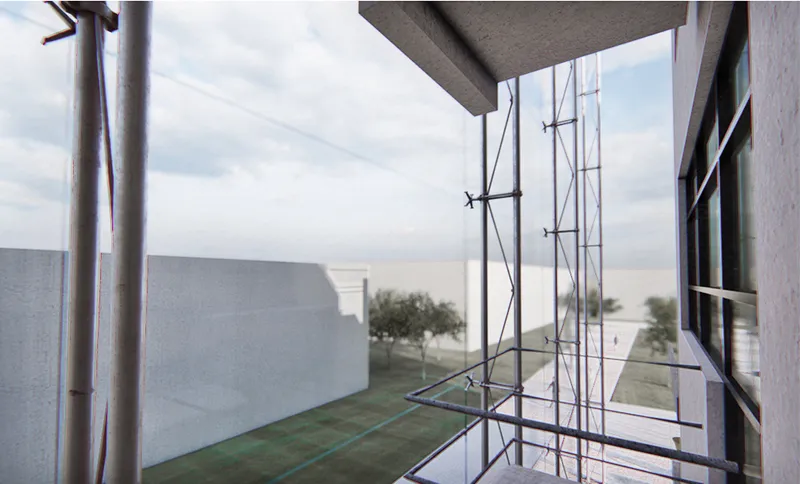
From inside the glazed facade, views push outward through the steel truss frame to the landscaped plaza beyond. Natural light floods the interior, reducing the need for artificial illumination and reinforcing the passive sustainability principles that underpin the design. The effect is of inhabiting a space that is simultaneously enclosed and exposed, protected and transparent. For a program built on the idea that architecture students learn best by critically analyzing buildings they can touch, this kind of spatial legibility is essential.
Section and Plan: How the Program Stacks
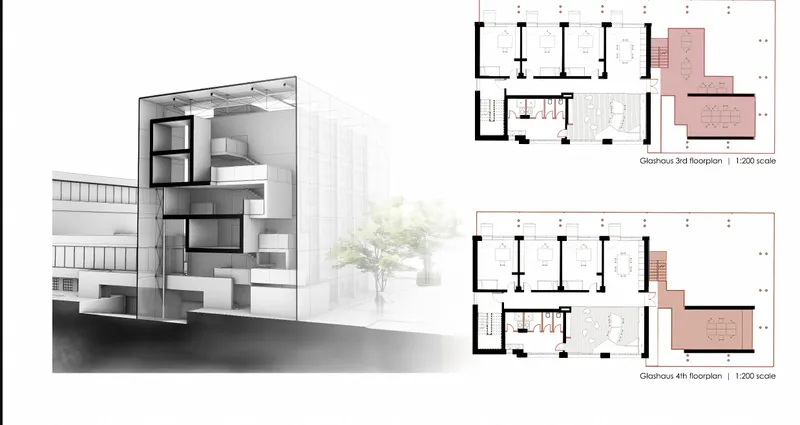
The architectural section and adjacent floor plans reveal how classrooms, communal living areas, and collaborative workspaces are vertically distributed. The section drawing makes clear that the new glass envelope creates generous double-height zones where the original building had more compressed floor-to-ceiling dimensions, giving the intervention its own spatial identity without altering the historic structure. Classroom layouts are compact and repeatable, while the vertical arrangement concentrates shared program at the levels most visible from the atrium, ensuring that communal life remains the dominant experience.
Why This Project Matters
Glashaus treats the Bauhaus not as a museum piece but as a live instrument. Enclosing it in a new transparent skin reframes preservation as an active, educational act rather than a static one, and the rotating international cohort ensures that the building's lessons are tested against a genuinely diverse set of perspectives every two months. The passive sustainability strategies, from natural ventilation to environmentally conscious materials, are not afterthoughts; they are integral to the argument that the Bauhaus' original commitment to functional, industrially informed design leads naturally to contemporary green architecture.
For Hardeman and Kuzina, the ambition goes beyond a single building. Their proposal sketches a network model in which the Bauhaus is one node among many globalized institutions, each contributing to a shared architectural framework. Whether or not that network materializes, the core proposition is sharp: the best way to prepare students for a sustainable future is to make them physically inhabit the tension between what architecture was and what it needs to become.
View the Full Project
About the Designers
Designers: Tim Hardeman, Diana Kuzina
Enter a Design Competition on uni.xyz
uni.xyz runs architecture and design competitions year-round that reward proposals with spatial conviction and real site intelligence.
Project credits: Glashaus by Tim Hardeman, Diana Kuzina Bauhaus Neue (uni.xyz).


Popular Articles
Popular articles from the community


Jaramillo Van Sluys Arquitectura and Urbanismo Turn a Demolished Registry Lot in Quito into an Orchard Plaza
In Quito's Centro Histórico, a 2,800 m² plaza exposes the San Agustín convent wall and redraws its lost Augustinian orchard in volcanic stone.

David Ortega Stacks a Two-Story Mexico City Penthouse Around a Steel Stair and a Pergola-Shaded Roof Terrace
In Colonia Roma, a 300 m² penthouse uses oak joinery, a planted steel stair and a slatted roof pergola to make a new-build apartment feel like a house.

Juan García Correa, John González and Claudia Rueda Sink a Circular Amphitheater into a Manizales Engineering Building
On the La Nubia campus in Manizales, Colombia, the S1 Building folds labs and offices into a hillside of ramped lawns that double as a campus route.

David Macias Steps a Doorless Stone and Plaster House Down a Tropical Colombian Hillside
In the humid hills of Colombia, Threshold House replaces the front door with an open void and terraces its 850 m² down the slope instead of fighting it.

Similar Reads
You might also enjoy these articles

Gil Mello Arquitetura Tilts a Single Roof Toward the Waterfalls on a Plateau Above Aiuruoca, Brazil
In Aiuruoca, Minas Gerais, a 200 m² house of local labor and reclaimed poles pairs a low valley veranda with a tall mountain one.

U.GA Architects Wraps an Oval Rooftop Pool in Curved Board-Formed Concrete on Busan's Jeollidan-gil
In Busan's Jeonpo-dong, a 454 m² mixed-use block stacks a neighborhood facility, guest rooms and an oval rooftop pool inside spiraling concrete walls.

Felipe Hess Arquitetos Turns a Blind Stone Wall to the Street and Opens a Brazilian House onto a Courtyard and Canal
A canal-front house in Brazil hides behind painted stone and planting, then opens to an olive-tree courtyard, a reed-ceilinged porch and a curving pool.
David Macias Steps a Doorless Stone and Plaster House Down a Tropical Colombian Hillside
In the humid hills of Colombia, Threshold House replaces the front door with an open void and terraces its 850 m² down the slope instead of fighting it.

Explore Environmental Architecture Competitions
Discover active competitions in this discipline

Challenge to design a shop stop sunk in the city

Challenge to design public laboratory
Comments (0)
Please login or sign up to add comments
No comments yet. Be the first to comment!