
Into The Wild House: Earthen Architecture in India
Earthscape Studio built a house from rammed earth in Tamil Nadu with no right angles, no beams, and a grass roof that merges into the hillside.

Mettupalayam is a small town at the foot of the Nilgiri Hills in Tamil Nadu, southern India. The land around it is flat, green, and agricultural: coconut palms, open fields, buffalo grazing on grass slopes. Into The Wild House, designed by Earthscape Studio, is a house that looks like it belongs to this landscape the way a termite mound belongs to a savannah. It is made of earth. It is covered in grass. It has no right angles. From above, it reads as a series of organic lobes radiating from a central garden courtyard. From the ground, it reads as a series of cave-like rooms connected by arched tunnels.
The project uses a construction method the studio calls "fold architecture": continuous curved walls and vaults built from rammed earth and lime plaster, with no columns, no beams, and no flat ceilings. The structure is the enclosure. The enclosure is the form. Everything is one material, folded.
The Form: An Organism on a Hillside
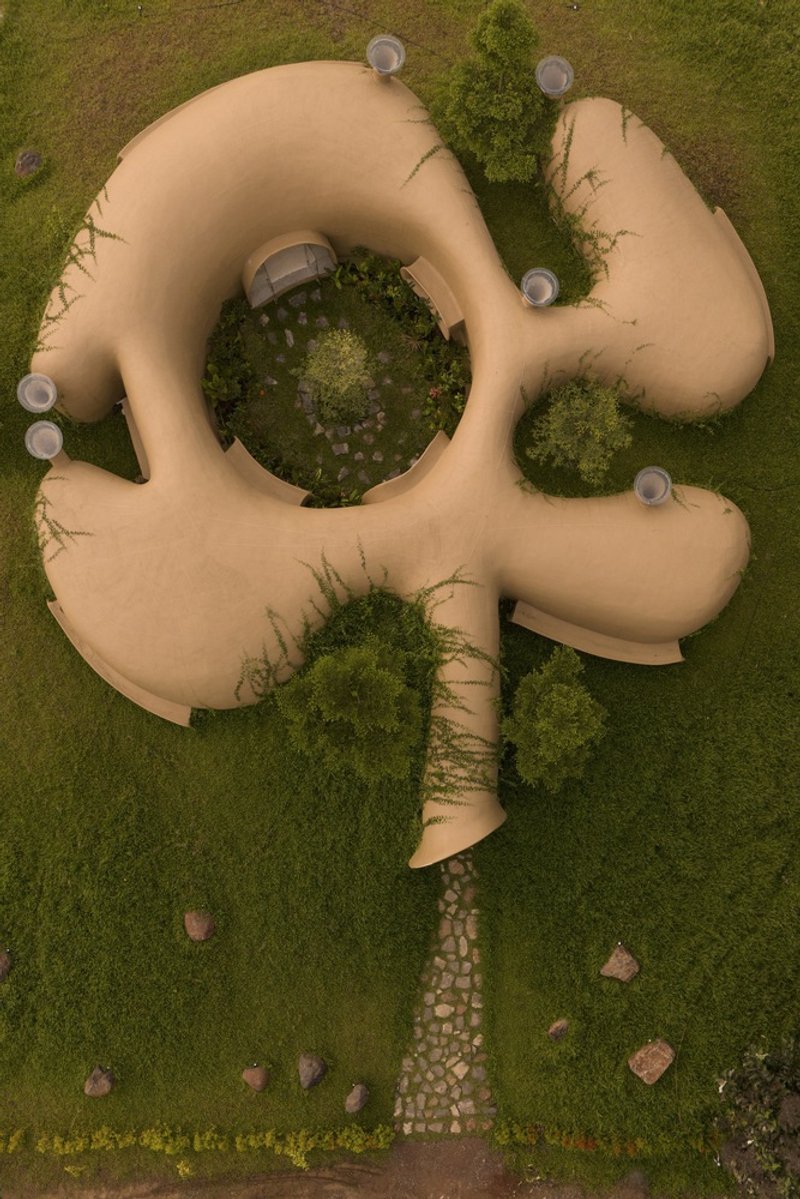
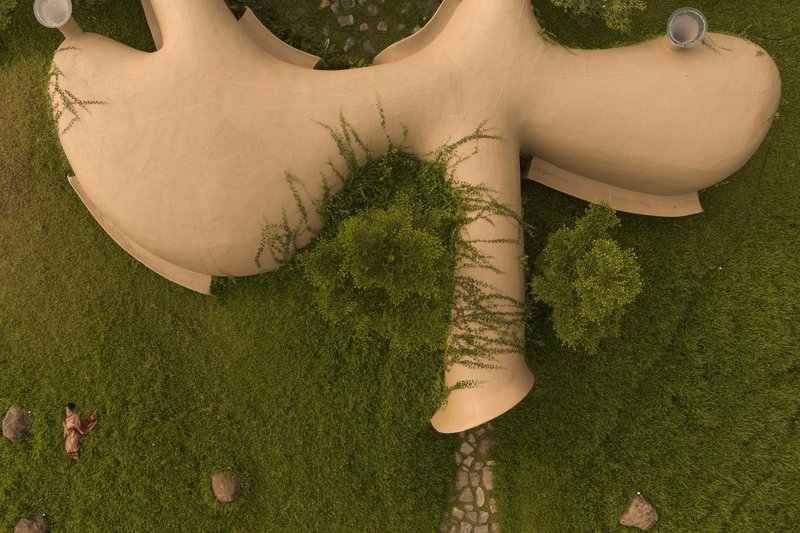
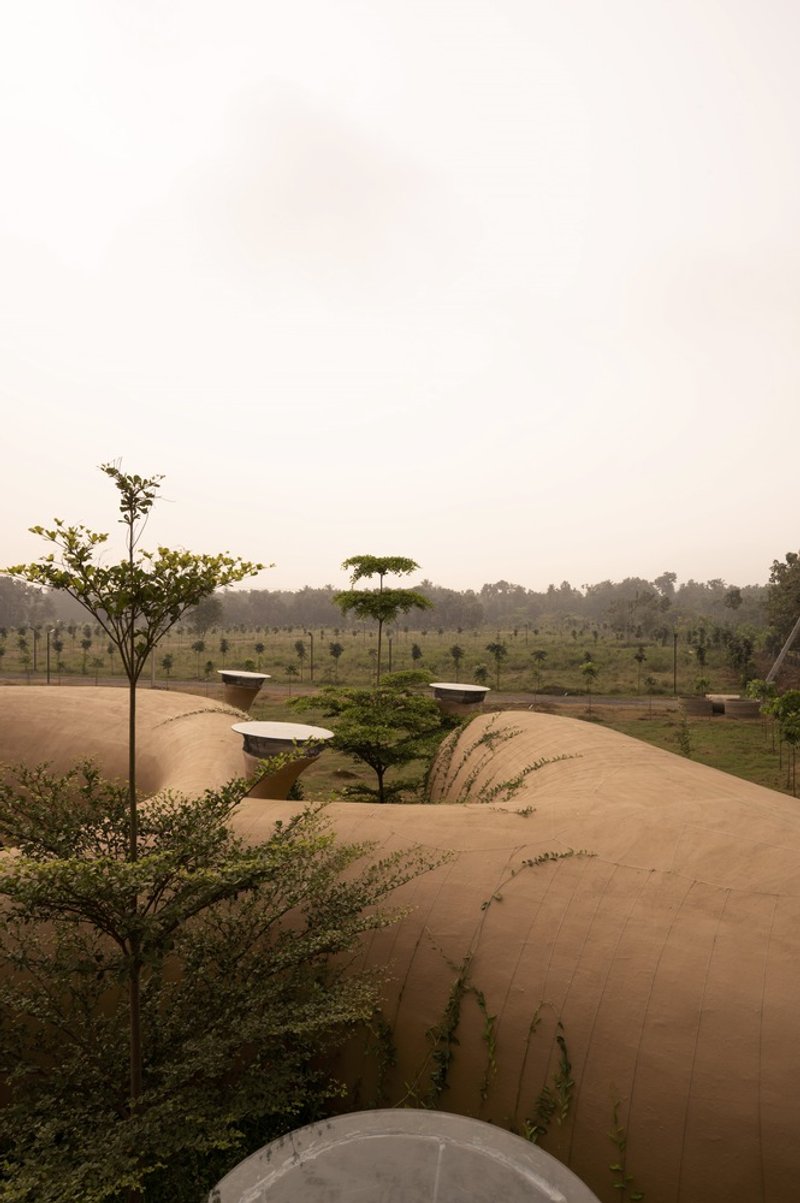
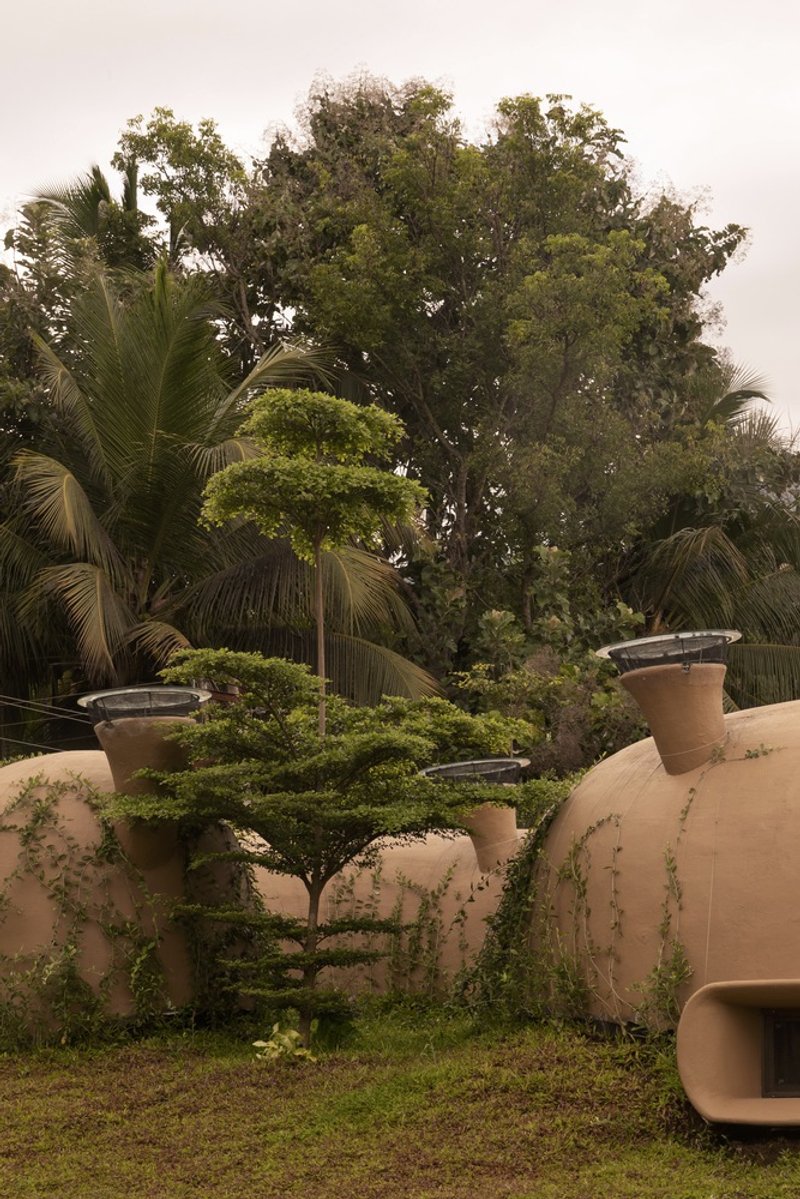
The aerial photographs show the building clearly. The plan is a cluster of lobes, like the petals of a flower or the chambers of a shell, wrapping around a central open courtyard where a tree grows. Each lobe contains a room: living, bedrooms, kitchen, bar. The corridors between them curve and narrow. The grass-covered roof merges into the surrounding hillside. Funnel-shaped ventilation chimneys rise above the roofline like organic sculptures.
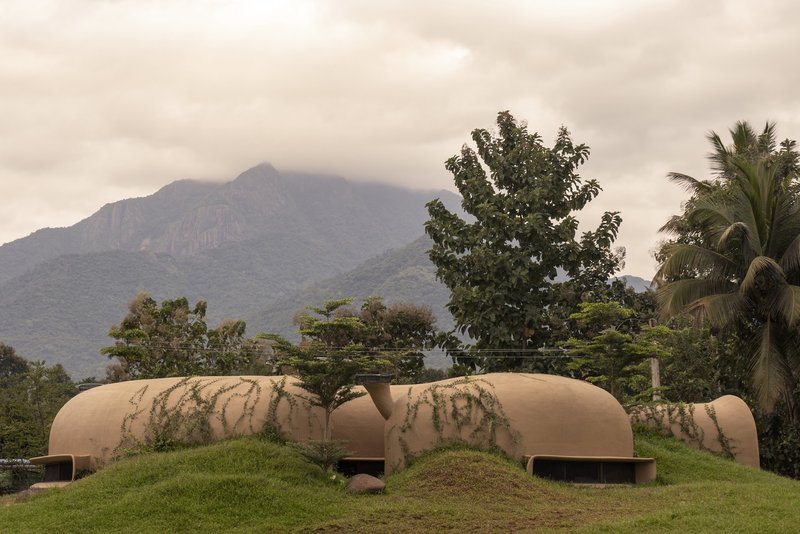
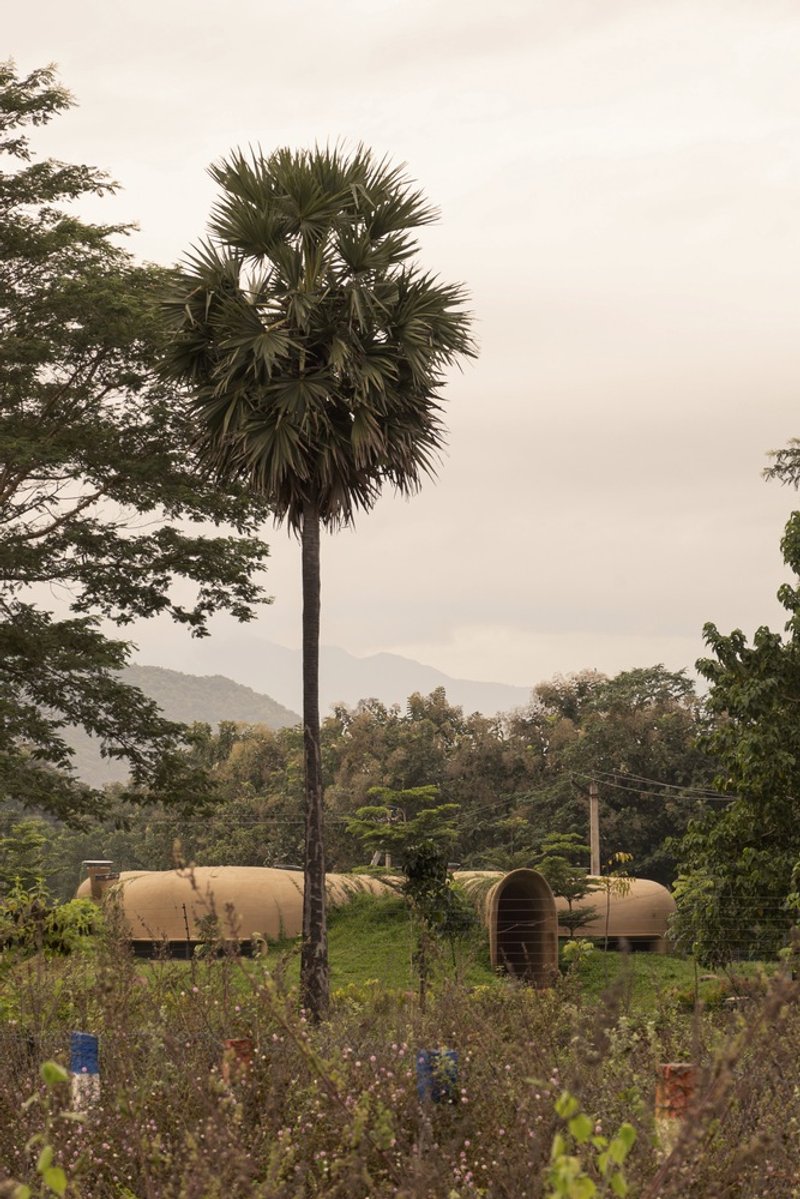
From a distance, the house disappears into the terrain. From up close, the arched entries emerge from the grass like cave openings. The boundary between building and landscape is genuinely dissolved.
Entry and the Arched Tunnels
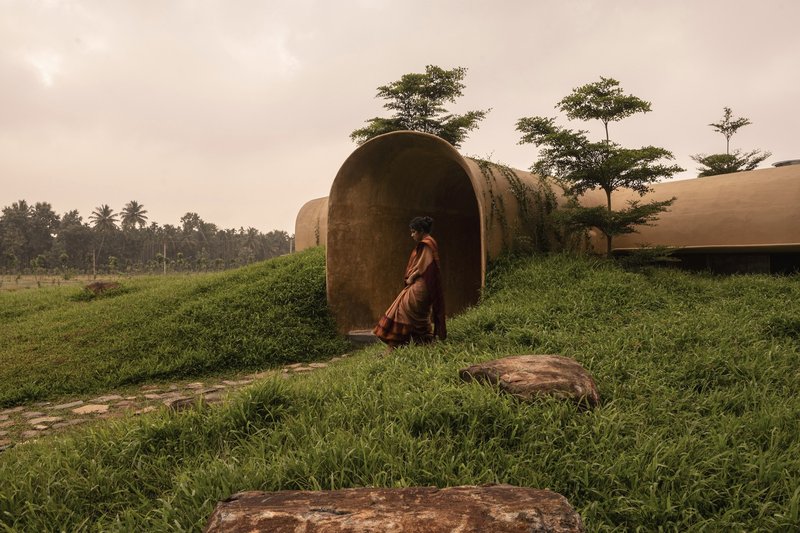
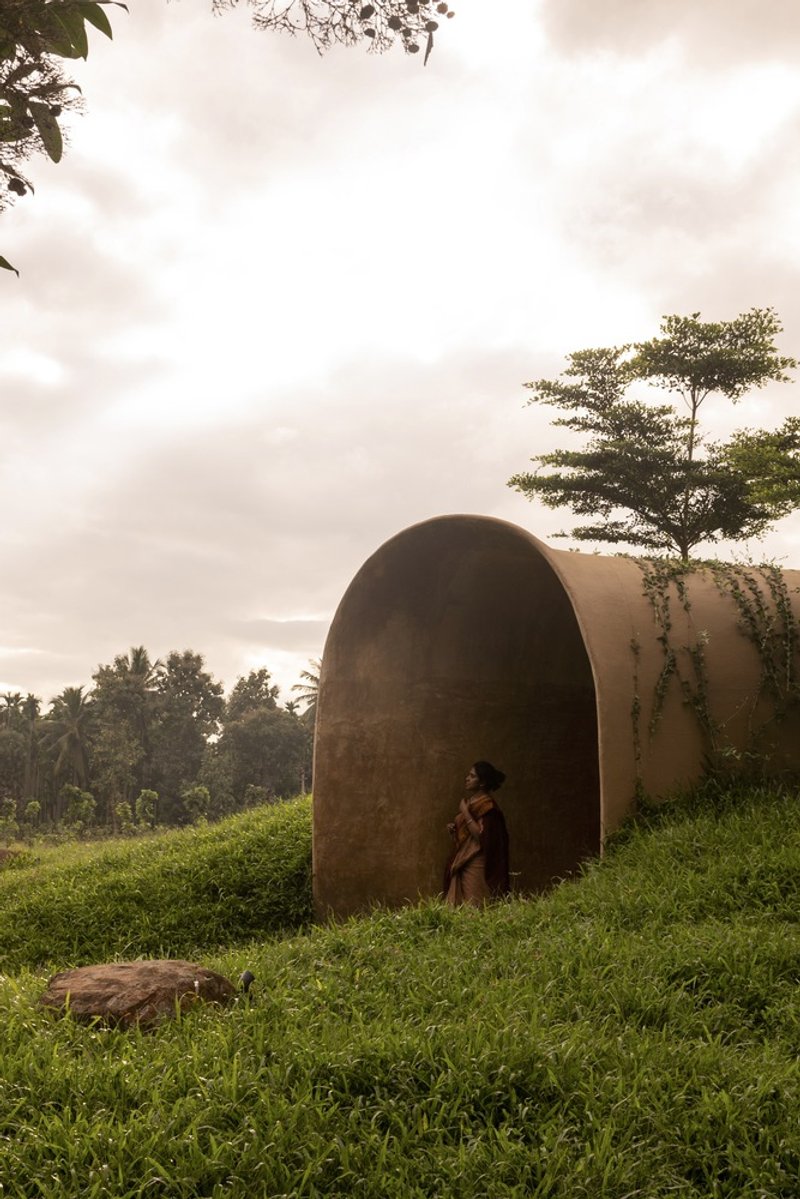
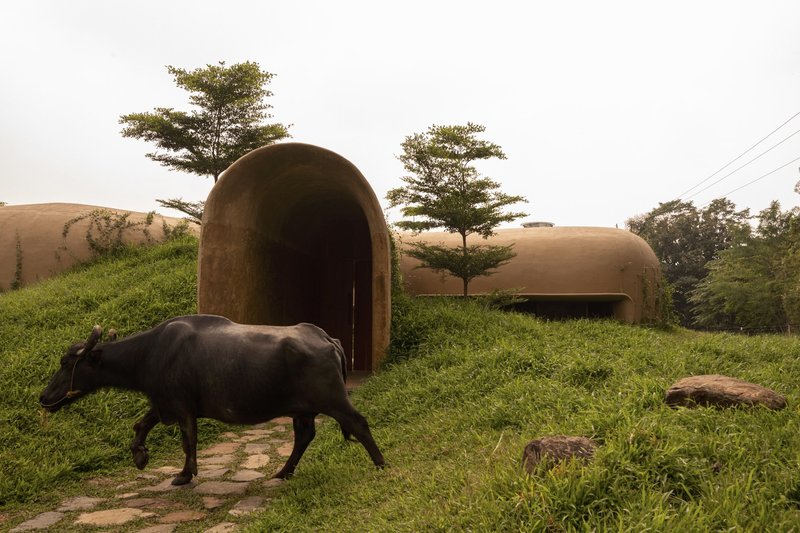
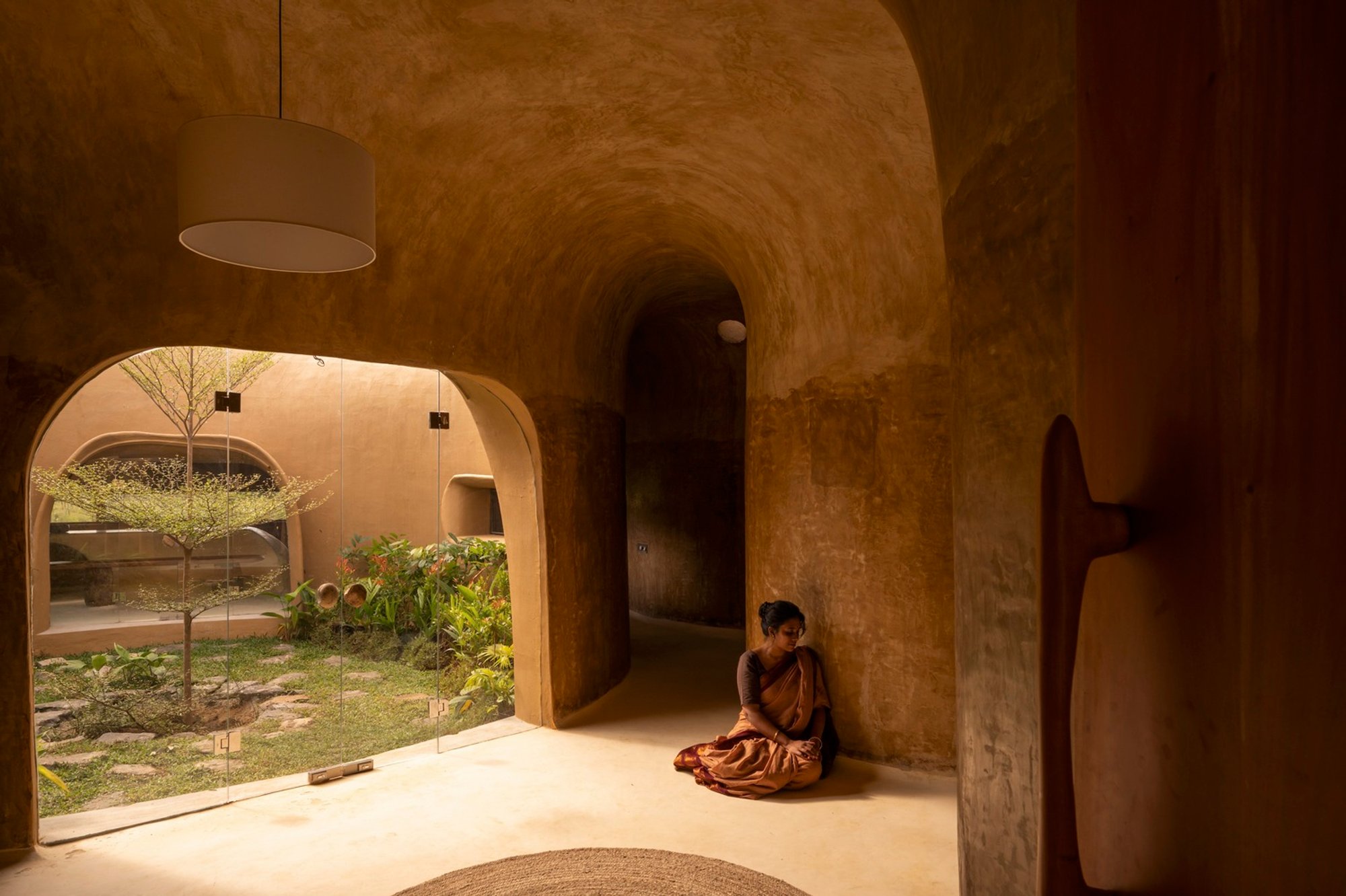
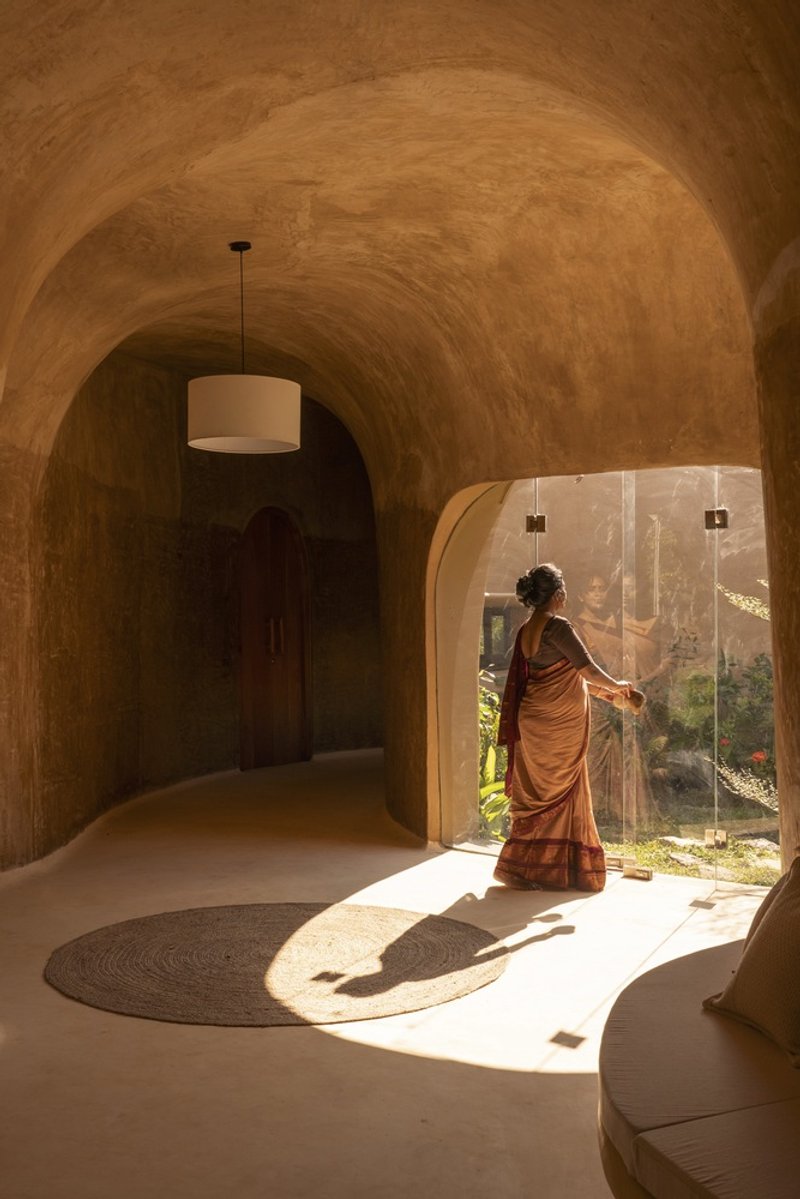
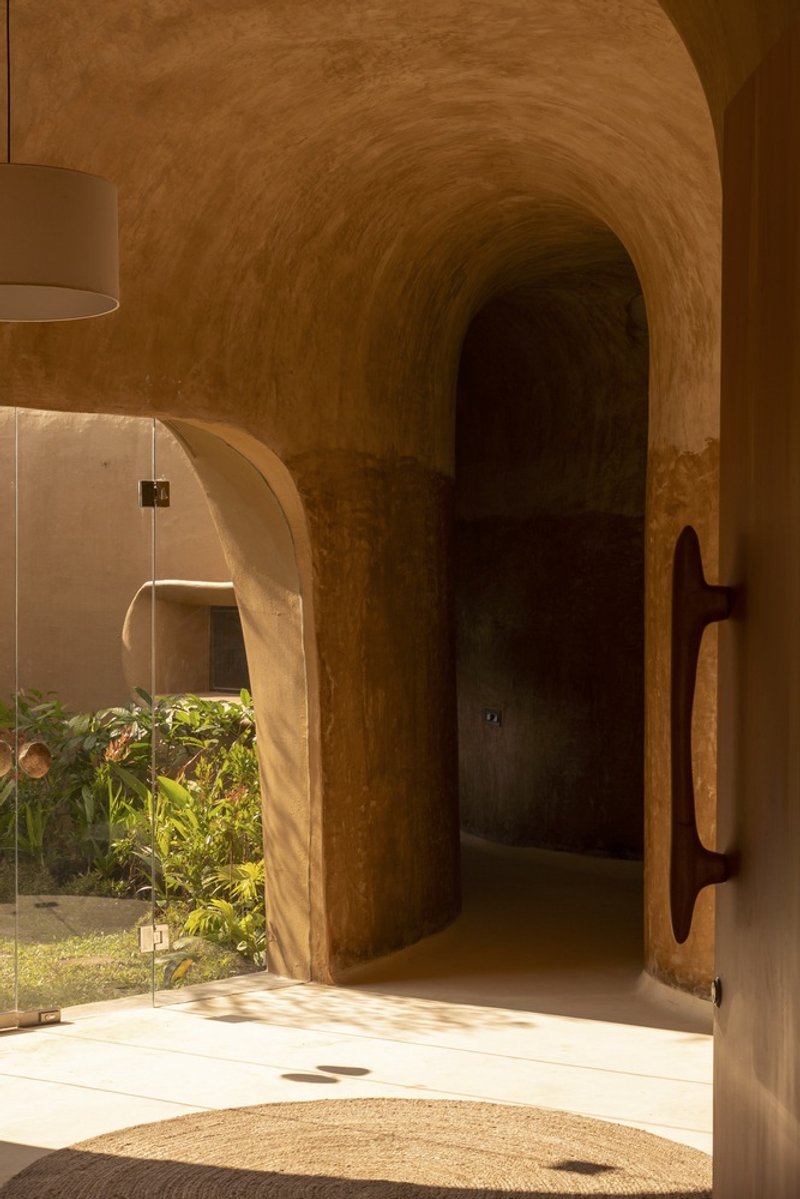
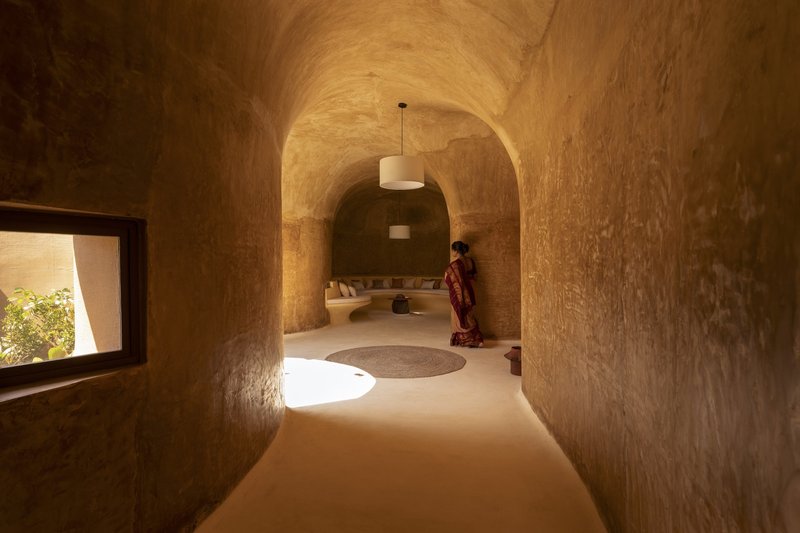
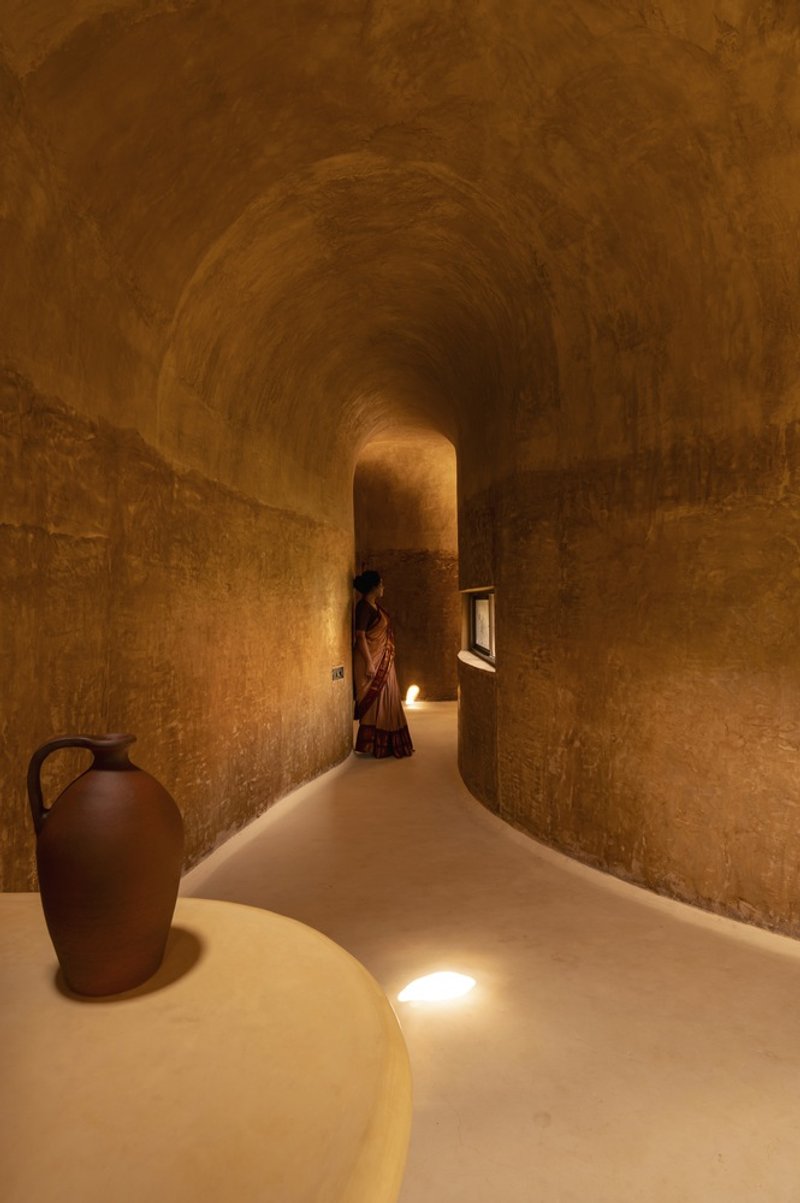
You enter through a tall arched opening in the earth, like walking into a hill. A stone path leads from the road across the grass slope to the tunnel mouth. Inside, the vaulted corridor curves and narrows. The surfaces are lime plaster over rammed earth: warm, textured, monochrome. The floor is polished. Light enters from the courtyard ahead and from narrow strip windows along the base of the walls.
The experience of entering is unlike any conventional house. It is closer to entering a cave or a crypt, but warm and dry. The acoustics change. The temperature drops. The light softens. You are inside the earth.
The Central Courtyard
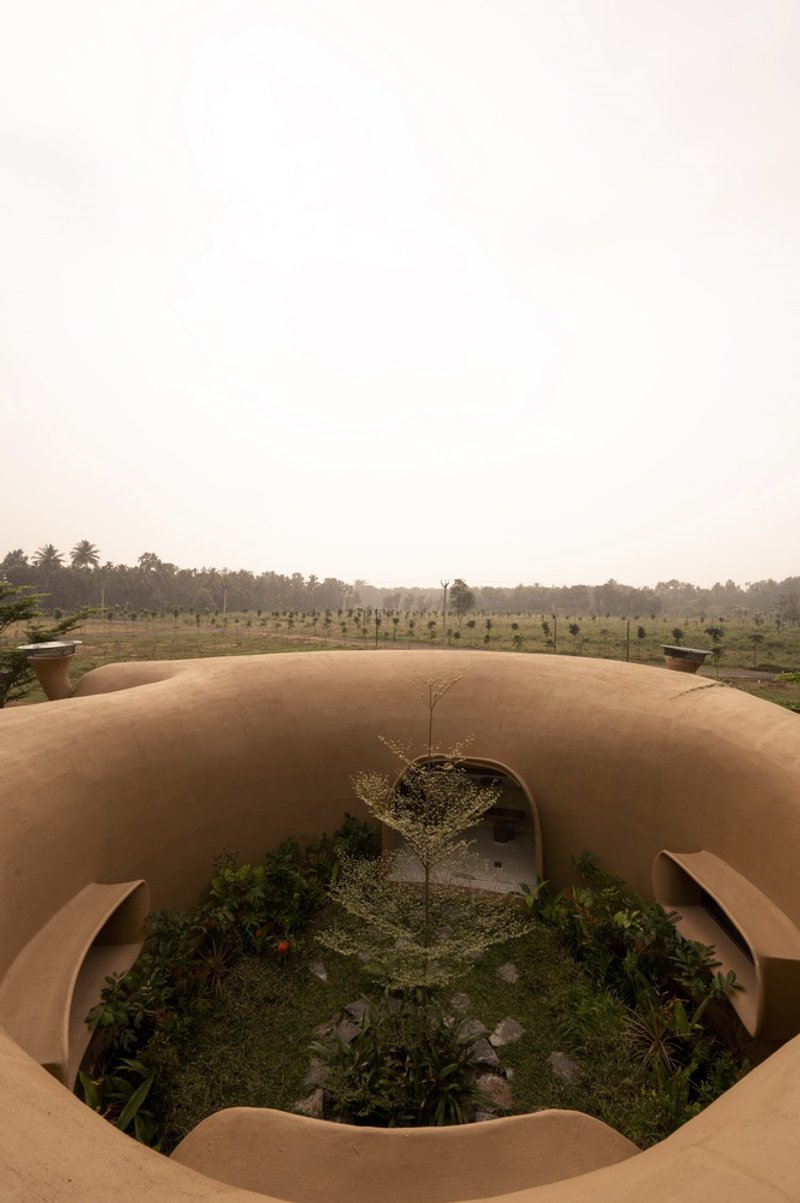
The courtyard is open to the sky. A tree grows in the centre. The curved earth walls of the surrounding rooms rise around it, creating an intimate garden that provides daylight, ventilation, and a view of the sky from every corridor. This is the heart of the passive cooling strategy: hot air rises through the courtyard and the funnel vents, drawing cooler air through the strip windows at floor level.
The Living Rooms
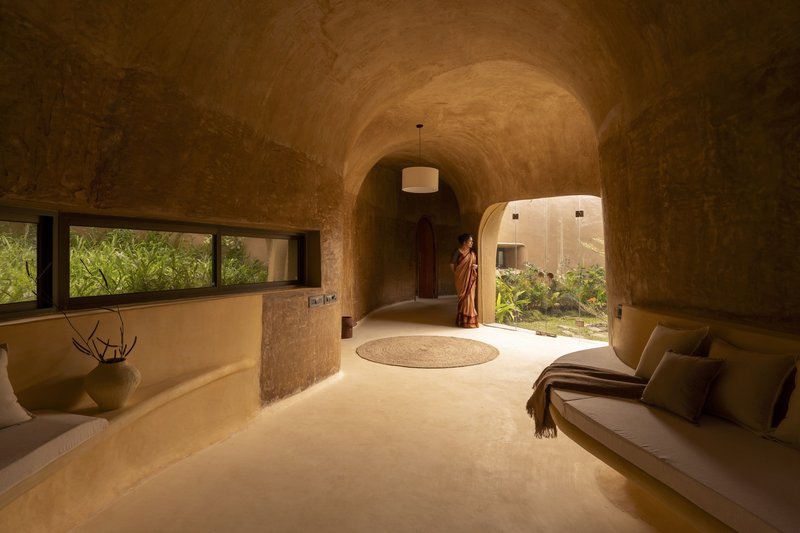
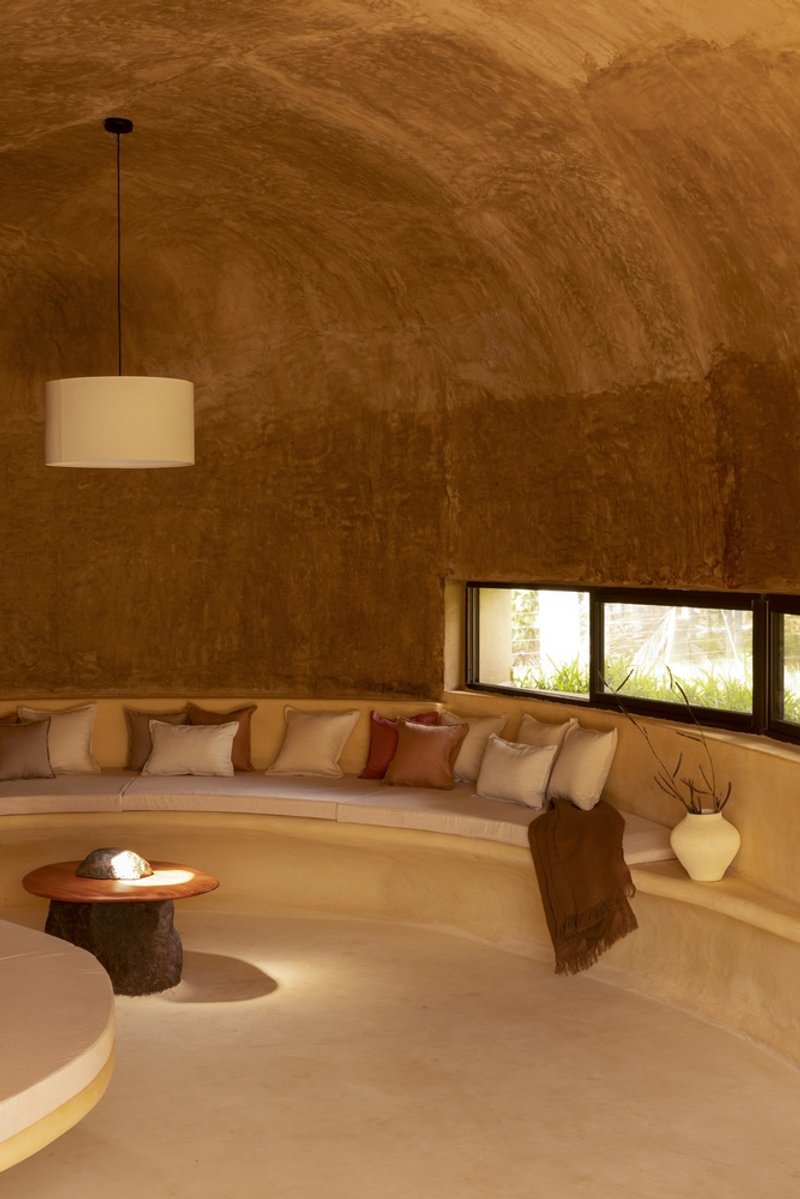
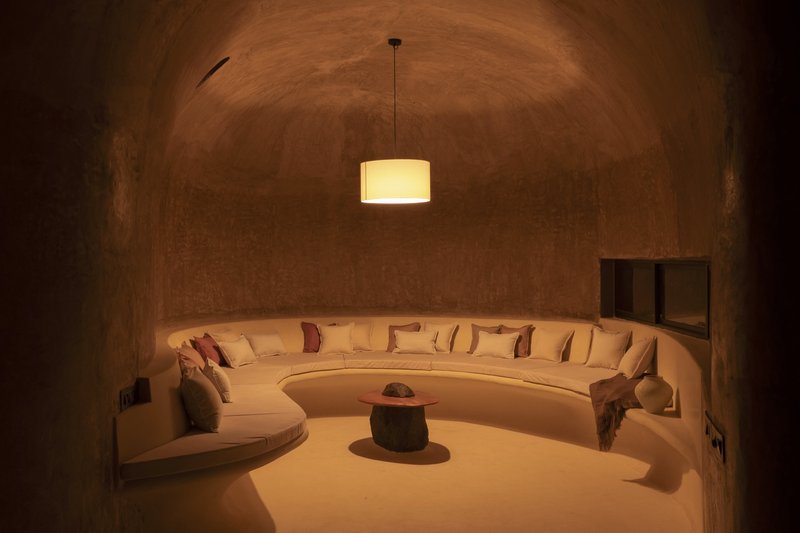
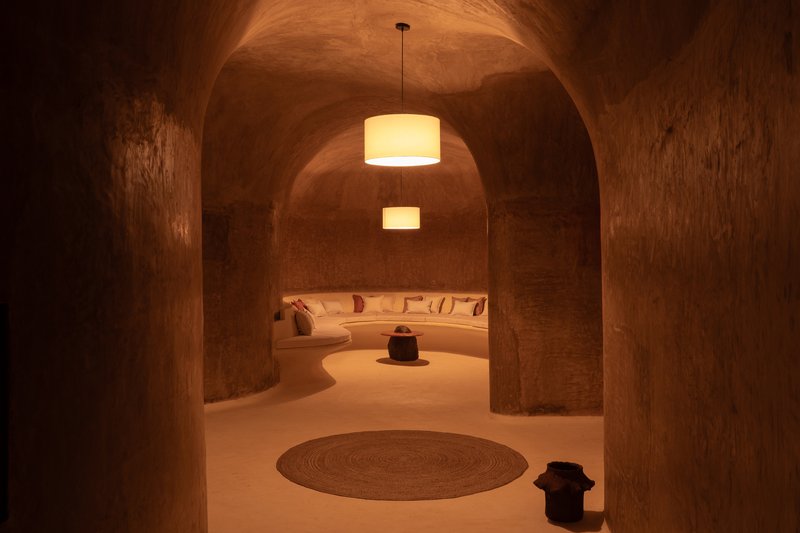
The living spaces are vaulted rooms with built-in earthen furniture. The sunken living room has a circular built-in sofa with cushions, a low timber table, and a pendant lamp hanging from the apex of the vault. The walls are continuous with the ceiling, curving without a joint. At night, the warm earth surfaces glow amber under the pendant lights.
The Dining and Kitchen
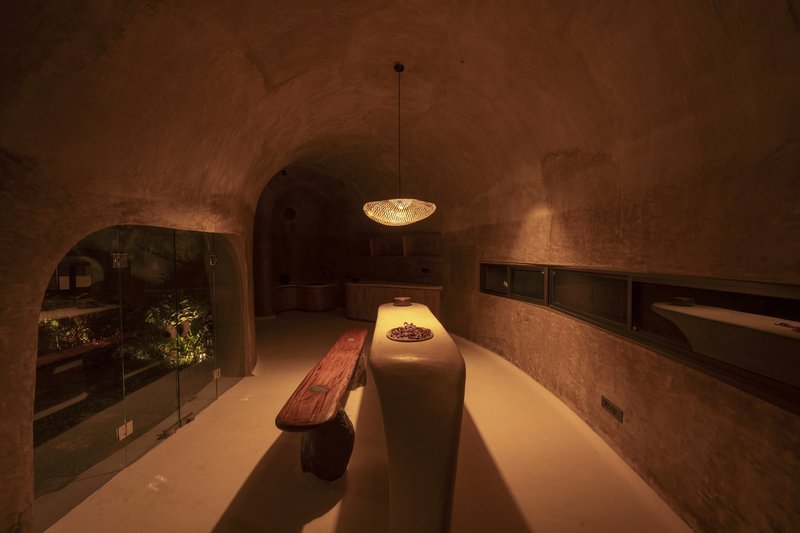
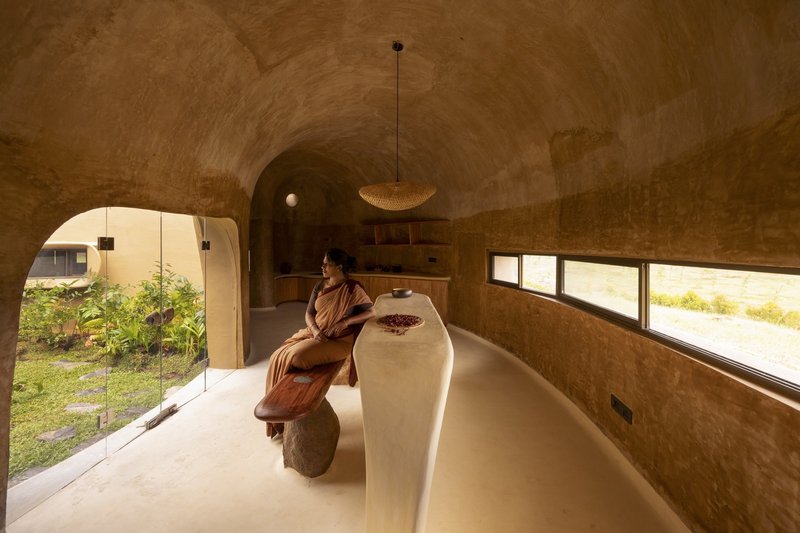
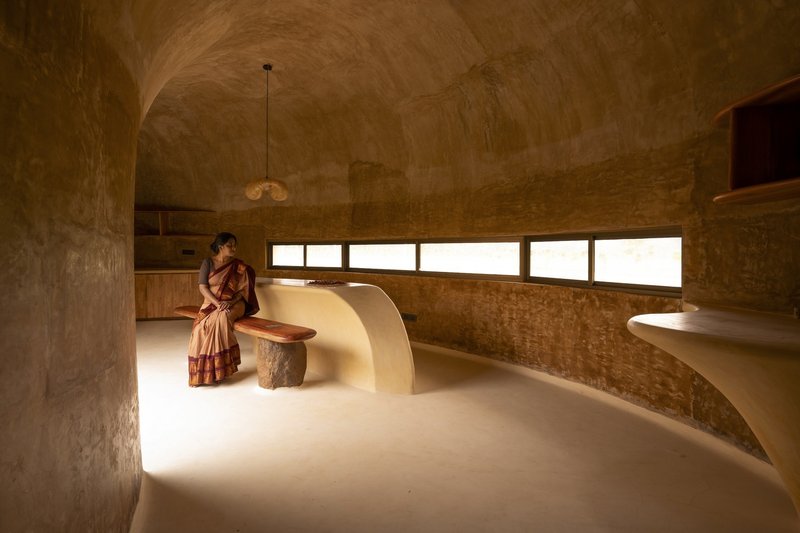
The dining area has a long built-in counter with a timber top under a vaulted ceiling. The kitchen is a barrel-vaulted room with a built-in earthen island, strip windows that frame the garden, and pendant lamps hanging low. The surfaces are lime plaster, smoothed by hand. Every element of furniture is sculpted from the same material as the walls.
The Bedrooms
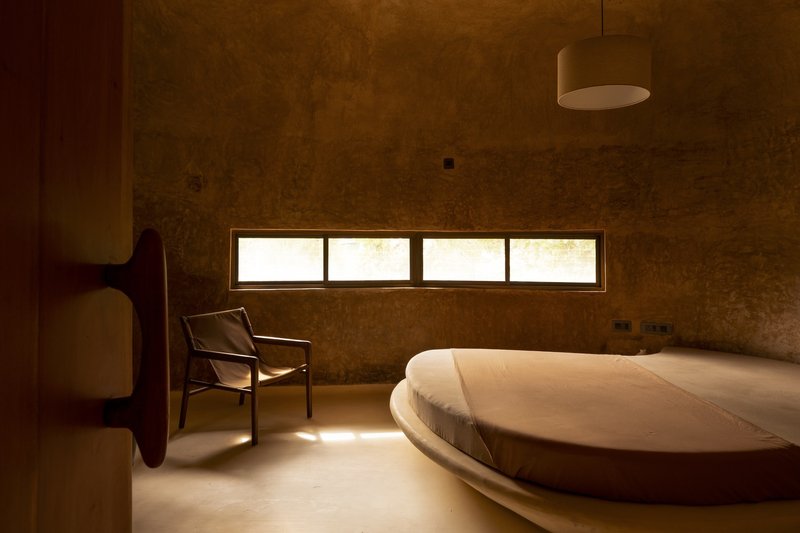
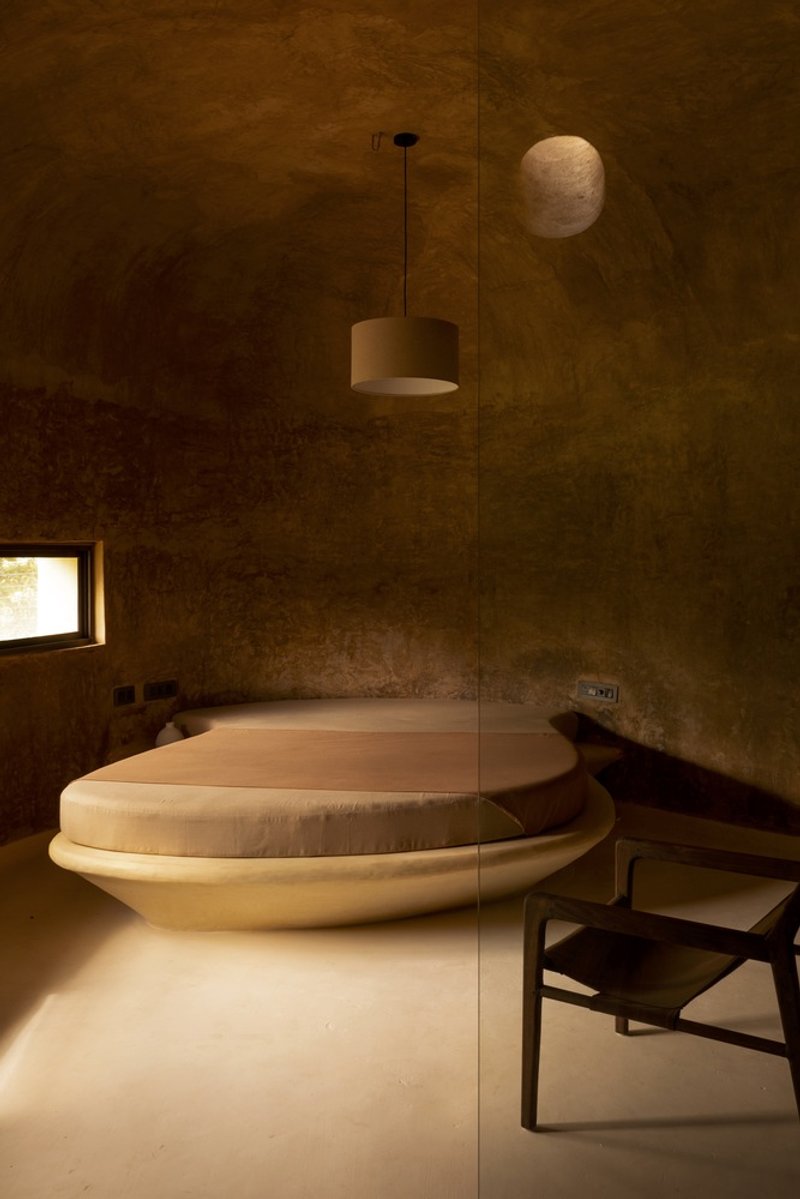
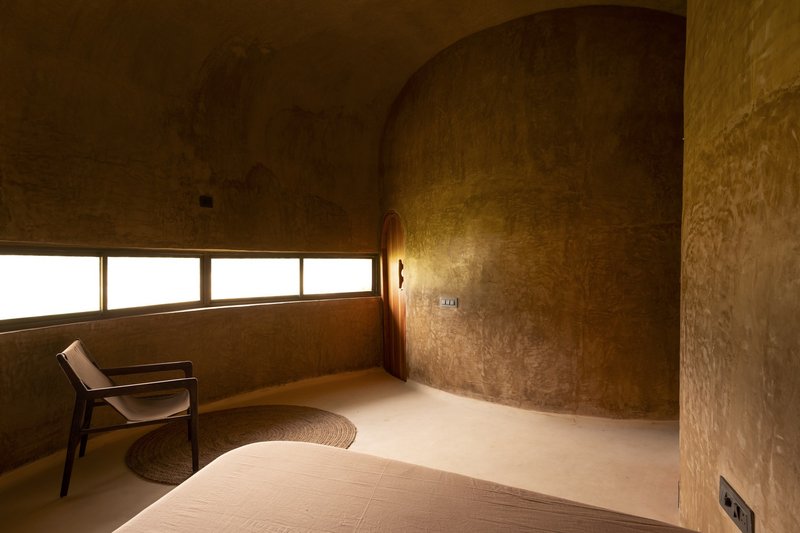
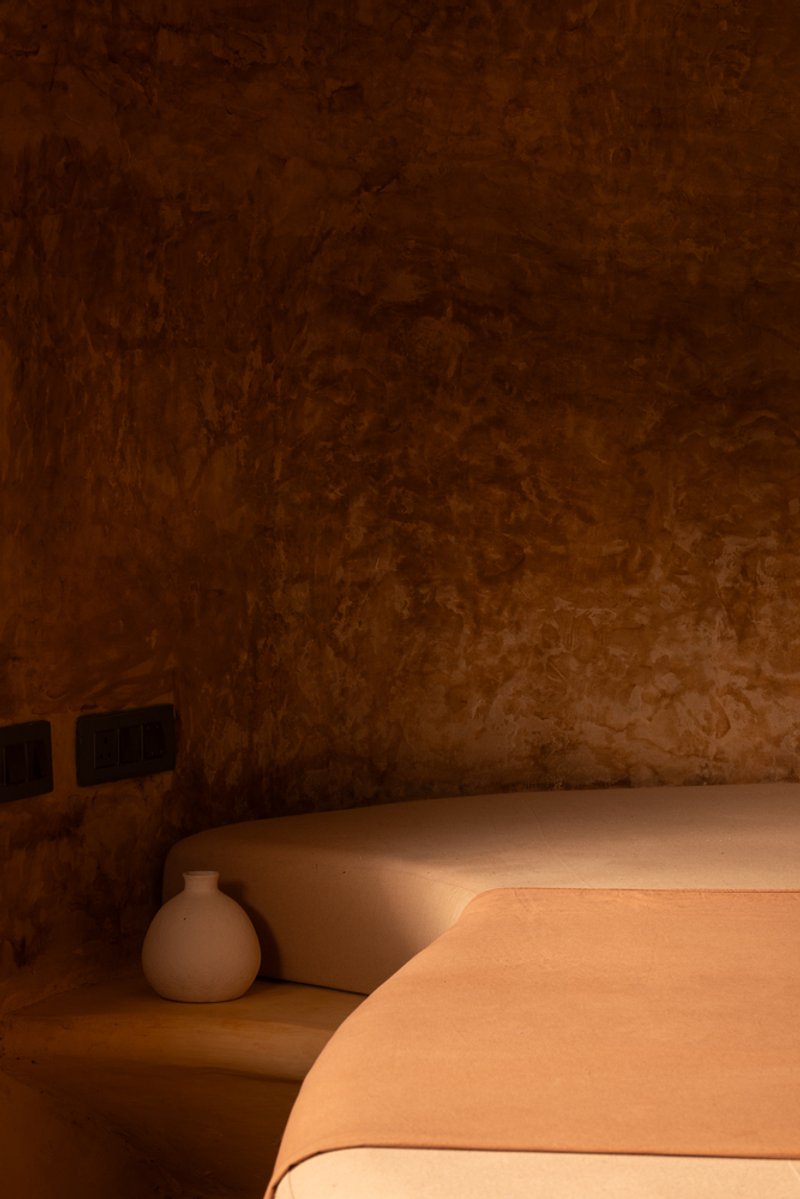
Each bedroom has a circular earthen bed platform, raised above the floor, with a vaulted ceiling above and strip windows at eye level. The rooms are monastic. The palette is warm earth. The light is soft and directional. The built-in furniture means there is nothing to move, nothing to rearrange. The room is complete.
Ventilation Chimneys and the Grass Roof
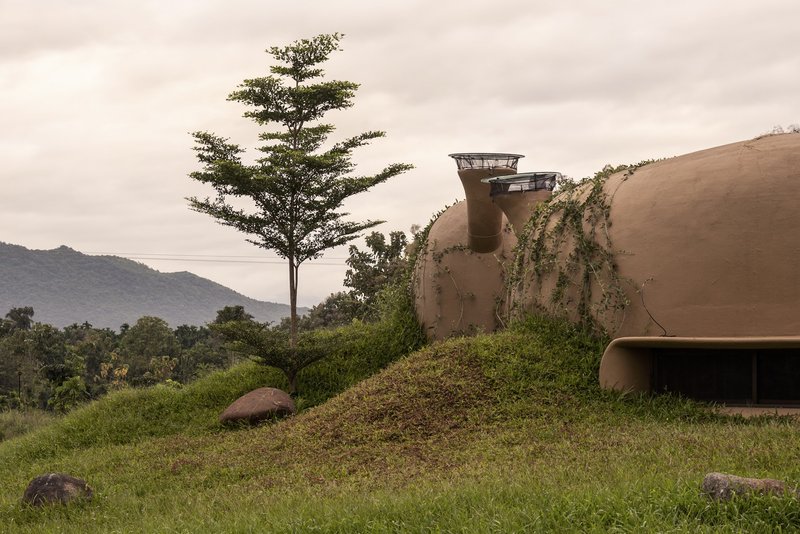
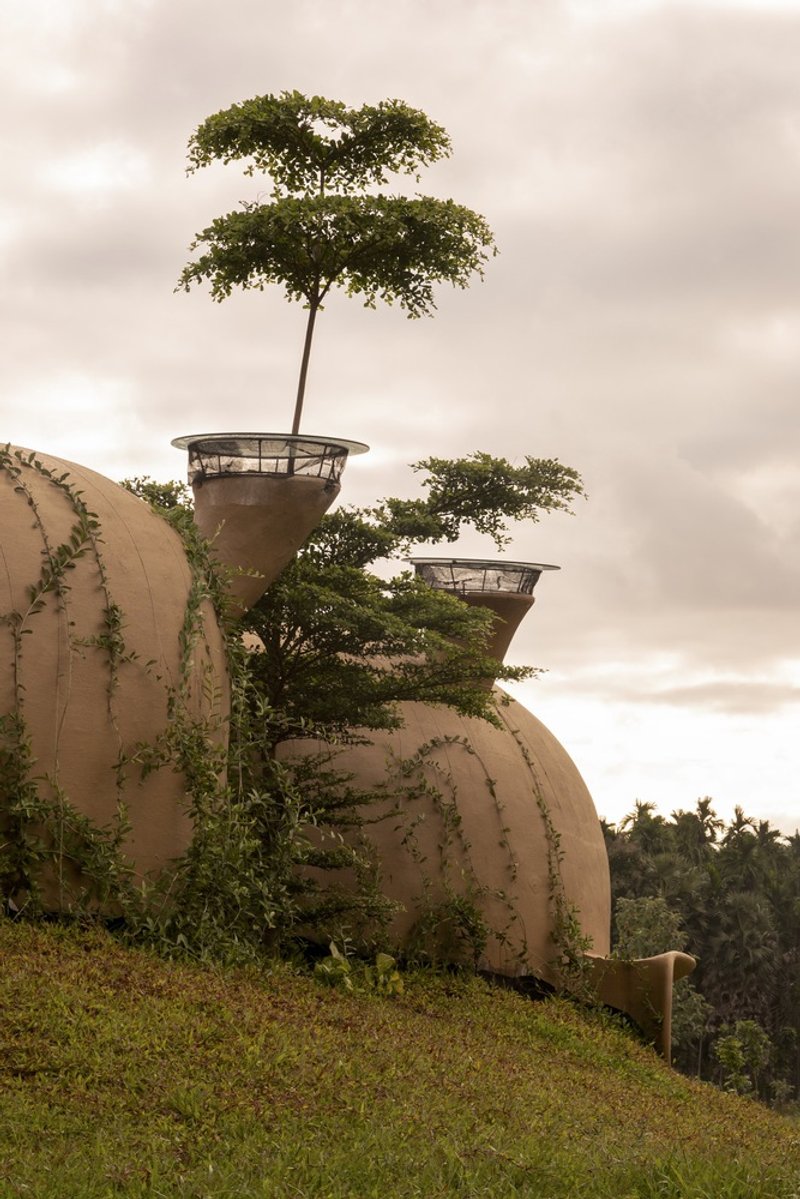
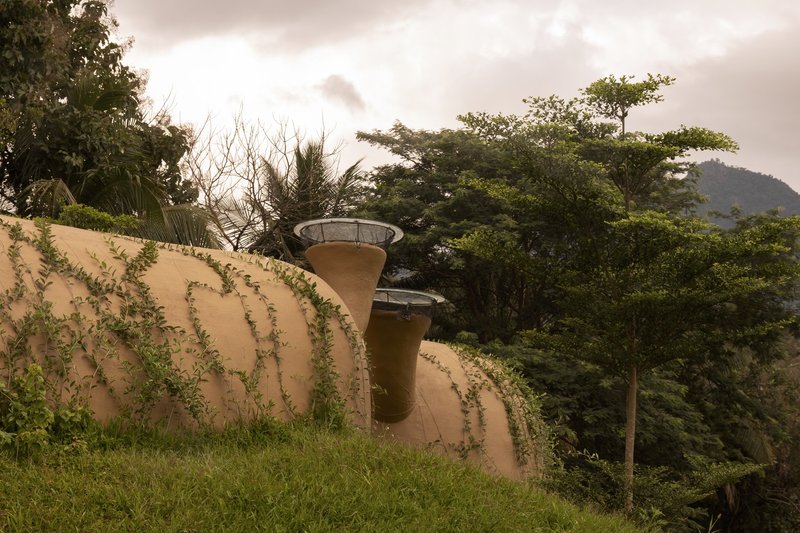
The funnel-shaped ventilation chimneys are the most visually distinctive elements. They rise above the grass roof as sculpted earth forms, catching wind and drawing air upward through the building. The grass roof insulates the vaults below, reduces heat gain, and merges the building into the landscape. Vines climb the exterior walls. After a few seasons, the building will be almost entirely green.
Context: Farm, Buffalo, and the Rural Landscape
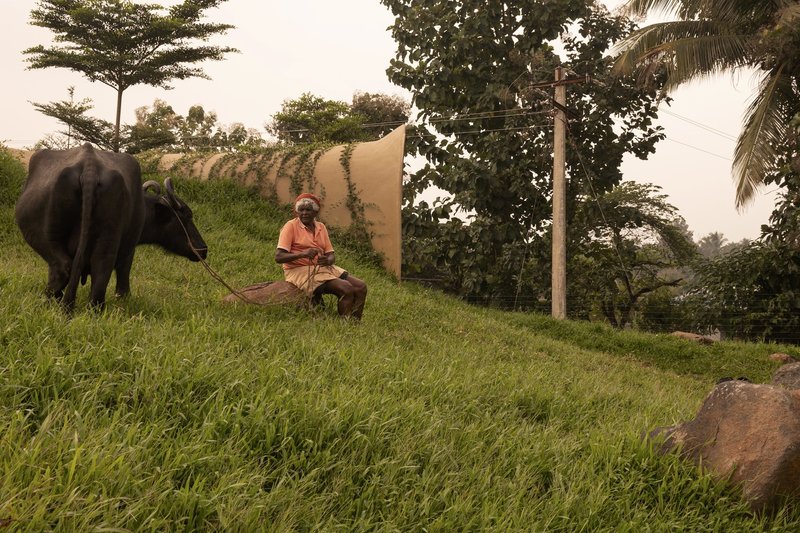
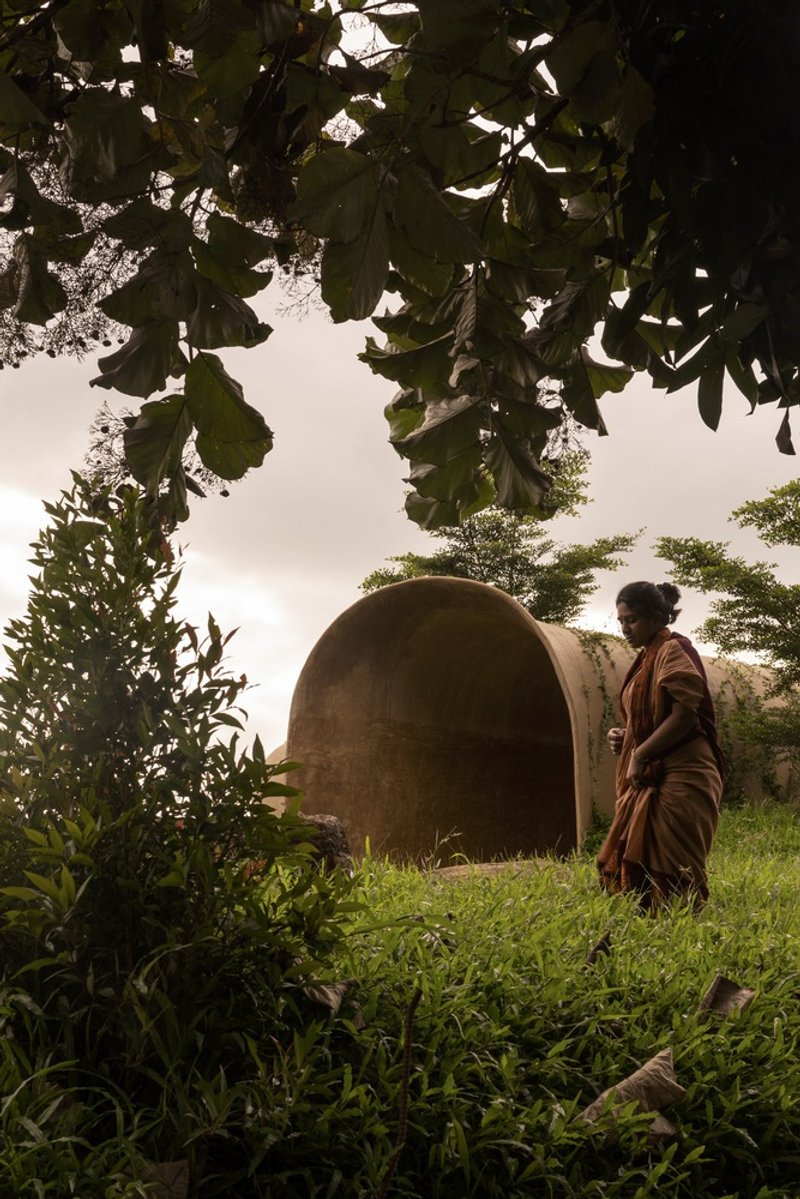
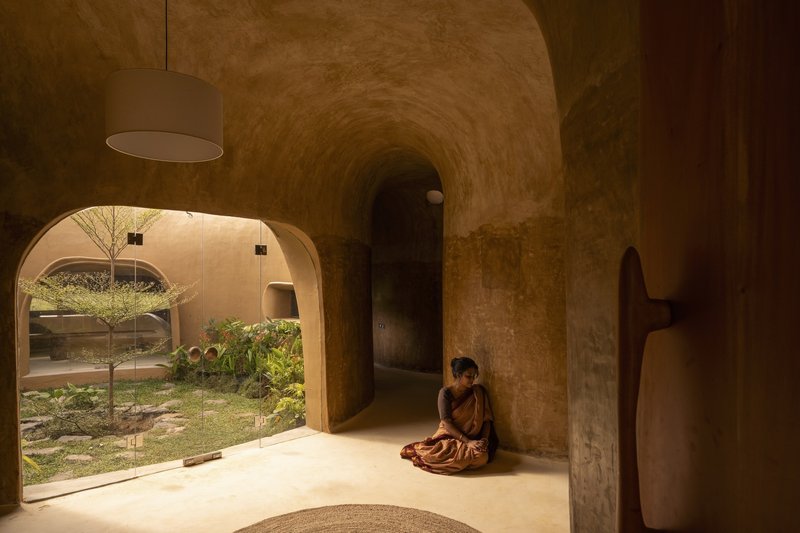
The photographs by Studio IKSHA include the surrounding context: a farmer with his buffalo, a woman in a sari, palm trees, grazing animals on the slope beside the house. These are not staged. This is the actual landscape that the house inhabits. The building is not a retreat from rural India. It is part of it. The earth it is made from came from this ground.
Drawings
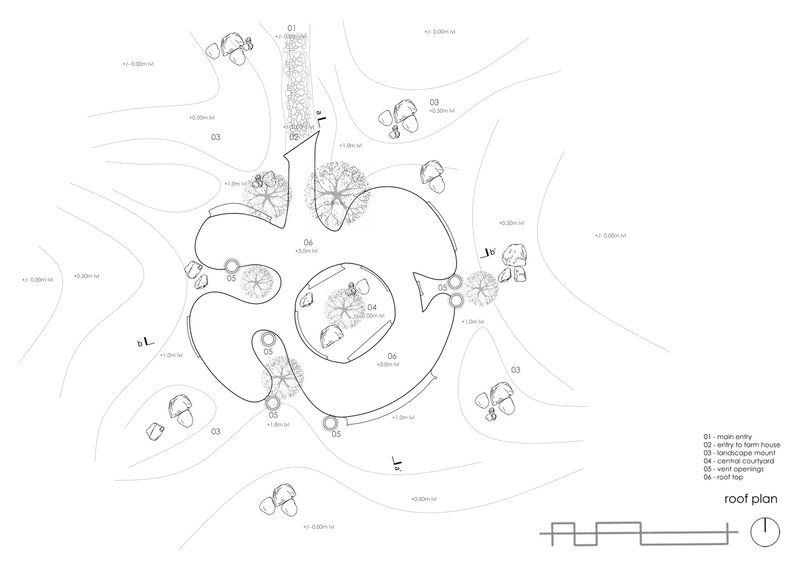
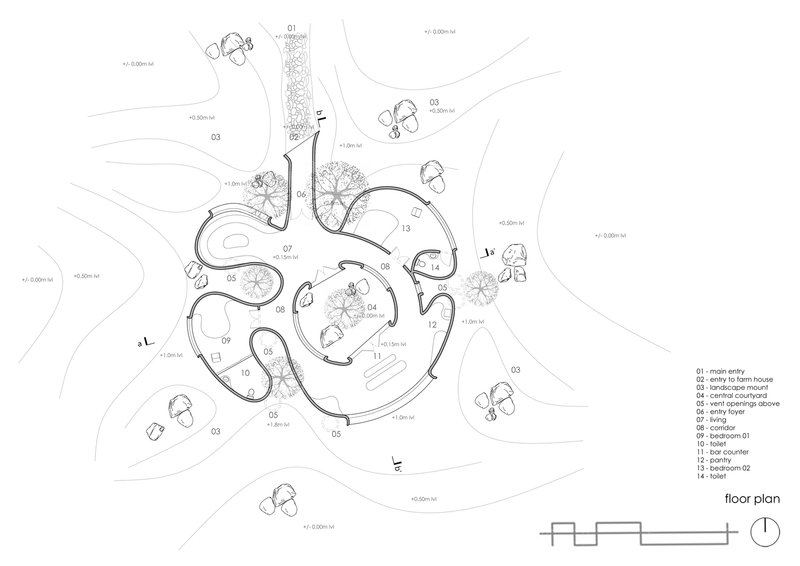
The roof plan and floor plan show the organic logic: rooms radiate from the central courtyard with no straight walls and no right angles. The floor plan labels the rooms: entry foyer, living, corridor, two bedrooms, bar counter, pantry, and toilet, all flowing around the central courtyard garden.
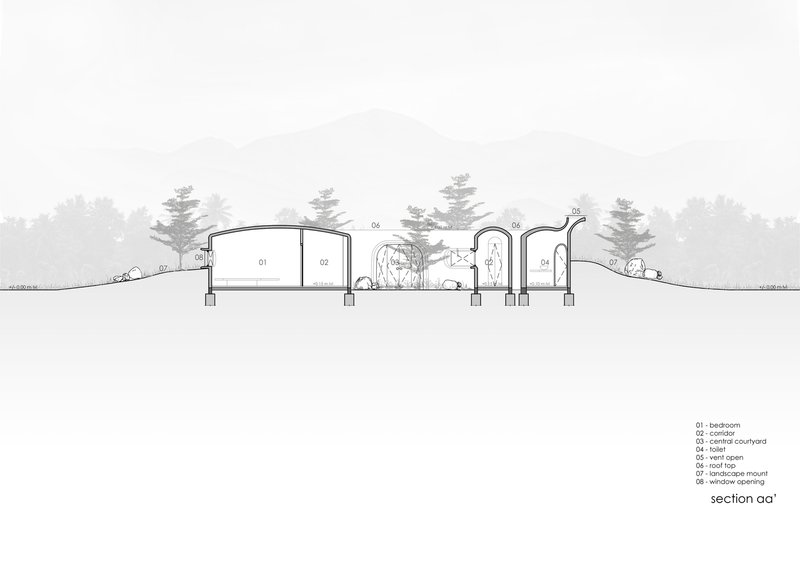
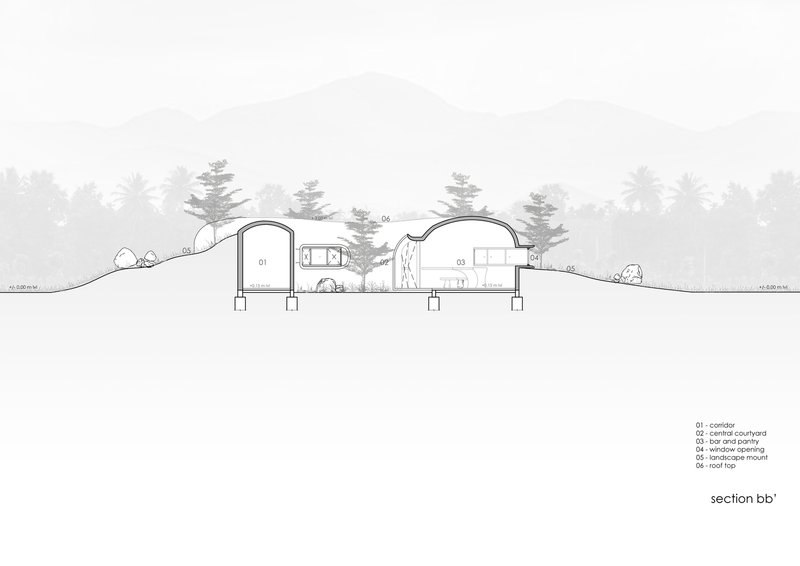
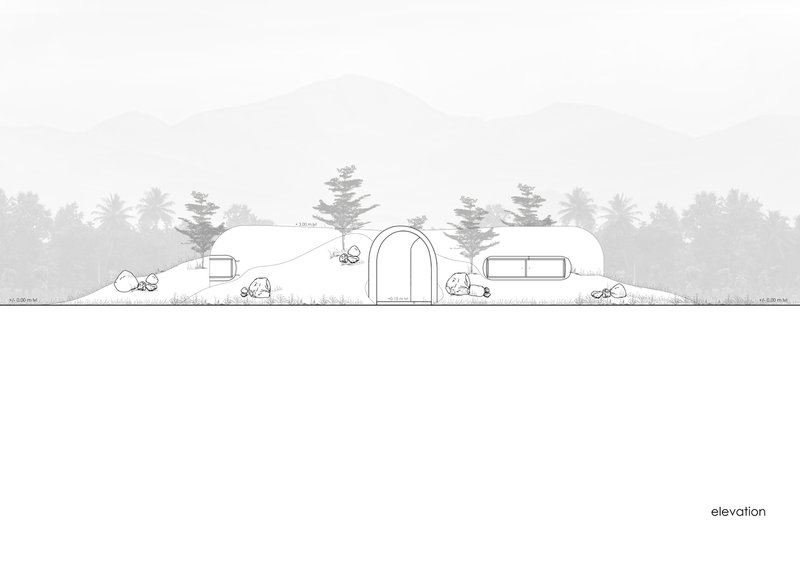
The two sections cut through the vaulted profiles, showing the landscape mounds at the edges, the courtyard tree, and the ventilation chimneys. The elevation reads as a series of gentle hillocks with arched openings, almost indistinguishable from the terrain behind.
Why This Project Matters
Earthen architecture is experiencing a global revival, but most of it is either decorative (earth-coloured render on a concrete frame) or experimental (art installations that cannot be lived in). Into The Wild House is neither. It is a functioning family home that is entirely built from earth, entirely passive, and entirely without conventional structural elements. The fold architecture technique produces a form that is structurally efficient, thermally insulated, and visually unprecedented.
If you are interested in earthen construction, passive design, organic form, or what a house can be when it is made from the ground it stands on, this is one of the most important recent projects in the world.
About the Studio
Share Your Own Work on uni.xyz
If you are working on earthen architecture, sustainable construction, or organic form, uni.xyz is a place to publish your work and connect with a global design community.
Project credits: Into The Wild House by Earthscape Studio. Mettupalayam, Tamil Nadu, India. Photographs: Studio IKSHA.




Popular Articles
Popular articles from the community

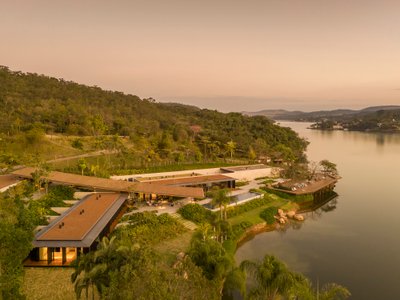
Bernardes Arquitetura Stretches a Timber Roof Along a Reservoir's Edge in Minas Gerais
Dam House in Itaúna lets a sweeping wooden canopy dissolve the boundary between hillside terrain and open water.
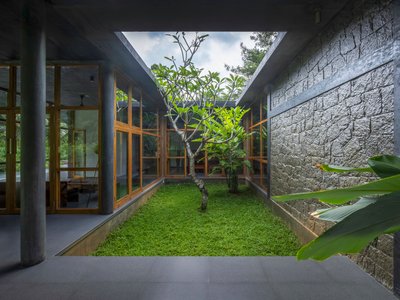
3dor Concepts Wraps a Kerala Home in Mirrored Concrete Arcs Around a Courtyard Tree
In the Western Ghats foothills of Thamarassery, a 270 m² single-story house uses two curved volumes to frame nature as its center.
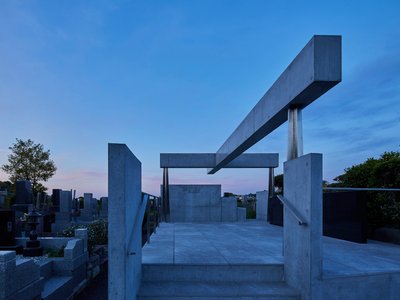
Takeshi Hosaka Architects Suspends a Concrete Cross Above a Yokohama Cemetery
A 28-square-meter burial renovation in Yokohama lifts the symbol of resurrection into the sky so mourners see it against heaven.
Fausto Terán and Toro Fuse Japanese Craft with Mexican Tradition in a Lakeside Retreat
Nakamura House pairs Shou-Sugi-Ban charred pine with handmade clay tile at the foot of Atlangatepec Lagoon in Mexico.


Similar Reads
You might also enjoy these articles

Olio Towers: A Mid-Rise for Performers That Fuses Housing, Rehearsal, and Stage
Located blocks from Houston's Theater District, this modular tower stacks living units around a central performance atrium.
Oasis: Modular Green Housing Carved into Dhaka's Urban Fabric
A shortlisted Plugin Housing entry reclaims unauthorized settlements in Dhaka with stepped concrete volumes, green roofs, and ventilation-driven design.

Black Hole: A Floating Megastructure for the Post-Physical Era
Emiliano Mazzarotto envisions a spherical, self-scaling arena where e-sports, digital hotels, and holographic stadiums replace traditional public space.
Compact & Sustainable Living in Piraeus: A Four-Level Family Home Built Around Light and Air
A narrow townhouse in one of Greece's densest port cities uses a central atrium and passive strategies to house three generations under one roof.


Explore Architecture Competitions
Discover active competitions in this discipline




The International Standard for Design Portfolios


The Global Benchmark for Architecture Dissertation Awards


The Global Benchmark for Graduation Excellence


Challenge to reimagine the Iron Throne
Comments (0)
Please login or sign up to add comments
No comments yet. Be the first to comment!