
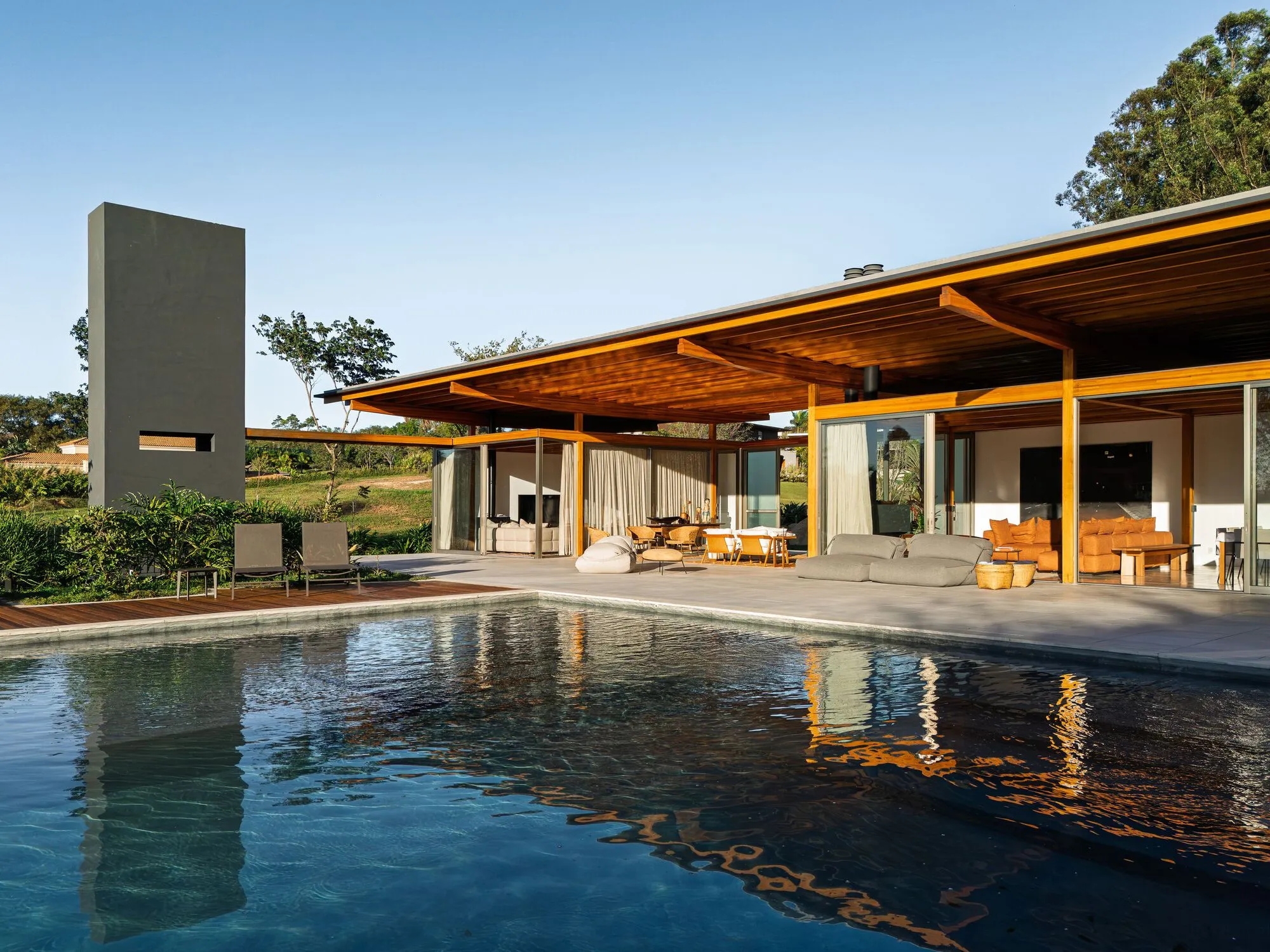
Itupeva House Grows from Rock and Root
UNA MUNIZVIEGAS tucks a 640 m² residence into boulders and eucalyptus on a protected hillside outside São Paulo.


Architecture that claims to "blend into the landscape" is a familiar refrain, and usually a generous overstatement. At Itupeva House, the claim holds up. UNA MUNIZVIEGAS, the São Paulo practice led by Cristiane Muniz and Fernando Viégas, designed a 640 m² residence that reads less as an object placed on a hillside and more as a geological event: timber canopies float over concrete volumes that are partially carved into the slope, and massive existing boulders sit undisturbed at the thresholds between inside and out.
What makes the project genuinely interesting is not the pastoral scenery but the structural logic that produces it. The house is organized as two connected pavilions, one primarily in concrete and the other defined by an expansive timber roof, linked by a courtyard and lap pool. Each pavilion responds to a different condition of the terrain: the lower volume digs into the hillside, while the upper one launches outward with deep overhangs. The result is a house with no single dominant facade, a building that changes character entirely depending on whether you approach from the garden, the pool deck, or the forested slope above.
Living Among Boulders
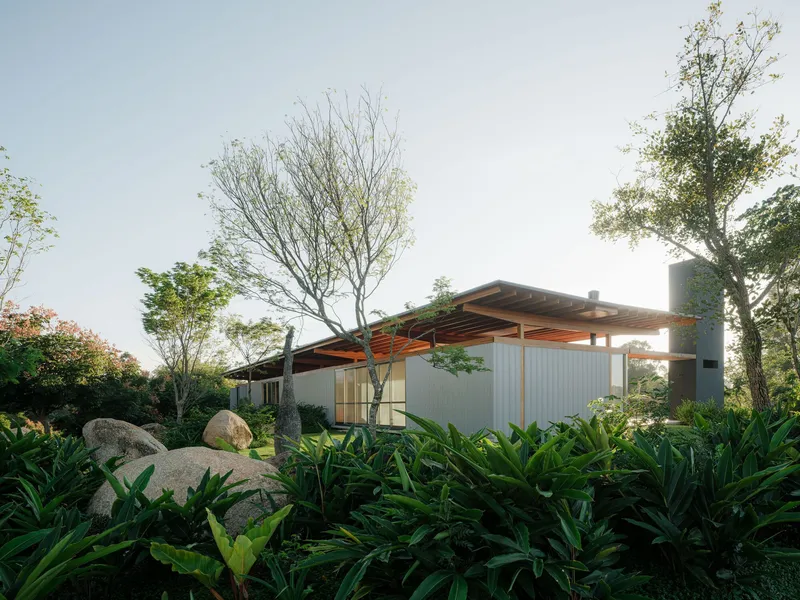
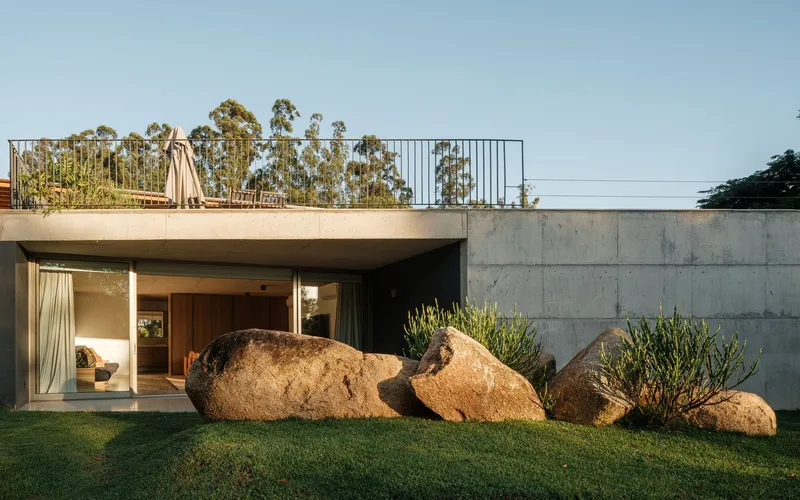
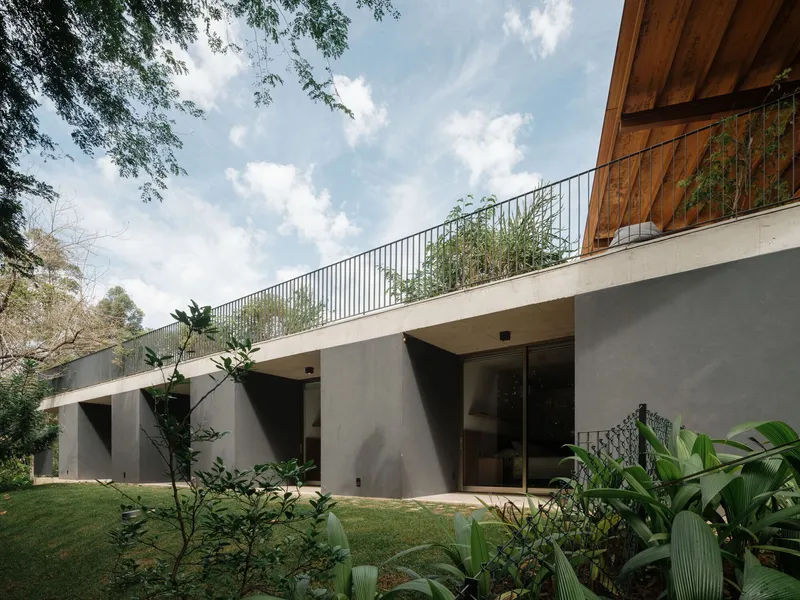
The site's existing boulders are not decorative props. They are structural facts that shaped the plan. Rather than blasting or relocating the rock formations, the architects treated them as fixed points around which walls, entries, and planting beds were negotiated. At the glass-walled entry, large boulders flank the threshold like gateposts that predate the building by millennia. The planted roof terrace above the concrete lower level extends this strategy vertically, layering vegetation over structure so that from certain angles the house appears to be growing directly out of the hillside.
The concrete volume is deliberately understated. Its facade presents a restrained rhythm of openings beneath a green roof, letting the material mass of the building defer to the geology around it. Steel railings and clean edges keep the detailing crisp without competing for attention.
The Timber Canopy
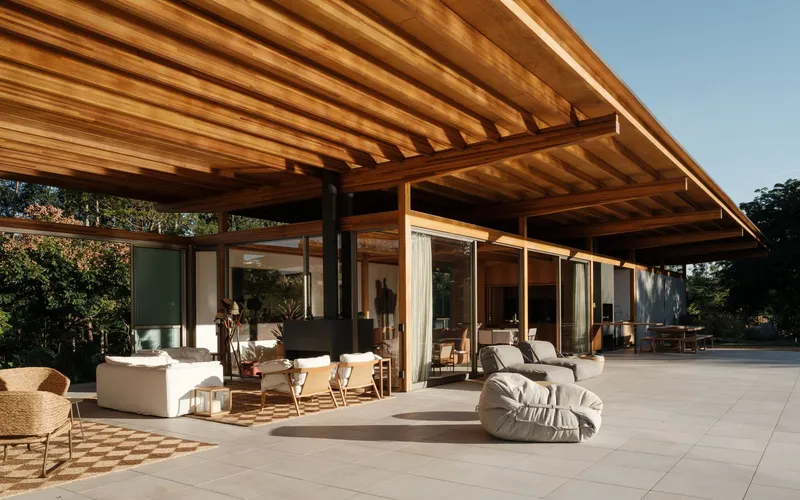
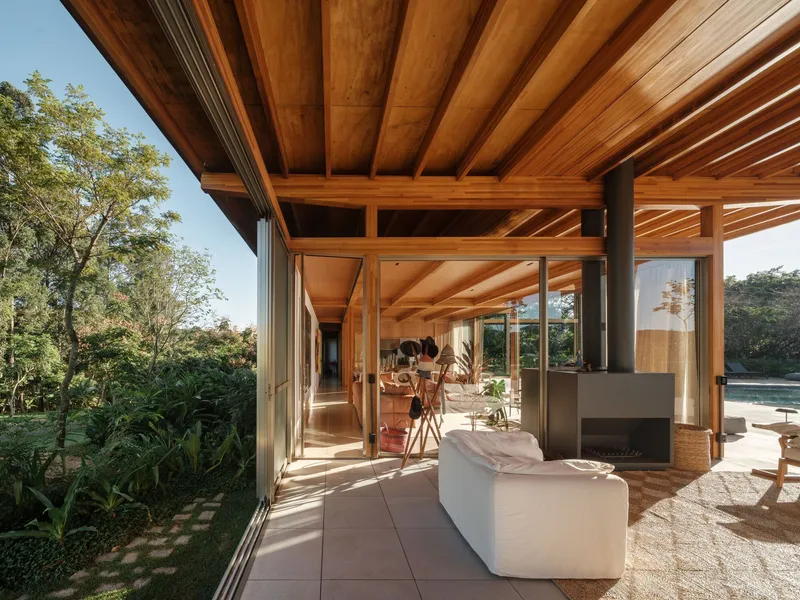
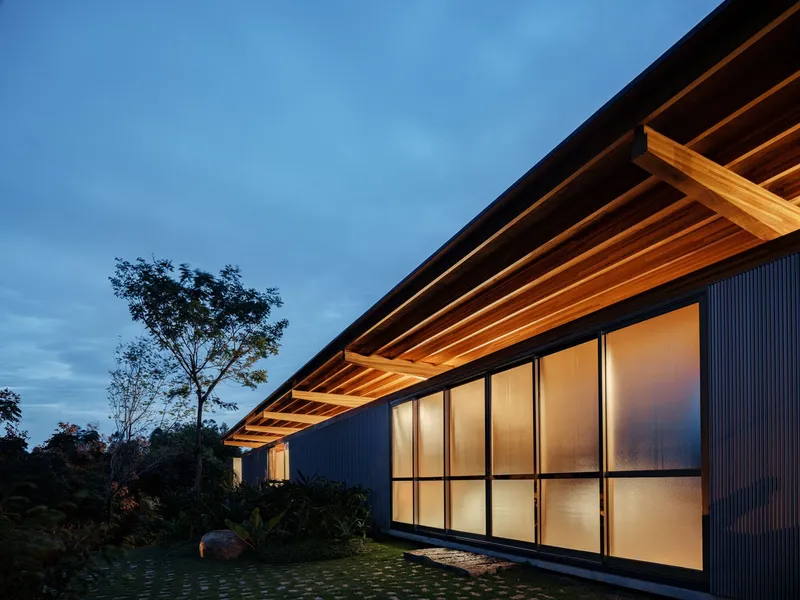
The defining element of the upper pavilion is its timber roof: heavy beams and exposed rafters that cantilever generously past the building envelope. The structure does several things at once. It shades floor-to-ceiling glazing from the subtropical sun, creates deep covered terraces that function as outdoor rooms, and gives the house a horizontal profile that echoes the flat canopy of the surrounding eucalyptus trees. The corrugated metal and translucent panel walls at the service zones are honest, low-cost backdrops that let the timber frame command the composition.
At the heart of this pavilion, a concrete fireplace core anchors the interior-exterior threshold. It is one of the few vertical gestures in a house that otherwise insists on the horizontal, and it works as both a spatial pivot and a material counterpoint to the warm timber overhead.
Pool, Courtyard, and the Space Between
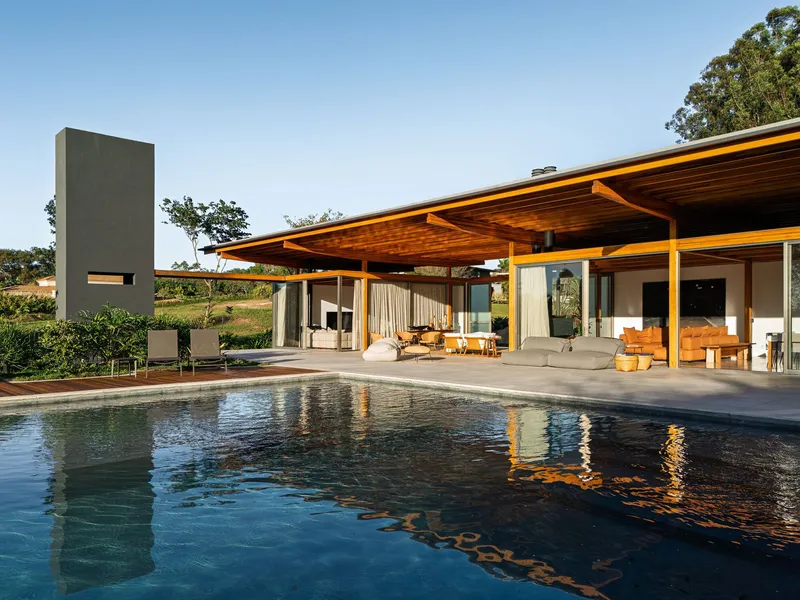
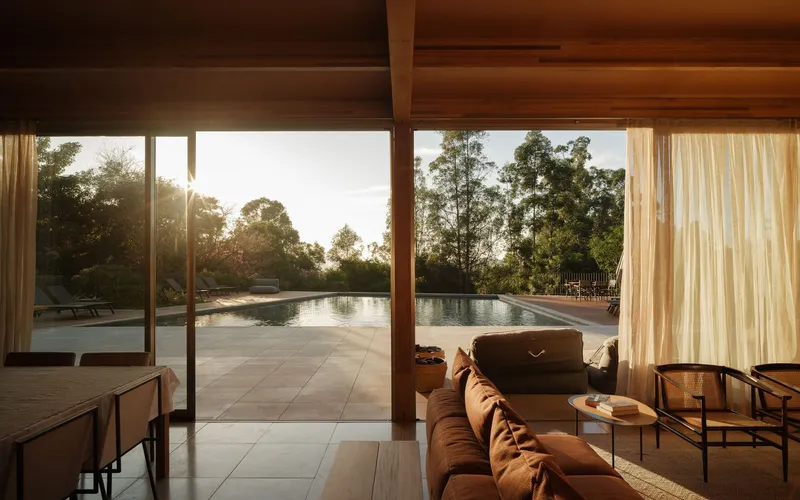
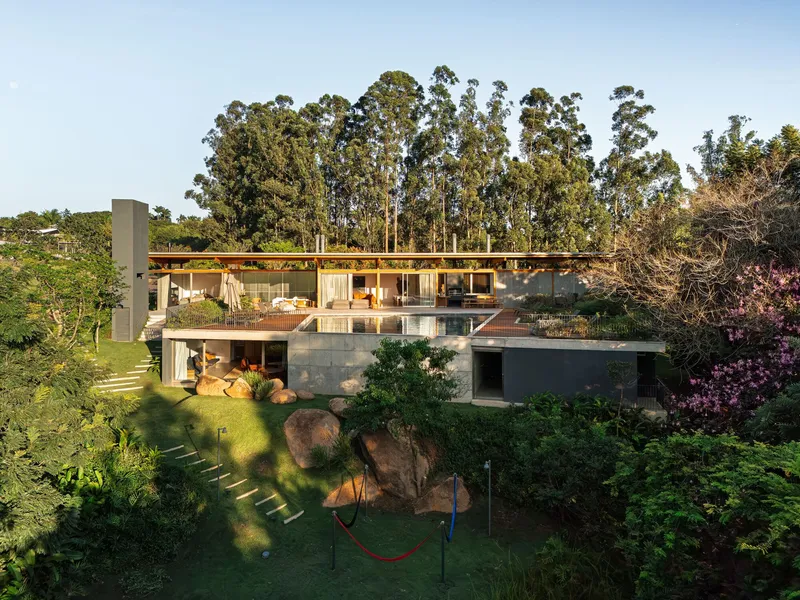
The lap pool is more than recreation. It is the seam between the two pavilions, a reflecting surface that multiplies light and extends the visual field from the living room out toward the trees. At sunset, the view from the living room through the timber ceiling overhang, past the water, and into the eucalyptus grove is the kind of composed perspective that justifies the entire spatial arrangement.
The courtyard organization means every principal room has a dual orientation: toward the protected interior garden and outward to the broader landscape. Tall eucalyptus trees edge the pool terrace, filtering light and reinforcing the sense that the house occupies a clearing rather than a cleared lot. The two-story facade with its cantilevered timber roof announces the scale of the project without overwhelming the trees that frame it.
Interior Atmosphere
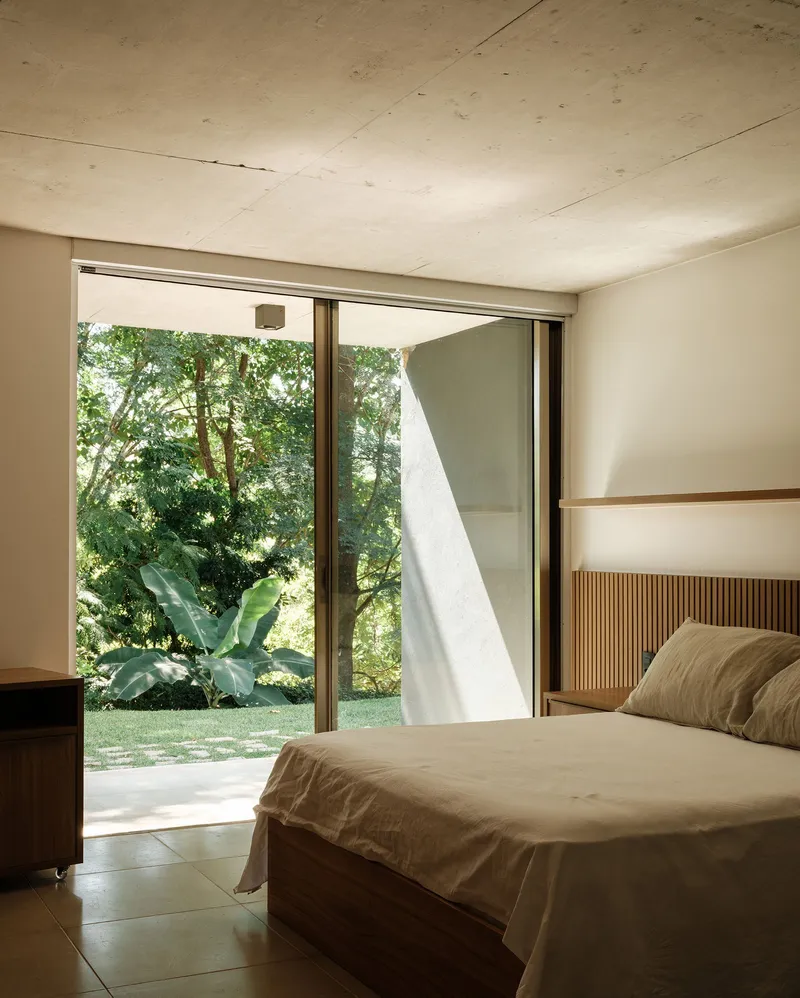
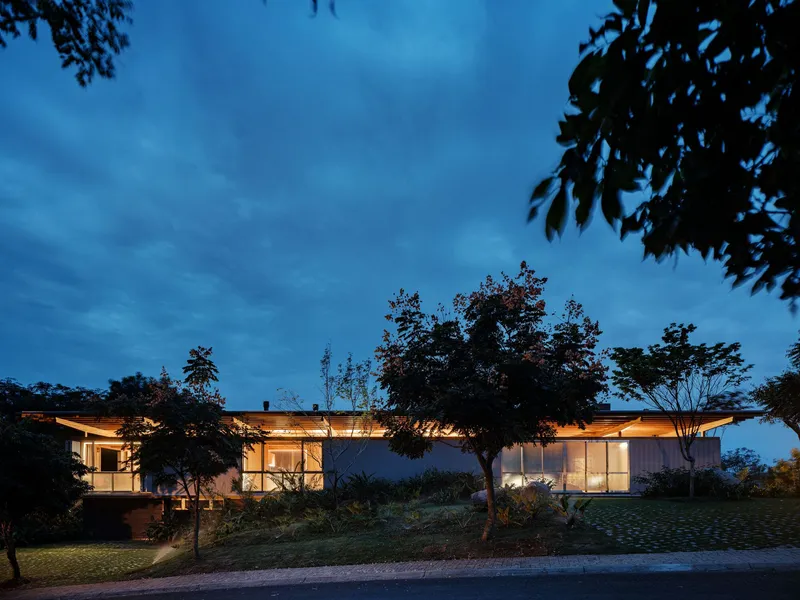
Inside, the material palette stays deliberately narrow: exposed concrete ceilings, timber structure, and glass. The bedrooms on the lower level open through full-height sliding doors onto intimate garden pockets planted with tropical species. Privacy comes not from walls but from topography and planting, a strategy that keeps even the most enclosed rooms connected to the ground.
The twilight view through the mature trees reveals how the house reads at a distance: a low-slung, illuminated volume whose broad roof overhang creates a lantern effect. The interiors glow without shouting. Light is warm, contained by the deep eaves, and the boundary between living room and landscape dissolves into a gradient of shade.
Plans and Drawings
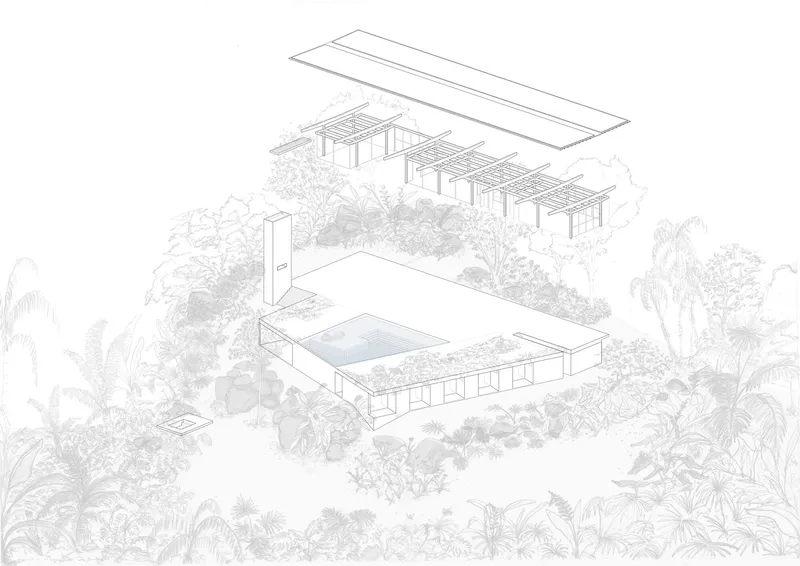
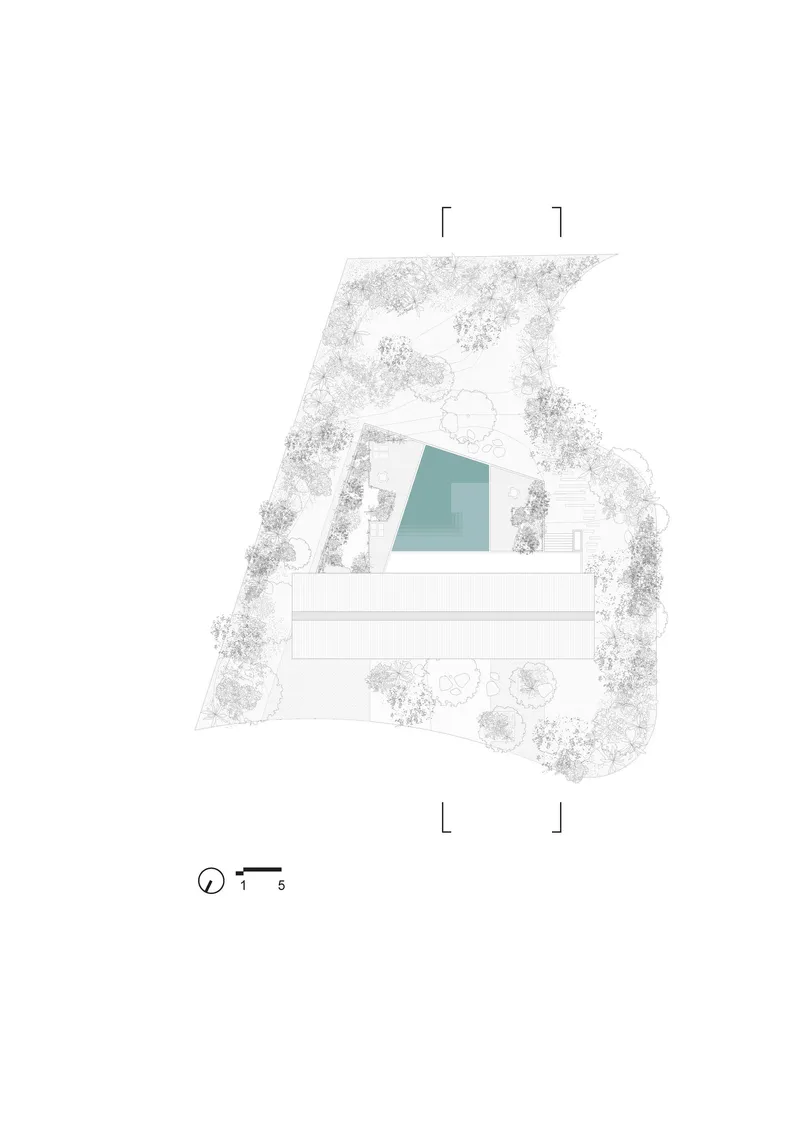
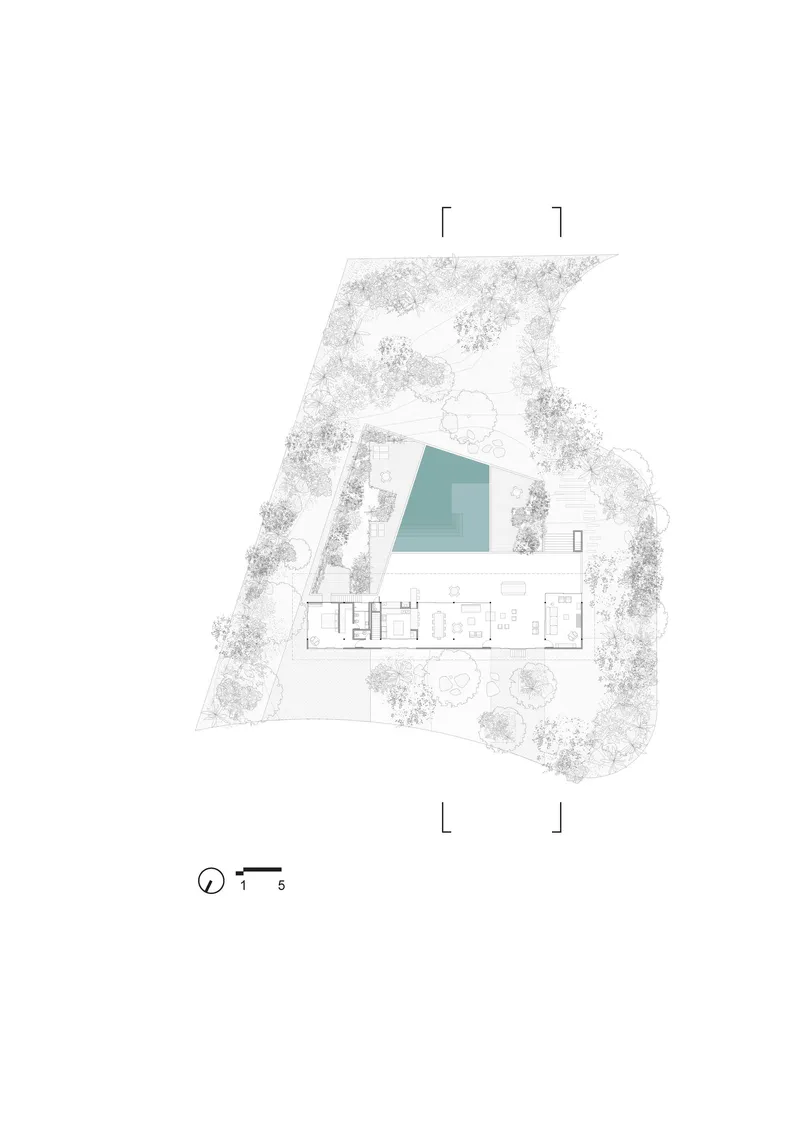
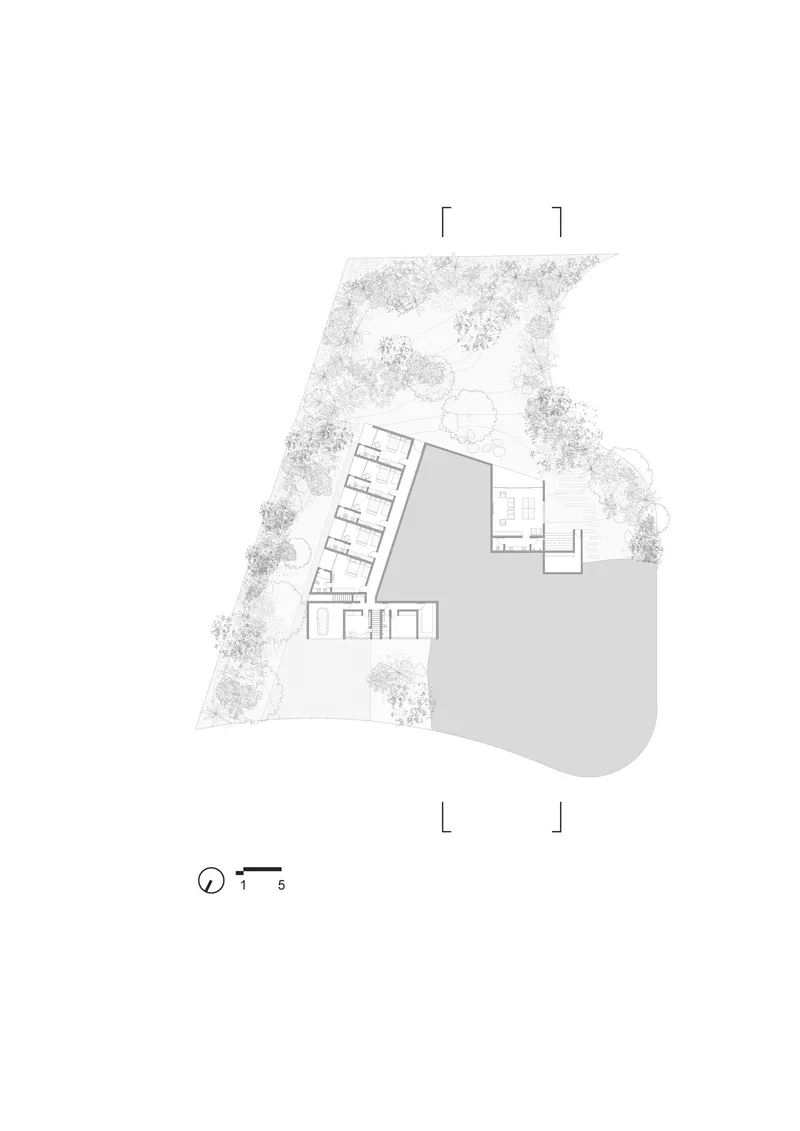
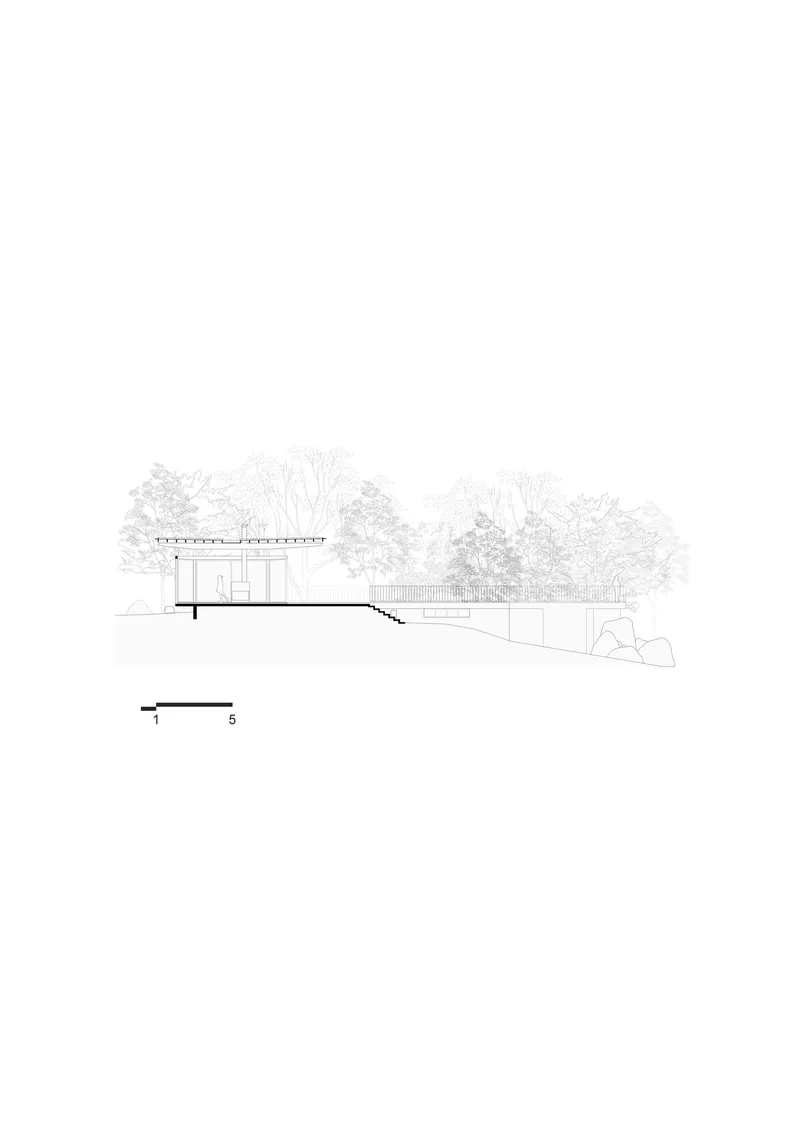
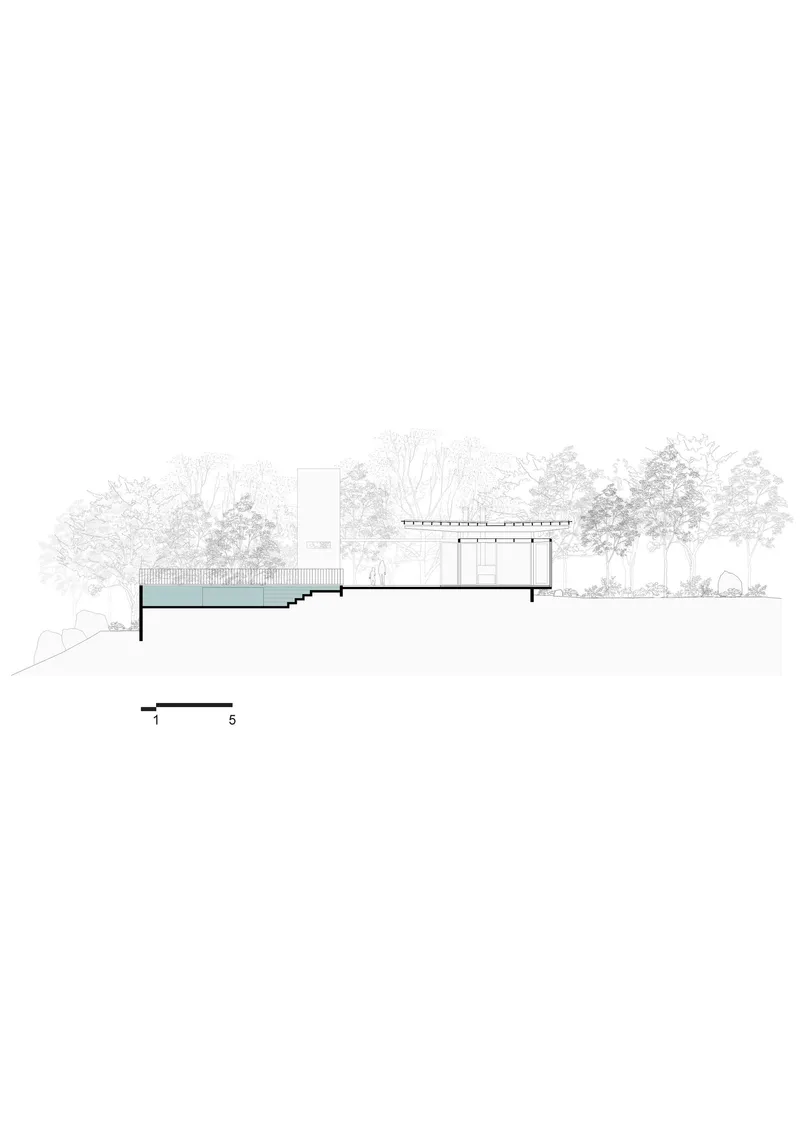
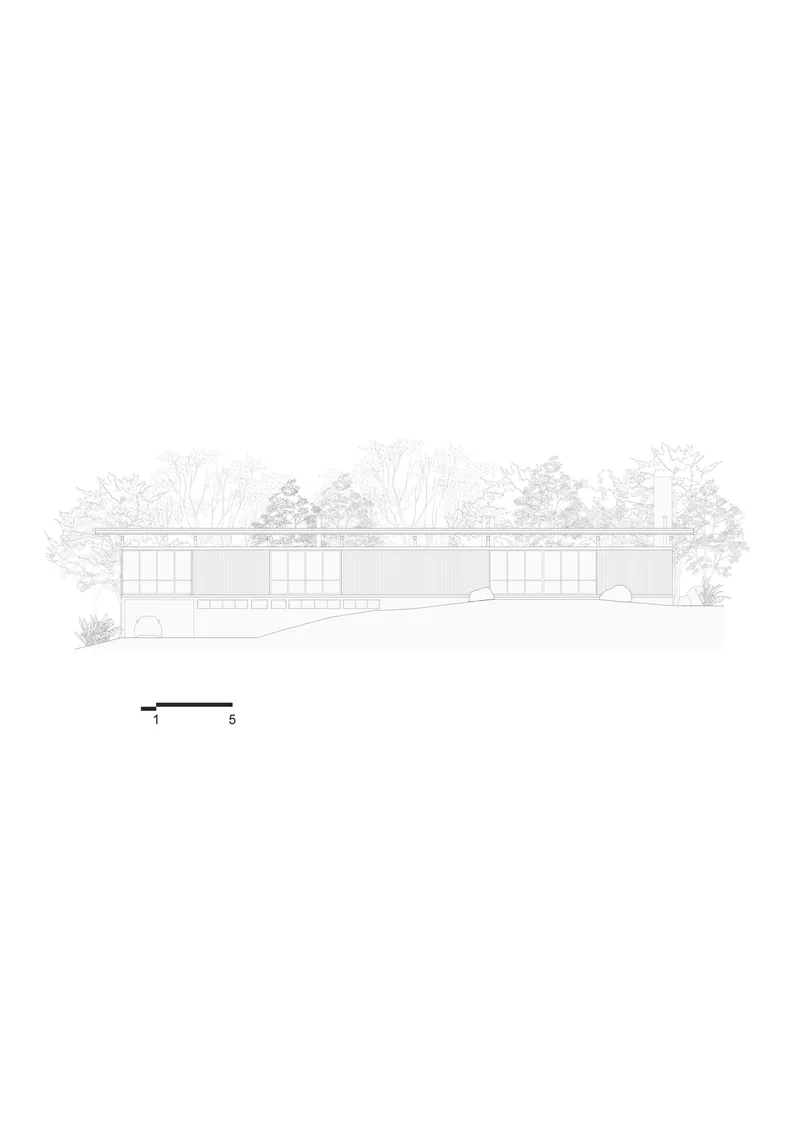
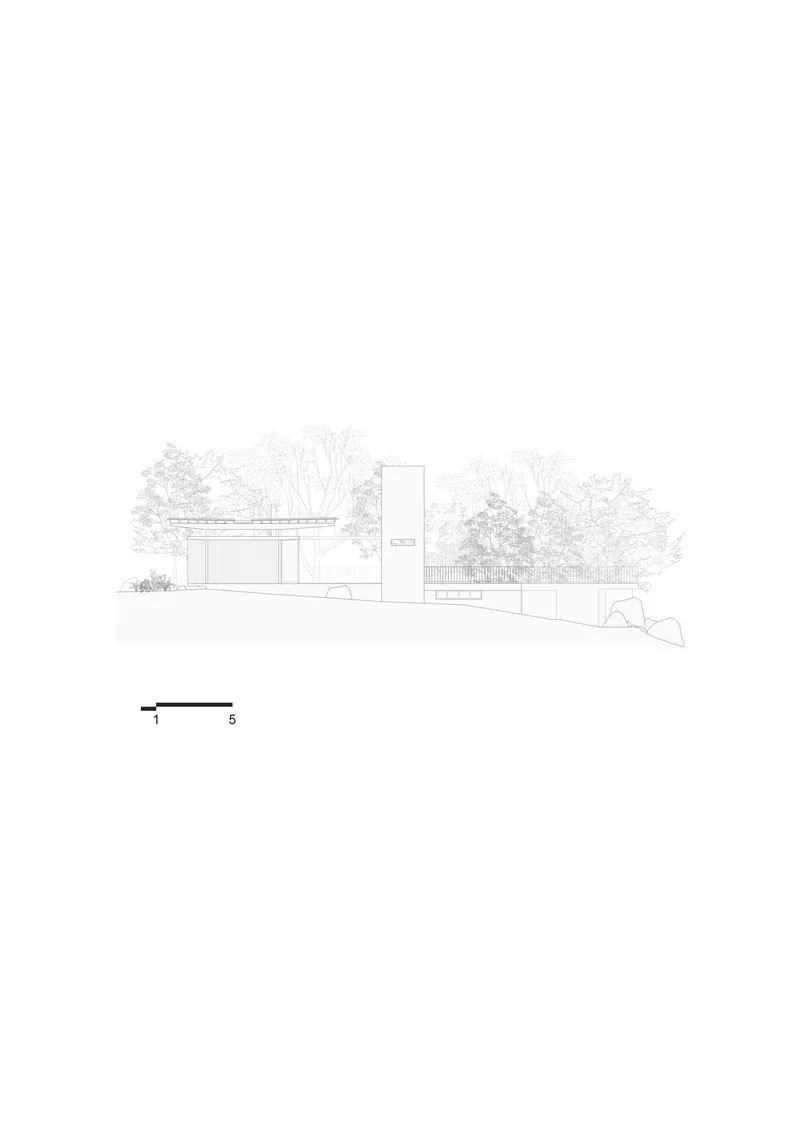
The axonometric drawing makes the organizational logic unmistakable: two pavilions, one angular and one rectangular, bracket a central courtyard pool. The site plan reveals how the triangular pool geometry plays against the orthogonal building footprint, generating tension in what could otherwise be a static composition. Ground and upper floor plans show a linear sequence of living spaces on the main level giving way to an angled bedroom wing above, each floor responding to different views and orientations.
The sections are where the project's relationship to topography becomes fully legible. The lower level is carved into the hillside, its concrete walls acting as retaining structure, while the main pavilion sits above grade with its timber roof floating free. The elevation drawings confirm the horizontality of the composition and reveal a vertical tower element that punctuates the long facade, perhaps housing circulation or services, providing the one moment of compression in an otherwise expansive scheme.
Why This Project Matters
Itupeva House belongs to a lineage of Brazilian residential architecture that takes the ground seriously. From Lina Bo Bardi's Glass House to Paulo Mendes da Rocha's hillside residences, the best work in this tradition treats terrain not as a surface to be leveled but as a collaborator in the design. UNA MUNIZVIEGAS continues that conversation with a contemporary material sensibility, using timber, concrete, and steel in a way that feels specific to this site rather than imported from a catalogue of tropical modernism.
The project also demonstrates that restraint and generosity are not opposites. At 640 m², this is a large house, but its low profile, embedded lower level, and planted roof mean it occupies far less visual territory than its area would suggest. The architects gave the boulders, the trees, and the slope top billing. The house, for all its craft and ambition, plays a supporting role. That is harder to pull off than it sounds, and it is exactly what makes the project worth studying.
Itupeva House by UNA MUNIZVIEGAS (Cristiane Muniz, Fernando Viégas), Itupeva, Brazil. 640 m², completed 2024. Photography by Rodrigo Fonseca and Pedro Kok.
About the Studio
Share Your Own Work on uni.xyz
If projects like this are the kind of work you want to make, uni.xyz is a place to publish your own, find collaborators, and enter design competitions.




Popular Articles
Popular articles from the community


Riyadh For All: Intergenerational Urban Design for Active Aging in Rabat
Riyadh For All reimagines urban design in Rabat with intergenerational co-living, adaptive courtyards, and Moroccan cultural exchange today.

Lunar Spiral: Space Architecture Shaped by the Mathematics of the Universe
Lunar Spiral reimagines space architecture through Fibonacci geometry, lunar regolith, levitating habitats, and self-sustaining Moon living.

The Musturak Paradise: Senior Living Architecture for a Connected Future in Temara, Morocco
The Musturak Paradise reimagines senior living architecture in Temara via private homes, social spaces, culture, community, and shared care.

The Ocean Hive: Sustainable Architecture for a Self-Sufficient Civilization at Sea
The Ocean Hive imagines sustainable architecture at sea, where modular habitats, algae, wave power and ocean waste sustain a growing colony.

Similar Reads
You might also enjoy these articles

Bao Huynh Watercolor Atelier: A Serene Art Retreat in Hội An
Bao Huynh Watercolor Atelier in Hội An blends multifunctional art spaces, sustainable design, local materials, and family-friendly living in a serene environment.

Atelier Macri Concept Store Interior Design by CASE-REAL
Atelier Macri store features a "ko" counter, walnut wood details, cork displays, blending retail, gallery, and seamless customer experiences.

Manuel Vargas Izquierdo Stadium and High-Performance Sports Center: Architectural Excellence in Jalpa de Méndez
The Manuel Vargas Izquierdo Stadium blends sustainable design, inclusive sports facilities, and cultural-inspired architecture, revitalizing Jalpa de Méndez’s public spaces.

KAKR Buluh Awar Hall: Revitalizing Community and Ecology Through Bamboo Architecture
Community built bamboo hall revitalizes Buluh Awar village, empowering youth, restoring ecology, celebrating vernacular craftsmanship through sustainable architecture and culture.

Explore Residential Building Competitions
Discover active competitions in this discipline



Challenge to design a portable theatre


Challenge to design a portable music platform


Challenge to design an open learning module for the elderly


Challenge to design mud housing for contemporary communities
Comments (0)
Please login or sign up to add comments
No comments yet. Be the first to comment!