
James Allen Architect Turns a Crumbling Adelaide Villa into a Sandstone Courtyard House
A Federation villa in Adelaide's Rose Park Historic Area gets a new pavilion, internal courtyard, and a second life in local stone.


There is a particular kind of project that tests an architect's restraint more than their invention: the rescue of a heritage house that has been left to rot. House in the City, designed by James Allen Architect for a couple retiring from the country to inner-city Adelaide, is exactly that. The Federation villa they purchased in the Rose Park Historic Area was, by all accounts, a wreck. A leaky roof, rising damp, subsiding footings, cracked walls, resident possums, and a garden that had swallowed the fence. The new work does not erase any of that history. It steadies it, then extends the conversation with a masonry pavilion and a new internal courtyard that reorients the house around light and air.
What makes the project genuinely interesting is the degree to which it reads as a single material argument rather than the typical old-front-new-back split. Adelaide Hills sandstone appears on the original facade, on the new fireplace wall, on the kitchen island, and on courtyard walls, binding the two eras of construction into one continuous surface language. The pavilion's Dutch-gable roof, a deliberate nod to the Adelaide villa archetype, is large enough to conceal its guttering and angled to the north to carry photovoltaic panels, so even the most nostalgic gesture is doing real climatic work. The project won the 2024 SA Architecture Award for Residential Architecture (Alterations and Additions), and it is easy to see why: it takes the hardest brief in residential practice and makes it look inevitable.
Restoring the Street Face
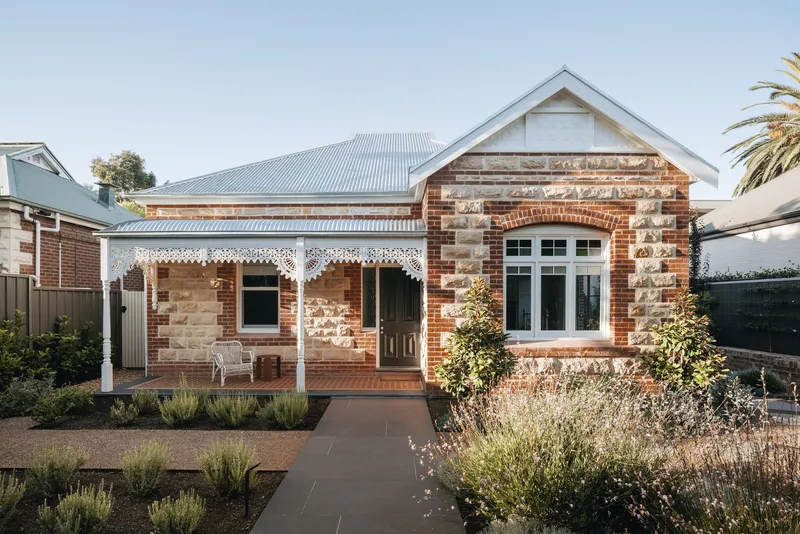
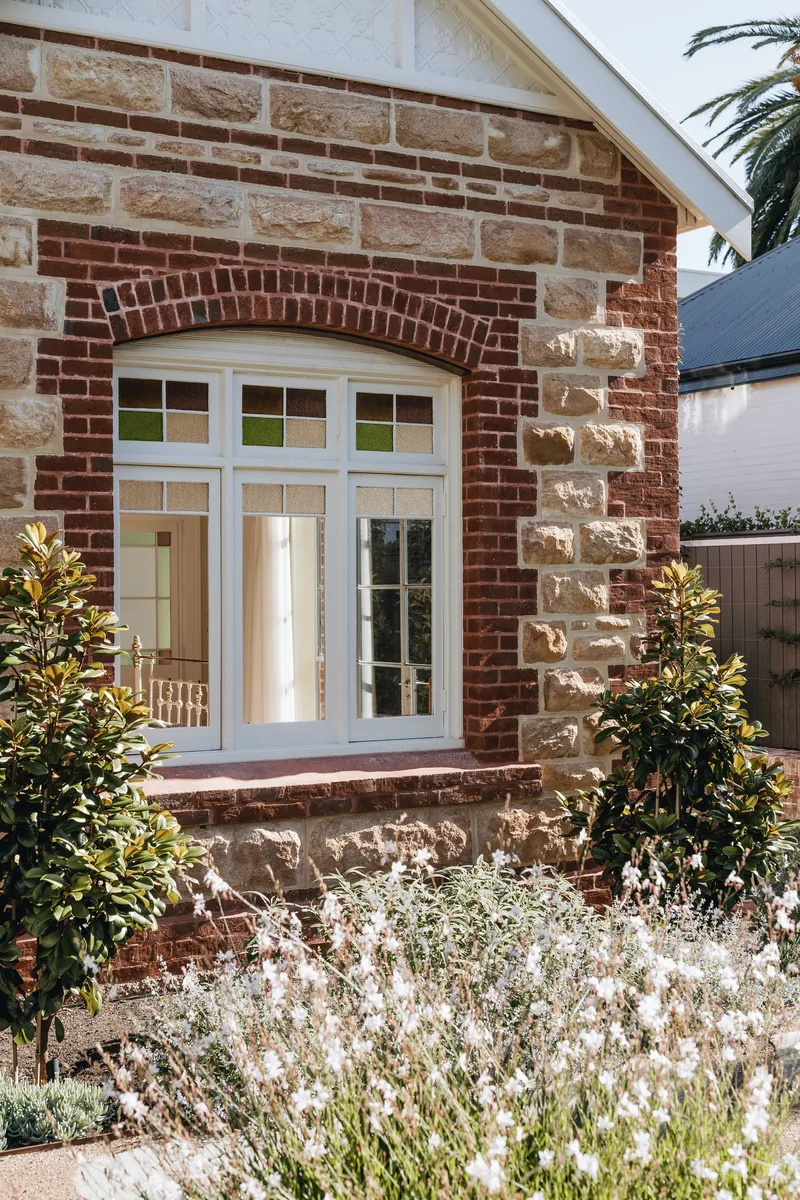
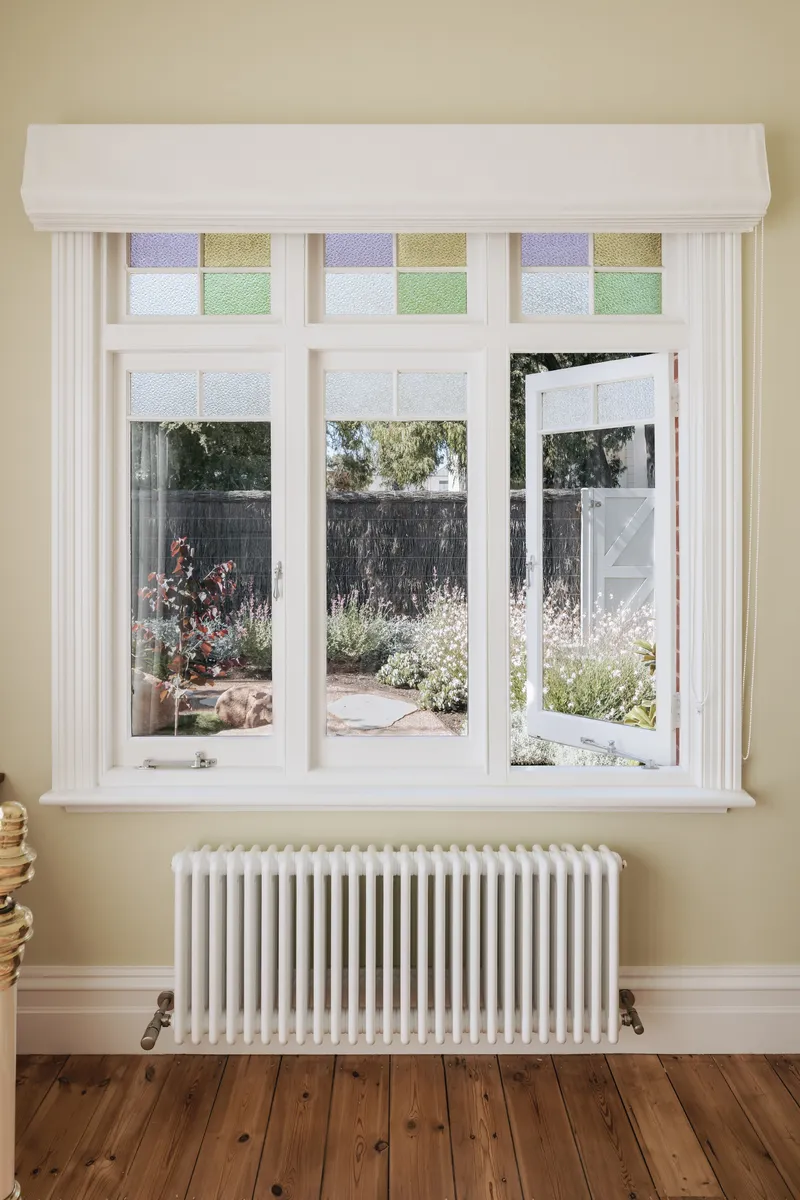
The street facade tells the story of careful archaeology rather than wholesale replacement. Mixed red brick and sandstone walls have been repointed, brick coining restored, and the original wrought iron lacework on the verandah rebuilt. The colored glass transom panels above timber-framed windows survive intact, a reminder that heritage value often lives in the smallest details. From the pavement, the house looks as though it has simply been well loved for a hundred years, which is precisely the point.
A contemporary cottage garden, designed by landscape architect David Burnett, fills the setback between fence and facade. Flowering plants, lavender, and grasses soften the masonry without disguising it. The decision to avoid a pristine period garden in favor of something looser and more modern signals that the house is occupied by people living now, not curating a museum.
The Courtyard as Hinge
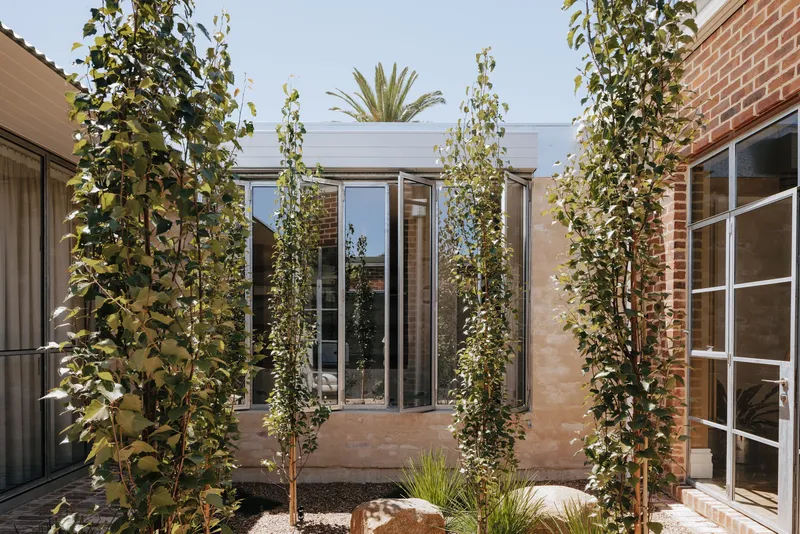
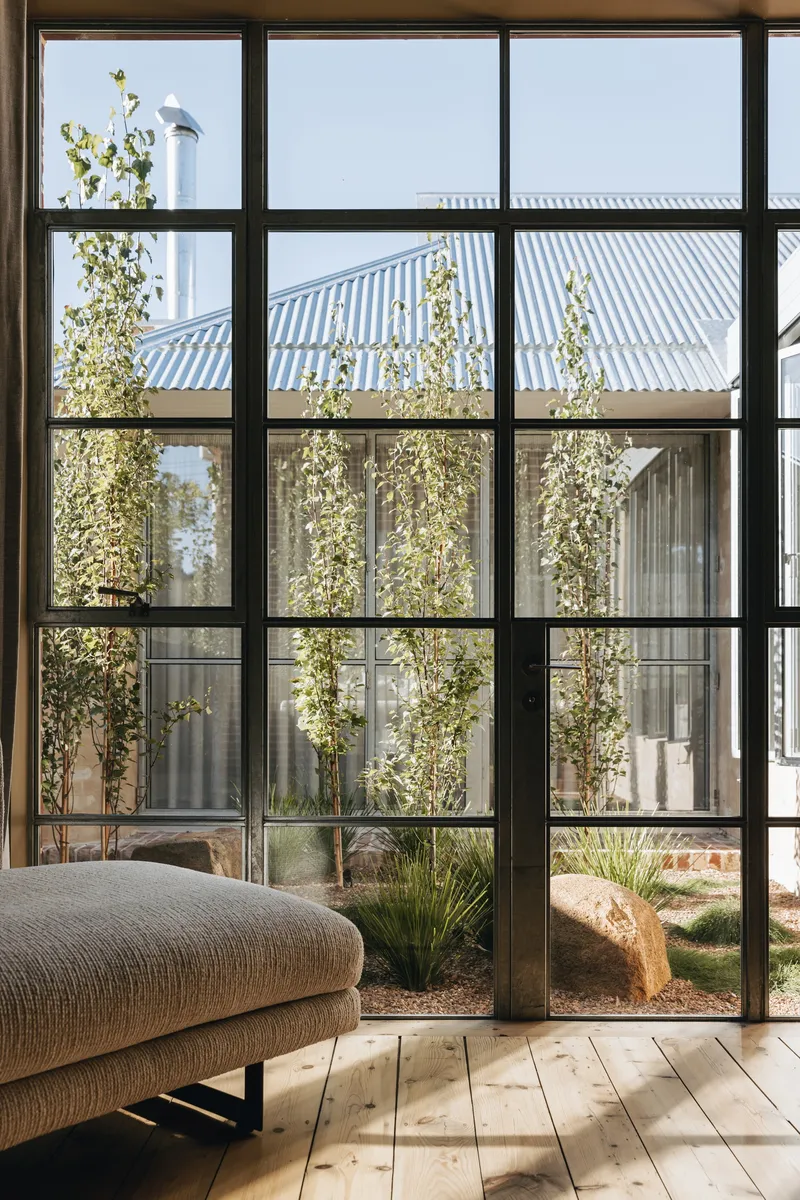
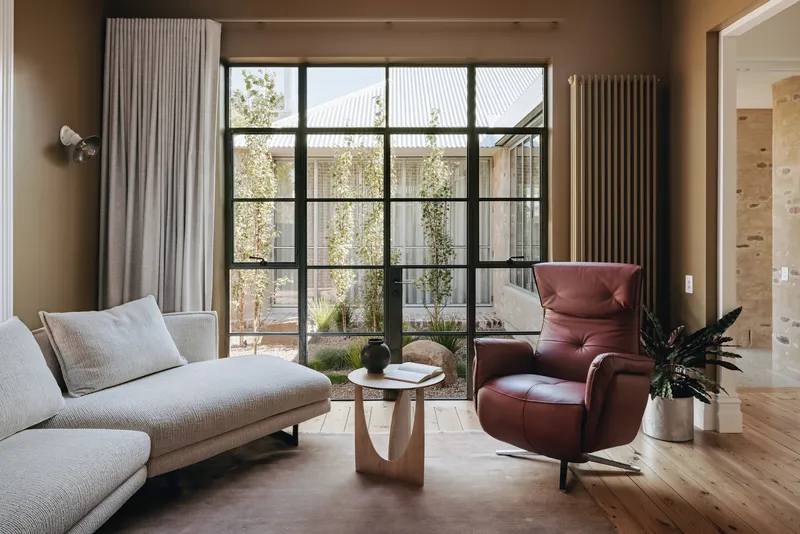
The new internal courtyard is the organizational heart of the project. It sits between the original house and the rear pavilion, defining old and new while connecting them with glazed steel-framed doors on both sides. Young birch trees planted in gravel and granite boulders give the space a spare, almost mineral quality that complements the sandstone walls framing it. Climbing vines are beginning to soften the corrugated metal roof edges visible from inside, and in a few years the courtyard will feel less like a gap and more like a garden room.
Critically, the courtyard pulls northern sun into the previously dim sitting room of the original house, transforming what was a dark middle zone into the brightest part of the plan. It is a textbook passive design move, but it works because the courtyard also solves the ventilation problem and creates a visual pause between the formal front rooms and the open living pavilion behind. Every good courtyard house needs this moment of compression before release.
Stone, Timber, and the Kitchen Island
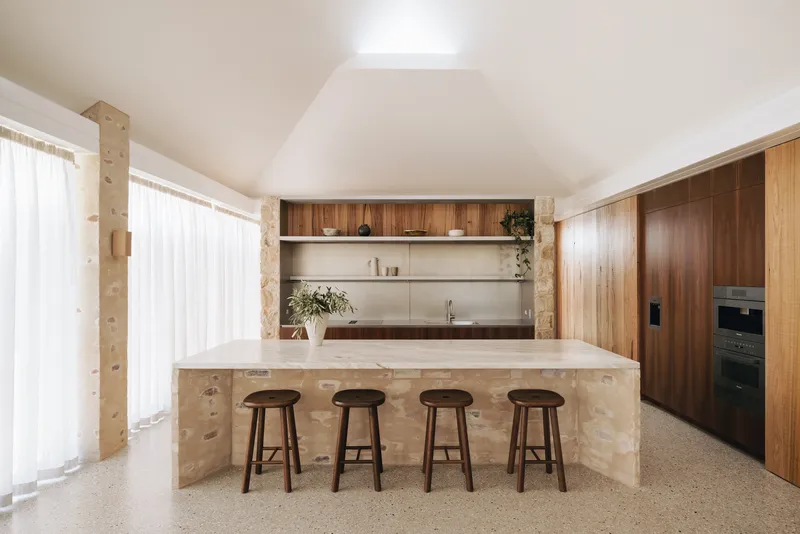
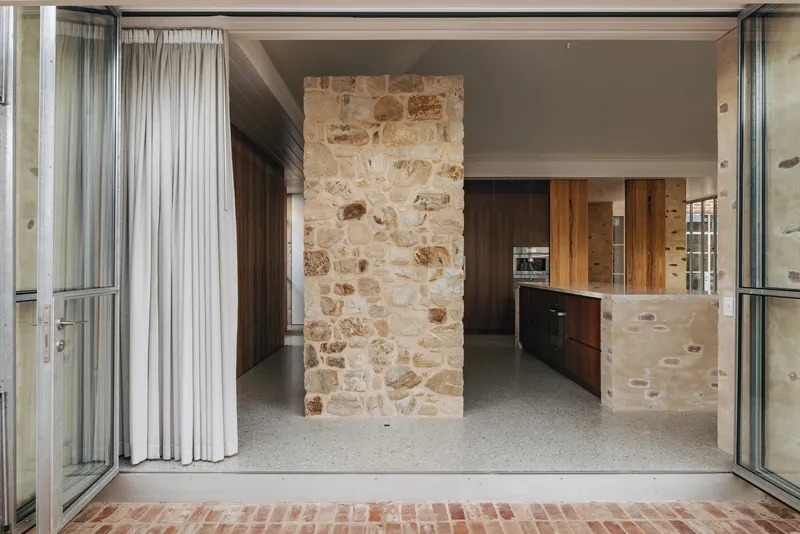
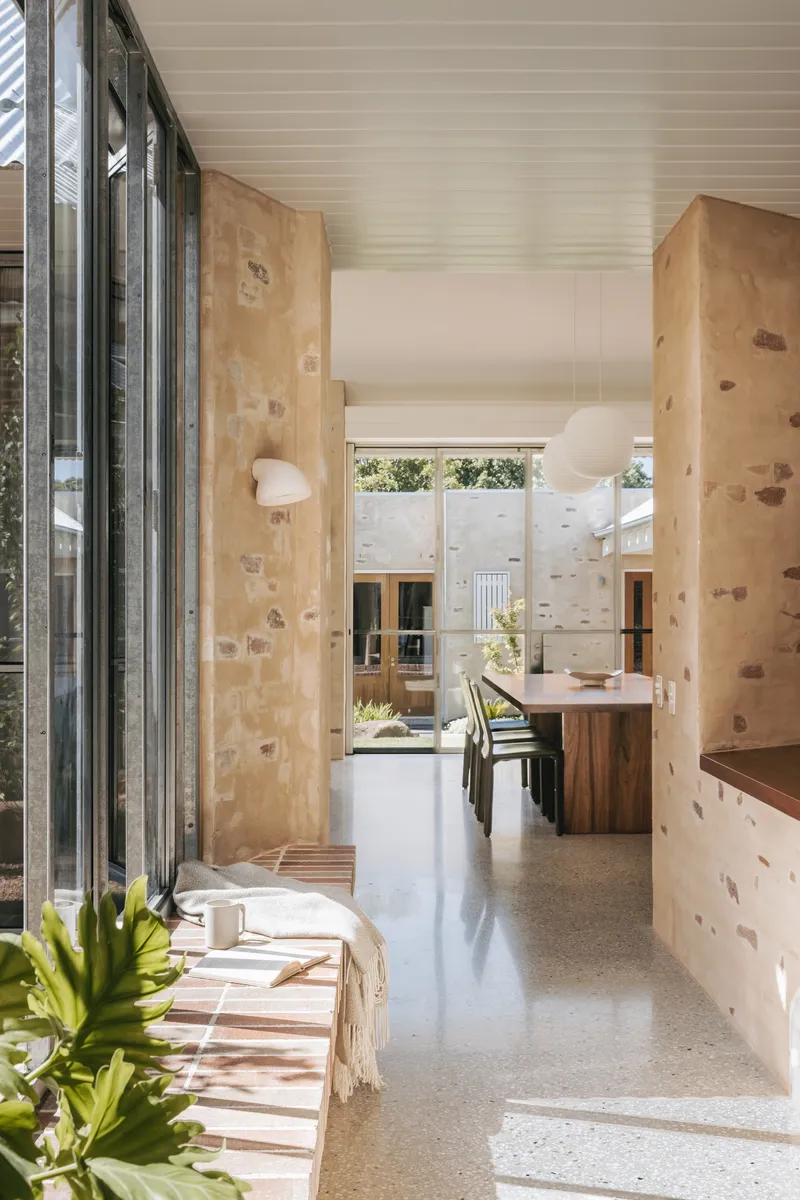
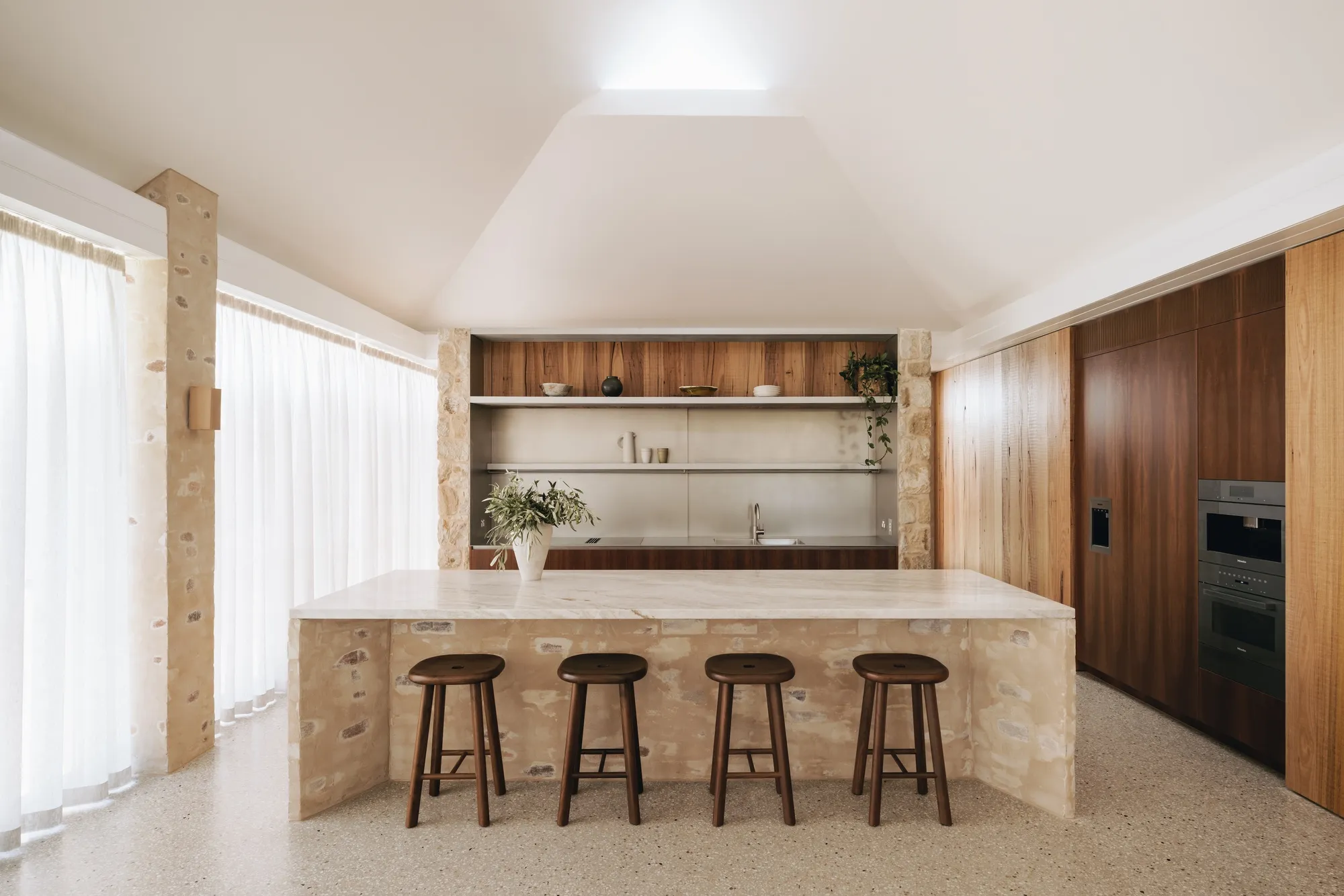
The new pavilion's kitchen is the most expressive room in the house. A freestanding island clad in Adelaide Hills sandstone blocks sits beneath a cathedral raked ceiling painted white, with glazed Dutch gable ends flooding the space with even light. Four timber stools line one side of the island, and rough timber joinery on the cabinetry behind gives the room a tactile warmth that prevents it from tipping into gallery-like abstraction. The natural quartzite benchtop and stainless steel splashback were inspired by the clients' previous farmhouse kitchen, a biographical detail that anchors the material choices in lived experience rather than trend.
Polished concrete floors run through the pavilion, while the original house retains its timber floorboards. The transition between the two happens at the courtyard threshold, so your feet register the shift between old and new before your eyes fully adjust. It is a small thing, but it matters.
Living with Fire and Stone
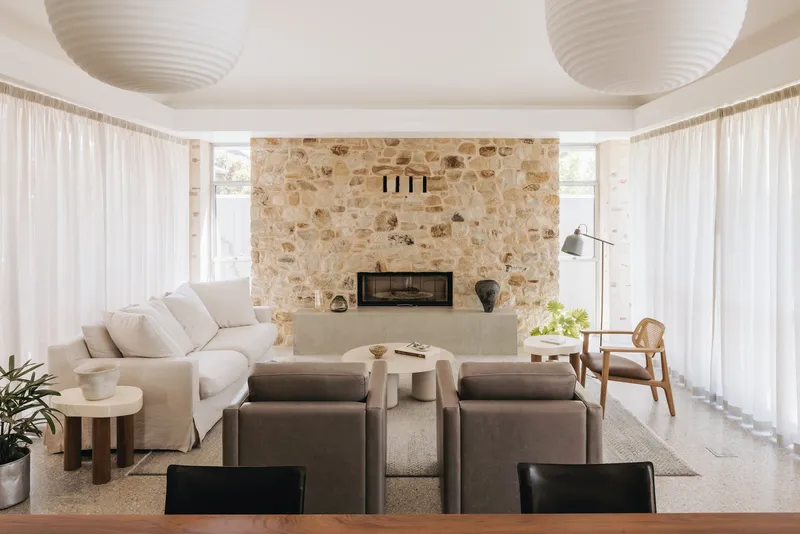
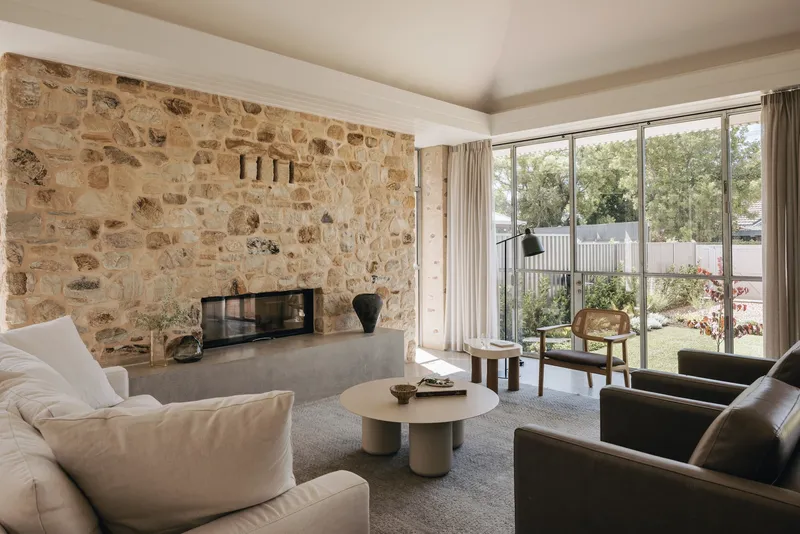
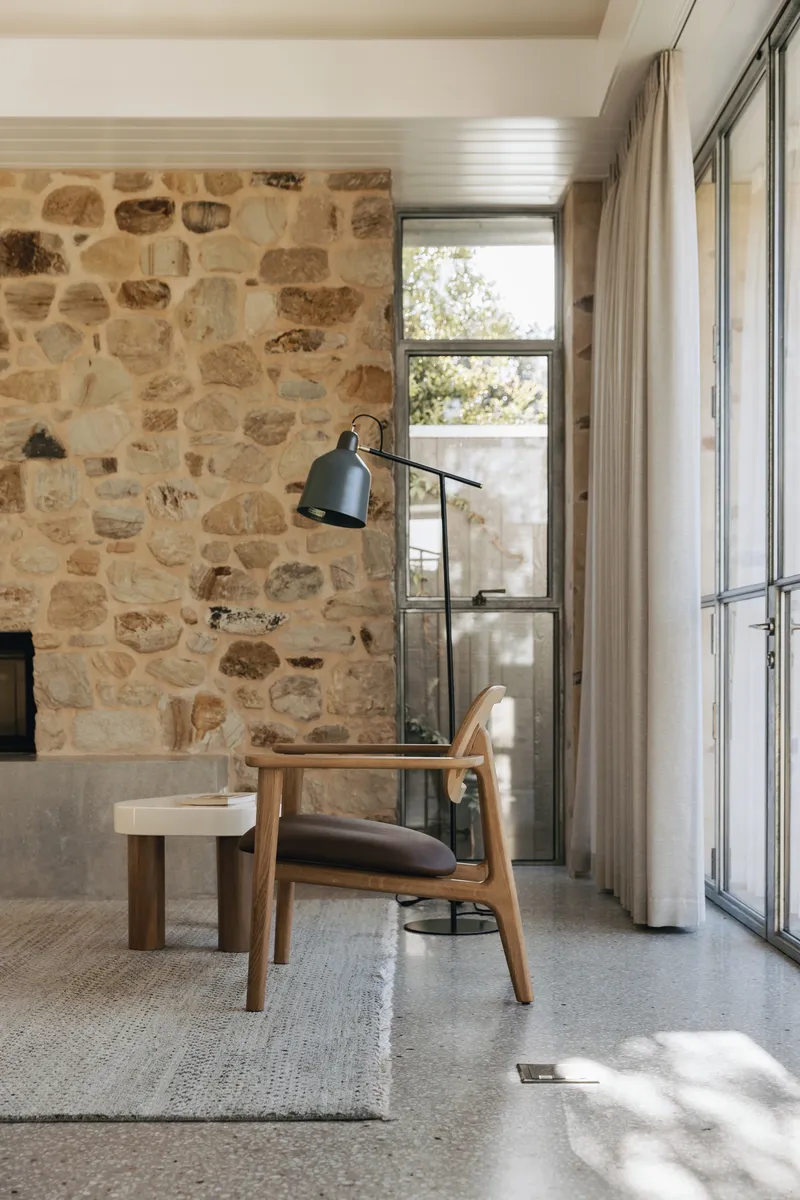
The sandstone fireplace wall in the living room is the pavilion's anchor. Floor-to-ceiling glass doors flank it on both sides, framing garden views and letting daylight wash across the stone surface so that its color shifts from warm ochre to cool grey as the sun moves. A solid concrete hearth grounds the composition, and the chimney breast reads as a thick, load-bearing element even though the actual structure is masonry behind. Two paper lanterns hang overhead, their soft geometry a deliberate counterpoint to the mass of the stone.
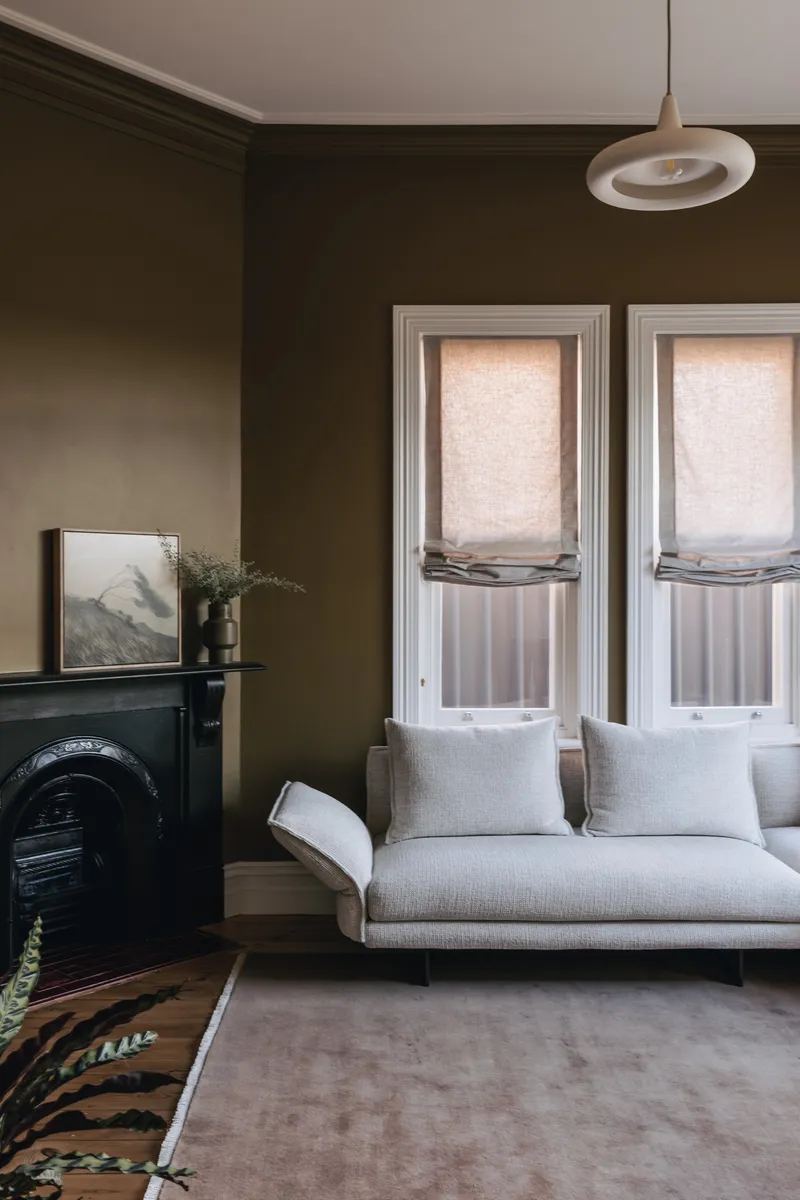
In the original house, a black cast iron fireplace in the front sitting room has been retained. Dark brown walls and a pendant light give this room a very different register: heavier, more enclosed, more Victorian in its proportions. The contrast between the two fireplaces captures the entire strategy of the house. One is inherited, the other invented, but they share a material seriousness that makes the whole composition cohere.
The Original Rooms and the Hallway
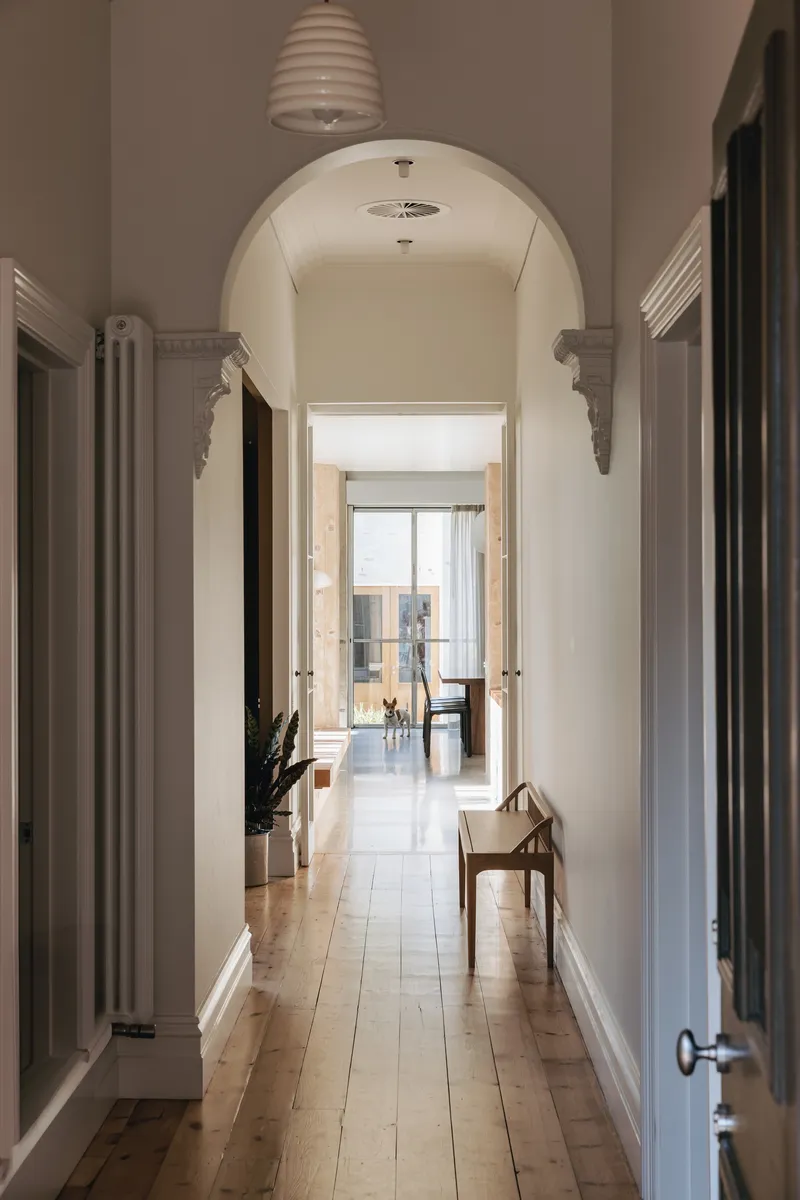
The formal front rooms of the Federation villa have been preserved in plan and proportion, with all internal ceilings and plasterwork replaced due to the extent of deterioration. An arched hallway with original timber floorboards runs the depth of the house, ending in a sunlit room with French doors that connects to the courtyard. The hallway acts as a spine, compressing the spatial experience before you reach the open pavilion beyond.
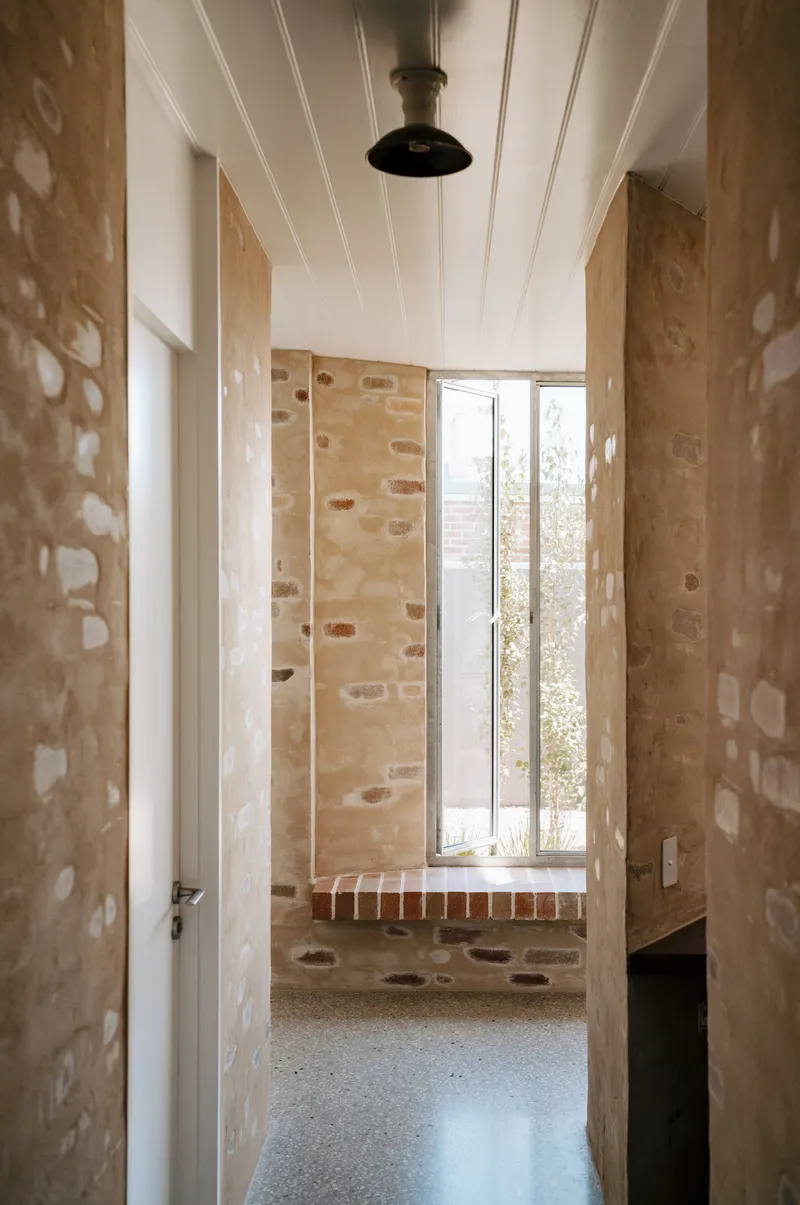
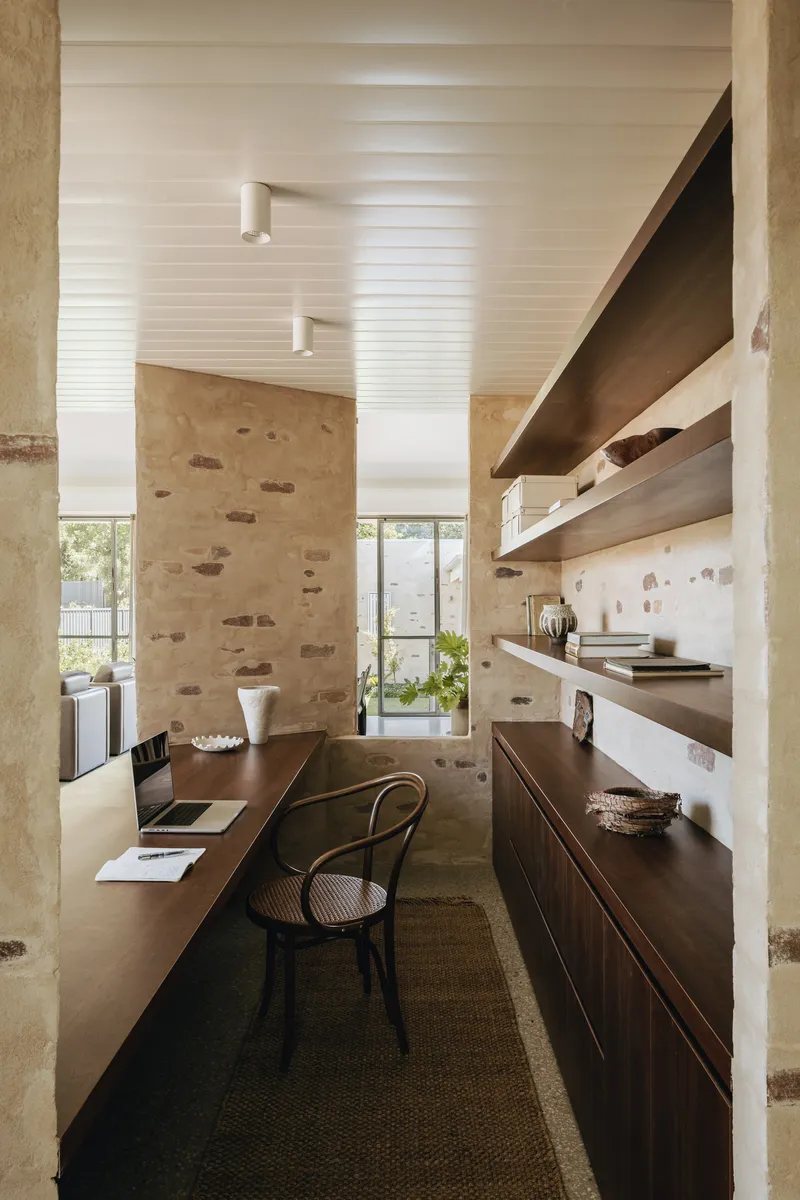
A narrow workspace tucked along one wall shows how the project accommodates the couple's working life alongside domestic routines. Exposed stone walls, horizontal timber shelving, and a white slatted ceiling create a room that feels both enclosed and airy. Office, studio, and workshop areas are distributed through the house, so retirement here clearly does not mean idleness.
Inside Out: The Rear Pavilion and Garden
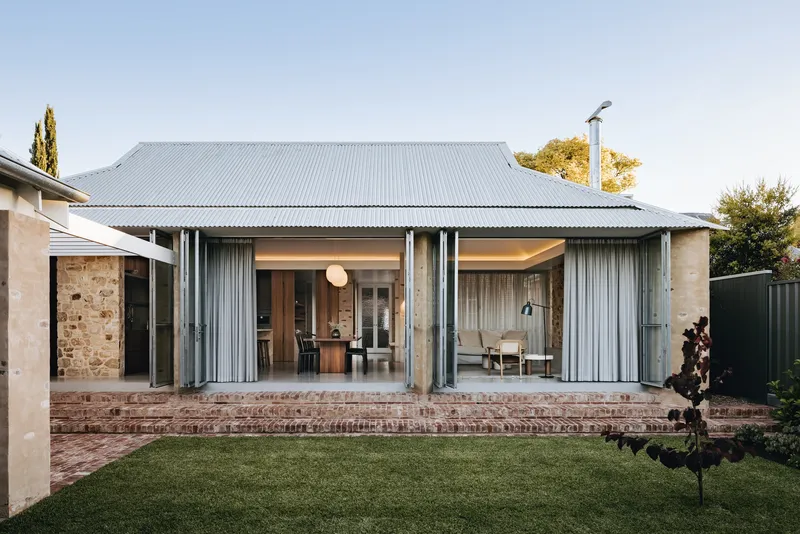
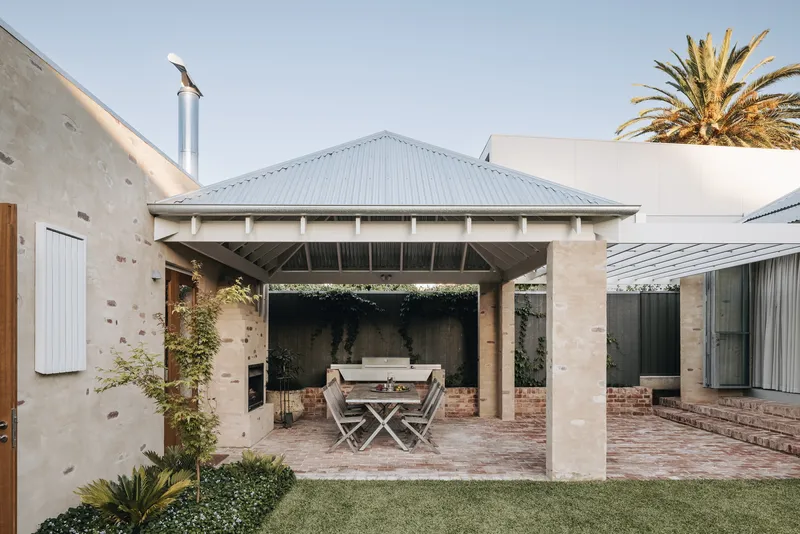
The rear elevation is where the new pavilion reveals itself most clearly. A large corrugated metal roof, described by the architect as resembling a stockman's hat, folds down over folding glass doors that open the living areas entirely onto brick steps and lawn. The covered outdoor terrace beneath the hipped roof, with stone columns and brick paving, creates an intermediate zone between house and garden that will be used most of the year in Adelaide's climate.
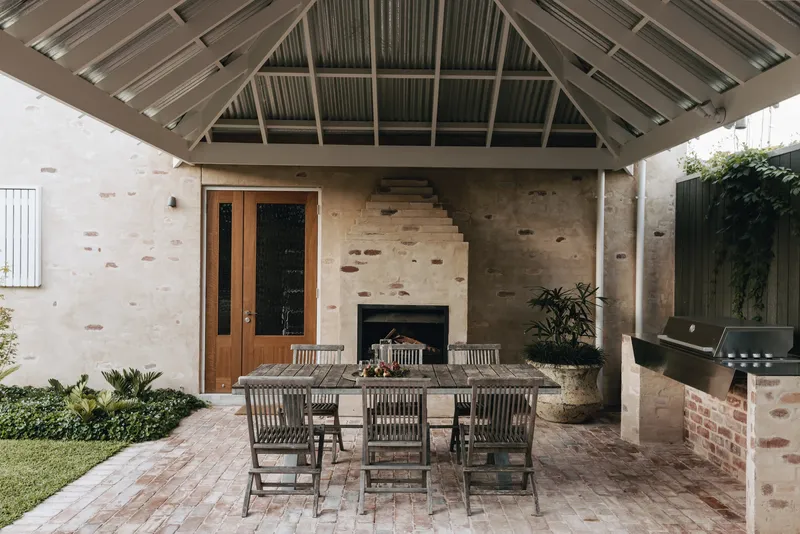
A second outdoor area at the back features an exposed timber roof structure and a sandstone fireplace wall patched with visible brick repairs. This layered, almost archaeological quality to the masonry is not accidental. It records the process of construction and renovation as part of the house's ongoing story. Recycled brick steps connect levels across the site, which sits on clay soil stabilized by 18 piles driven 3.5 metres to bedrock.
Thresholds and Details
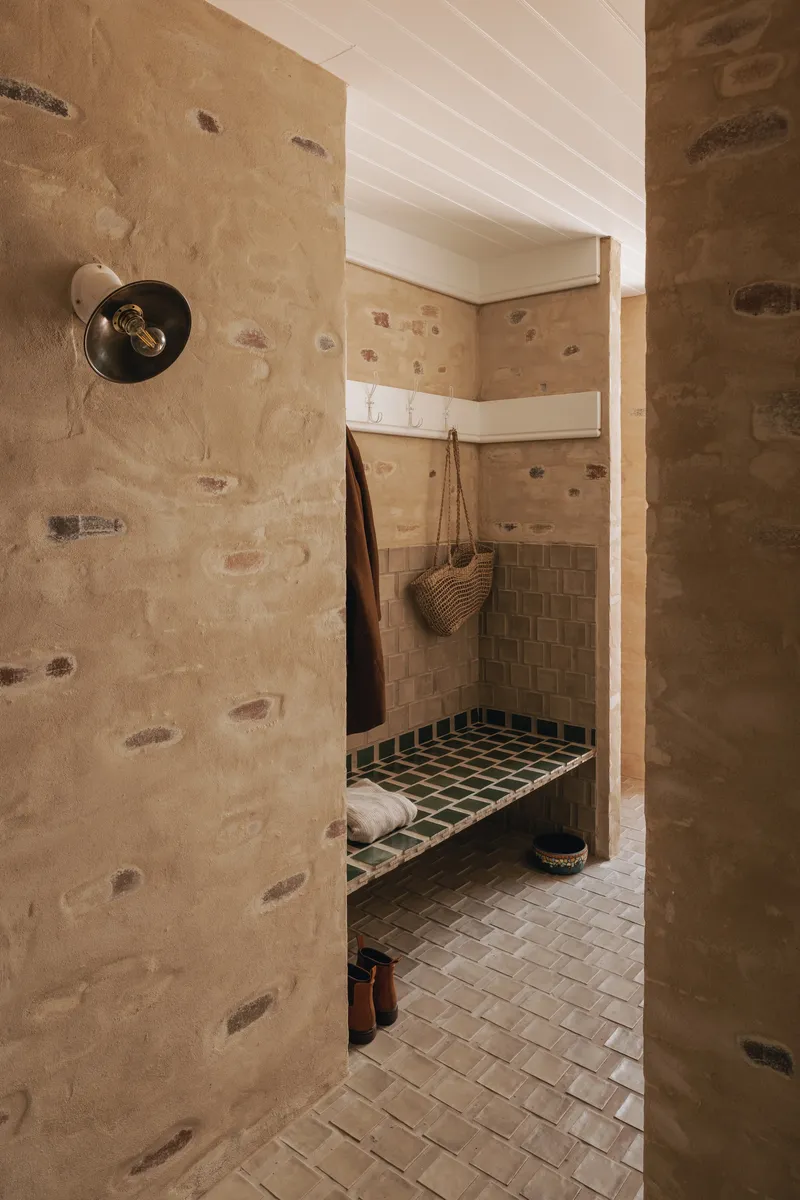
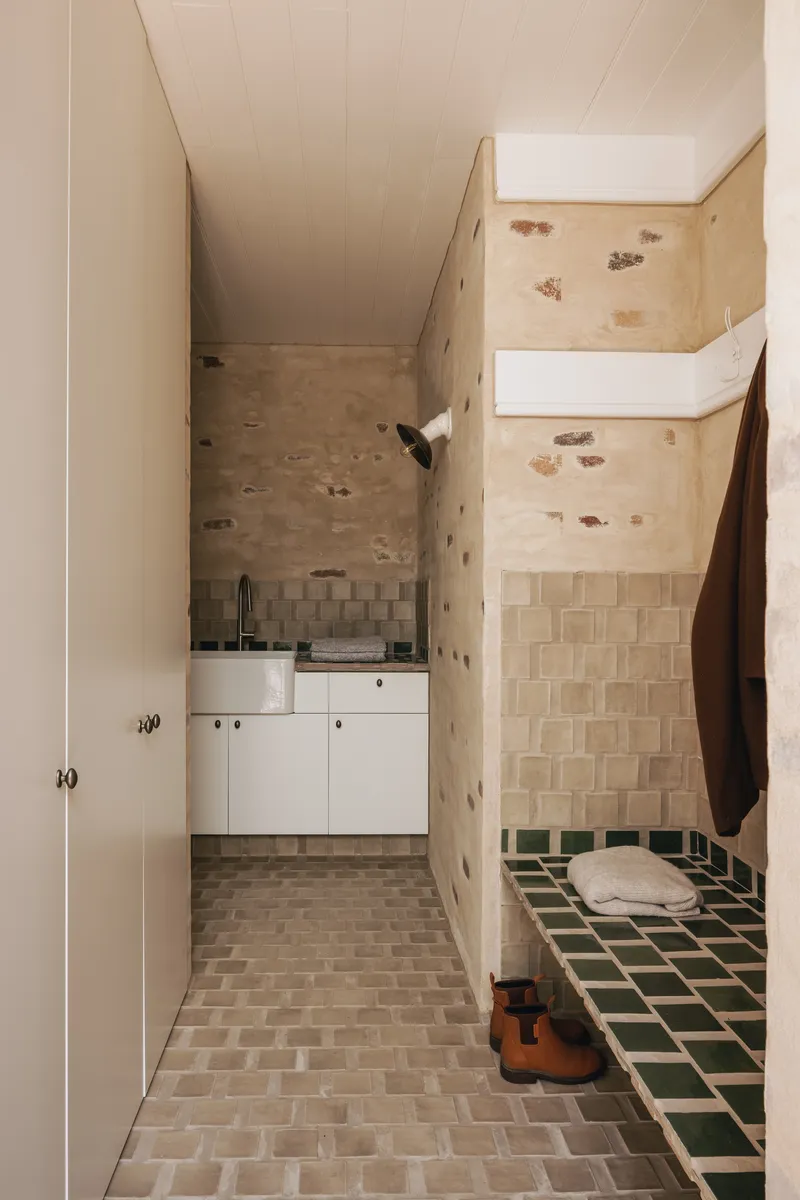
The entry alcove, with its stone walls, white timber ceiling, and green tiled bench, establishes the material palette before you step inside. Green tile reappears in the ensuite bathroom, where it meets Venetian plaster walls, terrazzo tile flooring, and exposed stone under a skylight. These are not interiors driven by a single aesthetic; they are rooms assembled from materials chosen for their weight and texture, each one doing something specific with light.
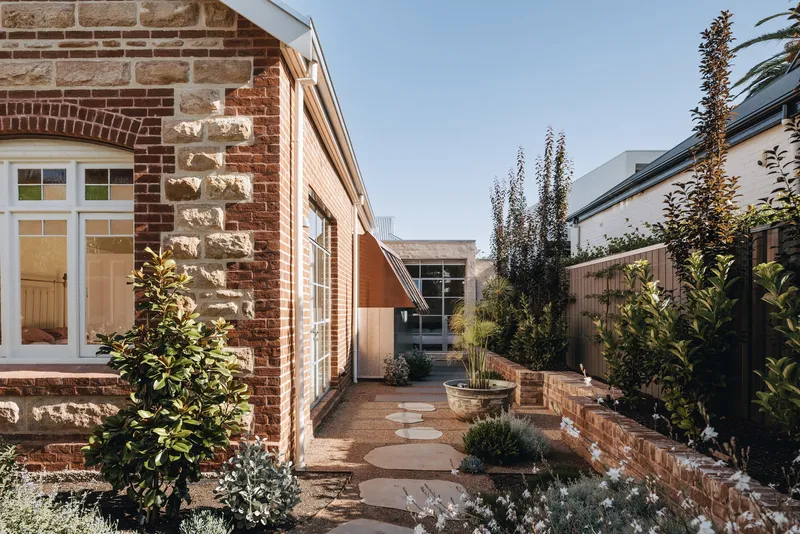
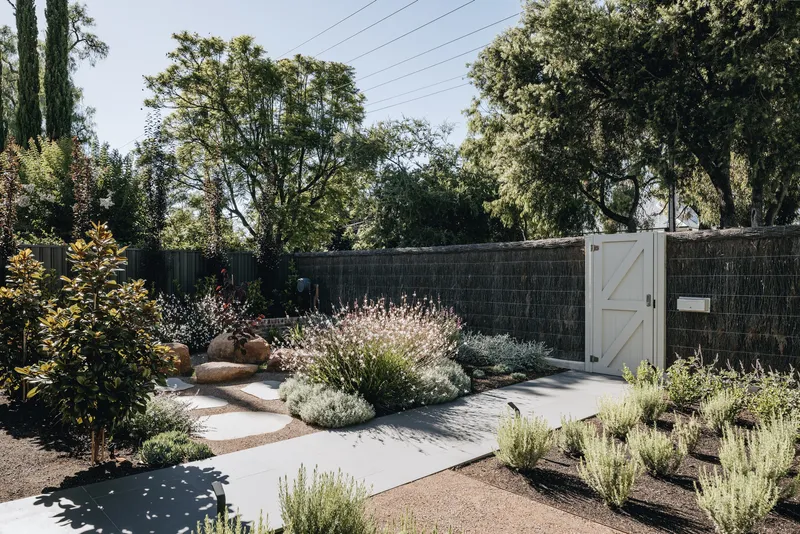
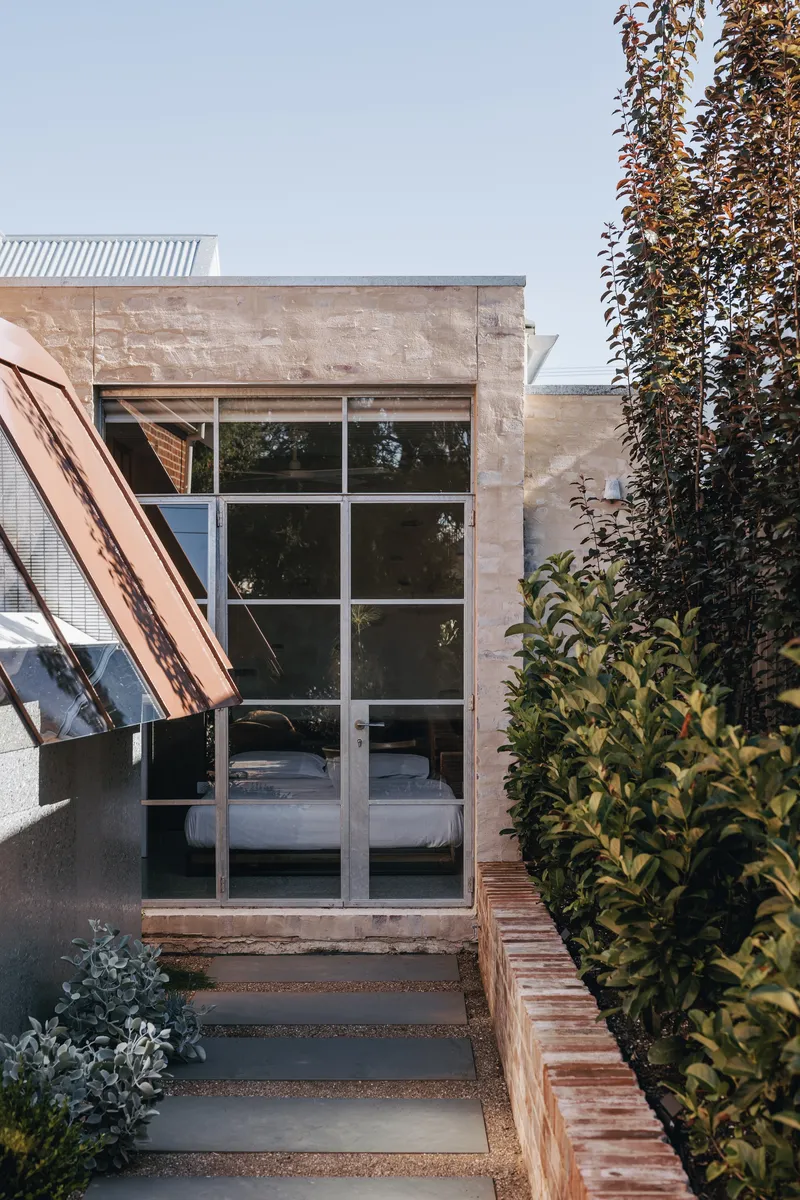
Side courtyards, stepping stone paths, and planted beds fill the 697 square metre site with moments of discovery between the principal rooms. A garden path lined with lavender leads to a white timber gate at the boundary. The galvanised windows facing the courtyard will patina over time, developing the same weathered quality as the original sandstone. Nothing here is trying to stay new.
Roof and Sky
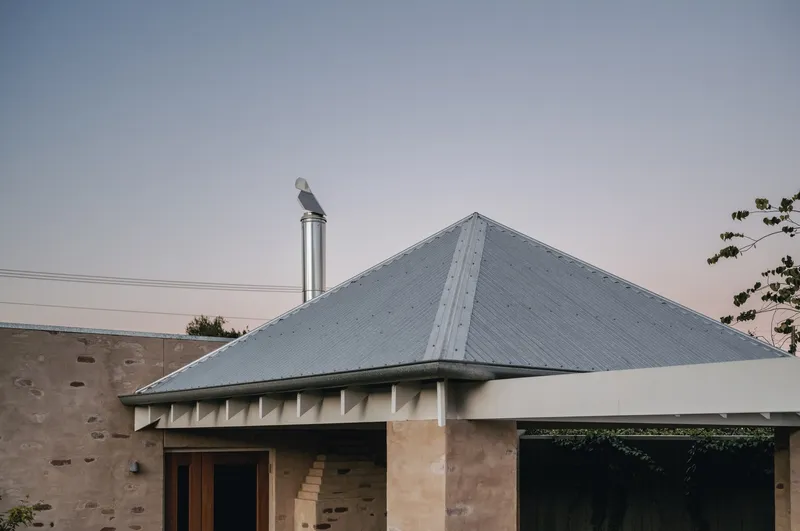
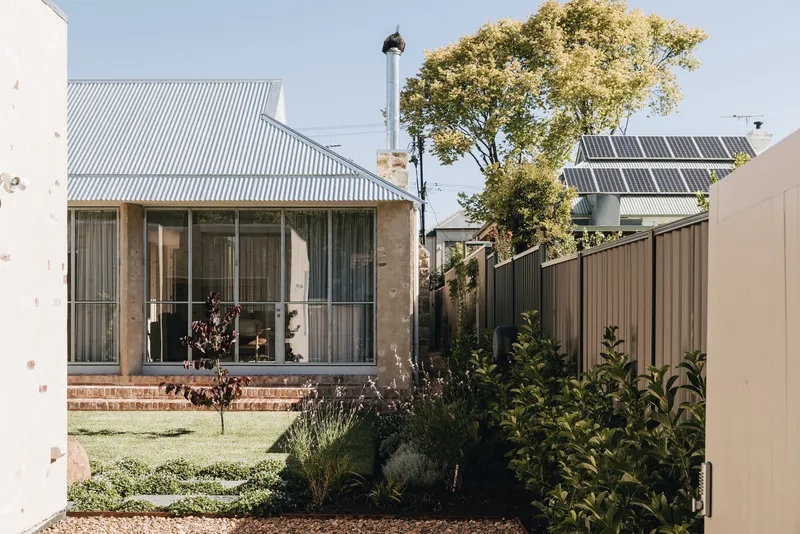
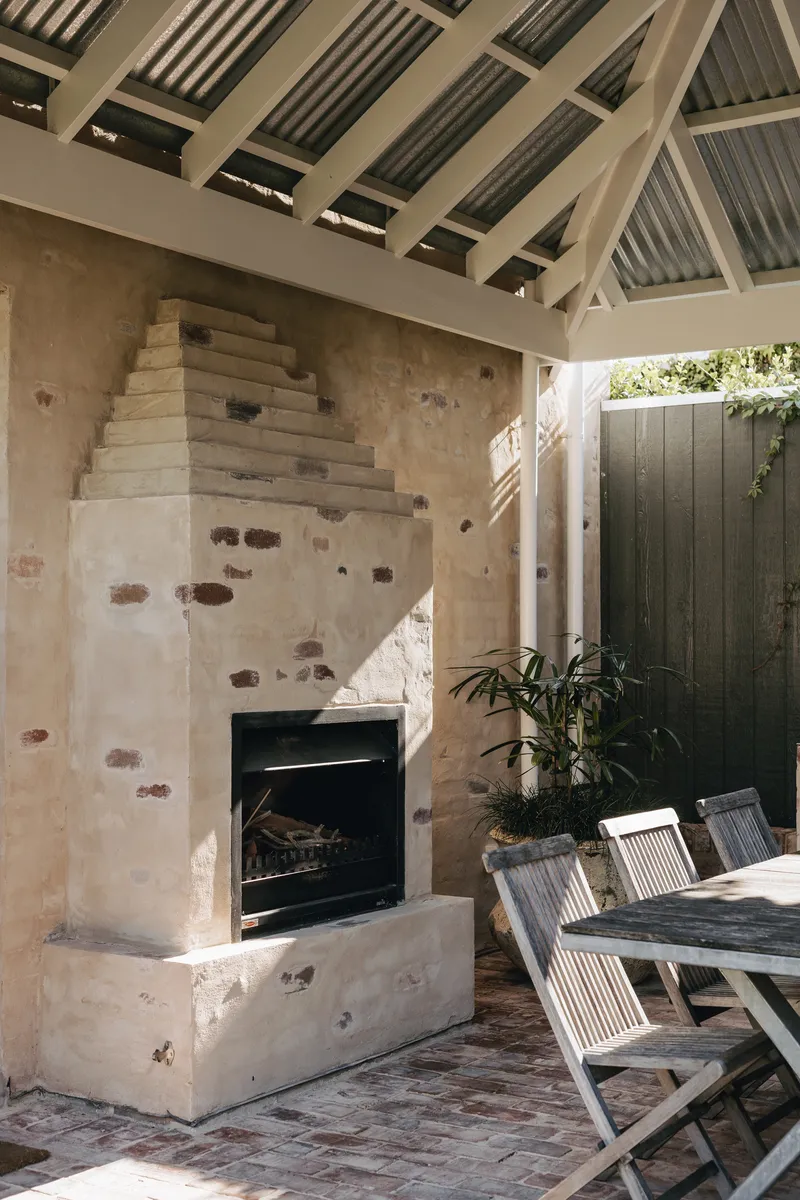
Seen against a pale evening sky, the hipped corrugated metal roof with its chimney flue reads as a simple, almost archetypal form. The concealed guttering within the Dutch gable keeps the profile clean. From the garden, the rear outbuilding's large skillion roof angled north is visible carrying photovoltaic panels, a pragmatic addition that earns its keep without disrupting the roofscape. The stepped sandstone fireplace under painted timber rafters, caught in afternoon light, is one of the most quietly beautiful moments in the house.
Why This Project Matters
House in the City matters because it demonstrates that heritage renovation and ambitious contemporary design are not opposing forces. The project does not hide behind the Federation facade or apologize for the new pavilion behind it. It treats both as part of the same material and spatial argument, connected by a courtyard that is simultaneously the oldest gesture in domestic architecture (the Roman atrium, the Islamic riad) and the most effective passive climate strategy available on this particular site. The fact that the architect is the clients' own son adds a biographical layer that helps explain the project's unusual patience and specificity.
In a residential market saturated with rear extensions that bolt a white box onto a brick cottage, this house proposes something more considered. It uses local sandstone, references regional building traditions, accommodates photovoltaics within a heritage-sensitive roofline, and treats every seam between old and new as an opportunity rather than a problem. The 18 piles driven to bedrock are an apt metaphor: sometimes the best way to build something light and livable is to go deep.
House in the City by James Allen Architect. Adelaide, Australia. 225 m². Completed 2023. Built by Build Theory. Landscape by David Burnett. Photography by Christopher Morrison.
About the Studio
Share Your Own Work on uni.xyz
If projects like this are the kind of work you want to make, uni.xyz is a place to publish your own, find collaborators, and enter design competitions.



Popular Articles
Popular articles from the community


The Musturak Paradise: Senior Living Architecture for a Connected Future in Temara, Morocco
The Musturak Paradise reimagines senior living architecture in Temara via private homes, social spaces, culture, community, and shared care.

Conexión: Biophilic Design Reimagines High-Rise Living in Hong Kong
Conexión reimagines high-rise living in Hong Kong through biophilic design, green facades, shared spaces, daylight, water and nature within.

Play: Fragments of Their World
Familiar architecture becomes modular playground design, creating safe spaces where displaced children can learn, connect, imagine and play.

Hill & Cross Opera: Sculptural Opera House Architecture Shaped by Tallinn’s Landscape and Identity
Hill & Cross Opera reimagines opera house architecture in Tallinn through its sculptural hill, civic plaza, glass wave and a luminous cross.

Similar Reads
You might also enjoy these articles

Bao Huynh Watercolor Atelier: A Serene Art Retreat in Hội An
Bao Huynh Watercolor Atelier in Hội An blends multifunctional art spaces, sustainable design, local materials, and family-friendly living in a serene environment.

Atelier Macri Concept Store Interior Design by CASE-REAL
Atelier Macri store features a "ko" counter, walnut wood details, cork displays, blending retail, gallery, and seamless customer experiences.

Manuel Vargas Izquierdo Stadium and High-Performance Sports Center: Architectural Excellence in Jalpa de Méndez
The Manuel Vargas Izquierdo Stadium blends sustainable design, inclusive sports facilities, and cultural-inspired architecture, revitalizing Jalpa de Méndez’s public spaces.

KAKR Buluh Awar Hall: Revitalizing Community and Ecology Through Bamboo Architecture
Community built bamboo hall revitalizes Buluh Awar village, empowering youth, restoring ecology, celebrating vernacular craftsmanship through sustainable architecture and culture.

Explore Residential Building Competitions
Discover active competitions in this discipline



Challenge to design a portable theatre


Challenge to design a portable music platform


Challenge to design an open learning module for the elderly


Challenge to design mud housing for contemporary communities
Comments (0)
Please login or sign up to add comments
No comments yet. Be the first to comment!