

JO Residence: A Tropical Beach House in Guaruja
Jacobsen Arquitetura designed a summer house in Guaruja with a cantilevered concrete roof, timber brise-soleil, a stone base, and a pool facing the ocean.


On the coast of Guaruja, an hour from Sao Paulo, a horizontal concrete roof floats above a pool that looks out to the Atlantic. JO Residence, designed by Jacobsen Arquitetura, is a summer house for a family that wanted to entertain, surf, and disappear into the tropical landscape. The house is two storeys: an open ground floor for living and a closed upper floor for sleeping, wrapped in vertical timber brise-soleil that filters the tropical sun into stripes.
Jacobsen Arquitetura is the master of the Brazilian beach house. JO Residence continues their method: a deep cantilevered roof, a stone base, timber screens, and a pool that connects the architecture to the ocean beyond. The material palette is grey: concrete, stone, timber in neutral tones. The colour comes from the garden, the sky, and the water.
The Approach: Timber Screen and Tropical Garden
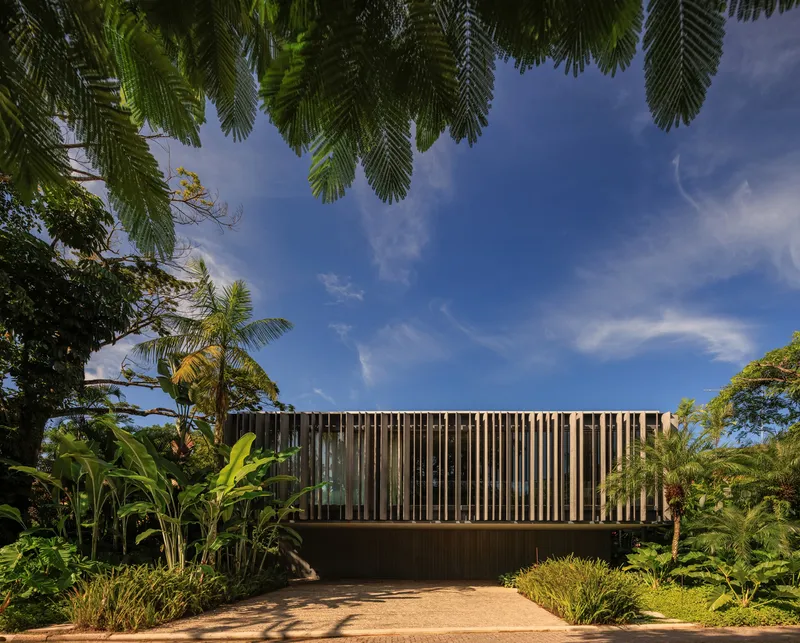
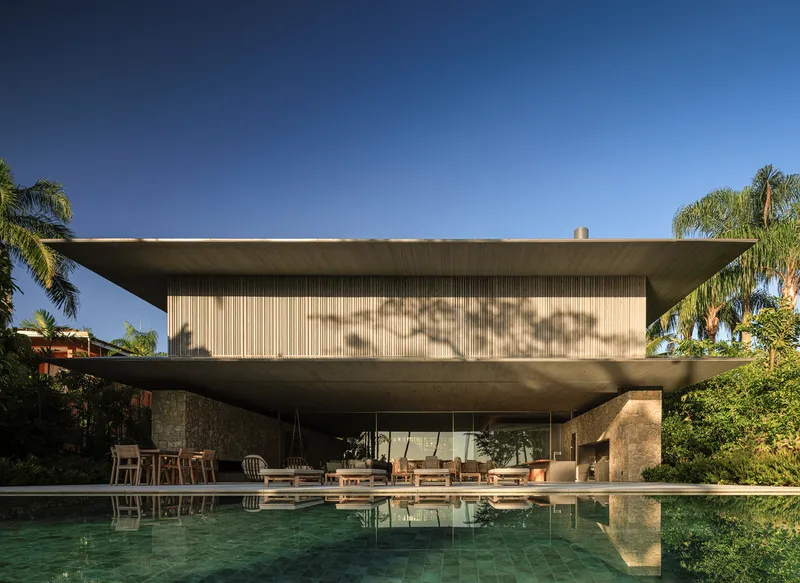
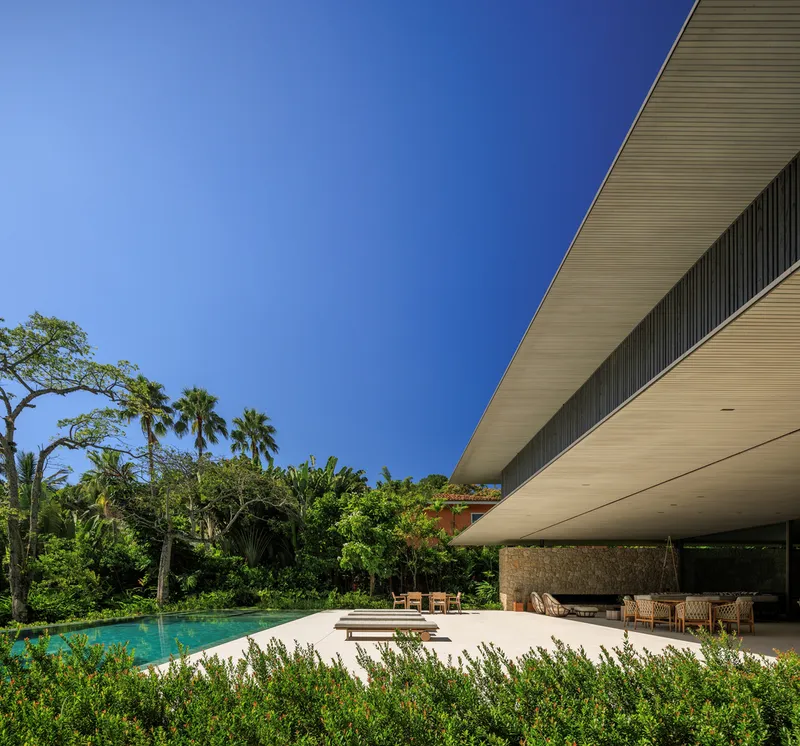
From the street, the house presents a wall of vertical timber brise-soleil behind dense tropical planting. The slats are Accoya wood, durable and grey-toned. You see the house through the planting and the screen, not as a facade but as a filtered presence. From the pool side, the composition is clearer: a stone wall at ground level, the timber-slatted upper volume above, and a deep concrete roof cantilevering over both. The pool reflects the entire facade. Palm trees frame the sky.
The Pool: Beach, Ocean, and Canopy
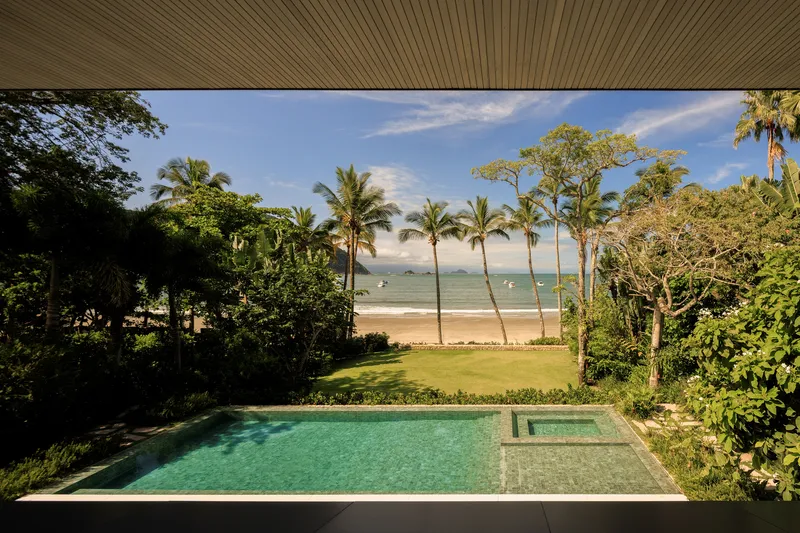
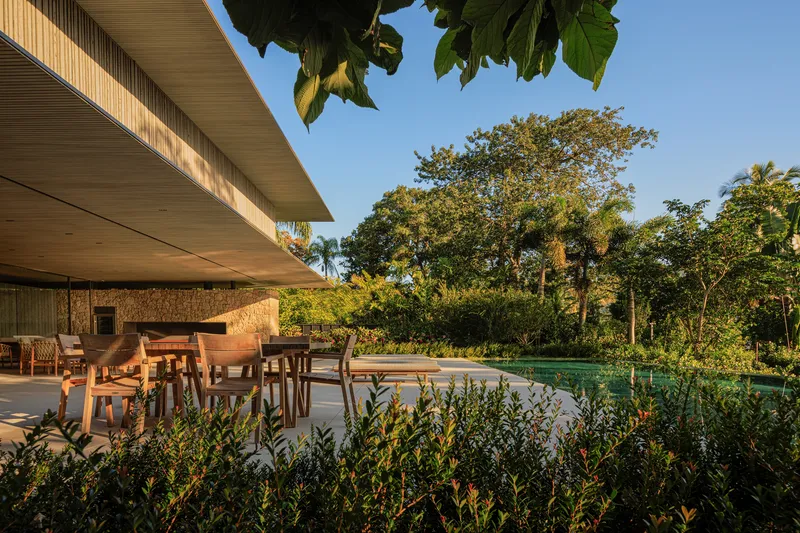
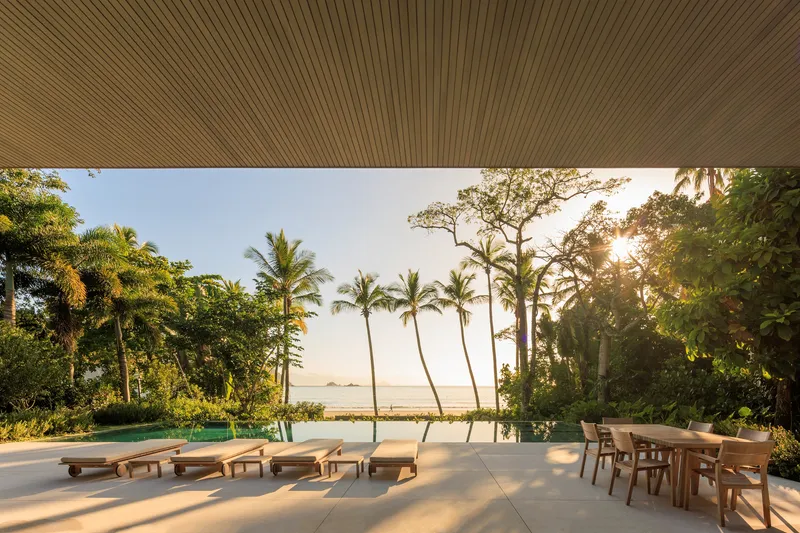
The pool terrace is the primary room. Under the deep concrete soffit, sun loungers and a timber dining table face the water. The pool sits on an elevated plateau, and beyond it the garden drops toward the beach. Palm trees, the sand, and the ocean are visible from the terrace. At sunset, the timber ceiling catches golden light, the palm trunks are silhouetted, and the ocean darkens. This is the twenty-minute window that the house is designed for.
The Staircase: Concrete and Shadow
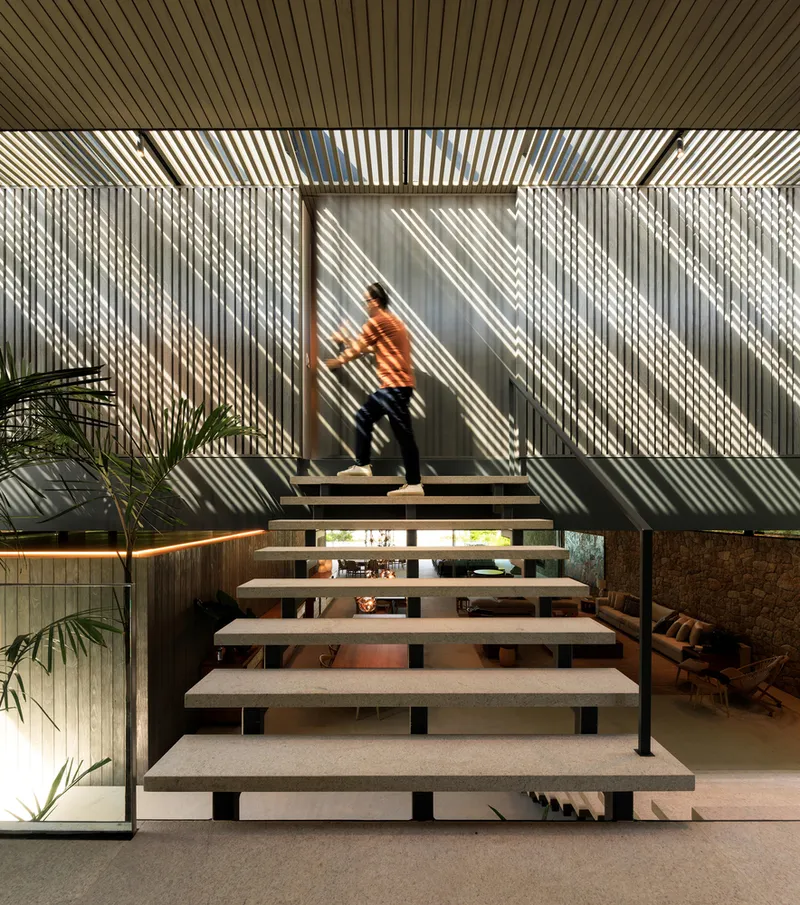
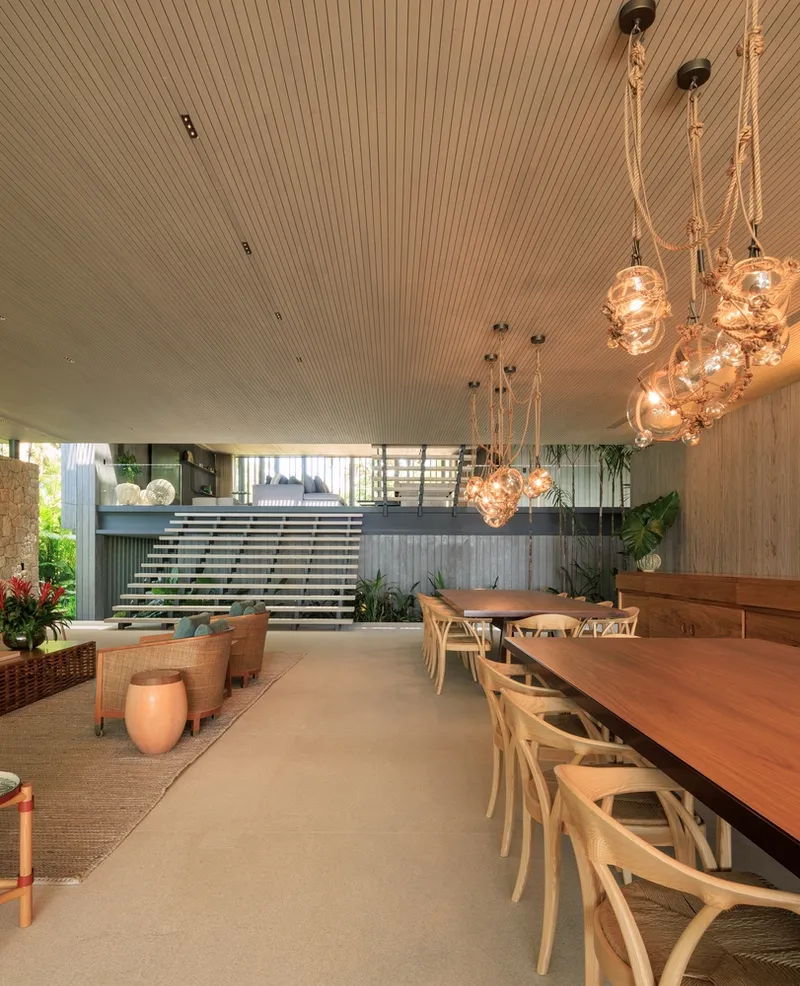
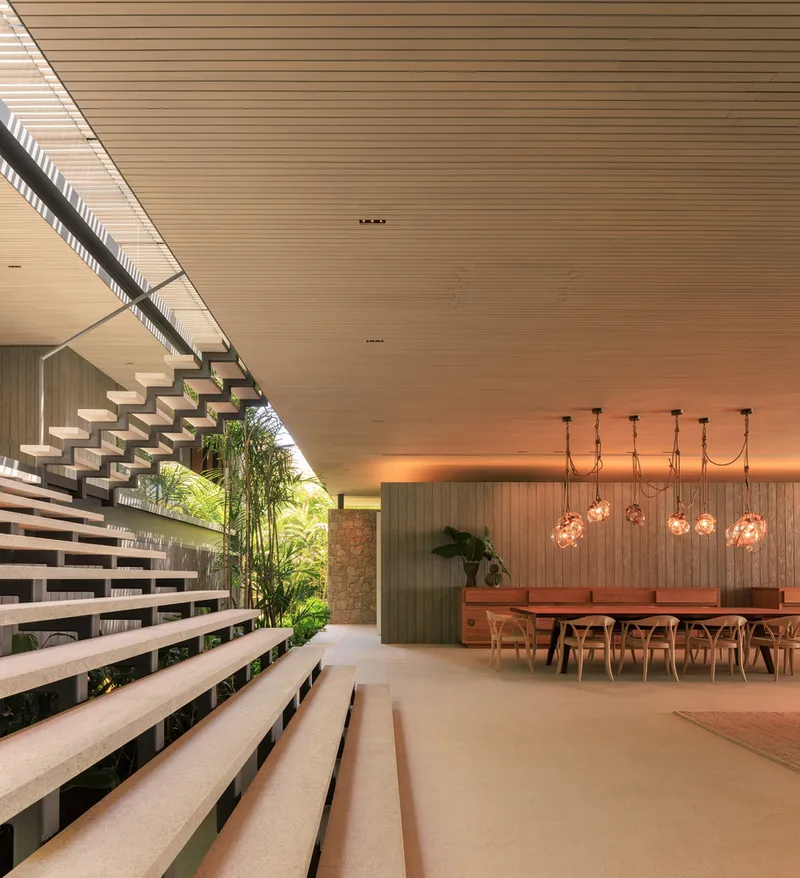
The staircase connects the social ground floor to the private upper floor. The treads are floating concrete slabs cantilevered from a central wall. Behind, the timber brise-soleil casts striped shadows across the stair and the figure ascending. In the dining area below, a cluster of glass bubble pendant lights hangs above a timber table with wishbone chairs. The stair is visible from the dining room, making it both circulation and centrepiece.
Interior: Timber Ceiling and Open Plan
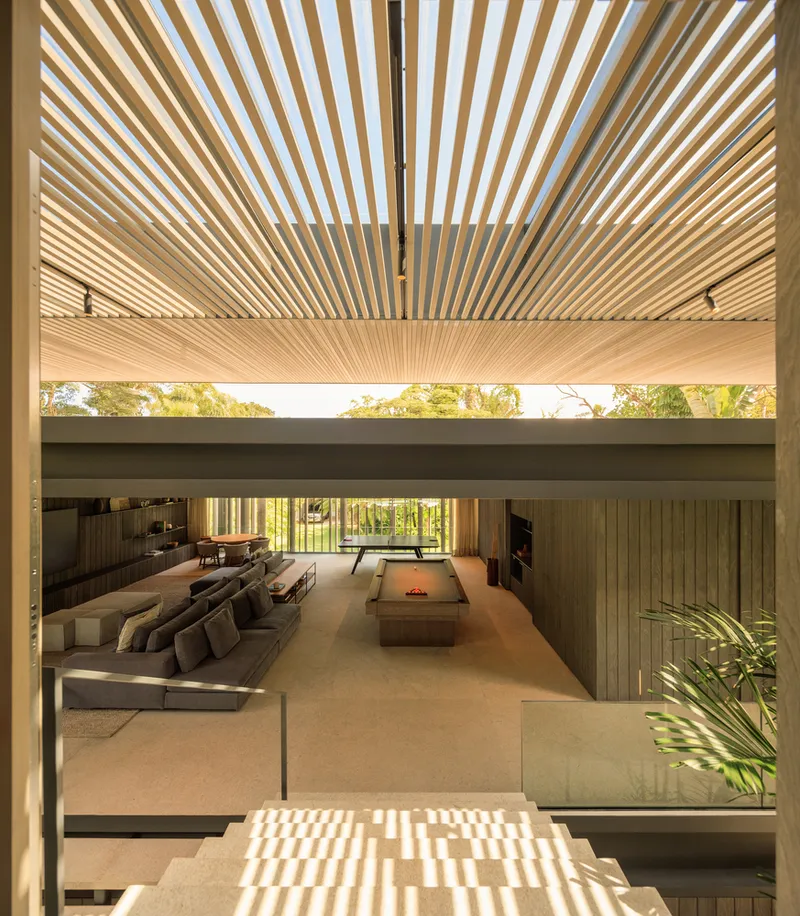
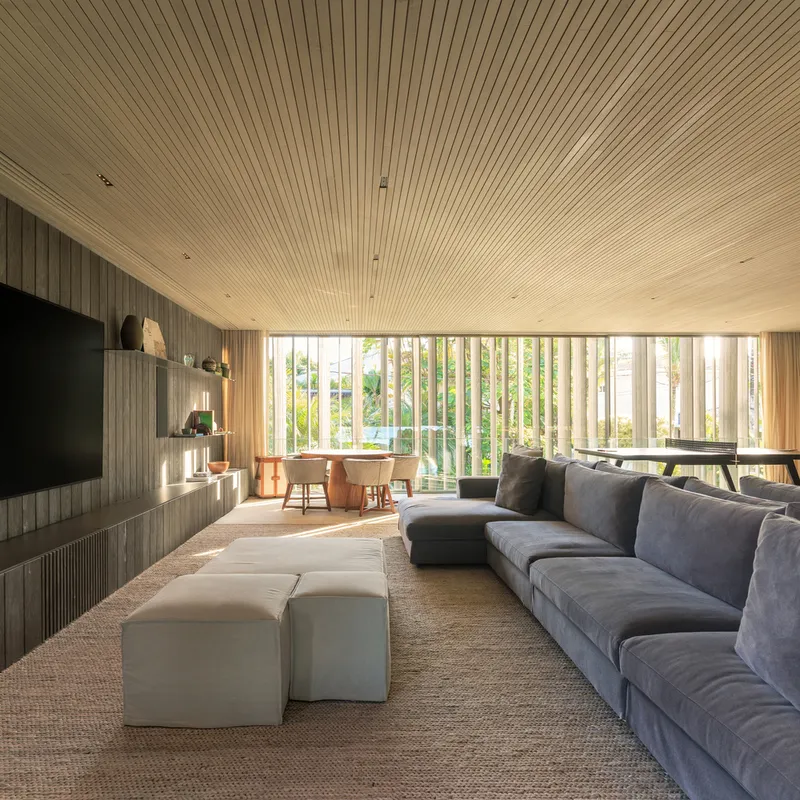
The ground floor is open plan under a continuous timber louvre ceiling. The louvres filter light from above and create a warm, even glow throughout the living and dining areas. An entertainment room on the lower level has a grey sectional sofa, a dark stone TV wall, and timber brise-soleil windows that repeat the facade treatment inside. The material palette is consistent: timber ceiling, stone walls, polished concrete floors, and neutral furniture. Nothing competes with the view.
Bedroom: Timber and Garden
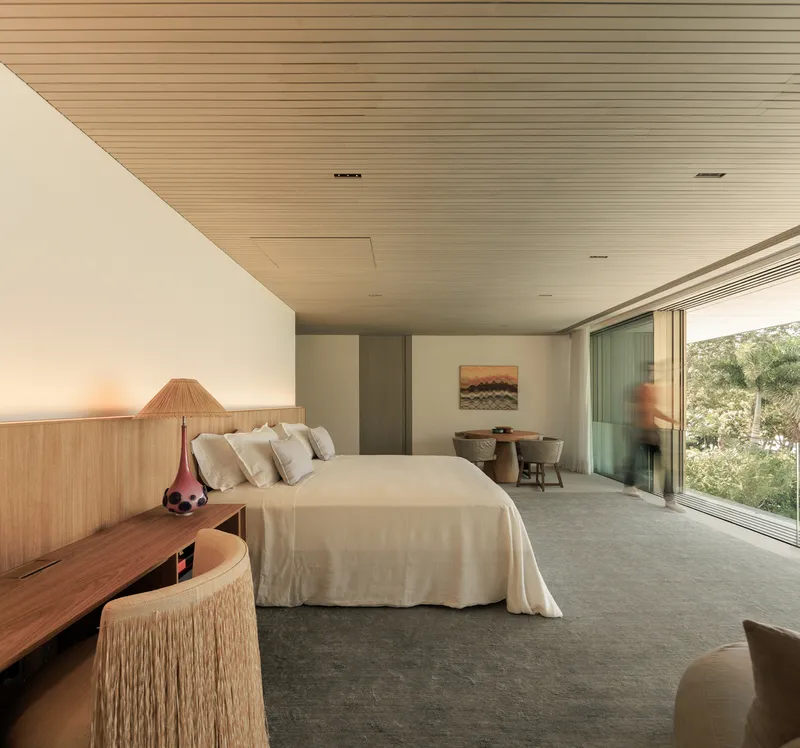
The upper floor has five bedrooms arranged along a central corridor, each with an en-suite bathroom. The master bedroom has a timber ceiling, a timber headboard wall, white bedding, a rattan armchair, and floor-to-ceiling glass opening to the garden canopy. The brise-soleil outside provides privacy and shade. The room is calm, warm, and oriented toward the trees rather than the ocean. The view is green, not blue. This is the correct hierarchy for a bedroom in the tropics: shade and quiet, not spectacle.
Context: House in the Canopy
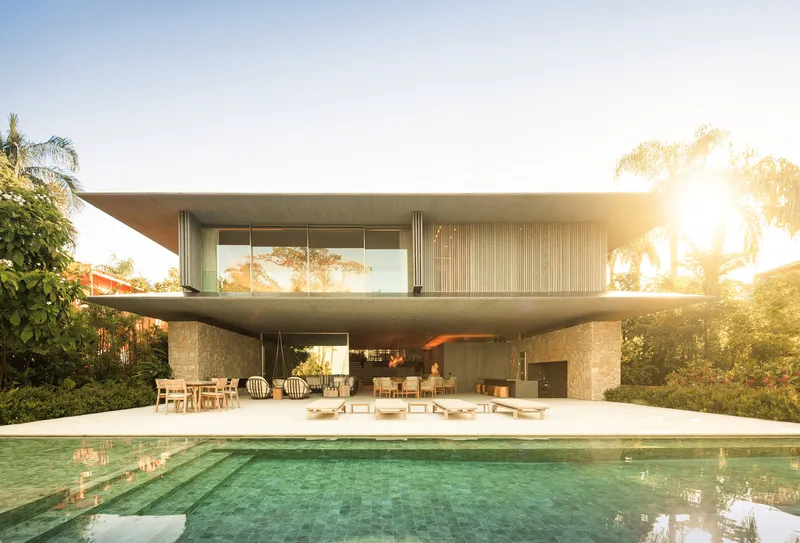
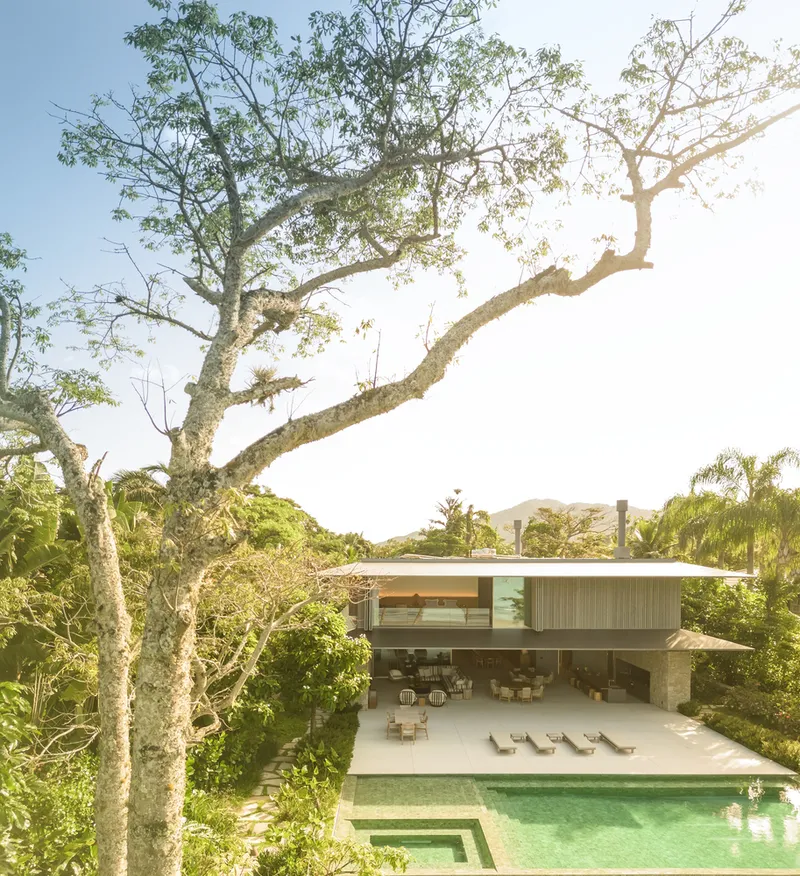
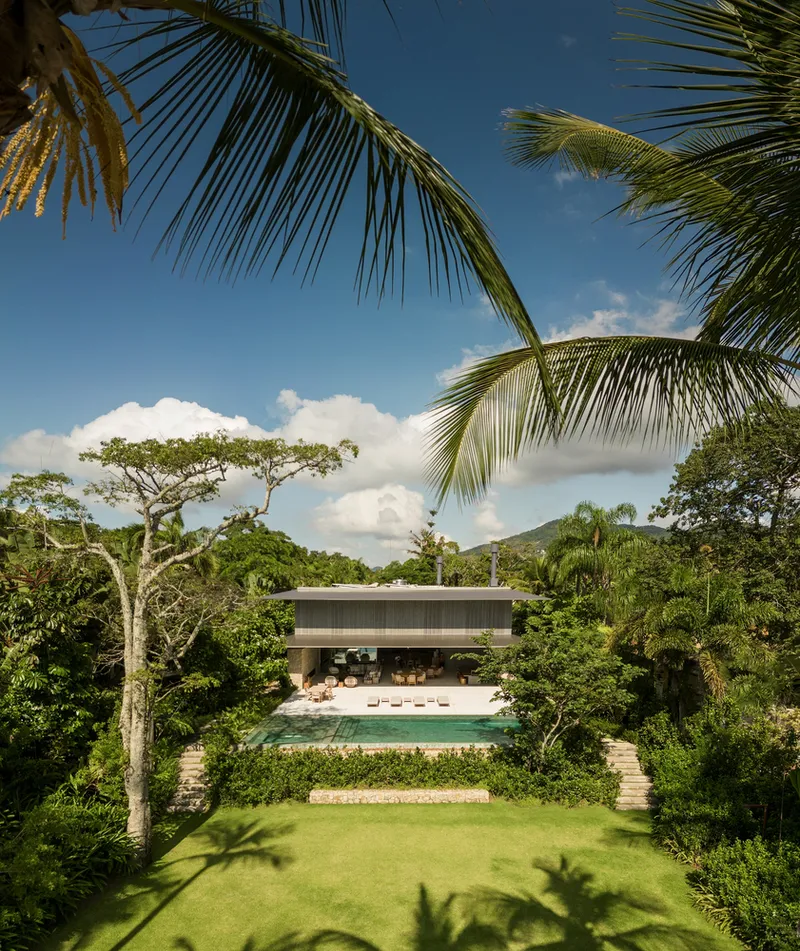
From the garden and the hillside above, the house reads as a horizontal concrete bar floating in the tropical canopy. The pool and stone terrace sit below. Sun loungers dot the deck. The deep cantilever provides shade for the entire ground floor without columns or screens at the edge. The house does not dominate its site. It hovers in it.
Plans
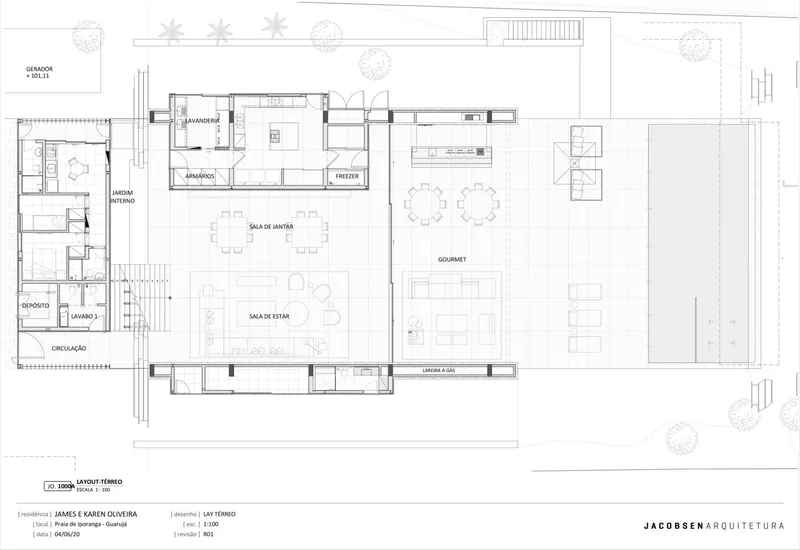
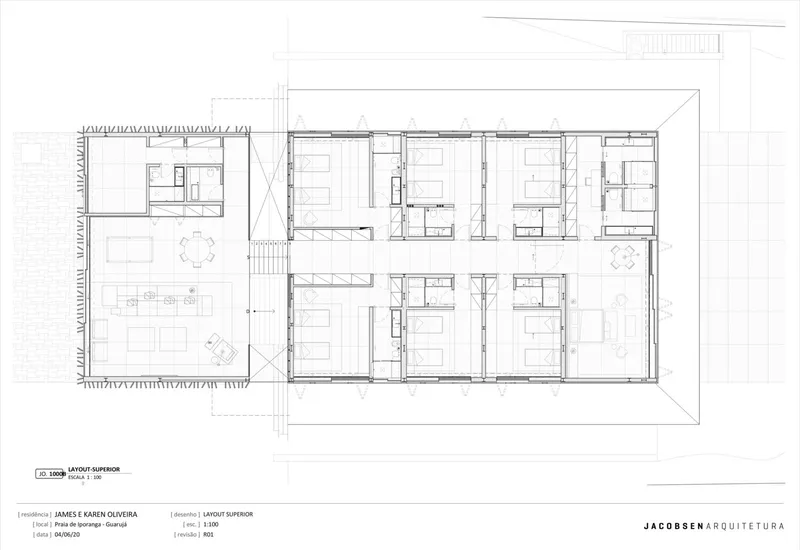
The ground floor plan shows the open living, dining, and kitchen areas wrapping around the pool and veranda. Service areas sit at the back. The upper floor plan shows five bedrooms along a central corridor with the timber brise-soleil facade running the full length. The plan is simple and horizontal: one room wide, two rooms deep, with the pool and garden on the long side.
Why This Project Matters
The Brazilian beach house is a type with a long history. Jacobsen Arquitetura has refined it over decades. JO Residence shows what that refinement looks like: a deep cantilevered roof that eliminates the need for shutters or blinds, a timber screen that provides privacy without enclosure, a stone base that anchors the house to the hillside, and a pool that connects the terrace to the ocean. Every element has been tested on previous projects and tuned here.
If you are designing a tropical house, a beach residence, or any project where the relationship between terrace, pool, and landscape is the primary architectural question, JO Residence is worth studying for how Jacobsen balances openness and shelter with three materials: concrete, stone, and timber.
About the Studio
Share Your Own Work on uni.xyz
If you are working on tropical residential architecture, beach houses, or landscape-integrated design, uni.xyz is a place to publish your work and connect with a global design community.
Project credits: JO Residence by Jacobsen Arquitetura. Guaruja, Sao Paulo, Brazil. Photographs: Fernando Guerra | FG+SG.


Popular Articles
Popular articles from the community


David Ortega Stacks a Two-Story Mexico City Penthouse Around a Steel Stair and a Pergola-Shaded Roof Terrace
In Colonia Roma, a 300 m² penthouse uses oak joinery, a planted steel stair and a slatted roof pergola to make a new-build apartment feel like a house.

Architekt Andreas Gruber Scatters 23 Dark Timber Chalets Across a South Tyrolean Forest Edge
In Molini di Tures, Amonti Chalets breaks a resort into a hamlet of gabled timber houses, with parking, storage and services pushed into the slope.

U.GA Architects Wraps an Oval Rooftop Pool in Curved Board-Formed Concrete on Busan's Jeollidan-gil
In Busan's Jeonpo-dong, a 454 m² mixed-use block stacks a neighborhood facility, guest rooms and an oval rooftop pool inside spiraling concrete walls.

Juan García Correa, John González and Claudia Rueda Sink a Circular Amphitheater into a Manizales Engineering Building
On the La Nubia campus in Manizales, Colombia, the S1 Building folds labs and offices into a hillside of ramped lawns that double as a campus route.

Similar Reads
You might also enjoy these articles


Hodi-Mandai Geram
Project Function: Preservation and revitalization of the Intangible heritage and socio-spatial identity of the Hodi by Housing, Cultural Memory Center, Sacred Grove, landscape, local tourism economy


Olio Towers: A Mid-Rise for Performers That Fuses Housing, Rehearsal, and Stage
Located blocks from Houston's Theater District, this modular tower stacks living units around a central performance atrium.

Oasis: Modular Green Housing Carved into Dhaka's Urban Fabric
A shortlisted Plugin Housing entry reclaims unauthorized settlements in Dhaka with stepped concrete volumes, green roofs, and ventilation-driven design.

Black Hole: A Floating Megastructure for the Post-Physical Era
Emiliano Mazzarotto envisions a spherical, self-scaling arena where e-sports, digital hotels, and holographic stadiums replace traditional public space.

Explore Architecture Competitions
Discover active competitions in this discipline

Challenge to reimagine the Iron Throne

Photograph architecture without architects

Illustrate the lost glory of Angkor Wat - Render Challenge

Design challenge to reuse E-waste
Comments (0)
Please login or sign up to add comments
No comments yet. Be the first to comment!