

NOMAL Turns a Forgotten Block in Jeonju into a Courtyard Restaurant Built on Ruins
Joomak Restaurant in Palbok-dong layers gravel, steel, and timber over weathered concrete to give a neglected Korean neighborhood a new anchor.


Palbok-dong is not the part of Jeonju tourists come for. It sits well outside the heritage hanok village that draws millions of annual visitors, and it has suffered the familiar fate of secondary urban districts in mid-sized Korean cities: population decline, deferred maintenance, and a slow drift toward invisibility. So when NOMAL was asked to turn a derelict plot here into a restaurant called Joomak, the question was never simply about making a good dining room. It was about whether a single architectural intervention could rewrite the social contract of a dying block.
What NOMAL delivered is less a building than a small compound. The scheme keeps existing ruins as found artifacts, threads new timber pavilions between them, and ties everything together with expansive gravel courtyards that function simultaneously as dining terraces, circulation, and breathing room for a dense urban fabric. The result is a place that feels genuinely old and genuinely new at the same time, with neither condition apologizing for the other. That tension is the project's real material.
A Compound, Not a Building
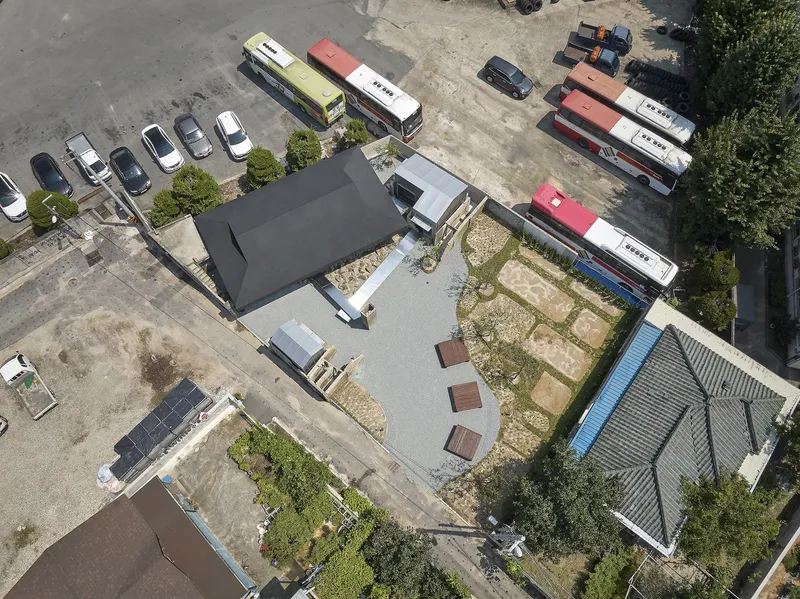
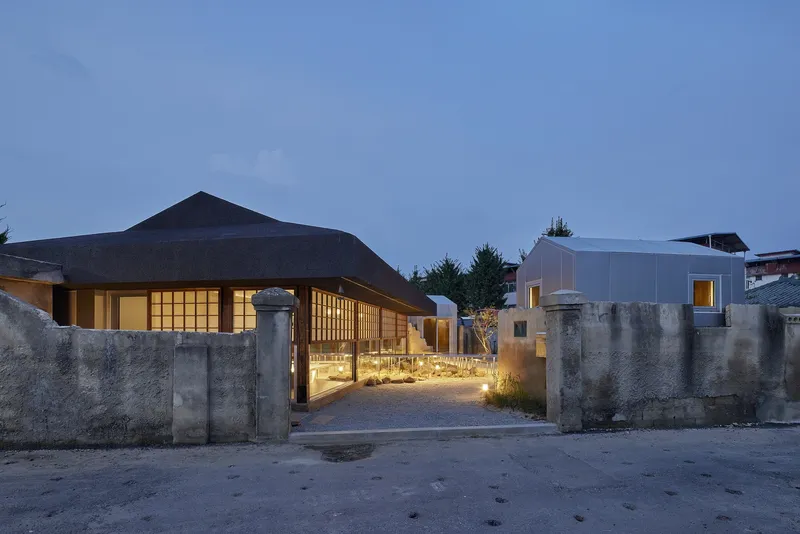
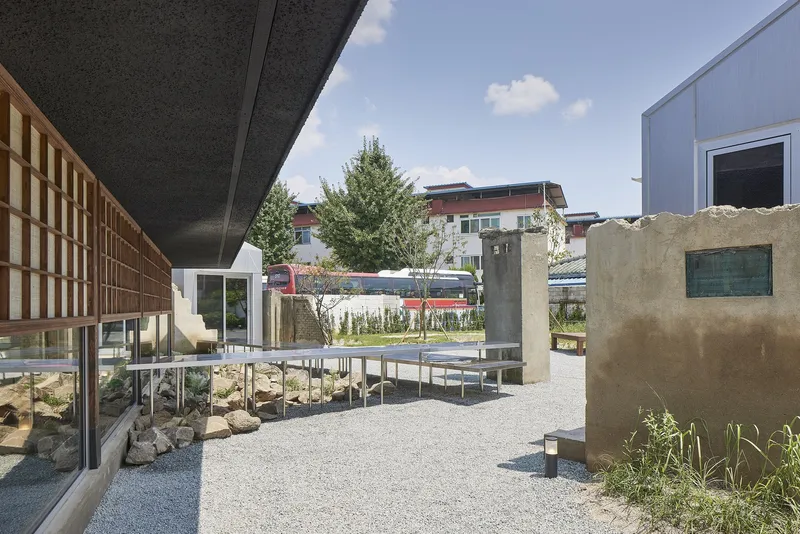
Seen from above, Joomak reads as a cluster of low volumes organized around open gravel courts. There is no single dominant facade, no front door asserting hierarchy. Instead, the compound logic distributes entry, dining, and service across several pavilions connected by outdoor paths. The aerial view reveals how modestly the intervention sits within its context of bus parking lots and roadside trees. It doesn't tower over the neighborhood. It infiltrates it.
At ground level, the dusk views make the strategy legible. Illuminated timber-framed pavilions glow behind gridded screens, casting warm light across gravel paths and concrete walls that were already there before the architects arrived. The planted beds and metal benches in the courtyards are deliberately minimal, keeping attention on the spatial sequence rather than any single object. You move through this place the way you move through a traditional Korean hanok compound: laterally, with peripheral vision doing as much work as focal.
Ruin as Anchor
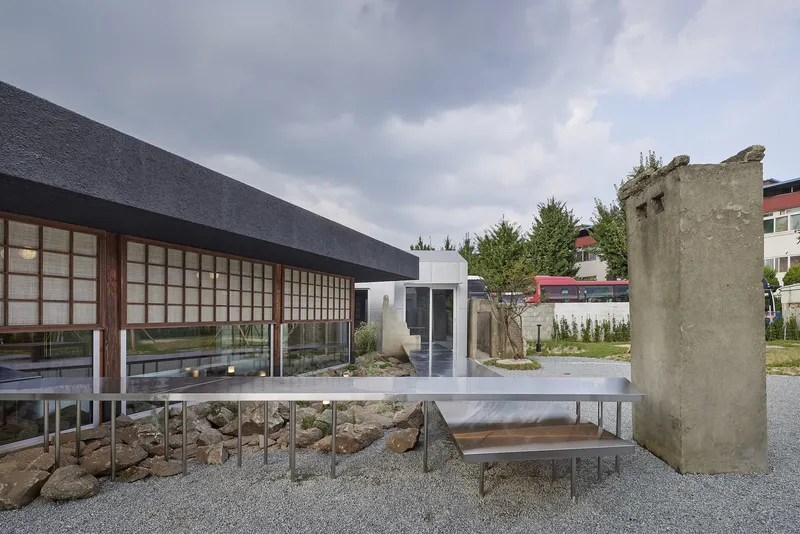
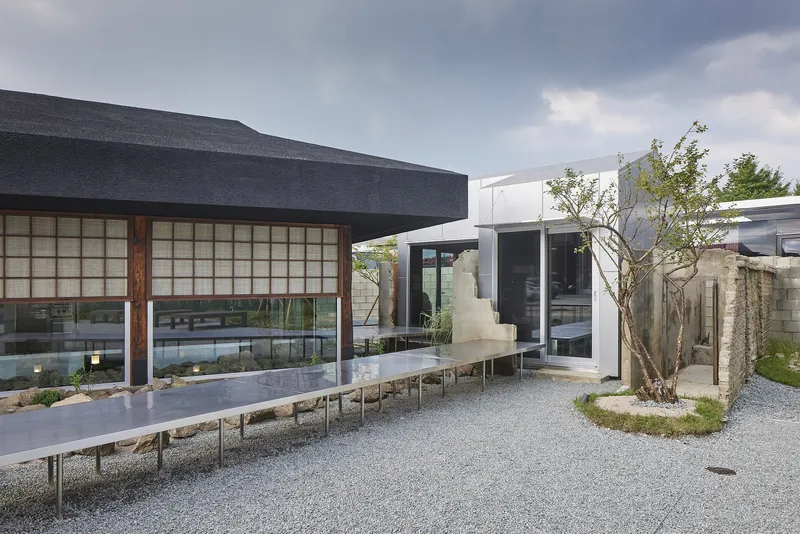
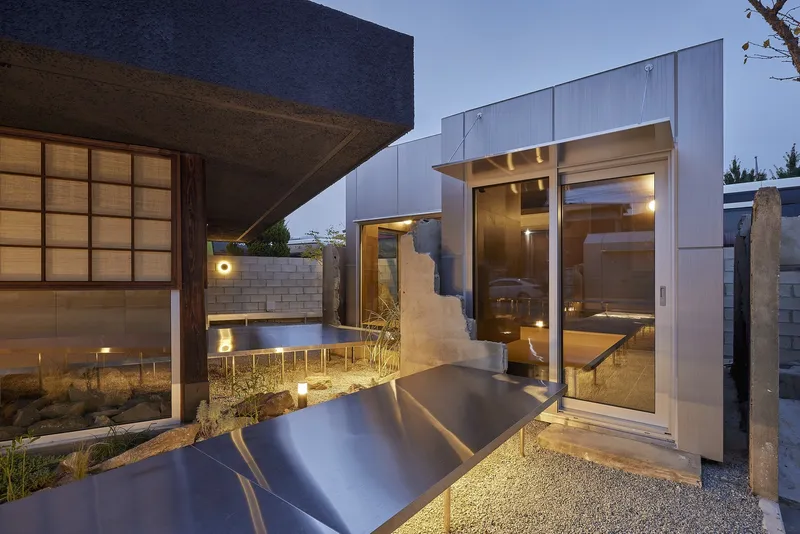
The weathered concrete columns and wall fragments scattered through the courtyards are not decorative. They are the bones of whatever occupied this site before, left standing as a deliberate refusal to erase. NOMAL positions new steel elements, like the elevated table and walkway, in direct conversation with these remnants, creating a visual dialogue between raw decay and precise fabrication. The gravel ground plane unifies everything, treating old and new as equal participants in the same landscape.
At dusk, the interplay becomes almost theatrical. The flat roof overhang of the new pavilion hovers behind a solitary concrete column, framing it like a stage prop. The metal-clad volumes adjacent to the gridded sliding doors register as cool and deliberate against the warmth of the ruined surfaces. It is a careful choreography: nothing is incidental, but nothing looks forced either.
Timber Structure and Translucent Screens
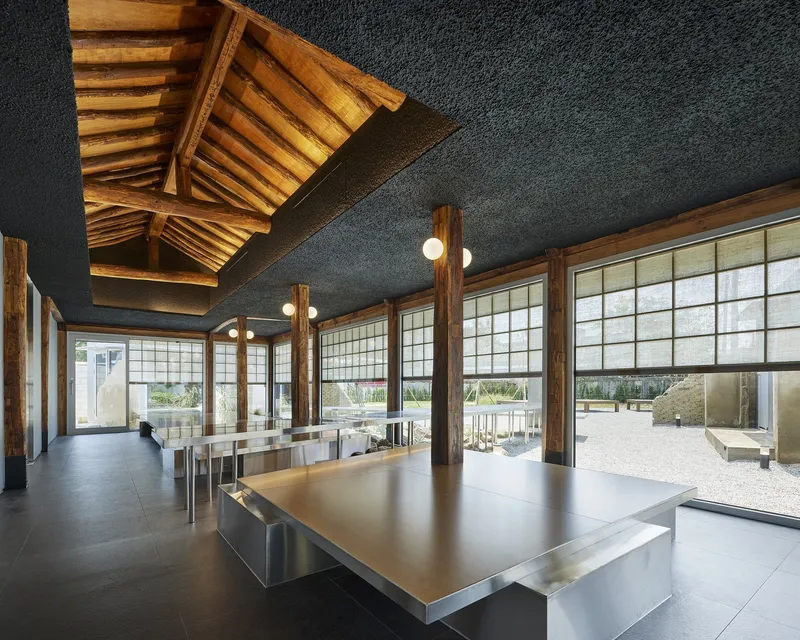
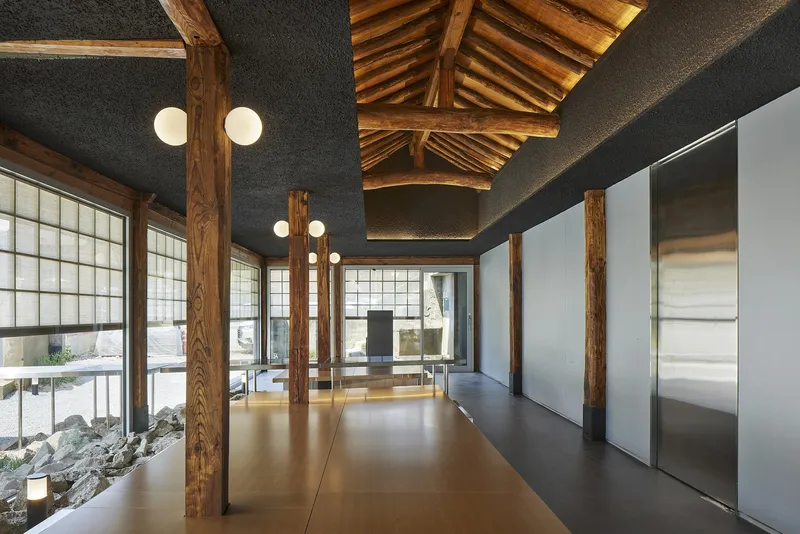
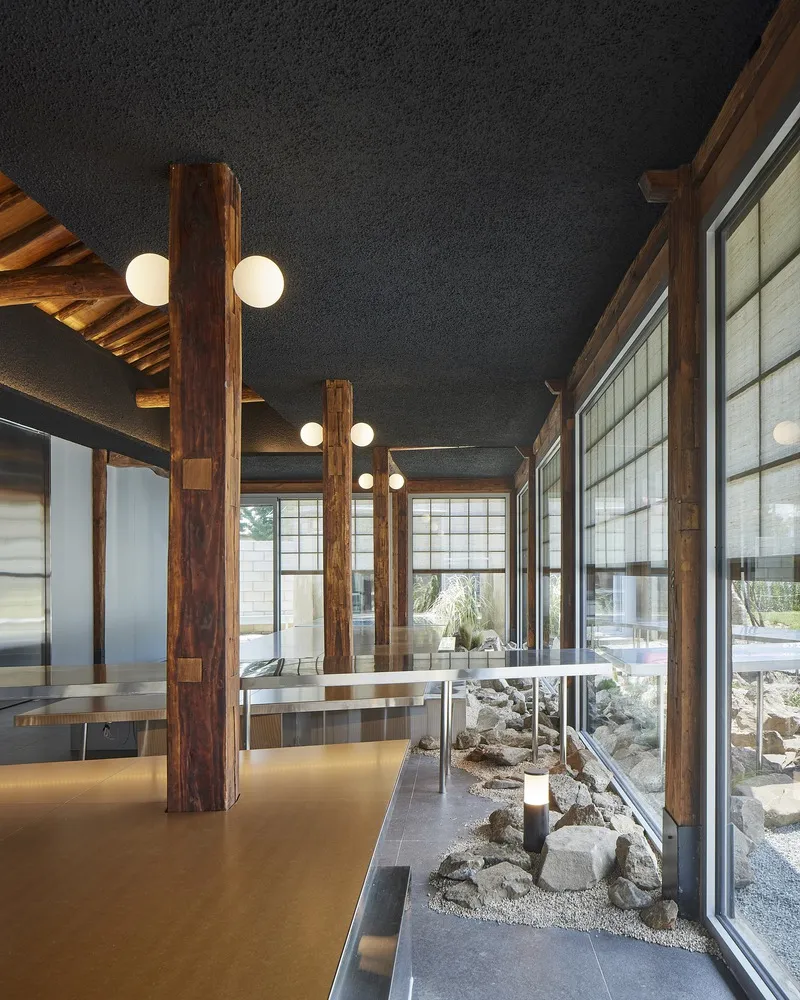
Inside the pavilions, the structural logic is exposed and unapologetic. Timber columns, many of them reclaimed, support a roof of rafters left visible overhead. The sections of the interior hall show how the rhythm of these columns organizes the dining floor without partition walls, allowing long sight lines across stainless steel tables and dark flooring that absorbs rather than reflects the overhead light.
The translucent grid windows and shoji-like screens work double duty. They filter daylight into a soft, even wash that flatters the rough textures of wood and concrete, and they provide privacy from the street without creating opacity. In one view, a rock garden is visible through gridded glass panels, collapsing the boundary between interior and courtyard into a single continuous experience. The polished resin floor in some sections catches the warmth of the timber above, giving the rooms a quiet luminosity.
Elevated Steel and Exposed Earth
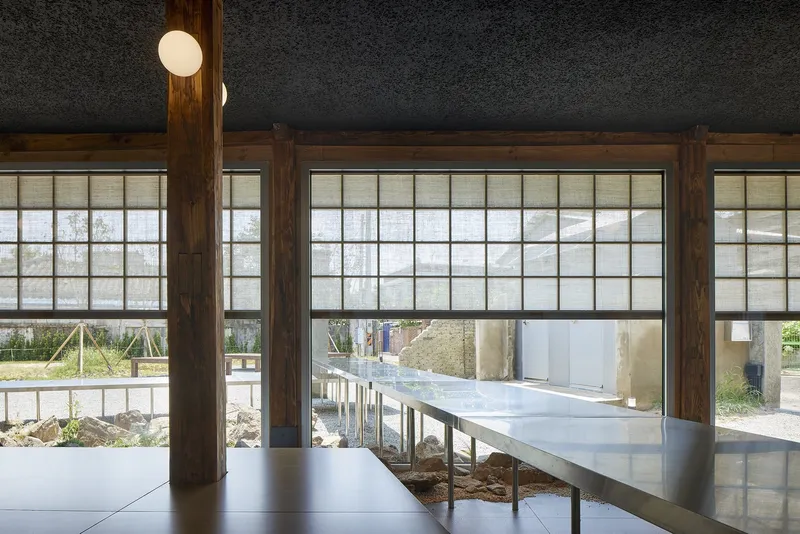
One of the most striking moments in the project is the elevated steel table that bridges exposed earth beneath, framed by timber shoji screens. The detail is both practical and symbolic: by lifting the dining surface away from the ground, NOMAL reveals the raw substrate of the site, reminding diners that they are eating on top of a place with its own geological and material history. It is a small gesture, but it carries the conceptual weight of the entire project.
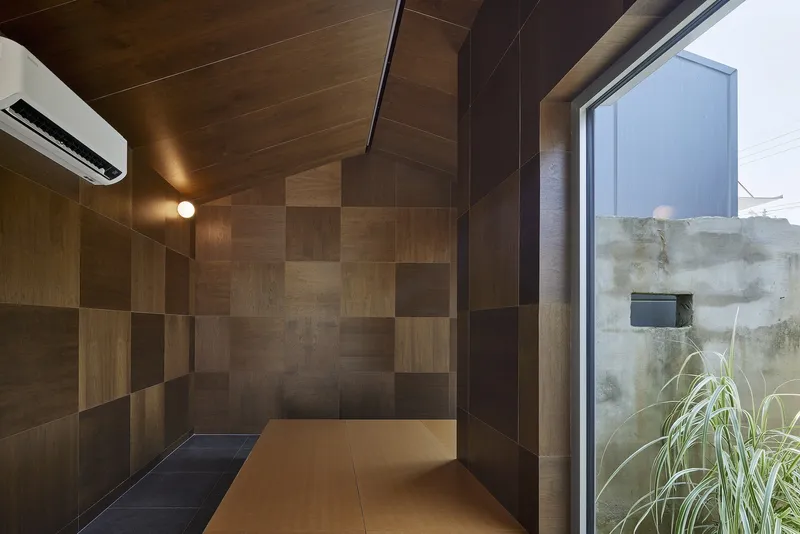
Elsewhere, a room clad in chequered wood paneling on walls and ceiling offers a more enclosed, meditative atmosphere. The view through to a concrete wall beyond keeps the ruin narrative alive even in the most finished interior spaces. NOMAL never lets you forget where you are or what was here before.
Plans and Drawings
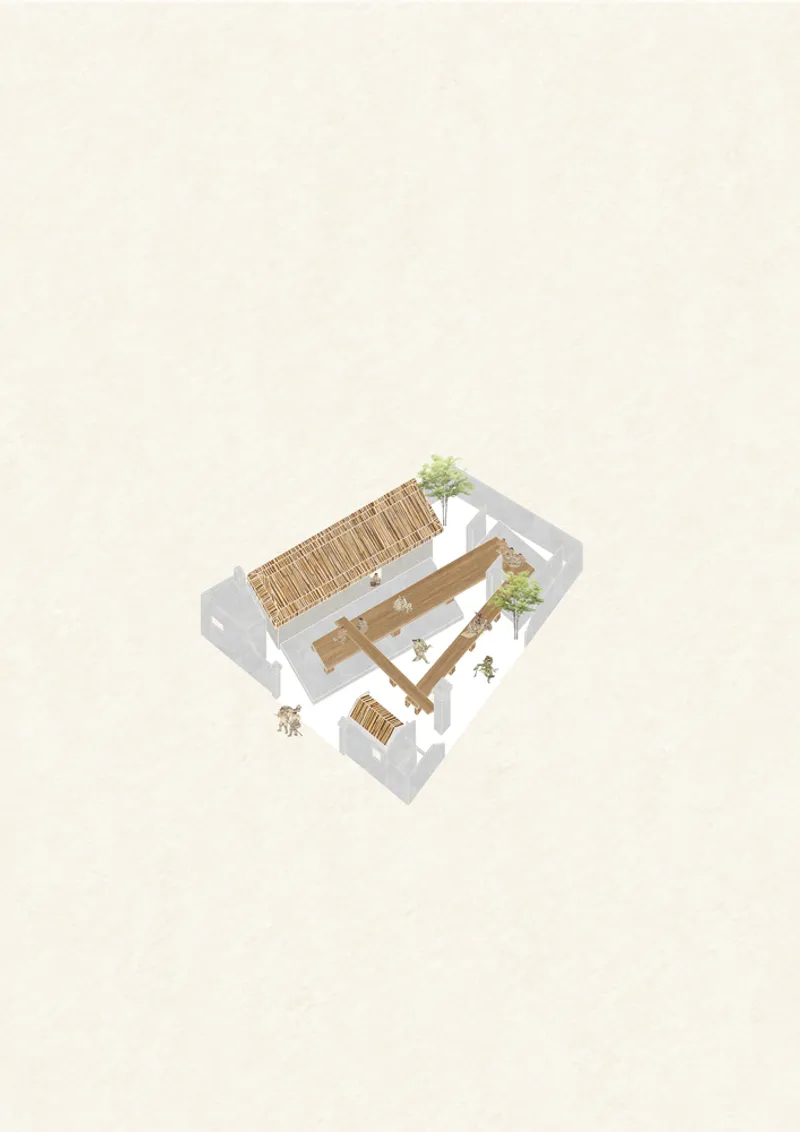
The axonometric drawing peels back the roof to expose the compound's organizational logic: a series of timber-framed volumes arranged around courtyard voids, with interior plantings punctuating the dining spaces. The drawing makes explicit what the photographs imply, that the courtyards are not residual space left over between buildings but are the primary organizing element around which everything else is arranged. Planting, structure, and circulation share the same spatial framework.
Why This Project Matters
Adaptive reuse projects in South Korea often default to one of two modes: total erasure followed by nostalgic reconstruction, or heavy-handed preservation that treats old fabric as untouchable. Joomak does neither. It treats the existing ruins as active participants in a new spatial composition, neither museumified nor hidden. The new timber pavilions have their own clear formal identity, and the gravel courtyards refuse to choose sides. The result is an architecture that acknowledges time without being sentimental about it.
For Palbok-dong, the stakes go beyond aesthetics. A neighborhood restaurant that brings people into a neglected district, that makes them linger in courtyards rather than eat and leave, has genuine urbanistic value. NOMAL has shown that you can build something humble in scale but serious in ambition, and that the most effective form of revitalization might not be a grand civic gesture but a place where you sit on a steel bench in a gravel courtyard, eat well, and notice, perhaps for the first time, the beauty of a weathered concrete column.
Joomak Restaurant by NOMAL, Palbok-dong, Jeonju, South Korea. Photography by Roh Kyung.
About the Studio
Share Your Own Work on uni.xyz
If projects like this are the kind of work you want to make, uni.xyz is a place to publish your own, find collaborators, and enter design competitions.



Popular Articles
Popular articles from the community

EW PARK: Sustainable Architecture Reimagines the Future of Urban Parking
EW PARK reimagines city parking as a modular wooden tower combining automation, solar energy, electric mobility, and adaptable urban design.

Hill & Cross Opera: Sculptural Opera House Architecture Shaped by Tallinn’s Landscape and Identity
Hill & Cross Opera reimagines opera house architecture in Tallinn through its sculptural hill, civic plaza, glass wave and a luminous cross.

Riyadh For All: Intergenerational Urban Design for Active Aging in Rabat
Riyadh For All reimagines urban design in Rabat with intergenerational co-living, adaptive courtyards, and Moroccan cultural exchange today.

Co-life: Sustainable Architecture for Age-Friendly Community Living
Co-life reimagines sustainable architecture for seniors through courtyards, rammed earth, shared gardens, and spaces designed for belonging.

Similar Reads
You might also enjoy these articles


Hodi-Mandai Geram
Project Function: Preservation and revitalization of the Intangible heritage and socio-spatial identity of the Hodi by Housing, Cultural Memory Center, Sacred Grove, landscape, local tourism economy


Olio Towers: A Mid-Rise for Performers That Fuses Housing, Rehearsal, and Stage
Located blocks from Houston's Theater District, this modular tower stacks living units around a central performance atrium.

Oasis: Modular Green Housing Carved into Dhaka's Urban Fabric
A shortlisted Plugin Housing entry reclaims unauthorized settlements in Dhaka with stepped concrete volumes, green roofs, and ventilation-driven design.

Black Hole: A Floating Megastructure for the Post-Physical Era
Emiliano Mazzarotto envisions a spherical, self-scaling arena where e-sports, digital hotels, and holographic stadiums replace traditional public space.


Explore Architecture Competitions
Discover active competitions in this discipline



Challenge to reimagine the Iron Throne


Photograph architecture without architects


Illustrate the lost glory of Angkor Wat - Render Challenge


Design challenge to reuse E-waste
Comments (0)
Please login or sign up to add comments
No comments yet. Be the first to comment!