
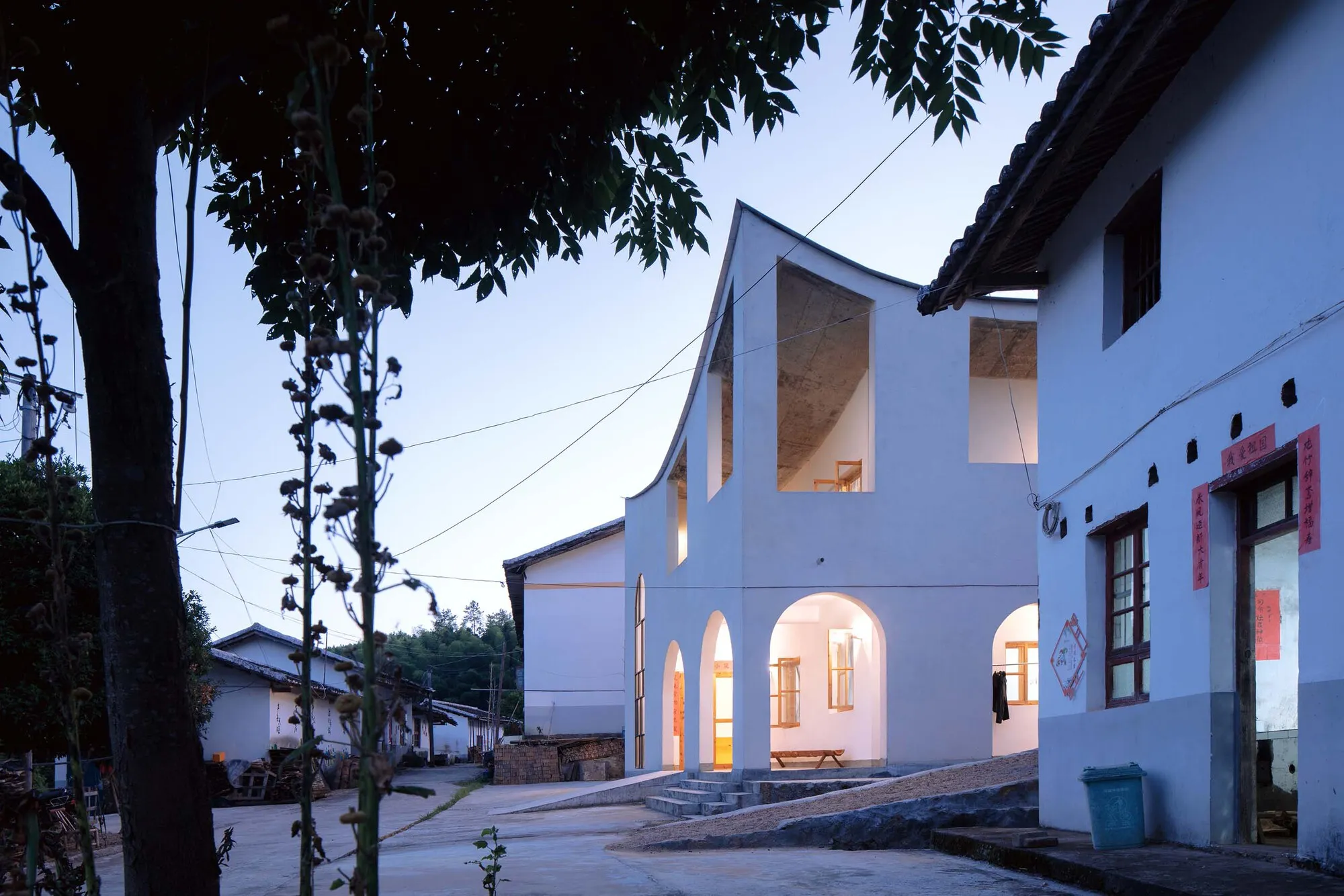
Jumping House Lab Lifts Four Roof Corners to Carve Light into a Rural Chinese Art Studio
A 310-square-meter workshop in Jiangxi Province reimagines the village house by turning its roofline into a landscape of clerestories.


The premise is deceptively simple: take a two-story village house and pull its four roof corners upward. The result is anything but simple. Designed by Jumping House Lab and led by architects Tiantian Wang and Yaqin Luo, this 310-square-meter art studio in Lukeng Village, Fuzhou, Jiangxi Province, transforms one structural gesture into a cascade of spatial consequences. Lifted corners become clerestory windows. Ceiling heights oscillate between half a story and a full double height. Rooms gain identity not through partition walls but through the variable volume above them.
What makes the project genuinely interesting is the way it smuggles formal ambition into a rural reconstruction context without shouting about it. The building is white-walled and tile-roofed, like every neighbor on the village lane. But the undulating roofline and arched openings betray a spatial intelligence that goes far beyond renovation. It is a house that behaves like a section drawing: every cut through it tells a different story about light, height, and use.
A Roofline That Reads as Landscape
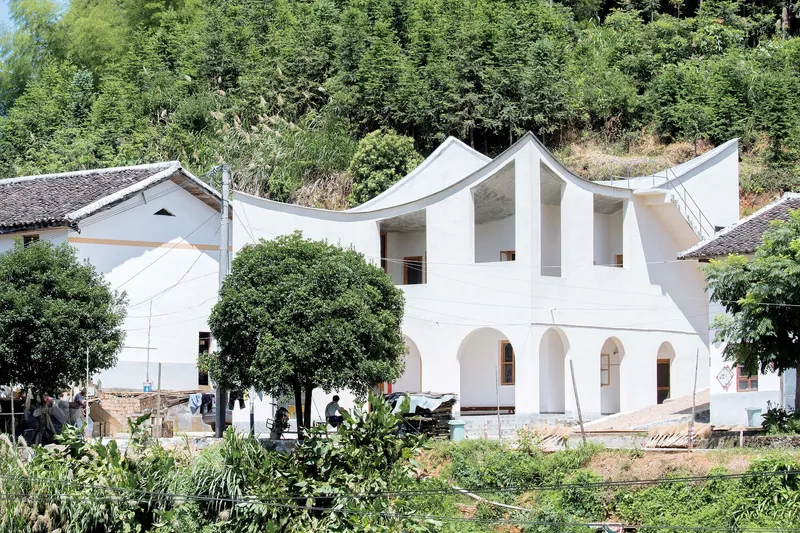
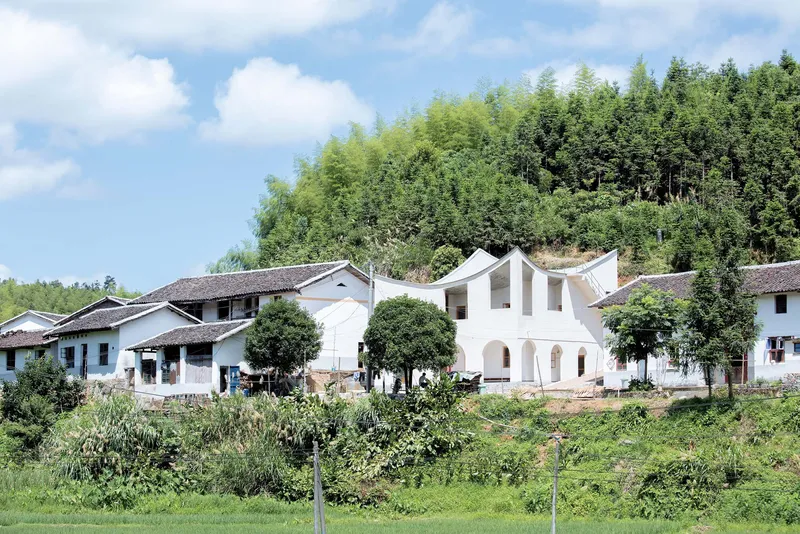
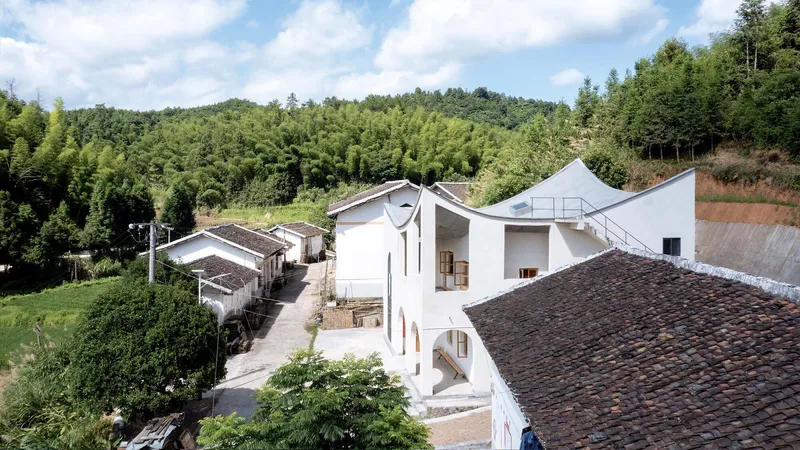
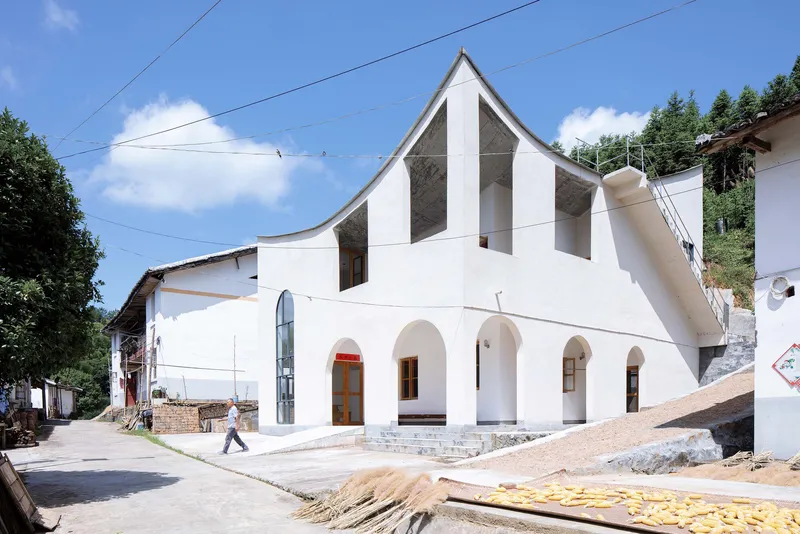
From the village street, the building announces itself through a series of curving peaks rather than a single ridge. Three undulating gable forms rise above the white stucco walls, their profiles just irregular enough to feel alive without veering into willful eccentricity. The effect is somewhere between a traditional roofscape and soft topography, as if the surrounding forested hills had been miniaturized and draped over the structure.
Critically, the building does not dominate its neighbors. Flanked by existing tile-roofed houses and fronted by cultivated fields, the studio holds its place in the village grain. The white walls and clay tiles are deliberate acts of continuity. The architecture's real ambition is all in section, hidden from the casual passerby but legible the moment you step inside.
The Courtyard and the Arch
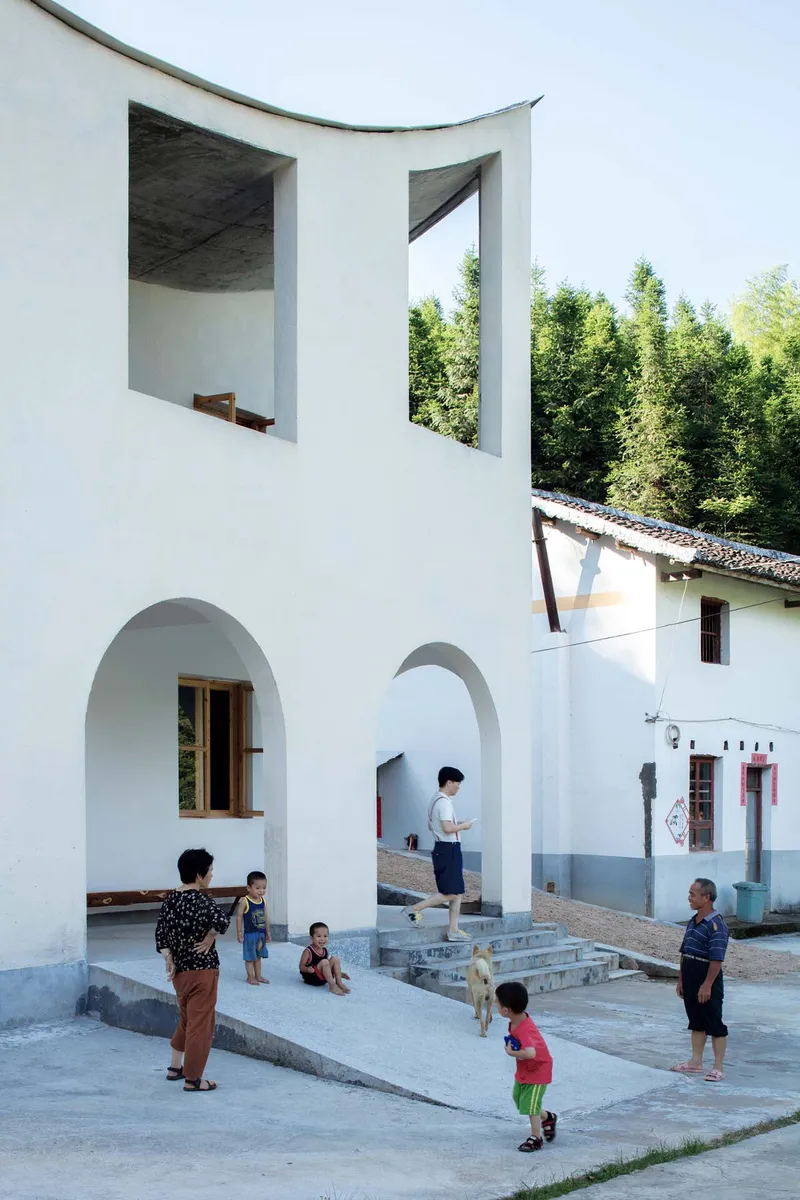
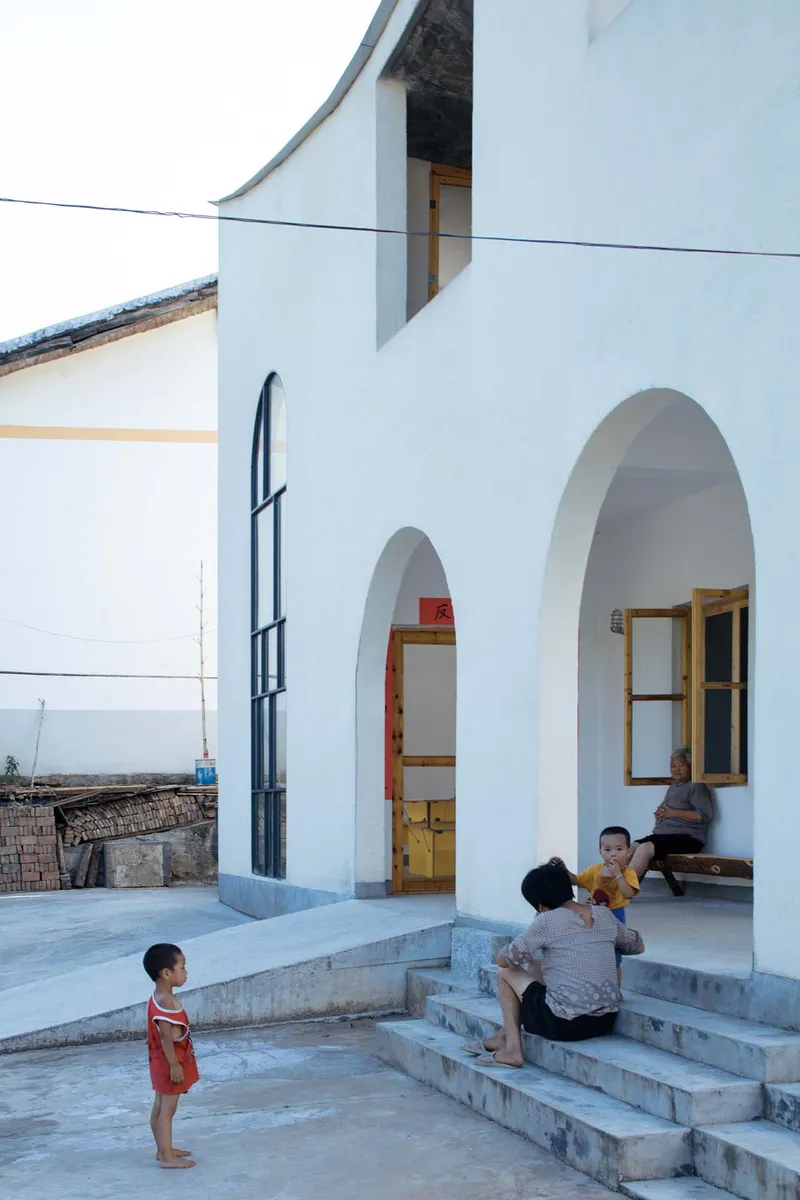
Arched openings appear throughout the building, in courtyard walls, in facades, in interior thresholds. They are not decorative quotations of classical architecture; they work as structural and spatial transitions, marking the boundary between inside and outside, between public and private. The stone-paved courtyard, framed by these arches, becomes a social room open to the sky, a place where children play under curved concrete canopy edges while adults gather in the shade.
The material palette reinforces this sense of generous austerity. Stone steps, white plaster, raw concrete soffits: everything is robust enough for rural life and precise enough to reward close attention. There is no precious detailing here, just careful proportioning of openings that make the courtyard feel both sheltered and expansive.
Interior Heights That Define the Program

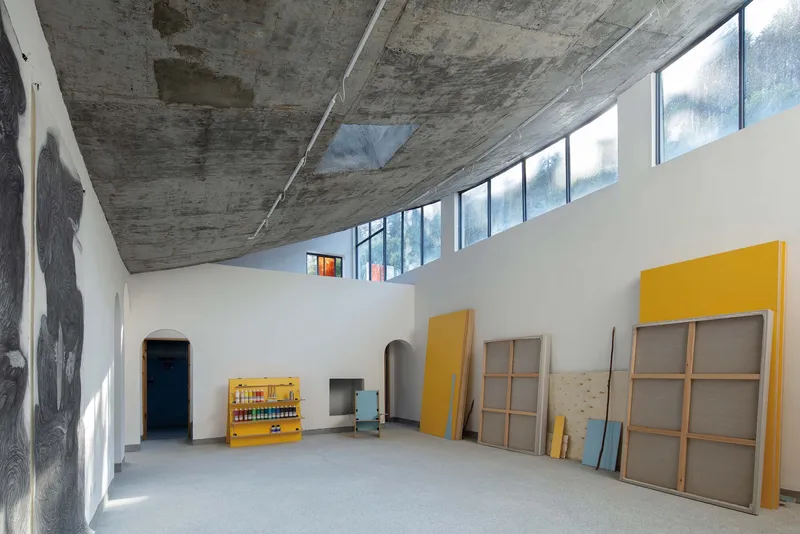
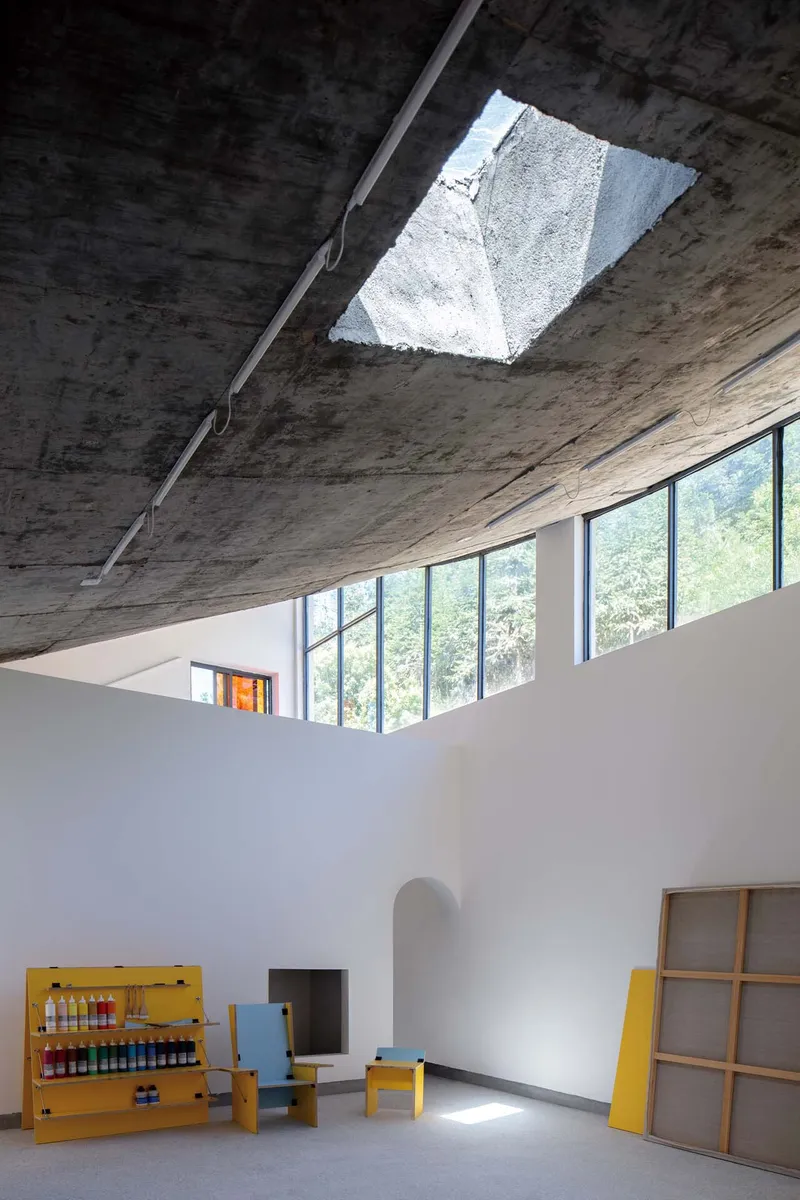
The lifted roof corners produce a cascade of ceiling heights inside, and the architects use this gradient to assign function without heavy partitioning. The double-height gallery space, with its exposed board-formed concrete ceiling and clerestory windows, is where the art studio breathes. Light enters from above in controlled slices, illuminating white walls that serve as both backdrop and potential exhibition surface. Yellow storage units line the lower walls, their color a warm punctuation against the otherwise restrained material vocabulary.
Where the ceiling drops to one-and-a-half or even half a story, rooms become intimate: reading nooks, sleeping platforms, corners defined by compression rather than enclosure. The logic is almost geological. You move through the building as you would move through a landscape of varying elevation, and your body registers the spatial shift before your mind names it.
Light as Material
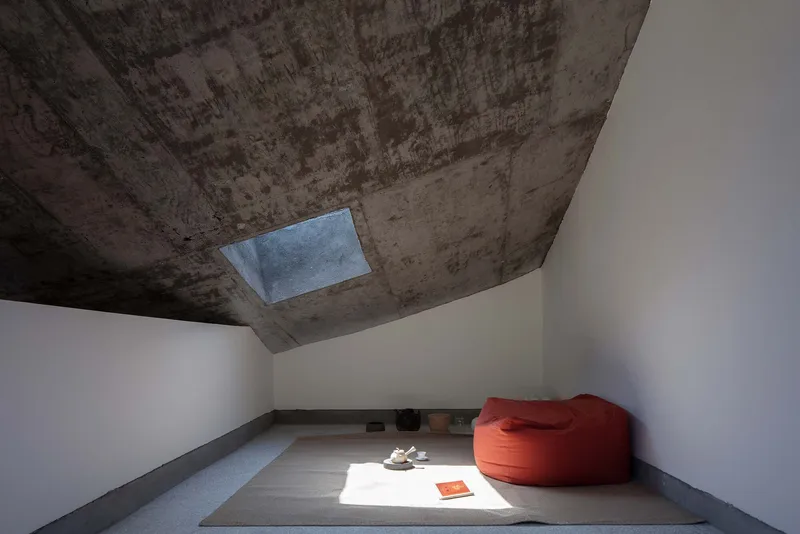
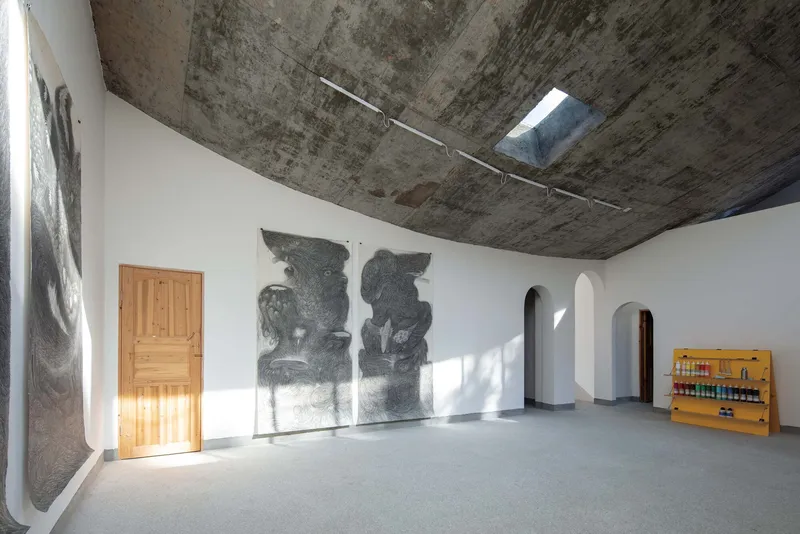
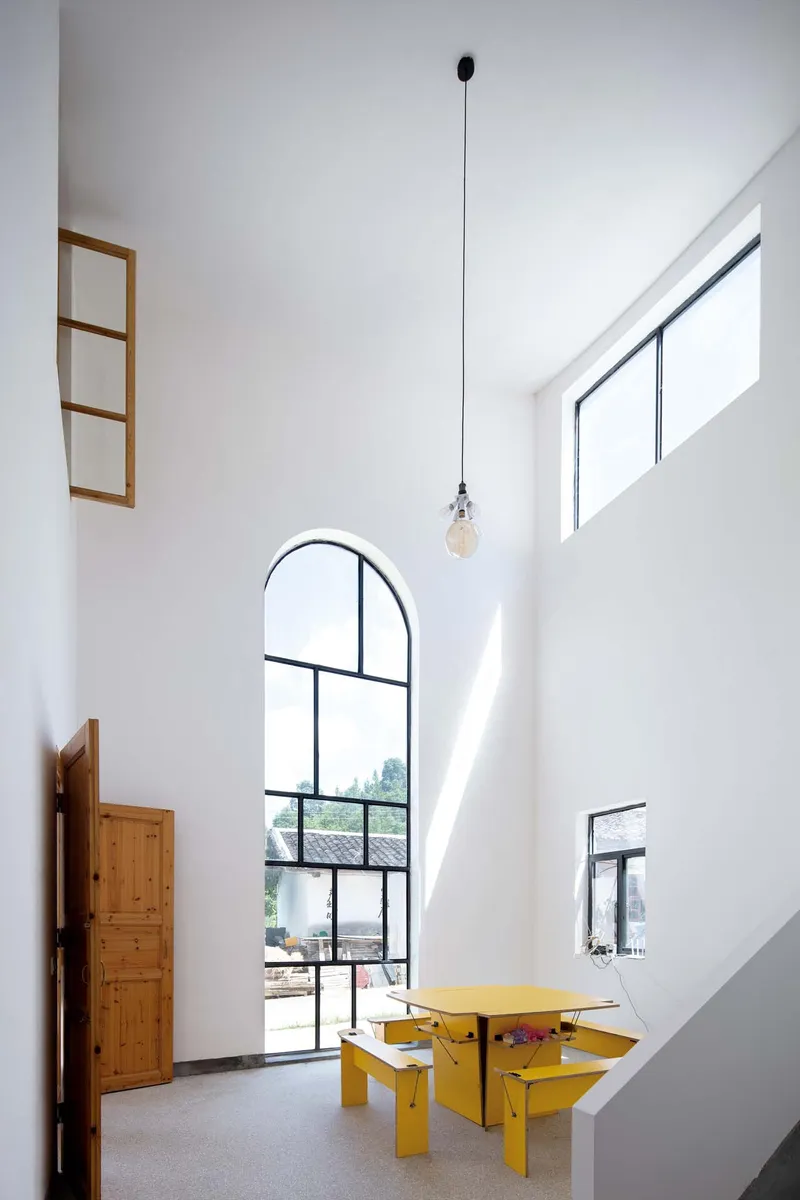
The building's relationship to light is its most accomplished quality. Rectangular skylights punched through the raw concrete ceiling create pools of daylight that shift across interior walls throughout the day. The arched windows, some with steel muntin grids, frame views of greenery with the deliberateness of landscape paintings hung on white plaster. A pendant bulb dangles beside one such window, a reminder that this is a working studio, not a gallery, and that electric light will take over when the sun sets.
The board-formed concrete ceilings deserve particular mention. Their texture absorbs and scatters light in a way that smooth plaster never would, lending warmth and grain to overhead surfaces that might otherwise feel oppressive at the lower ceiling heights. It is a material decision that does double duty: structural honesty and atmospheric calibration in one move.
After Dark
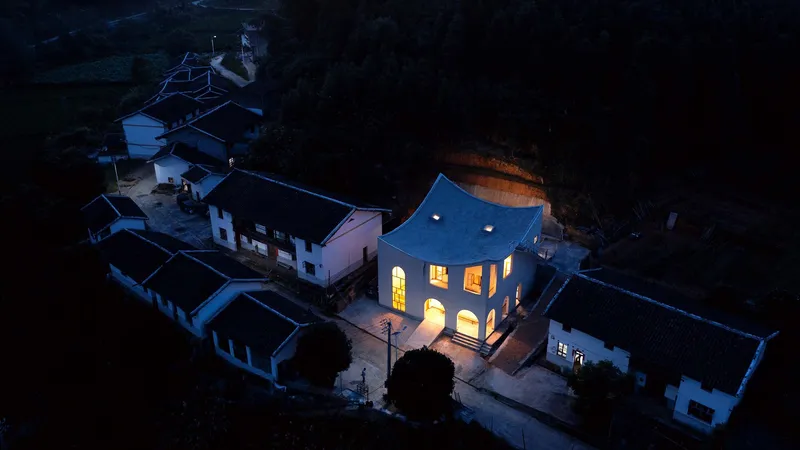
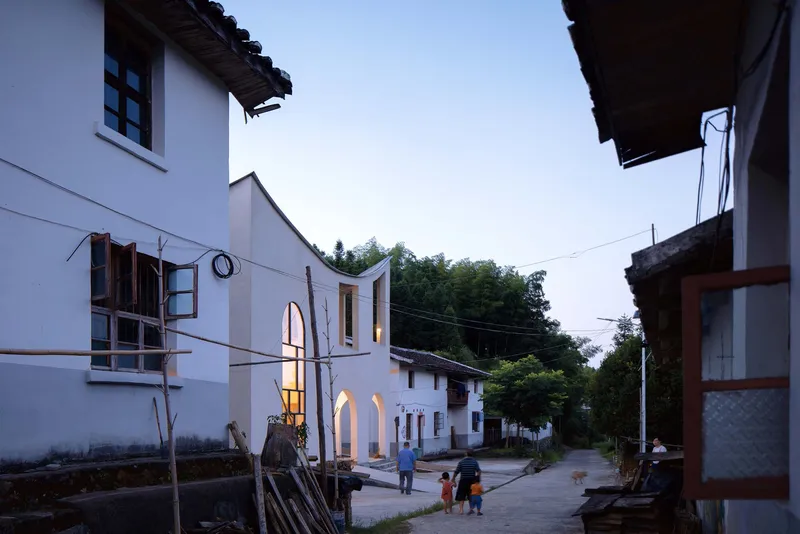
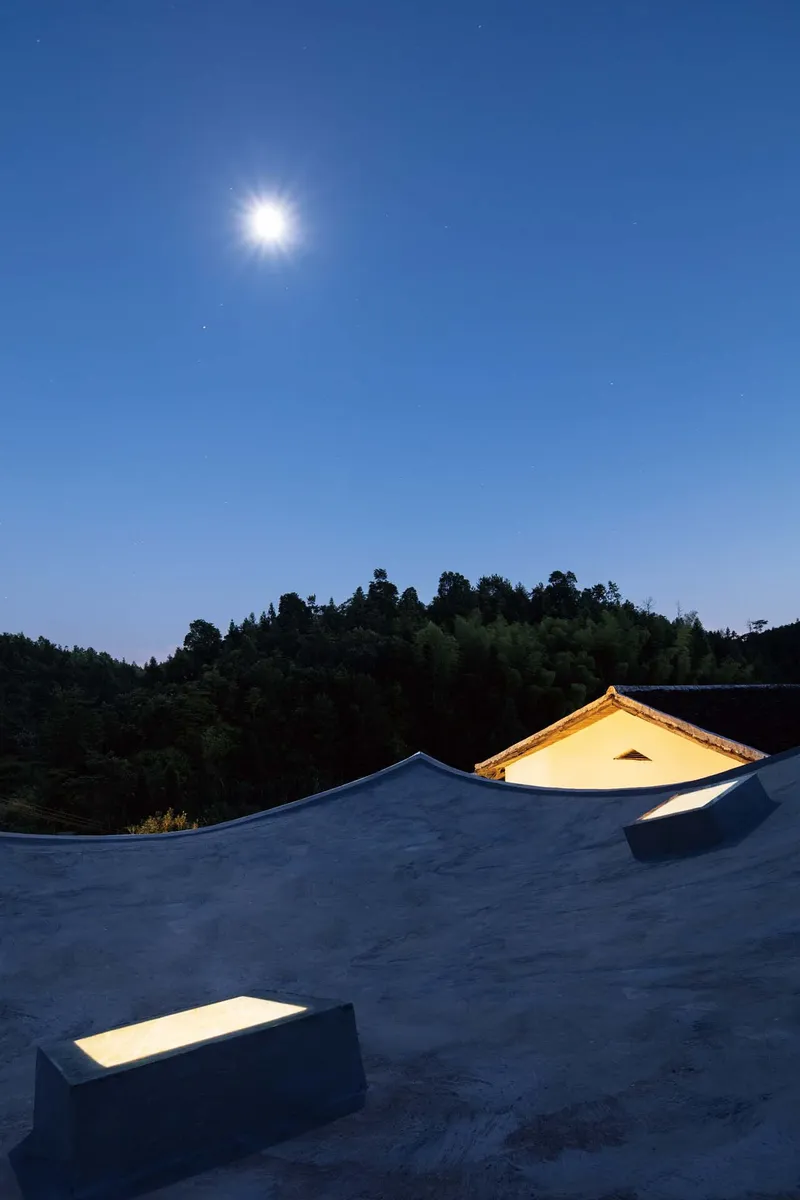
The twilight and nighttime photographs reveal a building that inverts its daytime character. Where daylight enters through skylights and clerestories, warm interior light now spills outward through the arched openings, turning the studio into a lantern on the village street. Residents walk past the glowing entrance as if it were the most natural thing in the world, which is precisely the point. The building's ambition is absorbed into the rhythms of daily life rather than standing apart from them.
On the rooftop terrace, curved parapets frame a lit gable skylight under moonlight. The forested hillside behind completes the composition. It is a genuinely atmospheric moment, one that justifies the complexity of the roof structure by offering a place to sit and look at the sky.
Terraces, Thresholds, and the View Beyond
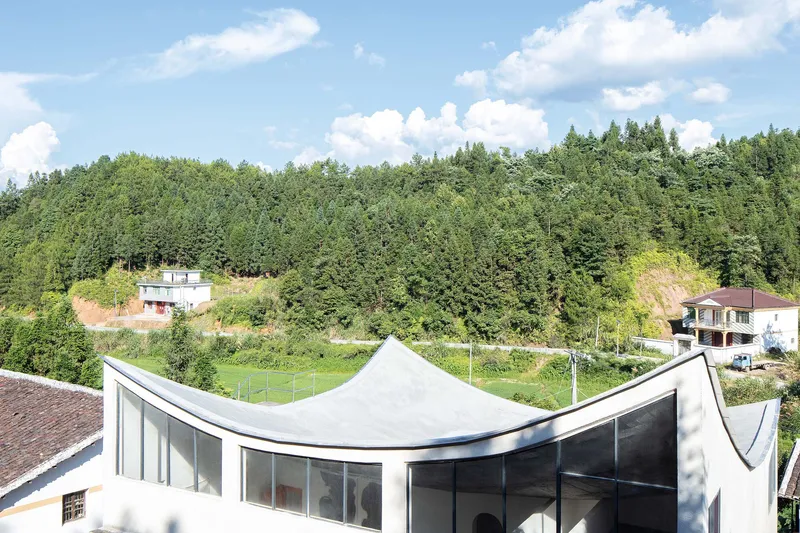
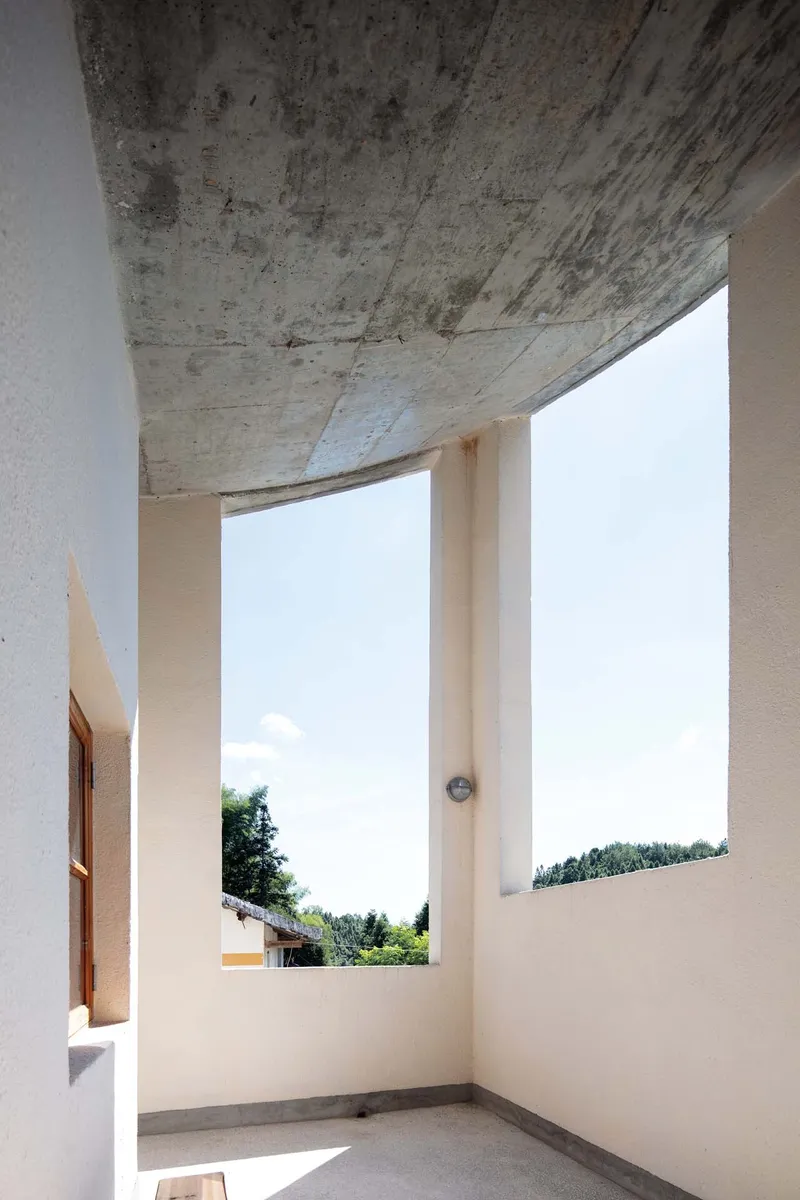
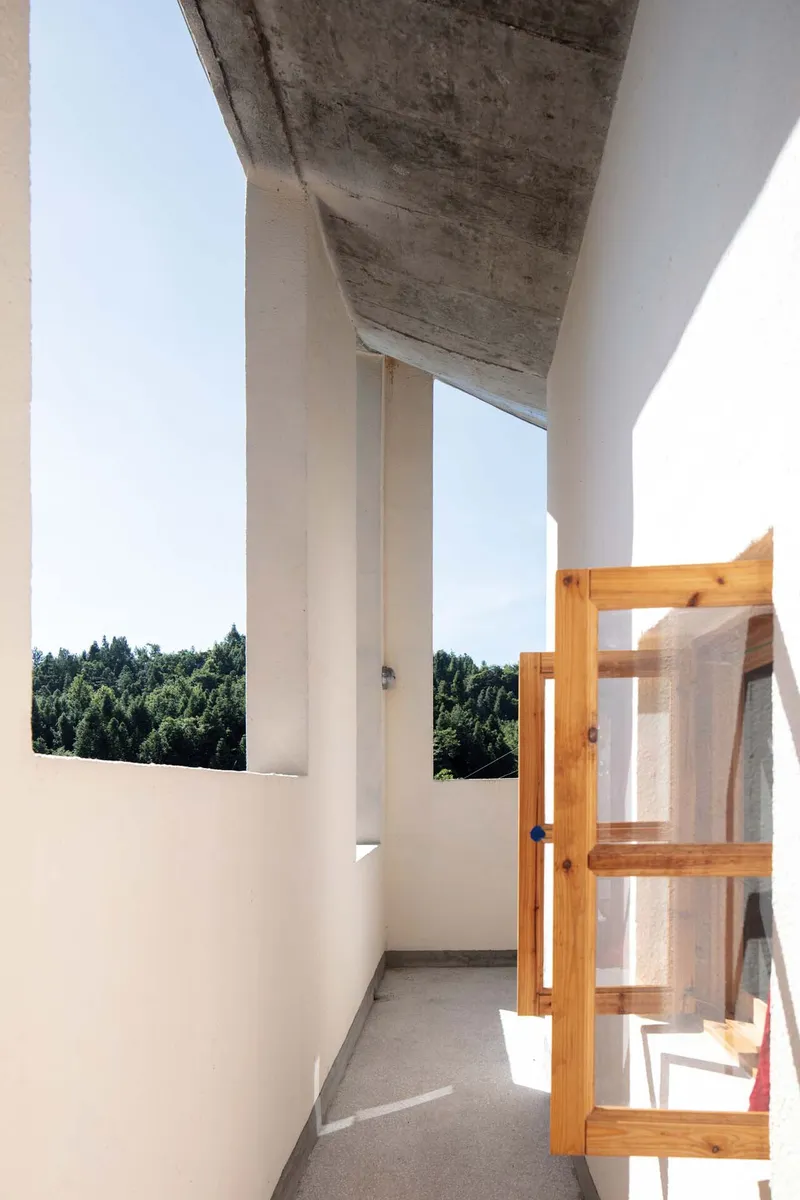
The upper levels offer a series of terraces and balconies that extend the interior life of the studio into the open air. A curving white roof canopy shelters floor-to-ceiling glazing that overlooks the valley. Narrow balconies with board-formed concrete soffits and timber window frames provide perches from which to watch the forested hills change color through the seasons. These are not afterthought spaces; they are carefully sized and oriented to maximize the views that the rural setting provides so generously.
The building's relationship with its landscape is reciprocal. It borrows the valley panorama for its interiors and returns, through its white walls and undulating silhouette, a composed object that the village itself can look at and recognize as belonging.
Village Context
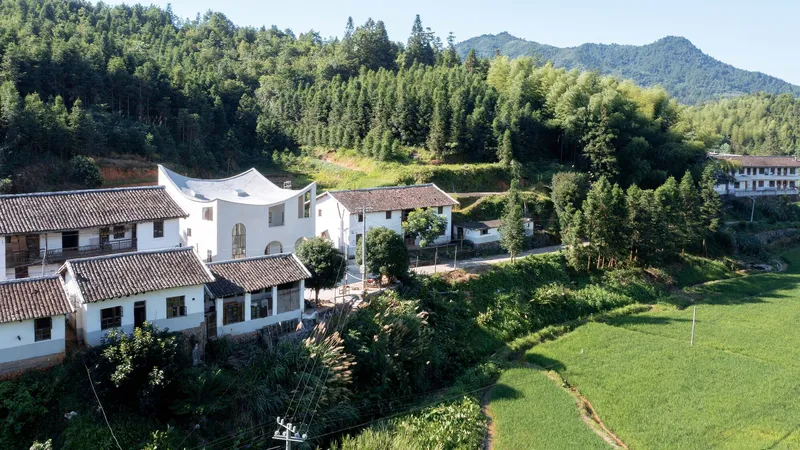
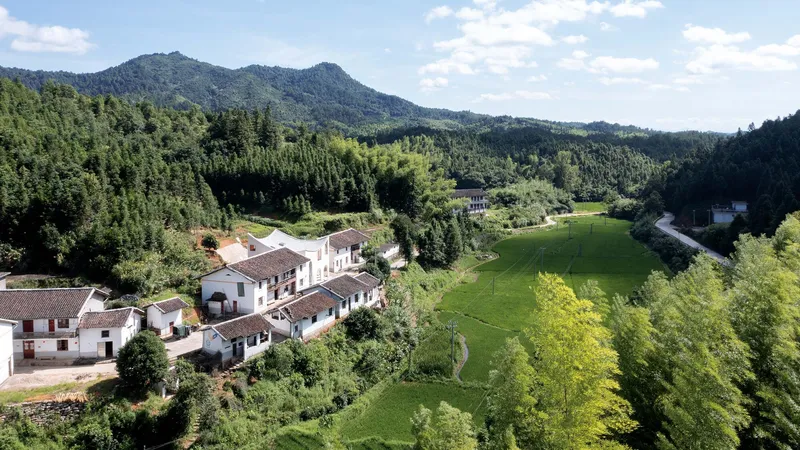

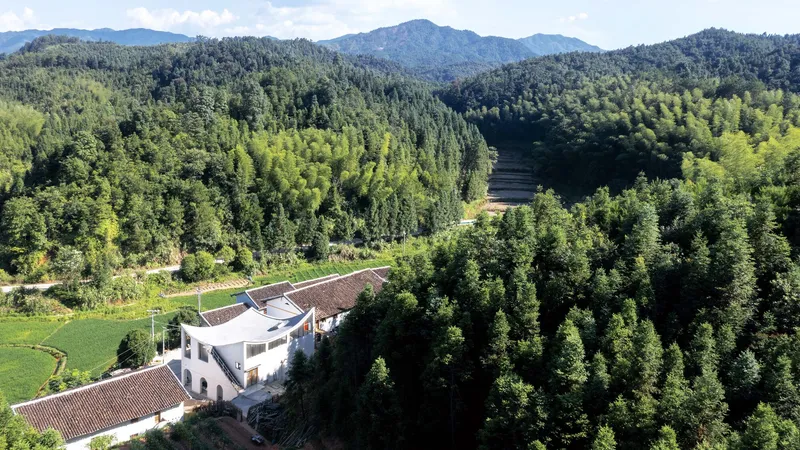
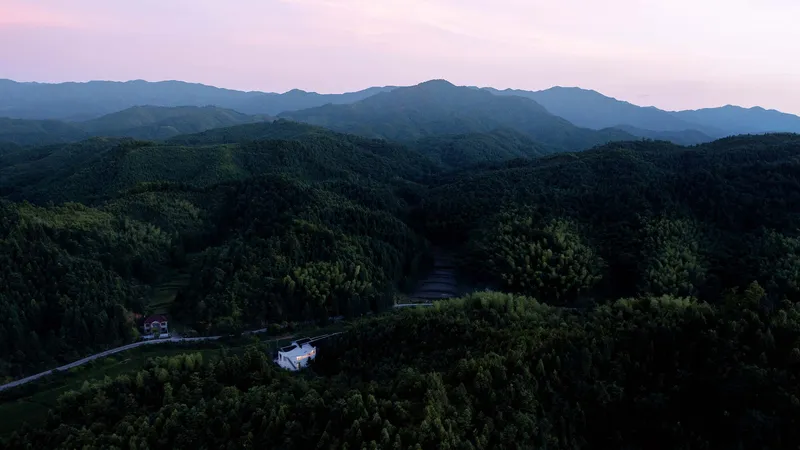
Aerial views situate the studio within the broader fabric of Lukeng Village: terraced farmland, rice paddies, bamboo forests, and clusters of whitewashed houses with tile roofs winding along narrow roads in a mountain valley. The studio is unmistakable from above, its flowing roof forms slightly larger and more assertive than its neighbors, but it does not rupture the settlement pattern. It occupies a compound footprint consistent with the village scale.
China's rural reconstruction movement has produced its share of overwrought gestures, buildings that impose metropolitan aesthetics on agricultural landscapes. This project avoids that trap by grounding its formal invention in a single structural idea, the lifted roof corners, and executing it in local materials: stone, concrete, wood, and plaster. The ambition is embedded in the section, not in the surface.
Plans and Drawings
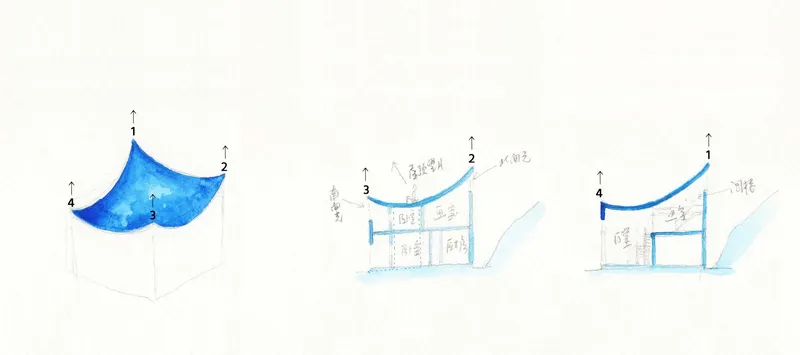
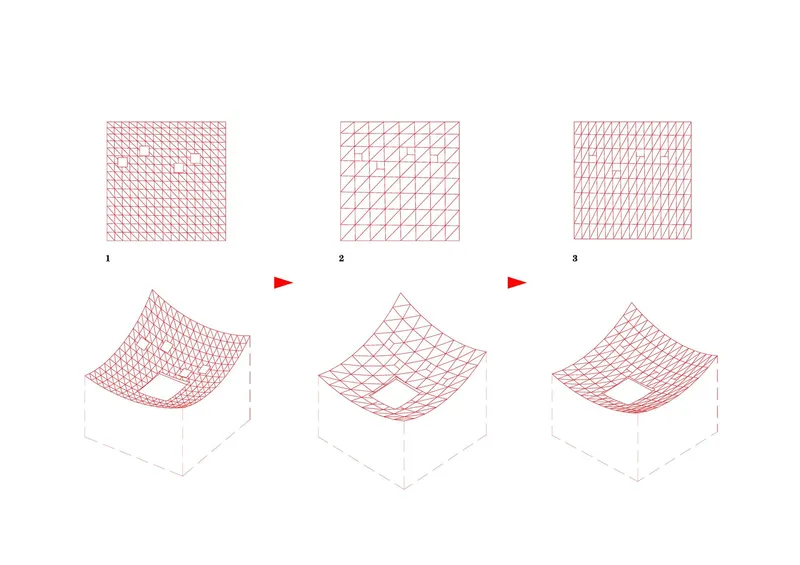

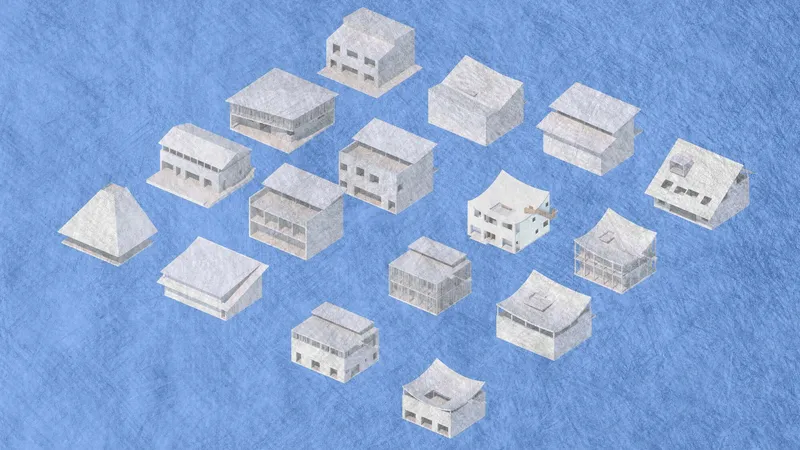
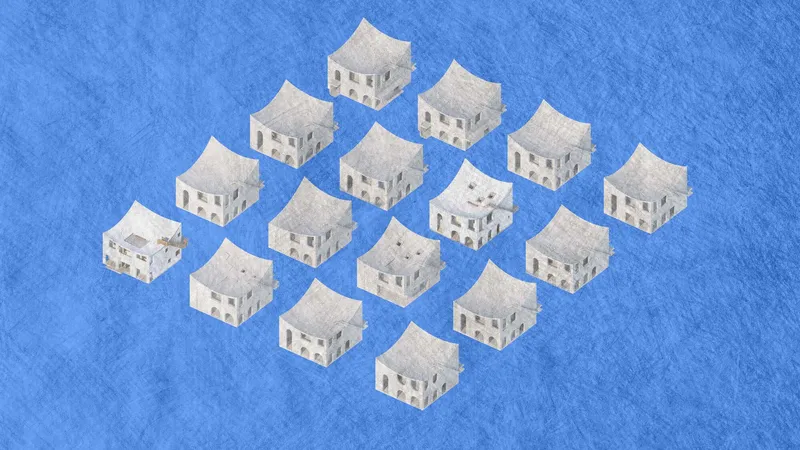
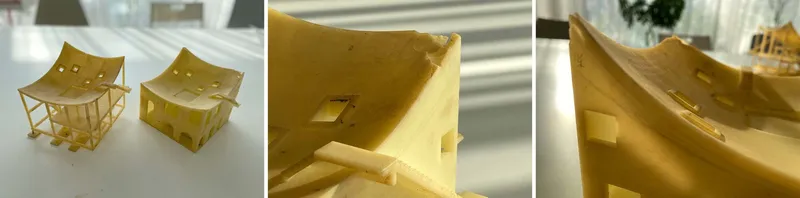
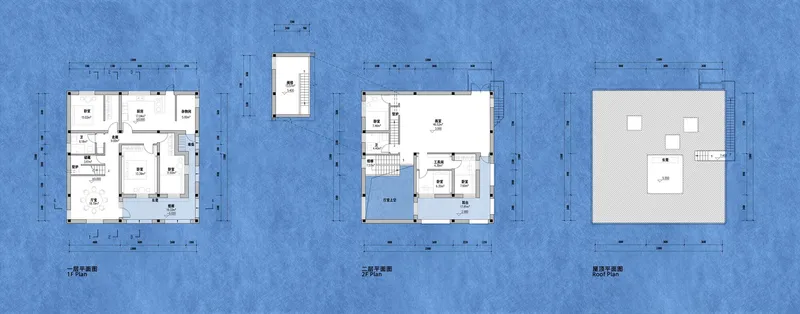
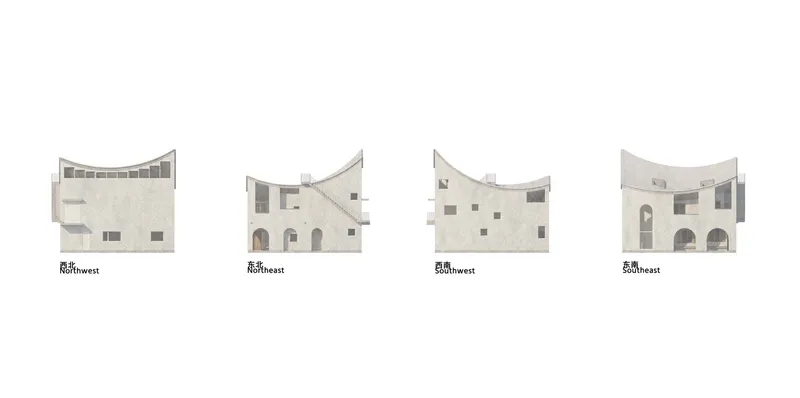
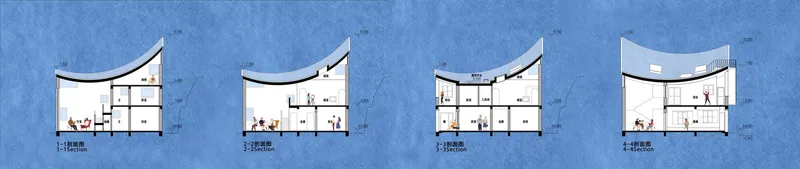
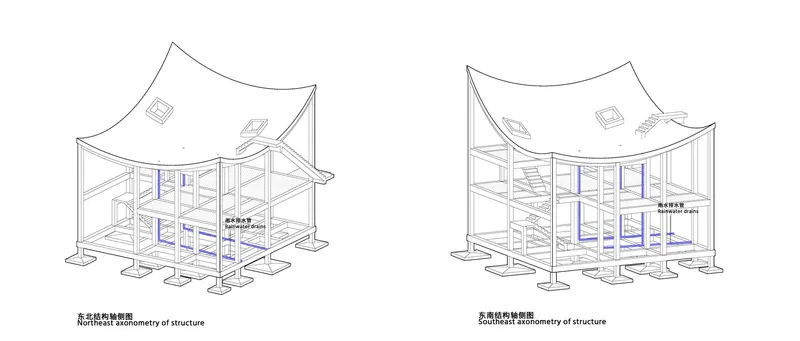
The drawings and diagrams lay bare the project's generative logic. Section diagrams show how a regular structural grid is deformed by lifting the four corners, creating a draped roof surface with central openings that admit zenithal light. The physical model, with its timber structure supporting a draped yellow fabric, makes the concept visceral: this is a tablecloth pinched at the corners, frozen in concrete. Axonometric studies trace the evolution from cubic volumes to arched, clustered forms. Floor plans reveal a compact three-level organization with a tower element, while elevations and sections confirm that every facade tells a different story about interior height.
The structural framing axonometric is particularly revealing. Symmetry annotations show that the roof's apparent freedom is governed by a disciplined grid, each deformation calculated to produce a specific ceiling height and light condition on the floors below. It is a reminder that expressive architecture requires rigorous engineering, and that the two are not in opposition.
Why This Project Matters
A Rural Art Studio matters because it demonstrates that a single structural idea, pursued with discipline and material restraint, can generate an entire building's spatial character. The lifted roof corners are not a formal flourish; they are the engine that drives ceiling heights, light quality, program distribution, and even the building's relationship to its village context. In a field prone to overcomplicating its narratives, this project offers a lesson in the power of one clear move.
It also matters as a contribution to the ongoing conversation about rural architecture in China. Too often, rural reconstruction projects treat villages as blank canvases for urban experimentation. Jumping House Lab has done something harder: they have introduced real spatial ambition while respecting the material language, scale, and settlement patterns of Lukeng Village. The result is a building that serves its client, an artist named Zhuzi, while enriching the collective life of the street. That is a rare and valuable thing.
A Rural Art Studio by Jumping House Lab (lead architects: Tiantian Wang, Yaqin Luo). Located in Lukeng Village, Fuzhou, Jiangxi Province, China. 310 m². Completed in 2021. Photography by Zhi Xia and Tiantian Wang.
About the Studio
Share Your Own Work on uni.xyz
If projects like this are the kind of work you want to make, uni.xyz is a place to publish your own, find collaborators, and enter design competitions.



Popular Articles
Popular articles from the community

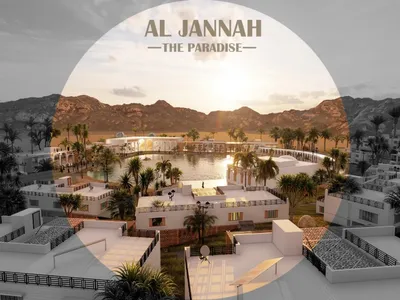
AL-JANNAH: Sustainable Architecture and Permaculture for Afghan Widows
AL-JANNAH uses sustainable architecture and permaculture to create resilient oasis of housing, learning, work and renewal for Afghan widows.
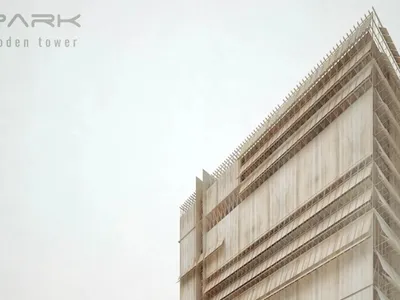
EW PARK: Sustainable Architecture Reimagines the Future of Urban Parking
EW PARK reimagines city parking as a modular wooden tower combining automation, solar energy, electric mobility, and adaptable urban design.

The Musturak Paradise: Senior Living Architecture for a Connected Future in Temara, Morocco
The Musturak Paradise reimagines senior living architecture in Temara via private homes, social spaces, culture, community, and shared care.

Co-life: Sustainable Architecture for Age-Friendly Community Living
Co-life reimagines sustainable architecture for seniors through courtyards, rammed earth, shared gardens, and spaces designed for belonging.
Similar Reads
You might also enjoy these articles

Bao Huynh Watercolor Atelier: A Serene Art Retreat in Hội An
Bao Huynh Watercolor Atelier in Hội An blends multifunctional art spaces, sustainable design, local materials, and family-friendly living in a serene environment.

Atelier Macri Concept Store Interior Design by CASE-REAL
Atelier Macri store features a "ko" counter, walnut wood details, cork displays, blending retail, gallery, and seamless customer experiences.

Manuel Vargas Izquierdo Stadium and High-Performance Sports Center: Architectural Excellence in Jalpa de Méndez
The Manuel Vargas Izquierdo Stadium blends sustainable design, inclusive sports facilities, and cultural-inspired architecture, revitalizing Jalpa de Méndez’s public spaces.
KAKR Buluh Awar Hall: Revitalizing Community and Ecology Through Bamboo Architecture
Community built bamboo hall revitalizes Buluh Awar village, empowering youth, restoring ecology, celebrating vernacular craftsmanship through sustainable architecture and culture.
Explore Chinese Small Scale Architecture Competitions
Discover active competitions in this discipline


Challenge to design mud housing for contemporary communities


Challenge to design luxury tourism on rails


VR headsets Storefront design competition

Designing a staircase for a client
Comments (0)
Please login or sign up to add comments
No comments yet. Be the first to comment!