
K-Studio Extends a 1920s Greek Wine Factory into a 45-Key Seaside Hotel on the Peloponnese Coast
At Kourouta Beach, derelict concrete wine tanks become terrace suites framed by timber pergolas, reflecting pools, and dune grasses.


Some ruins age into irrelevance. Others become more legible with time, their original purpose crystallizing into something worth preserving precisely because it can no longer be replicated. The Dexamenes Seaside Hotel belongs to the second category. Built on the Peloponnese waterfront in the 1920s so that ships could be loaded with wine directly from concrete storage tanks, the structure was abandoned in the 1980s when industrial production methods made its dockside logistics obsolete. K-Studio first intervened in 2019, converting the raw tanks into a hotel of radical restraint. Now, with a 2,760 square meter extension completed in 2026, the project grows without betraying its source material.
What makes this second phase compelling is not just the addition of eight seaview terrace suites, a taverna, and a cultural building, but the way K-Studio refuses to let the new work compete with the old. A lightweight structural frame hovers above the heavy concrete body, following the original grid of the tanks. Timber cladding, slender metal tubes, and wooden pergolas read as provisional next to the permanence of the 1920s concrete. The extension is designed to feel like a conversation between two eras, one muscular and industrial, the other thin-skinned and hospitable, and the building is better for the tension.
Industrial Memory on the Waterline
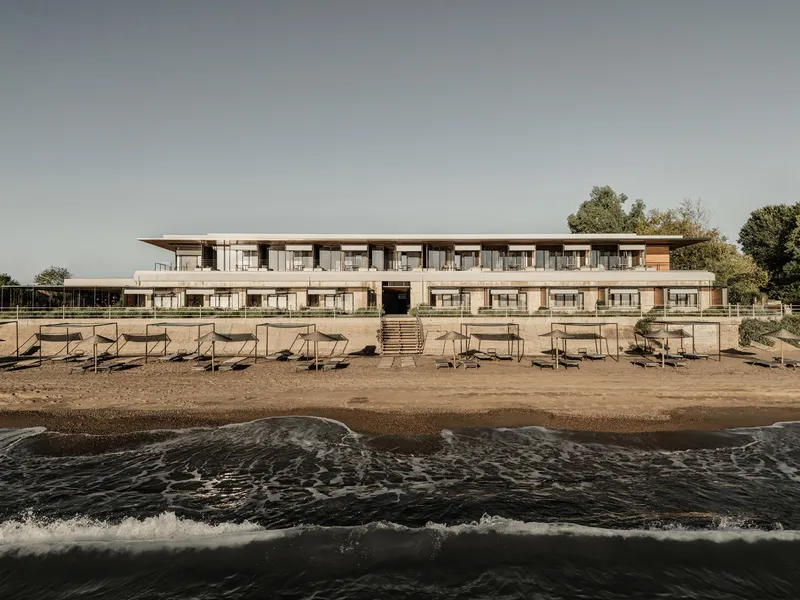
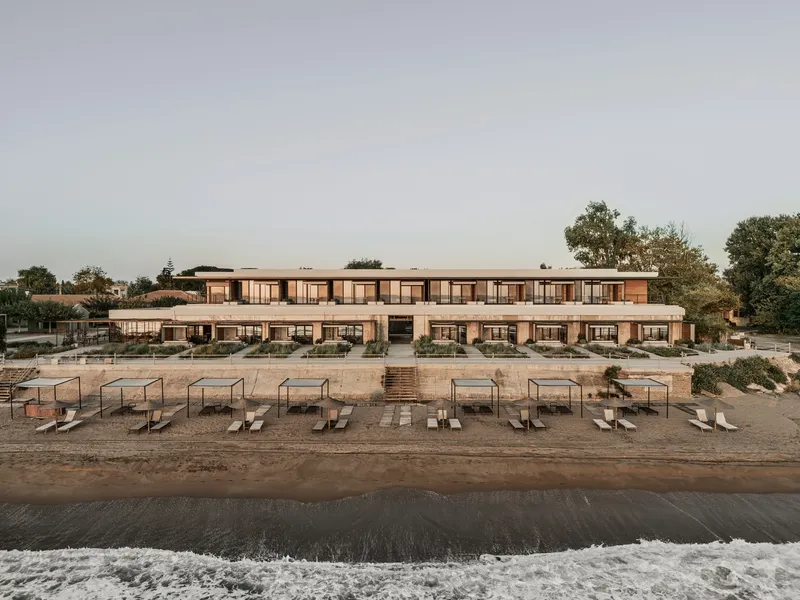
The beachfront facade is the project's most public face, and K-Studio handles it with deliberate understatement. Horizontal timber cladding wraps the upper level, its warm tone set against the bleached concrete of the original tanks below. The composition reads as two distinct registers: a heavy, weathered base that remembers the wine factory, and a lighter residential layer that belongs to the present. Dune grasses planted along the sandy shore blur the threshold between building and beach, refusing the hard line that a conventional hotel might impose.
At dusk, with lounge chairs arranged on the sand and gentle surf lapping at the shoreline, the scene could pass for a Mediterranean postcard. But the concrete is too rough, too honest for that. The building's industrial DNA keeps sentimentality at bay. That restraint is the project's signature move.
Courtyards and Reflecting Pools
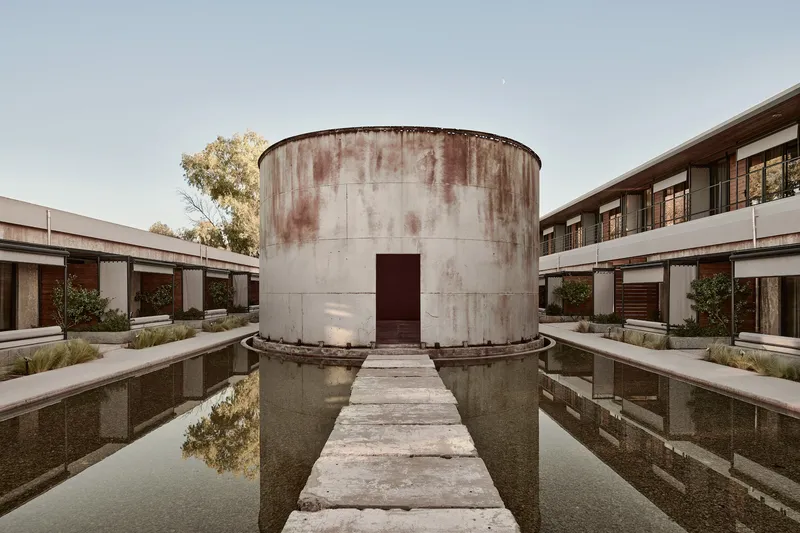
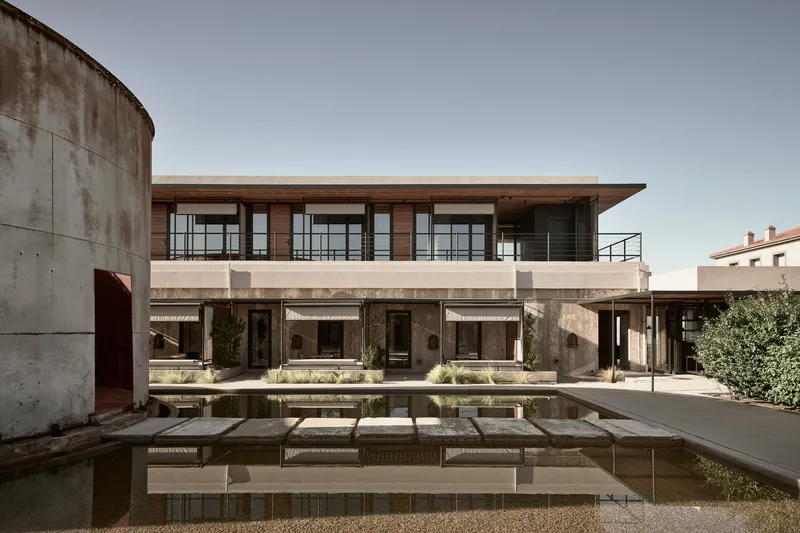
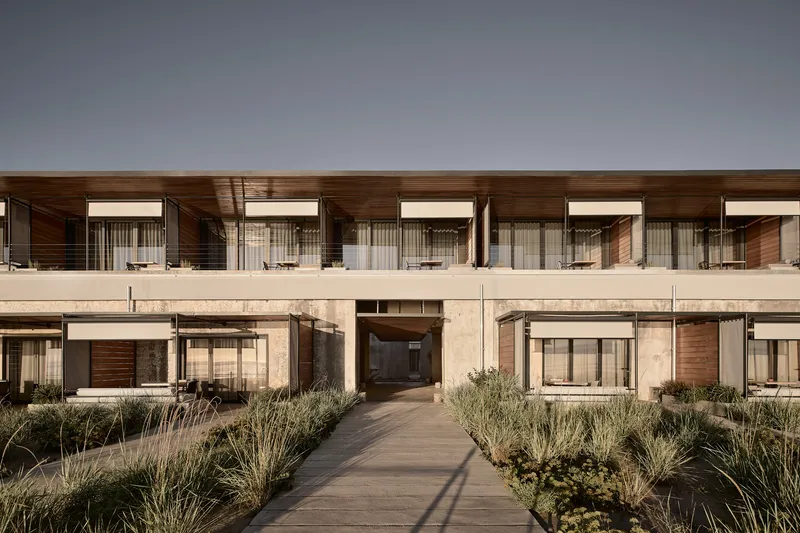
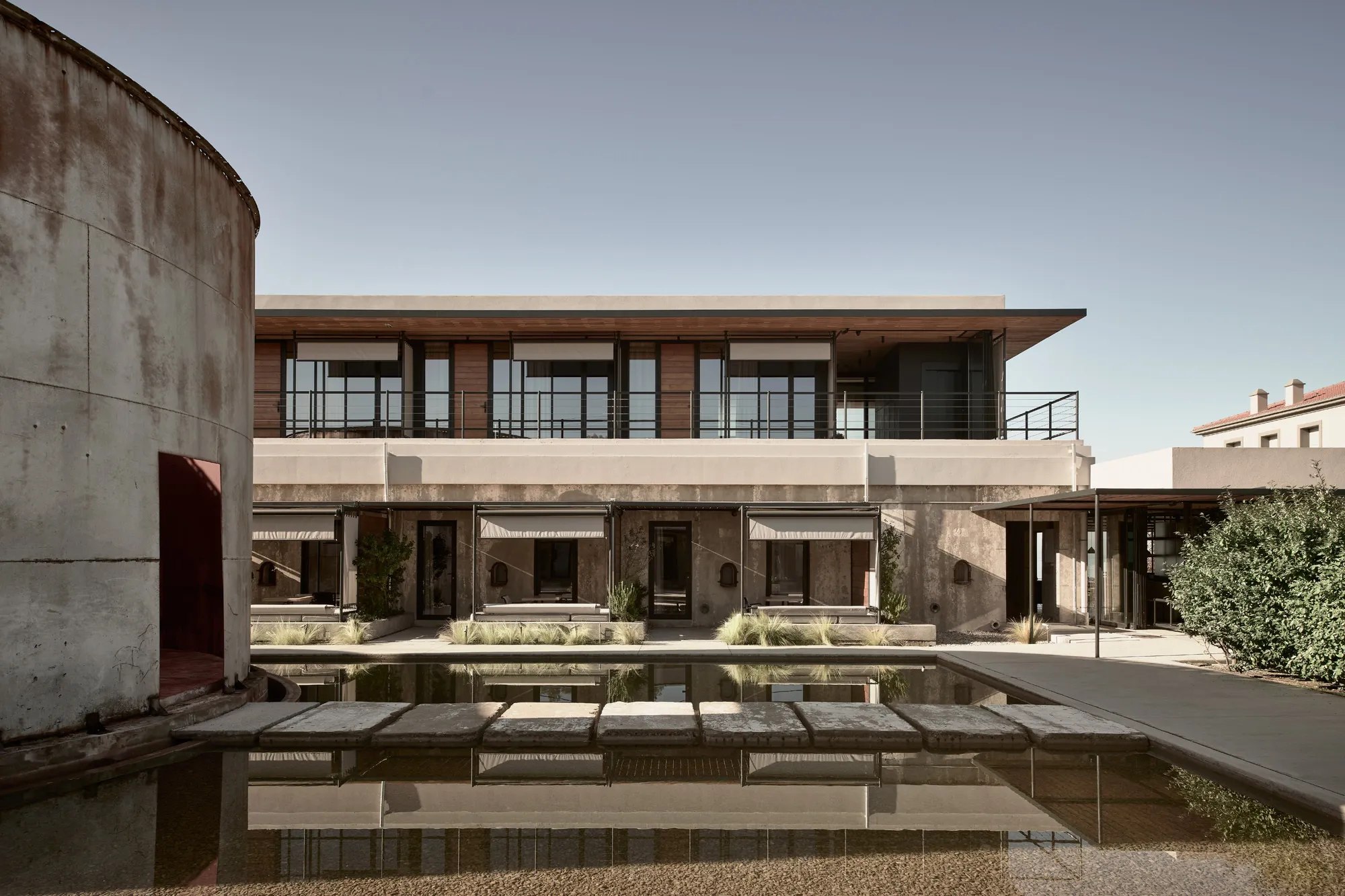
The interior courtyards are where the project reveals its spatial intelligence. A weathered concrete cylinder, likely a remnant of the original winery infrastructure, anchors one courtyard composition. A narrow water channel runs parallel to the facade at the terrace edge, and a reflecting pool with stepping stones doubles the mass of the two-story residential wings in its surface. The effect is meditative, almost monastic, a quality that comes from the decision to leave the heavy elements largely as found.
Entry arrives through a walkway flanked by planted beds of ornamental grasses, establishing the rhythm of the project early: hard concrete, soft planting, water, sky. K-Studio treats landscape not as decoration but as connective tissue between old and new structures, using cultivated vines and native grasses to soften what is fundamentally a concrete compound.
The Timber Canopy as Climate Strategy
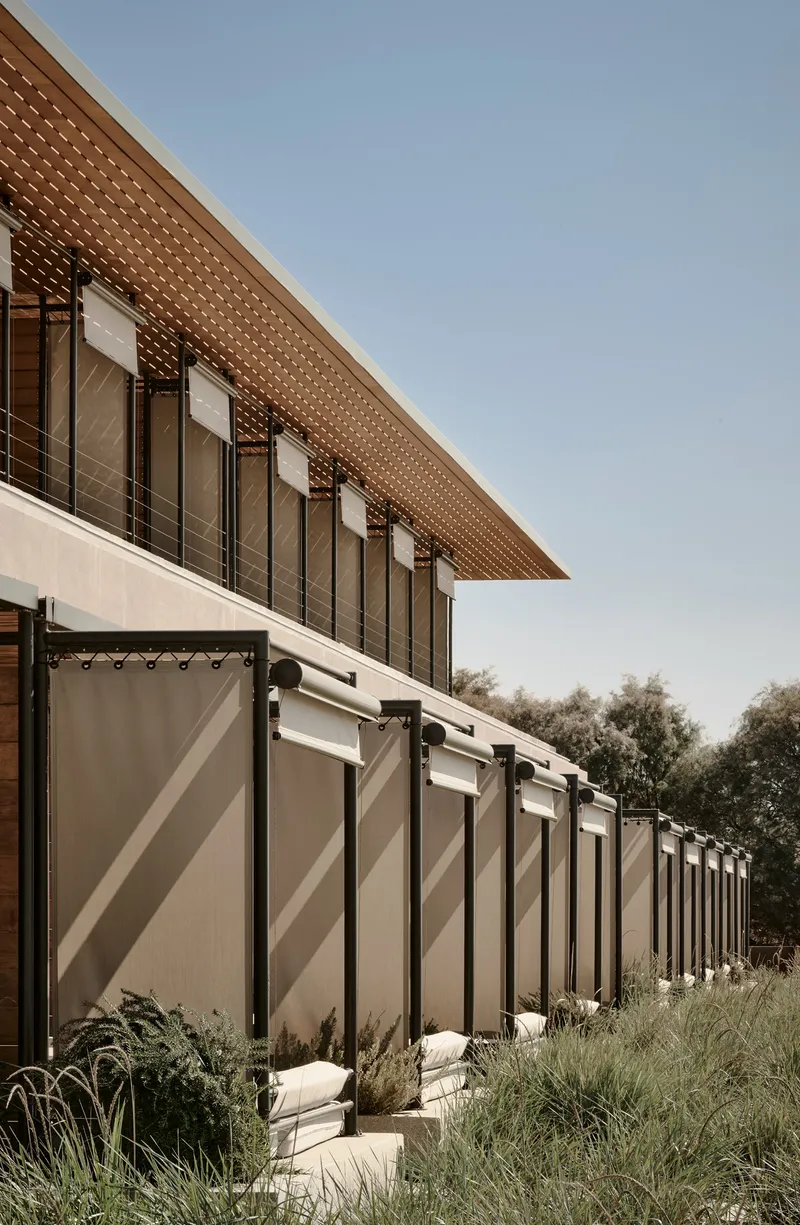
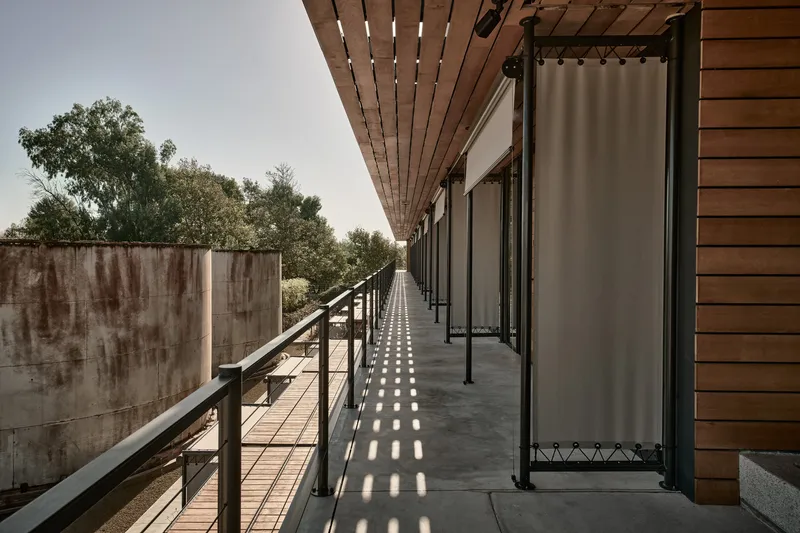
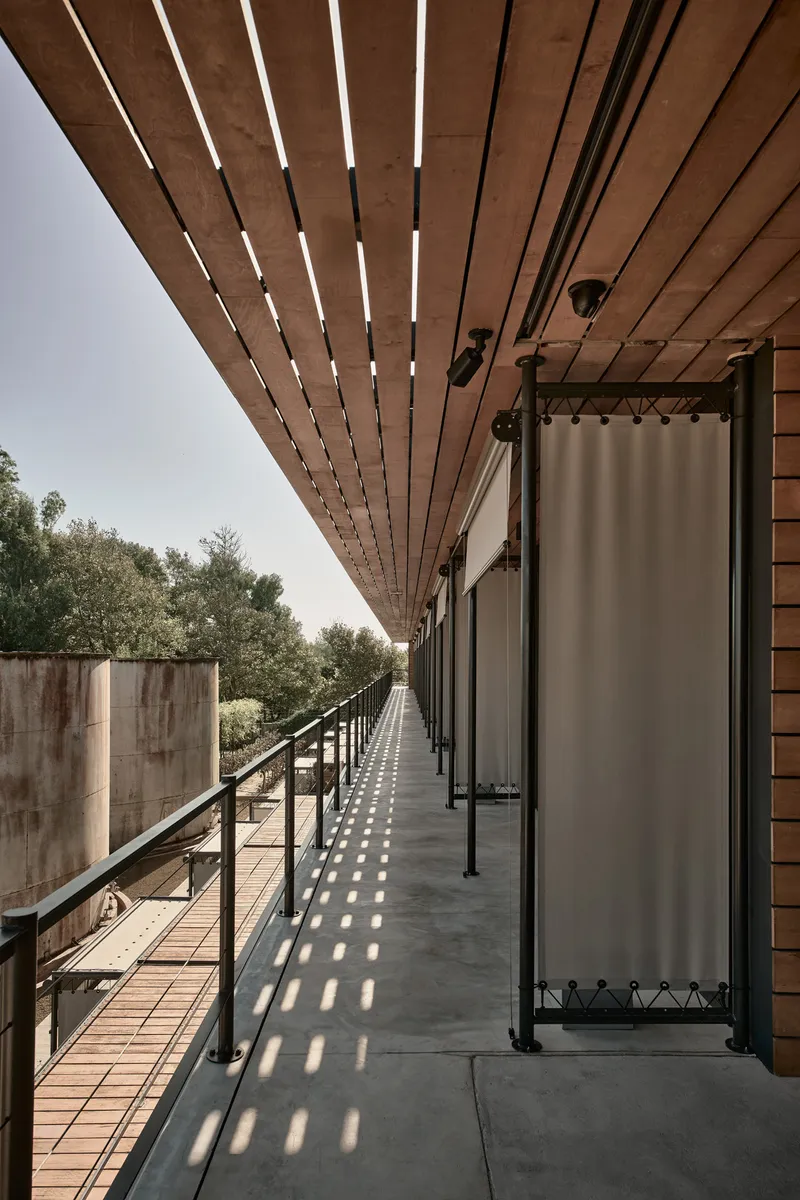
The Peloponnese sun is not kind. K-Studio responds with a consistent language of slatted timber pergolas and overhangs that cast patterned shadows across walkways and terraces. The perforated timber soffits modulate light without blocking it entirely, creating a shifting geometry of stripes on concrete floors that changes throughout the day. Folding canvas screens add another layer of adjustment, allowing guests to calibrate their exposure to sun and breeze.
These are not merely aesthetic gestures. Timber screens, sliding shutters, and recessed glazing work together as a passive cooling strategy, reducing reliance on mechanical systems while maintaining the openness that the seafront location demands. The covered walkways alongside weathered concrete walls become some of the building's most atmospheric spaces, where the play of shadow makes the corridor feel like an inhabitable drawing.
Rooms Inside the Tanks
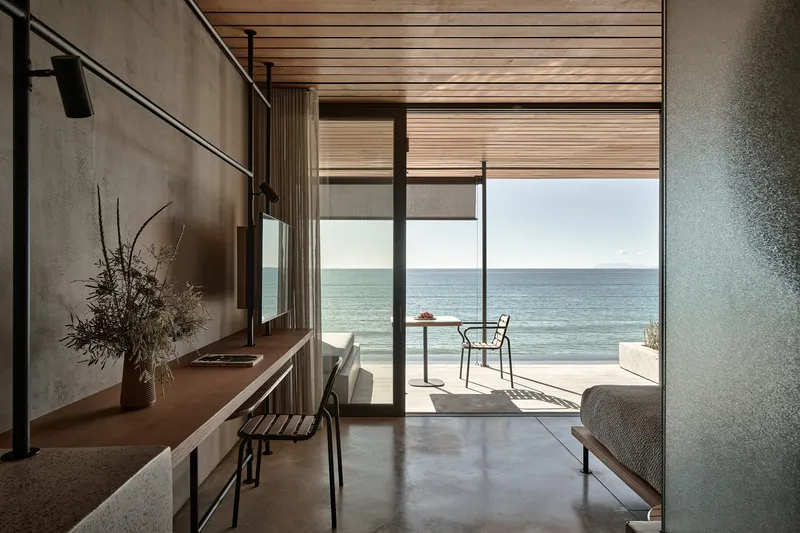
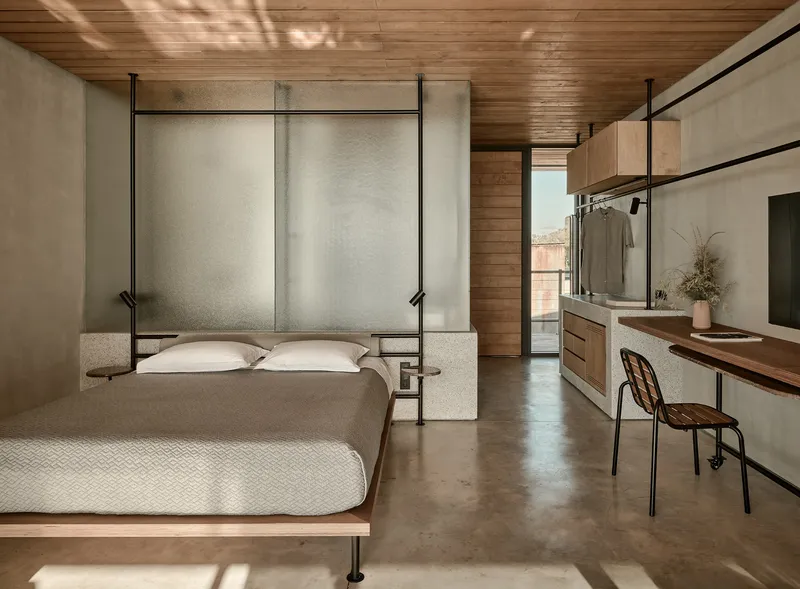
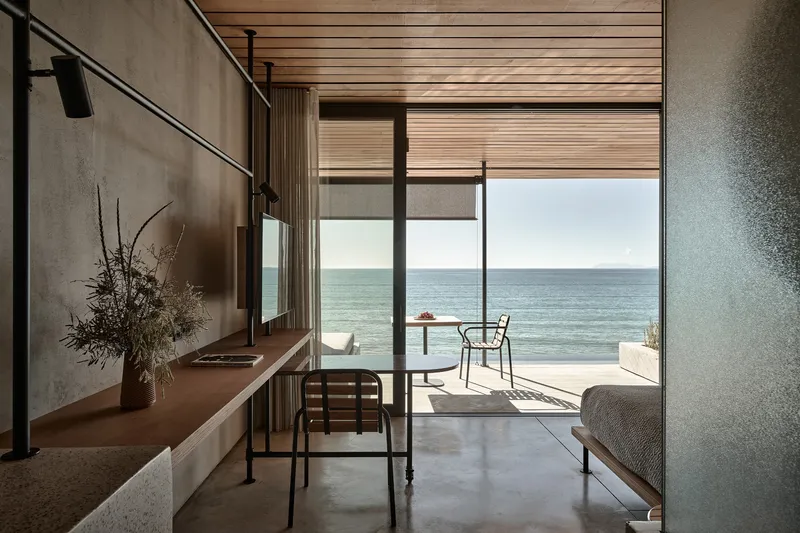
Each tank room measures roughly 30 square meters, the dimensions dictated by the original 5 by 6 meter storage vessels. The constraint is generative. Concrete walls frame full-height glazed doors that open directly onto ocean-facing terraces, collapsing the boundary between the room and the horizon. Polished terrazzo floors link to the colorful texture of beach-pebble aggregates that were revealed when the concrete walls were sliced open for window openings. The material palette is tight: concrete, timber, translucent glass partitions separating the bathroom.
The slatted timber ceilings add warmth overhead, a nautical reference that feels earned given the building's history of loading wine onto ships. A translucent panel headboard in the bedroom diffuses light from the bathroom side, creating a soft glow that reads as both contemporary and oddly timeless. Heavy concrete elements have been repurposed as interior furniture and external paving, keeping the material story continuous.
Terraces Calibrated to the Horizon
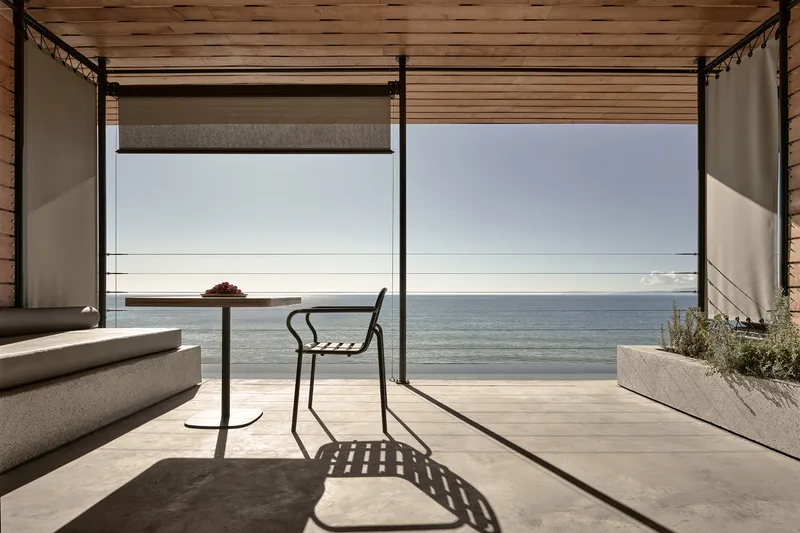
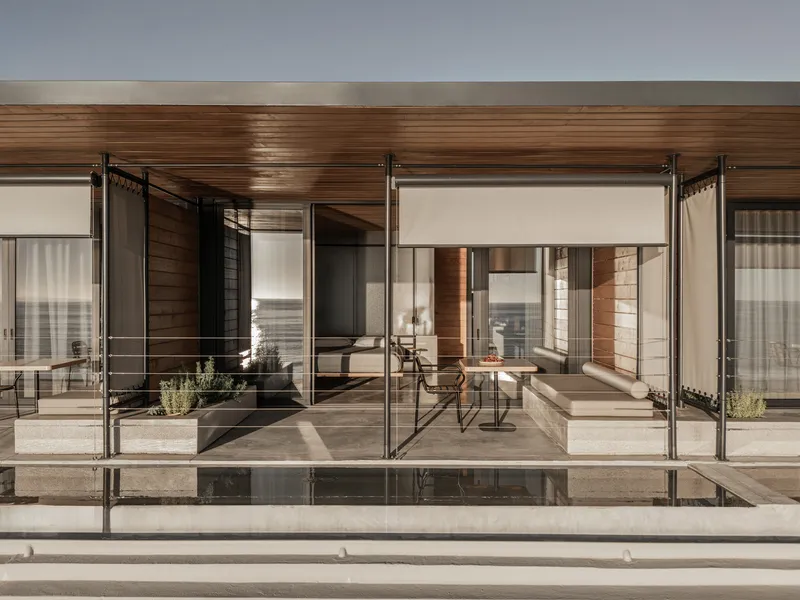
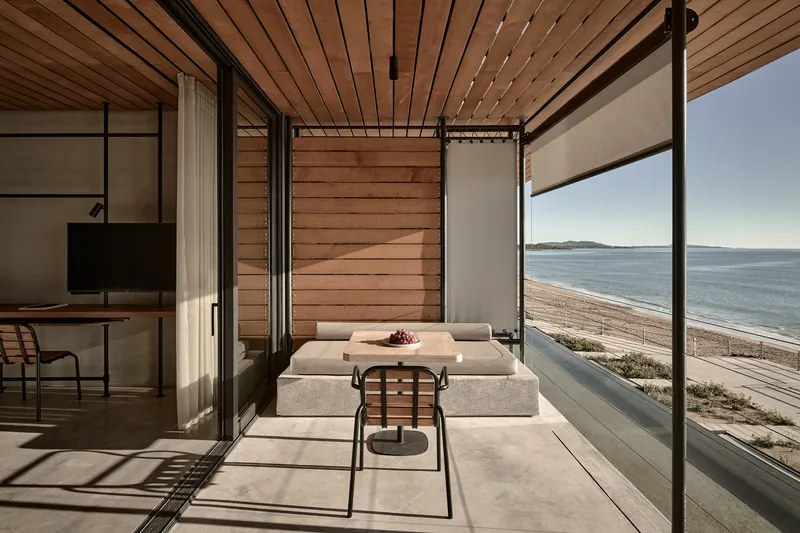
K-Studio credits the design concept to the experience of standing on the tank roofs, where sky met sea in an uninterrupted line. That moment is engineered into every terrace. The upper-level balconies, framed by steel canopies, present a single chair against the ocean horizon with almost cinematic precision. Below, glass-enclosed terraces with sliding panels dissolve the boundary between conditioned interior and open air, letting the reflecting pool act as a visual threshold between private space and infinite seascape.
Floor-to-ceiling glazing in the living areas pulls the beachfront and distant hills into the room's composition. The effect is not about luxury in the conventional hospitality sense. It is about calibrating the relationship between a human body and a very old coastline, using the industrial structure as a frame.
Public Pavilions and Rooftop Life
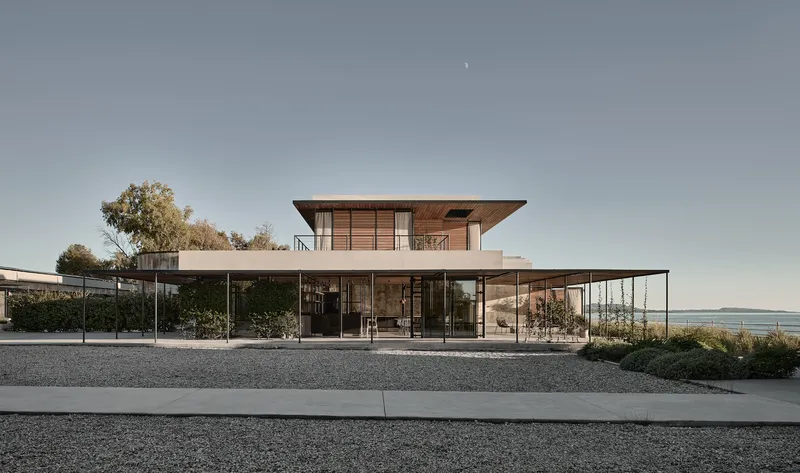
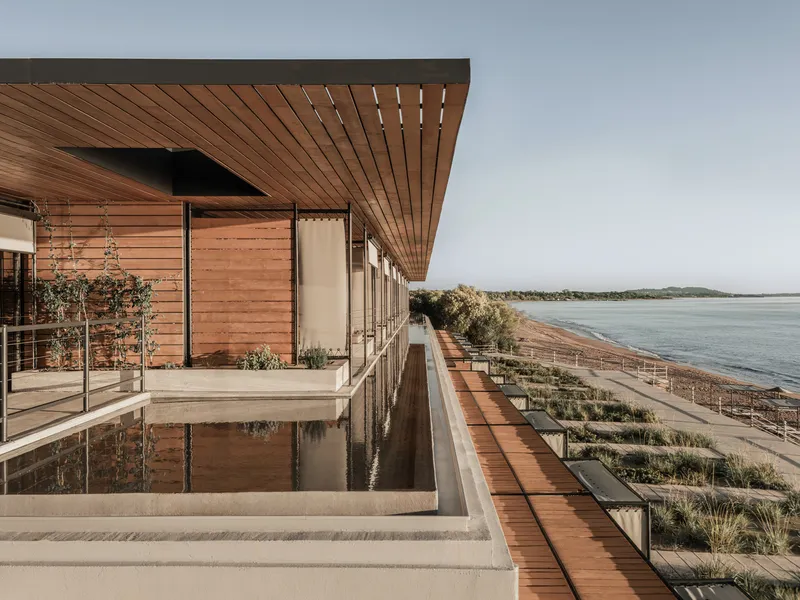
The extension introduces communal program that the original hotel lacked. A pavilion with a cantilevered timber roof and steel-framed perimeter canopy serves as the reception and gathering point, its louvered canopy offering respite from the sun while maintaining visual connection to the waterfront. The taverna includes an open kitchen with a communal dining table for wine tastings and cooking workshops, reinforcing the building's viticultural origins in a programmatic rather than decorative way.
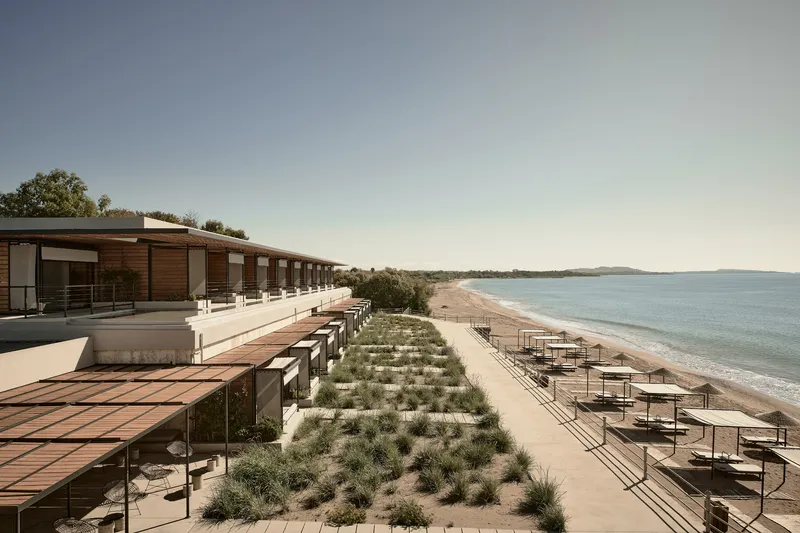
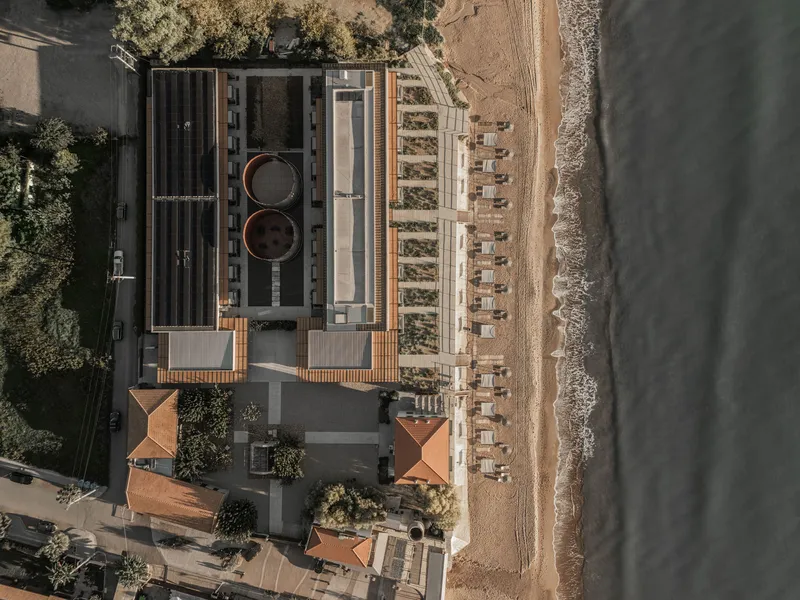
On the roof, timber decks surround reflecting pools that look out across coastal wetlands. Aerial views reveal the canopy structure as a delicate lattice tracing the length of the shoreline, its slenderness deliberate. K-Studio wanted the new components to dematerialize, allowing thin canopies to appear to float seemingly unsupported above the mass of the original tanks. The rooftop becomes both amenity and vantage point, a place where the project's relationship to its landscape is most legible.
Vineyard, Shore, and the Space Between
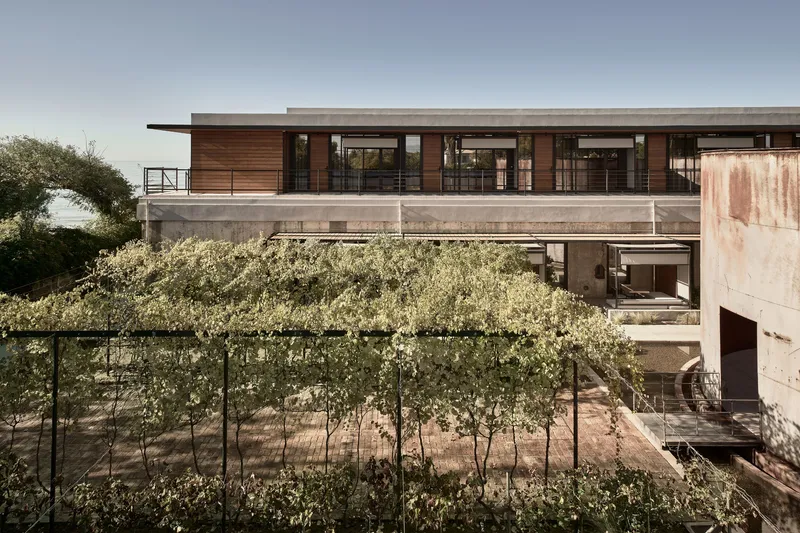
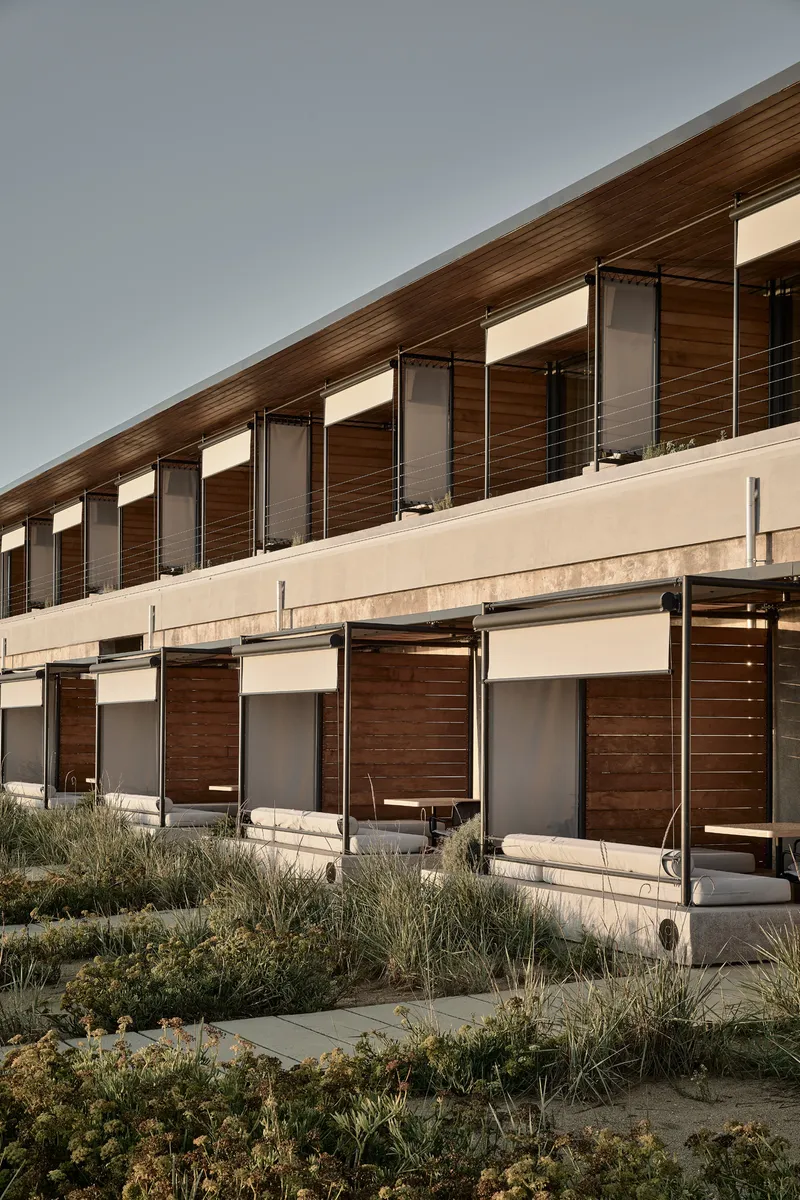
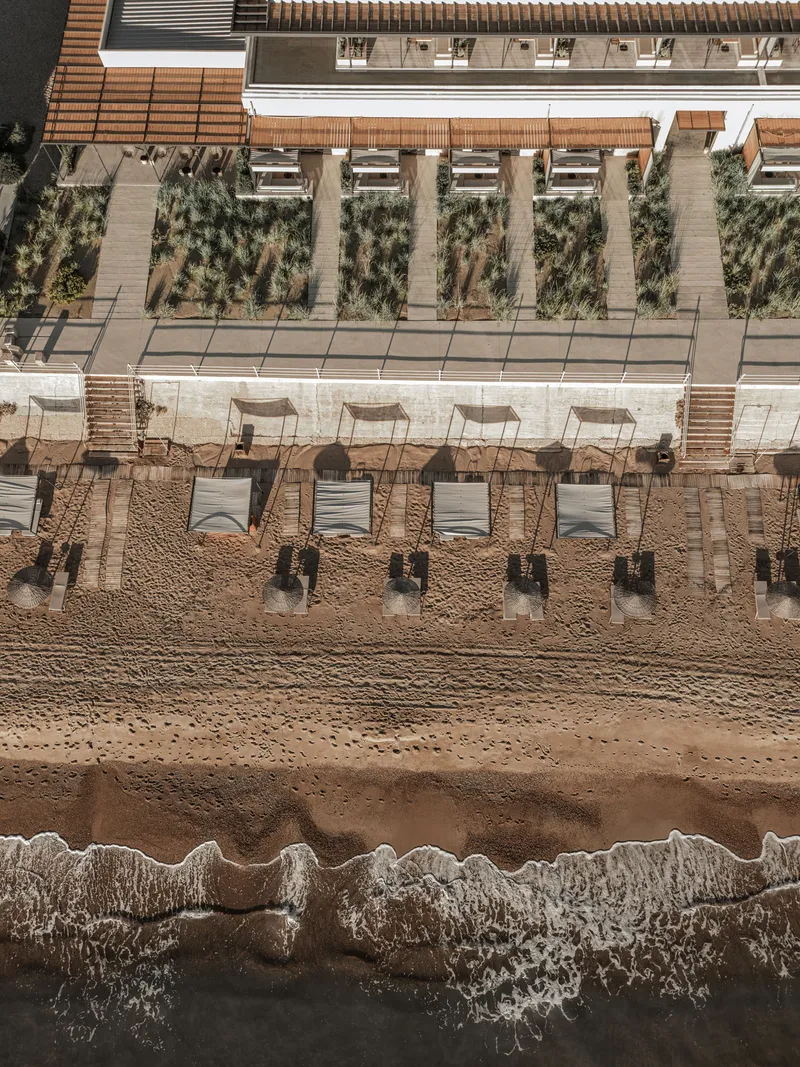
The extension's relationship to the ground is as considered as its relationship to the sea. One volume sits elevated above a terraced vineyard held by concrete retaining walls, a direct echo of the currant-to-wine economy that created these structures after the 1910 Currants Crisis. At ground level, sliding screens and planted beds between concrete stepping stones create a domestic rhythm that softens the industrial frame. Aerial views show timber cabanas and planted terrace beds mediating between the building edge and the beach, a zone of transition rather than a hard boundary.
The site strategy is rooted in the rural Peloponnese context: low-rise agricultural architecture, open fields, a coastline that has not been overdeveloped. Dexamenes's expansion respects that scale, never rising above two stories, never imposing a footprint larger than the original industrial compound demanded. The architecture earns its place by staying close to the ground and close to the history embedded in it.
Plans and Drawings
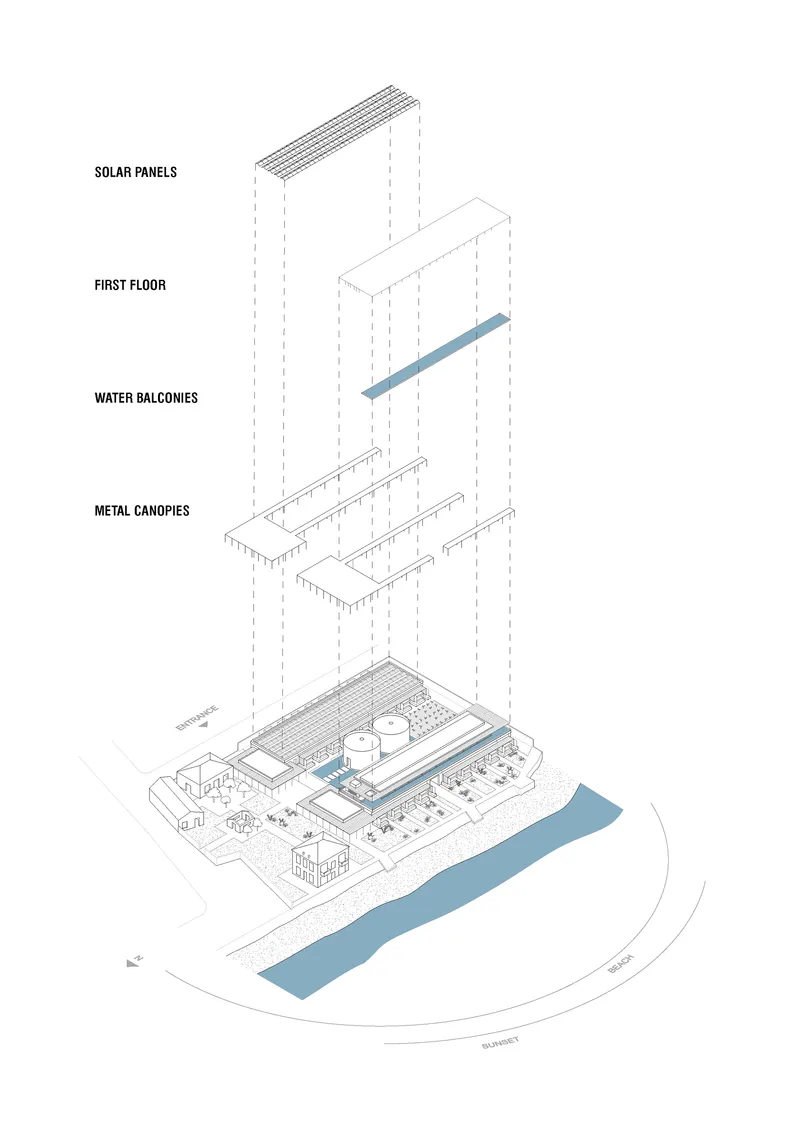
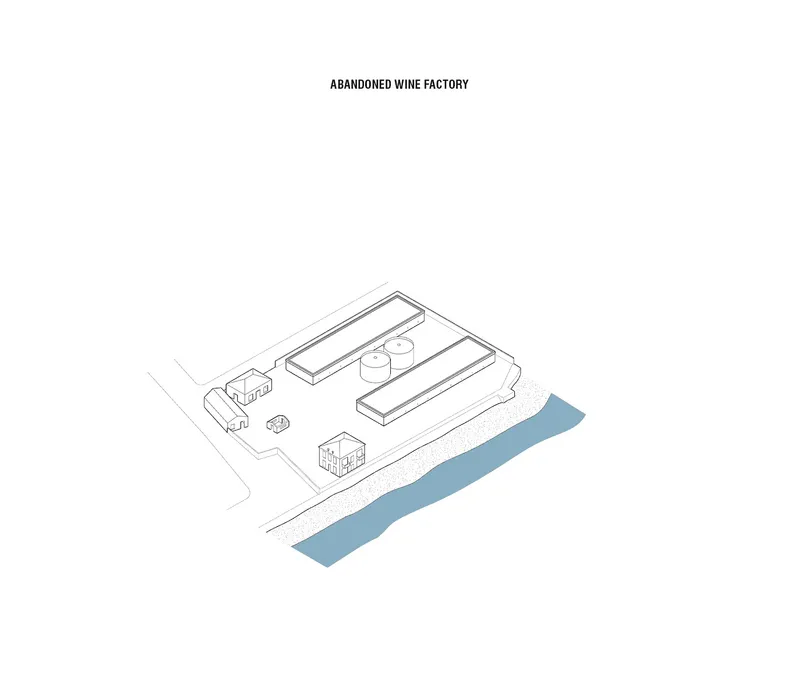
The exploded axonometric drawing reveals the layered logic of the extension: solar panels at the top, followed by the timber canopy, then balconies and metal canopies, all hovering above the beachfront volumes. Each layer is legible as a distinct system, and the drawing makes clear how the new frame follows the structural grid of the original tanks without mimicking their mass. The isometric site drawing places the cylindrical tanks and existing industrial structures in their waterfront context, showing the adjacency between heritage and intervention that defines the project.
Why This Project Matters
Adaptive reuse projects risk two failures: over-renovation that erases the qualities that made the original building worth saving, or timid preservation that turns architecture into a museum of itself. Dexamenes avoids both. K-Studio's extension grows the hotel from a boutique curiosity into a 45-key destination with communal dining, cultural programming, and rooftop amenity, all without diluting the raw concrete austerity that gives the place its character. The lightweight frame reads as a guest on the heavy body of the wine factory, welcome but clearly aware of whose house it is in.
The project also offers a quietly powerful model for coastal development in a Mediterranean context under pressure from tourism. Rather than building new, K-Studio reactivates a derelict structure. Rather than maximizing floor area, it works within the dimensional logic of wine tanks. Rather than importing materials, it uses reclaimed bricks, locally made ceramic tiles, and terrazzo aggregate drawn from beach pebbles. The result is a hotel that feels less designed than discovered, as if the building had been waiting a century for someone to open its walls to the sea.
Dexamenes Seaside Hotel Extension by K-Studio, Kourouta, Greece. 2,760 m², completed 2026. Photography by BREBA Claus Brechenmacher & Reiner Baumann.
About the Studio
Share Your Own Work on uni.xyz
If projects like this are the kind of work you want to make, uni.xyz is a place to publish your own, find collaborators, and enter design competitions.




Popular Articles
Popular articles from the community


Co-life: Sustainable Architecture for Age-Friendly Community Living
Co-life reimagines sustainable architecture for seniors through courtyards, rammed earth, shared gardens, and spaces designed for belonging.

Riyadh For All: Intergenerational Urban Design for Active Aging in Rabat
Riyadh For All reimagines urban design in Rabat with intergenerational co-living, adaptive courtyards, and Moroccan cultural exchange today.

Lunar Spiral: Space Architecture Shaped by the Mathematics of the Universe
Lunar Spiral reimagines space architecture through Fibonacci geometry, lunar regolith, levitating habitats, and self-sustaining Moon living.

The Earth Pod: 3D Printed Homes for Resilient Refugee Communities
The Earth Pod reimagines refugee housing through 3D printed homes made from clay, combining resilience, self-sufficiency, and rapid shelter.


Similar Reads
You might also enjoy these articles

Bao Huynh Watercolor Atelier: A Serene Art Retreat in Hội An
Bao Huynh Watercolor Atelier in Hội An blends multifunctional art spaces, sustainable design, local materials, and family-friendly living in a serene environment.

Atelier Macri Concept Store Interior Design by CASE-REAL
Atelier Macri store features a "ko" counter, walnut wood details, cork displays, blending retail, gallery, and seamless customer experiences.

Manuel Vargas Izquierdo Stadium and High-Performance Sports Center: Architectural Excellence in Jalpa de Méndez
The Manuel Vargas Izquierdo Stadium blends sustainable design, inclusive sports facilities, and cultural-inspired architecture, revitalizing Jalpa de Méndez’s public spaces.

KAKR Buluh Awar Hall: Revitalizing Community and Ecology Through Bamboo Architecture
Community built bamboo hall revitalizes Buluh Awar village, empowering youth, restoring ecology, celebrating vernacular craftsmanship through sustainable architecture and culture.


Comments (0)
Please login or sign up to add comments
No comments yet. Be the first to comment!