

Mecanoo Stacks Staggered Balconies to Rethink Social Housing in Kaohsiung
A public housing tower in southern Taiwan uses offset volumes, planted terraces, and deep screening to dignify affordable living.


Social housing rarely gets to be the skyline protagonist. In Kaohsiung, Taiwan's southern port city, Mecanoo has delivered a residential tower that refuses the anonymity typical of affordable housing programs. Instead of flat repetition, the building presents a shifting composition of balconies, screens, and planted terraces that give each unit a distinct face on the city. It is a serious argument that public investment in housing does not have to look like public investment in housing.
What makes the project worth studying is its disciplined use of a small repertoire of moves. Projecting balconies, dark vertical screening panels, varied window openings, and pockets of vegetation are combined and recombined across the facades. The effect is lively without being chaotic. Mecanoo treats the tower not as a container for units but as a vertical neighborhood, with shared rooftop terraces and a ground-level public plaza that connects residents to the surrounding urban fabric.
A Facade That Moves
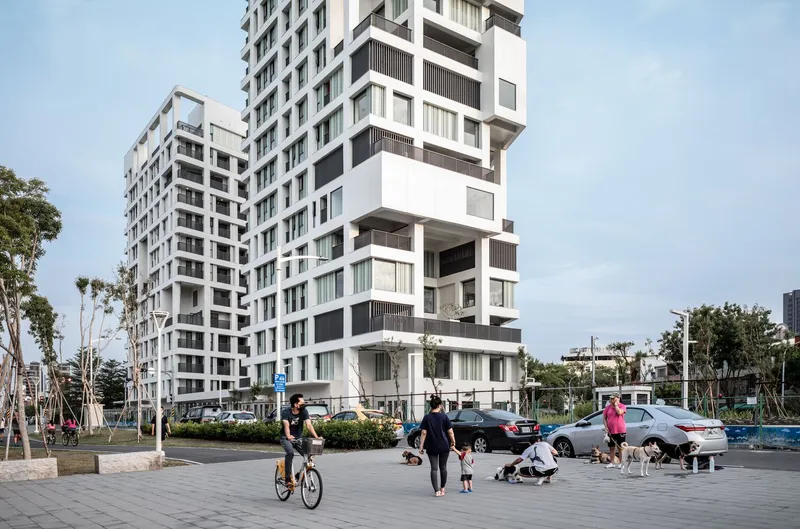
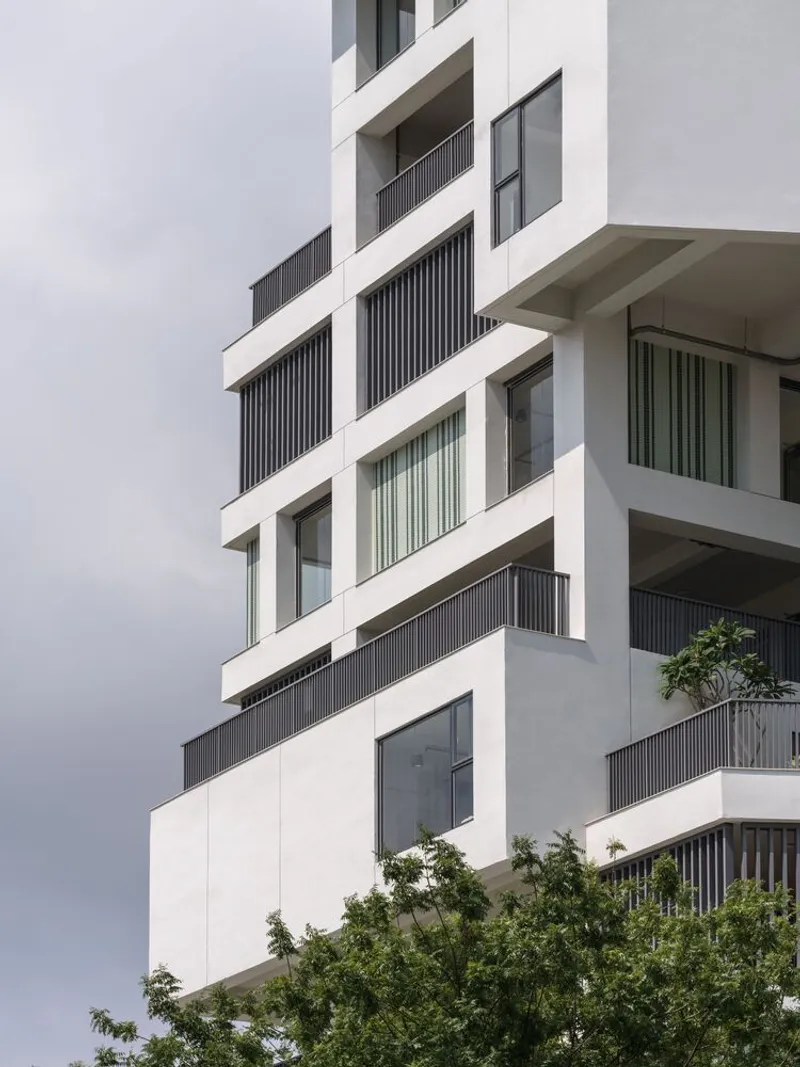
The staggered balconies are the building's signature. Viewed from the public plaza, the white facade reads as a three-dimensional grid where no two floors line up neatly. Projecting volumes push out at different depths, creating pockets of shade and privacy without resorting to heavy curtain walls. Dark vertical screen panels break up the rhythm further, adding a layer of texture that reads differently at every hour of the day.
Under overcast skies, the interplay between recessed glazing and the dark screening becomes especially pronounced. The facade avoids monotony not through decorative additions but through the intelligent arrangement of functional elements: every screen filters light, every offset balcony creates a microclimate. It is composition through necessity, which is always more convincing than composition through ornament.
Planted Terraces as Shared Infrastructure
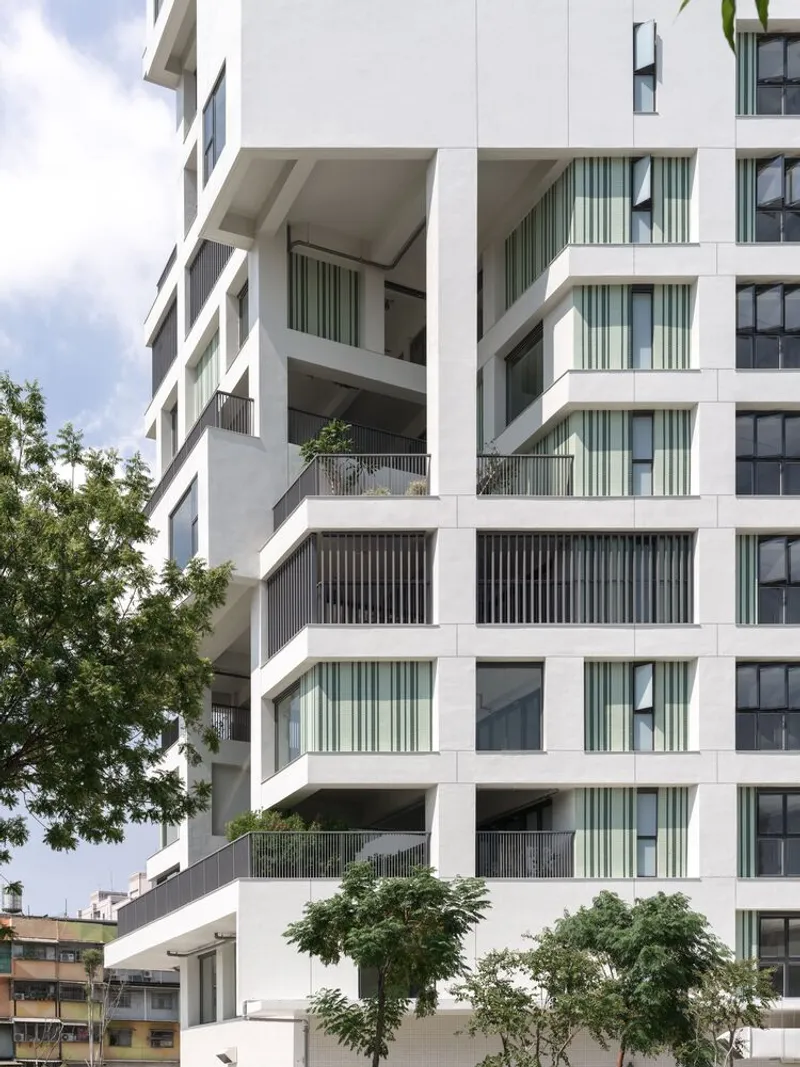
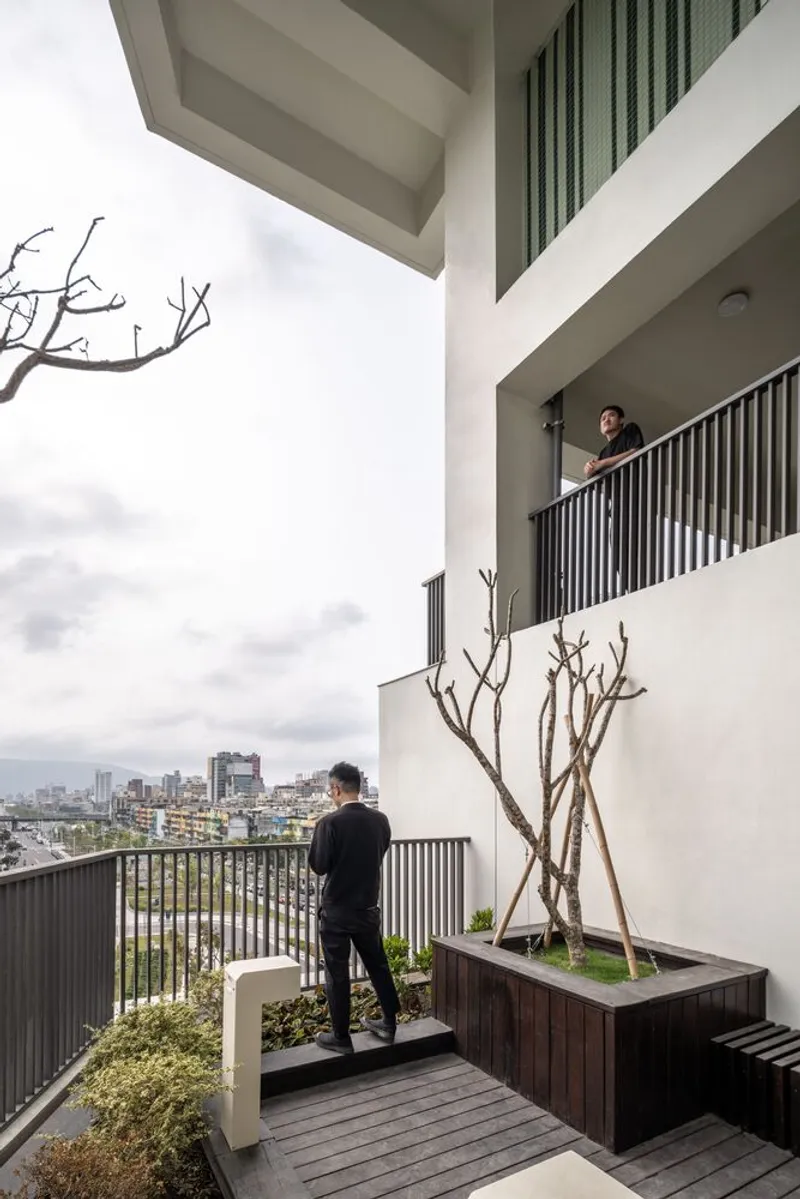
Greenery here is not cosmetic. Timber planters and mature trees at multiple levels turn the terraces into usable outdoor rooms rather than token gestures toward sustainability. The stacked balconies visible in close-up show residents actually occupying these spaces, sitting among potted plants and bare-branched trees that mark the seasons. Social housing often struggles with communal outdoor space because it is designed as leftover area rather than a programmed amenity. Mecanoo treats planting as integral to the architecture.
Framed by the building's offset geometry, these green pockets gain a sense of enclosure and ownership. A resident on a lower terrace looks up at a different canopy than the one above. The variation in depth and orientation means each planted zone receives its own quality of light and breeze, a crucial consideration in Kaohsiung's subtropical climate.
The Tower at Dusk
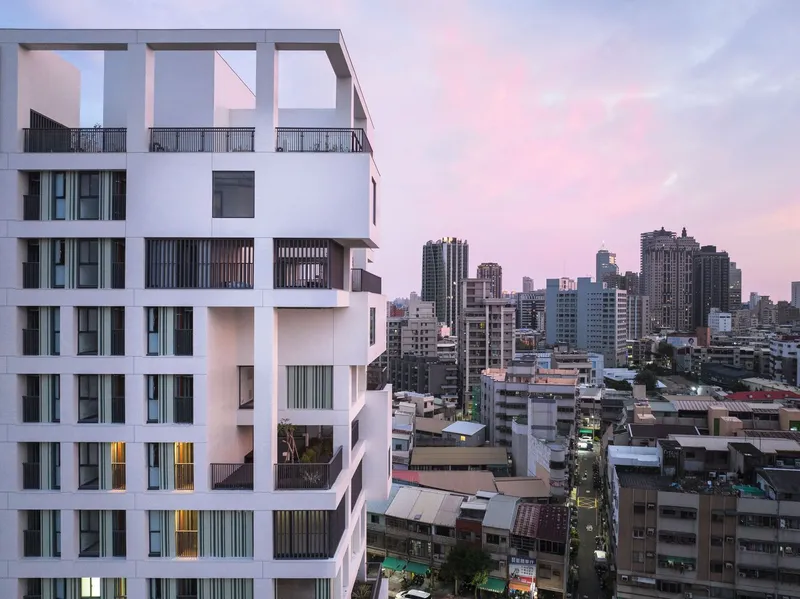

At dusk, the white tower asserts itself against Kaohsiung's dense urban skyline. The varied window openings, which during the day appear as a restrained pattern, begin to glow unevenly as residents light their homes. The building becomes legible as a collective of individual lives rather than a monolithic block. It is one of the clearest demonstrations of Mecanoo's intent: to give social housing a civic presence.
The rooftop terrace reinforces this ambition. Concrete beams and simple metal railings frame panoramic views of the city, offering residents a shared vantage point that private-market towers typically reserve for penthouses. Two figures at sunset on this rooftop are not an afterthought; they are the reason the building exists.
Plans and Drawings
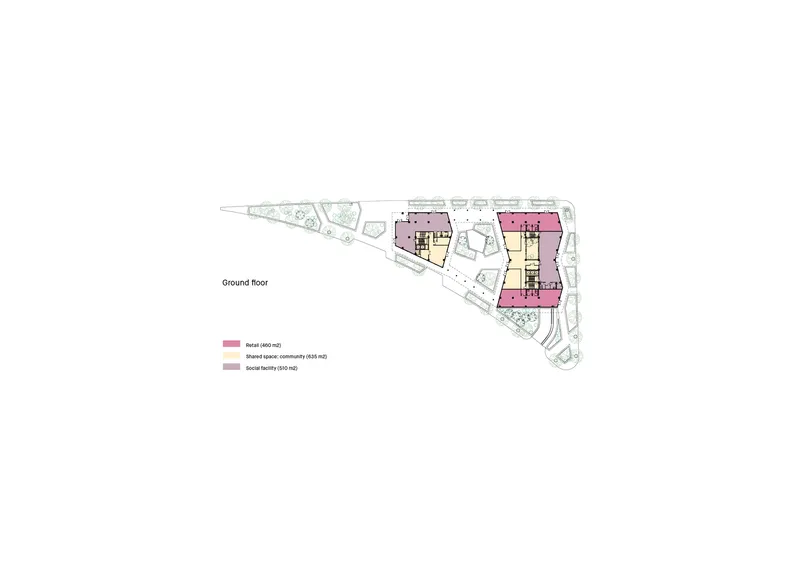
The ground floor plan reveals a triangular site that Mecanoo has organized into clustered volumes rather than a single extruded footprint. The irregular geometry of the lot, which could have been a constraint, becomes the generator of the building's shifting massing. Pink and yellow zones suggest distinct programmatic uses or unit types, and the interstitial spaces between volumes create natural pathways and gathering points at grade. The plan confirms what the elevations suggest: this is a project that thinks in three dimensions from the ground up.
Why This Project Matters
Kaohsiung's social housing by Mecanoo matters because it treats affordability and architectural quality as compatible goals. Too many public housing programs operate under the assumption that cost control requires visual austerity. Here, the offset balconies, the planted terraces, and the varied facade all emerge from practical decisions about climate, privacy, and density. The design intelligence is in the system, not in expensive finishes.
The project also offers a rebuke to the idea that social housing should be invisible within the city. Mecanoo has given Kaohsiung a building that holds its own against the commercial towers surrounding it, one that announces rather than hides the presence of public investment in domestic life. If housing is a right, then the architecture of housing should aspire to more than shelter. This tower does.
Kaohsiung Social Housing by Mecanoo, Kaohsiung, Taiwan.
About the Studio
Share Your Own Work on uni.xyz
If projects like this are the kind of work you want to make, uni.xyz is a place to publish your own, find collaborators, and enter design competitions.



Popular Articles
Popular articles from the community


Lunar Spiral: Space Architecture Shaped by the Mathematics of the Universe
Lunar Spiral reimagines space architecture through Fibonacci geometry, lunar regolith, levitating habitats, and self-sustaining Moon living.

The Musturak Paradise: Senior Living Architecture for a Connected Future in Temara, Morocco
The Musturak Paradise reimagines senior living architecture in Temara via private homes, social spaces, culture, community, and shared care.

The Earth Pod: 3D Printed Homes for Resilient Refugee Communities
The Earth Pod reimagines refugee housing through 3D printed homes made from clay, combining resilience, self-sufficiency, and rapid shelter.

Co-life: Sustainable Architecture for Age-Friendly Community Living
Co-life reimagines sustainable architecture for seniors through courtyards, rammed earth, shared gardens, and spaces designed for belonging.

Similar Reads
You might also enjoy these articles


Hodi-Mandai Geram
Project Function: Preservation and revitalization of the Intangible heritage and socio-spatial identity of the Hodi by Housing, Cultural Memory Center, Sacred Grove, landscape, local tourism economy


Olio Towers: A Mid-Rise for Performers That Fuses Housing, Rehearsal, and Stage
Located blocks from Houston's Theater District, this modular tower stacks living units around a central performance atrium.

Oasis: Modular Green Housing Carved into Dhaka's Urban Fabric
A shortlisted Plugin Housing entry reclaims unauthorized settlements in Dhaka with stepped concrete volumes, green roofs, and ventilation-driven design.

Black Hole: A Floating Megastructure for the Post-Physical Era
Emiliano Mazzarotto envisions a spherical, self-scaling arena where e-sports, digital hotels, and holographic stadiums replace traditional public space.
Explore Social Housing Competitions
Discover active competitions in this discipline



Challenge to reimagine the Iron Throne


Photograph architecture without architects


Illustrate the lost glory of Angkor Wat - Render Challenge


Design challenge to reuse E-waste
Comments (0)
Please login or sign up to add comments
No comments yet. Be the first to comment!