

Karim + Elias Stack 150 Rammed-Earth Spheres into an Open-Air Landscape for Dubai Design
A grand installation of hand-pressed sand and clay spheres transforms a Dubai plaza into an earthen terrain at Downtown Design 2022.


There is something almost absurd about building with sand in a city that sits on top of it. Dubai imports stone and marble for its towers while the desert material beneath its foundations goes largely ignored as a construction medium. IOTA, a 165 m² open-air installation by Karim + Elias, treats that paradox as its central argument: over 150 hand-pressed rammed-earth spheres, composed of locally sourced sand, earth, clay, and water, occupy a paved forecourt at Downtown Design Dubai 2022, proposing the region's most abundant material as a viable alternative to the imported finishes that define the emirate's built environment.
What makes IOTA worth studying is not just its ecological premise but the structural audacity of stacking freestanding spheres, tangent to tangent, without bracing them to the ground. The internal connections are fully concealed once assembled, so the clusters read as precarious geological formations rather than engineered objects. Architects Karim Tamerji and Elias El Hage, both graduates of architecture programs in 2016, working with the support of House Of Today, a non-profit platform for emerging Lebanese designers, have produced something rare: a material argument that also functions as public space, channeling visitors between areas of circulation and rest on their way into and out of the fair.
A Terrain of Spheres

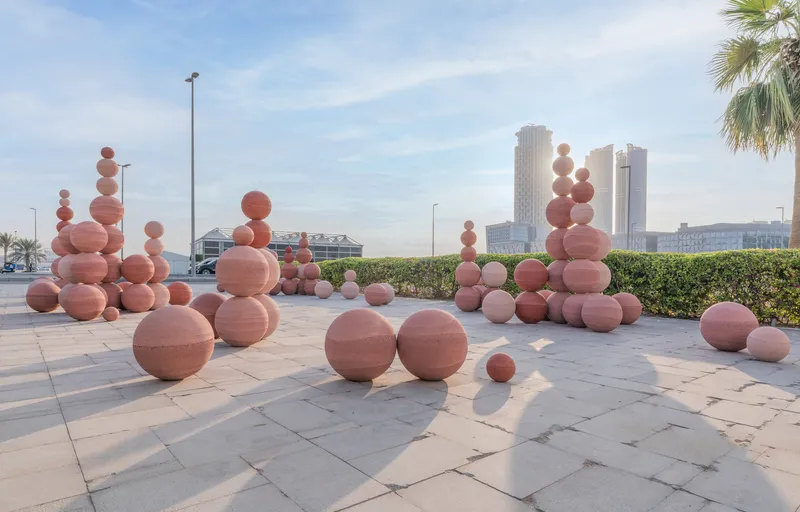
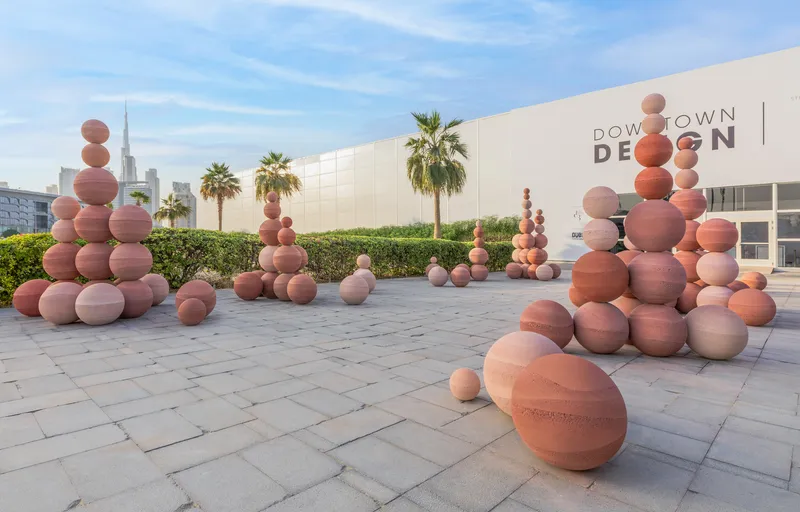
Seen from a distance, the installation reads as something between landscape and architecture. Clusters of blood-orange and powder-pink spheres are scattered across the paved plaza in loose groupings that vary in height, some standing alone at ground level, others stacked three or four high to create towers that compete with the surrounding palm trees. The layout is deliberate without being gridded. Pathways emerge between the clusters organically, guiding foot traffic without resorting to barriers or signage.
At dusk, the installation shifts register entirely. The warm terracotta tones deepen against the fading sky, and the spheres begin to resemble eroded geological features, as if a flash flood had deposited boulders across the forecourt. It is a reading the architects clearly encourage. IOTA is not a pavilion with walls and a roof; it remains open to the sky, an earthen topography imposed on an urban datum.
Rammed Earth at the Scale of the Hand
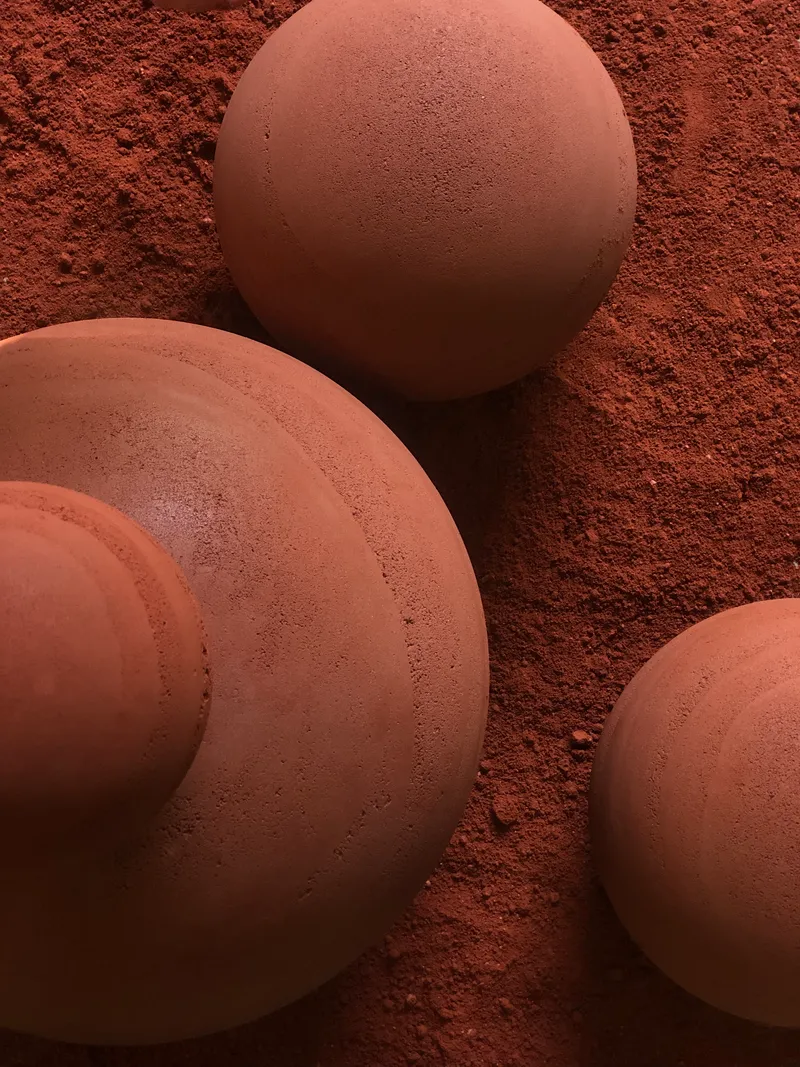
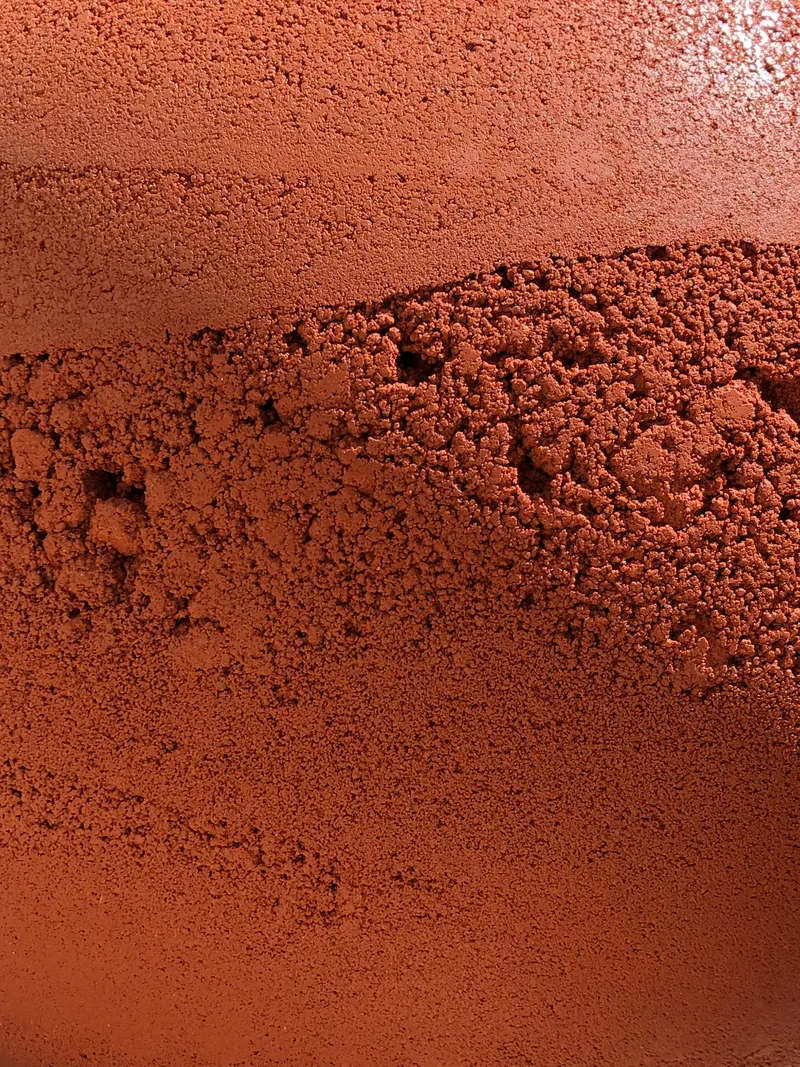

The surface of each sphere tells you exactly how it was made. Visible tooling marks, layered construction lines, and the coarse grain of natural aggregate are all on display. This is rammed earth at the most intimate scale: sand and clay pressed by hand, layer above layer, into molds that produce modular units. No rendering, no paint, no protective coating. The naturally pigmented tones come from the material itself.
The technique has deep historical resonance in the region, where rammed-earth construction predates the petroleum economy by centuries. Karim + Elias are not reviving a lost craft for nostalgic effect. They are testing whether these vernacular methods can produce objects precise enough to stack, ship, and reassemble in a contemporary urban setting. The seams where hemispheres meet are tight and clean, evidence that the molds were machined even if the pressing was done by hand.
Structure Without Visible Support


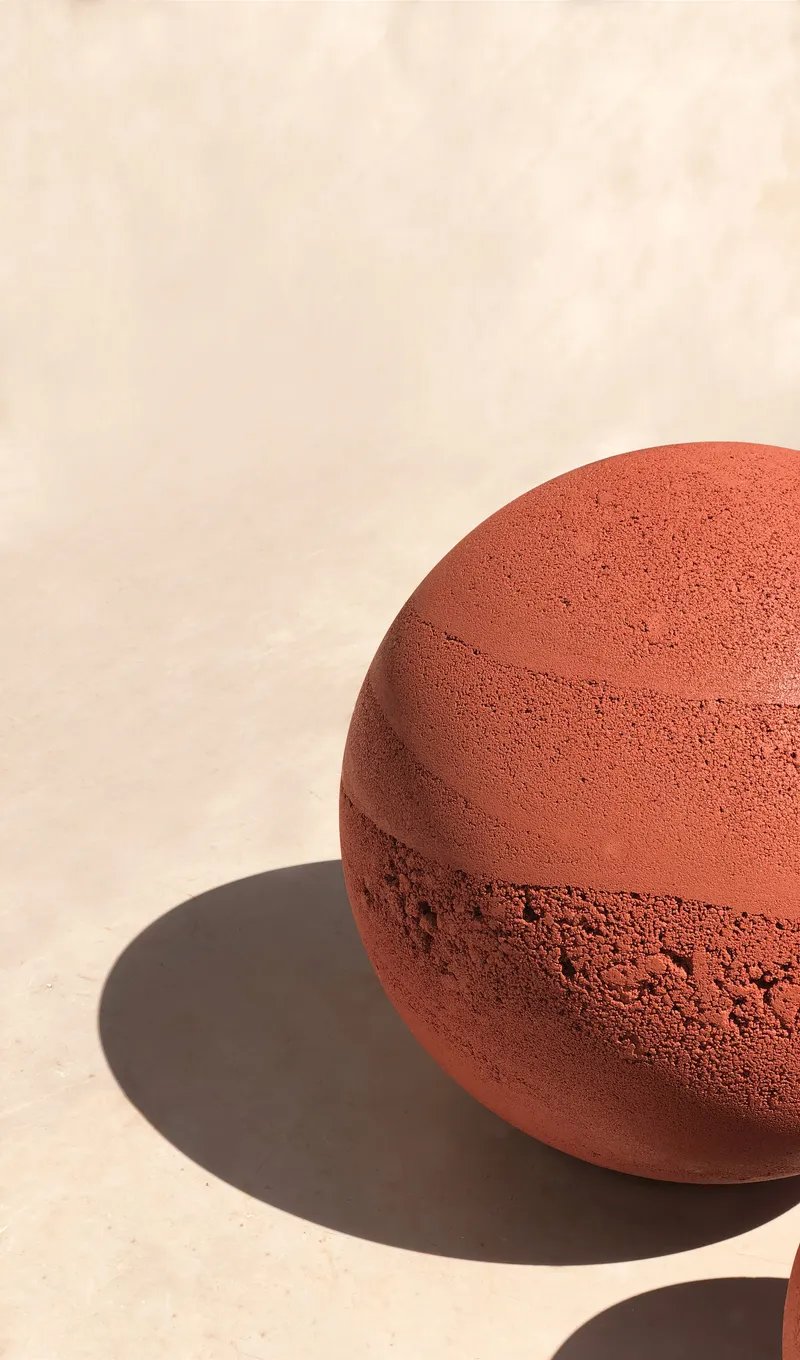
The hardest thing to accept about IOTA is that the stacked spheres are not bolted to the floor. Each cluster is freestanding, with spheres interconnected at their tangent points through concealed internal connections. Once assembled, nothing reads as structural; the joints disappear. The result is a collection of forms that look like they could roll away at any moment, lending the installation a tension that static architectural objects rarely achieve.
Hard shadows on the pale concrete flooring reinforce the impression of weightlessness. A single sphere casting a crisp circular shadow in bright sunlight becomes an almost graphic composition, pigment dust staining the ground beneath it like evidence of geological weathering. The architects understand that in Dubai's relentless light, shadow is as much a material as sand.
Threshold and Framing
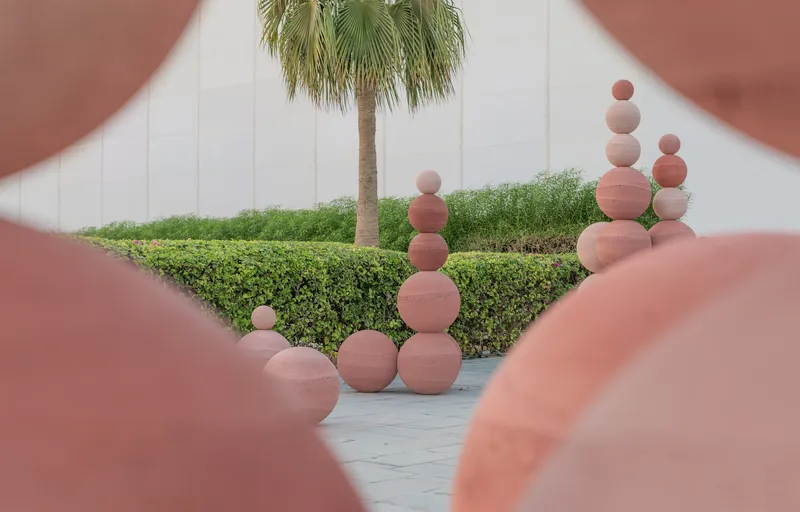
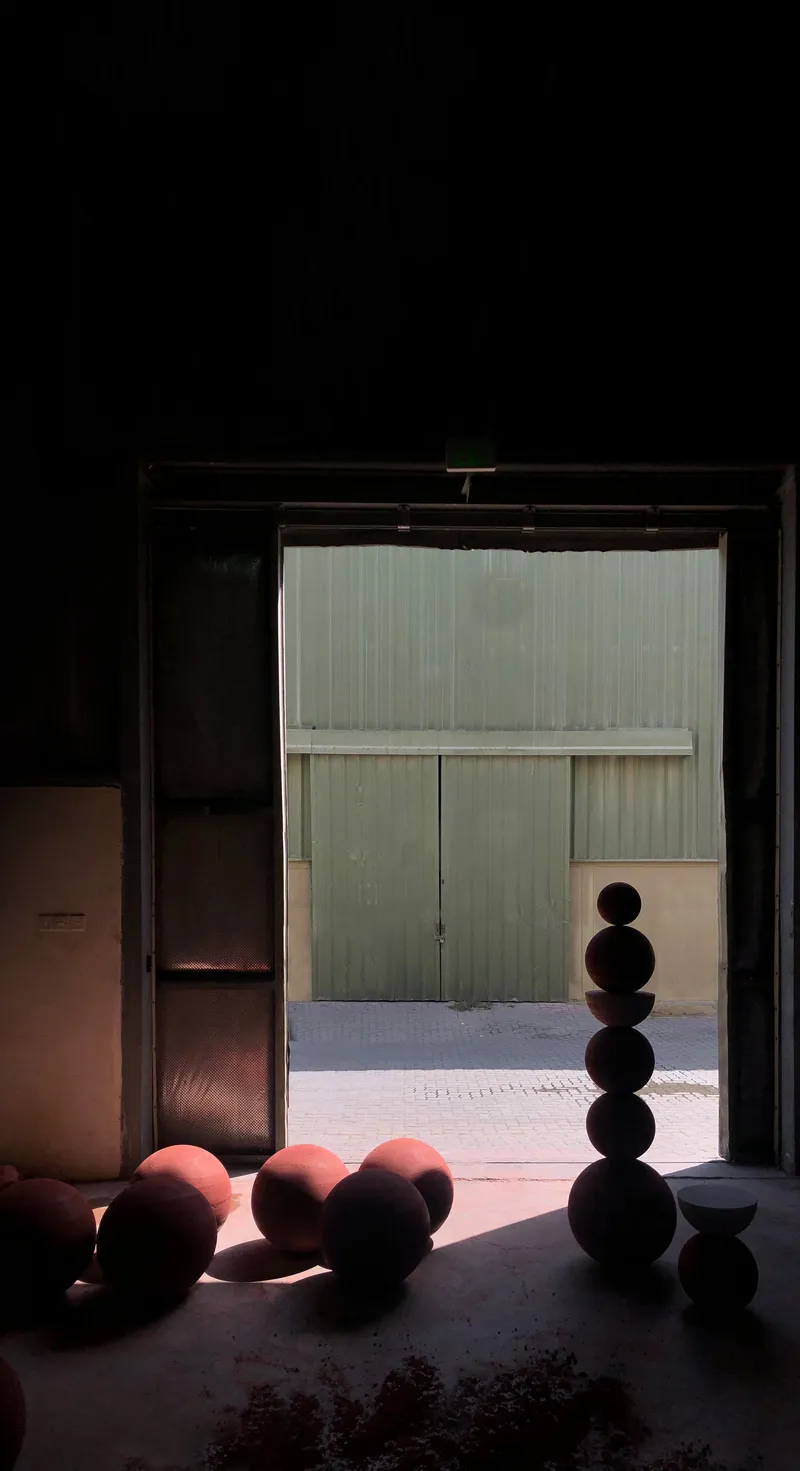

IOTA was designed to welcome visitors into the fair, and its spatial effect is strongest at the thresholds. Viewed through a doorway, the stacked orbs beyond trimmed hedges and green metal doors create a layered depth of field, pulling the eye from shadow into sunlit courtyard. Framed between the spheres themselves, glimpses of palm trees and hedgerows compose incidental vignettes that feel cinematic.
The installation also holds its own against the glazed entrance facades of the surrounding buildings. Where the architecture behind it is flat and reflective, the spheres are massive and matte, absorbing light rather than bouncing it. The contrast is the whole point. IOTA sits in the Dubai Design District not as a complement to its context but as a provocation against it.
Making Process


Images from the studio reveal a workspace populated by ceramic discs, hemispheres, and finished spheres in various stages of completion. Two people work at a table surrounded by the components, and the scene communicates the labor-intensive nature of the project. Each of the 150-plus modules was hand-pressed and dried before being transported to site, a logistical feat for a temporary installation.
Assembly studies show the spheres and hemispheres at a smaller scale, stacked on a clean white background with human figures for reference. These images clarify the compositional logic: towers of varying height, gaps calibrated to allow passage, and isolated single spheres placed as anchoring punctuation. The modular system is flexible enough to adapt to different site geometries, which raises the question of whether IOTA could travel. The answer, given its stackable kit-of-parts nature, is clearly yes.
Plans and Drawings
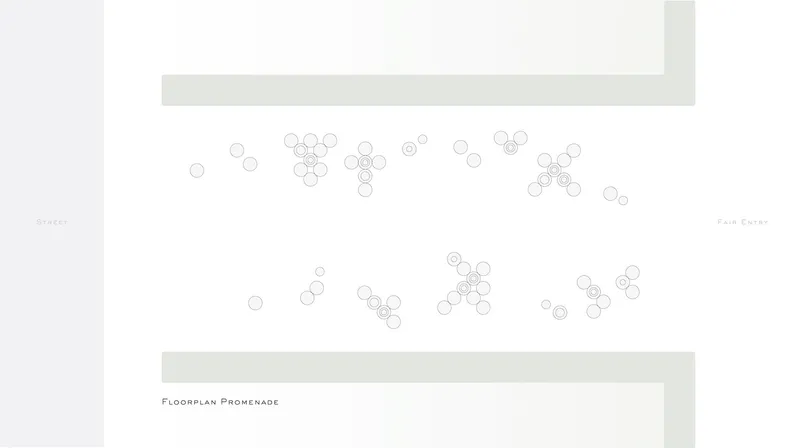
The floor plan reveals the installation's relationship to its immediate surroundings: circular elements clustered between the street edge and the fair entrance, organized in dense pockets that thin out to create corridors. The plan reads like a particle simulation frozen mid-frame, each sphere placed with apparent randomness that is, on closer inspection, carefully calibrated to manage crowd flow.
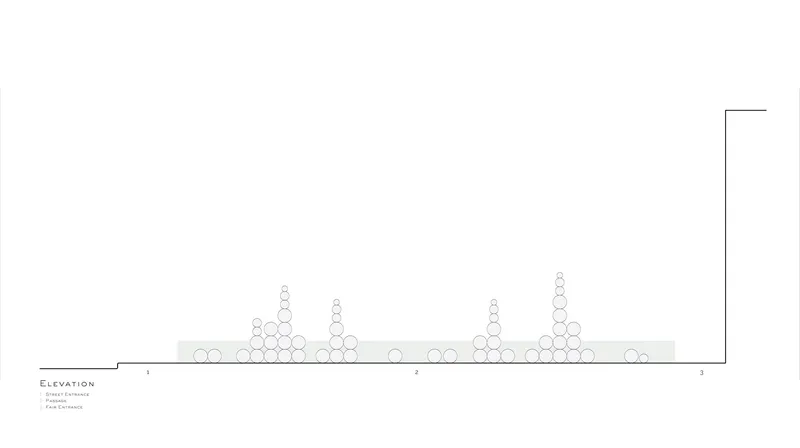
The elevation drawing is more revealing. Stacked circular forms of varying heights sit along a horizontal datum line, and the silhouette they produce is jagged and irregular, closer to a ridge line than to conventional architecture. The tallest stacks anchor the composition at its center, with lower groupings trailing off at the edges. It is a drawing that reads more like a landscape section than a building elevation, which is precisely the territory IOTA occupies.
Why This Project Matters
IOTA matters because it reframes a material conversation that the Gulf region has been slow to have. Sand is not just cheap filler here; it is the literal ground condition, and the idea that it could substitute for imported stone or concrete in certain applications is worth serious investigation. Karim + Elias do not claim that rammed-earth spheres will replace curtain walls. They claim, more modestly and more usefully, that the region's most elemental resource deserves a place in its design vocabulary beyond the ornamental.
The project also demonstrates that temporary installations can carry structural and material ambition without enormous budgets. 150 handmade modules, no mechanical fixings to the floor, natural pigmentation, an open-air layout: the means are spare and the effect is substantial. For emerging architects working outside the patronage systems that fund major commissions, IOTA offers a model of practice that is both research-driven and public-facing, proving that you do not need a building permit to build an argument.
IOTA Installation by Karim + Elias. Located in Dubai, United Arab Emirates. 165 m². Completed in 2022. Photography by Michal Stancelewski.
About the Studio
Share Your Own Work on uni.xyz
If projects like this are the kind of work you want to make, uni.xyz is a place to publish your own, find collaborators, and enter design competitions.


Popular Articles
Popular articles from the community


Opera on the Sea: Driftwood Logic Shapes a Timber Opera House on Estonia's Coast
Trevor Orgill's opera house translates the entangled drift of floating timber into a civic building where wood, water, and music converge.

Singing Woman: Contemporary Architecture Inspired by Estonia’s Voice and the Sea
Singing Woman turns Estonia’s song culture into flowing opera house architecture, blending public life, landscape, sea, and national memory.

Manzana Morphosis: Stretching Barcelona's Grid into a Living Landscape for 2050
A radical reworking of the Eixample manzana turns density into a tool for generous public space, vertical ecology, and environmental performance.
Cloaked Colonization: A Mobile Underwater Habitat That Moves Like a Fish
Micah Abaya's shortlisted EHC Pacific entry reimagines ocean settlement as a dispersed network of self-sustaining architectural organisms.

Similar Reads
You might also enjoy these articles

Bao Huynh Watercolor Atelier: A Serene Art Retreat in Hội An
Bao Huynh Watercolor Atelier in Hội An blends multifunctional art spaces, sustainable design, local materials, and family-friendly living in a serene environment.

Atelier Macri Concept Store Interior Design by CASE-REAL
Atelier Macri store features a "ko" counter, walnut wood details, cork displays, blending retail, gallery, and seamless customer experiences.

Manuel Vargas Izquierdo Stadium and High-Performance Sports Center: Architectural Excellence in Jalpa de Méndez
The Manuel Vargas Izquierdo Stadium blends sustainable design, inclusive sports facilities, and cultural-inspired architecture, revitalizing Jalpa de Méndez’s public spaces.

KAKR Buluh Awar Hall: Revitalizing Community and Ecology Through Bamboo Architecture
Community built bamboo hall revitalizes Buluh Awar village, empowering youth, restoring ecology, celebrating vernacular craftsmanship through sustainable architecture and culture.

Explore Desert Architecture Competitions
Discover active competitions in this discipline

Challenge to design a portable theatre

Challenge to design a portable music platform

Challenge to design an open learning module for the elderly

Challenge to design mud housing for contemporary communities
Comments (0)
Please login or sign up to add comments
No comments yet. Be the first to comment!