
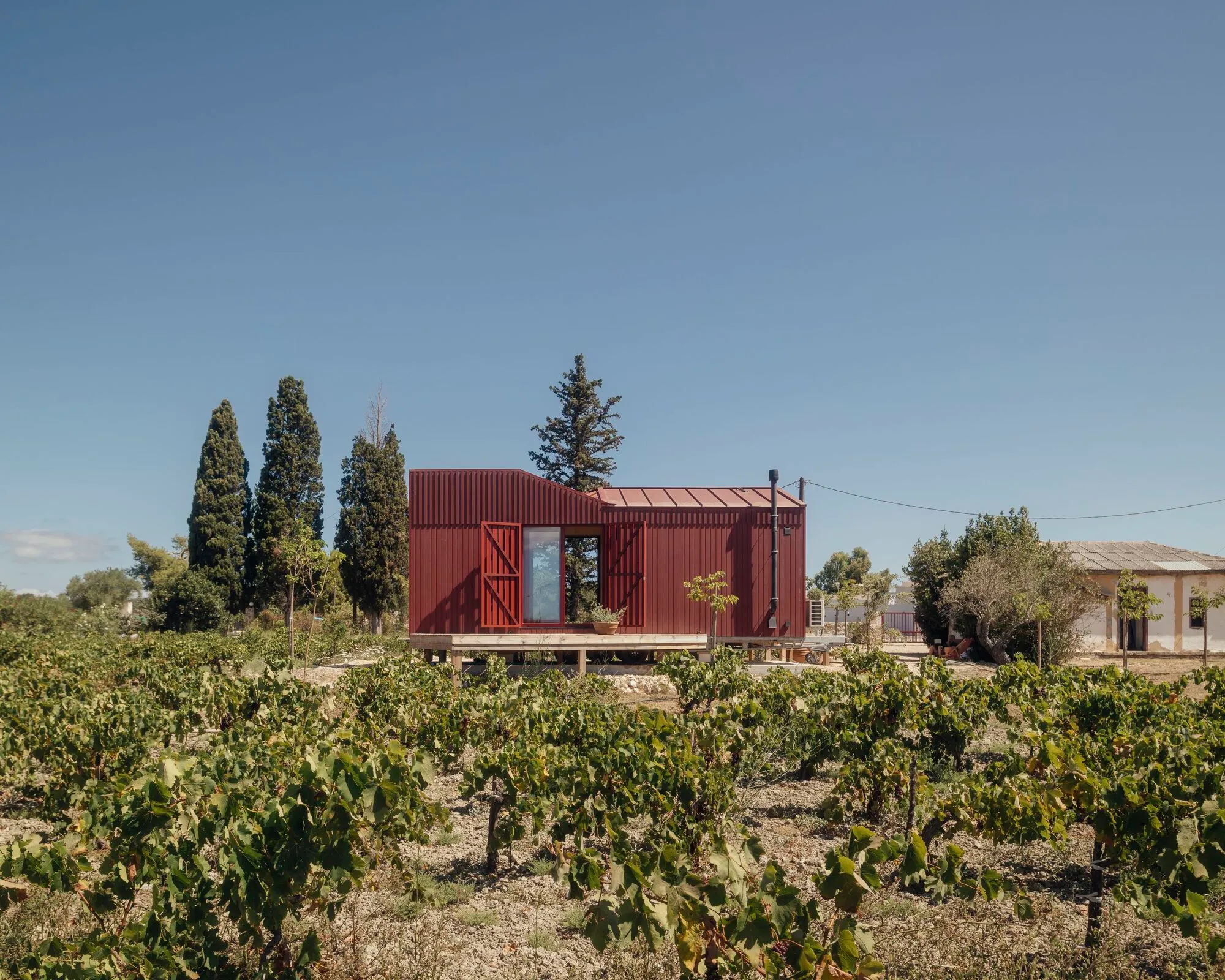
Kasawoo Plants a Deep Red Timber Cabin in a Family Vineyard on Zakynthos
A prefabricated 20 square meter retreat on ancestral farmland challenges the concrete vernacular of the Greek islands.


The Greek islands are not short on architecture rhetoric. White-washed walls, blue domes, sun-bleached stone: the visual language is so familiar it has become wallpaper. On Zakynthos, the dominant building material is concrete, and most new construction follows its carbon-intensive logic without much question. Kasawoo, the London-based practice led by Katie Kasabalis and Darius Woo, has answered that condition with The Root Cabin, a prefabricated timber volume dropped onto ancestral farmland in the village of Vanato. At just under 20 square meters, it is modest in footprint but deliberate in every decision it makes.
What makes the project interesting is not simply its smallness or its material palette, though both matter. It is the fact that Kasawoo designed and commissioned the cabin for themselves, on land that has been in Kasabalis's family for over a century. The site includes a pre-war stone house, an active vineyard producing raisins, and ancient olive groves. Placing a deep red corrugated structure in that landscape is a conscious provocation: a low-carbon alternative to the concrete norm, wrapped in a color that actually references traditional island houses. The cabin is self-initiated, self-funded criticism of how the island builds.
A Red Object in a Working Landscape
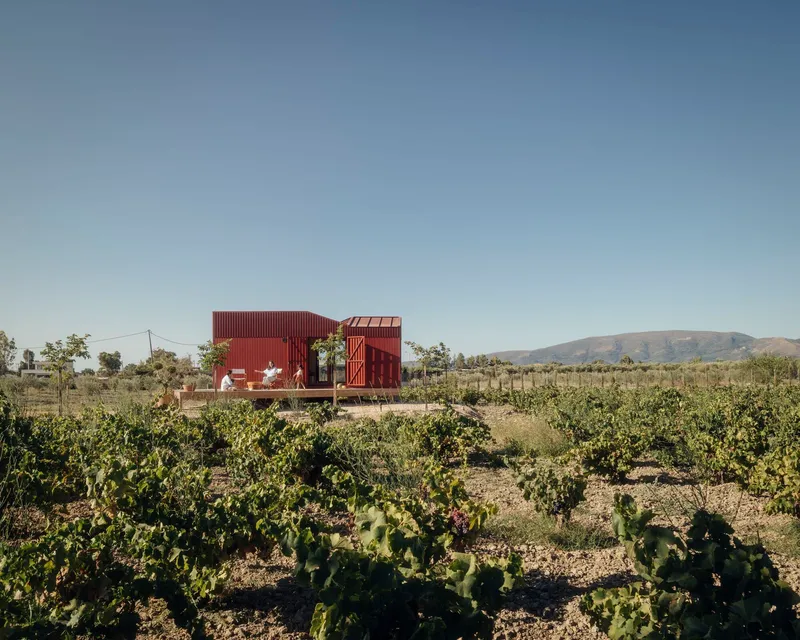
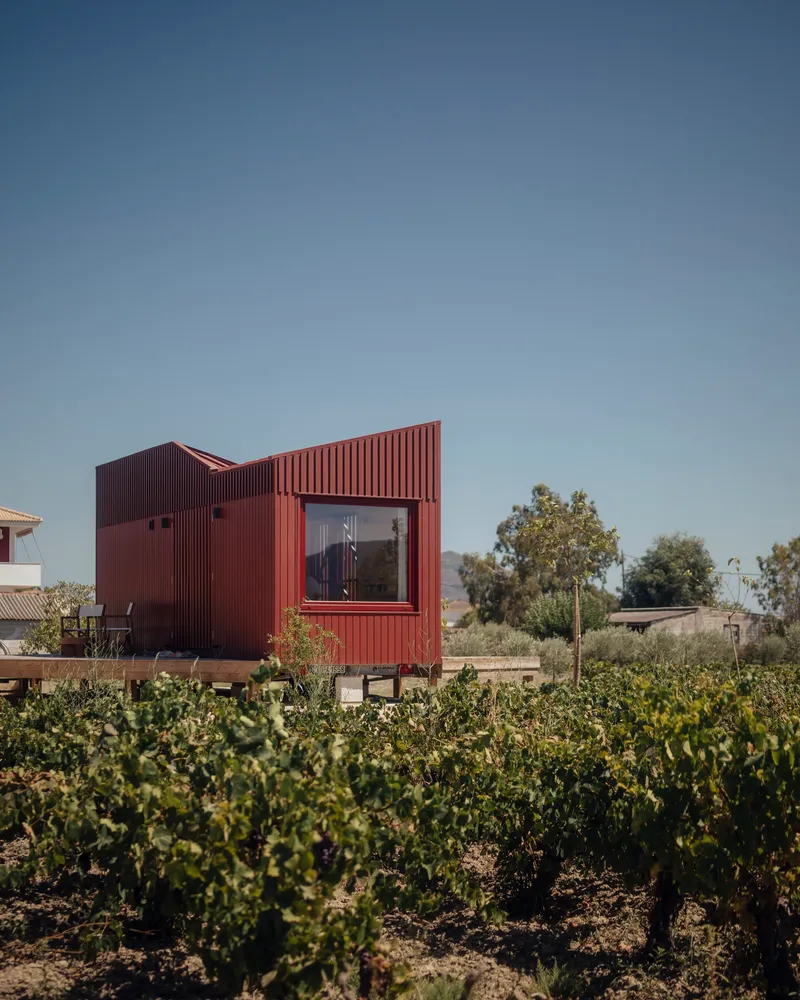
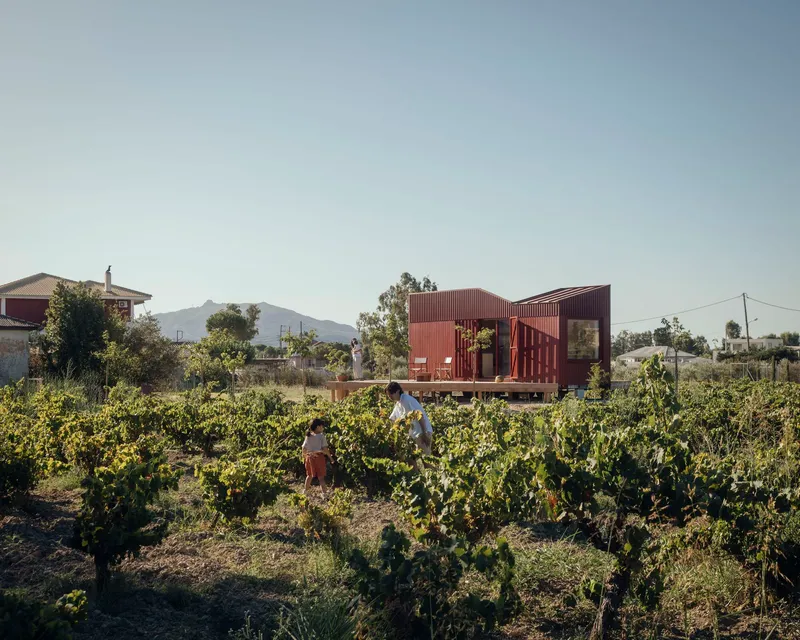
Seen from across the vineyard, the cabin reads as a single bold mark against a backdrop of rolling hills and grapevine rows. The deep red cladding is not arbitrary. It draws from a vernacular color found across traditional Zakynthian houses, grounding the cabin in local context even as its form and construction method depart from it. The corrugated profile adds texture and shadow play that shifts throughout the day, turning what could feel like a shipping container into something that holds its own against the landscape.
At 2.5 meters by 8 meters, the proportions are deliberately elongated. The cabin sits on a raised timber deck that extends its footprint outward on the north and south edges, creating a threshold zone between the interior volume and the vineyard. It is less a house and more an inhabited datum line drawn across the terrain.
Site Memory and Contrast

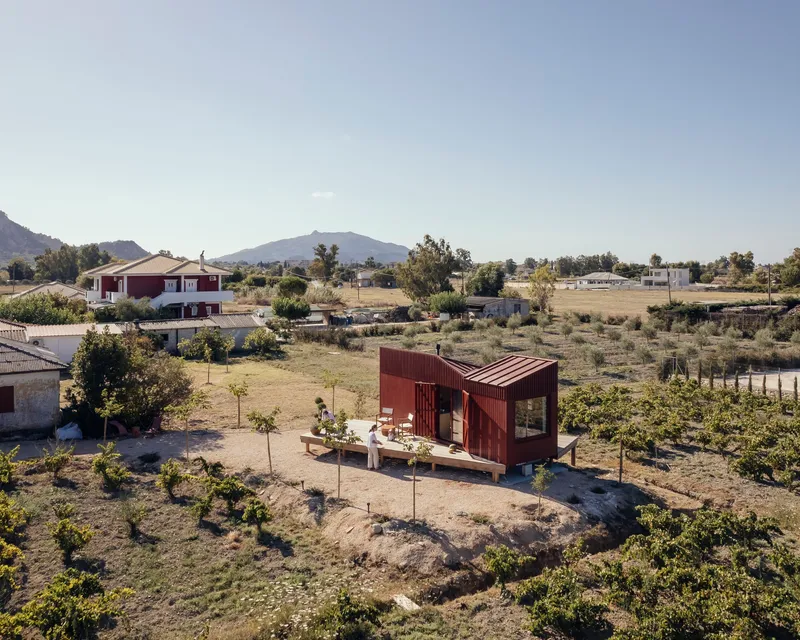
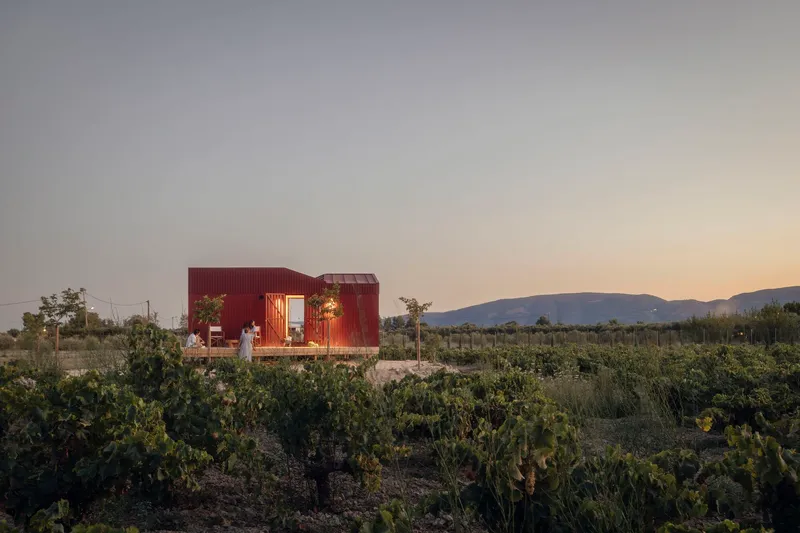
The land in Vanato has been vacant since the early 1950s, though the family's pre-war stone house still stands on the property. You can see it through the entry gate, framed by a low stone wall. The Root Cabin does not try to mimic it. Instead, the two structures exist in productive tension: one heavy, masonry, rooted in the soil; the other light, prefabricated off-site by Eco Tiny Homes and Tiny Home Greece, and elevated above the ground on its deck. The contrast is the point.
The aerial view reveals how precisely the cabin has been sited among young trees and vine rows. It does not dominate the plot; it occupies it carefully, as if aware that the landscape was here first and will outlast the structure. At dusk, the red volume glows against the scrubland, its open sides dissolving the boundary between shelter and field.
The Facade as Mechanism
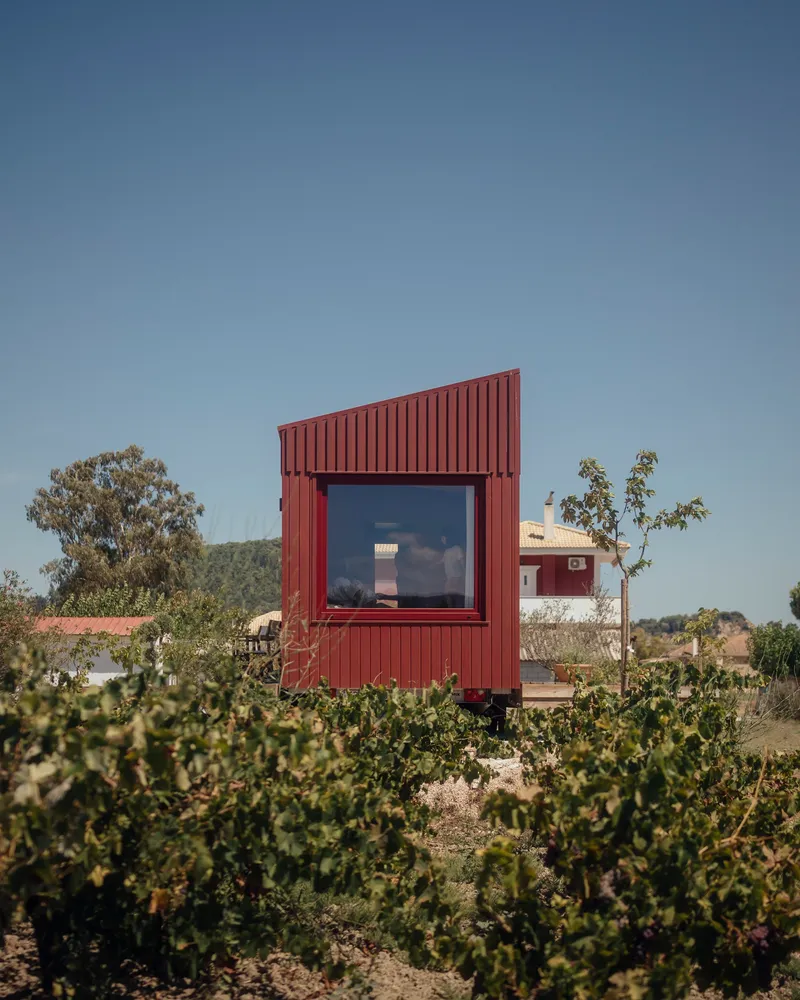

The facades are not decorative; they are operational. At the bedroom and bathroom ends, smaller picture windows punch through the corrugated skin to frame specific views: olive groves on one side, coastal landscape on the other. The front elevation is restrained, almost secretive, with a single square window set among the vertical corrugation and vine tendrils. It gives nothing away.
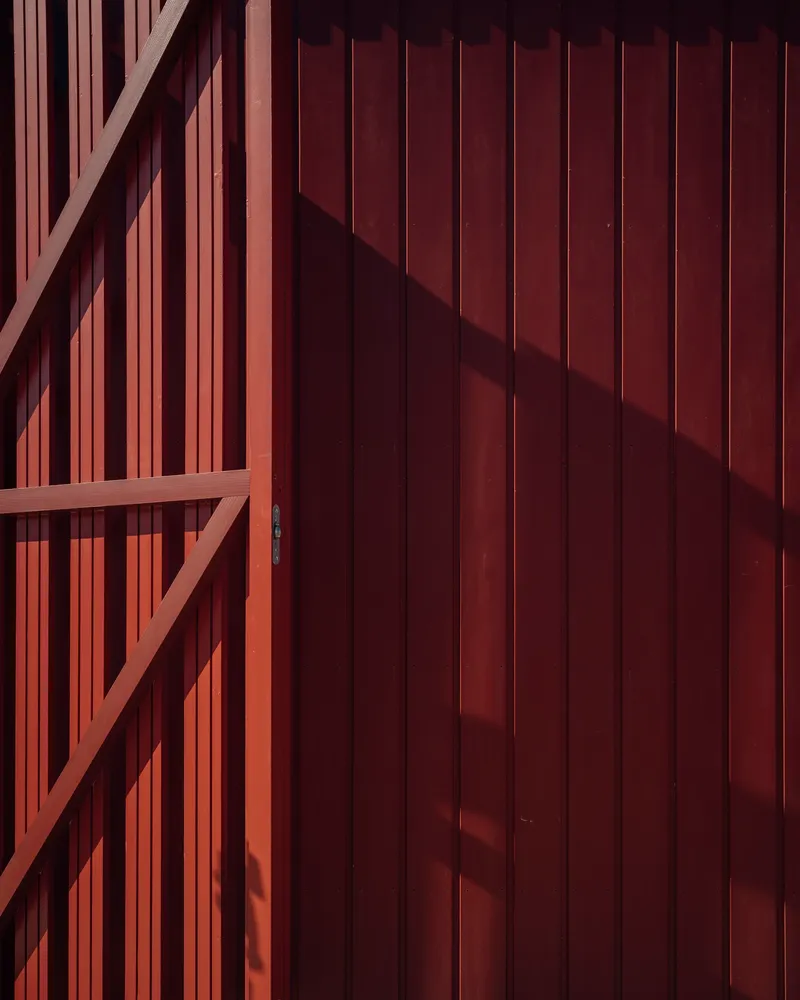
The real move happens on the long sides, where timber-framed sliding doors with vertical battens create large external shutters. When open, two sets of sliding glass doors establish a visual corridor that cuts through the entire cabin, connecting north and south landscapes in a single sightline. When closed, the shutters cast angular shadows across the red-stained wood, turning the facade into a sundial of sorts. This is passive design working as architecture, not just engineering.
Living on the Deck
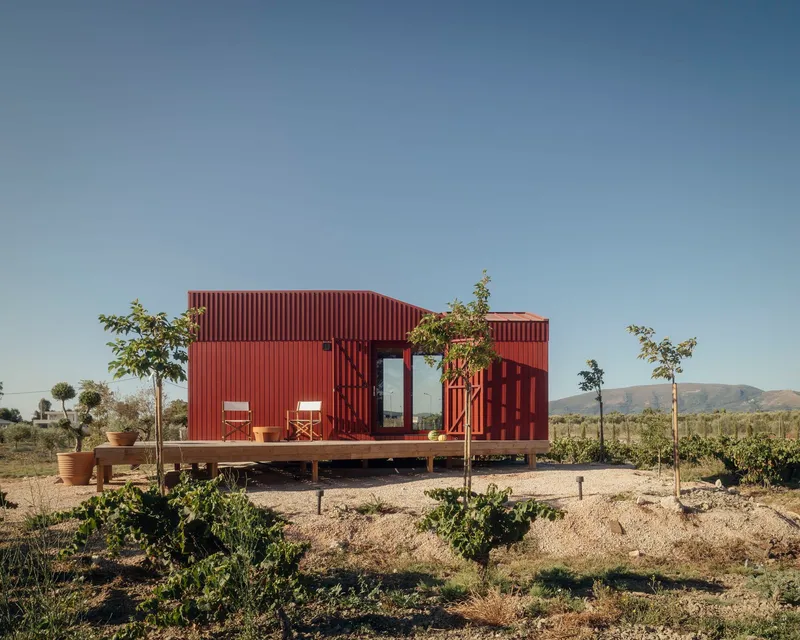
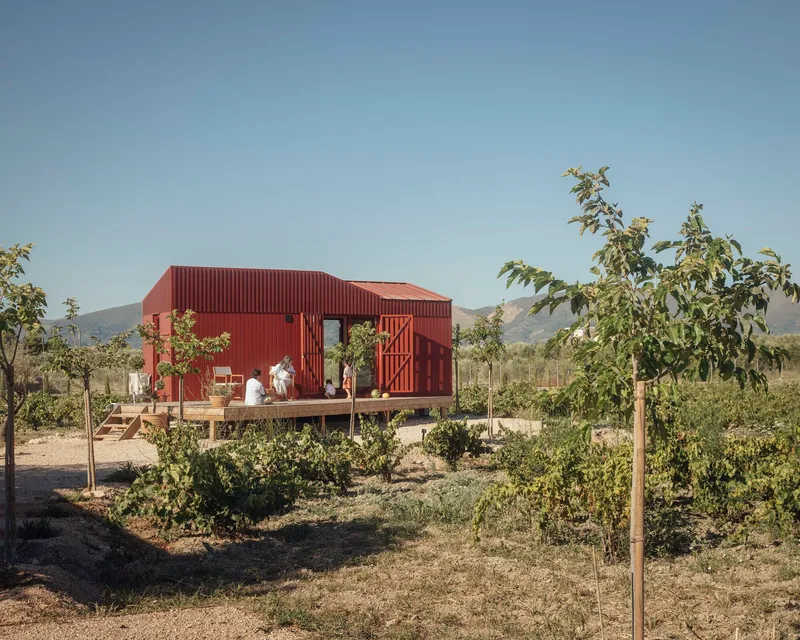

In a 20 square meter cabin, the deck is not a luxury; it is an essential room. The sustainably sourced timber platform extends the living space in every direction, creating zones for sitting, eating, and simply being outside that feel continuous with the interior. Kasawoo understands that in the Greek climate, the threshold between inside and outside is where most of life happens.
The cypress trees and young orchard surrounding the deck filter light and provide scale. Two figures seated on the platform in afternoon light give a sense of proportion: the cabin is human-sized, intimate, proportioned to the body rather than to any aspirational notion of grandeur. The covered portion of the deck offers shade while keeping the connection to the vineyard immediate and unmediated.
A Plywood Interior That Does Everything
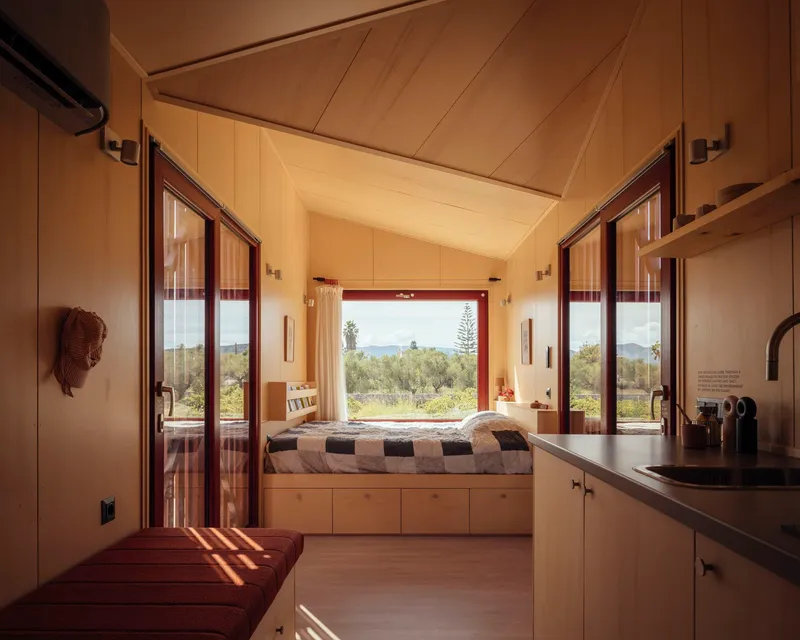

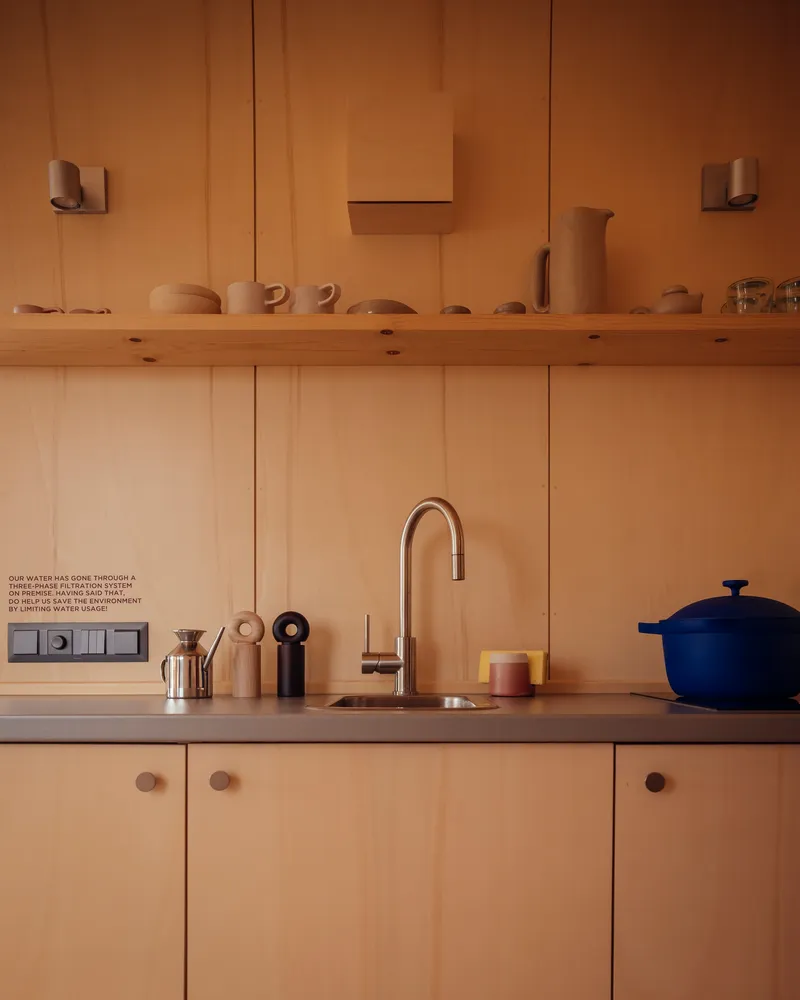
Inside, sustainably sourced plywood lines every surface: walls, ceiling, built-in furniture. The effect is warm but not cloying, because the twisted roof line creates an undulating ceiling that mimics the mountainous topography of Zakynthos. This single geometric gesture prevents the interior from feeling like a box. Light enters from multiple directions, shifting through the day as the sun moves across the sliding doors and picture windows.
The kitchen is a compact masterpiece of integration. A gooseneck faucet over a small sink, an open shelf displaying ceramics, and birch plywood walls that double as storage surfaces. The built-in bench with its red cushion and striped pillows occupies the opposite wall, turning what could have been a corridor into a living space. Every centimeter has been assigned a job, and nothing reads as leftover.
Bookended by Rest and Ritual
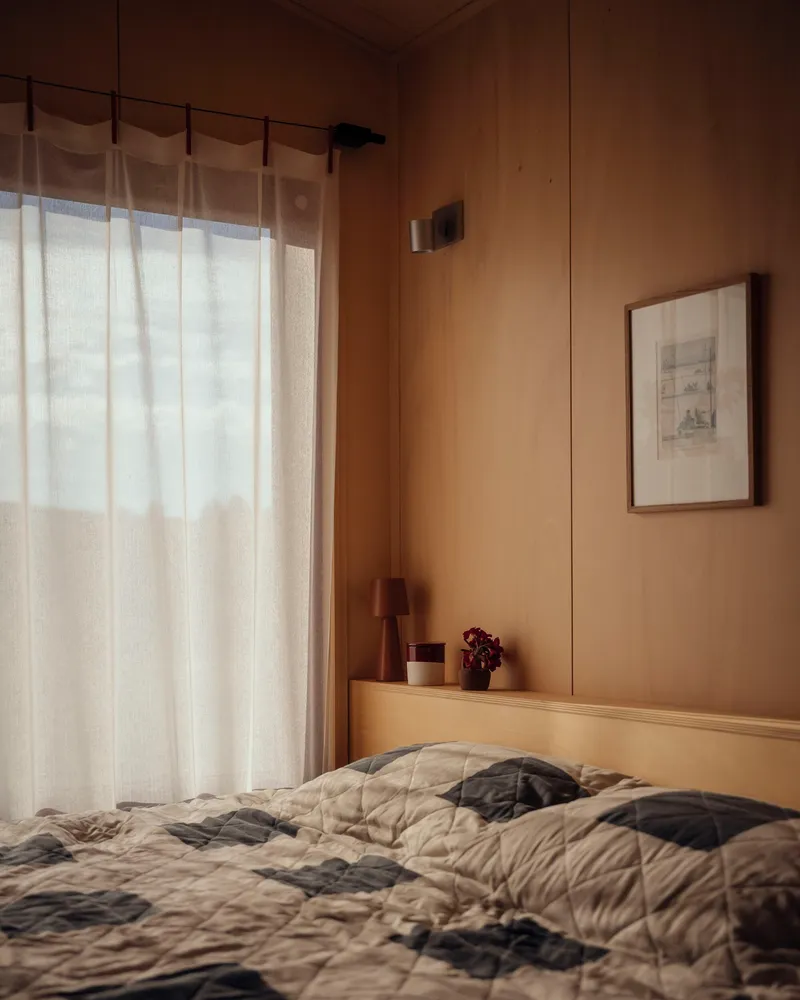


The bedroom and bathroom anchor the east and west ends of the cabin, creating a clear linear sequence: sleep, live, bathe. The bedroom is a study in softness within a hard shell. Pale timber paneling, sheer curtains filtering daylight, an unmade bed that feels lived-in rather than styled. A small shelf holds magazines, confirming that this is a place for actual rest, not performance.
The bathroom is the cabin's surprise. A shift from warm plywood to powder blue and dark blue walls signals a change in register: cooler, more intimate. Through a tall glazed door, the coastal landscape appears like a painting at the end of a narrow corridor. It is a clever psychological trick, making the smallest room in the cabin feel like it opens onto the entire island.
The Blue Room
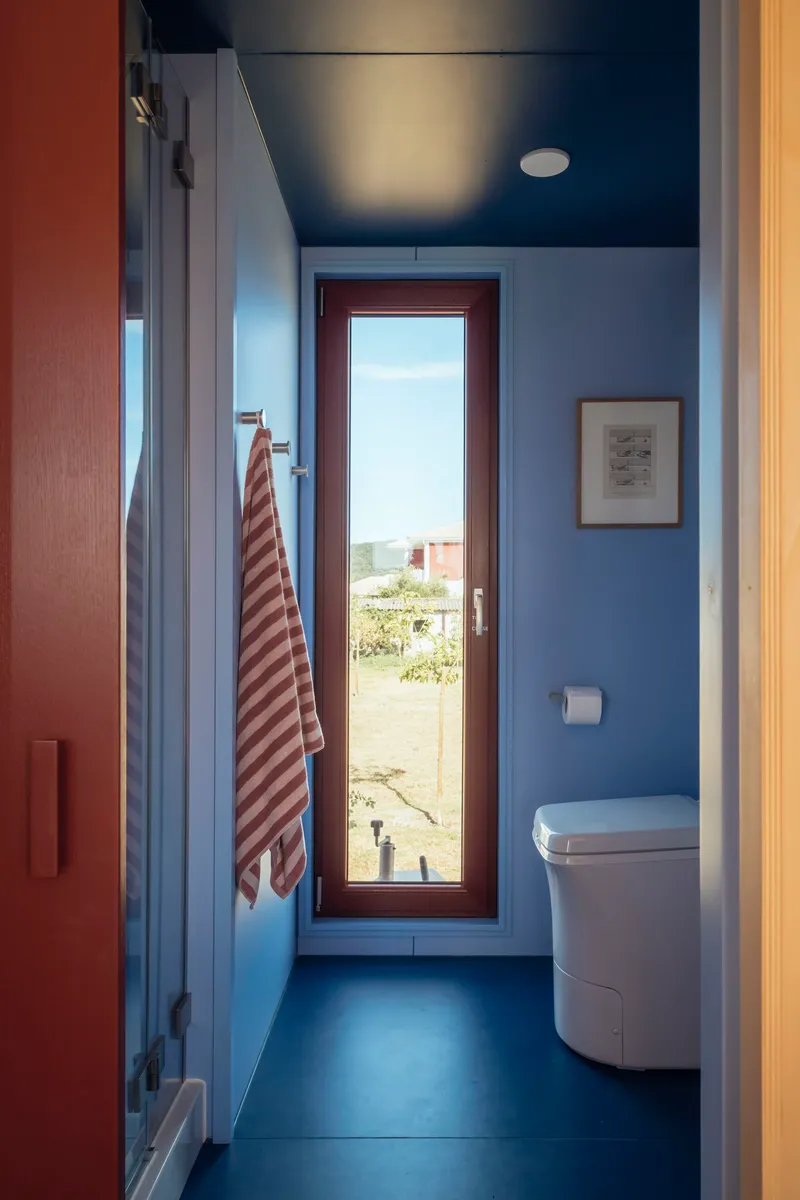
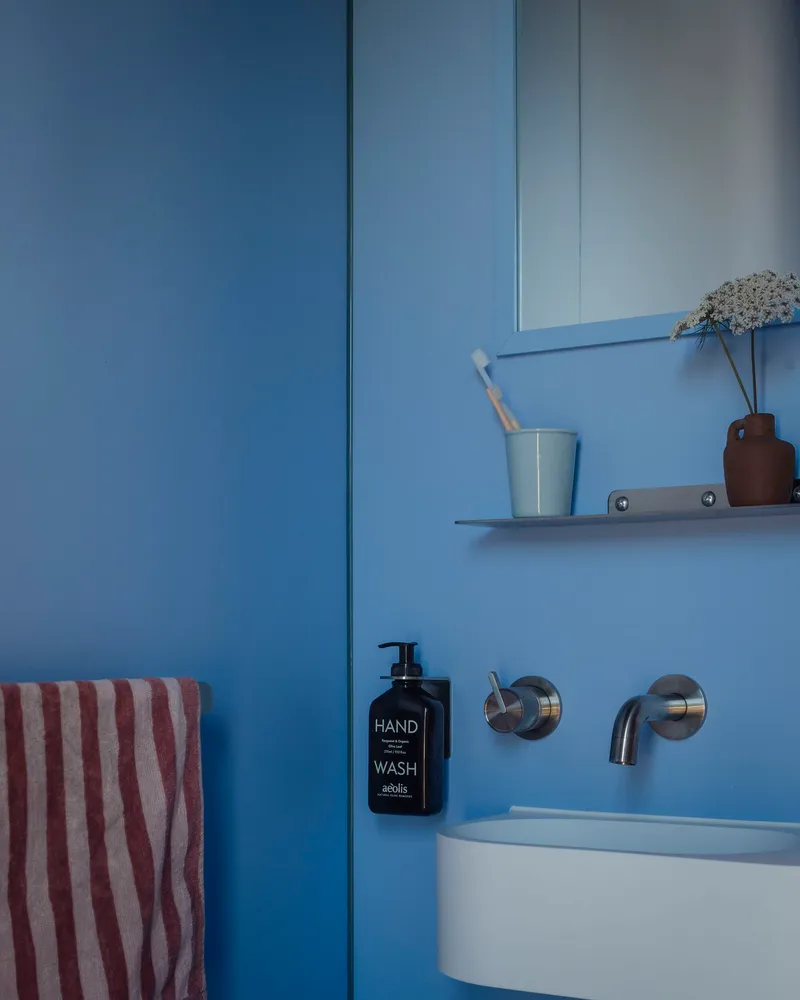
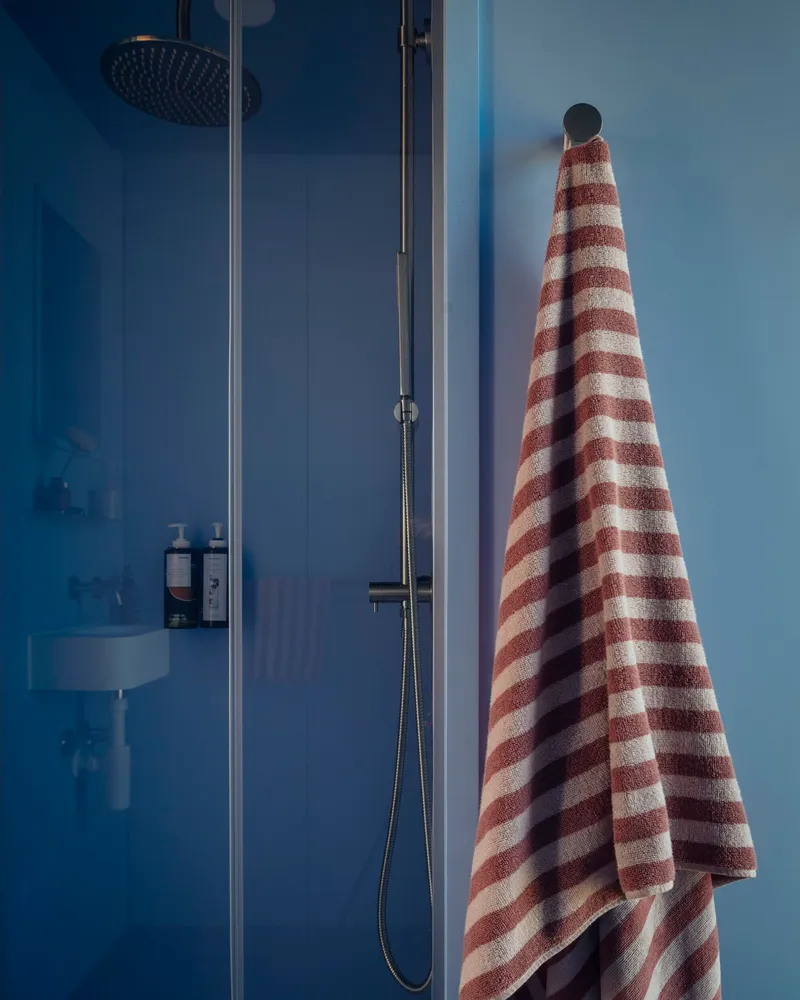
The bathroom deserves its own moment. The blue-tiled walls, the wall-mounted basin with circular chrome taps, the overhead rain shower behind a glass enclosure: these details are calibrated to feel generous within a space that is objectively tiny. The color choice is bold for a cabin that otherwise speaks in timber and red tones. It introduces a Mediterranean reference that the exterior, with its corrugated agrarian character, deliberately avoids.
A striped towel hangs on the blue wall. A small mirror reflects warmly lit plywood from the bedroom beyond. These are moments of domestic pleasure that no amount of square meters can guarantee. They have to be designed in, and Kasawoo has done exactly that.
Why This Project Matters
The Root Cabin is a polemic in timber. On an island where concrete dominates new construction and the building industry defaults to carbon-intensive methods, Kasawoo has demonstrated that a prefabricated low-carbon structure can be beautiful, functional, and culturally legible. The fact that it was self-commissioned by the architects, on family land that carries over a century of memory, gives it a personal dimension that most prefab projects lack. It is not speculative or theoretical; it is someone's actual retreat, built because they believed it needed to exist.
At 20 square meters, the cabin also makes an argument for sufficiency. Not minimalism as lifestyle brand, but genuine spatial economy where every element serves multiple purposes and the landscape does the work that extra rooms would otherwise do. The deck becomes the living room; the vineyard becomes the garden; the mountain horizon becomes the art on the walls. If this is what low-carbon architecture on the Greek islands can look like, the question shifts from whether it is possible to why it is not happening more often.
The Root Cabin by Kasawoo (Katie Kasabalis and Darius Woo), located in Vanato, Zakynthos, Greece. 20 m². Completed 2025. Photography by Jim Stephenson.
About the Studio
Share Your Own Work on uni.xyz
If projects like this are the kind of work you want to make, uni.xyz is a place to publish your own, find collaborators, and enter design competitions.




Popular Articles
Popular articles from the community


Co-life: Sustainable Architecture for Age-Friendly Community Living
Co-life reimagines sustainable architecture for seniors through courtyards, rammed earth, shared gardens, and spaces designed for belonging.

Riyadh For All: Intergenerational Urban Design for Active Aging in Rabat
Riyadh For All reimagines urban design in Rabat with intergenerational co-living, adaptive courtyards, and Moroccan cultural exchange today.

Conexión: Biophilic Design Reimagines High-Rise Living in Hong Kong
Conexión reimagines high-rise living in Hong Kong through biophilic design, green facades, shared spaces, daylight, water and nature within.

AL-JANNAH: Sustainable Architecture and Permaculture for Afghan Widows
AL-JANNAH uses sustainable architecture and permaculture to create resilient oasis of housing, learning, work and renewal for Afghan widows.


Similar Reads
You might also enjoy these articles

Bao Huynh Watercolor Atelier: A Serene Art Retreat in Hội An
Bao Huynh Watercolor Atelier in Hội An blends multifunctional art spaces, sustainable design, local materials, and family-friendly living in a serene environment.

Atelier Macri Concept Store Interior Design by CASE-REAL
Atelier Macri store features a "ko" counter, walnut wood details, cork displays, blending retail, gallery, and seamless customer experiences.

Manuel Vargas Izquierdo Stadium and High-Performance Sports Center: Architectural Excellence in Jalpa de Méndez
The Manuel Vargas Izquierdo Stadium blends sustainable design, inclusive sports facilities, and cultural-inspired architecture, revitalizing Jalpa de Méndez’s public spaces.

KAKR Buluh Awar Hall: Revitalizing Community and Ecology Through Bamboo Architecture
Community built bamboo hall revitalizes Buluh Awar village, empowering youth, restoring ecology, celebrating vernacular craftsmanship through sustainable architecture and culture.



Comments (0)
Please login or sign up to add comments
No comments yet. Be the first to comment!