
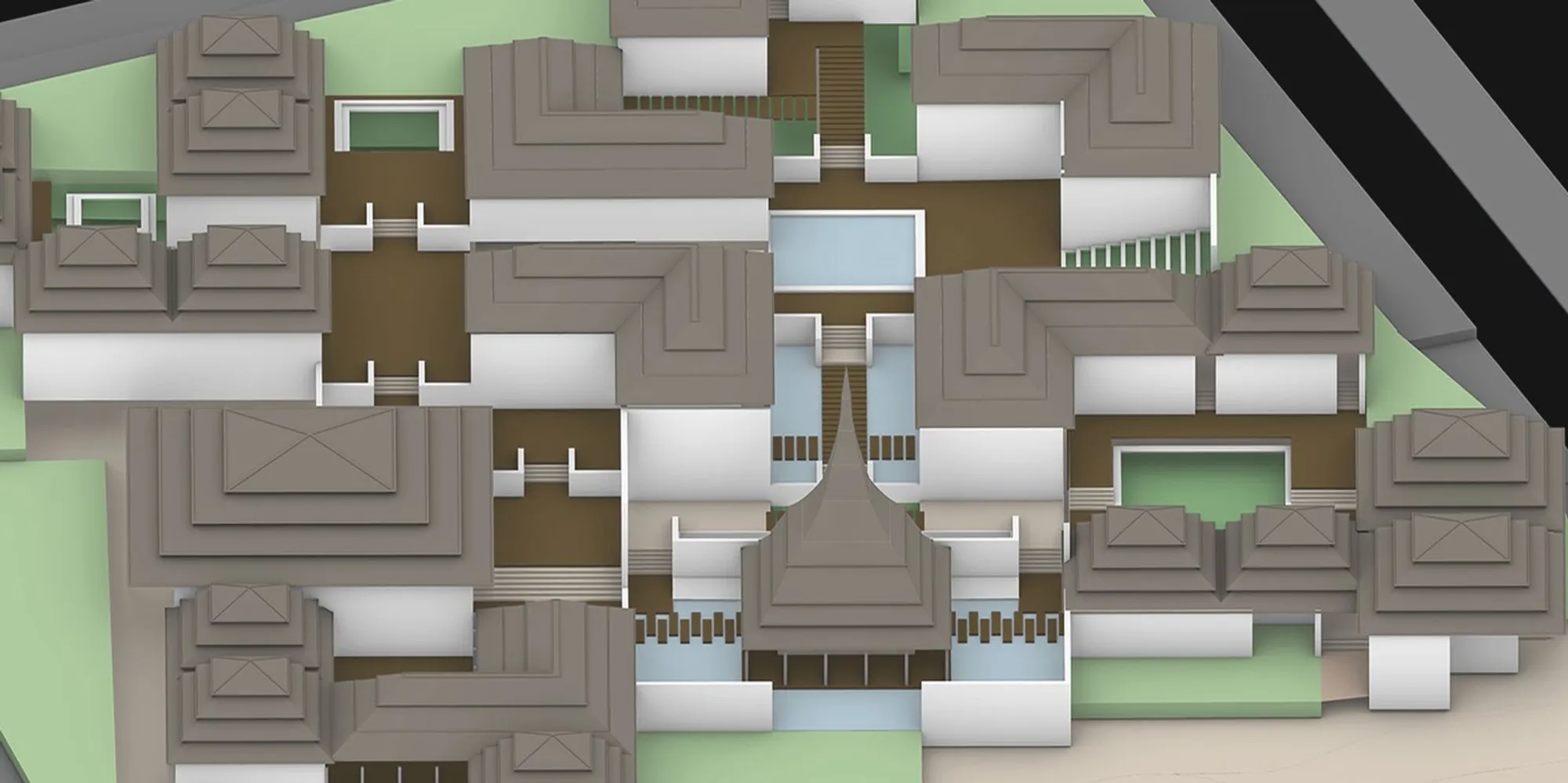
Kashmir 2.0: Vernacular Architecture as a Medium for Cultural Healing
A shortlisted Bharat Bhavan 2020 entry reimagines Kashmiri settlement patterns as a clustered cultural campus of courtyards, water axes, and craft studios.


What happens when architecture stops trying to be neutral and instead takes sides with memory? In a region where identity is contested daily, Kashmir 2.0 proposes that the built environment can do what diplomacy often cannot: hold space for every tradition simultaneously. The project translates centuries of Kashmiri settlement logic, from pitched timber roofs and courtyard-centric clusters to the linear water channels of Mughal gardens, into a contemporary cultural campus that refuses to flatten regional identity into a generic civic form.
Designed by Nitya Kapoor and shortlisted in the Bharat Bhavan 2020 competition, the project confronts a specific gap: while ancient heritage structures in Jammu and Kashmir are frequently referenced for inspiration, contemporary buildings rarely carry forward the same spatial DNA. Kashmir 2.0 reinterprets the Bharat Bhavan typology as a 21st-century cultural hub, drawing on square-planned mosques, multi-tiered wooden temples, and vernacular homes to produce a compound that feels both rooted and entirely new.
Reading the Site Through Settlement Patterns
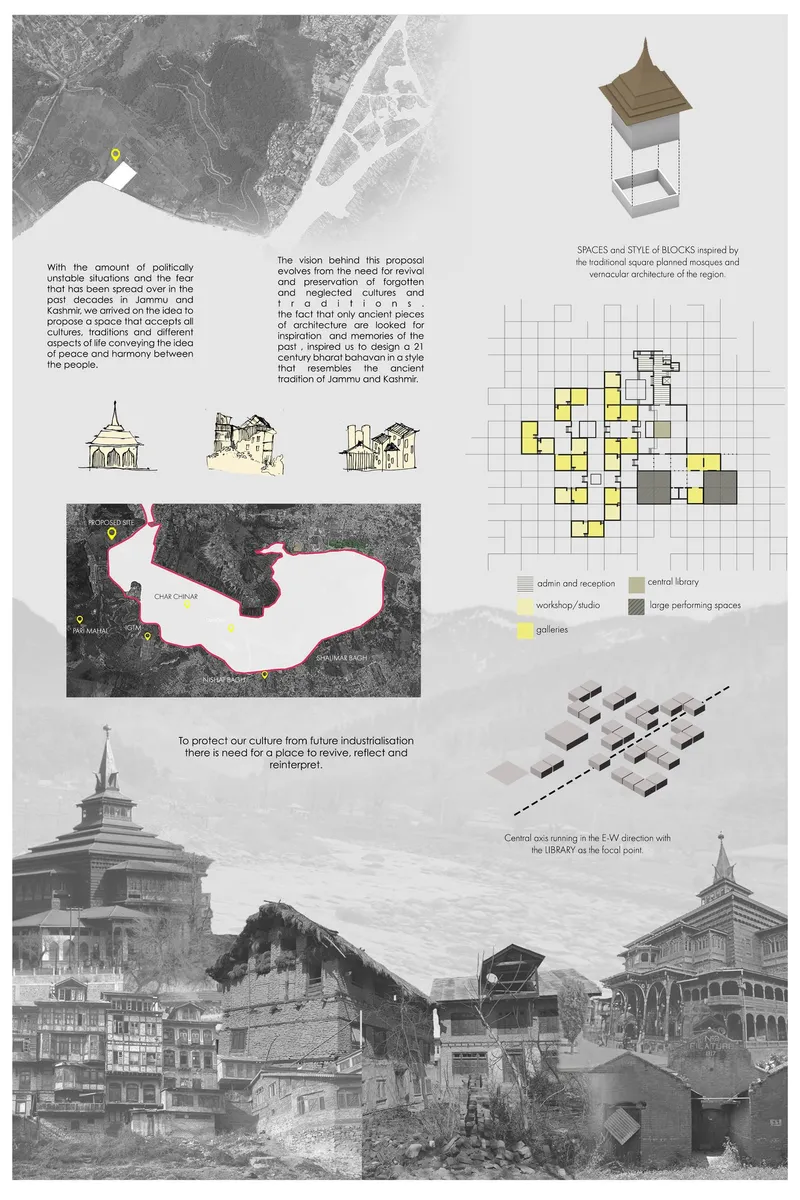
The opening presentation board maps the analytical groundwork. Aerial views, grid diagrams, and composite photographs of hillside structures establish the design's source material. Rather than beginning with a programmatic brief, the project starts by studying how Kashmiri communities have historically organized themselves: dense, interlocking clusters of rectangular volumes connected by narrow passages, with courtyards acting as shared lungs. The grid analysis breaks these organic patterns into a modular logic that can be redeployed at the scale of a cultural institution.
The sketches on this board reveal a key move: the settlement pattern is not merely aesthetic inspiration but a structural principle. Each block in the eventual masterplan mirrors the proportions and adjacencies found in traditional neighborhoods, preserving the spatial hierarchy where private, semi-public, and fully public zones transition through thresholds rather than hard boundaries.
Water, Axis, and the Choreography of Arrival
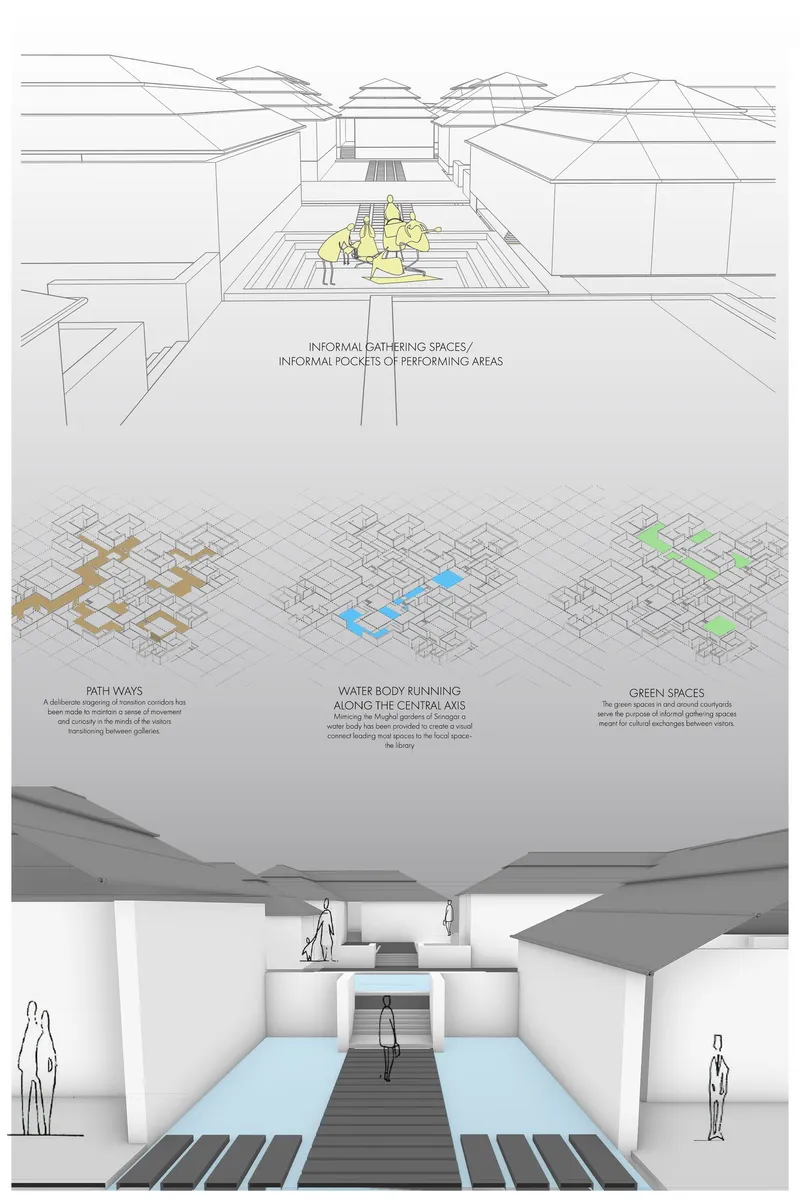
A perspective sketch and section view reveal the project's primary spatial gesture: a linear water body marking the east-west central axis, inspired by Mughal gardens and traditional sanga water channels. The section cuts through a stepped water feature flanked by gathering spaces, showing how the terrain itself becomes programmatic. Sunken and elevated platforms allow spontaneous performance and informal assembly, turning circulation into event space.
The axonometric diagrams on this board clarify how movement is orchestrated. Staggered transition corridors create a sense of exploration that mirrors walking through dense Kashmiri settlements, where every turn reveals something unexpected. The water axis anchors this choreography, pulling visitors toward the Central Library at its terminus. That positioning is deliberate: knowledge and intellectual exchange occupy the symbolic heart of the entire complex, giving the library visual and axial prominence over every other program element.
A Clustered Campus Within a Walled Perimeter
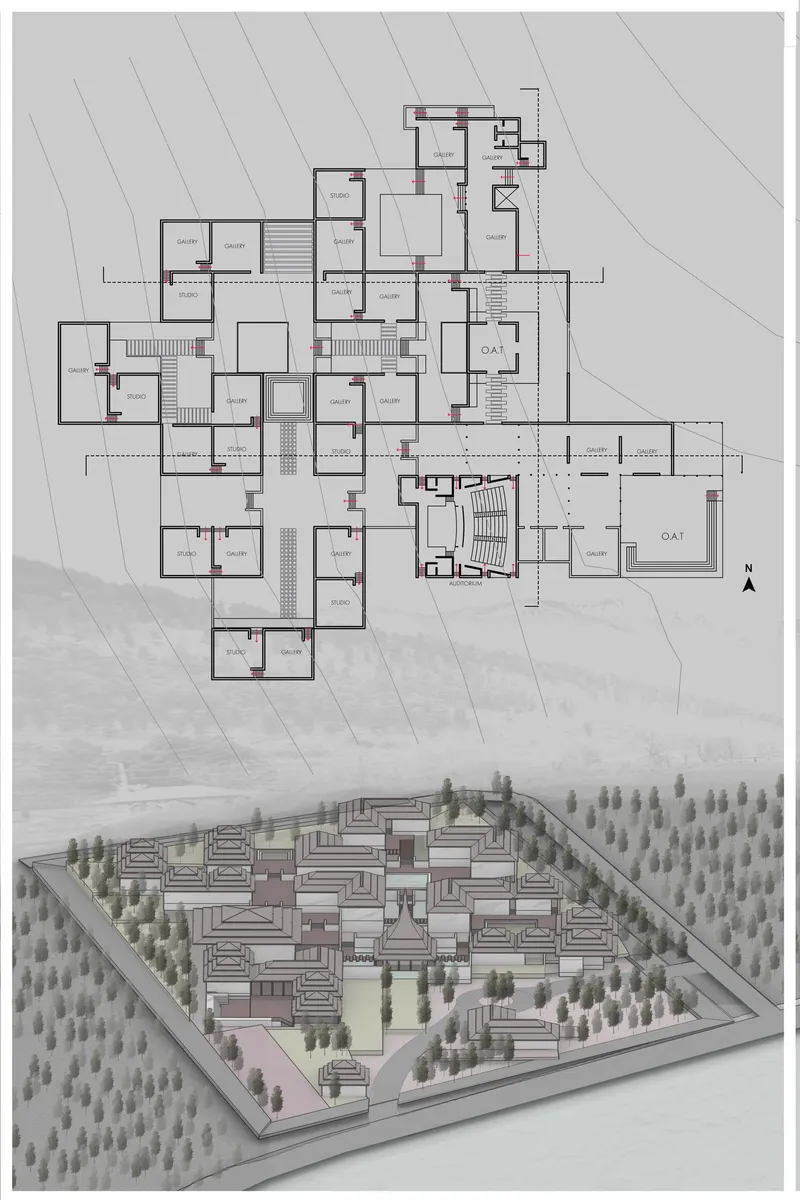
The floor plan and axonometric rendering show how the masterplan resolves into a grid of interconnected blocks contained within a clearly defined walled perimeter. Inside, the program distributes across galleries, studios and workshops for craft revival, exhibition spaces dedicated to cultural memory, large and informal performance areas, administrative zones, public plazas, water courts, and green pockets. Each cluster of rectangular volumes creates its own courtyard condition, producing a compound that reads as a small village rather than a monolithic institution.
The walled boundary does not isolate. Instead, it frames. Small garden pockets and open courtyards punctuate the built mass, serving as informal gathering zones, performance nooks, and spaces for cultural exchange. These green interruptions soften the architecture and recall the communal warmth of traditional Kashmiri neighborhoods, where the threshold between indoors and outdoors is always porous.
Tiered Roofs and Pine Trees: Elevations That Belong
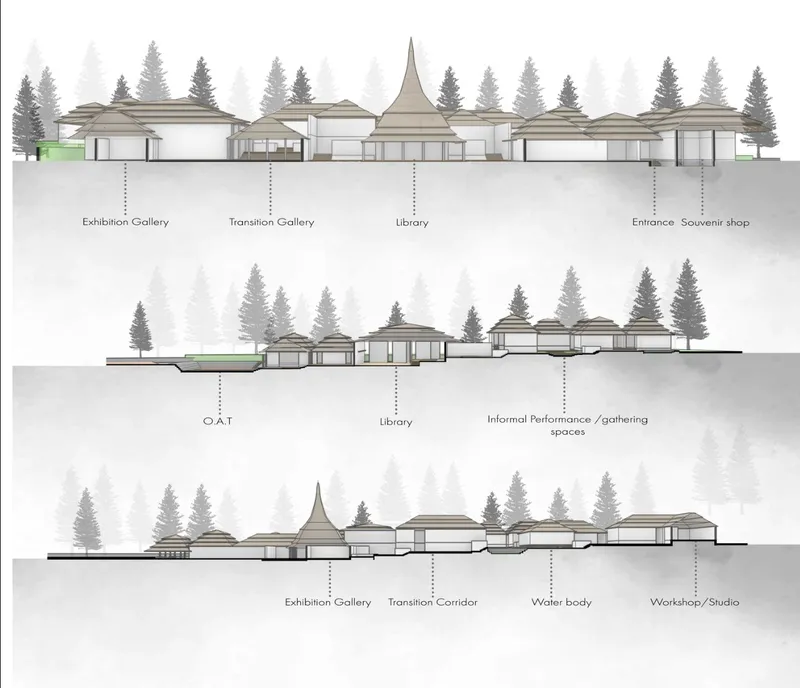
The section drawings are perhaps the most revealing sheets in the set. Three elevations show low pavilions with tiered roofs and a central spire nestled among pine trees, making clear that the project's silhouette is derived directly from the multi-tiered wooden roof forms found in Kashmiri shrines and village homes. The proportions are modest. No volume competes with the landscape; instead, the buildings sit beneath the treeline, deferring to the topography that defines the region's identity.
The layered roof profiles do more than reference tradition. They create interior volumetric variety: high-ceilinged gallery halls under the steepest pitches, more intimate workshop spaces beneath lower tiers. The rhythm across the section, alternating between solid volumes and open-to-sky courtyards, generates a spatial cadence that rewards slow movement and repeated visits, exactly the kind of temporal engagement a cultural institution needs to sustain relevance.
Why This Project Matters
Kashmir 2.0 operates on a premise that is easy to state but difficult to execute: that vernacular architecture is not a style to be quoted but a system to be reactivated. By extracting the organizational logic of Kashmiri settlements, the modular planning of traditional communities, and the material hierarchies of regional construction, Nitya Kapoor builds an argument for cultural institutions that grow from their context rather than being dropped into it. The campus does not look like a museum performing tradition; it reads as a place where tradition is still being lived.
In a moment when cultural centers worldwide default to spectacular form-making, the restraint here is notable. The project's strength lies in its insistence that healing happens through familiar spatial patterns, not grand gestures. Courtyards, water channels, tiered roofs, and meandering corridors are not nostalgic props. They are the infrastructure of community life that Kashmir has refined over centuries. Giving them a contemporary civic framework is a quiet but powerful act of architectural resistance against erasure.
View the Full Project
About the Designers
Designer: Nitya Kapoor
Enter a Design Competition on uni.xyz
uni.xyz runs architecture and design competitions year-round that reward proposals with spatial conviction and real site intelligence.
Project credits: KASHMIR 2.0 by Nitya Kapoor Bharat Bhavan 2020 (uni.xyz).




Popular Articles
Popular articles from the community


Co-Life: Senior Housing Design That Reconnects Older Adults With the City
Co-Life reimagines senior housing design through healing gardens, shared streets, workshops, and a sustainable community across generations.

Riyadh For All: Intergenerational Urban Design for Active Aging in Rabat
Riyadh For All reimagines urban design in Rabat with intergenerational co-living, adaptive courtyards, and Moroccan cultural exchange today.

The Earth Pod: 3D Printed Homes for Resilient Refugee Communities
The Earth Pod reimagines refugee housing through 3D printed homes made from clay, combining resilience, self-sufficiency, and rapid shelter.

Hill & Cross Opera: Sculptural Opera House Architecture Shaped by Tallinn’s Landscape and Identity
Hill & Cross Opera reimagines opera house architecture in Tallinn through its sculptural hill, civic plaza, glass wave and a luminous cross.

Similar Reads
You might also enjoy these articles

The Musturak Paradise: Senior Living Architecture for a Connected Future in Temara, Morocco
The Musturak Paradise reimagines senior living architecture in Temara via private homes, social spaces, culture, community, and shared care.

The Leaf Center: Cultural Center Architecture for Social Integration in Amsterdam
Cultural center architecture becomes a bridge at The Leaf Center, connecting international students with Amsterdam through art and exchange.

Conexión: Biophilic Design Reimagines High-Rise Living in Hong Kong
Conexión reimagines high-rise living in Hong Kong through biophilic design, green facades, shared spaces, daylight, water and nature within.

Wander to Wonder: Modular Playground Design for Children in Kutupalong Refugee Camp
Wander to Wonder uses modular playground design to create flexible, imaginative play spaces for children in Kutupalong refugee camp.





Comments (0)
Please login or sign up to add comments
No comments yet. Be the first to comment!